



















27.2 C
Bangkok
Sunday, July 12, 2026
Home Blog Page 3270

Thai Junta Says it Doesn’t Like the Word “Coup”

BANGKOK — In an ongoing effort to soften the public perception of its military takeover on 22 May, the Thai military junta has announced it does not like the word “coup.”

“I try not to use the word coup, because I feel that what we are doing at the moment is quite different, completely different than what happened in the past,” a spokesperson for the junta’s National Council for Peace and Order (NCPO) said at the Foreign Correspondent’s Club in Bangkok last night.

Col. Werachon Sukondhapatipak said he preferred to use the phrase “military intervention.”

Since becoming a constitutional democracy in 1932, Thailand has experienced 22 coup attempts, 13 of which were successful. The Thai army staged its most recent putsch last month and has since announced plans to govern the country until October, after which it will appoint an interim government to carry out national reforms. The junta says elections will not be held for at least another 15 months, and only if “conditions are stable.”

There is wide agreement that this military takeover is different from the most recent coup in 2006 — but not because it is less “coup-like” as Col. Werachon suggested.

Rather, many experts have observed that this military takeover is different because the junta is exercising its authoritarian powers more harshly and extensively than in any coup in Thailand's recent past.

“This is worse than previous coups,” a political science lecturer at university in Bangkok told Khaosod English. “Because in [1991 and 2006], the military held onto power for a short time and then they organized a technocrat government to take care of all these economic issues for them. The NCPO on the other hand, their actions look more like the military regimes of the 1950s and 1960s."

The NCPO says it plans to maintain control of the country’s administration until October, which is the longest any junta has held onto power since 1971. The coupmakers say it was necessary to seize power in order to resolve the political conflict that led to paralysing street protests and sporadic violence between Thailand's rival political factions over the past six months. 

Since seizing power, the junta has banned all forms of peaceful political expression, raided homes without search warrants, censored the media, and summoned and detained hundreds of politicians and activists, all under the banner of "returning happiness to the Thai people."

Last night, the NCPO spokesperson said he doesn't like the word "detention” either. 

“I don’t like the word detention,” Col. Werachon said, “Because the conditions that happen are quite different.” 

He went on to list the amenities provided to detainees, which include “air conditioning,” “good food,” and “all kinds of activities that make the time pass quickly.”

“Is this detention?” Col. Werachon asked.

Col. Werachon said the army bars detainees from having any contact with the outside world in order to provide them with a “cooling-off period. This is a necessary part of the junta’s goal to reconcile the country’s political divisions and “return happiness to the people, he said.

“We talk to them, we try to convince them to put the country’s interests before their own,” Col. Werachon said.  “We don’t want them to have information from the outside. We just want them to be on their own.”

Many of those who have been released from military custody have confirmed that they were treated well, aside from being aggressively interrogated and subjected to various forms of “psychological warfare.”

However, those who do not report to the military soon after receiving a summons order can face up to two years in prison. A well-known Redshirt leader and anti-coup activist, Sombat Boonngamanong, is expected to face trial in martial court for defying a summons order and organising anti-coup protests on social media. Col. Werachon said he does not consider Mr. Sombat to be a "political prisoner." 

The military has released the majority of its detainees within seven days, which is the upper limit under martial law. However, Human Rights Watch has identified at least one case in which a Redshirt activist has been held in an undisclosed location for more than two weeks.

Col. Werachon said that no more than 15 people are currently being held by the military.

“We ask people to refrain from expressing any political views because we believe that this is not the time,” said Col. Werachon. “We are trying to adjust the mood and tone of society.” 

 
For comments, or corrections to this article please contact:[email protected]

You can also find Khaosod English on Twitter and Facebook
http://twitter.com/KhaosodEnglish
http://www.facebook.com/KhaosodEnglish
Advertisement

Khon Kaen Model Raises Questions in the Northeast

(The Isaan Record)

KHON KAEN – Since the May 22 coup d’état, Thailand’s military has tried to sweep the country clean of weapons to quell fears of a violent uprising. But in Isaan, the heartland of the Red Shirts, some of the soldiers’ actions have raised doubts about the military’s intentions. Red Shirts here believe that the military may be wrongly framing peaceful Red Shirts as violent terrorists in a high-profile legal case, which could set the stage for a wider crackdown on Red Shirts in the region.

On May 23, soldiers raided an apartment building in Khon Kaen city and arrested around twenty people allegedly involved in a terrorist plot. The military claims the plot, known as the ‘Khon Kaen Model,’ was designed to incite violence in Khon Kaen. In the following days, they arrested additional suspects in their homes, bringing the total number of the accused to twenty-four.

Read the rest of the story here


Note: Khaosod English is not responsible for content on other websites.

Advertisement

Thai Junta Says it Doesn’t Like the Word 'Coup'

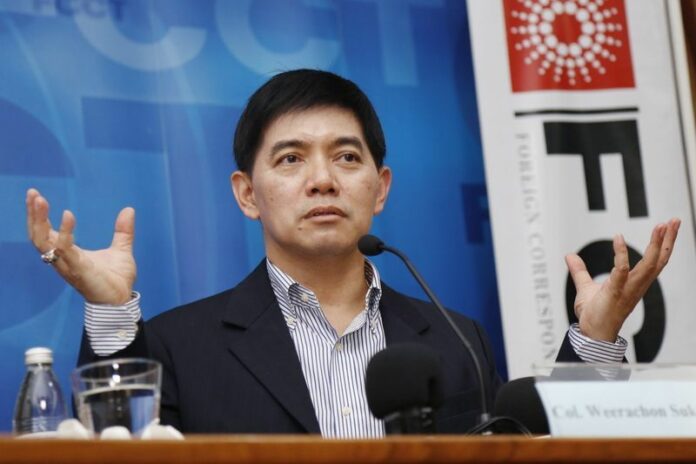
Thai army spokesman Colonel Werachon Sukondhapatipak speaks during a press conference at the Foreign Correspondents' Club of Thailand (FCCT) in Bangkok, 11 June 2014. EPA/LUONG THAI LINH

BANGKOK — In an ongoing effort to soften the public perception of its military takeover on 22 May, the Thai military junta has announced it does not like the word “coup.”

"I try not to use the word coup, because I feel that what we are doing at the moment is quite different, completely different than what happened in the past," a spokesperson for the junta’s National Council for Peace and Order (NCPO) said last night.

Col. Werachon Sukondhapatipak said he preferred to use the phrase "military intervention."

Since becoming a constitutional democracy in 1932, Thailand has experienced 22 coup attempts, 13 of which were successful. The Thai army staged its most recent putsch last month and has announced plans to govern the country until October, after which it will appoint an interim government to carry out national reforms. The junta says elections will not be held for at least another 15 months, and only if "conditions are stable."

There is wide agreement that this military takeover is different from the most recent coup in 2006 — but not because it is less coup-like as Col. Werachon suggested.

Rather, many experts have observed that the current junta is exercising its authoritarian powers more harshly and extensively than military rulers in Thailand's recent past.

"This is worse than previous coups," a political science lecturer at university in Bangkok told Khaosod English. "Because in [1991 and 2006], the military held onto power for a short time and then they organized a technocrat government to take care of all these economic issues for them. The NCPO on the other hand, their actions look more like the military regimes of the 1950s and 1960s."

The NCPO says it plans to maintain control of the country’s administration until October, which is the longest any junta has held onto power since 1971. The coupmakers say it was necessary to seize power in order to resolve the political conflict that led to street protests and sporadic violence between Thailand's rival political factions over the past six months. 

Since seizing power, the junta has banned all forms of peaceful political expression, raided homes without search warrants, censored the media, and summoned and detained hundreds of politicians and activists, all under the banner of "returning happiness to the Thai people."

Last night, the NCPO spokesperson said he doesn't like the word "detention" either. 

"I don’t like the word detention," Col. Werachon said, "Because the conditions that happen are quite different." 

He went on to list the amenities provided to detainees, which include “air conditioning,” “good food,” and “all kinds of activities that make the time pass quickly.”

"Is this detention?" Col. Werachon asked.

Col. Werachon said the army bars detainees from having any contact with the outside world in order to provide them with a "cooling-off period." This is a necessary part of the junta’s goal to reconcile the country’s political divisions and "return happiness" to the people, he said.

"We talk to them, we try to convince them to put the country’s interests before their own," Col. Werachon said.  “"We don’t want them to have information from the outside. We just want them to be on their own."

Many of those who have been released from military custody have confirmed that they were treated well, aside from being aggressively interrogated.

However, those who do not report to the military soon after receiving a summons order can face up to two years in prison. A well-known Redshirt leader and anti-coup activist, Sombat Boonngamanong, is expected to face trial in martial court for defying a summons order and organising anti-coup protests on social media. Col. Werachon said he does not consider Mr. Sombat to be a "political prisoner." 

The military has released the majority of its detainees within seven days, which is the upper limit under martial law. However, Human Rights Watch has identified at least one case in which a Redshirt activist has been held in an undisclosed location for more than two weeks.

Col. Werachon said that no more than 15 people are currently being held by the military.

"We ask people to refrain from expressing any political views because we believe that this is not the time," he said. "We are trying to adjust the mood and tone of society." 

(Reporting by Sally Mairs)


For comments, or corrections to this article please contact:[email protected]

You can also find Khaosod English on Twitter and Facebook
http://twitter.com/KhaosodEnglish
http://www.facebook.com/KhaosodEnglish
Advertisement

Thai Junta Holding 10 to 15 People For "Cooling Off"

BANGKOK (DPA) — Thailand's junta is currently holding between 10 and 15 people of the 300 summoned since the May 22 coup, a military spokesman said late Wednesday.

"At the moment there are 10-plus people remaining in army accommodation, less than 15," said Colonel Werachon Sukondhapatipak, spokesman for the ruling National Council for Peace and Order (NCPO).

The majority of the more than 300 politicians, activists, academics and journalists summoned for "talks" have been released, Werachon told an audience at the Foreign Correspondents Club of Thailand.

The detentions, often in undisclosed locations with no access allowed to relatives, have sparked criticisms from human rights groups.    

The NCPO spokesman said those held were provided with air-conditioned rooms, good food and entertainment.

"We talk to them," Werachon said. "We try to tell them to put the country before their own interests. We prefer to call it a cooling-off period than detention."

Army chief General Prayuth Chan-ocha has said he staged the coup to put an end to mounting violence accompanying nearly seven months of street protests in Bangkok and a resulting political deadlock.

Thailand has been under martial law since May 20, allowing authorities to detain people for up to seven days without charges.

Among the people summoned by the junta was former prime minister Yingluck Shinawatra, whom the army said was never formally detained.

"Yingluck was invited for a conversation and then was allowed to go home on the same day," Werachon said.

Advertisement

Suthep Calls Off 10,000 Baht Per Seat Dinner Party

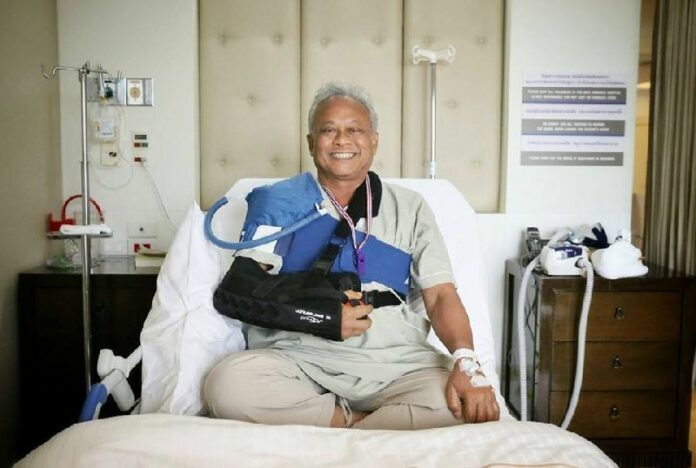
Suthep Thaugsuban after undergoing shoulder surgery for too many fist pumps as leader of the anti-government PCAD, 12 June 2014.

BANGKOK — Former leader of the anti-government protests Suthep Thaugsuban has indefinitely postponed the fundraiser dinner originally scheduled for this Saturday.

"I thank you all for booking and buying the ticket for 'Dinner With Senior Village Headman [Mr. Suthep's nickname]' on Saturday the 14th," Mr. Suthep wrote on his Facebook, "But there have been reasonable calls for reconsideration of the event, and I have concluded that the event may not be in accordance with the martial law and orders of the National Council For Peace and Order (NCPO)."

"Furthermore, it may let some people to exploit the opportunity and stage activities to cause damage to our country," he continued, "Therefore, I have postponed the Dinner With Senior Village Headman until appropriate situation."

Those who have bought the tickets, which cost 10,000 baht per seat, can apply for a refund, Mr. Suthep said.

The dinner was supposed to take place at an exclusive club in central Bangkok. The former leader of the People's Committee for Absolute Democracy With the King As Head of State (PCAD) billed the dinner as an opportunity to raise money for PCAD supporters who have were injured over the group's six-month campaign against the former government.

PCAD will find "other ways" to assist the injured protesters, now that the dinner party has been cancelled, Mr. Suthep insisted. "Please do not worry."

In another Facebook post, Mr. Suthep said the operation on his right shoulder has been successful. The PCAD leader, who is currently recovering from the surgery at Bangkok Hospital, said the injury was caused by 'fist pumping' too many times over the past six months.

PCAD's protests came to an end when the military staged a coup on 22 May and toppled the government that PCAD had been seeking to depose for months. 


For comments, or corrections to this article please contact: [email protected]

You can also find Khaosod English on Twitter and Facebook
http://twitter.com/KhaosodEnglish
http://www.facebook.com/KhaosodEnglish
Advertisement

Two Charged With Lèse Majesté After Reporting to Military

(Prachatai English)

Two men were charged with lèse majesté after being detained for seven days by the military. The court denied their bail requests. 
 
On Tuesday, police charged Chaleaw J. and Kathawut B. under Article 112 of the Criminal Code or the lèse majesté law. They were denied bail and sent to Bangkok Remand Prison.  
 
Read more of the story.
 
Note: Khaosod English is not responsible for content on other websites.
Advertisement

Philippines Vows to Curb Illegal Fishing Amid EU Pressure

The Philippines on Wednesday vowed to curb illegal fishing after the European Union warned of a possible import ban. CHRISTIAN CHARISIUS/dpa

MANILA (DPA) — The Philippines on Wednesday vowed to curb illegal fishing after the European Union warned of a possible import ban.

"The Philippines is working actively to comply with the EU's requirements," said presidential spokesman Herminio Coloma. "The Philippines seeks to meet EU norms as the country endeavours to increase trade with EU countries and raise level of investments."

The Bureau of Fisheries and Aquatic Resources was leading efforts to meet the EU's standards on illegal, unreported and unregulated fishing, he said.

The Philippines' fishery exports to the EU, the world's biggest fish importer, totalled 170 million euros (230 million dollars) in 2013.

The EU issued a "yellow card" or a formal warning against the Philippines and Papua New Guinea on Tuesday, noting that they had to improve their standards within six months to avoid trade sanctions, which could include a ban.

"We want the Philippines as a partner to combat illegal fishing," said Maria Damanaki, the European commissioner in charge of maritime affairs and fisheries. "We want the country to improve its legal and control systems as required by international rules."

The EU said it had offered technical assistance to help the Philippines address deficiencies in monitoring, controlling and surveillance of fisheries.

"In view of the serious threat posed by illegal fishing, the EU is able to take certain trade measures against non-cooperative states including a ban on that country selling fisheries products to the EU," it said.

The EU said it had been discussing the issue with the Philippines since 2012, but had not noticed any progress.

In March, the EU banned fish imports from Belize, Cambodia and Guinea for "acting insufficiently against illegal fishing."

Up to 26 million tonnes of fish are caught illegally every year, making up at least 15 per cent of the global catch, the EU said.
 

Advertisement

Red Politician Describes Surprise Arrest by Soldiers

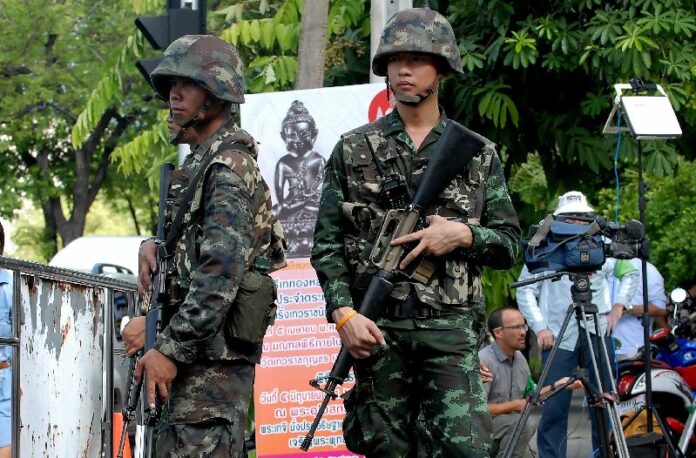
Soldiers guard the Army Club in Bangkok where hundreds of activists and politicians have been summoned to report. 23 May 2014.

BANGKOK — Prominent politician and Redshirt leader Singthong Buachoom said he was greatly frightened when soldiers woke him up and arrested him in his home on Monday.

"I was so surprised because the NCPO never summoned me to report to them,” Mr. Singthong said, referring to the military junta’s National Council for Peace and Order (NCPO). Since seizing power in a coup d’état on 22 May, the NCPO has publicly summoned and detained hundreds of politicians and activists, most of whom were allied with the former Pheu Thai government.

According to the former Pheu Thai MP, a group of armed soldiers arrived unannounced at his home on 9 June and instructed his housekeeper to open the gate for them. Once the gate was opened, they rushed in and searched every room before they found Mr. Singthong asleep in his bed.

"The soldiers 'invited' me while I was in my pajamas," Mr. Singthong said. "They said the NCPO had issued a summons for me to report on 10 June, so I told them I would be there on 10 June, but they said no. They told me I had to leave right then and there."

The Pheu Thai MP added that he was "shocked" by the sudden raid because he has not been involved in politics or talked to any Redshirt leaders since the coup.

"Then they took me on a pick-up truck,” Mr. Singthong said. “Soldiers with M-16 rifles flanked me. I tried to ask them where they were taking me, but they wouldn't tell me. I asked to use my phone, but they said no.”  

Once he arrived at the military camp, Mr. Singthong was asked by a group of military officers to “cooperate” with the NCPO's stated mission to reconcile the country’s political divisions and restore happiness to the people. Mr. Singthong said he was also asked to give his opinions on a variety of political issues, such as the proposal by conservative politicians that the votes of Bangkokians are more valuable than those from Thailand’s rural provinces.

After "a long talk" Mr. Singthong said he was let go without signing any conditions of release. Most detained politicians and activists have been forced to promise they will not participate in any political activities.

Mr. Singthong said he later received a formal apology from Col. Songwit Noonpakdee, the commander of the raid on his house, who reportedly admitted that the soldiers were wrong to detain him in such way.

"He said, 'If you ever talk to the press, please tell them I apologize for the action of the soldiers,’” Mr. Singthong told Khaosod. “He apologised to me and my family.” 

In a statement released today, Human Rights Watch (HRW) condemned the Thai military’s arbitrary arrests of politicians and activists and cited the case of Mr. Singthong specifically.

“The military needs to stop summarily arresting anyone they want and taking them to undisclosed locations,” said Human Rights Watch’s Asia Director Brad Adams.

The human rights group also called upon the Thai military to confirm the location of a Redshirt activist that has been secretly held for nearly two weeks. Under martial law, the military is only permitted to detain citizens without charges for up to seven days.

According to HRW, Kritsuda Khunasen has not been seen or heard from since the military arrested her during a raid on Redshirts in Chonburi province on 28 May.

“Kritsuda and all the others held without being charged with a credible offense should be freed immediately,” HRW’s Mr. Adams said. 


For comments, or corrections to this article please contact: [email protected]

You can also find Khaosod English on Twitter and Facebook
http://twitter.com/KhaosodEnglish
http://www.facebook.com/KhaosodEnglish

Advertisement

Earthquake Damaged Schools in Chiang Rai get Financial Assistance

(Chiang Rai Times)

CHIANG RAI —  The office of the Basic Education Commission (OBEC) has allocated 18 million baht to assist the educational institutions that sustained damage in the quake in Chiang Rai Province, and will urgently request budget of 200 million baht from the military government for further crucial maintenance.

Read the rest of the story here.


Note: Khaosod English is not responsible for content on other websites.

Advertisement

Media Giant Wins Exclusive Rights to World Cup Broadcasts

Divers play football in Chiang Mai Zoo aquarium in anticipation of the FIFA World Cup.

UPDATE: The Thai military junta has ordered RS to air all World Cup matches on state-owned television channels in exchange for 427 million baht.

BANGKOK — Thailand’s supreme administrative court has granted Thai media giant RS exclusive rights to broadcast the 2014 FIFA World Cup matches, making it the first time in Thai history that viewers will not be able to watch the entire football tournament for free.

The court decision follows a bitter legal fight between RS and Thailand's media-regulating body, the National Broadcasting and Telecommunication Commission (NBTC), over who had the rights to broadcast the World Cup tournament to Thai viewers. 

RS argued that it secured the rights to broadcast the matches from FIFA, the tournament's organiser, and said that viewers who wanted to watch the games on their TVs had to purchase a special 1,700 baht "signal box" from the corporation.

The NBTC attempted to challenge RS's exclusive claim to the World Cup broadcasts, citing a potential breach of customers' rights, and ordered that all of the matches be made available on Thailand's state-owned TV for free. In response, RS filed a lawsuit against the NBTC.

In a key ruling announced today, a judge struck down NBTC's order and upheld RS’s sole rights to the matches, making it the first time in Thai history that a private corporation has owned exclusive rights to broadcast World Cup matches. In previous years, a "pool" of state-owned TV channels shared the rights and broadcasted the matches for free.

This year, RS has agreed to allow state-owned TV channels to broadcast 22 out of 64 games, including the final matches. TrueVision, Thailand's major cable TV corporation, has also bought the rights from RS, at an undisclosed sum, to broadcast all 64 matches to its subscribers. 

Although restaurants and pubs that have purchased RS's signal boxes will be able to broadcast the matches to their customers, many Thais will likely be forced to buy the signal boxes for their own homes because the military junta has not lifted its midnight – 4 am curfew. Most of World Cup matches will be played during in those curfew hours. 

There were hopes among Thai football fans that the military junta may intervene and force RS to relinquish its exclusive rights. Daily News quoted Gen. Prayuth Chan-oca, army chief and chairman of the National Council for Peace and Order (NCPO), as saying the army will ask for cooperation from RS to broadcast all of the 64 matches on Channel 5 and 7, which are operated by the army.

The news led many commentators on social media to joke that the NCPO is finally "Returning Happiness to the People" — the name of the military's national reconciliation campaign

However, their hopes were dashed when NCPO spokesperson, Col. Winthai Suwaree, told FM 97.0 radio this morning that he is not aware of any plan by the NCPO or Gen. Prayuth to ask for cooperation from RS to broadcast the matches on army-operated channels.

"Let me stress that I am not aware of this information," Col. Winthai said. 

Col. Winthai also previously told the press last week that the NCPO has no immediate plan to revoke the military curfew in time for the kick-off of 2014 World Cup. 

Football is extremely popular in Thailand, and World Cup matches typically bring huge crowds to restaurants and bars across the country. This year's FIFA World Cup will kick off in Brazil on 12 June, which falls on the early morning of 13 June according to Thailand's timezone. 


For comments, or corrections to this article please contact: [email protected]

You can also find Khaosod English on Twitter and Facebook
http://twitter.com/KhaosodEnglish
http://www.facebook.com/KhaosodEnglish
Advertisement

Hot News

LATEST NEWS

Bangkok
overcast clouds
27.2 ° C
27.2 °
26.6 °
85 %
3.7kmh
100 %
Sat
28 °
Sun
35 °
Mon
34 °
Tue
28 °
Wed
31 °