30 C
Bangkok
Saturday, July 4, 2026
Home Blog Page 3301

Diving Bell to Help Find South Korean Ferry Casualties

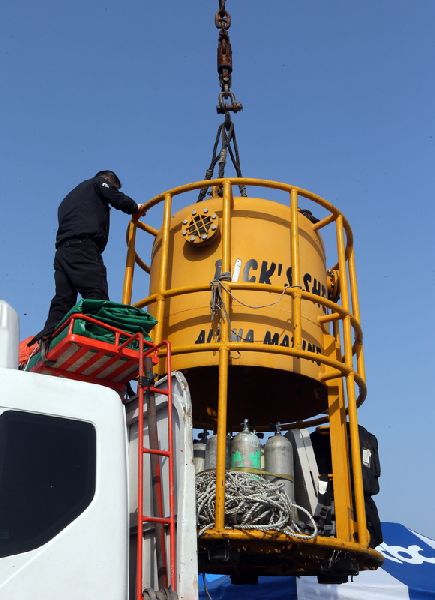
diving bell, a rigid chamber used to transport divers to lower depths in the ocean, is moved to be used in the search and rescue operation for the capsized ferry Sewol's missing passengers at a Jindo Island port in southwestern South Korea, 25 April 2014.

SEOUL (DPA) — South Korean divers are preparing to use a diving bell to help in the recovery of bodies from a sunken ferry, the Yonhap News Agency reported.

More than 90 bodies were thought to be trapped in the wreck of the Sewol, which capsized and sank on a journey from Incheon to the resort island of Jeju on April 16.

The use of the diving bell will help searchers stay underwater longer and dive deeper in their recovery efforts. The bell has an air-filled space for divers where they can rest and resupply, the report said.

High tides, strong currents and poor visibility have hindered the divers' efforts.

The authorities have confirmed that 210 of the 476 people on board are dead and that 92 people are still missing. One hundred and seventy-four people escaped on the day the ship sank.

Advertisement

Thai Banks 'Capable of Facing Prolonged Crisis'

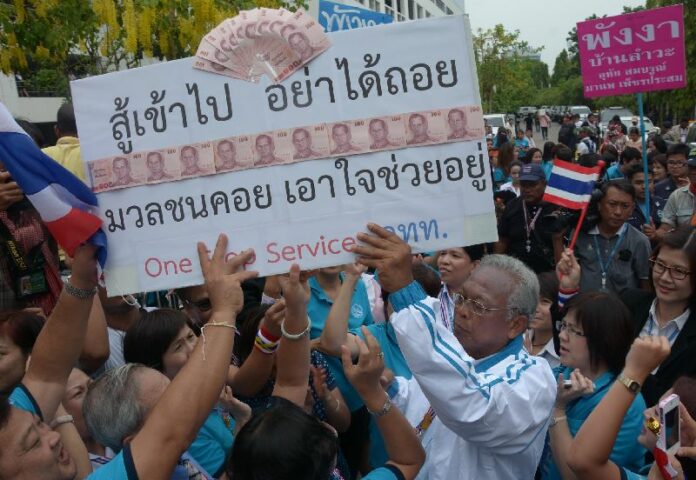
Anti-government protesters rally at the Port Authority of Thailand, 30 April 2014.

BANGKOK — Despite the economic fallout caused by Thailand’s protracted political crisis, Thai commercial banks are still enjoying a high level of stability, a top official insists.

Salinee Wangtal, deputy director of the Bank of Thailand (BOT), says an analyst team has run a simulation of "the worst case scenario" for Thailand’s economy, and discovered that the country’s financial sector is well-equipped to survive a prolonged economic recession.

Even with "2-3 years" of recession, Thai commercial banks will still be able to function normally as the pillar of the national economy, Ms. Salinee claimed.

She added that Thai banks have a vast reserve of emergency funds to cover the cost of defaulted debts.

In fact, she said, overall credits among the Thai commercial banks have been gradually growing over the past few months.

"The growth is lower than the same period last year … but it's a normal pace for a slowing economy," Ms. Salinee said.  


For comments, or corrections to this article please contact: [email protected]

You can also find Khaosod English on Twitter and Facebook
http://twitter.com/KhaosodEnglish
http://www.facebook.com/KhaosodEnglish


Advertisement

Monks Pay Visit to 109 Year Old Man in Phitsanulok

(Chiang Mai City News)

Yesterday, a Radburana temple abbot and clergy visited a 109 year old man named Poon Takosai in Amphur Wangthong.

Mr. Poon, born in 1905, says he always eats chili sauce with vegetables, which he claims makes him strong and keeps him in good health.

You can read the rest of the article here: http://www.chiangmaicitynews.com/news.php?id=3759


Note: Khaosod English is not responsible for content on other websites.

Advertisement

12-Year-Old Boy Killed in Rocket Accident

Remnants of a the homemade rock that accidentally exploded and killed a 12-year-old boy in Ubon Ratchathanee province, 30 April 2014.

UBON RATCHATHANEE — A 12-year-old boy was killed this morning when a homemade rocket accidentally exploded in Ubon Ratchathanee province.

The incident took place in Pho Yai district at around 11:30 a.m. Police say the boy, identified as Wuttinan Moonsaeng, was found at the scene with severe wounds to the head.  

Naikham Moonsaeng, the boy’s 50-year-old uncle, said Wutthinan was helping him prepare a traditional rocket to be fired in a ceremony to honour the local spirits on 1 May.

The rocket consisted of a plastic pipe filled with saltpetre. Mr. Naikham was pouring the saltpetre and his nephew was placing metal plates at the bottom of the missile to seal its ignition chamber when a small explosion suddenly occurred, sending the metal plate into the boy's skull, according to Mr. Naikham.

The police say they are investigating the incident to determine whether the death was caused by negligence. 


For comments, or corrections to this article please contact: [email protected]

You can also find Khaosod English on Twitter and Facebook
http://twitter.com/KhaosodEnglish
http://www.facebook.com/KhaosodEnglish
Advertisement

Australian Asylum Seekers Go To Cambodia Under New Deal

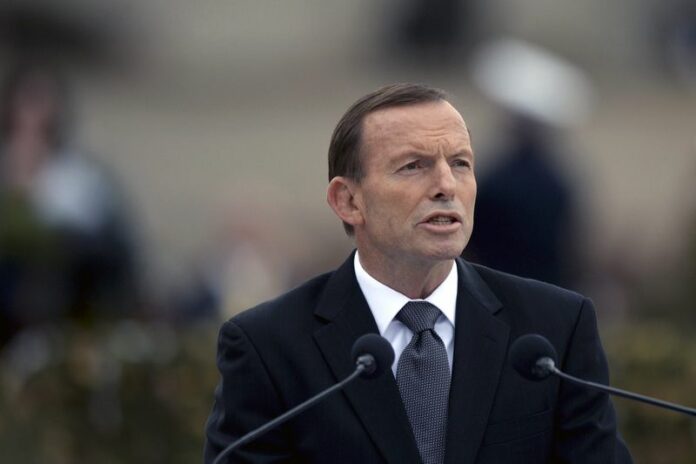
Australian Prime Minister Tony Abbott addresses the Commemorative Service during the Anzac Day ceremony at the Australian War Memorial in Canberra, Australia, 25 April 2014 (DPA).

By Kate Bartlett (DPA)

PHNOM PENH (DPA) — Cambodia will take in asylum seekers picked up during their attempts to reach Australia – as part of a deal reached between the two nations, the Cambodian government announced late Tuesday.

The deal would give some breathing room to the Australian government, which hopes to resettle such asylum seekers in a third country and keep a promise it made about limiting immigration.

Visting Australian officials first made the request of Cambodia last month.

"In principle we agree," Foreign Ministry spokesman Koy Kuong told dpa Tuesday.

"In principle we accept refugees, but now we have to set up a committee" to be in charge of the process, he continued, adding that there was no date set yet for when the first asylum seekers would arrive in Cambodia.

Simon Fellows, deputy head of mission at the Australian Embassy in Phnom Penh, said he was not immediately able to comment Tuesday.

Cambodia is one of the poorest nations in the region and receives 90 million US dollars in aid annually from Australia – making Australis one of Cambodia's biggest donors.

Australian Prime Minister Tony Abbott was elected in September on a strong promise to "stop the boats" and has proudly declared that no boat carrying asylum seekers has arrived on Australian soil for more than 100 days.

His government's controversial measures include forcibly towing asylum seekers back to Indonesia and incarcerating others in camps in Papua New Guinea and the Pacific Island of Nauru.

More than 2,000 asylum seekers are being held in crowded detention centres on remote Manus Island, part of Papua New Guinea, and the Pacific island nation of Nauru.

In Cambodia there has been widespread criticism of the idea of Cambodia taking the asylum seekers, primarily from rights groups, who say Cambodia's own shameful recent history with refugees makes it quite the wrong country to take Australia's.

In 2009, Cambodia repatriated 20 Uighur refugees to China while their asylum applications were still being processed by the United Nations. Many of them were subsequently given life in prison in China. After the deportation, China pledged 1 billion dollars worth of investment to Cambodia.

The announcement comes as UN Deputy High Commissioner for Human Rights Flavia Pansieri is visiting Cambodia.

She told local newspaper The Cambodia Daily that the UN would be willing to provide support for the asylum seekers' resettlement, saying: "We stand by ready to provide support to ensure standards are met."

However, Denise Coghlan, who heads the Jesuit Refugee Service in Cambodia said that Australia should not be fobbing off its responsibility onto poorer nations.

"Australia has enough space and money" to accommodate asylum seekers, she said.

Advertisement

Justice Seeker for 2010 Crackdown Victims Dies

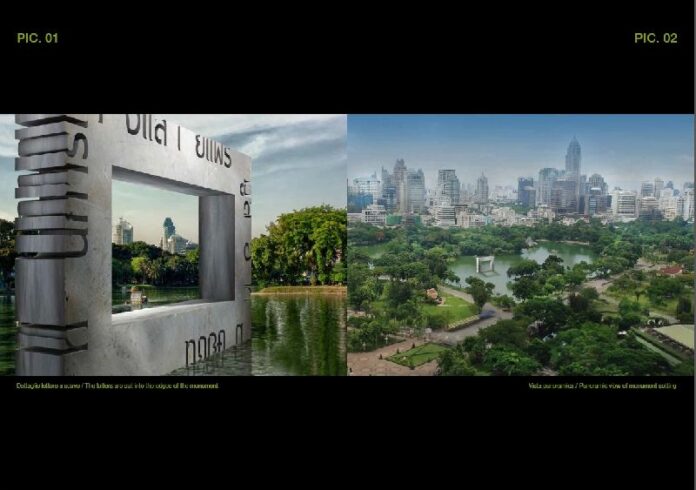
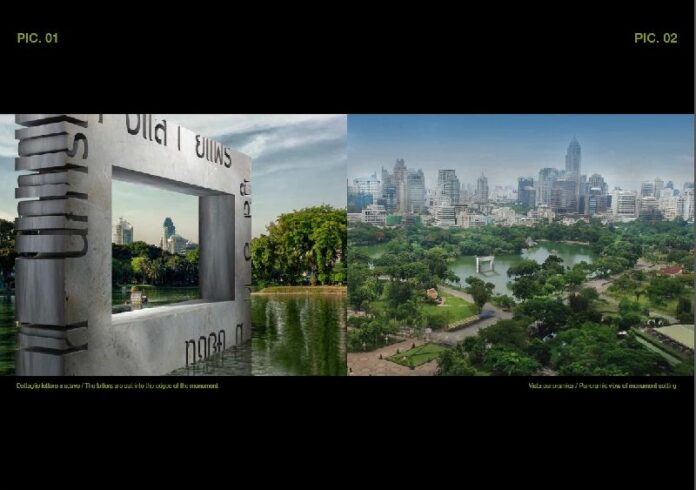
A draft of the memorial for the 2010 crackdown victims designed by Elizabeth Polenghi (image provided by Jarupan Kuldilok)

BANGKOK — The Italian photographer-turned-activist who campaigned for justice on behalf of victims of the 2010 crackdown, including her own brother, passed away last night.

Elizabeth Polenghi died at a hospital in Milan, Italy, where she had been hospitalised for pancreatic cancer, Prachatai reports. She was 51.

A photographer and artist by profession, Ms. Polenghi turned to activism shortly after her brother, photojournalist Fabio Polenghi, was shot dead while covering the Thai military’s assault on Redshirt protesters in downtown Bangkok on 19 May, 2010.

Citing ample evidence and numerous witnesses, a 2013 court inquest ruled that the military was most likely responsible for Fabio's death, despite its insistence otherwise.

Ms. Polenghi has made numerous trips to Thailand—an expense she covered by selling her photography studio, she said—to seek justice on behalf of her brother and other victims who lost their lives in the 2010 unrest. She had also expressed her opposition to the idea of granting amnesty to politicians and military leaders behind the crackdown.

Her quest for accountability from the Thai authorities, whom Ms. Polenghi once described as plagued by the culture of impunity, was featured in a 2011 BBC documentary, "Thailand: Justice on Fire."

"She has devoted the last years of her life to uncovering the truth for the world," said Jarupan Kuldilok, a former Pheu Thai MP and associate of Ms. Polenghi.

Ms. Jarupan said she and her fellow activists intend to continue Ms. Polenghi's fight for justice by filing a complaint to a European court if the Thai justice system fails to prosecute the authorities who approved the deadly crackdown in 2010.

The former Pheu Thai MP, who provided assistance to Ms. Polenghi during her stays in Thailand, added that she last saw Ms. Polenghi on 29 May 2013, when the court ruled on the circumstances of Fabio's death. 

According to Ms. Jarupan, Ms. Polenghi left her with two instructions before she passed away: to pursue Fabio's case to the end for the sake the rule of law, and to construct a memorial in honour of journalists who were killed and wounded during the political unrest of April-May 2010.

Ms. Polenghi has already provided her with a detailed plan of the memorial, Ms. Jarupan said. The memorial—dubbed "Frames"—will consist of a large rectangular concrete frame, symbolising a camera viewfinder, set in a pond in Lumpini Park, close to where Fabio lost his life.

The draft also features the inscription, "Freedom of Information Guarantees Human Rights," on the memorial. 

Ms. Jarupan said her organisation, the United Front of Democracy Against Dictatorship (UDD), will discuss the draft of the memorial and campaign for its construction, though its location and physical design may be altered. 

Fabio Polenghi was one of two journalists who died in the 2010 unrest; the other was Hiroyuki Maramoto, a Japanese national who was working as a cameraman for Reuters. Many other journalists, both Thai and foreign, were also injured by the violence.


For comments, or corrections to this article please contact: [email protected]

You can also find Khaosod English on Twitter and Facebook
http://twitter.com/KhaosodEnglish
http://www.facebook.com/KhaosodEnglish
Advertisement

Justice Seeker for 2010 Crackdown Victims Dies

A draft of the memorial for the 2010 crackdown victims designed by Elizabeth Polenghi (image provided by Jarupan Kuldilok)

BANGKOK — The Italian photographer-turned-activist who campaigned for justice on behalf of victims of the 2010 crackdown, including her own brother, passed away last night.

Elizabeth Polenghi died at a hospital in Milan, Italy, where she had been hospitalised for pancreatic cancer, Prachatai reports. She was 51.

A photographer and artist by profession, Ms. Polenghi turned to activism shortly after her brother, photojournalist Fabio Polenghi, was shot dead while covering the Thai military’s assault on Redshirt protesters in downtown Bangkok on 19 May, 2010.

Citing ample evidence and numerous witnesses, a 2013 court inquest ruled that the military was most likely responsible for Fabio's death, despite its insistence otherwise.

Ms. Polenghi has made numerous trips to Thailand—an expense she covered by selling her photography studio, she said—to seek justice on behalf of her brother and other victims who lost their lives in the 2010 unrest. She had also expressed her opposition to the idea of granting amnesty to politicians and military leaders behind the crackdown.

Her quest for accountability from the Thai authorities, whom Ms. Polenghi once described as plagued by the culture of impunity, was featured in a 2011 BBC documentary, "Thailand: Justice on Fire."

"She has devoted the last years of her life to uncovering the truth for the world," said Jarupan Kuldilok, a former Pheu Thai MP and associate of Ms. Polenghi.

Ms. Jarupan said she and her fellow activists intend to continue Ms. Polenghi's fight for justice by filing a complaint to a European court if the Thai justice system fails to prosecute the authorities who approved the deadly crackdown in 2010.

The former Pheu Thai MP, who provided assistance to Ms. Polenghi during her stays in Thailand, added that she last saw Ms. Polenghi on 29 May 2013, when the court ruled on the circumstances of Fabio's death. 

According to Ms. Jarupan, Ms. Polenghi left her with two instructions before she passed away: to pursue Fabio's case to the end for the sake the rule of law, and to construct a memorial in honour of journalists who were killed and wounded during the political unrest of April-May 2010.

Ms. Polenghi has already provided her with a detailed plan of the memorial, Ms. Jarupan said. The memorial—dubbed "Frames"—will consist of a large rectangular concrete frame, symbolising a camera viewfinder, set in a pond in Lumpini Park, close to where Fabio lost his life.

The draft also features the inscription, "Freedom of Information Guarantees Human Rights," on the memorial. 

Ms. Jarupan said her organisation, the United Front of Democracy Against Dictatorship (UDD), will discuss the draft of the memorial and campaign for its construction, though its location and physical design may be altered. 

Fabio Polenghi was one of two journalists who died in the 2010 unrest; the other was Hiroyuki Maramoto, a Japanese national who was working as a cameraman for Reuters. Many other journalists, both Thai and foreign, were also injured by the violence.


For comments, or corrections to this article please contact: [email protected]

You can also find Khaosod English on Twitter and Facebook
http://twitter.com/KhaosodEnglish
http://www.facebook.com/KhaosodEnglish

Advertisement

Giant Buddha Head Attracts Lotto Hunters

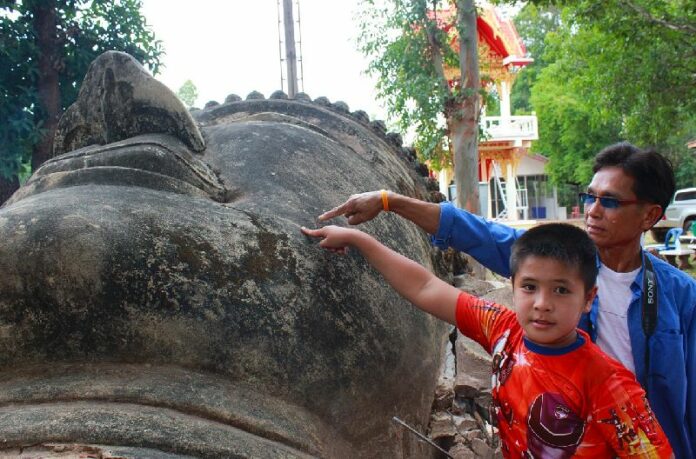
NAKHON PANOM — Buddhist worshipers are flocking to the fallen head of a giant Buddha statue, which was recently unearthed in Nakhon Panom province, in search of good luck.

The head was a part of a failed construction project to build a 9-metre-tall Buddha statue at Wat Buddha Nimit Temple in Tha Uthen district 26 years ago.

The construction was halted when scaffolds around the huge Buddha collapsed, injuring several construction workers, local officials said. The head of the Buddha also fell off from its body. Over time, the Buddha and its detached head became completely buried underground. Local administration officials unearthed the artifacts for the first time earlier this week.

The news has attracted much attention from local residents, who flocked to witness the unearthed giant Buddha head and construct a number of colourful shrines filled with offerings of fruit and flowers around the artifiact. 

Those hoping to win the next lottery draw also closely inspected the Buddha head for potential clues to prize-winning numbers.

One such lottery hunter, Sitthichai Mikawan, 35, said he arrived with his family members this morning after hearing about the incident on TV to seek a divine fortune for next try at the lottery on 1 May. 

Asked whether he found what he sought, Mr. Sitthichai said he noticed a mark resembling the number five near the Buddha head.

Lampoei Chanapot, village headman of Na Soke Nuea community, told reporters that some residents claim to have seen the numbers 815 and 915, while others swear that they have witnessed "holy water" trickling out of the Buddha head's neck.

"It's a strange incident, but I don't want them to be too superstitious," Mr. Lampoei said.


For comments, or corrections to this article please contact: [email protected]

You can also find Khaosod English on Twitter and Facebook
http://twitter.com/KhaosodEnglish
http://www.facebook.com/KhaosodEnglish

Advertisement

CAPO Slams Court Official's 'Favouritism' Letter

BANGKOK — The government has harshly criticised a top court official for lobbying the chief of the Royal Thai Police to grant a promotion to a policeman he knows personally.

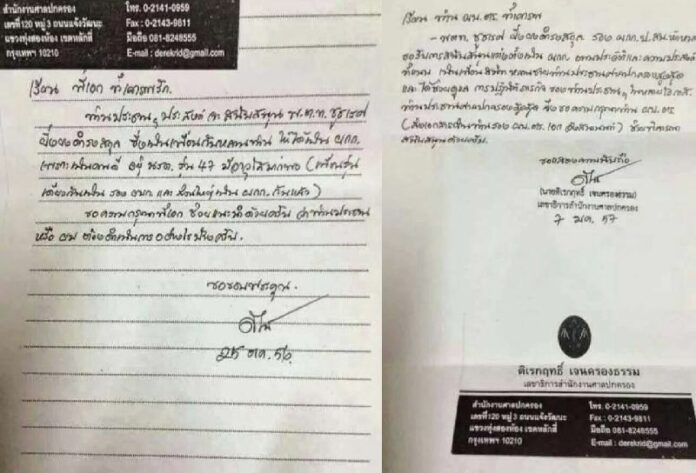
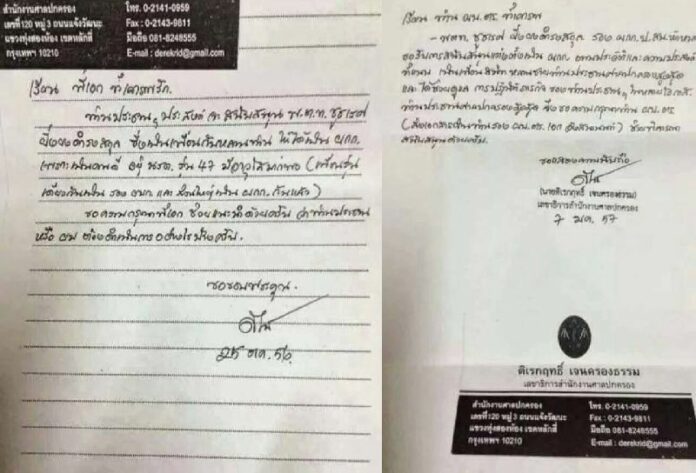
The letter was written by the secretary general of the Administrative Court, Direkrit Jenkrongtham, and addressed to the Thai police chief, Pol.Gen. Adul Saengsingkaew. 

In the letter, Mr. Direkrit asked the police chief to consider promoting another police officer, Pol.Lt.Col. Chutharet Yingyongdamrongsakul, from deputy commander to the position of station commander.

According to Isra News, which published the letter online, Pol.Lt.Col. Chutharet is a friend of the nephew of Mr. Direkrit's boss, the chairman of the Supreme Administrative Court, Hassawut Withiwiriyakul. It is also understood that Pol.Lt.Col. Chutharet and Mr. Direkrit know each other personally.

The image of the letter has been widely shared on social media, attracting many comments that brand Mr. Direkrit's action as a typical case of the favouritism that plagues Thai bureaucracy. 

Mr. Direkrit defended the letter in an interview with Isra News, insisting that he has not violated any laws or bureaucratic regulations because his request was not made through an official channel.

In fact, Mr. Direkrit told Isra News that it is the media who is at risk of violating the law by publishing internal memos with the potential intention to defame or accuse an official like himself.

Mr. Direkrit added that it is important to have policemen who are close to court officials in high-ranking positions, for the sake of reliable security service. 

"The request for policemen we trust, such as those who are our relatives or used to work with us … to be in a position to provide security is perfectly reasonable," Mr. Direkrit said. 

"We need people we can trust in charge. We can't use just anyone. They may stab us in the back later on," Mr. Direk told Isra News. "This is not an interference or abuse of power."

He added, "As far as I know, many police officers do this on a regular basis. It's nothing illegal."

However, the Centre for Administration of Peace and Order (CAPO) has a different view. 

"It warrants the strongest terms of criticism and condemnation," said CAPO spokesperson Pol.Lt.Col Anchulee Theerawongpaisan. “It’s an act that violates the ethics decreed under the Constitution at the hands of one of the highest leaders in the judicial branch."

The CAPO spokesperson also raised concern that the incident may lead the public to question the impartiality of the courts, especially when the Constitutional Court will soon rule on the status of Prime Minister Yingluck Shinawatra following complaints that she unfairly removed a former head of the National Security Council.

"CAPO does not have the power to take any action in this case," Pol.Lt.Col Anchulee said. "But it is the task of  CAPO to solve conflicts in society. Therefore, we demand the two officials in the Administrative Court reconsider their action,” Pol.Lt.Col Anchulee said in reference to Mr. Direkti and his superior, chairman of the Supreme Administrative Court Mr. Hassawut.


For comments, or corrections to this article please contact: [email protected]

You can also find Khaosod English on Twitter and Facebook
http://twitter.com/KhaosodEnglish
http://www.facebook.com/KhaosodEnglish
Advertisement

CAPO Slams Court Official's 'Favouritism' Letter

BANGKOK — The government has harshly criticised a top court official for lobbying the chief of the Royal Thai Police to grant a promotion to a policeman he knows personally.

The letter was written by the secretary general of the Administrative Court, Direkrit Jenkrongtham, and addressed to the Thai police chief, Pol.Gen. Adul Saengsingkaew. 

In the letter, Mr. Direkrit asked the police chief to consider promoting another police officer, Pol.Lt.Col. Chutharet Yingyongdamrongsakul, from deputy commander to the position of station commander.

According to Isra News, which published the letter online, Pol.Lt.Col. Chutharet is a friend of the nephew of Mr. Direkrit's boss, the chairman of the Supreme Administrative Court, Hassawut Withiwiriyakul. It is also understood that Pol.Lt.Col. Chutharet and Mr. Direkrit know each other personally.

The image of the letter has been widely shared on social media, attracting many comments that brand Mr. Direkrit's action as a typical case of the favouritism that plagues Thai bureaucracy. 

Mr. Direkrit defended the letter in an interview with Isra News, insisting that he has not violated any laws or bureaucratic regulations because his request was not made through an official channel.

In fact, Mr. Direkrit told Isra News that it is the media who is at risk of violating the law by publishing internal memos with the potential intention to defame or accuse an official like himself.

Mr. Direkrit added that it is important to have policemen who are close to court officials in high-ranking positions, for the sake of reliable security service. 

"The request for policemen we trust, such as those who are our relatives or used to work with us … to be in a position to provide security is perfectly reasonable," Mr. Direkrit said. 

"We need people we can trust in charge. We can't use just anyone. They may stab us in the back later on," Mr. Direk told Isra News. "This is not an interference or abuse of power."

He added, "As far as I know, many police officers do this on a regular basis. It's nothing illegal."

However, the Centre for Administration of Peace and Order (CAPO) has a different view. 

"It warrants the strongest terms of criticism and condemnation," said CAPO spokesperson Pol.Lt.Col Anchulee Theerawongpaisan. “It’s an act that violates the ethics decreed under the Constitution at the hands of one of the highest leaders in the judicial branch."

The CAPO spokesperson also raised concern that the incident may lead the public to question the impartiality of the courts, especially when the Constitutional Court will soon rule on the status of Prime Minister Yingluck Shinawatra following complaints that she unfairly removed a former head of the National Security Council.

"CAPO does not have the power to take any action in this case," Pol.Lt.Col Anchulee said. "But it is the task of  CAPO to solve conflicts in society. Therefore, we demand the two officials in the Administrative Court reconsider their action,” Pol.Lt.Col Anchulee said in reference to Mr. Direkti and his superior, chairman of the Supreme Administrative Court Mr. Hassawut.


For comments, or corrections to this article please contact: [email protected]

You can also find Khaosod English on Twitter and Facebook
http://twitter.com/KhaosodEnglish
http://www.facebook.com/KhaosodEnglish
Advertisement

Hot News

LATEST NEWS

Bangkok
overcast clouds
30 ° C
30 °
30 °
70 %
4.5kmh
100 %
Fri
30 °
Sat
30 °
Sun
31 °
Mon
30 °
Tue
31 °