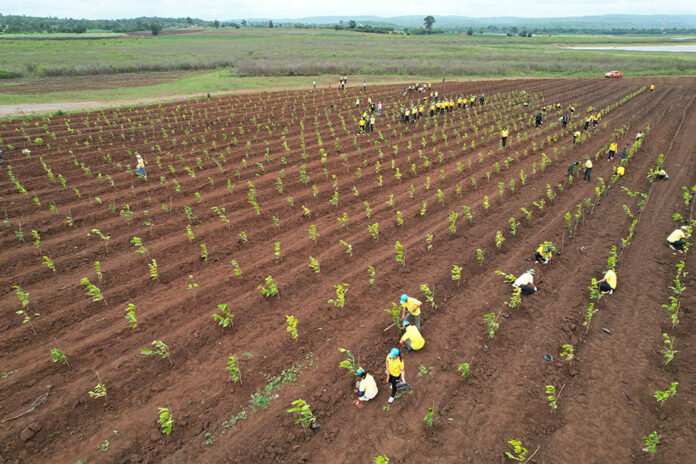
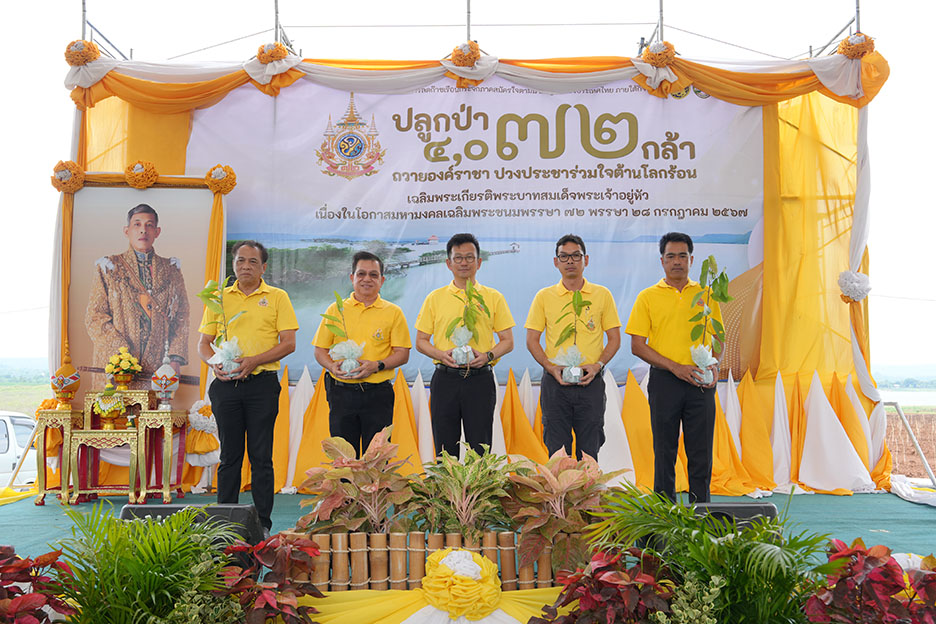
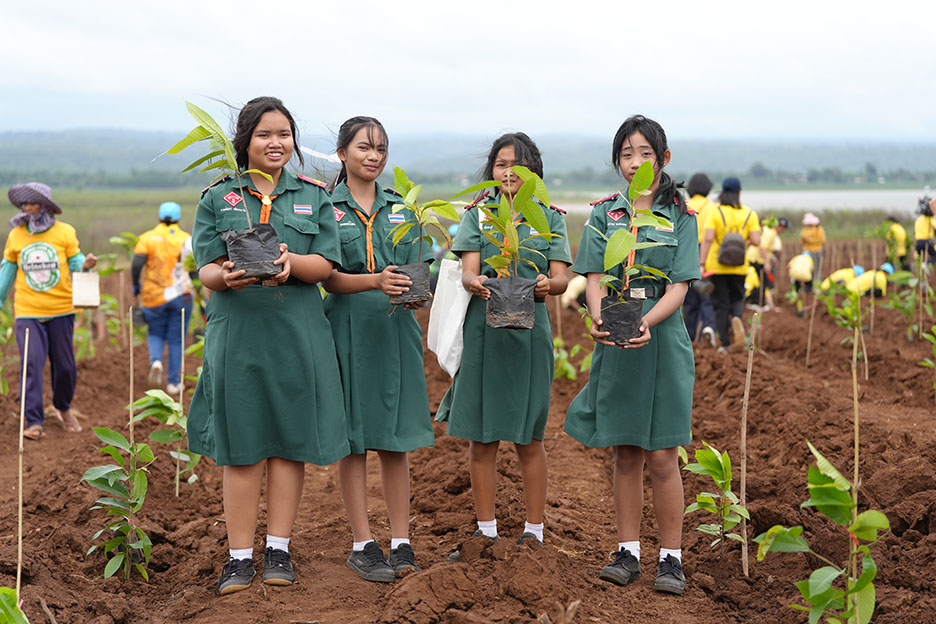
The Royal Irrigation Department is planting 4,072 saplings on over 20 rai of land at the Lam Chae Water Delivery and Maintenance Project in Khon Buri District, Nakhon Ratchasima Province.
NAKHON RATSIMA — The Royal Irrigation Department is advancing efforts to increase forested areas to combat global warming through the planting of 4,072 saplings on over 20 rai or 32000 square metres of land at the Lam Chae Water Delivery and Maintenance Project in Khon Buri District, Nakhon Ratchasima Province.
This area serves as a pilot project for reinforcing irrigation areas, aiming towards the Carbon Credit Project. The activity was held on July 25, 2024, during celebrations honoring His Majesty the King’s 72nd birthday anniversary.
Mr. Wiwat Thitirattana-ast Director of Engineering division Regional Irrigation Office 8, and Mr.Somkiet Wiriyakulnant, Deputy Governor of Nakhon Ratchasima Province, jointly presided over the event. Representatives from provincial and district government agencies, local administrative organizations, residents, students, state enterprises, private sector organizations, and the media attended.
Youth representatives participating in the tree planting came from Ban Khokbaibua School, Ban Khokkrachai Nonkoom School, and Ban Mapbkrad School.
Viwat stated that the Royal Irrigation Department is prepared to enhance its operations to achieve carbon neutrality and net-zero greenhouse gas emissions by 2065.
Additionally, policies have been established to align with the Ministry of Agriculture and Cooperatives’ Agricultural Climate Change Adaptation Action Plan 2023-2027, which aims to reduce greenhouse gas emissions by 1 million tons.
The Lam Chae Reservoir project has been actively engaged in reforestation efforts since 2021, having planted around 38 rai of forest. They have also participated in landscape enhancement and expansion of green spaces.
This year, they plan to grow an additional 20 rai of forest. The tree species planted include Yang Na, Makha Mong, Pradu Paa, and Payung, some of which were cultivated from seedlings by the Lam Chae Reservoir project’s staff. Reforestation activities will continue into the following year.
Furthermore, the Royal Irrigation Department plans to expand reforestation areas by implementing irrigation projects in various localities to survey potential areas for reforestation.
______
Plan to Reduce Global Warming in Rice Cultivation
The Agricultural Action Plan to Address Climate Change 2023-2027 of the Ministry of Agriculture and Cooperatives aims to reduce greenhouse gas emissions by 1 million tons. The Royal Irrigation Department has been tasked with promoting and supporting alternate wetting and drying (AWD) rice cultivation in collaboration with the Rice Department.
The Royal Irrigation Department initiated the concept of AWD rice farming in 2015. In 2016, it was presented at the 2nd World Irrigation Forum and received the WatSave Awards.
The team has created a manual for AWD rice farming to guide farmers. This method has seen increased adoption among farmers. It has led to a reduction in water usage from 1,200 cubic meters per rai to no more than 860 cubic meters per rai. Additionally, it reduces fertilizer usage by 30-40% per rai and increases crop yields by 20-30% per rai.
Please note: 1 rai is equal to 1,600 square meters
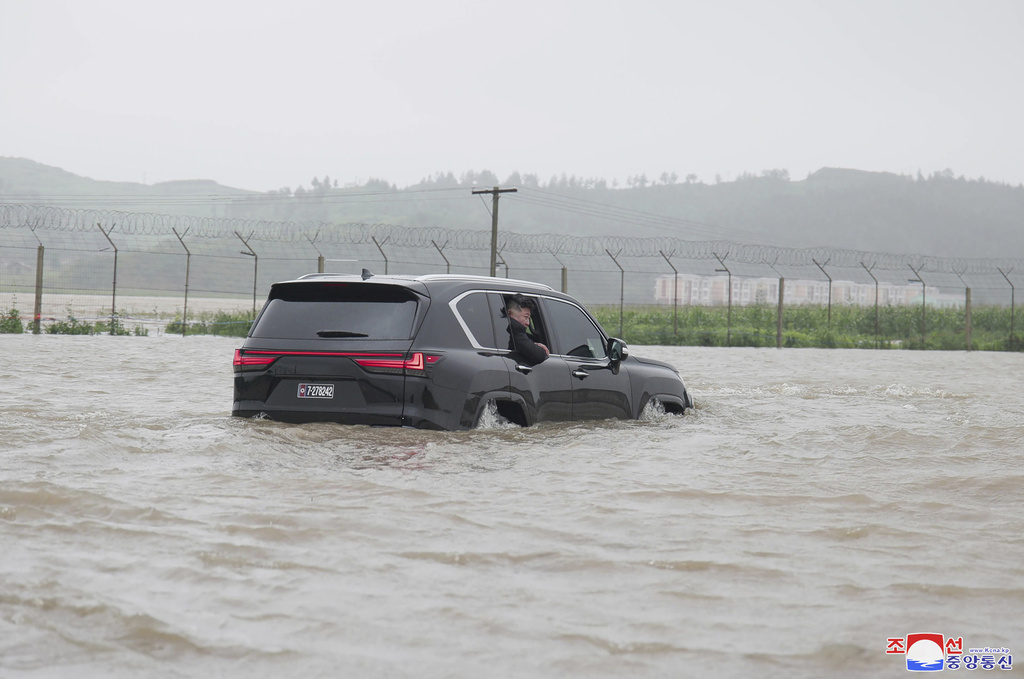
In this photo provided by the North Korean government, North Korean leader Kim Jong Un inspects a flood-hit area in North Phyongan province, North Korea Sunday, July 28, 2024. (Korean Central News Agency/Korea News Service via AP)
SEOUL, South Korea (AP) — More than 5,000 people isolated by flooding in northwestern North Korea were rescued by airlift and other evacuation work after heavy summer rains caused a river on the Chinese border to swell, state media reported Monday.
The official Korean Central News Agency did not mention any deaths or how much damage the flooding on Saturday caused.
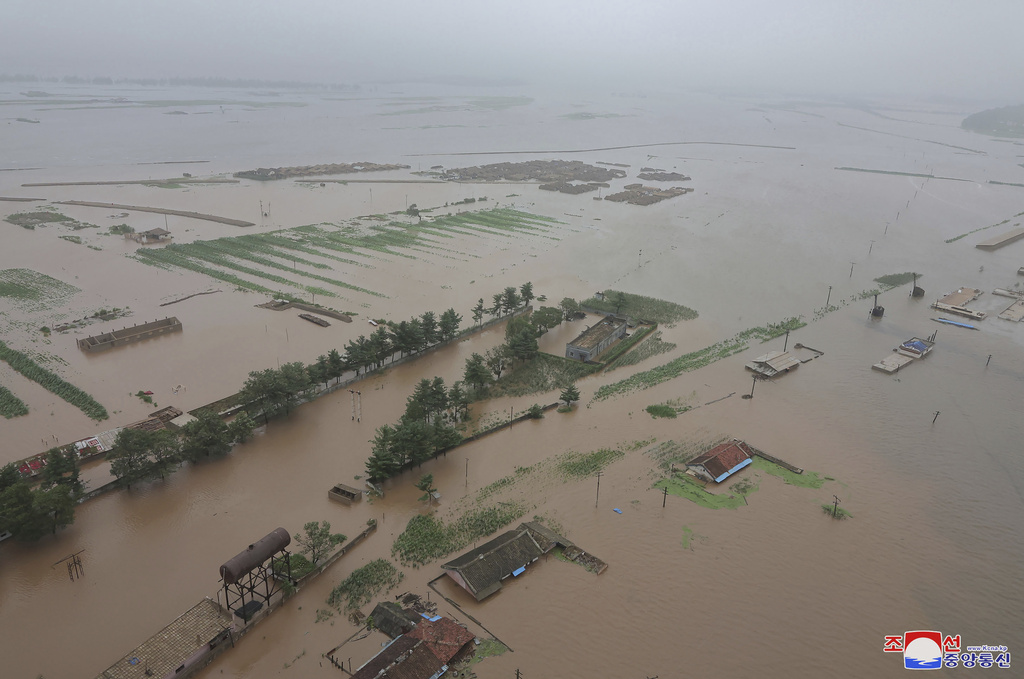
Summer floods in North Korea often cause serious damage to farmlands due to poor drainage, deforestation and dilapidated infrastructure.
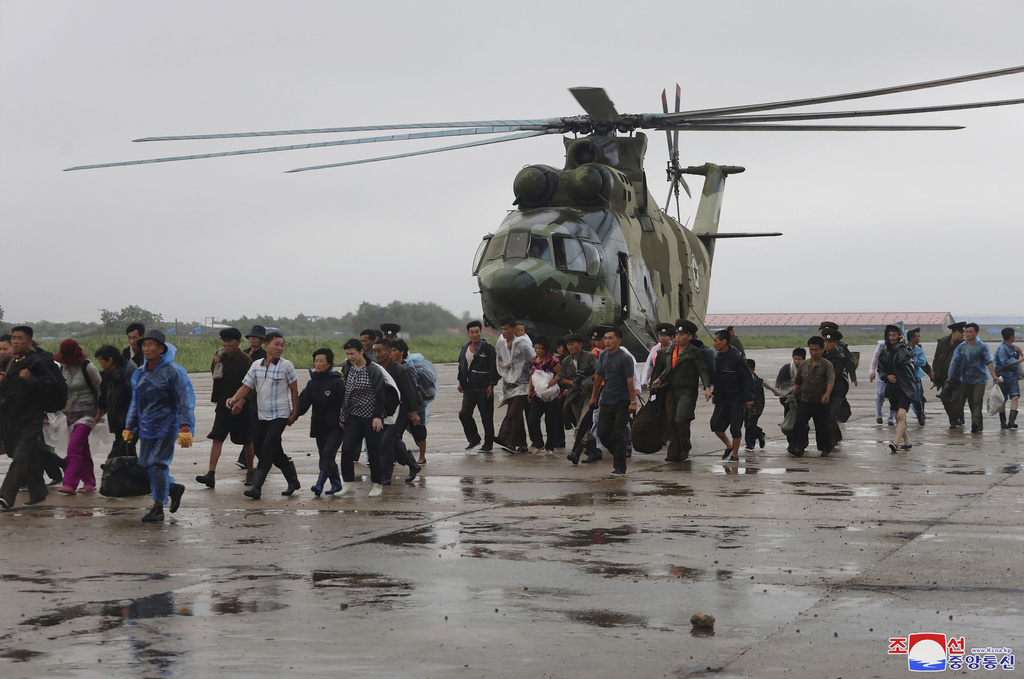
About 10 military helicopters and navy and government boats were mobilized for the evacuation efforts in Sinuiju city and Uiju town where flooding had stranded residents. KCNA said that about 4,200 people were rescued by airlifts.
In this photo provided by the North Korean government, North Korean leader Kim Jong Un inspects a flood-hit area in North Phyongan province, North Korea Sunday, July 28, 2024. (Korean Central News Agency/Korea News Service via AP)
KCNA credited leader Kim Jong Un with overseeing the rescue operation on Sunday, likely aiming to portray him as an able leader handling a disaster and caring about the public’s well-being.
During his weekend visit to the flooded region, KCNA quoted Kim calling the rescue works “miraculous” and ordering food and other necessities to be provided to the affected people.
Kim scolded officials for failing to prepare for floods despite his orders to prevent flood damage, KCNA said, in a possible effort to shift blame while North Korea struggles with economic difficulties.
“They, seized with defeatism at combat with nature, do not confidently turn out in the disaster prevention work, only expecting chance from the sky,” Kim said, according to KCNA.
Kim said the North’s emergency response agency and the Ministry of Public Security didn’t know the exact populations of the flood-hit areas, so the number of people rescued was much larger than expected.
This undated photo provided on Monday, July 29, 2024 by the North Korean government, shows a flood-hit area in North Phyongan province, North Korea. (Korean Central News Agency/Korea News Service via AP)In this photo provided by the North Korean government, people who were affected by heavy rainfall in North Phyongan province, North Korea are rescued Sunday, July 28, 2024. (Korean Central News Agency/Korea News Service via AP)
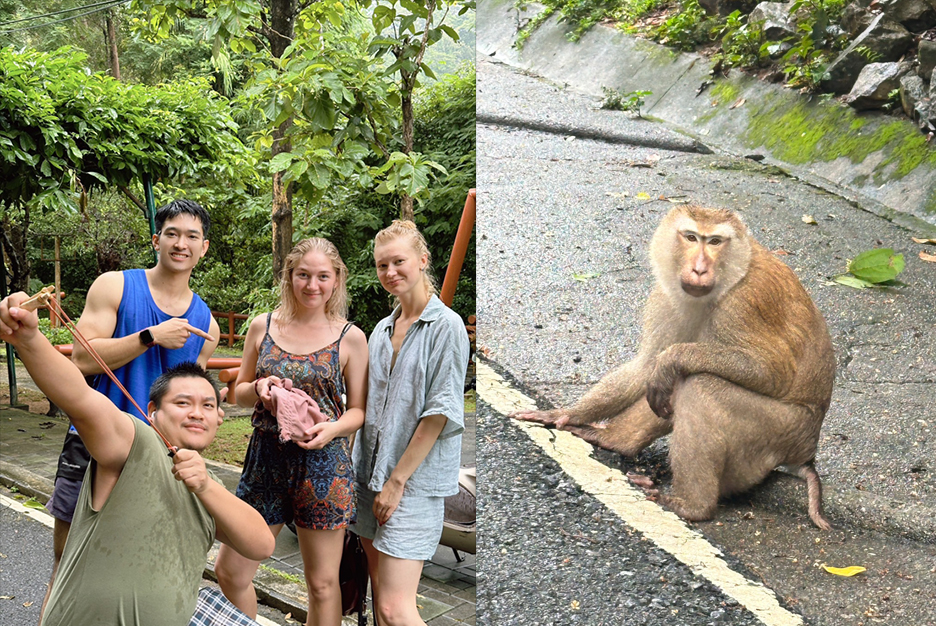
A Phuket Provincial Police officer helps a Russian female tourist retrieve her items stolen by a monkey at Khao To Sae hill in central Phuket on July 29, 2024.
PHUKET — Two Phuket Provincial Police officers, who were off-duty and exercising on Khao To Sae hill in central Phuket, came to the aid of a Russian female tourist who was attacked by a monkey that snatched her bag while she and her friend were walking on the hill.
Lance Corporal Supachai Arunchoat and Lance Corporal Phuthip Chottiwattanakorn suspected that the female tourist might have gotten too close to the monkey, causing it to jump onto the foreign woman’s back. It then grabbed various items from her, including her phone, room key card, bag, and battery charger, before escaping up a tree. They happened to pass by and offered to help.
Two Phuket Provincial Police officers help a Russian female tourist retrieve her items stolen by a monkey at Khao To Sae hill in central Phuket on July 29, 2024.
Based on information from local residents that if someone wants to retrieve items stolen by monkeys, they should throw rocks up (but not hit the monkeys), and the monkeys will throw the items back down. He followed this advice, and indeed, the monkey released all the items. He then collected and returned them to the tourist.
Afterward, they took photos together, which were shared on the Newshawk Phuket Facebook page. People left playful comments such as “naughty monkey” and “how many years in prison for this offense?” One person shared their experience: “I was once kicked in the back by a monkey on Khao To Sae hill just because I wanted to return an umbrella, officer.”
Lance Corporal Supachai advised tourists hiking on the hill to keep their distance from monkeys. Some people might think monkeys are friendly, but they like to snatch things. Visitors should avoid carrying items or getting too close to monkeys, as some can be aggressive.
Khao To Sae is located on a hill over 250 meters high in Ratsada sub-district, Mueang district. It’s an eco-tourism spot in Phuket with seven scenic viewpoints, each offering different beautiful views. There’s also a health park surrounded by lush forests with various wildlife, with monkeys and squirrels being the most commonly seen.
Earlier this year, the Phuket Provincial Administrative Organization held a meeting to address the problem of monkeys attacking tourists on Khao To Sae. The meeting resulted in assigning the Phuket Forestry Center to notify unauthorized vendors in the forest area to cease operations and remove their shops immediately. They were also tasked with finding ways to feed the monkeys that wouldn’t cause trouble for tourists.
David William, an English teacher and influencer who has long resided in Thailand, posts a critical video of Apple's new advertisement on his TikTok account with the question, 'Why does Apple make our country look so bad?'
BANGKOK — Netizens are displeased with Apple’s new advertisement, “The Underdogs: OOO (Out Of Office) | Apple at Work”. Despite being filmed in Thailand and featuring Thai elements such as food, clothing, and public transport, many commenters feel it’s discriminatory. The old-fashioned color tone, outdated appearance, and difficult travel depicted seem to portray Thailand as a third-world country.
This 9.57-minute Apple advertisement, recently filmed in Thailand, presents what Apple describes as “Join Apple at Work for one heck of a business trip as the Underdogs head to Thailand to get stuff made! See Mac, iPhone, iPad and Apple Vision Pro come together to help them find a new packaging factory, solve last-minute design changes, create prototypes, break down language barriers and so much more.”
A screenshot from Apple’s “The Underdogs: OOO (Out Of Office) | Apple at Work” advertisement that the Thai government believes will boost Thailand’s tourism.
However, Thai netizens widely criticize how the ad adjusts color tones, scenes, costumes, props, and featured vehicles to create a dated look. Everything appears backward, including the airport, buses, taxis, and even the executive hotel where mosquitoes are a problem.
David William, an English teacher with 1.6 million Facebook followers and 2.9 million TikTok followers, who has long resided in Thailand, posted a critical video of this ad on his TikTok account @davidwilliamdw. The video has over 9.7 million views and more than 10,000 comments.
He says, “Apple’s ad filmed in Thailand makes Thai people look terrible in the world’s eyes.” Both the airport and hotel look ancient, as if from 50 years ago. Compared to other Apple clips filmed in places like New York or Chicago, which look great.
Thai netizens widely criticize how the ad adjusts color tones, scenes, costumes, props, and featured vehicles to create a dated look.
“I want to ask Apple and their team, what’s wrong? You came all the way to Thailand, but sorry, it doesn’t look like this at all. Watching it, I wondered if this was Thailand 50 or 70 years ago. Why isn’t there any modernity? You didn’t need to come to my country; a quick Google search would show you that Thailand is modern. The answer that would immediately come up is Y-E-S, extremely modern.”
What Apple should know is that Thai people already feel looked down upon globally. Foreigners already tend to discriminate against us. The question is, was it necessary for you to add to this? Allow me to say, it’s not nice at all.
He concludes, “If you’re going to sell things to us while looking down on us like this, making us look bad in the world’s eyes, out of the annoyance in my heart, I’ll run to buy a Samsung foldable phone immediately.”
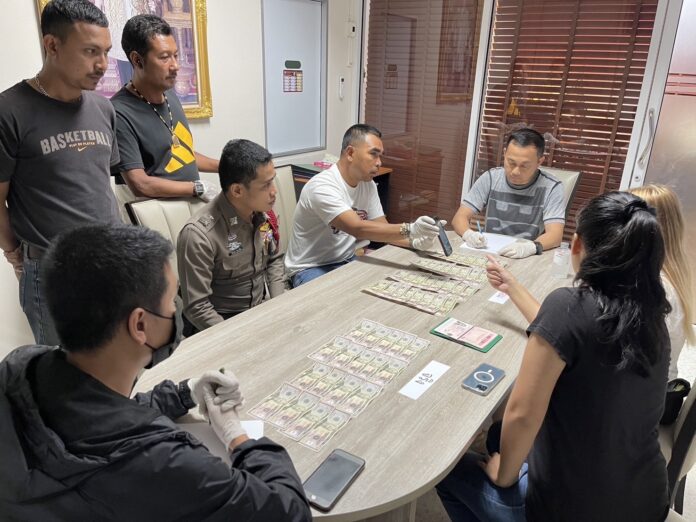
Ms. Yevgeniya, a 22-year-old Russian national, along with three of her compatriots, is questioned at Kamala Police Station on July 27, 2024.
PHUKET — A Russian woman was arrested by Kamala police in Phuket for using counterfeit U.S. dollars. She claimed she was unaware the bills were counterfeit, stating her father provided them for her trip.
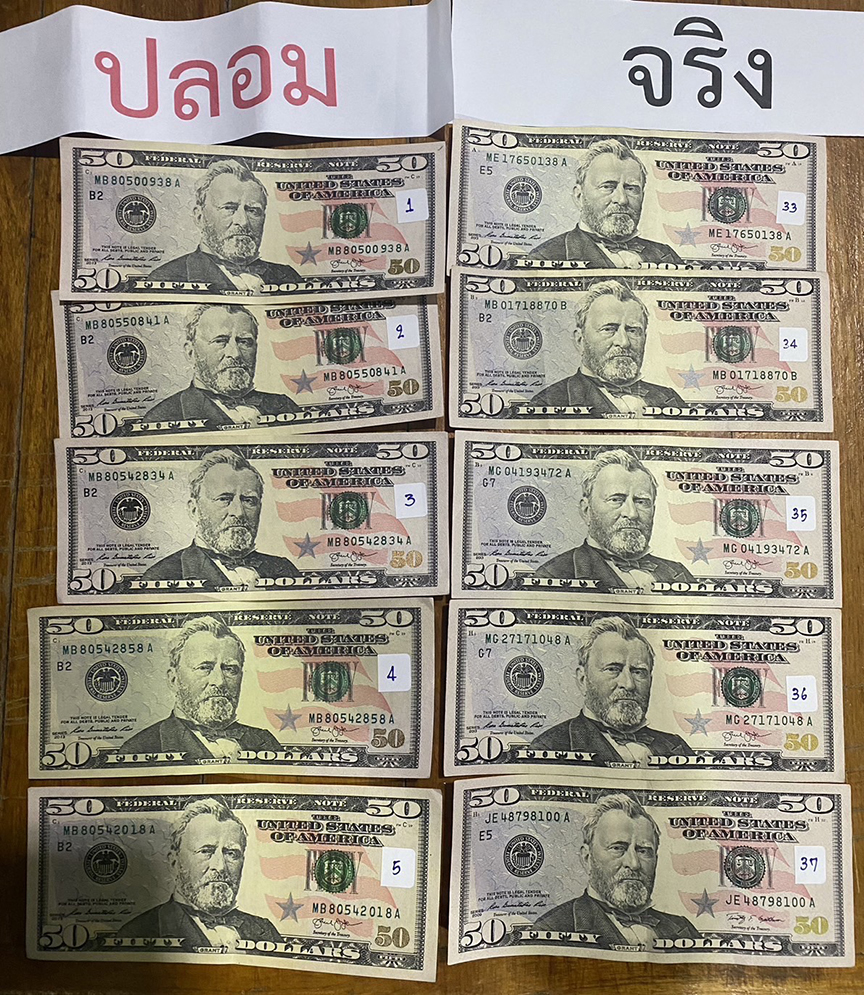
Police display US dollar bills, comparing genuine notes with counterfeit ones.
Police officers from Kamala Police Station in Phuket arrested Ms. Yevgeniya, a 22-year-old Russian national, along with three of her compatriots at a pool villa in Moo 5, Kamala Subdistrict, Kathu District, on the evening of July 27. They seized 32 counterfeit $50 bills as evidence.
All four were brought to Kamala Police Station for further questioning. Ms. Yevgeniya claimed she didn’t know the bills were fake, stating that her father had given her 60 of these bills for her trip to Phuket with friends.
On July 23, she exchanged four $50 bills at a currency exchange counter in front of Big C Kamala, receiving 5,348 baht. She said the exchange went normally, so she didn’t suspect the bills were counterfeit.
Investigation revealed that the suspect and her friends traveled from Moscow, Russia, transiting in Shanghai before flying directly to Phuket on July 22. They checked into the pool villa, and on July 23, exchanged the four $50 bills.
The Russian woman’s statement matched the report from the Thai employee at the currency exchange counter, who had photographed her passport. Out of the four $50 bills exchanged, three were found to be counterfeit.
Counterfeit US dollar bills seized by police from a Russian female tourist.
Police investigators later located the Russian woman’s accommodation, invited the suspects for questioning, and found an additional 32 counterfeit bills mixed with genuine dollar bills, out of a total of 75 bills. If all 35 counterfeit bills had been exchanged, the potential damage would have been about 62,800 baht.
Police are currently investigating whether this is connected to an international criminal organization counterfeiting U.S. dollar bills, which has been prevalent in tourist cities.
Initially, the Russian woman has been charged with bringing counterfeit currency into the kingdom, possessing counterfeit currency with intent to distribute knowing it’s fake, and bringing goods through customs into the kingdom by evading prohibitions.
A group of female Myanmar workers presented evidence to Boonyarit Nipawanich, head of the Region 5 Registration Administration Center, Chiang Mai Branch on July 26, 2024
CHIANG MAI — Migrant workers have complained to Thai officials in Chiang Mai province that they were deceived by a fake law office, losing tens of thousands of baht for processing “zero-head cards”. At least 50 victims have been identified, with some losing over 100,000 baht. Authorities are preparing to coordinate with the Department of Special Investigation (DSI) to treat this as a special case.
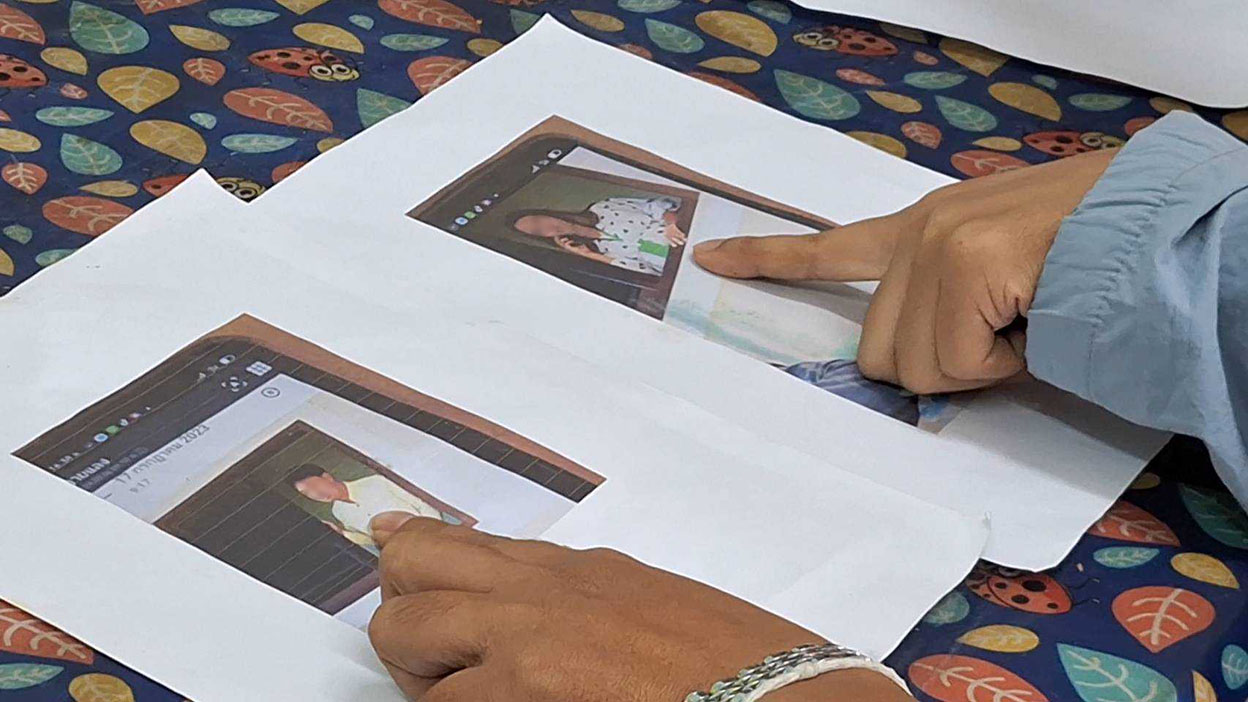
On July 26, a group of female Myanmar workers presented evidence to Boonyarit Nipawanich, head of the Region 5 Registration Administration Center, Chiang Mai Branch. They claimed they were tricked by individuals at a law office in San Kamphaeng into transferring 25,000-60,000 baht each as a fee for processing new biographical data for working in Thailand.
The fraudsters claimed they could change the workers’ “pink cards” (non-Thai national ID cards) to “zero-head cards” (ID cards for persons without registration status).
The victims said these individuals falsely claimed to have government officials’ assistance and even staged visits to district offices. After several months without results and unable to get refunds, the workers became certain they had been scammed.
Myanmar workers point to a photo of the person who deceived them.
The victims reported that from late 2023 to early 2024, they were advised by fellow migrant workers about an office in Mae Pu Kha sub-district, San Kamphaeng district, Chiang Mai province. This office, which appeared to be a law firm, offered to change pink cards to zero-head cards by deleting old registration data and creating new profiles for a service fee of 35,000 baht per person.
After the workers made contracts and transferred money, the man scheduled meetings at various district offices in Chiang Mai. He staged scenarios that appeared to be legitimate processes, including having people interview the workers and take fingerprints.
When the workers inquired about progress, the man cited various obstacles. When they tried to get refunds, they were constantly deflected and had difficulty contacting him. Recently, they found that the office was just a rented house and had closed down, leading them to believe they had been scammed. With at least 50 victims identified, they decided to file a complaint for assistance.
The workers hope to recover their hard-earned savings and prevent others from falling victim to similar scams.
Boonyarit stated that this was certainly a scam, as normally, migrant workers with “pink cards” cannot change to “zero-head cards”, which don’t require time and expenses for card and visa renewals. He emphasized warning migrant workers not to fall for such offers.
Boonyarit added that this case not only caused financial damage to the migrant workers but also damaged the government’s reputation due to the false claims of official involvement. He stated that legal action would be pursued to the fullest extent.
Initially, he has coordinated with the DSI’s Special Case Operations Center, Region 5, Chiang Mai Province, to investigate and accept this as a special case.
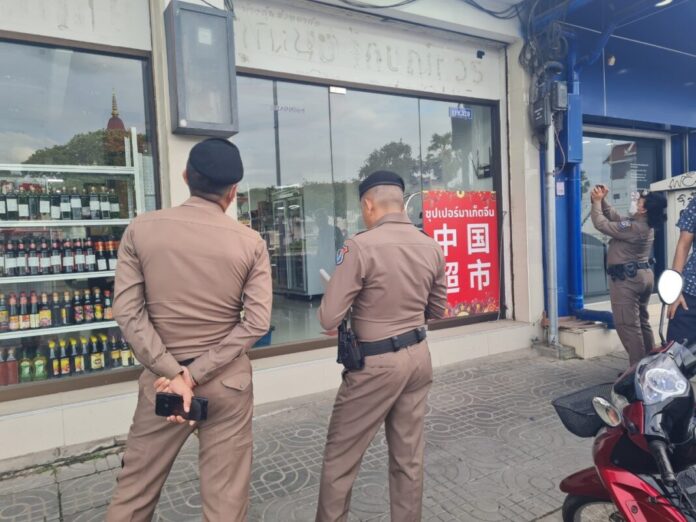
Police officers inspect a Chinese supermarket in Nakhon Ratchasima province on July 25, 2024.
What a xenophobic, or more accurately a ‘sinophobic’, week for Thailand, particularly Thai netizens.
First, was the loud cries of condemnation against a large billboard solely in Chinese language found in the heart of Bangkok’s Huai Kwang district offering potential Chinese customers to purchase passports and nationalities from four countries: Cambodia, Indonesia, Turkey, and Vanuatu. PM Srettha Thavisin felt compelled to visit the site in person and the billboard was quickly removed to ease the anger of Thai netizens. Two Chinese behind the ads quickly left Thailand, one slapped with a fine for 5,000 baht, and both told they are no longer welcomed in Thailand.
Just two days later, photos of a Chinese supermarket with a large sign in Chinese and smaller sign in Thai in Korat, Nakhon Ratchasima province, with virtually all goods made in China, spread on social media. Again, after a day, the supermarket, which was located just a short walk from the much-revered statue of Thao Suranari Monument, mysteriously shutdown.
What is going on? Why are some Thais becoming very upset, outraged even, and so fragile to anything from mainland China, particularly given that Thailand has a long history of centuries of gradual migrations and assimilation of Chinese migrants whom their children, grandchildren, (including this writer) became Thai?
The fears expressed on social media is that Thailand is becoming an economic colony of China, or a vassal state or China, if not it has already become one. What is more, they think corrupt officials and some politicians are enabling the takeover, which includes illegal businesses and activities.
Here are some of the reasons which they differ from the past waves of Chinese migrants to Siam and what eventually became known as Thailand:
The Wealth
Most are not migrants. They are not destitute or illiterate unlike the past waves of Chinese from southern China that made up the ancestors of Thai-Chinese today. They are fairly educated, with capital to invest, with technology and the might of a new superpower that is China in 2024 behind them.
The Speed
The ease of traveling, transportation, and communication means the speed of change is very rapid and the number of the new waves of Chinese in Thailand (not including Chinese tourists) is overwhelming.
The Style
They have little desire or inclination to really assimilate. Just like most of the millions of Chinese tourists who constitute the largest group of tourists in Thailand, they use Mandarin, and some expect us to understand. Some find some of them brash, loud, and inconsiderate.
The Scope
They are into many businesses, including de facto taking over local private universities. Or think of new EV plants in Thailand. It appears they could just do business with the most minimum use of Thai workforce and partners – or use them as proxies.
These are but some of the key differences. Thailand is not alone in the Southeast Asian region with such anxieties, however In Singapore, according to an opinion piece on Singapore’s Straits Times newspaper on Thursday, its government earlier in July blocked a network of 95 X accounts that “accuses Singapore of being a vassal state of the Communist Party of China.”
The key person behind the spread of the accusation was identified as Mr. Guo Wengui, a self-exiled Chinese businessman in the U.S. and “staunch critic of Chinese leadership and convicted fraudster” who alleged that “China was involved in the [recent] selection of Singapore’s fourth-generation leaders.”
Here in Thailand, we do not need to wait for a Chinese person in the U.S. to make such an allegation. More and more Thais do it themselves as they believe China’s growing influence is no longer benign if not even nefarious.
Thais and Thai-Chinese should not overreact. China is not going away, and Thailand cannot afford to become a hermit kingdom.
We will have to better adapt with the new reality in a calm and collected manner and publicly discuss how best to manage the rise of China. Let’s start from there instead of spreading xenophobia which leads to knee-jerk reactions.
Chiang Rai Police officers question Mr. Lin Chun Hung, a Taiwanese national, and Mr. Sophon, a Thai local, at Ban Du Police Station in Mueang district, Chiang Rai, on July 27.
CHIANG RAI — Officials combating scammers, or call center gangs, are currently investigating and expanding their operation against scammers who evade detection, following the arrest of a Taiwanese man with evidence in Chiang Rai province.
Mr. Lin Chun Hung, a Taiwanese national, and Mr. Sophon, a Thai local from Mae Salong Nok district, Chiang Rai, were taken for questioning at Ban Du Police Station in Mueang district, Chiang Rai, on July 27. They were arrested on July 25 with evidence including one set of telephone signal distribution equipment, or Simbox, along with one set of internet signal distribution equipment.
This arrest came after the police from the Investigation Division, Region 5, received information through a project collecting and analyzing call center number locations in Ban Du sub-district, Mueang district, Chiang Rai. They investigated and believed that the suspects were hiding equipment in an apartment building in Ban Du sub-district. They then obtained a search warrant from the Chiang Rai Provincial Court.
The police then searched Building G, room G03, and found one tp-link IP camera model: tapo C200, one tp-link internet router model: Archer MR600, and were able to arrest both suspects.
The investigation revealed that Mr. Lin brought various equipment to install for distributing telephone signals, randomly dialing numbers so that the call recipients couldn’t identify the caller’s identity or country of origin. Meanwhile, he hired Mr. Sophon as an interpreter to help coordinate the work for 1,000 baht per day.
Regarding the Simbox or mobile phone signal distribution equipment, the law does not allow individuals to install and use it for signal transmission without permission from officials. Therefore, the officials charged both suspects with jointly making, possessing, using, importing, exporting, or trading radio communication devices without a license from officials; jointly setting up a radio communication station without a license from officials; and jointly using frequency spectrum in telecommunication business without permission.
Previously, Prime Minister Srettha visited Chiang Saen district in Chiang Rai Province and ordered the cutting of telephone signals and the destruction of ‘poles, lines and SIM cards’ along border areas used by criminals to deceive the public. The first measures began in the King’s Romans area of Laos. He has urged the police to crack down on call center gangs that have been defrauding the public.
The Immigration Department is also working on a database of Thai nationals at risk of working in call center gangs, as well as foreign nationals, to expand arrests.
Learning Muay Thai is part of the promotion to attract French tourists to Thailand.
BANGKOK — The Tourism Authority of Thailand (TAT) is partnering with Carrefour Voyages to promote Thai tourism through over 115 travel agencies in France. Siripakorn Cheawsamoot, TAT’s Deputy Governor for Europe, America, Middle East and Africa Markets, announced this initiative aimed at attracting French tourists to Thailand before, during, and after the Paris Olympic Games.
Siripakorn Cheawsamoot, TAT’s Deputy Governor for Europe, America, Middle East and Africa Markets
TAT has set itself a target for 2024: 632,000 French tourist arrivals generating 42.9 billion baht in revenue. Taking advantage of the large influx of people traveling to Paris for the Olympics, the TAT is promoting Thai tourism in both online and offline media, hoping to reach 2,000 sales in August.
Travel packages, offered by 115 travel agencies, start at around 1,469 euros for a 17-day, 14-night trip, including international airfare and accommodation. Special packages include:
A package with international flight and a trip to Northern Thailand, starting from 1,799 euros.
A package with international flight and excursions to Northern Thailand and Phuket, from 1,849 euros.
TAT collaborated with the following local tour operators for the advertising campaign:
Joint promotion with Voyage Privé from July 30, 2024 to September 9, 2024, offering travel packages to Thailand with various sports activities such as learning Muay Thai in Pattaya, diving in Koh Samui and other islands in Surat Thani, trekking in Khao Yai and Flying Gibbons in Chiang Mai.
Joint promotion with Singapore Airlines and the Singapore Tourism Board from July 1 to 24, 2024, with special airfares and stopover packages in Singapore
Joint promotion with Oovatu focusing on Green Season tourism experiences in Thailand through gastronomy tourism in luxury 5-star hotels.
This marketing campaign primarily targets French tourists, 56 percent of whom are traveling to Thailand for the first time and 44 percent of whom are repeat travelers. The average length of stay is 17.88 nights, with an average spend of 66,796 baht per person per trip.
The most popular destinations include Bangkok, Krabi, Surat Thani, Phuket and Chiang Mai.
TAT is promoting Thai tourism in both online and offline media, hoping to reach 2,000 sales in August.
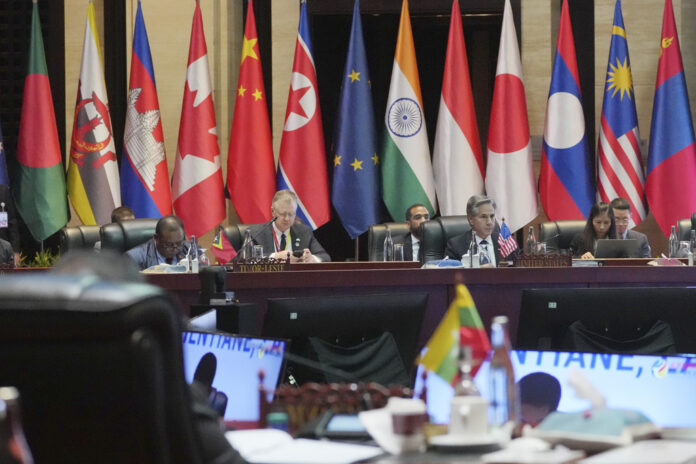
U.S. Secretary of State Antony Blinken, center, attends the ASEAN Regional Forum Ministerial Meeting in Vientiane, Laos, Saturday, July 27, 2024. (AP Photo/Achmad Ibrahim, Pool)
JINTAMAS SAKSORNCHAI, VIENTIANE, Laos — Southeast Asian top diplomats on Saturday condemned violence in Myanmar’s ongoing civil war and urged for “practical” means to defuse rising tensions in the South China Sea during the last of the three-day regional talks with allies including the U.S., Russia and China.
Foreign Minister Saleumxay Kommasith of Laos, which currently chairs the Association of Southeast Asian Nations (ASEAN), hailed dialogue partners for “frank, candid and constructive exchanges” on key issues revolving around regional security.
The weekend talks in the Laotian capital were dominated by the increasingly violent and destabilizing civil war in ASEAN-member Myanmar as well as maritime disputes of some of the bloc members with China, which have led to direct confrontations that many worry could lead to broader conflict.
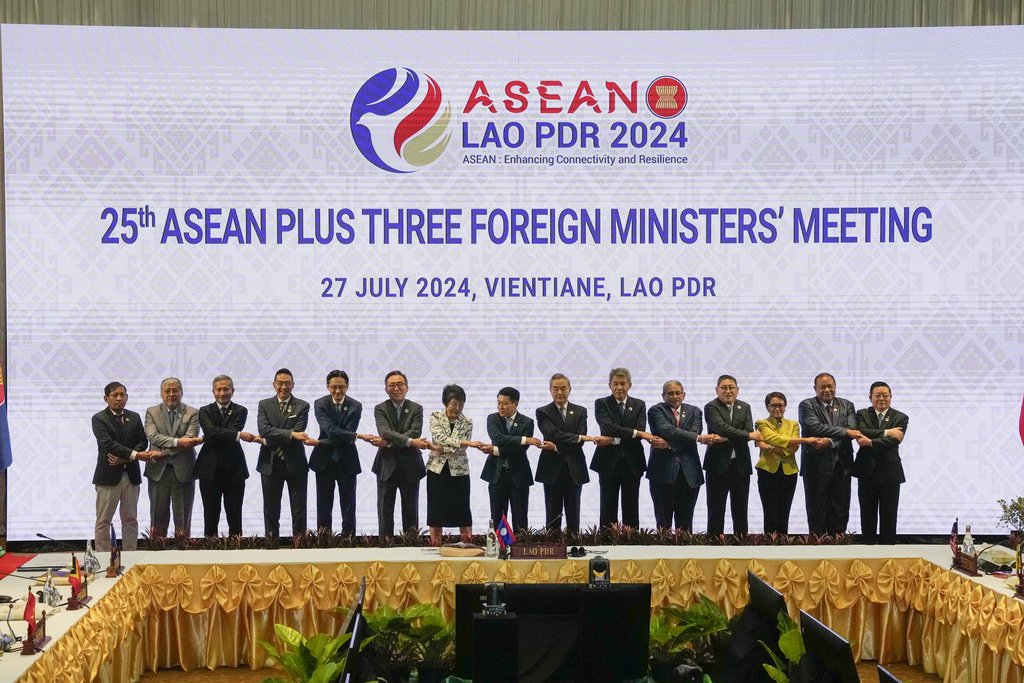
A group photo at the 25th ASEAN Plus Three Foreign Ministers session of the Association of Southeast Asian Nations (ASEAN) Foreign Ministers’ Meeting in Vientiane, Laos, Saturday, July 27, 2024. (AP Photo/Sakchai Lalit)
In a joint statement issued at the end of the talks, the bloc said there’s an urgent need to address the humanitarian crisis in Myanmar, and called for “all relevant parties in Myanmar to ensure the safe and transparent delivery of humanitarian assistance, to the people in Myanmar without discrimination.”
“We strongly condemned the continued acts of violence against civilians and public facilities and called for immediate cessation, and urged all parties involved to take concrete action to immediately halt indiscriminate violence,” it said.
The army in Myanmar ousted the elected government of Aung San Suu Kyi in February 2021 and suppressed widespread nonviolent protests that sought a return to democratic rule, leading to increasing violence and a humanitarian crisis.
Thailand, which shares long borders with Myanmar, said it was given ASEAN backing to play a wider role there, including in providing humanitarian assistance in which it’s already heavily involved. It also said more peace talks have been proposed to include additional stakeholders, especially Myanmar’s neighbors Thailand, China and India.
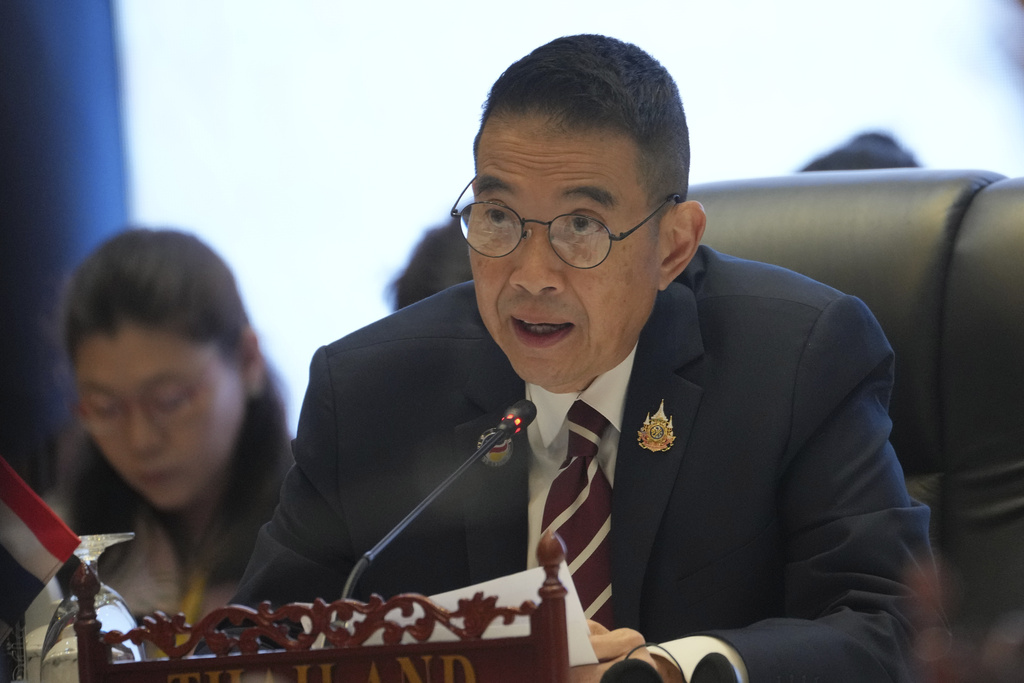
Thailand’s Foreign Minister Maris Sangiampongsa speaks during the ASEAN Post Ministerial Conference with Japan at the Association of Southeast Asian Nations (ASEAN) Foreign Ministers’ Meeting in Vientiane, Laos, Friday, July 26, 2024. (AP Photo/Achmad Ibrahim)
More than 5,400 people have been killed in the fighting in Myanmar and the military government has arrested more than 27,000 since the coup, according to the Assistance Association for Political Prisoners. There are now more than 3 million displaced people in the country, with the numbers growing daily as fighting intensifies between the military and Myanmar’s multiple ethnic militias as well as the so-called people’s defense forces of military opponents.
ASEAN has been pushing a “five-point consensus” for peace, but the military leadership in Myanmar has so far ignored the plan, raising questions about the bloc’s efficiency and credibility. The peace plan calls for the immediate cessation of violence in Myanmar, a dialogue among all concerned parties, mediation by an ASEAN special envoy, provision of humanitarian aid through ASEAN channels, and a visit to Myanmar by the special envoy to meet all concerned parties.
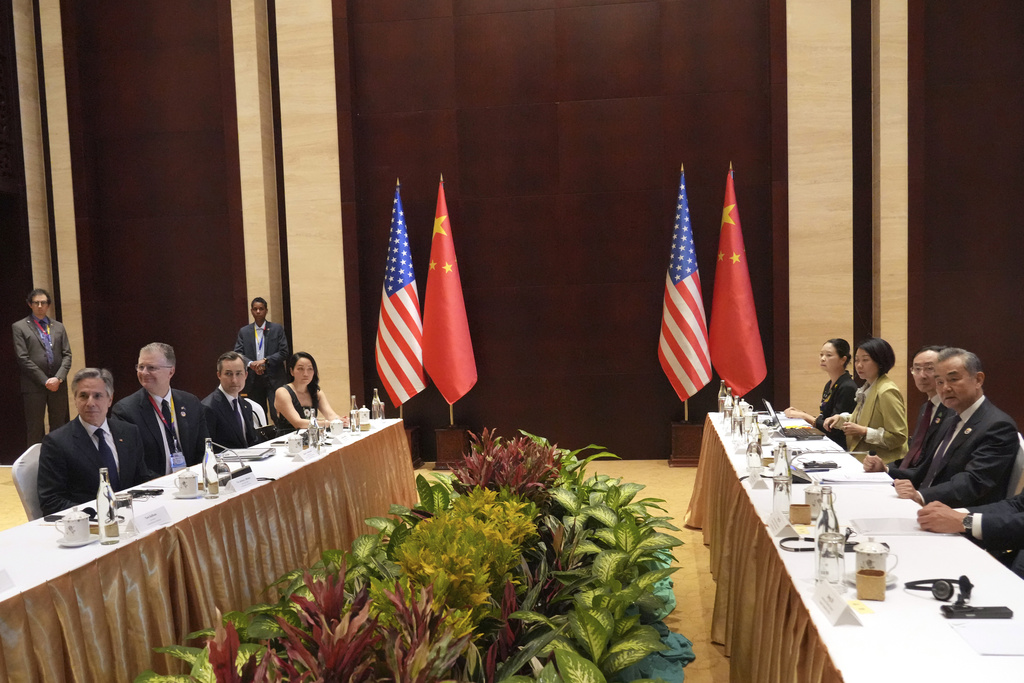
The meetings also served to highlight rivalries in the region as the U.S. and China look to expand their influence there. U.S. Secretary of State Antony Blinken met his Chinese counterpart Wang Yi in Vientiane on Saturday after Russian Foreign Minister Sergey Lavrov held direct talks with Wang on Thursday. Washington’s two biggest rivals, Moscow and Beijing, which have grown closer over the past two years, prompting deep concerns about their combined global influence.
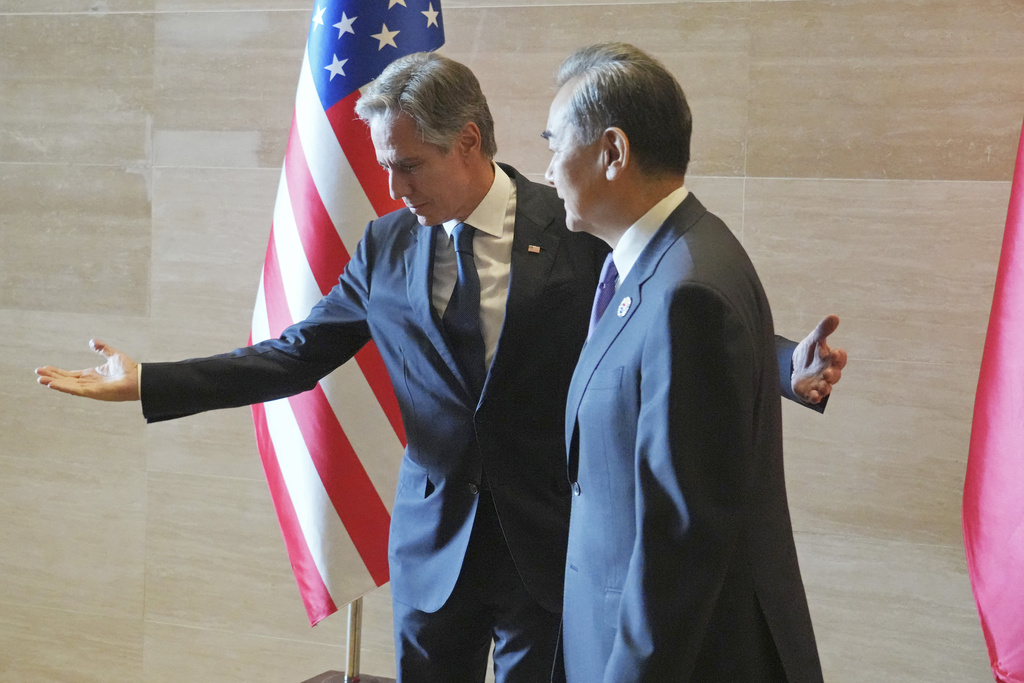
U.S. Secretary of State Antony Blinken, left, gestures to Chinese counterpart Wang Yi on the sideline of the Association of Southeast Asian Nations (ASEAN) Foreign Ministers’ Meeting in Vientiane, Laos, Saturday, July 27, 2024. (AP Photo/Achmad Ibrahim, Pool)
Regarding tensions in the South China Sea, ASEAN said it maintains its position on the freedom of navigation over the sea and urged a full implementation of a South China Sea code of conduct, which the bloc has been working on with China for some time.
ASEAN members Vietnam, the Philippines, Malaysia and Brunei all have conflicts with China over its claim of sovereignty over virtually all of the South China Sea, one of the world’s most crucial waterways for shipping. Indonesia has also expressed concern about what it sees as Beijing’s encroachment on its exclusive economic zone.
ASEAN foreign ministers also welcomed “practical measures that could reduce tensions and the risk of accidents, misunderstandings, and miscalculation,” in an apparent reference to a rare deal between the Philippines and China that aims to end their confrontations, establish a mutually acceptable arrangement for the disputed area without conceding each other’s territorial claims.
U.S. Secretary of State Antony Blinken, left, and Chinese counterpart Wang Yi, right, hold a talk on the sideline of the Association of Southeast Asian Nations (ASEAN) Foreign Ministers’ Meeting in Vientiane, Laos, Saturday, July 27, 2024. (AP Photo/Achmad Ibrahim, Pool)
Prior to the deal, tensions between the Philippines and China escalated for months, with China’s coast guard and other forces using powerful water cannons and dangerous blocking maneuvers to prevent food and other supplies from reaching Filipino navy personnel.
On Saturday, the Philippines said it was able to make a supply trip to the disputed area without having to confront Beijing’s forces, the first such trip since the deal was reached a week ago. Blinken applauded it as a success in his opening remarks at the meeting with ASEAN foreign ministers, while calling China’s past actions against the Philippines — a U.S. treaty partner — “escalatory and unlawful.”
The United States and its allies have regularly conducted military exercises and patrols in the area to assert their “free and open Indo-Pacific” policy — including the right to navigate in international waters — which has drawn criticism from China.
Wang said in his meeting with Philippines Secretary of Foreign Affairs Enrique Manalo on Friday that the deployment of a U.S. intermediate-range missile system in the Philippines would create regional tension and trigger an arms race, according to a statement from the Chinese Foreign Ministry.
___
Associated Press journalist Ken Moritsugu in Beijing contributed to this report.