MAE HONG SON — Health officials have begun urine testing for arsenic exposure among residents living along the Salween River in Mae Hong Son province after concerns over contamination in the waterway.
The health screening follows growing concern over arsenic contamination in the Salween River after researchers from Chiang Mai University reported in late 2025 that arsenic levels in parts of the river were as much as five times higher than Thai safety standards.
Authorities later expanded monitoring across Mae Hong Son province, with the Pollution Control Department finding arsenic contamination above standards at all 13 sampling points tested along the river.
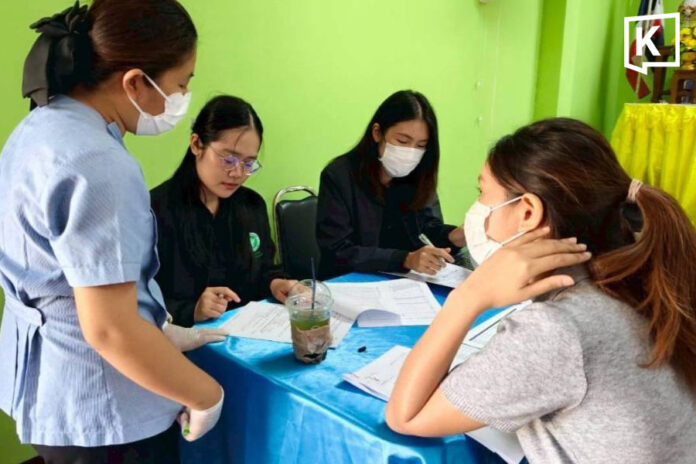
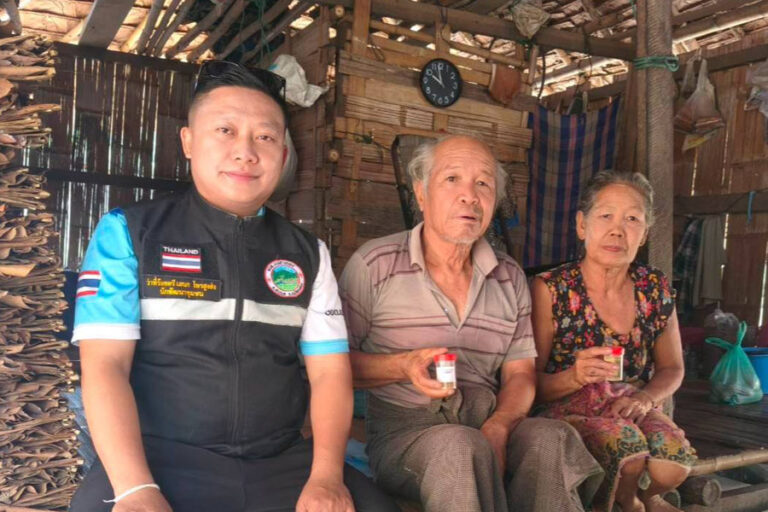
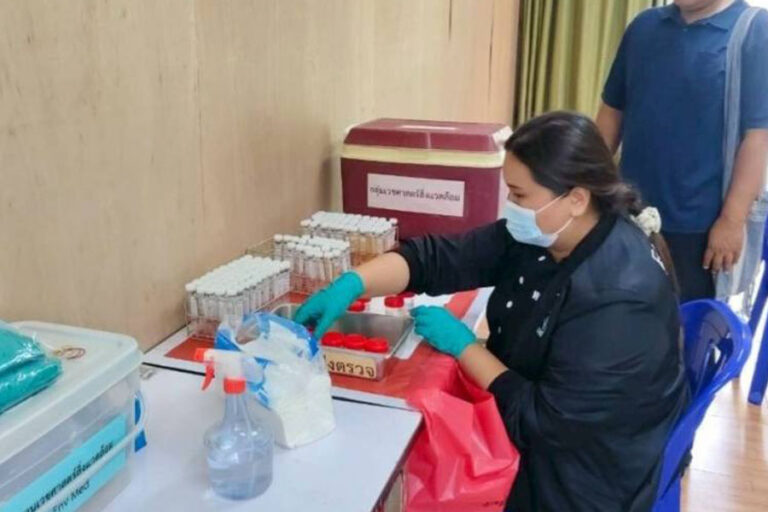
Officials from the Department of Disease Control, together with local public health offices and hospitals, conducted urine tests on residents of Sob Moei and Mae Sariang districts bordering the Salween River on 6 May to screen for potential health risks linked to arsenic contamination.
Mr. Phongphipat Meebenjamat, chief executive of the Mae Sam Laep Subdistrict Administrative Organisation in Sob Moei District, said agencies involved included the Office of Disease Prevention and Control Region 1 in Chiang Mai, the Department of Disease Control’s occupational and environmental disease divisions, Sob Moei Hospital, local health promotion hospitals, the Mae Sam Laep local administration, and Salween River monitoring volunteers.
The screening operation was carried out at the Salween Building of the Mae Sam Laep Subdistrict Administrative Organisation and focused on residents from Ban Tha Ta Fang, Ban Mae Sam Laep, and Ban Sob Moei villages.
Officials collected medical histories and urine samples from 99 residents, which will be analysed in a laboratory. However, due to budget limitations and the high cost of testing, authorities said they were unable to screen all villagers in the affected communities.
Test results are expected within three months.
Mr. Phongphipat said residents in both Mae Sariang District and Sob Moei District, who have long relied on the Salween River for daily use and consumption, remain deeply concerned about contamination in the river and its psychological impact on local communities.
Environmental researchers have increasingly warned that unregulated mining activity in Myanmar’s border regions is affecting major river systems flowing into Thailand, raising concerns about long-term health risks for communities dependent on rivers for drinking water, fishing, and agriculture.
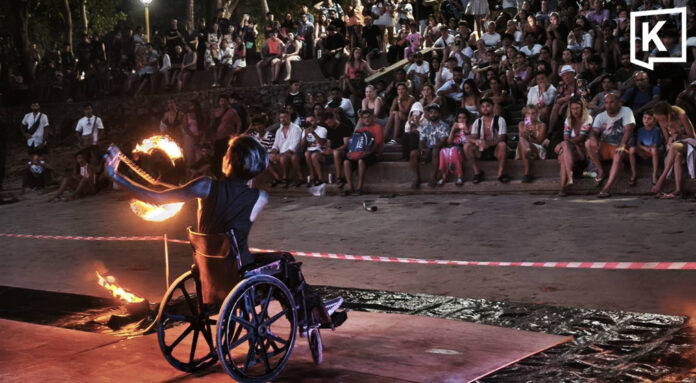
KRABI — 6 May 2026, Tourists flocked to Ao Nang beach on Phi Phi island in Krabi after authorities relaxed restrictions on fire-twirling performances along the shoreline.
The atmosphere at Ao Nang beach became lively again after the Protected Area Committee (PAC) approved the return of fire shows under strict regulations.
Large numbers of Thai and foreign tourists gathered along the beachfront from dusk to watch the performances. Flames spun skilfully through the air drew loud applause and excitement from crowds lining the beach, helping revive the local night-time economy and tourism sector.
The performances had previously been banned by Hat Noppharat Thara-Mu Ko Phi Phi National Park because they were deemed illegal.
One of the most popular performance spots featured a disabled local performer and his team. Sarawut Bilmat, also known as “Nong Bao”, expressed his gratitude to Krabi provincial authorities, national park officials, the PAC and the provincial Social Development and Human Security Office for helping restore the performances.
“We can clearly see tonight that Ao Nang beach has come back to life after being quiet for some time without the fire shows,” he said.
Sarawut said his team would perform for around 40 minutes each evening, approximately from 18:40 to 19:20, before cleaning the area in accordance with national park regulations.
The easing of restrictions followed discussions between local operators and Hat Noppharat Thara-Mu Ko Phi Phi National Park to find a compromise. Authorities introduced guidelines covering zoning and designated performance areas to minimise impacts on the environment and other beachgoers.
All performers must register with the national park authorities and comply with safety measures, including the use of protective equipment and precautions to prevent sparks or oil stains from contaminating the sand.
The return of the fire shows is seen as restoring livelihoods for local performers, including the disabled entertainer, while also strengthening Krabi’s tourism image through cultural “soft power” attractions.
A British woman has vanished after allegedly leaving a rented condominium in Chiang Mai filled with rubbish and severe damage, with repair costs estimated at 500,000 baht ($15,500).
The incident was reported to police on 6 May by Chantanee Wiwechawin, 41, a housekeeper responsible for overseeing a condominium in Suthep subdistrict, Muang district, Chiang Mai.
She told investigators that the British tenant, believed to be around 35 years old, had signed a six-month lease for the unit at 25,000 baht ($780) per month, beginning on 16 October 2025.
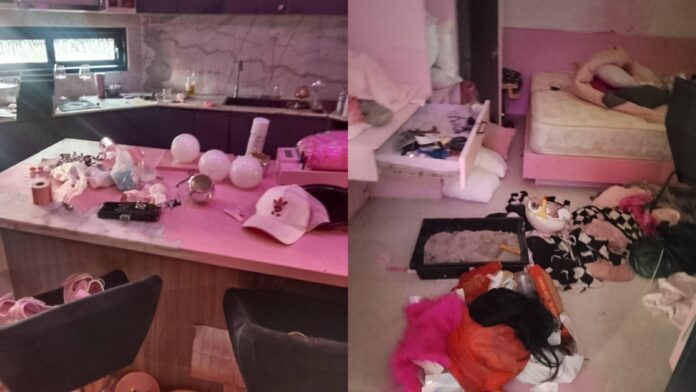
According to Chantanee, suspicions arose in March after a foul smell began coming from the room and the tenant could no longer be contacted. Using a spare key, she entered the condominium and was shocked by what she found.
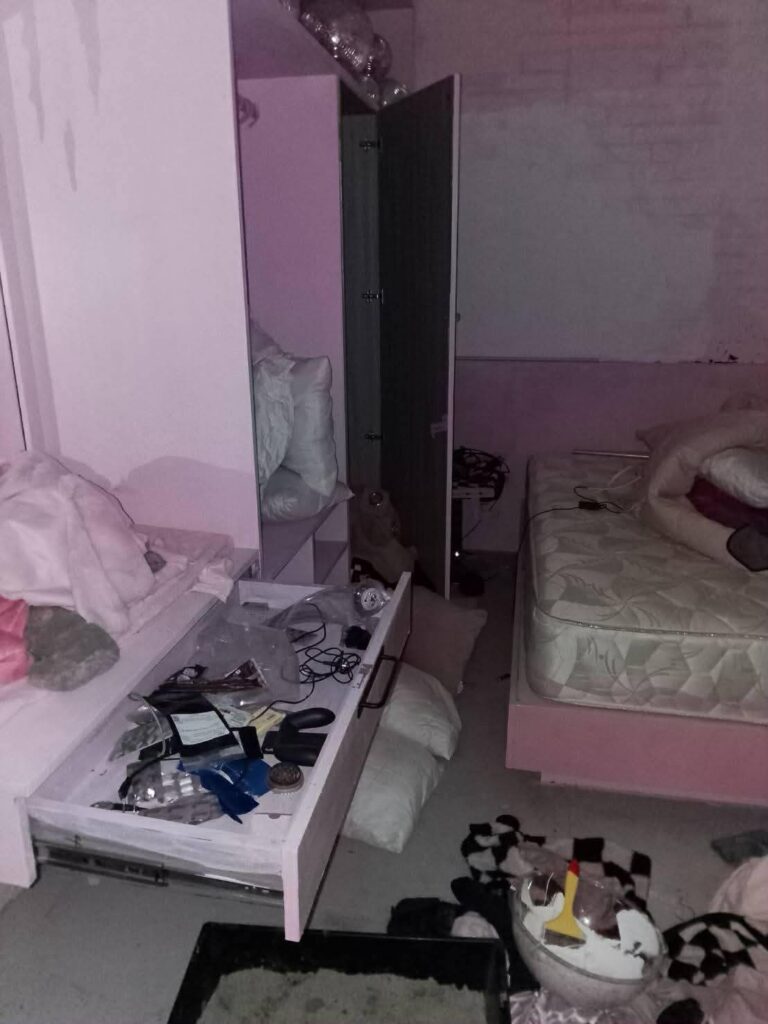
The room was reportedly strewn with garbage, rotting waste, underwear and clothes. Paint had also been smeared across the walls.
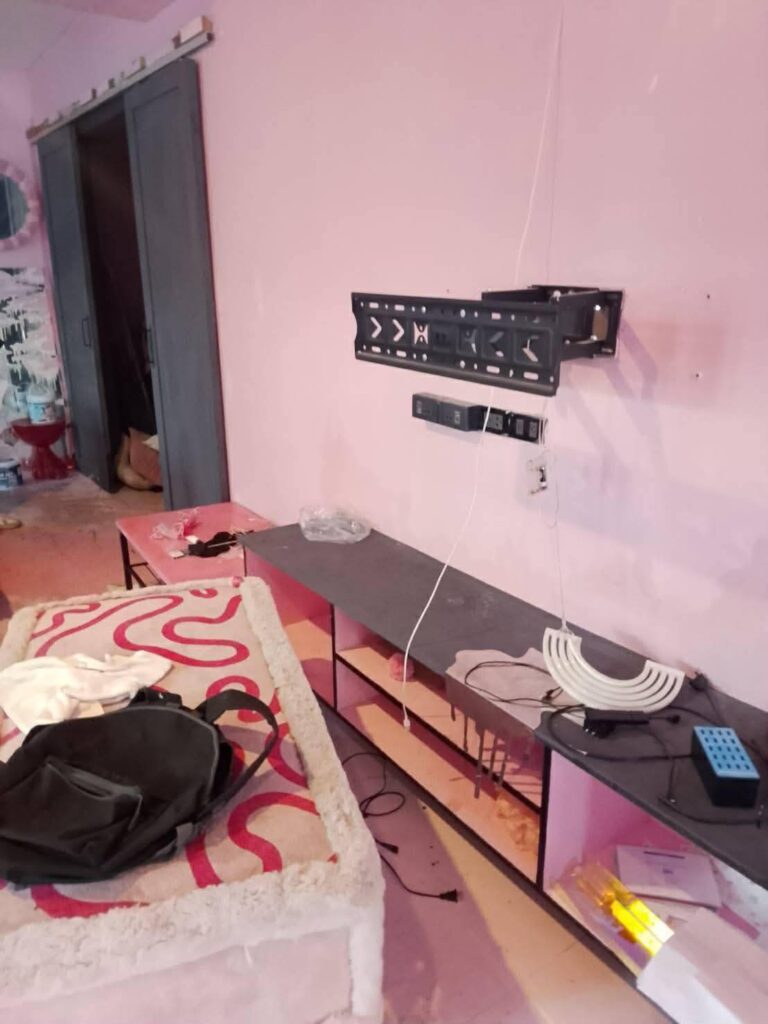
Furniture including the bed and sofa was found damaged, dirty and deteriorated, while the overall condition of the room was described as severely damaged.
A technician later inspected the property and estimated restoration costs could reach around 500,000 baht. A television set was also reported missing and is believed to have been stolen.
Chantanee said she wanted to warn condominium owners and landlords to regularly inspect rental properties, particularly those rented to foreign tourists.
“In the past, we mostly saw news about Thai tenants causing problems and leaving rooms dirty, but this time it was a foreigner. I thought she would be clean and well-mannered, but it turned out to be unbelievably filthy,” she said.
Police at Phu Ping Rajanives station are reportedly preparing to summon the tenant for questioning and to seek compensation for the damages.
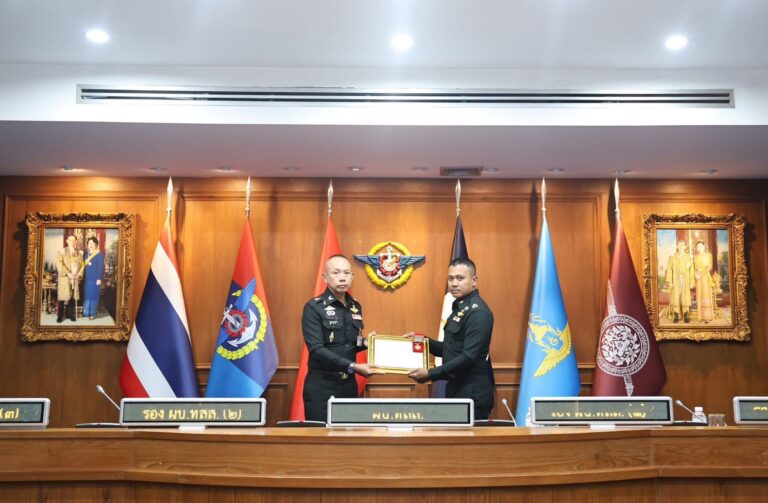
Thailand’s top military commander on Tuesday awarded “Bang Rachan” medals to four soldiers injured while carrying out missions along the Thai-Cambodian border, honouring what the military described as acts of bravery and sacrifice in defence of national sovereignty.
The ceremony took place at the Royal Thai Armed Forces Headquarters in Bangkok, where Gen. Ukrit Boontanon, The Chief of Defence Forces, presented the medals and certificates to the injured personnel.
According to the Defence Ministry, the Bang Rachan Medal is awarded to military personnel who are killed or seriously injured while performing duties related to national security, sovereignty protection and maintaining public order.
The medal takes its name from the historic Bang Rachan villagers, who are remembered in Thai history for resisting invading forces during the Ayutthaya period. The military said the award symbolises courage, sacrifice and loyalty to the nation.
The round medal features the emblems of Thailand’s three armed services on the front alongside the word “Bang Rachan”, while the reverse bears the inscription: “Honouring those who perform duties for the nation.”
Military officials said the award represents one of the Defence Ministry’s highest honours for personnel wounded in the line of duty.
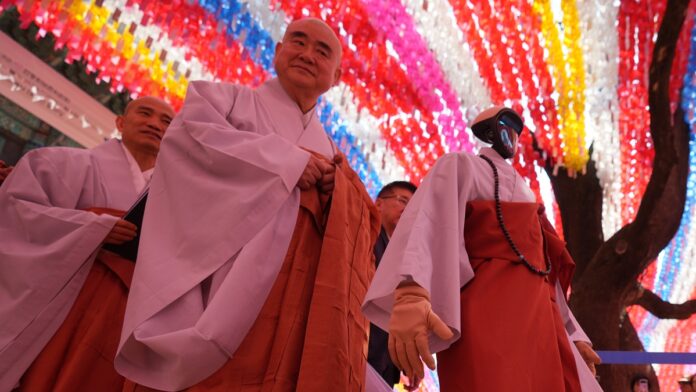
A humanoid robot, center, and Buddhist monks walk during an ordination ceremony ahead of upcoming Buddha's birthday on May 24 at Jogye temple in Seoul, South Korea, Wednesday, May 6, 2026. (AP Photo/Lee Jin-man)
SEOUL, South Korea — A South Korean Buddhist temple has ordained a humanoid robot as a lay Buddhist follower in a ceremony blending centuries-old religious traditions with artificial intelligence technology, according to Korean local media reports.
The ceremony took place on Wednesday at Jogye Temple in central Seoul under the Jogye Order of Korean Buddhism. The 130-centimetre-tall humanoid robot, known as G1, received the Dharma name “Gabi” during the ordination ritual, or sugye, ahead of Buddha’s Birthday celebrations on 24 May.
Although both monks and ordinary Buddhists can receive Buddhist precepts, Gabi was ordained as a lay follower rather than a fully ordained monk. However, the robot is expected to take on the symbolic role of an “honorary” monk during the upcoming festive season.
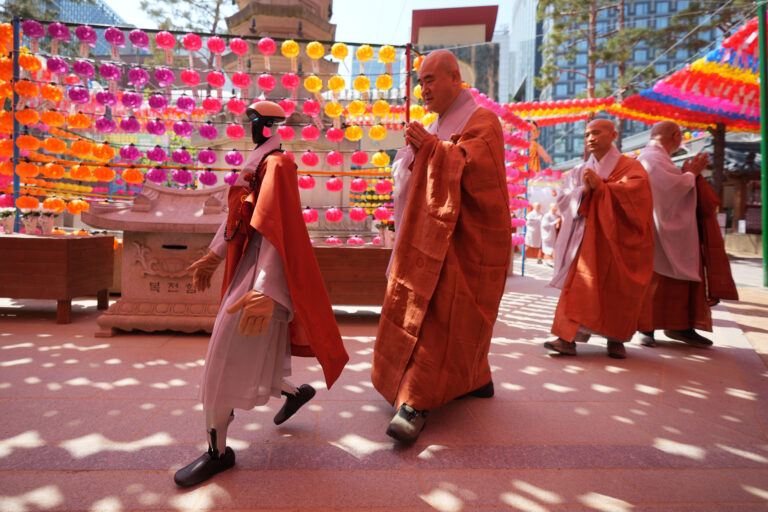
A humanoid robot, left, and Buddhist monks pass around a pagoda during an ordination ceremony ahead of upcoming Buddha’s birthday on May 24 at Jogye temple in Seoul, South Korea, Wednesday, May 6, 2026. (AP Photo/Lee Jin-man)
Dressed in Buddhist robes and wearing a helmet designed to resemble a shaved monk’s head, Gabi stood before senior monks with its palms pressed together while participating in ceremonial rites.
Instead of the traditional incense-burning purification ritual performed on humans, monks attached a lotus lantern festival sticker to the robot’s arm and placed a 108-bead Buddhist prayer necklace around its neck.
According to Korean media, the Jogye Order also created a special version of Buddhism’s Five Precepts tailored for robots. The revised rules included instructions not to harm life, damage other robots or objects, deceive humans or overcharge batteries.
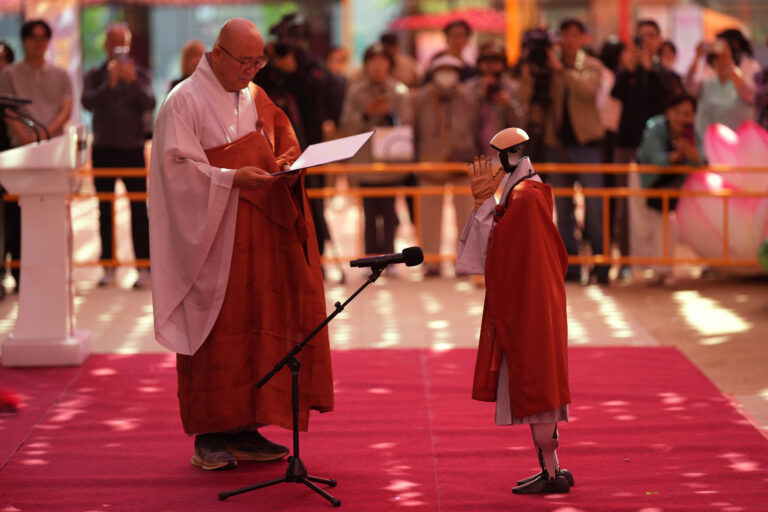
A humanoid robot attends an ordination ceremony ahead of upcoming Buddha’s birthday on May 24 at Jogye temple in Seoul, South Korea, Wednesday, May 6, 2026. (AP Photo/Lee Jin-man)
When asked during the ceremony whether it would devote itself to the Buddha, Gabi replied: “Yes, I will devote myself.”
The Jogye Order described the event as a symbol of how technology should be guided by compassion, wisdom and responsibility while promoting harmony between humans and machines.
Gabi is also expected to participate in Seoul’s annual Lotus Lantern Festival on 16 May alongside several other robots as part of Buddha’s Birthday celebrations.
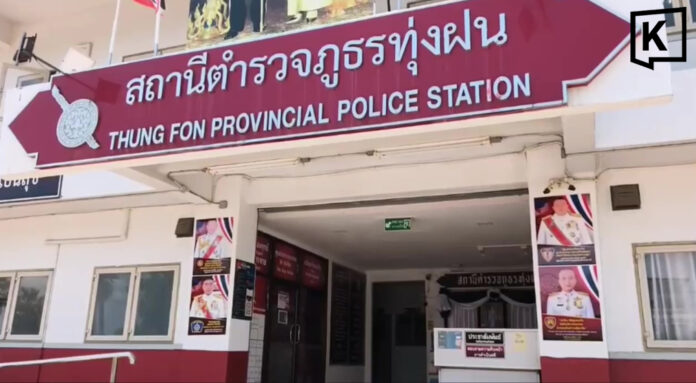
THUNG FON — 6 May 2026, A 17-year-old boy has been accused of firing gunshots outside a rival’s home in northeastern Thailand, in an apparent escalation of a feud dating back more than three years, police said.
The incident occurred at about in Ban Tha Chuang village, Kut Kha subdistrict, Thung Fon district, Udon Thani province.
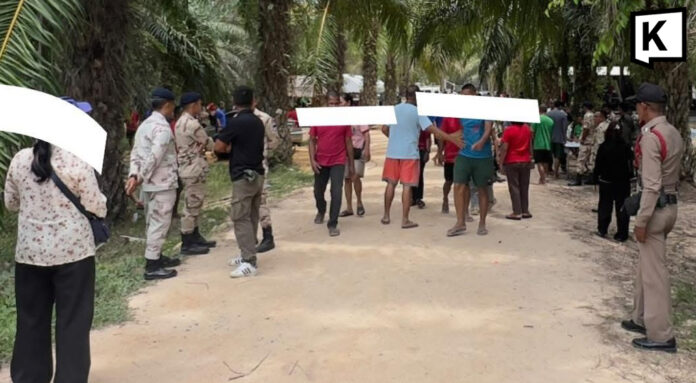
CCTV footage showed two teenage males arriving on a motorcycle before gunshots were heard and shouting broke out directed at people inside a house. The suspects then fled the scene, alarming nearby residents.
No injuries or deaths were reported.
Victims, identified as “Nawin”, 17, and “No”, 19, later filed a complaint with Thung Fon police at 10:30 the same day, accompanied by their guardians, urging authorities to take legal action.
Officers who inspected the scene found a spent 20-gauge shotgun shell, believed to have been fired from a homemade weapon.
According to witness accounts, the suspects stopped outside the house, shouted challenges for the occupants to come out, and when no one responded, opened fire. They allegedly fired multiple rounds at several houses before returning to the original location to shoot again.
Police said the attack stemmed from a long-running dispute between local youth groups that began more than three years ago after a fight at a traditional molam performance.
Pol. Col. Atirot Thajang, chief of Thung Fon police station, said investigators have identified the suspects as local youths, including two 17-year-olds known as “Jele” and “Dido”, who already have records with authorities.
Police are seeking warrants and working to apprehend those involved.
“We know who they are. People who create danger like this cannot be allowed to remain at large,” Atirot said. “Thung Fon must be safe, and those responsible will face the full extent of the law.”
Thailand’s Board of Investment (BOI) has approved six major investment projects worth a combined 958 billion baht ($29.9 billion), with TikTok accounting for the largest share through a massive data infrastructure expansion project.
BOI Secretary-General Narit Therdsteerasukdi said on 6 May that the board approved three data centre and data hosting projects worth a combined 913.8 billion baht ($28.6 billion), reflecting continued investor confidence in Thailand’s digital economy ambitions.
The largest project belongs to TikTok Systems (Thailand) Co., Ltd., which plans to invest 842.35 billion baht ($26.3 billion) in Bangkok, Samut Prakan and Chachoengsao provinces.
The project will expand server installations to strengthen Thailand’s role as a strategic regional hub for data storage and processing, supporting growing demand from users across the region.
The BOI said TikTok will also develop digital literacy and e-commerce training programmes aimed at creating new business opportunities for Thai entrepreneurs and improving the country’s digital workforce.
Other approved digital infrastructure projects include a 46.9 billion baht ($1.46 billion) investment by Skyline Data Center and Cloud Services, part of the UAE-based DAMAC Group, in Chachoengsao province. The facility will support an IT load capacity of 200 megawatts.
Bridge Data Centres IIO (Thailand) Co., Ltd. also received approval for a 24.6 billion baht ($769 million) data centre project in Chonburi province with an IT load capacity of 134 megawatts.
Beyond the digital sector, the BOI approved projects in recycled plastics, wind power and potassium chloride production.
Narit said Thailand continued attracting strong investment interest in digital and high-technology industries despite global economic uncertainty, reinforcing the country’s ambitions to become a regional tech hub.
He added that the BOI was working with partner agencies to improve infrastructure, electricity systems and clean energy mechanisms while accelerating investment approvals through the Thailand FastPass programme.
NAKHON SI THAMMARAT — 6 May 2026, Chaos broke out at a drug rehabilitation centre in southern Thailand on Wednesday morning when hundreds of patients attempted to flee, prompting a large-scale response from police and local officials.
Authorities were alerted at about to unrest at the facility in Moo 3, Kaew Saen subdistrict, Nakhon Si Thammarat province. Officers from multiple agencies were deployed to the scene.
Initial reports said around 500 people undergoing treatment tried to escape. Police and officials spread out to track those who fled, while senior officers, including regional police commanders, travelled to the centre to oversee operations.
No injuries or property damage were immediately reported.
Police said they were working to restore order and urged residents to report any suspicious individuals.
By 13:00, district chief Weeraphan Sukawal said the situation had returned to normal. Most of those who left the facility had been located and brought back, while about 30 had returned home safely with relatives.
Officials said the incident appeared to have been triggered by a group of around 10 patients who had been undergoing treatment for nearly a year. The centre had previously contacted their families to arrange their return home, but relatives had not responded.
Authorities believe the group, under stress and wanting to leave, took advantage of a power outage in the morning to force open a door and initiate the escape. Others followed once the exit was opened.
Officials said there was no violence or damage, and the incident was likely driven by stress among those undergoing treatment.
The rehabilitation centre is expected to be temporarily closed while authorities review the situation.
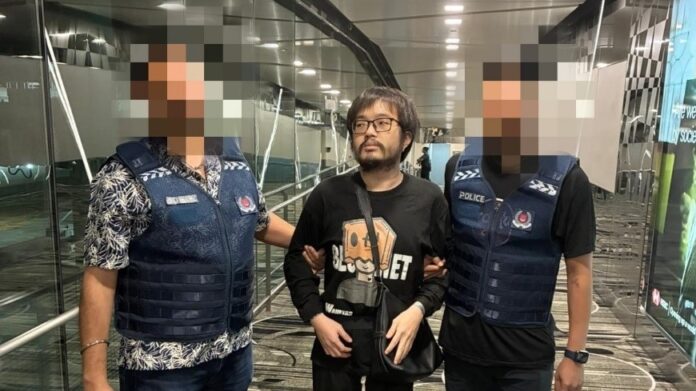
A 30-year-old Singaporean man accused of involvement in a Cambodia-based organised scam syndicate targeting victims in Singapore has been arrested in Phnom Penh and returned to Singapore, authorities said.
The Singapore Police Force (SPF) said Ngiam Siow Jui was arrested by the Cambodian National Police (CNP) in Phnom Penh following close cooperation and intelligence sharing between the two agencies.
Ngiam was among 34 suspects earlier sought by Singaporean authorities in connection with investigations into an organised criminal group allegedly operating from Cambodia.
He was repatriated to Singapore on 4 May and arrested upon arrival. Authorities said he will be charged in court on 6 May with facilitating the commission of a serious offence in furtherance of the illegal purpose of a locally linked organised criminal group under Singapore’s Organised Crime Act 2015.
If convicted, he faces up to five years’ imprisonment, a fine of up to S$100,000, or both.
According to the SPF, the syndicate is believed to be linked to at least 535 reported scam cases involving losses of around S$53 million.
The group allegedly operated from a scam compound in Phnom Penh that was disrupted during a joint operation by Singaporean and Cambodian police on 9 September 2025.
Singaporean authorities said they had previously seized assets linked to the syndicate and issued prohibition of disposal orders as part of ongoing investigations.
The SPF also announced that additional INTERPOL Red Notices were issued on 25 March against two other Singaporean men believed to be members of the syndicate.
The two suspects — Jonathan Boneta, 27, and Lee Ding Hao, 33 — are believed to be outside Singapore and remain at large.
The SPF said it would continue working closely with foreign law enforcement agencies to track down suspects involved in scams targeting victims in Singapore.
It is a rare rainy day in Bangkok’s dry season. The wet smell of petrichor rises off the asphalt as I stride down an alley off Sukhumvit from Nana station. In that moment, it feels like a place locals would rarely desire to patron.
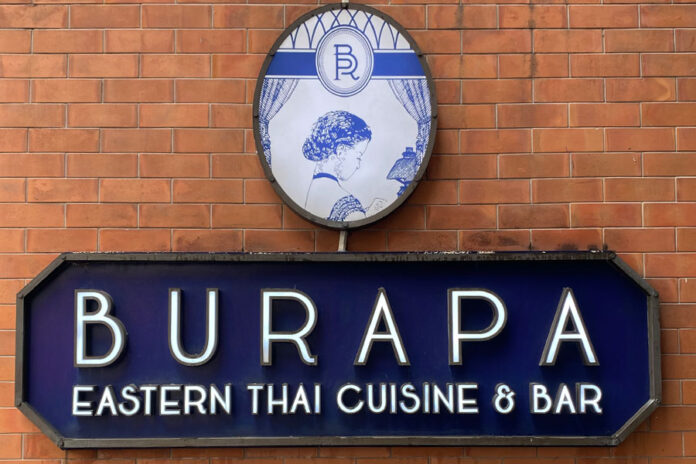
Today is different. I am here to visit an esteemed Eastern Thai restaurant that I have read much about, but have yet to try: Burapa. I have come to sample its new lunch menu at the invitation of a friend.
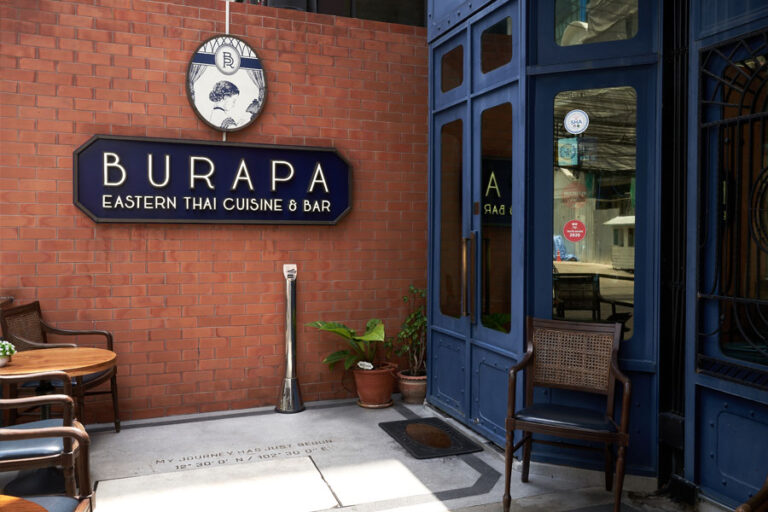
‘My Journey Has Just Begun’ above the coordinates of Ack’s hometown are subtly printed into the concrete below the sign.
Unlike many of the businesses along this alley which seem to cater more to one-time tourists than repeat visitors, Burapa stands out as an inspired icon amid a slurry of forgettable fluff. The restaurant, like much of Eastern Thai cuisine, is tucked away in an area that I would not normally visit without good reason. Located on the corner of Soi 11 in the heart of Bangkok, it could easily be missed amongst the hustle and bustle—but today I approach with anticipation.
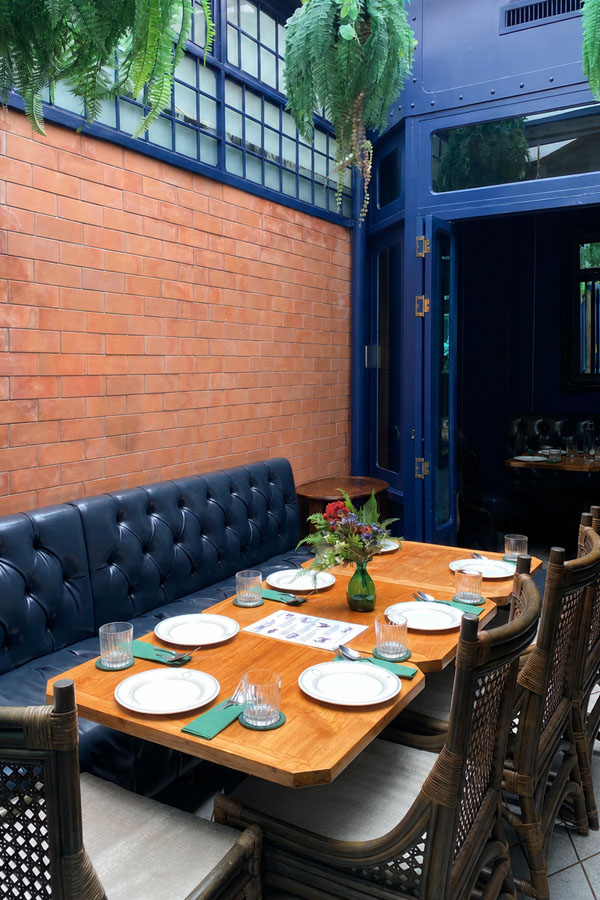
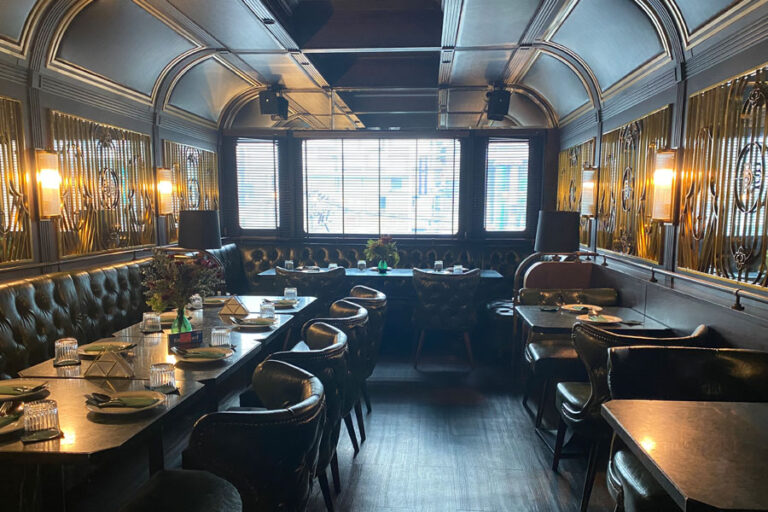
A restaurant greets you before you walk in the door. This time it is not staff, but a friend that waves me in. As soon as I enter, I feel the warmth of Burapa. A reprieve from a rainy day, the foyer feels lived-in, and the naturally bright lunchroom immediately shines. Before I sit down it already feels like an excellent place for lunch.
The bottom floor of Burapa offers a sharp bright mood for lunchtime diners.
Like most visitors to Thailand, I do not know what to expect from Eastern Thai cuisine, but I am curious. I have tasted the strong fermented flavours of the northeast, experienced the sugar-laden dishes of Bangkok, and been overwhelmed by the intense spices of the south. Eastern Thai, as I am told, balances in-between all of those, forming something distinct.
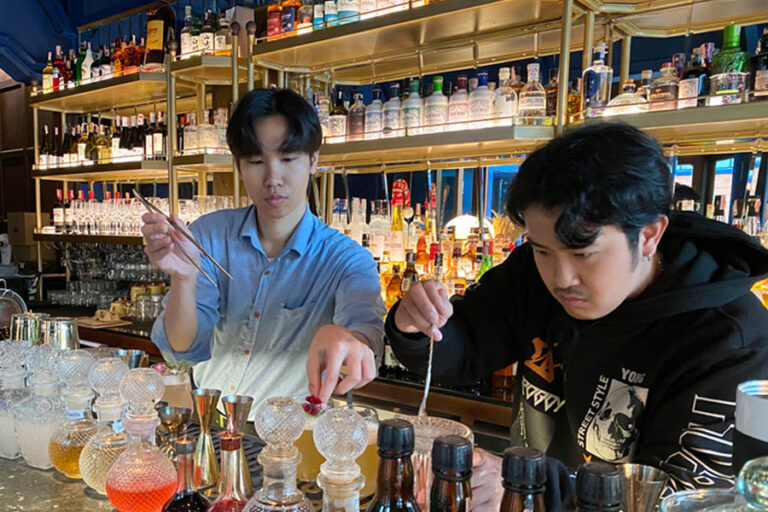
Before I eat, I am introduced to the long teak bar, where house-made fruit syrups in glass vessels line the counter. Without saying anything, I watch the staff work. It is immediately clear that they are well-trained, attentive, and experienced. If not for the menu ahead, I could have spent the hour here simply appreciating their focused process.
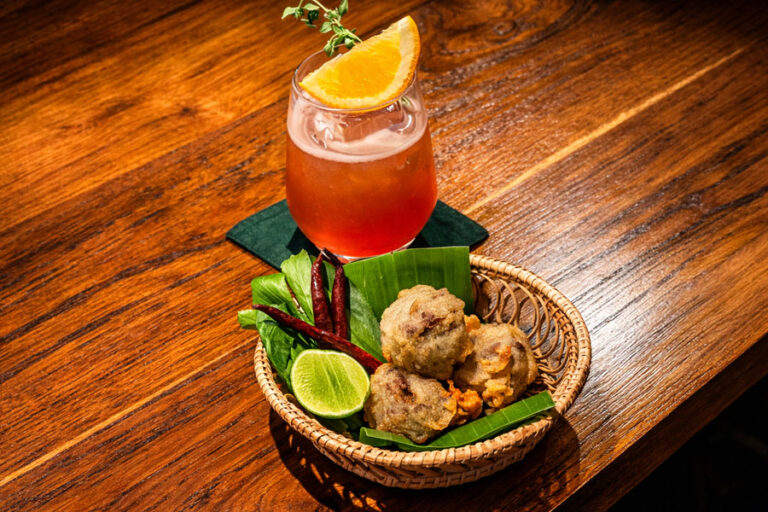
My drink, like the staff and décor, did not disappoint. It is a balanced, slightly sweet cocktail made with Bussaba, a beer from Full Moon Brewworks. It is garnished with an orange slice, which I happily indulge in. It is fruity, aromatic, and effortlessly enjoyable. I would recommend it to anyone except those who prefer only the most bitter beverages. The snack pairing was equally well executed: elegant in texture and light. Some restaurants treat bar snacks as afterthoughts, but at Burapa even these elements are carefully considered.
A cocktail and snack pairing, priced at 380 baht, has been introduced alongside Burapa’s new lunch menu.
A whole table of options are brought before me, some new and some familiar. I try everything I can while maintaining my manners. Unlike western restaurants, where dishes are typically prepared for individuals, in true Thai fashion we share many dishes among the table.
There are too many items for me to list them all, but here are a few notable ones before I share my favourite:
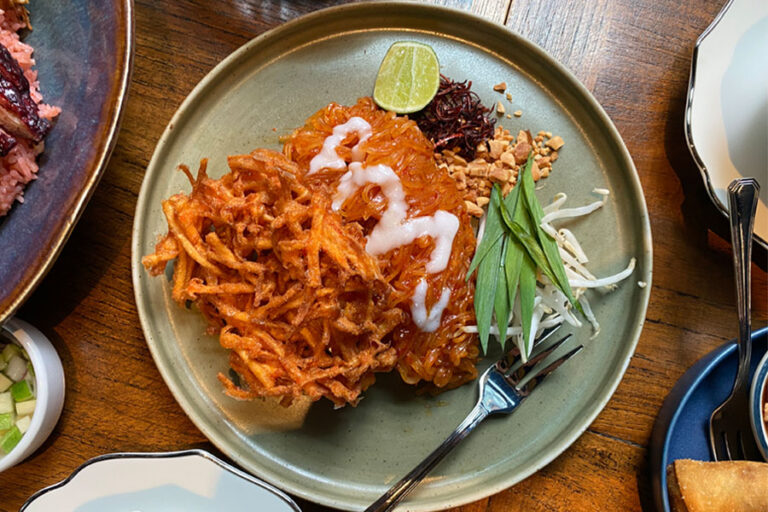
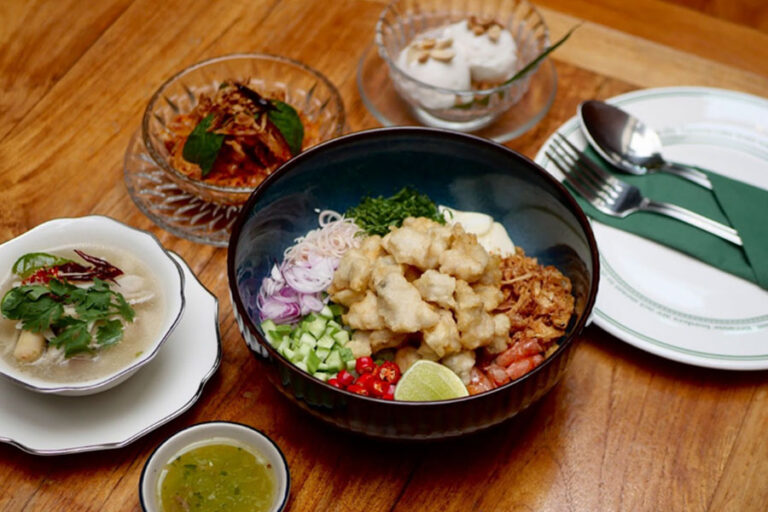
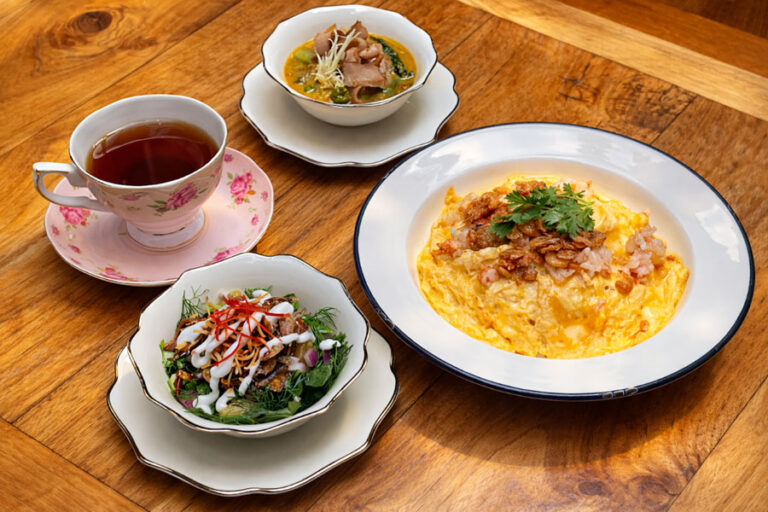
Trat’s pad thai with grilled giant tiger prawn, paired with crispy lemongrass fried chicken wings—ideal for those seeking an elevated version of the dish. Lunch menu items start at 550 baht, with some extra options if you’re in the mood for more.Rice topped with fried seabass and assorted condiments, served with Siamese cardamom chicken soup and pickled papaya salad. There is also a vegetarian version available starting at 530 baht.Shrimp creamy omelette over rice, served with pork jowl rawang curry and minnow fish salad.
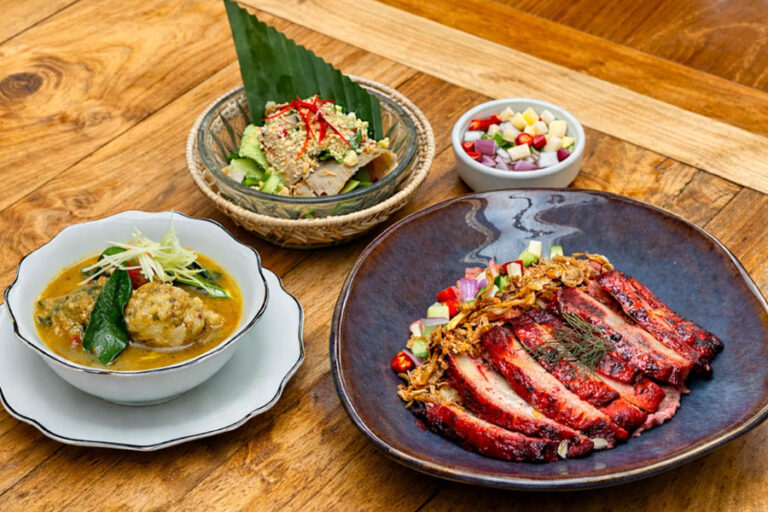
My dish of the day, however, is the grilled red chicken, followed closely by the rawang curry. The meat is wonderfully tender and disappears quickly from my plate. The curry was soothing and warm, with a finely tuned flavour profile. The salad is a thoughtful accompaniment.
Railway fried rice with grilled red chicken, accompanied by chicken rawang curry and grilled pork jowl cucumber salad—the writer’s top recommendation.
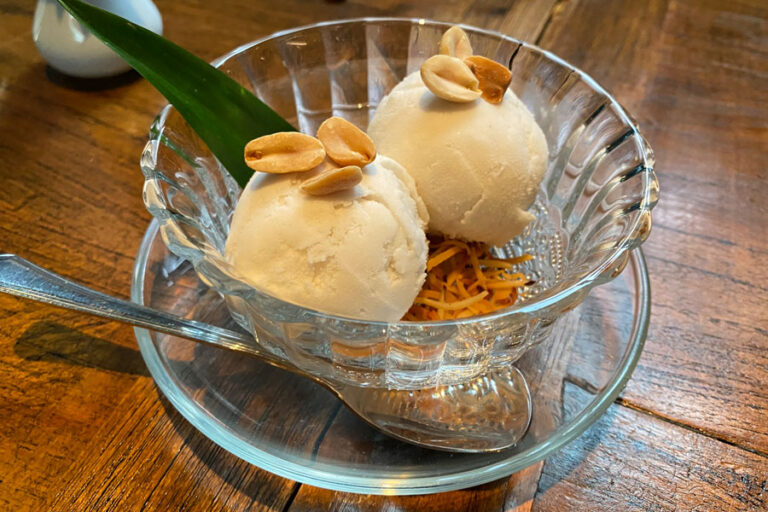
Stuffed from such a large sampling, we still, of course, made room for dessert. The most memorable to me is the salted coconut ice cream, but this one is not for those with a sweet tooth. The sweetness is subtle, while the salt cuts through. The toasted coconut underneath offers a light crunch that constrasts against the smooth, creamy texture of the ice cream.
The homemade sea-salted ice cream with toasted ice cream was not the sweetest, but perhaps the most elegant dessert.
The notion of balance emerges again and again across the new lunch menu. There is sourness, spice, sweetness, and umami, yet none of these flavours dominate. Instead, Burapa serves a composition of flavours, ensuring that no dish is confined to a single part of the palate. After trying almost everything on offer, I can confidently say that not a single item lets me down.
Order anything on the lunch menu that appeals to you, and you should experience a refined balance of texture and flavour. I come away from Burapa feeling as though I have experienced fine dining, with the satisfaction and warmth of a home-cooked meal.
Worth the visit and worthy of return, I recommend this Eastern Thai restaurant to anyone visiting Bangkok. Whether you are new to Thai cuisine or well versed, you are likely to be impressed by some of the best food I have had the pleasure of tasting in the city.
Burapa is well worth seeking out—find the location below.