Thailand’s Special Envoy attended the funeral of the late Supreme Leader of the Islamic Republic of Iran in Tehran on 3 July, where Thailand conveyed its deepest condolences to the Iranian government and people over their profound national loss, according to the Ministry of Foreign Affairs.
Parnpree Bahiddha-Nukara, Chief Advisor to the Deputy Prime Minister and Minister of Foreign Affairs, attended the funeral in his capacity as the Special Envoy of the Prime Minister. The ministry said the gesture reflected the longstanding friendship between Thailand and Iran.
During the visit, the Special Envoy also held talks with Iranian Foreign Minister Seyed Abbas Araghchi. According to the ministry, the Special Envoy expressed Thailand’s hope that the implementation of the Islamabad Memorandum of Understanding and negotiations over the coming 60-day period would lead to lasting peace while creating greater economic opportunities between Iran and the international community, including enhanced economic cooperation between Thailand and Iran.
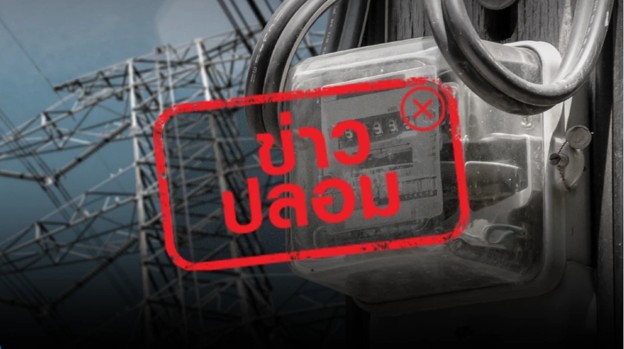
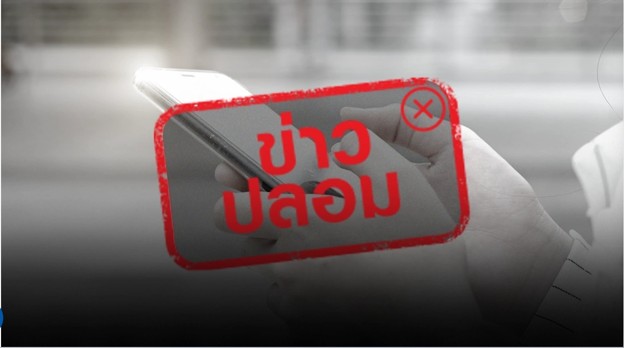
DE warns the public about fake notices claiming that PEA will disconnect electricity due to faulty meters and require meter replacement, urging people to beware of scammers attempting to trick them into making transactions or disclosing personal information.
The Ministry of Digital Economy and Society (DE), through the Anti-Fake News Center Thailand (AFNC), has released the latest results of its fake news monitoring and reporting efforts. The initiative is in line with the policy of Mr.Chaichanok Chidchob, Minister of Digital Economy and Society, to strengthen public awareness of technology-related crimes, fake news, and misinformation.
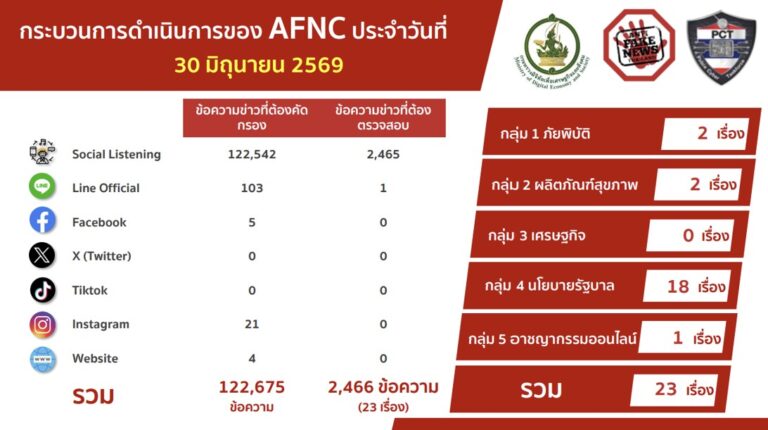
On 30 June 2026, AFNC monitored a total of 122,675 messages and identified 2,466 messages requiring verification. The largest number of reports came from Social Listening channels, accounting for 2,465 messages, followed by one report received through the AFNC Line Official account. A total of 23 issues were investigated, with verification results received from relevant agencies for 15 cases.
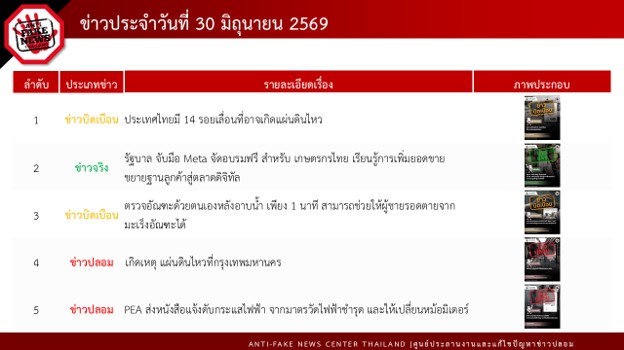
Among the eight stories that attracted the greatest public attention, one was confirmed as true, five were identified as fake news, and two were classified as misleading information. These included:
Misleading Information: Thailand has 14 active fault lines that could cause earthquakes.
Fake News: The Government and Meta are offering free training for Thai farmers to increase sales and expand into digital markets.
Misleading Information: A one-minute self-examination after a shower can help men survive testicular cancer.
Fake News: An earthquake occurred in Bangkok.
Fake News: PEA has issued notices of electricity disconnection due to faulty electricity meters and requires customers to replace their meters.
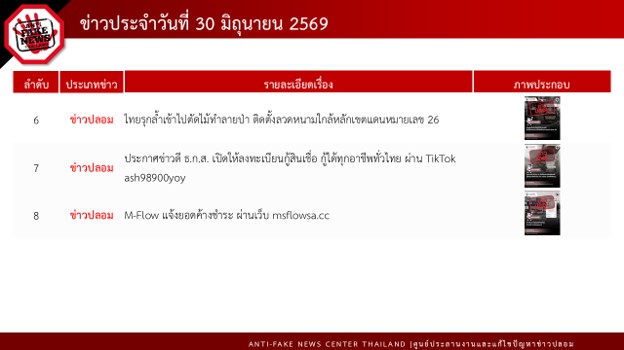
True News: Thailand encroached into forest areas and installed barbed wire near Border Marker No. 26.
Fake News: BAAC is accepting loan applications for all occupations through the TikTok account **ash98900yoy**.
One of the most notable fake stories claimed that the Provincial Electricity Authority (PEA) had issued notices informing customers that electricity would be disconnected because of faulty electricity meters and that meter replacement was required. The DE Ministry coordinated with PEA and confirmed that the claim is false.
PEA confirmed that the document circulating online is a **fake document** created by scammers. The authority has no policy of sending notices or documents informing customers that electricity will be disconnected due to faulty meters or requiring meter replacement.
Electricity users are advised not to trust anyone sending such documents, as they may be intended to trick victims into registering for fraudulent transactions or revealing personal information. Anyone with questions should contact the **1129 PEA Contact Center** or their local PEA office directly.
The DE Ministry remains concerned about the spread of fake news and misinformation across online and social media platforms. Sharing unverified information may lead to misunderstanding, financial losses, misuse of personal information, and broader impacts on society.
The public is encouraged to trust and share information only from official sources and to carefully verify facts and website links before believing or forwarding any information.
People who encounter suspicious information or possible fake news can report it or verify information through the Anti-Fake News Center Thailand via Hotline **1111 ext. 87**, available 24 hours a day.
The new Royal Decree on government data sharing will strengthen Thailand’s fight against online scammers by improving information exchange among government agencies. Within four months, financial losses from online scams have already fallen by nearly 75 percent.
On 1 July 2026, Mr.Chaichanok Chidchob, Minister of Digital Economy and Society, said that the Royal Decree on the Disclosure of Personal Information Held by Government Agencies to Other Government Agencies B.E. 2569 (2026), which came into force on 30 June 2026, will significantly strengthen Thailand’s efforts to prevent and combat online crime.
The new regulation enables more effective data sharing among government agencies, particularly information related to individuals linked to criminal organizations, corruption, human trafficking, and online fraud.
The Ministry of Digital Economy and Society (DE) has already been integrating information with five key agencies: the Royal Thai Police, the Department of Special Investigation (DSI), the Anti-Money Laundering Office (AMLO), the Bank of Thailand (BOT), and the Securities and Exchange Commission (SEC). Under Section 4 of the Emergency Decree on Measures for the Prevention and Suppression of Technology Crimes, financial institutions and business operators are required to exchange transaction account information related to suspected scammers. The information is then used to support preventive and enforcement measures in cooperation with relevant agencies, including the National Broadcasting and Telecommunications Commission (NBTC), network service providers, and banks.
As a result of this cooperation among the five agencies and other related organizations, financial losses caused by online scammers have declined significantly. In June 2026, reported losses totaled 530 million baht, down from approximately 2.111 billion baht in March 2026—a reduction of 1.581 billion baht, or about 74.89 percent, within four months.
“The enforcement of the Royal Decree on government data sharing will enable the DE Ministry and relevant agencies to integrate information with many more government organizations, including customs data, tax information from the Ministry of Finance, and business registration records from the Department of Business Development under the Ministry of Commerce,” said Mr.Chaichanok.
“This will further strengthen efforts to prevent and suppress online scams, reduce financial losses, and improve the ability to recover money for victims more quickly. All data sharing will be carried out under strict personal data protection measures and international cybersecurity standards. At the same time, greater data integration among government agencies will improve public services, enable more targeted welfare policies, increase transparency, strengthen law enforcement, support economic policymaking, and enhance Thailand’s national competitiveness,” he said.
DE warns the public about fake claims inviting people to add a LINE account for “legal underground lottery” allegedly certified by the Government Lottery Office, urging people to beware of scammers seeking money and personal information.
The Ministry of Digital Economy and Society (DE), through the Anti-Fake News Center Thailand (AFNC), has released the latest results of its fake news monitoring and reporting efforts. The initiative is in line with the policy of Mr.Chaichanok Chidchob, Minister of Digital Economy and Society, to strengthen public awareness of technology-related crimes, fake news, and misinformation.
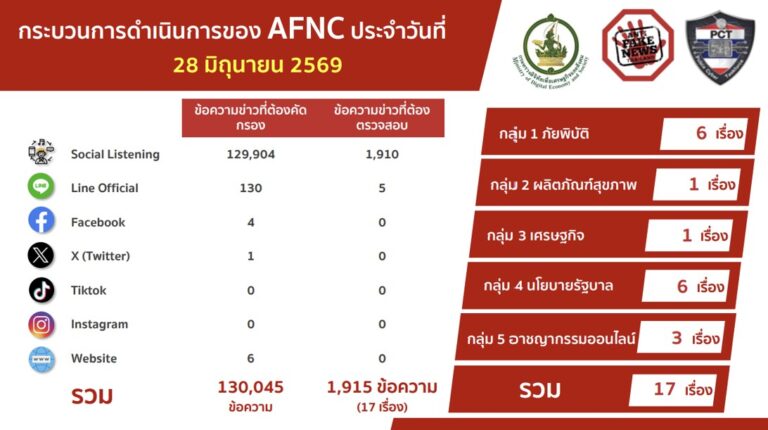
On 28 June 2026, AFNC monitored a total of 130,045 messages and identified 1,915 messages requiring verification. The largest number of reports came from Social Listening channels, accounting for 1,910 messages, followed by five reports received through the AFNC Line Official account. A total of 17 issues were investigated, with verification results received from relevant agencies for 14 cases.
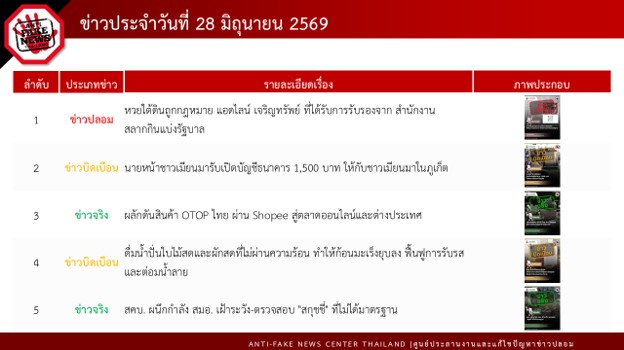
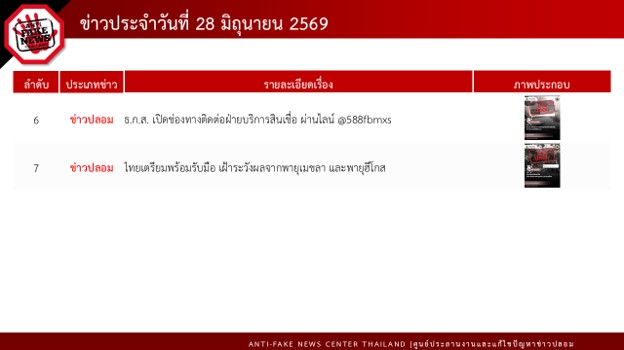
Among the seven stories that attracted the greatest public attention, two were confirmed as true, three were identified as fake news, and two were classified as misleading information. These included:
Fake News: A legal underground lottery operated through the LINE account “Charoen Sap” is certified by the Government Lottery Office.
Misleading Information: A Myanmar broker is opening bank accounts for Myanmar nationals in Phuket for 1,500 baht.
True News: Thailand is promoting OTOP products through Shopee to expand into online and international markets.
Misleading Information: Drinking smoothies made from raw leaves and vegetables can shrink cancer tumors and restore taste and salivary gland function.
True News: The Office of the Consumer Protection Board (OCPB) and the Thai Industrial Standards Institute (TISI) are monitoring and inspecting substandard “Squishy” products.
Fake News: BAAC provides loan service inquiries through the LINE account **@588fbmxs**.
Fake News: Thailand is preparing for the impacts of Tropical storms Higos and Mekkhala.
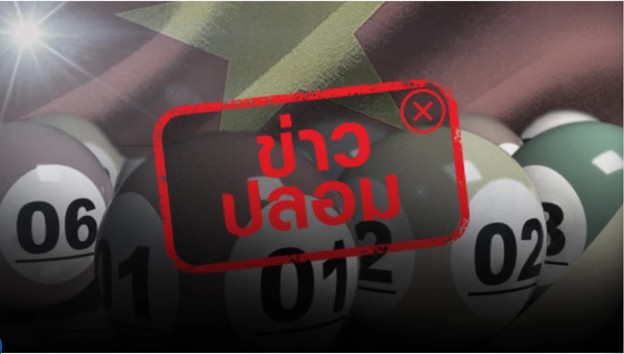
One of the most notable fake stories claimed that a “legal underground lottery” operated through the LINE account **Charoen Sap** had been certified by the Government Lottery Office (GLO). The DE Ministry coordinated with the Government Lottery Office under the Ministry of Finance and confirmed that the claim is false.
The Government Lottery Office stated that it has no connection with the LINE account mentioned in the claim. Scammers have falsely used the agency’s name to make the information appear credible.
The Government Lottery Office also confirmed that official online lottery tickets are sold only through the **Paotang** application and other authorized channels. The public is urged not to believe or share information that does not come from official sources.
The DE Ministry remains concerned about the spread of fake news and misinformation across online and social media platforms. Sharing unverified information may lead to misunderstanding, financial losses, misuse of personal information, and broader impacts on society.
The public is encouraged to trust and share information only from official sources and to carefully verify facts and website links before believing or forwarding any information.
People who encounter suspicious information or possible fake news can report it or verify information through the Anti-Fake News Center Thailand via Hotline 1111 ext. 87, available 24 hours a day.
DE warns the public about fake claims that Thai, Lao, and Hanoi lottery tickets can be purchased through the Paotang application using benefits from the Thais Help Thais Plus (60/40) scheme, urging people not to be misled by false information.
The Ministry of Digital Economy and Society (DE), through the Anti-Fake News Center Thailand (AFNC), has released the latest results of its fake news monitoring and reporting efforts. The initiative is in line with the policy of Mr.Chaichanok Chidchob, Minister of Digital Economy and Society, to strengthen public awareness of technology-related crimes, fake news, and misinformation.
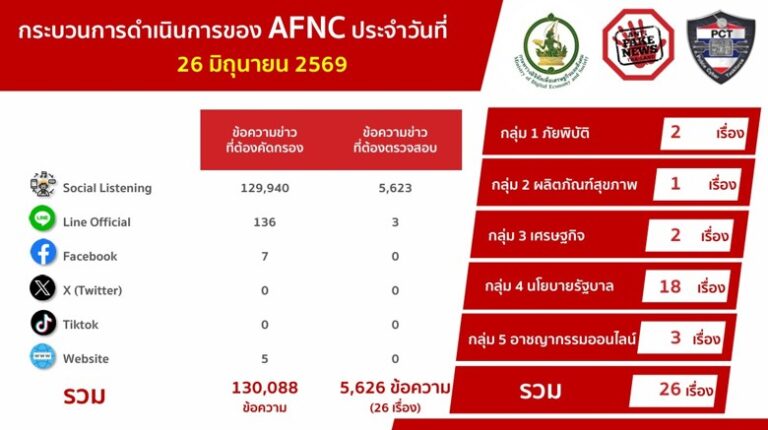
On 26 June 2026, AFNC monitored a total of 130,088 messages and identified 5,626 messages requiring verification. The largest number of reports came from Social Listening channels, accounting for 5,623 messages, followed by three reports received through LINE. A total of 26 issues were investigated, with verification results received from relevant agencies for eight cases.
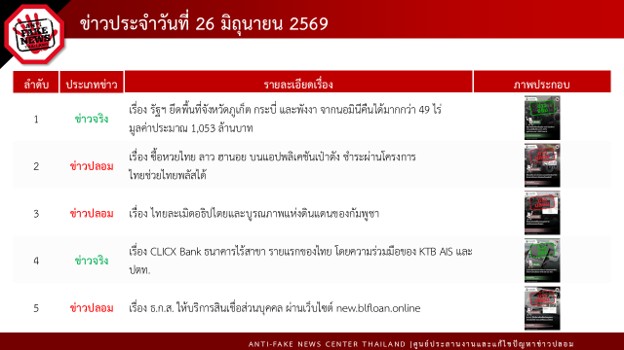
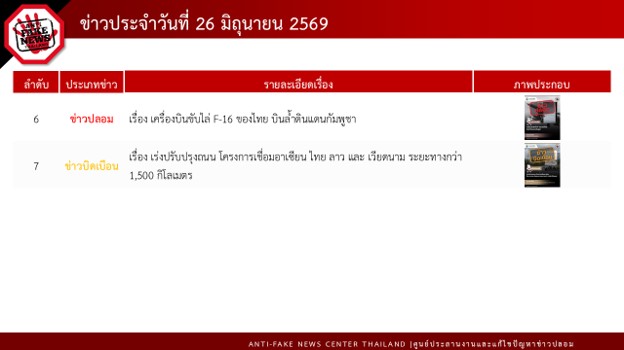
Among the seven stories that attracted the greatest public attention, two were confirmed as true, four were identified as fake news, and one was classified as misleading information. These included:
True News: The Government recovered more than 49 rai of land in Phuket, Krabi, and Phang Nga from nominee ownership, with an estimated value of 1.053 billion baht.
Fake News: Thai, Lao, and Hanoi lottery tickets can be purchased through the Paotang application using benefits from the Thais Help Thais Plus scheme.
Fake News: Thailand violated Cambodia’s sovereignty and territorial integrity.
True News: CLICX Bank becomes Thailand’s first branchless bank through the cooperation of KTB, AIS, and PTT.
Fake News: BAAC offers personal loans through a website.
Misleading Information: Thailand is accelerating a 1,500-kilometer road project linking Thailand, Laos, and Vietnam.
One of the most notable fake stories claimed that users could purchase Thai, Lao, and Hanoi lottery tickets through the **Paotang** application and pay using benefits under the **Thais Help Thais Plus (60/40)** scheme. The DE Ministry coordinated with Krungthai Bank under the Ministry of Finance and confirmed that the claim is false.
Krungthai Bank clarified that benefits under the **Thais Help Thais Plus** scheme cannot be used to purchase Thai, Lao, or Hanoi lottery tickets through the **Paotang** application. The application also does not provide any illegal gambling services. Benefits under the scheme can only be used in accordance with the project’s terms and conditions and at participating merchants.
The DE Ministry remains concerned about the spread of fake news and misinformation across online and social media platforms. Sharing unverified information may lead to misunderstanding, financial losses, misuse of personal information, and broader impacts on society.
The public is encouraged to trust and share information only from official sources and to carefully verify facts and website links before believing or forwarding any information.
People who encounter suspicious information or possible fake news can report it or verify information through the Anti-Fake News Center Thailand via Hotline 1111 ext. 87, available 24 hours a day.
DE warns the public about fake emails claiming to be from Paotang by Krungthai offering additional benefits under the Thais Help Thais Plus (60/40) scheme, urging people to beware of scammers seeking money and personal information.
The Ministry of Digital Economy and Society (DE), through the Anti-Fake News Center Thailand (AFNC), has released the latest results of its fake news monitoring and reporting efforts. The initiative is in line with the policy of Mr.Chaichanok Chidchob, Minister of Digital Economy and Society, to strengthen public awareness of technology-related crimes, fake news, and misinformation.
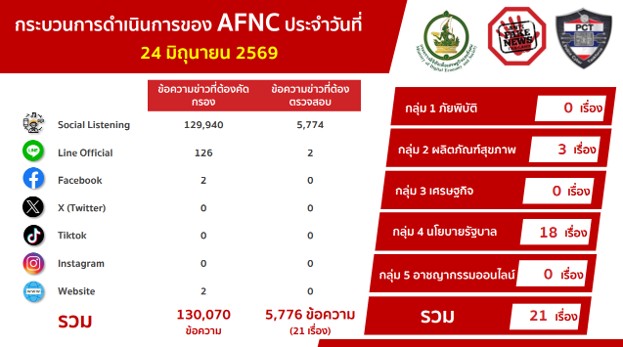
AFNC monitored a total of 130,070 messages and identified 5,776 messages requiring verification. The largest number of reports came from Social Listening channels, accounting for 5,774 messages, followed by 2 reports received through the AFNC Line Official account. A total of 21 issues were investigated, with verification results received from relevant agencies for 6 cases.
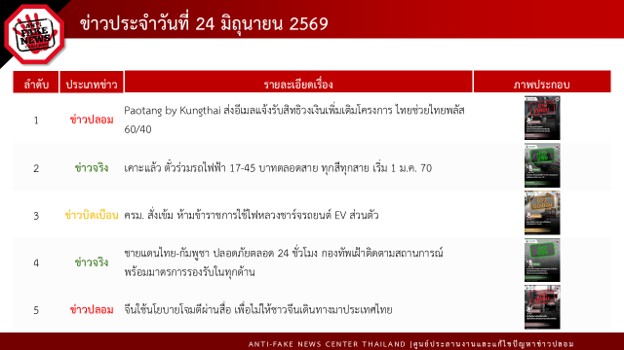
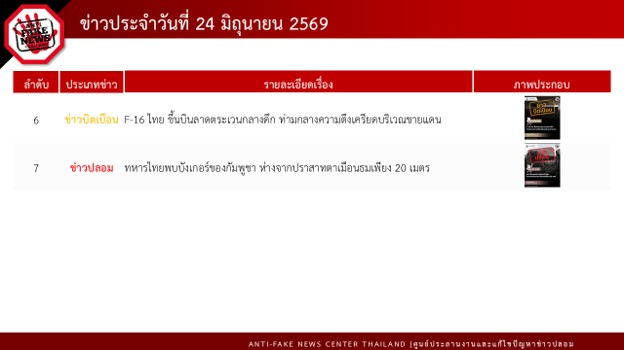
Among the 7 stories that attracted the greatest public attention, 2 were confirmed as true, 3 were identified as fake news, and 2 were classified as misleading information. These included:
Fake News: Paotang by Krungthai sends emails offering additional benefits under the Thais Help Thais Plus (60/40) scheme.
True News: The long-awaited flat-fare policy of 17–45 baht for all electric rail lines will begin on 1 January 2027.
Misleading Information: The Cabinet has banned civil servants from using government electricity to charge their personal EVs.
True News: The Thai-Cambodian border remains secure around the clock, with the military closely monitoring the situation and preparedness measures in place.
Fake News: China is using media campaigns to discourage Chinese tourists from traveling to Thailand.
Misleading Information: Thai F-16 fighter jets conducted late-night patrols amid tensions along the border.
Fake News: Thai soldiers discovered a Cambodian bunker just 20 meters from Ta Muen Thom Temple.
One of the most notable fake stories claimed that **Paotang by Krungthai** had sent emails informing recipients that they were eligible for additional benefits under the **Thais Help Thais Plus (60/40)** scheme. The DE Ministry coordinated with Krungthai Bank under the Ministry of Finance and confirmed that the claim is false.
Krungthai Bank explained that the email is fraudulent and was created by scammers impersonating the **Paotang** application to trick people into claiming additional benefits under the **Thais Help Thais Plus (60/40)** scheme.
The bank confirmed that it has **no policy** of sending emails asking users to claim additional benefits under the scheme. The public is urged not to click suspicious links or provide personal information through untrusted emails.
The DE Ministry remains concerned about the spread of fake news and misinformation across online and social media platforms. Sharing unverified information may lead to misunderstanding, financial losses, misuse of personal information, and broader impacts on society.
The public is encouraged to trust and share information only from official sources and to carefully verify facts and website links before believing or forwarding any information.
People who encounter suspicious information or possible fake news can report it or verify information through the Anti-Fake News Center Thailand via Hotline 1111 ext. 87, available 24 hours a day.
DE and MonoMax discussed stronger takedown measures against illegal websites, enhancing public-private cooperation to combat copyright infringement and online gambling during FIFA World Cup 2026.
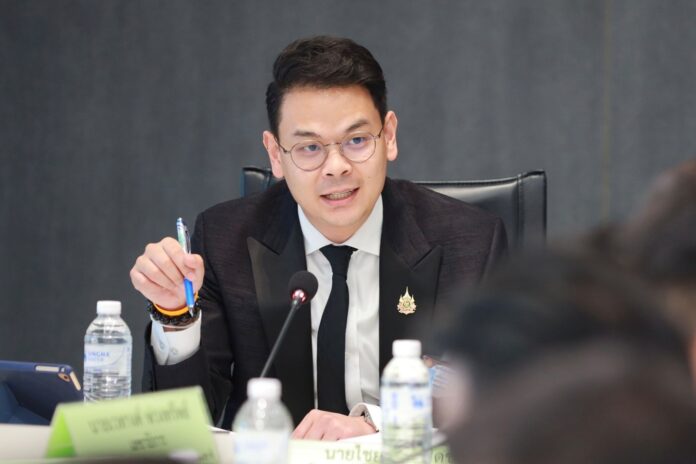
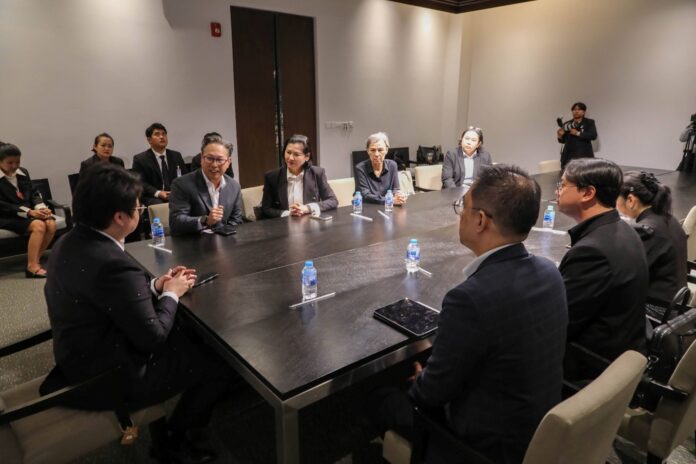
Ms.Nan Boontida Somchai, Deputy Minister of Digital Economy and Society, and Mr.Nawamin Prasopnet, Chief Executive Officer of Mono Next Public Company Limited, held discussions on measures to prevent and suppress illegal websites and platforms involved in online gambling and copyright infringement related to FIFA World Cup 2026 broadcasts.
Ms.Nan Somchai said the Government, through the Ministry of Digital Economy and Society (DE), places great importance on combating online crime, intellectual property infringement, and online gambling, particularly during FIFA World Cup 2026.
Between 10 and 24 June 2026, the Illegal Website Monitoring Center of the DE Ministry blocked 12,671 URLs linked to copyright infringement and online gambling. Of these, 4,496 URLs were blocked under court orders, while another 8,175 URLs were removed in cooperation with social media platforms, including Facebook, Instagram, X, and YouTube.
During the meeting, Mono Next Public Company Limited, the official broadcasting rights holder for FIFA World Cup 2026 and the English Premier League in Thailand, expressed its readiness to integrate data and work closely with the DE Ministry’s Illegal Website Monitoring Center. The cooperation will help accelerate the process of blocking illegal platforms immediately after violations are detected, further strengthening enforcement against unlawful online activities.
“The Government, through the DE Ministry, conducts 24-hour monitoring and enforcement against illegal online activities. We are ready to work closely with the private sector to combat illegal websites and platforms. This cooperation will speed up the coordination and takedown process while helping prevent offences that affect the public, society, and the digital economy. The Government remains fully committed to reducing public harm and supporting Thailand’s economic growth,” said Ms.Nan.
The public can report websites related to online gambling during FIFA World Cup 2026 through the GCC Hotline 1111 ext. 87, available 24 hours a day, or by contacting the DE Ministry’s Illegal Website Monitoring Center via email at [email protected]
Down a small street within walking distance of BTS Phra Khanong, a blue-lit dragon guards the entrance to one of Bangkok’s more improbable hospitality projects.
But before we come back to the future, lets dial back to the past. Arcadia began as a cyberpunk barcade: part craft beer bar, part retro gaming den, and part gathering place for the sort of Bangkok residents who are rarely impressed by another polished rooftop lounge. Now it has evolved into something larger and stranger.
Above the newly expanded Arcadia Live café, bar and event space is Cinematique, a boutique hotel designed as a collection of forgotten film sets from Thailand’s cinematic past.
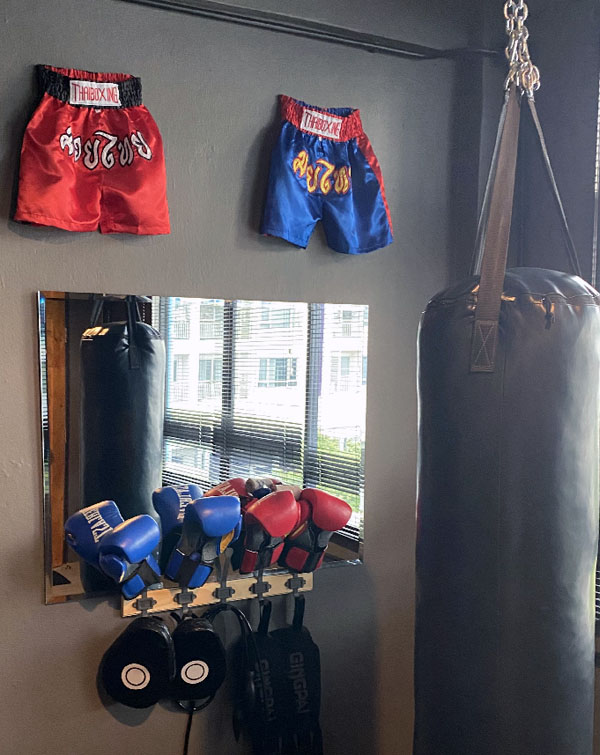
Each room belongs to its own fictional lost production. Guests can spend the night inside a Thai ghost story, a jungle adventure, a vintage romance or the Bangkok hideout of a 1960s secret agent. One room even draws inspiration from the sweat, bravado and gloriously excessive action films of the 1980s, complete with its own Muay Thai training area.
The project is the latest creation of Todd Ruiz, a writer and journalist who previously worked as an editor at Khaosod English. Seeing a former colleague bring such an ambitious and deeply personal project to life is a source of pride for our newsroom — although anyone familiar with Todd’s enthusiasm may be a bit less surprised.
Arcadia began across the street as a smaller barcade. When a nearby property came up for sale, Todd jumped at the chance to build something bigger. The result was Arcadia Live and Cinematique: a larger home for the community that had already formed around the original bar, with a boutique hotel layered above it.
The project has been driven by an unusually determined do-it-yourself spirit, which Todd says he inherited from his father, a former NASA engineer. When he wanted arcade cabinets, he built them himself despite having no prior carpentry experience. When he needed custom-programmed LED strips, he taught himself how.
Todd seems to operate on the belief that almost any skill can be learned if the project is interesting enough. Cinematique gives him the perfect outlet: a nerdy, neon-noir, alternative-history love letter to old cinema.
As Cinematique began taking shape, he personally worked on the rooms, filling them with props, vintage furniture and carefully arranged details. Cinematique is packed with original movie-poster prints displayed throughout the hotel, locally sourced through a nearby seller to add another layer of character to the space
The Lore
The hotel’s backstory is nearly as elaborate as the rooms themselves. According to Cinematique lore, the building once housed a Thai-American film studio founded in 1967, producing bilingual melodramas, ghost films, jungle adventures and spy thrillers before mysteriously closing its doors in the 1980s.
Retrieved from Cinematique’s official site
Costumes, scripts and unfinished reels were supposedly left behind. Clues to the studio’s fate are scattered through the rooms for guests to uncover.
Whatever truths lie behind the backstory, the affection for old Thai cinema is unmistakable. Cinematique feels less like a conventional themed hotel than a lost Thai film set where the cameras stopped rolling, but the atmosphere never cleared.
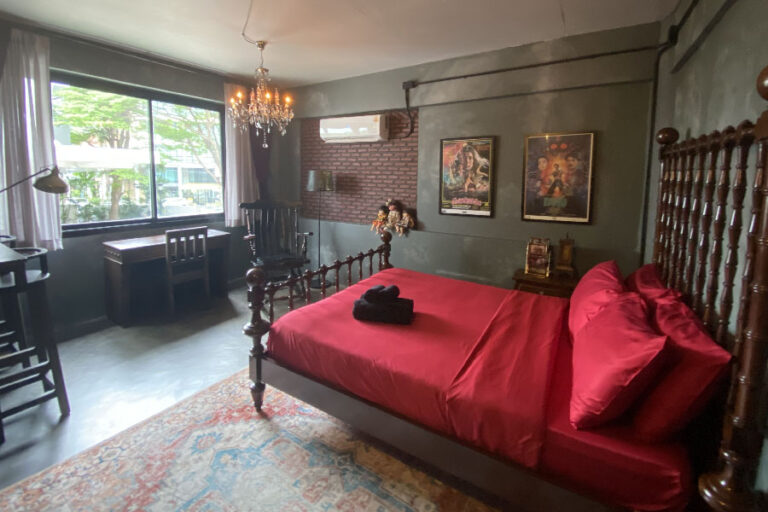
Todd invited us to stay in the “Return to the House of Phaya Nak”, the hotel’s spooky room, where antique furniture, low lighting and unsettling details create the impression that the previous occupants may not have entirely checked out.
It is excellently decorated, and meticulously clean. Sensitive sleepers should note, however, that some noise from the bar and events space below can carry upstairs, particularly on busy weekend nights. This is a hotel above a lively venue, not a silent retreat.
That minor drawback is also part of the broader story. Cinematique and Arcadia Live occupy the same building because the project is not simply about accommodation. It is about creating a place where people stay, eat, drink, play games and return for whatever strange event may be happening that week.
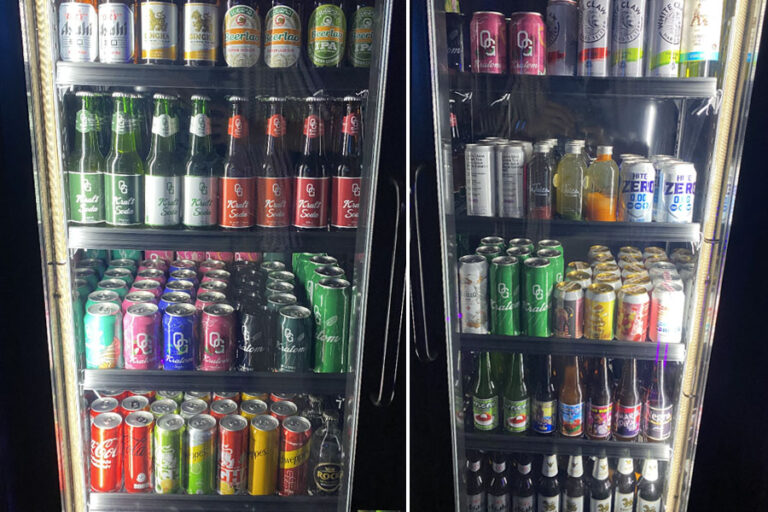
Arcadia Live Café opens at 09:00 with coffee, snacks and lunch items from a kitchen led by chef Arturo Villegas Rosas. The venue also offers cocktails and an interesting craft beer selection, alongside drinks that may interest visitors curious about Thai drinking culture.
The beetroot salad, like most items on the menu, is vegan, but it was not lacking in flavour or texture. The orange sauce in particular stood out.
These include kratom beverages and yadong, a traditional herbal liquor. Both deserve to be approached responsibly, particularly by newcomers unfamiliar with their effects. For foreign visitors who are curious but hesitant to experiment with the famous Thai drinks, Arcadia offers an approachable introduction.
OG Kratom was available both canned and on draft.
As for Arcadia, its most impressive achievement may not be its custom-built arcade cabinets, cinematic rooms or glowing retro-futurist aesthetic. It is the loyalty it has inspired.
The venue attracts regulars and repeat visitors, including expatriates who have lived in Thailand for years and already have no shortage of Bangkok bars to choose from. Arcadia has managed to build something more difficult to manufacture than an eye-catching interior: a genuine community.
That community now has more room to grow. Arcadia Live hosts regular events, including DJ nights, gaming sessions, live performances and comedy shows, with upcoming activities announced on its Facebook and Instagram pages.
Always a work in progress
Cinematique is the kind of project that will likely never be complete in Todd’s eyes. He is still designing additional rooms and has plans to make greater use of the rooftop for future events.
That unfinished quality feels appropriate. Arcadia has never seemed interested in reaching a final form. It exists more like a real-life RPG: get started, level up, and keep going, one quest after another.
Cinematique and Arcadia Live are located at 1112/91–93 Soi Sukhumvit Plus, within walking distance of Phra Khanong BTS station.
DE warns the public about fake claims that AMLO has opened a new LINE account called “Anti-Money Laundering”, urging people to beware of scammers who may steal money and personal information.
The Ministry of Digital Economy and Society (DE), through the Anti-Fake News Center Thailand (AFNC), has released the latest results of its fake news monitoring and reporting efforts. The initiative is in line with the policy of Mr.Chaichanok Chidchob, Minister of Digital Economy and Society, to strengthen public awareness of technology-related crimes, fake news, and misinformation.
AFNC monitored a total of 130,627 messages and identified 4,757 messages requiring verification. The largest number of reports came from Social Listening channels, accounting for 4,756 messages, followed by one report received through the AFNC Line Official account. A total of 22 issues were investigated, with verification results received from relevant agencies for 8 cases.
Among the seven stories that attracted the greatest public attention, one was confirmed as true, four were identified as fake news, and two were classified as misleading information. These included:
Fake News: AMLO has opened a new LINE account called “Anti-Money Laundering”.
True News: An announcement prohibits the purchase, sale, or transfer of occupancy rights in Thap Lan National Park.
Fake News: The movie Ong-Bak is a Cambodian film that was dubbed into Thai.
Fake News: Caregivers of persons with disabilities will receive a monthly allowance of 800 baht.
Misleading Information: Applying large amounts of sunscreen causes hair thinning.
Fake News: PEA allows customers to contact the head of its meter department via LINE to claim electricity bill refunds.
Misleading Information: Foreign media reported that Thailand is a major producer of methamphetamine.
The most notable fake story claimed that the Anti-Money Laundering Office (AMLO) had opened a new LINE account called “Anti-Money Laundering”. The DE Ministry coordinated with AMLO and confirmed that the information is false.
The LINE account being circulated is not an official account of AMLO. The office confirmed that it has only one official LINE account: **@insideamlo**.
The public is therefore advised to exercise caution and verify the authenticity of any contact account before sharing personal information or conducting any transaction, in order to avoid becoming a victim of fraud.
The DE Ministry remains concerned about the spread of fake news and misinformation across online and social media platforms. Sharing unverified information may lead to misunderstanding, financial losses, misuse of personal information, and broader impacts on society.
The public is encouraged to trust and share information only from official sources and to carefully verify facts and website links before believing or forwarding any information.
People who encounter suspicious information or possible fake news can report it or verify information through the Anti-Fake News Center Thailand via Hotline 1111 ext. 87, available 24 hours a day.
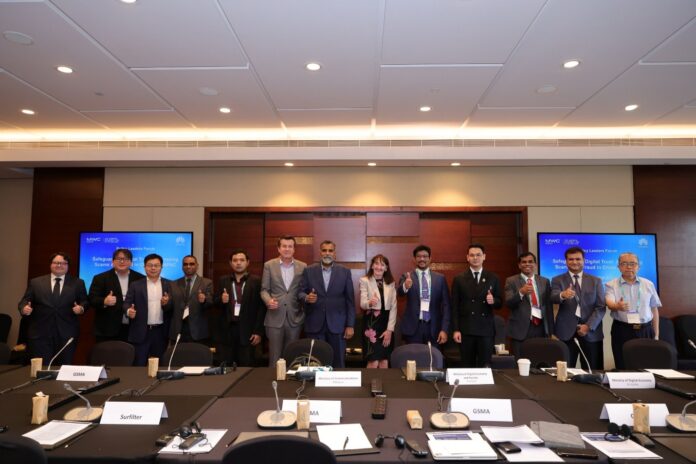
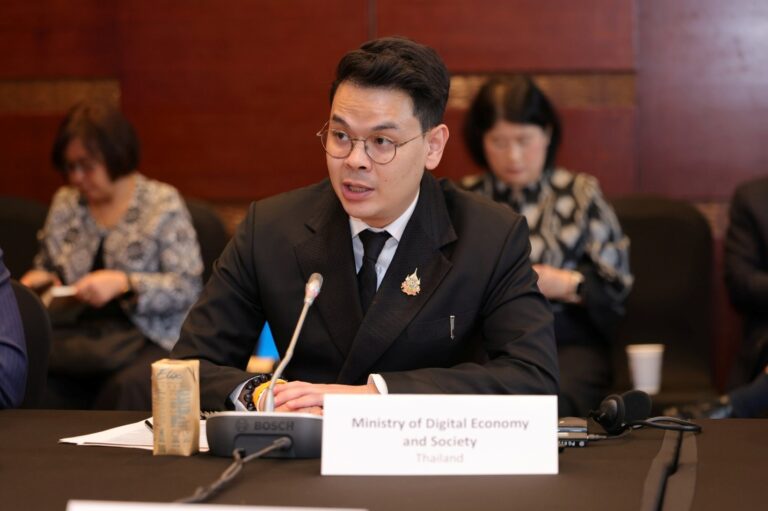
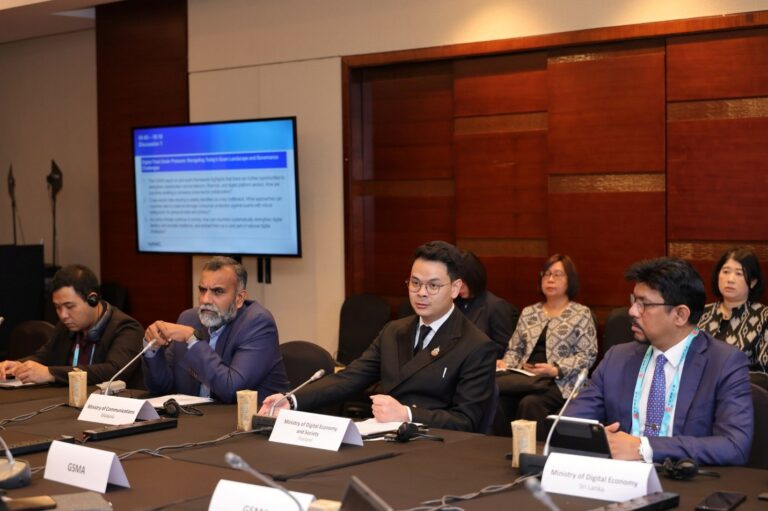
Minister of DE highlights the “Shared Responsibility” model at MWC, calling for stronger cooperation across all sectors to enhance online safety and build public trust in the digital society.
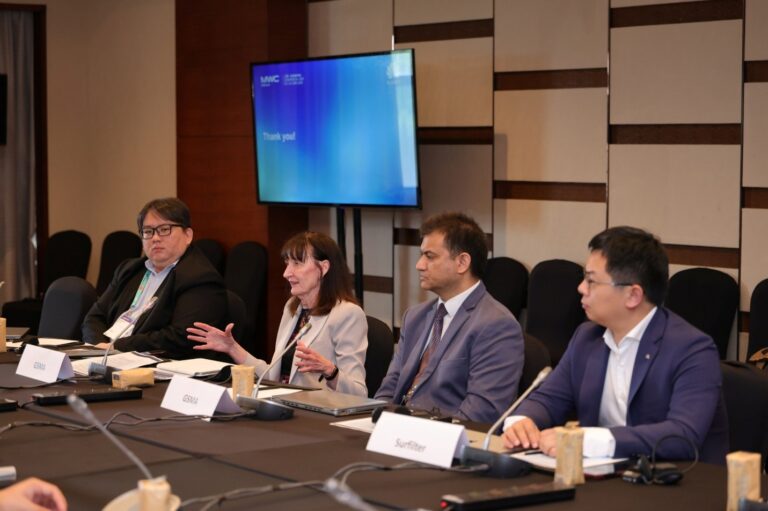
Mr.Chaichanok Chidchob, Minister of Digital Economy and Society, said during the GSMA Roundtable held as part of Mobile World Congress (MWC) Shanghai 2026 in Shanghai, China, that one of the key challenges in tackling online threats today is not only the rapid advancement of technologies used by scammers, but also gaps in coordination among relevant agencies.
For Thailand, the country has accelerated efforts to build cooperation mechanisms among the government, financial institutions, telecommunications providers, digital platform providers, the Royal Thai Police, public agencies, and relevant private sector partners to ensure faster and more effective responses to incidents.
For the Ministry of Digital Economy and Society (DE), a key mechanism is the Anti-Online Scam Operation Center, or AOC 1441, which serves as a 24-hour coordination center. The center has helped reduce the time needed to freeze mule accounts from about one hour to an average of just 15 minutes, increasing the chances of preventing losses and tracing money flows in a timely manner.
In addition to improving operational mechanisms, Thailand has also updated its laws to support the lawful exchange of information related to financial crime prevention. The country is also advancing the principle of “Shared Responsibility”, requiring financial institutions, telecommunications providers, and digital platforms to play a joint role in prevention and take responsibility if they fail to implement necessary measures.
This principle is not intended to increase burdens or penalties on businesses. Rather, it aims to create incentives for all sectors to work together toward the same goal: protecting the public from online threats and reducing the shifting of responsibility among agencies.
Another key issue is balancing online crime prevention with personal data protection. Thailand follows the principle of using data under a clear legal framework, limiting data use to what is necessary, and ensuring oversight by independent agencies in order to build public trust in digital systems.
At the same time, Thailand continues to promote digital literacy, which is considered an important form of infrastructure, no less important than internet networks and telecommunications systems. The country aims to integrate digital knowledge into the education system, workplaces, and elderly care, as older adults are among the groups most at risk of falling victim to online scammers.
Online crime is a global challenge that no single country can solve alone. Thailand is ready to share its experience and exchange best practices with other countries to strengthen regional cooperation in building a secure, safe, and trusted digital ecosystem.
“When scammers can share their tactics across borders, countries must also work together to share ways to protect the public. Trust in the digital world is the foundation for safe and sustainable economic and social development in the future,” said the Minister of Digital Economy and Society.