




































Prime Minister Anutin Charnvirakul said Thailand should avoid being forced to choose sides amid growing geopolitical rivalry, arguing that countries should instead maintain strategic autonomy by building diverse partnerships.
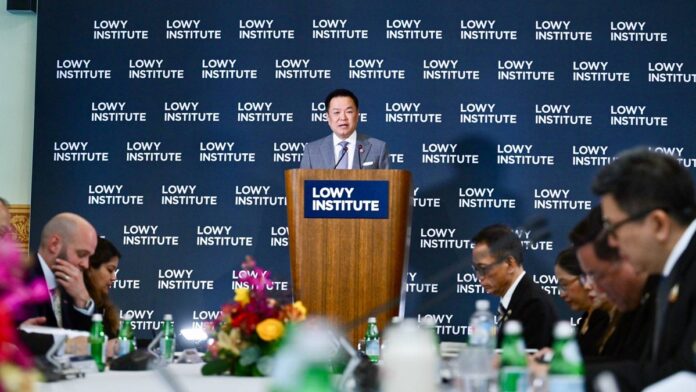
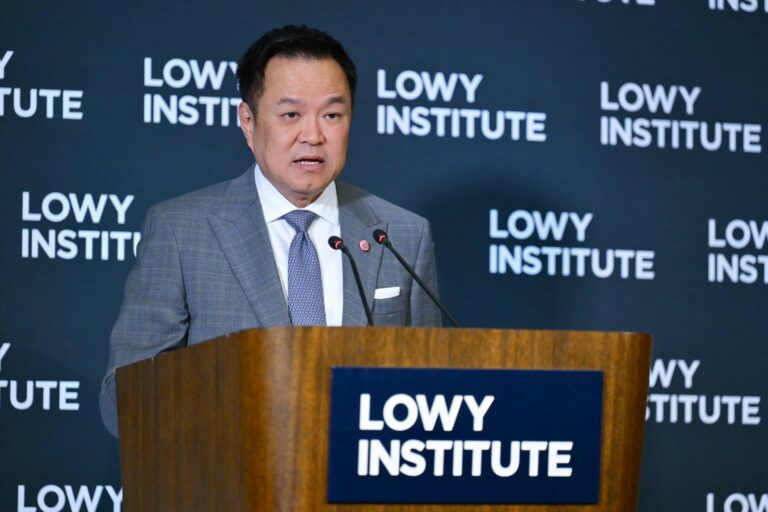
Speaking at the Lowy Institute in Sydney on Tuesday, Anutin outlined Thailand’s approach to a changing international order, saying stronger regional cooperation, strategic autonomy and economic resilience were key to navigating global uncertainty.
“Not choosing sides does not mean having no choices,” Anutin said, stressing that strategic autonomy meant maintaining the ability to make independent decisions and work with a range of partners based on national interests.
He said Thailand and Australia, as middle powers, could play a greater role in shaping how power is exercised in the region, even if they could not determine the global balance of power.
ASEAN remains Thailand’s strategic anchor
Anutin said regional institutions would become increasingly important as reaching consensus at the global level becomes more difficult.
For Thailand, ASEAN remains a “strategic anchor” that has helped transform Southeast Asia from a region marked by division and mistrust into one focused on dialogue, cooperation and greater integration.
He said ASEAN must strengthen its unity and centrality while developing greater capacity to set its own agenda and respond effectively to regional challenges.
On Myanmar, Anutin said Thailand continues to support ASEAN’s Five-Point Consensus while pursuing calibrated re-engagement to maintain channels for dialogue and encourage concrete progress.
He welcomed Myanmar authorities’ recent decision to allow the International Committee of the Red Cross to meet detained former leader Aung San Suu Kyi, saying Thailand had consistently pushed for such access.
On Cambodia, Anutin said Thailand remained committed to resolving disputes peacefully through dialogue and agreed bilateral mechanisms while maintaining ASEAN unity.
‘Not choosing sides, but creating more options’
Anutin said strategic autonomy should not be interpreted as isolation or neutrality on every issue.
Instead, he said countries should diversify their partnerships so they have more options and are less vulnerable to pressure to align with another country’s interests.
Thailand and Australia should also expand cooperation through minilateral arrangements focused on specific issues, he said, citing efforts to combat cybercrime and transnational crime.
Anutin and Australian Prime Minister Anthony Albanese are scheduled to sign a joint statement on cooperation against transnational crime in Canberra.
Building a more resilient economy
Anutin also called for deeper economic integration between Thailand and Australia to strengthen resilience and reduce excessive dependence on any single market or supply source.
Thailand and Australia have had a free trade agreement since 2005, with bilateral trade reaching about A$32 billion in 2025.
He said the two countries should build on their economic ties by linking Australia’s strengths in critical minerals, energy, education, technology and capital with Thailand’s capabilities in advanced manufacturing, food production, regional connectivity, and growing green and digital industries.
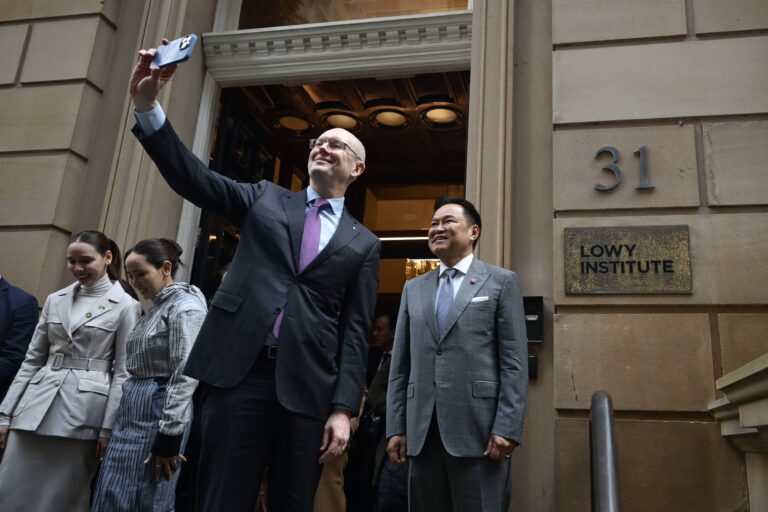
Potential areas for cooperation include critical minerals, batteries, next-generation vehicles, clean energy, advanced manufacturing, food security, agricultural technology, digital trade, cybersecurity and responsible artificial intelligence.
Anutin also thanked Australia for supporting Thailand’s bid to join the Organisation for Economic Co-operation and Development (OECD), saying the process would help raise Thailand’s regulatory standards and support innovation-driven growth.
“Thailand and Australia may not be countries that determine the balance of power in the world, but we can help shape how power is used in our region,” Anutin said.
The prime minister said the international system could not simply return to the way it was in the past, and called for partnerships that preserve strategic choices while strengthening economic resilience, regional stability and long-term prosperity.