28.1 C
Bangkok
Thursday, August 20, 2026
Home Blog Page 59

US-based Walk for Peace monks mourn Thai monks killed in Mukdahan tragedy

A group of Buddhist monks behind the Walk for Peace pilgrimage in the United States has expressed its deepest condolences following the deaths of Thai monks in a devastating road accident in northeastern Thailand, saying the tragedy resonates with them on a deeply personal level.

In a statement released after the 2 July accident, the group said it was “deeply saddened” by the news that a vehicle struck a group of monks during their walking pilgrimage in Mukdahan province, killing nine monks and injuring many others. The group also reassured supporters that the monks participating in the US-based Walk for Peace were not involved in the incident and were safe.

“As brothers in the Dhamma, we feel this profound loss deeply in our hearts,” the statement read. The group extended its condolences to Thailand’s Sangha, the families of the deceased and everyone affected, while praying for the departed monks and wishing those injured a full recovery.

738261736 1004799929186226 6869307012699449358 n

The monks said the tragedy brought back memories of their own close call during the Walk for Peace on 19 November 2025 near Dayton, Texas, when a vehicle lost control and veered towards their walking group. They said the incident reminded them how vulnerable monks are while walking long distances in pursuit of peace.

The Walk for Peace pilgrimage began in Texas late last year, with around 20 monks travelling on foot to Washington, DC, to promote peace, mindfulness and loving-kindness. The group said such journeys are never without hardship, citing severe weather, physical exhaustion and the dangers of walking on public roads.

“Every step is an offering — a quiet and steadfast promise to endure adversity so that seeds of peace may be planted across the world,” the monks said, adding that the tragedy also serves as a reminder of the fragility of life and the importance of living each moment with mindfulness and compassion.

The statement concluded with a prayer for all beings to be free from suffering and to live in peace, safety and good health.

Advertisement

Tropical Storm Maysak to bring heavier rain across Thailand

Tropical Storm Maysak to bring heavier rain across Thailand

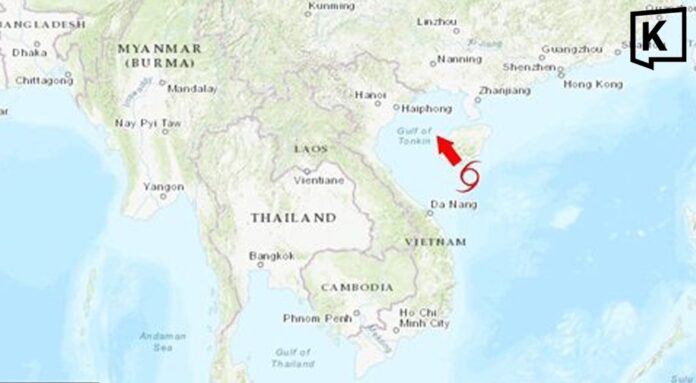
BANGKOK — 3 July 2026, The Department of Disaster Prevention and Mitigation (DDPM) is closely monitoring Tropical Storm Maysak, which is expected to bring heavier rainfall to many parts of Thailand despite not making landfall in the country.

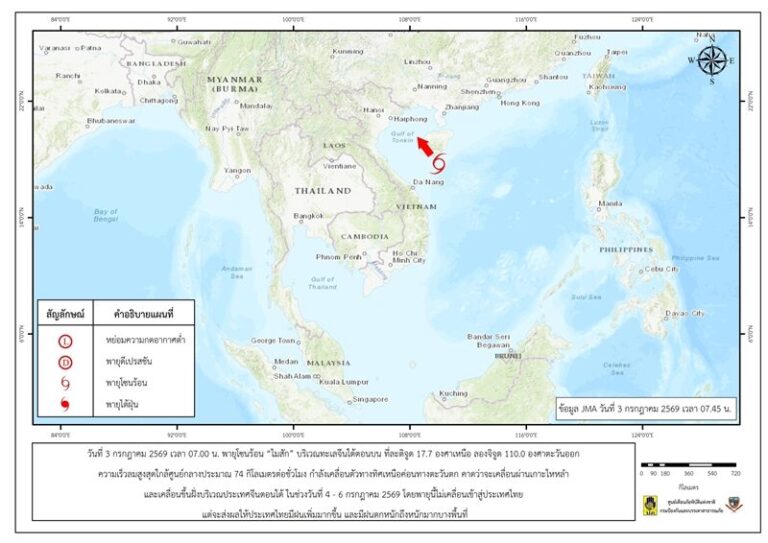
The DDPM, through the National Disaster Warning Centre, said the storm is forecast to pass over Hainan Island before making landfall in southern China between 4 and 6 July.

Although Maysak is not expected to move directly into Thailand, the agency warned that it will strengthen the southwest monsoon, resulting in increased rainfall nationwide, with isolated heavy to very heavy rain.

As of Friday, the storm’s centre was located over the northern South China Sea, packing maximum sustained winds of around 74 kilometres per hour and moving north-northwest.

According to forecast tracks, Maysak will cross Hainan Island before moving ashore in southern China between 4 and 6 July. While Thailand lies outside the storm’s direct path, its circulation is expected to enhance the southwest monsoon, increasing rainfall across much of the country.

Authorities urged residents, particularly those living in areas prone to flash floods, forest runoff and landslides, to closely monitor official weather forecasts and disaster warnings and follow instructions issued by local officials.

The DDPM also encouraged the public to stay updated through official weather bulletins. Emergency assistance is available around the clock via the department’s 1784 hotline.

3 ปภ1 0

Advertisement

British tourist arrested after assault on Phuket tuk-tuk driver, visa revoked

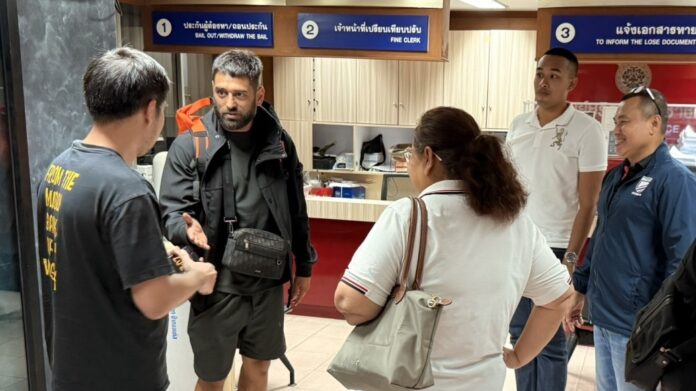
PHUKET — Police have tracked down and arrested a British tourist accused of assaulting a tuk-tuk driver in Patong after the incident went viral on social media, with immigration authorities revoking his permission to stay in Thailand.

Patong police identified the suspect as 33-year-old British national Shane Daniel Correia. Officers brought him in for questioning on Friday before proceeding with legal action on assault-related charges. Immigration police in Phuket were later notified to take action under the Immigration Act.

The case stems from an incident at around 05:00 on 2 July, when a 48-year-old tuk-tuk driver from Trang province was allegedly assaulted outside a hotel on Na Nai Road in Patong, Kathu district. The victim filed a police complaint at 06:13, saying the suspect fled the scene in a car after the attack.

news144430 OnUKVL8qkj1783050752

Police said Correia had been granted permission to remain in Thailand for business purposes. However, authorities determined that his alleged conduct posed a threat to public safety and social order, making him a prohibited person under Section 12(7) of Thailand’s Immigration Act.

On 3 July, the commander of Immigration Division 6 issued an order revoking Correia’s permission to stay in the kingdom under Sections 12(7) and 36 of the Immigration Act. He was informed of his right to appeal before being handed back to Patong police and later transferred to the Phuket Immigration Detention Centre for further legal proceedings.

Advertisement

Thailand ranked 8th for best healthcare system in global 2026 survey

Thailand ranked 8th for best healthcare system in global 2026 survey

BANGKOK — 3 July 2026, the government has welcomed Thailand being ranked the world’s eighth-best healthcare system in 2026 by the Numbeo website, saying the result reflects the country’s efficient healthcare management and broad access to medical services.

Deputy Government Spokesperson Ploytalay Laksameesangjan said on Friday that the ranking was published by Numbeo, the world’s largest crowd-sourced cost-of-living and quality-of-life database, which compiles user-reported data on healthcare, housing, crime, transportation, cost of living and other indicators. According to the 2026 survey, Thailand ranked eighth globally for healthcare.

The top 10 countries with the best healthcare systems in the 2026 survey were:

  1. Taiwan — 87.1 points
  2. South Korea — 82.9 points
  3. Netherlands — 81.1 points
  4. Japan — 80.1 points
  5. Austria — 78.9 points
  6. Ecuador — 77.7 points
  7. Finland — 77.6 points
  8. Thailand — 77.5 points
  9. Denmark — 77.2 points
  10. Spain — 77.2 points

Ploytalay said Thailand’s healthcare system has been recognised for combining affordable medical costs with high-quality services, efficient administration and broad access to treatment.

She also highlighted the Universal Coverage Scheme (UCS), commonly known as the 30-baht scheme or Gold Card scheme, which allows eligible Thai citizens to receive healthcare using only their national identification card. The programme covers a wide range of medical services, from common illnesses to chronic and high-cost conditions, through Thailand’s network of public and participating private hospitals.

The government noted that the latest ranking also reinforces Thailand’s reputation as one of the world’s leading destinations for medical tourism.

Advertisement

Tourists apologise after taking offering coconut in Pattaya

Tourists apologise after taking offering coconut in Pattaya

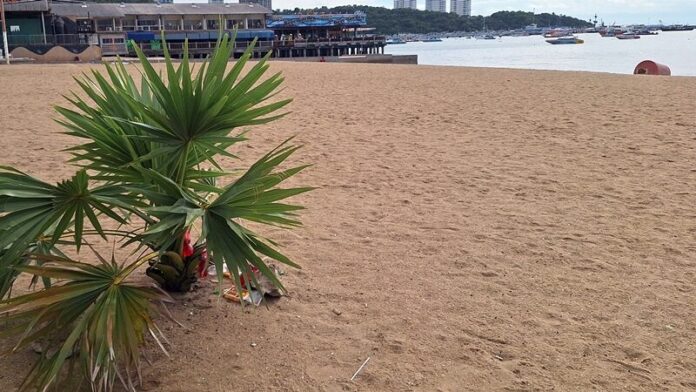
CHONBURI — 2 July 2026, Two foreign women have apologised after unknowingly taking a coconut left as an offering to local spirits at Pattaya Beach for a photo, sparking widespread discussion on social media.

The incident came to light after a Facebook user posted a 45-second video showing the tourists picking up a coconut from beneath a tree at South Pattaya Beach, Chon Buri, and using it as a photo prop by the sea.

Reporters visiting the site found that local residents regularly leave coconuts, desserts and bottles of red soft drink beneath the tree as offerings to guardian spirits, believing the practice brings good fortune.

ป2 2 696x392 1

The spot is also popular with both Thai and foreign visitors taking photos of the beach. Locals believe the women were unaware the coconut was part of a religious offering and had no intention of showing disrespect.

Wanchai, 35, who recorded the video, said he had earlier seen a group of four or five foreign tourists resting under the tree. After asking whether they planned to visit Koh Larn, one tourist picked up the offering coconut and walked to the beach to take photographs.

He later used a translation app to explain that the coconut had been placed there as an offering.

ป1 3 696x392 1

“Once they understood, they looked shocked and immediately apologised,” he said. “They said they did not know about the Thai custom, offered an apology in Russian, and returned the coconut to its original place.”

The incident has prompted online discussion about the importance of cultural awareness when visiting religious or spiritually significant sites in Thailand.

Advertisement

Indonesia arrests 12 over 3.37 tonnes of cannabis from Thailand

JAKARTA — 3 July 2026 Indonesian authorities have seized 3.37 tonnes of cannabis buds allegedly imported from Thailand and arrested 12 suspects, including foreigners, in a drug trafficking case linked to the production of cannabis-laced vape products.

Reuters reported that Indonesia’s National Narcotics Agency announced the seizure this week following operations carried out in several Indonesian cities from 29 June to 1 July.

National Narcotics Agency chief Police General Suyudi Ario Seto said the cannabis buds were hidden inside suitcases and rubber boxes. The shipment originated from Thailand and was seized in East Java province.

2ks
FILE – Marijuana plants display buds as they are in the flowering stage at the indoor growing facility of Mockingbird Cannabis in Raymond, Miss., Jan. 20, 2023. A federal proposal to reclassify marijuana as a less dangerous drug has raised the hopes of some pot backers that more states will embrace cannabis. (AP Photo/Rogelio V. Solis)

Investigators found that the cannabis was allegedly intended for distribution in major Indonesian cities, including Jakarta and Bali, and would be used to produce vape products containing cannabis.

The agency said the network had been recently established and included foreign nationals among its members.

Indonesia has some of the world’s strictest drug laws. One of the country’s most high-profile drug cases involved the Bali Nine, a group arrested in 2005 while attempting to smuggle heroin out of Bali’s international airport.

Two Australian ringleaders in the case were executed in 2015, causing a diplomatic rift between Indonesia and Australia.

3ks
FILE — AP Photo/Robert F. Bukaty
Advertisement

Why Chadchart Won and Why We Should Think Beyond Bangkok

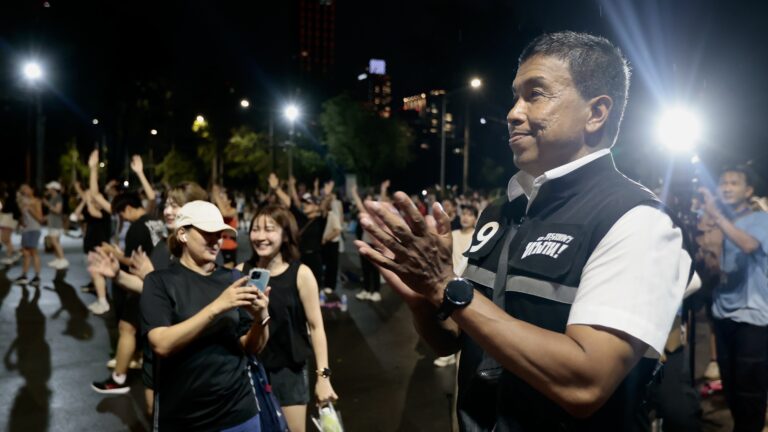
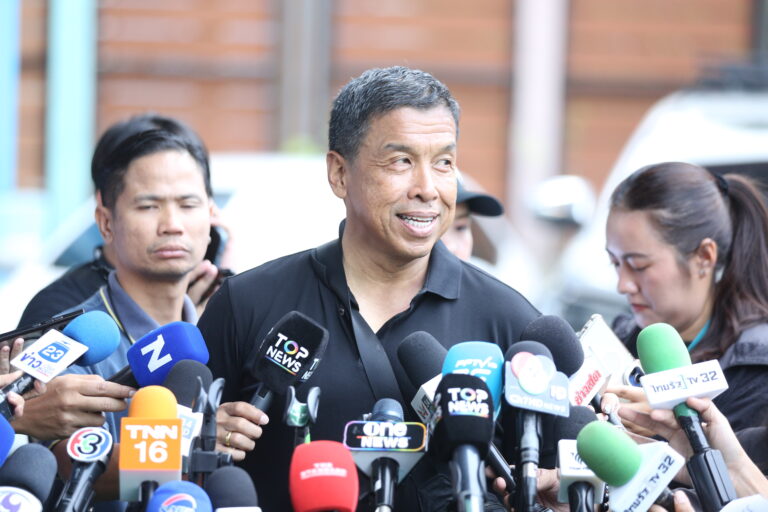
​In the end, incumbent Bangkok Governor Chadchart Sittipunt won a historic landslide victory, securing re-election with a record of more than 1.44 million votes despite earlier speculation that he might not win more than a million.

Chadchart won more votes than the next four closest candidates combined. In fact, the votes of his four major rivals combined amounted to less than half of what Chadchart received on Sunday. It is a clear mandate that he should put to good use for the public over the next four years.

​When I met Chadchart on the campaign trail late last week—less than three days before Election Day, at a market in Bangkok’s Huai Khwang district—the 60-year-old veteran politician was in his element, casually talking to voters. He did not even press them to vote for him, but simply asked them to go out and vote on Sunday.

​Say what you will about Chadchart, the man is rather down-to-earth in his approach to people, and Bangkok could definitely have had a worse governor over the past four years.

​Yes, persistent issues facing Bangkok include the PM2.5 pollution shrouding the capital during the cool and dry season, and Chadchart will have to do more. Little progress has been made in four years when it comes to rubbish separation. Furthermore, City Hall’s failure to assist homeless people and provide them with a more decent environment is clear for all to see—particularly along Ratchadamnoen Avenue at night, where you can witness a side of Bangkok that no Bangkokian can be proud of.

​Beyond Bangkok, if Chadchart succeeds in outdoing himself in the next four years, he could definitely become serious PM material for Thailand. That matter is still in the distant future, however.

​As for the candidate who was supposed to be Chadchart’s most realistic competitor for the seat at City Hall, the main opposition People’s Party candidate, Chaiwat Sathawornwichit, was the biggest disappointment. The 44-year-old, Japan-educated candidate failed miserably, finishing not second, but a distant third with just over 176,000 votes compared to Chadchart’s 1.44 million. This occurred despite the fact that the party won all the MP seats in Bangkok during the February general election less than five months earlier.

S 7315499 0
Chadchart Sittipunt

​One factor making more and more people resent the People’s Party is its arrogance—or stubborn pride. Many within the party seem to believe that because they see themselves as the heroes on the righteous side, they never need to back down or admit they might have made a mistake. This was evident when the party appointed former junta supporter Surapol Nitikraipot as chief adviser to their Bangkok gubernatorial candidate, as well as in their decision late last year to vote for Anutin Charnvirakul as PM.

These moves were made despite loud, immediate objections from many well-intentioned supporters. These are but two clear examples. If the party refuses to listen to criticism or acknowledge missteps, it risks losing the trust of even more people moving forward.

​The party essentially missed another golden opportunity to put one of its members in a position of power that could make a difference and prove to the public that it could run the Thai capital better than Chadchart.

​In the end, the party wasted an opportunity. Surapol became a major distraction that sucked away a week of precious campaign time that could have been used to convince voters that Chaiwat was the better candidate. Instead, the party spent a full week defending its appointment decision.

​Choosing Surapol was a strategic blunder, as it needlessly conflated deeply polarised national politics with local politics.

​Ultimately, voters did not have enough confidence in Chaiwat. The party and his supporters also spent more time criticising and attacking Chadchart than convincing voters of why Chaiwat might provide better governance and improve Bangkok.

To be fair, the People’s Party actually led in 22 out of 50 districts in the concurrent Bangkok Metropolitan Council election. This means the party is still relatively popular in Bangkok as many voters chose split-ticket strategy—preferring Chadchart’s proven leadership while backing PP councillors for legislative oversight. But that’s also because Chadchart didn’t endorse any district councillor candidate.

​Another big surprise was independent candidate Mallika Boonmeetrakool’s second-place finish, receiving significantly more votes than the People’s Party candidate. She secured over 288,000 votes, proving herself bold on social media and adept at delivering her conservative messages. In the end, she gained significantly more traction than the People’s Party candidate, despite the People’s Party enjoying a clean sweep of MPs across all Bangkok districts in February.

​Meanwhile, the ruling Bhumjaithai Party chose not to field a candidate. The party is well aware that it remains unpopular in Bangkok, where voters view party leader Anutin Charnvirakul and de facto party boss Newin Chidchob with doubt and disfavour.

​Whether you like or dislike Governor Chadchart is less important than Bangkokians pushing for positive change, holding their governor accountable, and working together to solve the city’s problems. That is how Bangkok can become a more liveable city. Our society cannot progress if the losing parties keep obstructing the winner.

S 30597149 0
Chadchart Sittipunt

​At the same time, Thais should keep pushing for greater decentralisation so that provinces across Thailand have more power to manage their own affairs. It is time for elected governors in Chiang Mai, Khon Kaen, Phuket, and elsewhere.

There is no justification for continuing to deny people in these major provinces and cities the right to elect their own governors, as Bangkokians do, so they can have a more responsive local government that is truly answerable to the people. Any argument against it—that patronage politics is more deeply rooted in the provinces, or that elected governorships would risk producing mafia governors—is ultimately indefensible. Democracy cannot mature if people are permanently told they are not ready for it. They will have to learn, make mistakes, hold bad leaders accountable, and grow.

In the end, it would be good not just for these provinces, but for Thailand as a whole. The system of having provincial governors appointed by the central government in Bangkok is over a century old and completely outdated.

​Bangkokians, who have enjoyed the right to elect their own governor for several decades now, should support such a move. The Bangkok-based press can, and should, do more to raise this issue as well. Thais elsewhere deserve no less.

Advertisement

Thailand pledges $200,000 to support Palestinian refugees through UN agency

UNITED NATIONS — Thailand has pledged $200,000 in renewed multi-year funding to the United Nations Relief and Works Agency for Palestine Refugees in the Near East (UNRWA) for the 2027–2031 period, reaffirming its support for Palestinian refugees.

The announcement was made by Charge d’Affaires a.i. Pawaree Xuto Chaipatiyut at the 2026 UNRWA Pledging Conference on 30 June.

In addition to the five-year commitment, Thailand also announced an extra $50,000 contribution to support UNRWA’s 2026 Flash Appeal, which provides emergency humanitarian assistance to Palestinian refugees.

Speaking at the conference, Pawaree said the international community should continue providing strong political support to ensure UNRWA can carry out its mandate independently and impartially.

“Supporting UNRWA is not only a humanitarian imperative, but also an investment in dignity, stability, and hope for millions of Palestine refugees,” she said.

Advertisement

Gulf successfully closes oversubscribed US$600 million offshore syndicated term loan, expanding international funding access

Gulf Development Public Company Limited (“GULF” or the “Company”) has successfully closed its offshore syndicated term loan facility, a US$600 million syndicated term loan facility (the “Facility”), marking a significant milestone in the Company’s funding strategy.

Initially launched in May 2026 at US$400 million, comprising 3-year and 5-year tranches, the Facility received strong support from GULF’s relationship banks and attracted significant interest from a broad group of lenders, including several institutions establishing lending relationships with GULF for the first time. At closing, the Facility brought together 33 banks and achieved peak demand of approximately 4 times the initial facility size, enabling GULF to exercise its greenshoe option and upsize the Facility by US$200 million to reach the final amount of US$600 million.

The Facility attracted participation from a diverse group of international financial institutions across Japan, Taiwan, Singapore, China, Hong Kong, Philippines, India, Macau, and France, supported by GULF’s longstanding relationships with Japanese and Chinese partners, suppliers, and EPC contractors across its projects.

The strong market response reflects lenders’ confidence in GULF’s robust financial position, disciplined capital management, stable cash flow generation, and proven track record in developing and operating       large-scale energy and infrastructure projects. It also demonstrates recognition of GULF’s position as a leading infrastructure and investment group with the ability to capture future growth opportunities beyond its traditional businesses.

Ms. Yupapin Wangviwat, Chief Financial Officer of GULF Group, said: “The successful completion of this Facility represents an important milestone in GULF’s funding strategy, expanding our access to international markets and further diversifying our sources of financing. The strong response from the banking community, with commitments reaching nearly four times the initial facility size at peak demand, reflects lenders’ confidence in GULF’s financial strength, operational track record, and long-term growth strategy. This confidence is further reinforced by GULF’s achievement of an ‘A’ credit rating with a Stable outlook from Japan Credit Rating Agency (JCR), equivalent to Thailand’s sovereign rating. The transaction strengthens our relationships with existing banking partners, establishes new partnerships with international lenders, and enhances our financial flexibility by providing an additional funding source beyond the domestic Thai baht bond market.”

DBS Bank Ltd., Mizuho Bank, Ltd., MUFG Bank, Ltd., Natixis, Singapore Branch, Sumitomo Mitsui Banking Corporation Singapore Branch, and United Overseas Bank Limited acted as Mandated Lead Arrangers, Underwriters, and Bookrunners, as well as Coordinators for the Facility. Mizuho Bank, Ltd. also acted as the Facility Agent.

Advertisement

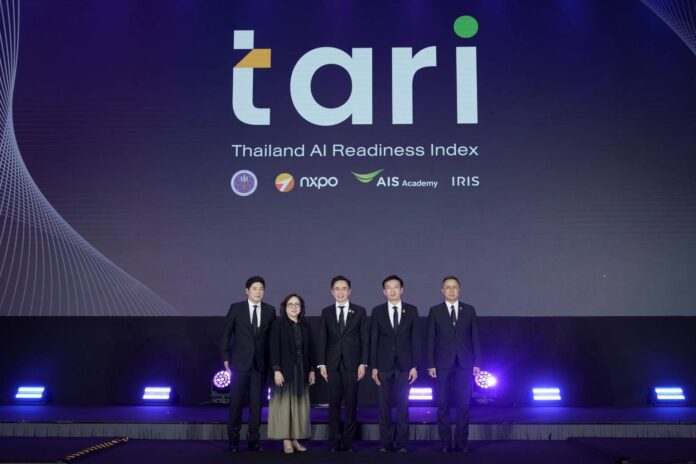
Thailand’s First AI Readiness Index: MHESI, through NXPO, Joins Forces with AIS Academy and IRIS to Launch “TARI”

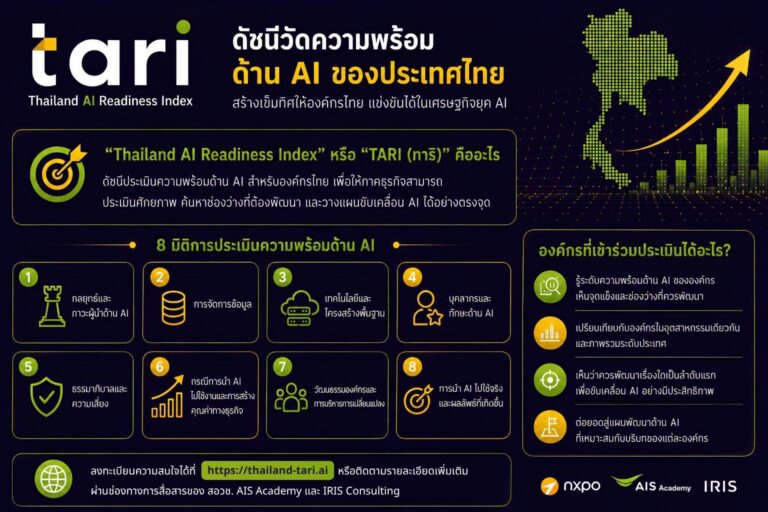
Thailand is entering a critical phase of transformation across its economy, technology landscape, and workforce. As AI becomes a key driver of national and business competitiveness, Thai organizations are increasingly exploring how to apply AI within their operations. The focus, however, is no longer simply on access to technology, but on organizational readiness to translate AI adoption into meaningful impact across people, skills, data, processes, governance, and organizational culture. To address this need, the Ministry of Higher Education, Science, Research and Innovation (MHESI), through the Office of National Higher Education Science Research and Innovation Policy Council (NXPO), in collaboration with AIS Academy and IRIS Consulting, has developed the “Thailand AI Readiness Index” or “TARI,” Thailand’s first AI readiness assessment index for organizations. TARI aims to provide Thai businesses with a practical framework to assess their current capabilities, identify priority areas for improvement, and plan their AI transformation more effectively.  The initiative also opens the door for organizations across industries to take part in shaping the assessment framework and contributing to a national benchmarking database, strengthening the readiness of Thai enterprises and supporting the country’s transition toward an AI-driven economy.
140395

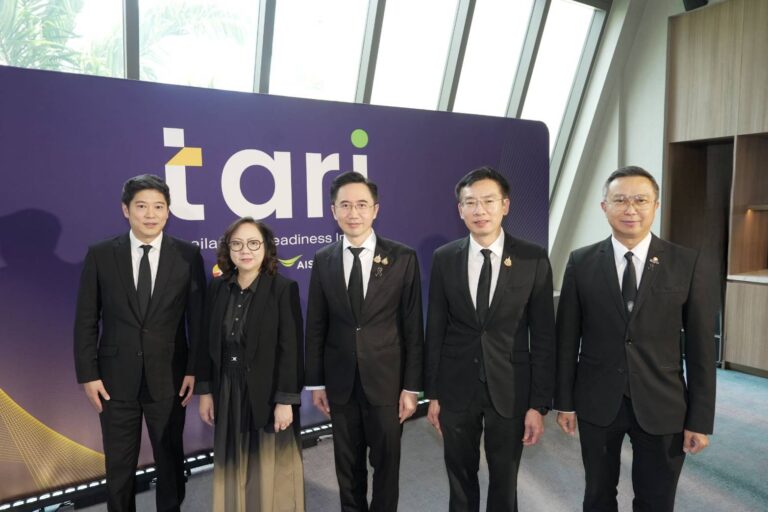
Professor Dr. Yodchanan Wongsawat, Deputy Prime Minister and the Minister of Higher Education, Science, Research and Innovation (MHESI), said, “AI is not merely a new technology. It is becoming a key factor in shaping the direction of national development across the economy, industry, innovation, and workforce. The ability of Thai organizations to adopt AI effectively will serve as an important mechanism to strengthen the country’s long-term competitiveness. The TARI initiative therefore plays an important role in building a systematic understanding of the current level of AI readiness among Thai organizations. These insights will provide a critical foundation for the government to design targeted policies and support programs that help Thai organizations strengthen their AI readiness and adoption, while enabling the business sector to plan a stable and sustainable transition toward the AI economy.”
140394

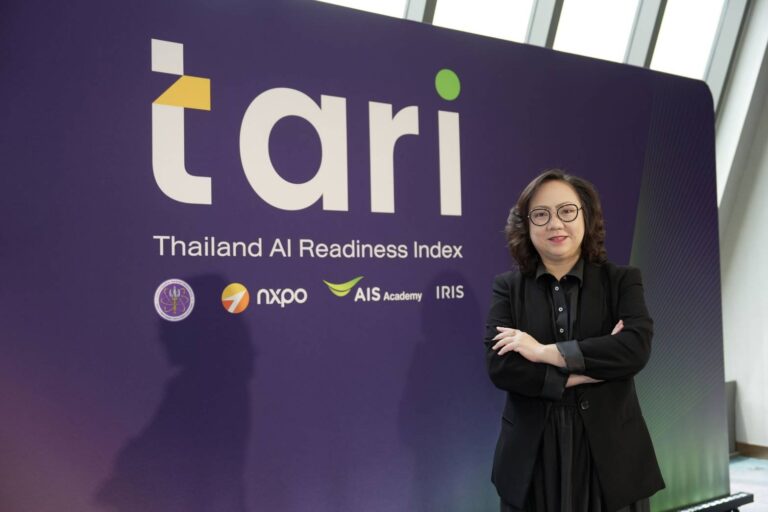
Ms. Kantima Lerlertyuttitham, Deputy Chief Executive Officer and Chief Corporate Officer at AIS, said, “Thailand is reaching a critical milestone in its transition toward an AI economy, a shift that is not only changing the way we work, but also redefining the country’s competitiveness. The key question is therefore not whether AI will replace people, but how we can prepare people, organizations, and the nation to use AI to enhance productivity and drive economic growth. However, the challenge many organizations face today is not a lack of technology, but uncertainty over how ready they are, where they should begin, and how AI can be applied to create real business impact. This is a critical question that we must work together to address with urgency.”

“Drawing on AIS’s experience in driving AI transformation within the organization, from building AI literacy and preparing teams to use AI to improve work efficiency, to upskilling employees at all levels and extending AI capabilities into products and services for enterprise customers, we believe that the transition into the AI era must begin with a clear understanding of an organization’s readiness across people, skills, data, work processes, and organizational culture, rather than technology investment alone.”

“Guided by AIS’s core vision of ‘Think Ahead for Thais,’ we look beyond the development of technology and capabilities within our own organization. We also think ahead for the readiness of Thai organizations, Thai people, and the country as a whole. This vision has led to our collaboration with leading partners to develop TARI as a common tool that helps Thai organizations assess their readiness, identify gaps, and define a more effective direction for AI adoption. We believe TARI will become an important mechanism to help Thai organizations and  the country move confidently toward the AI economy, at a time when competitiveness is no longer defined by who has more AI, but by who is better prepared to use AI effectively,” Ms. Kantima added.

Dr. Surachai Sathitkunarat, President of the Office of National Higher Education Science Research and Innovation Policy Council (NXPO), said, “One of the key challenges in developing AI policy is the availability of sufficient, reliable data that accurately reflects the current state of Thai organizations. At present, data on AI adoption readiness remains fragmented, making it difficult to gain a systematic overview of readiness across industries. TARI will therefore play an important role in establishing a common assessment framework that enables all sectors to gain a clearer understanding of their level of readiness. NXPO will use the aggregated insights from TARI to analyze and design support measures that align with the specific context of each industry, while ensuring careful data governance to build trust among participating organizations and enable the appropriate use of data for policy development.”

Mr. Boriwat Pinpradab, Chairman at IRIS Consulting, says that “From IRIS’s experience working with organizations across a wide range of industries, we have found that many organizations are committed to advancing AI, but remain uncertain about where to invest first. Should they start by developing people, strengthening data capabilities, or redesigning certain work processes as the first priority?  At the same time, some organizations may already have AI projects in place but have yet to clearly connect them to organization-wide impact.

This is why a standardized readiness assessment tool is essential. Before developing a roadmap, organizations must first understand their starting points. The development of TARI is the result of collaboration among the public sector, policymakers, and leading businesses in Thailand to answer a key question: how should Thai organizations assess their AI readiness in a way that reflects reality and enables the results to be applied in practice? For IRIS, we are proud to be part of designing TARI as more than an assessment index, but as a strategic framework that helps Thai organizations see their development direction more clearly and establishes a common language for AI readiness in Thailand going forward.”
140398

Under this collaboration, TARI will act as a mechanism to bring together the public sector, private sector, and industry to establish a systematic standard for AI readiness assessment. The framework is designed to cover assessments at the organizational, functional, and individual levels, reflecting readiness from leadership vision, strategy, and policy to data capabilities, work processes, AI use cases, as well as employees’ knowledge, understanding, and capability to apply AI in practice.

TARI will assess organizational readiness across eight dimensions: 1) AI strategy and leadership, 2) data management, 3) technology and infrastructure, 4) people and AI skills, 5) governance and risk, 6) AI use cases and business value creation, 7) organizational culture and change management, and 8) AI implementation and realized impact. The initiative will be driven through three key stages:

  • Measure – Helping organizations gain a comprehensive understanding of their AI readiness, enabling them to identify strengths, gaps, and priority areas for development.
  • Benchmark – Enabling organizations to compare their capabilities against industry peers and national benchmarks, helping them prioritize development and investment for maximum impact.
  • Activate -Turning assessment results into practical action plans, including workforce development, process improvement, technology adoption, and the creation of an AI ecosystem tailored to each organization’s context.

More than 40 leading organizations across various industries have expressed interest in joining the pioneer group to help develop Thailand’s AI readiness index. The initiative will later expand to SMEs, supply chain businesses, and organizations across different sectors, with a target of at least 5,000 organizations participating                   in the assessment in the first year and more than 20,000 organizations in the next phase. This will enable Thai businesses at all levels to apply AI to create real value and achieve sustainable growth in the AI economy.

Organizations interested in contributing to the development of the Thailand AI Readiness Index (TARI) can learn more and register their interest at https://thailand-tari.ai, or stay updated through the official communication channels of NXPO, AIS Academy, and IRIS Consulting.


Advertisement

Hot News

LATEST NEWS

Bangkok
light rain
28.1 ° C
28.3 °
27.2 °
73 %
0.5kmh
100 %
Wed
28 °
Thu
28 °
Fri
29 °
Sat
27 °
Sun
29 °