31.6 C
Bangkok
Monday, June 15, 2026
Home Blog Page 8

DE warns of fake “Thais Help Thais Plus” SMS

DE Warns of Fake “Thais Help Thais Plus” SMS Offering 900 Baht a Day, with Fraudulent Links Posing Risks to Money and Personal Data.

Mr.Wetang Phuangsup, Ministry of Digital Economy and Society Spokesperson, revealed the latest monitoring results from the Anti-Fake News Center Thailand (AFNC), in line with the policy of Mr.Chaichanok Chidchob, Minister of Digital Economy and Society, to strengthen public awareness of technology-related crimes, fake news, and misinformation.

Picture1 2

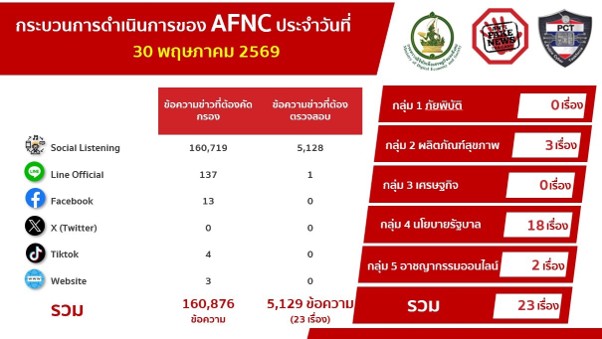
AFNC monitored a total of 160,876 messages and identified 5,129 messages requiring verification. Most reports came from Social Listening channels, accounting for 5,128 messages, while one report was received through the AFNC Line Official account.

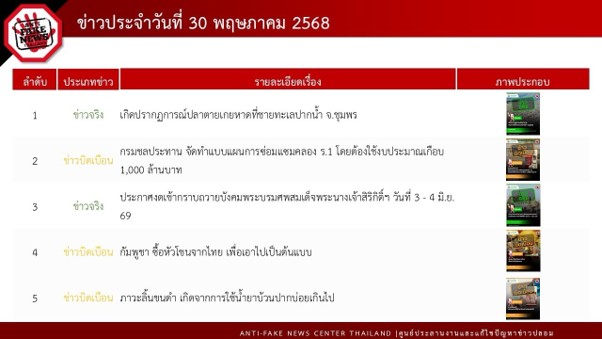
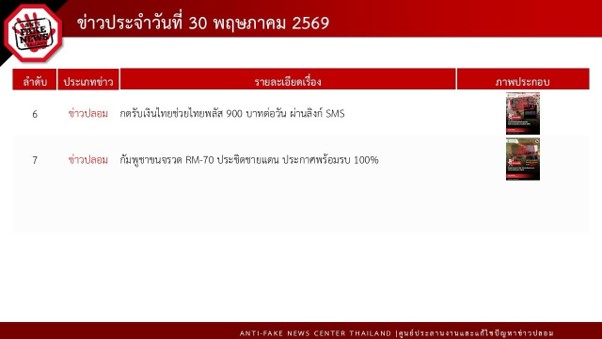
A total of 23 issues were investigated, with verification results received for four cases. Among the seven stories that attracted the highest public interest, there were two true stories, two fake stories, and three misleading stories.

One of the most notable fake stories claimed that people could receive 900 baht per day through the “Thais Help Thais Plus” scheme by clicking a link sent via SMS.

The Ministry of Digital Economy and Society coordinated with the Fiscal Policy Office (FPO) under the Ministry of Finance and confirmed that the SMS message contained a fraudulent link. The ministry therefore warns the public not to click links attached to SMS messages claiming to provide benefits or financial assistance, as scammers may use them to steal personal information or money.

The “Thais Help Thais Plus” scheme was open for registration from 25–29 May 2026, between 6:00 a.m. and 10:00 p.m., exclusively through the “Paotang” application. No other registration channels were provided, and government agencies do not send SMS messages containing registration links.

The ministry remains concerned about the spread of fake news and misinformation on online and social media platforms. Sharing unverified information may cause misunderstanding, financial losses, the misuse of personal data, and wider social impacts.

The public is encouraged to trust and share information only from official sources and to carefully verify facts and website links before believing or forwarding any information.

People who encounter suspicious information or possible fake news can report it or verify information through the Anti-Fake News Center Thailand via Hotline 1111 ext. 87, available 24 hours a day.

Picture2 2Picture3 2

Advertisement

German Tawandang launches custom Foam Art beer experience

BANGKOK — German Tawandang has introduced “Foam Art”, a new serving concept that allows personalised images and messages to be printed directly onto beer foam.

The company says the concept is built on its signature micro-foam technique, which produces a dense, stable layer of foam designed to preserve aroma and enhance flavour. According to German Tawandang, the foam can also serve as a printable surface for customised designs, including photographs, logos, messages and signatures.

Marketed under the slogan “Print Your Moment”, the service uses food-grade edible ink to create personalised beer presentations for celebrations, corporate events and social gatherings.

1 web 2

German Tawandang says it is the first Thai brand to offer large-scale beer foam printing as part of its customer experience programme.

The company has also launched the “Foam Art On Tour” campaign, bringing the concept to venues across Thailand.

More information is available through the German Tawandang Facebook page.

Advertisement

Hundreds lose nearly 1.1 million Baht in BTS ticket booking scam

Hundreds lose nearly 1.1 million Baht in BTS ticket booking scam

BANGKOK — 9 June 2026, June 2026, Hundreds of concertgoers say they were defrauded by an X account offering BTS World Tour ticket-buying services after the operator allegedly deleted the account and disappeared with nearly 1.1 million baht ($33,398) in customer payments.

The account had built a strong following by offering ticket-booking services for major concerts and sharing numerous positive reviews under the hashtag #รีวิวกดบัตรร้านซัมซัม. The service reportedly charged booking fees of 300 to 700 baht per ticket and required customers to transfer deposits and ticket payments in advance.

However, on Tuesday, the day BTS World Tour tickets went on sale, the account was abruptly deleted and customers were unable to contact the operator through either X or LINE. Victims subsequently created a Line Open Chat group to exchange information, gather evidence and trace the flow of funds.

According to information compiled by the group, most payments were transferred to bank accounts registered to a nursing student. The account holder later joined the chat group and claimed she had been paid to allow another person to use her account to receive transfers, insisting she was unaware it was allegedly being used for fraudulent activity.

She said the funds were subsequently transferred to another individual identified as “Praewa” through bank accounts and TrueMoney Wallet transactions. Both the nursing student and Praewa reportedly told victims that they had been working on behalf of another person known only as “Gam” and did not know their actions were connected to an alleged scam.

Many victims remain unconvinced, citing financial links they say connect the individuals involved.

One victim, identified only as “Rin”, said she discovered the service through BTS-related hashtags on X and was persuaded by what appeared to be numerous positive reviews. She paid the service to secure two VIP tickets before realising she had become one of hundreds of alleged victims.

Another victim, “Nui”, said information collected through a shared Google Sheet indicated that at least 145 people had been affected, with total losses approaching 1.1 million baht. Victims also identified multiple receiving accounts at several banks, including Kasikornbank and Krungthai Bank, leading some to suspect the operators used multiple accounts to make transactions more difficult to trace.

Many victims believe the operation was carefully orchestrated. They allege that numerous review accounts and testimonials were created to build credibility and gain the trust of prospective customers. Following the account’s disappearance, many of the promotional review posts and hashtags also vanished, leaving behind warnings from victims and discussions about the alleged fraud.

Affected customers have begun filing complaints with police while collecting transfer records, chat logs and other evidence to support the investigation.

Most recently, “Palm” Nithikorn Boonyokulcharoen, a former People’s Party party-list candidate, joined the victims’ Line Open Chat group and pledged to help pursue the case. He said he would coordinate with members of parliament, relevant parliamentary committees and the media to assist victims and raise public awareness.

Victims are urging anyone affected to preserve transfer slips, chat records, screenshots and other relevant evidence, and to file police reports as soon as possible to help investigators trace the money trail and identify those responsible.

Advertisement

13 hospitalised after eating noodle soup made with mystery powder in Udon Thani

UDON THANI — 9 June 2026, 13 people were hospitalised after eating noodle soup from a roadside restaurant in northeastern Thailand, where a mystery white powder collected from a rubbish pile was allegedly used in place of salt, authorities said.

Police, forensic officers and public health officials inspected the noodle shop in Muang district, Udon Thani province, after customers and members of the owner’s family fell ill on 8 June. Six people remained in hospital on 9 June, while others had been discharged.

Victims reported symptoms including nausea, vomiting, dizziness, breathing difficulties and diarrhoea. Among those affected were the noodle vendor and her daughter.

Provincial public health officials collected food samples, ingredients and other evidence from the shop for laboratory testing. Authorities said the exact cause of the illnesses remains under investigation.

Police said the shop owner, a 70-year-old woman identified as Pan, had been operating the business for six to seven years. She told investigators that she believed the white powder was salt after tasting it and finding it salty.

According to her account, her son had brought her two small bags of the substance several days earlier. After running out of salt on the morning of 8 June, she used the powder while preparing the noodle broth.

“The powder looked old and slightly yellow, but when I tasted it, it was salty, so I thought it was salt,” she said.

Pan said she sampled the broth after cooking and soon developed numbness around her lips, followed by dizziness and diarrhoea. She later sought medical treatment.

She broke down in tears while speaking to reporters, insisting she had never experienced a similar incident during years of running the business.

“If it was poison, it would have harmed everyone in the kitchen as well,” she said. “My family ate the noodles too. I feel very sorry that this happened.”

A relative who helped run the shop said she also tasted the broth before serving customers and later suffered severe vomiting and diarrhoea.

She said the owner’s daughter became seriously ill, suffering convulsions and temporary vision loss before being rushed to hospital by rescue workers.

The owner’s son, 46-year-old Sinchu, admitted bringing the powder to the shop. He told police he had obtained it from a local man and believed it was salt.

Investigators later accompanied him to the man’s home, where large quantities of discarded materials collected for resale were stored. The man, identified only as “A”, told police he regularly gathered unwanted items from rubbish dumps and roadside waste for recycling and had warned Sinchu not to take the bags because they had come from a rubbish pile and were not clean.

2 web 6

Forensic officers seized three bags containing white powder from the property for further examination.

Later on 9 June, the father of a 35-year-old construction worker filed a police report after his son, who had eaten at the shop, was admitted to intensive care.

The father said his son developed stomach pain, breathing difficulties, tremors and a rapid heartbeat shortly after eating noodle soup at the restaurant. He was eventually transferred to Udon Thani Hospital, where he was placed on a ventilator.

Doctors later informed the family that he was no longer in critical condition but would remain under observation for several days.

“I want the restaurant to take responsibility for what happened,” the father said. “Food should be prepared safely and hygienically.”

Results from forensic and laboratory testing remain pending as authorities continue their investigation.

Advertisement

Deadly storm kills 757 flying foxes after century-old tree falls

Deadly storm kills 757 flying foxes after century-old tree falls

NAKHON NAYOK — 10 June 2026, A powerful storm toppled a century-old Yang Na tree at a temple in Nakhon Nayok province, killing 757 large flying foxes and injuring 47 others, wildlife officials said.

Officials and veterinarians from the Protected Areas Regional Office 1 (Prachin Buri), together with Ruamkatanyu Foundation rescue volunteers, worked to clear the fallen tree at Wat Kradan in Ban Na district after it collapsed during a storm on the afternoon of 9 June.

10 ฝน4 0

The tree, estimated to be more than 100 years old, served as a roost for thousands of large flying foxes and their young. Authorities said strong winds and heavy rain brought the ageing tree down, trapping many of the animals beneath branches and debris before they could escape.

Rescue teams spent more than five hours cutting the fallen tree into smaller sections and searching for surviving animals.

10 ฝน6 0

Officials classified the bats into three groups: those that died, those that were injured and those that remained unharmed. Carcasses were collected for disposal in accordance with Department of National Parks regulations, while injured animals were transported to Wildlife Rescue Centre 1 in Nakhon Nayok for treatment and rehabilitation. Healthy bats were released onto nearby trees within the area.

Preliminary surveys found that 757 flying foxes had died, while 47 injured animals were taken for veterinary care.

10 ฝน5 0

Authorities said they would continue searching the site for additional injured bats and remove any remaining carcasses in accordance with wildlife management procedures.

Wildlife officials also appealed for public donations of cages, medical supplies and other equipment to support the treatment of injured bats at the rescue centre in Nakhon Nayok.

Advertisement

DE speeds up refunds for scam victims ahead of new regulation

DE Expedites Refund Process for Scam Victims Ahead of Ministerial Regulation Taking Effect on 12 August 2026

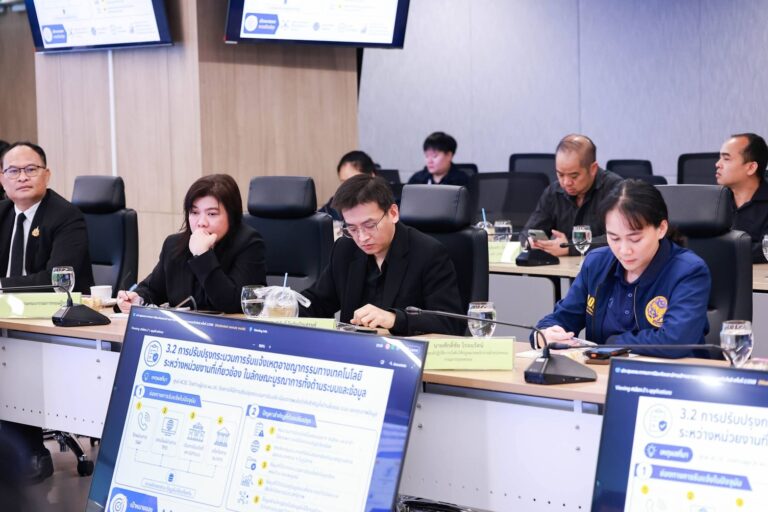
Mr. Chaichanok Chidchob, Minister of Digital Economy and Society (DE), assigned Ms. Nan Boontida Somchai, Deputy Minister of Digital Economy and Society (DE), to chair the second meeting of the Committee on the Prevention and Suppression of Technology Crimes under Section 13 of the Emergency Decree on Measures for the Prevention and Suppression of Technology Crimes B.E. 2566 (2023). The meeting was attended by Mr. Patchara Anuntasilpa, Permanent Secretary of the Ministry of Digital Economy and Society, along with representatives from relevant agencies, at the Ministry of Digital Economy and Society.

Picture2 1

Ms. Nan Boontida Somchai stated that the meeting reviewed the implementation of measures undertaken by various agencies to prevent and suppress online crimes. The committee acknowledged a report from the Royal Thai Police indicating that the average daily financial losses caused by scams had declined significantly, from approximately 100 million baht per day to around 25 million baht per day. This reduction reflects the effectiveness of intensified and continuous enforcement measures.

Picture3 1

The meeting also followed up on preparations for the implementation of the Ministerial Regulation on the Refund of Assets to Victims of Technology Crimes B.E. 2569 (2026), issued pursuant to Sections 8/1 paragraph four and 8/2 paragraph three. The regulation was published in the Royal Gazette on 14 May 2026 and will come into force after a 90-day grace period, on 12 August 2026.

Picture4 1

The regulation is expected to facilitate a faster and more convenient refund process for victims by reducing procedural steps. Under the new mechanism, compensation can be returned through the Anti-Money Laundering Office (AMLO) Transaction Committee without the need to wait for a court order. AMLO is currently accelerating preparations and establishing clear operational guidelines to ensure readiness when the regulation becomes effective.

“The Ministry of Digital Economy and Society and all relevant agencies place great importance on expediting compensation for victims of scams in order to alleviate the hardships faced by affected citizens. Every aspect of the process will be carefully reviewed to ensure maximum readiness when the ministerial regulation comes into effect,” said the Deputy Minister.

Advertisement

Pathum Thani aims to transform the “Eye of Thailand” into a global landmark

PATHUM THANI — 9 June 2026, The Pathum Thani Provincial Administrative Organization (PAO) is pushing forward plans to develop the “Eye of Thailand,” a circular floating island located in a wetland in Pathum Thani, into the province’s newest landmark. Discussions are underway with private landowners and experts to establish conservation guidelines and explore its potential as a future eco-tourism destination.

On Tuesday, Pol. Lt. Gen. Kamronwit Toopkrachang, President of the Pathum Thani PAO, and Assoc. Prof. Dr. Prinya Thaewanarumitkul jointly outlined proposed management plans for the site. Interest in the location has surged after images of the Eye of Thailand went viral online due to its resemblance to “El Ojo,” a near-perfect circular floating island in Argentina.

2 web 5

Assoc. Prof. Dr. Prinya said he first identified the island during an aerial drone survey two years ago but only recently decided to publicise its existence. He said he was concerned that, if left unprotected, the area could be altered by landowners seeking to avoid vacant land tax obligations, potentially leading to the loss of the unique natural feature.

Preliminary assessments suggest the island formed naturally within an abandoned soil excavation pit that has remained unused for more than 50 years. Over time, aquatic plants and vegetation accumulated into a floating mass that was gradually shaped by wind and shoreline friction, eventually forming a circular structure resembling an eye.

Pol. Lt. Gen. Kamronwit said that although the land remains privately owned by a corporate entity, the PAO is prepared to work with the owners to preserve its natural condition and study the feasibility of developing the area into a public park, including the possible construction of an observation tower for visitors.

“If this area can be developed, it could become a wonder of the world located in Pathum Thani,” he said. “We hope that in the future, when people think of Pathum Thani, they will think of the Eye of Thailand alongside the province’s other distinctive features.”

The growing interest in the site has also prompted scientific scrutiny. Assoc. Prof. Dr. Jessada Dendoungboripant, a lecturer at the Faculty of Science, Chulalongkorn University, analysed historical satellite imagery using Google Earth and found that the location was previously a large pond covered with aquatic vegetation and water hyacinths.

Satellite images dating back to 2004 show the floating vegetation continuously changing shape before gradually developing its distinctive circular appearance. The findings support the theory that the formation resulted from the natural movement of aquatic plants driven by wind currents and environmental conditions, rather than any unexplained phenomenon.

The Pathum Thani PAO has urged the public not to enter the area, as it remains private property and is currently under review as part of ongoing discussions on conservation and development. Officials said the restriction is intended to protect the ecosystem and ensure any future public access can be managed safely.

Advertisement

Thai PM Warns Against Use of Force Amid Border Conflict

Thai PM Warns Against Use of Force Amid Border Conflict

HANOI, Vietnam — 9 June 2026, Thai Prime Minister Anutin Charnvirakul said Thailand has never infringed upon another country’s sovereignty and warned that anyone considering the use of force against Thailand should “think carefully”, following reports in Cambodian media about remarks by former Cambodian leader Hun Sen.

Speaking to reporters in Vietnam at 16:15 on 9 June, Anutin responded to reports that Hun Sen had vowed to reclaim territory through negotiations or, if necessary, by force.

“I would like to reaffirm that Thailand has never invaded or violated the sovereignty of other countries,” Anutin said. “Thailand’s position is clear: we will not allow anyone to encroach upon our sovereignty.”

He said measures taken by Thailand were aimed solely at protecting its territorial integrity and national sovereignty.

“I believe anyone thinking of encroaching on Thailand or using force against Thailand should think very carefully,” he added.

When asked whether his remarks were intended as a warning, Anutin responded jokingly: “They wouldn’t dare.”

Advertisement

Cambodia vowed to fire officials who failed to stop scam centres. Has anyone been held accountable?

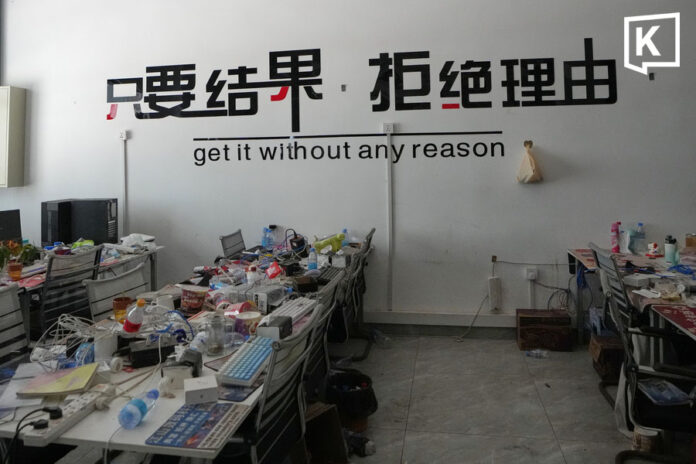
A view of a work station at the scam compound in O'Smach, Cambodia, Tuesday, 7 April 2026. (AP Photo/Sakchai Lalit)

When Cambodia launched its largest nationwide crackdown on online scam operations last July, Prime Minister Hun Manet’s government issued an unusually blunt warning to officials responsible for carrying it out.

Authorities who failed to follow the order, or refused to cooperate with the campaign, could face a performance review leading to reassignment or dismissal, according to the nine-point directive signed on 4 July 2025 and reported by Khmer Times on 16 July in the same year.

Nearly a year later, Cambodia is defending the results of that campaign after Amnesty International published a major new report alleging that most of the scam compounds identified by its researchers appear to have escaped the crackdown.

The dispute leaves a central question unresolved: who is being held accountable under the government’s own order?

Amnesty International said on Monday that it had identified 33 additional scamming compounds since its previous investigation in June 2025, bringing the total number of confirmed locations in its research to 86 as of the end of April.

The rights group said it found evidence of state intervention at only 24 of those compounds. It also documented mass escapes or releases at a further seven locations, with no police presence reported at the time.

Amnesty acknowledged that the absence of publicly available evidence does not necessarily prove that authorities failed to visit a particular location. However, the organisation said the lack of transparency surrounding the crackdown made government claims difficult to independently verify.

Its findings contrast sharply with Cambodia’s public account of the campaign.

In March, Senior Minister Chhay Sinarith, who heads the Commission for Combating Online Scams, told the Associated Press that authorities had targeted around 250 locations and shut down approximately 80 per cent of them, or about 200 sites. At the time, he said Cambodia hoped to close the remaining operations by the end of April.

Responding to Amnesty’s latest report, Chhay Sinarith rejected the implication that Cambodia was failing to act against online scam operations.

In a statement reported by Reuters, he described Amnesty’s findings as “selective, one-sided, and lacking full understanding of the realities on the ground”, arguing that the report overlooked coordinated police operations, arrests, asset seizures and the dismantling of criminal compounds across several provinces.

In a separate written response to Bloomberg, he said the findings “do not reflect the significant efforts and concrete measures” taken by the government.
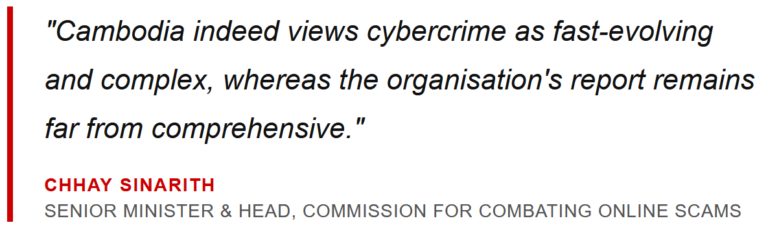
cchay web quote

Cambodia has cited significant enforcement figures. The government says it has revoked the licences of 25 casinos suspected of involvement in scams, charged nearly 1,500 suspects from 19 countries, deported almost 19,000 foreign nationals and recorded the voluntary departure of around 290,000 others.

Those figures suggest that the crackdown has had a substantial impact. Amnesty itself acknowledges that enforcement pressure likely contributed to the release or escape of thousands of people from scam compounds.

But the government’s response leaves a striking gap. While the minister dismissed Amnesty’s 178-page report as “far from comprehensive”, Cambodian authorities have not publicly produced a comparably detailed account of the crackdown, nor directly addressed the report’s central findings: that many compounds appeared to continue operating after the campaign began, that alleged perpetrators have often avoided accountability, and that survivors still face serious shortcomings in protection and support.

The dispute is therefore not over whether Cambodia has taken action. It is over whether that action has dismantled the networks behind the compounds — and whether the government has provided enough evidence to substantiate its claims of success.

A campaign built around official responsibility

The government’s nine-point order placed responsibility across several layers of the state, requiring coordinated action by provincial authorities, national police, border officials, the courts and Cambodia’s gambling regulator.

It also carried a warning directed at law enforcement and military personnel.

“not following this order, or not cooperating with this order, in any action, this is used as a form of performance review to either change your position or fire you from your position,”

That warning is now especially significant because Amnesty alleges that some interventions were reactive, ineffective or undermined by apparent collusion between police and compound managers.

In some cases, survivors told Amnesty that people held inside compounds were moved shortly before authorities arrived.

One survivor, identified by the pseudonym Winta, said managers at a compound in Chrey Thum told captives that police were on their way before relocating them across the country to a site near Poipet.

Amnesty said another survivor reported that a vehicle with military licence plates led the journey between the two locations. The organisation also cited accounts of vehicles with military plates entering and leaving the second compound.

Such allegations are not new. The US State Department’s 2024 human rights report said observers had reported that scam compounds often received advance warning of impending law-enforcement actions or were not investigated. Khaosod English reported in January that Thai authorities had identified a new compound deeper inside Cambodia, with officials warning that scam syndicates were relocating to escape regional crackdowns.

The Cambodian government has rejected Amnesty’s broader characterisation of its crackdown and has argued that transnational criminal networks are highly adaptive and deliberately designed to evade law enforcement.

That explanation may account for some of the difficulties authorities face. Online scam networks operate across borders, move workers between locations and frequently adapt their methods in response to police pressure.

However, it does not fully answer the accountability question raised by the government’s own order.

If compound operators received advance warning of police actions, were officials investigated? If compounds continued operating after state interventions, were local authorities asked to explain why? Have any officials been reassigned, suspended or dismissed under the performance-review mechanism announced last July?

The public responses issued following Amnesty’s report have emphasised the scale of enforcement activity. They have not explained whether the government has taken action against officials who may have failed to carry out the order or enabled compounds to remain operational.

Survivors treated as immigration offenders

Amnesty’s report also argues that Cambodia has failed to protect people escaping the compounds.

Its researchers interviewed 73 survivors from 16 countries who had been held across 20 sites during the crackdown period. The organisation said their testimony documented a consistent pattern of trafficking, forced labour, torture or other ill-treatment, and deprivation of liberty amounting in many cases to enslavement.

Six women described rape by, or at the direction of, compound managers or team leaders.
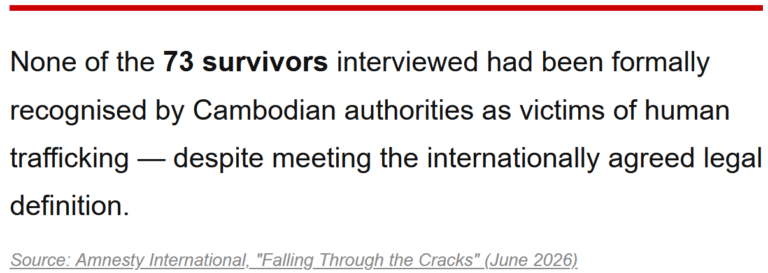
73 amnesty

Instead, the organisation said some people escaping or released from compounds were treated as irregular migrants, detained in substandard immigration facilities and charged visa-overstay fees. Some survivors reportedly had to borrow money to leave the country.

In at least six cases, Amnesty said police threatened victims with arrest or detained them without providing access to legal counsel.

The crackdown will be judged by what survives it

Cambodia’s scam industry presents an unusually complex challenge because it creates victims on both sides of the operation. People around the world lose money through fraudulent investments, romance scams and other schemes. At the same time, many of the workers carrying out those scams are themselves trafficked into prison-like compounds and forced to work under threat of violence.

Cambodia’s government says it is confronting a fast-moving criminal industry with extensive enforcement operations.

Amnesty’s report raises a more uncomfortable question: whether the raids are dismantling the industry, or merely creating the appearance of action while the networks behind it adapt, relocate and survive.

The answer may depend not only on the number of raids conducted or people deported, but on whether Cambodia enforces its own promise to hold officials accountable when scam compounds continue operating under their watch.


Advertisement

Two-year-old baby dies after alleged drink-driving crash

Two-year-old baby dies after alleged drink-driving crash

LAMPANG — 9 June 2026, A two-year-old baby “Nong Termfun,” who was tragic victim of former assistant village headman’s drink-driving, has died despite doctors’ efforts to save his life.

This follows an incident where a black Isuzu pickup truck with a Lampang license plate crashed into a parked car before ploughing into pedestrians walking along the roadside. The impact struck a family consisting of a father, a mother, and their 2-year-old son, who were walking along the side of the road. The force of the crash threw the 2-year-old boy, leaving him unconscious with life-threatening injuries at the scene. Rescue workers rushed to perform cardiopulmonary resuscitation (CPR) to save the boy’s life.

news138485 bSpAa14Cyy1780909360

The mother suffered serious injuries, including a broken leg and multiple wounds, and was taken to hospital for treatment. The father narrowly escaped being hit. The pickup driver was injured as well. The crash occurred on Monday along the Lampang-Ngao Road near Ban Pong Wang in Pichai subdistrict, Mueang district.

Preliminary investigations found that the driver, a former assistant village headman, was allegedly driving under the influence of alcohol when the crash occurred.

Most recently, at 02:25 on Tuesday, relatives of 2-year-old “Nong Termfun” announced that the child had passed away peacefully at Lampang Hospital. This came after the medical team fought with all their might to save his life, but due to the severity of his injuries, they were unable to pull him through, leaving his relatives in deep grief and mourning.

news138485 ay9p0JGyoU1780909360 0

Advertisement

Hot News

LATEST NEWS

Bangkok
broken clouds
31.6 ° C
32.8 °
30.5 °
79 %
4kmh
79 %
Mon
32 °
Tue
35 °
Wed
35 °
Thu
36 °
Fri
36 °