







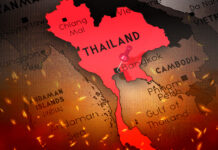















It was another precarious week for Thailand–Cambodia relations, judging by several incidents over the past few days. Some were entirely unnecessary. There was also a missed opportunity at last month’s ASEAN Summit: Prime Minister Anutin Charnvirakul and his Cambodian counterpart, Hun Manet, couldn’t even hold a bilateral meeting by themselves without the mediation of ASEAN chair Ferdinand Marcos Jr., the president of the Philippines.
This spoke volumes about the continuing distrust between the two sides, five months after the ceasefire in late December. Anutin may also be wary of giving ammunition to Thais who suspect that any private discussion with the Cambodian leader could involve a secret deal, as critics once alleged of former prime minister Thaksin Shinawatra. Two decades after it was signed, Thailand revoked the 2001 memorandum of understanding on maritime disputes late last month.
As if the situation were not precarious enough, Thailand this week built a large Buddha statue along the border, which led to a protest from Cambodia, which claimed that the statue had been built on Cambodian soil occupied by Thailand.
The Thai army, meanwhile, was quick to reject Cambodia’s protest over border installations, including a Buddha statue and Thai flags, saying all activities were carried out within Thai sovereign territory.
It was an unnecessary and immature move by Thailand, which doesn’t seem to understand the notion of a ‘disputed’ territory, to allow Buddha statues to be built and put Thai flags up, which led to the protest by the Cambodian Foreign Ministry. Such actions delay the normalisation of relations between the two nations.
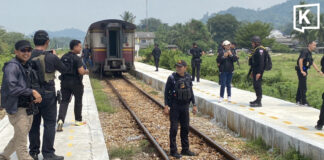
Then there is the barbed-wire installation incident along the border. The Thai Army said the measures were aimed at boosting morale and ensuring security, but Cambodian soldiers thought it may have been placed on their side of the border. After several minutes of tense argument and a stand-off captured on video, the Cambodian troops withdrew from the Chong Bok area of Ubon Ratchathani. Again, this shows the persistence of the overlapping claims and was not necessary at all.
Also this week, there were rumours about Thai authorities allowing Cambodian students to cross the border to study in Thailand at the beginning of the new school term, which went viral on social media. Now, this is intriguing and tragic. It was likely a domestic sabotage attempt against the Anutin government. And although this should be welcome news if true, it is now something that is abnormal and taboo, particularly as more Thais are speaking out against spending Thai taxpayers’ money to send the children of Cambodian migrant workers to school. In the end, the government even threatened to take legal action against those who spread the rumours.
As if these were not enough to complicate relations, PM Hun Manet was also accused by some influential Thai netizens of having been educated at West Point in the US under Thailand’s quota, and thus of being ungrateful to Thailand. This led to a public denial by Hun Manet this week. In a bizarre move, some Thais continue to believe that Hun Manet lied despite having no evidence to support their belief. One influential Thai-American netizen known as Jaa Oh posted a vitriolic video full of expletives and concluded that because Hun Manet had to come out and deny it, he must be lying. Talk about logic.
All this is happening in an environment of continued mutual hate speech between some Thai and Cambodian netizens.
They should take a break, breathe deeply and recognise that holding on to hatred is unhealthy for them.
With the 2001 MoU unilaterally revoked by the Thai side in a Cabinet resolution on 5 May, this week also saw Cambodia publicly pursuing a settlement to the maritime border disputes through UNCLOS, or the UN Convention on the Law of the Sea.
What should Thais expect? Thailand cannot simply withdraw from the 2001 agreement that had guided negotiations on overlapping maritime claims and expect Cambodia not to resort to an alternative channel to settle the dispute in what it perceives to be its best interests. Cambodia is a smaller country and lost disputed land territories after two brief border wars last year, so it would naturally be less keen to engage in bilateral negotiations without a third party. Now, the Thai government will have to deal with the consequences and the belligerent attitudes of some Thais.
While PM Hun Manet said the move is aimed at resolving the dispute through international law and peaceful dialogue, not escalation, the Thai side wasn’t happy. Thai officials feel both nations should seek to resolve the dispute bilaterally first.
Hun Manet said Cambodia viewed the MoU as the only agreed bilateral framework for resolving maritime disputes and developing resources in contested waters. With its cancellation, he said, bilateral negotiations had effectively reached a dead end.
He stressed that UNCLOS conciliation is a peaceful legal mechanism aimed at facilitating negotiations through an independent panel of international experts, not an escalation of the dispute. But as expected, Thai Foreign Minister Sihasak Phuangketkeow warned that the move could undermine efforts to restore relations and discuss border security.
And so the precarious state of Thai-Cambodian relations continues. And it continues as neither Thailand nor Cambodia has a meaningful and effective opposition capable of checking its government on the issue
Allow me to elaborate on the Thai side, which technically should have a strong opposition but appears blinded by ultranationalism.
Exiled historian and political dissident Somsak Jeamteerasakul posted the following message in Thai on Facebook earlier this week: “The issue of the military and the Cambodian border is something the [main opposition] People’s Party could certainly address. They don’t need to fear Article 112 [the royal defamation law] at all.
”Yet they have done nothing. They have not come out to condemn the frenzied nationalist agitation.
“It is deeply disappointing.
“(As for the Pheu Thai Party—needless to say—they have also cowered and done nothing.)”
Unrestrained nationalism has been rearing its ugly head quite clearly since last year’s Thai-Cambodian conflict, and the People’s Party is not immune. If anyone thinks that Thais who oppose the lèse-majesté law and have a critical understanding of the monarchy are few in number, those who are able to see through and challenge Thai ultranationalism are even fewer—by dozens or even hundreds of times.
At its peak, tens of thousands once took to the streets of Bangkok to demand reform of the monarchy half a decade ago. But the number of Thais who came out to call for peace during the Thai-Cambodian war last year did not even reach 100 at its peak.
Given the situation, it should be clear that Cambodians and Thais cannot just leave the matter to their respective governments or opposition camps, but they themselves will have to try to play a positive and proactive role in an attempt to normalise relations between both nations.
We can start by refraining from engaging in hate speech and discouraging our fellow countrymen from doing so; by not resorting to stereotypical branding of the other; by not automatically and uncritically supporting our government’s handling of Thai-Cambodian ties; and by not succumbing to a defeatist mentality or a self-fulfilling prophecy that our relationship is doomed for eternity.
Look how far France and Britain have come in restoring normal and good relations with Germany despite the horrors of World War II. Or think about the fact that, once upon a time, the British burned down the White House in that young nation that is the United States, or how Singaporeans and Malaysians today are fond of sushi, ramen and many things Japanese despite Japan’s brutal occupation and the immense suffering caused during the Second World War.
I have no doubt that one day, Thai-Cambodian relations will be normalised. However, it is up to us, sensible Thais and Khmers, to try to steer our relations back on track sooner rather than later, because we stand to lose more otherwise.
We cannot leave the matter to politicians and army generals who may have vested interests in perpetuating the idea of the neighbouring country as the nemesis in order to unite people domestically against a common ‘enemy’ and distract us from real issues they may not want us to pay attention to.