













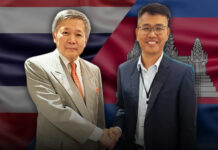

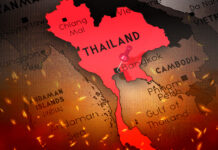

















M uch has been written about how the five-day undeclared war between Thailand and Cambodia was a result of a nasty feud between two very powerful families: the Shinawatra in Thailand and the Hun family in Cambodia. Too much has been read into it, even. Too much has been attributed to the two egoistic yet very influential families, the damning leaked phone call between Cambodian Senate President Hun Sen and Thai PM Paetongtarn Shinawatra, and even the call-centre scams and casinos in Cambodia.
Yes, the angry exchanges of nasty words between the two families contributed to this senseless war, which led to dozens of people—Cambodian and Thai soldiers and civilians from both neighbouring nations—being killed. (And most of them were poor and innocent people.) However, the magnitude of mutual hatred and animosity, which has deep roots in the selective teaching and reading of the history of relations between Thailand and Cambodia, and the stereotyping of the other, ensured that the conflict spread from two families, or two governments, to a people-to-people level.
I would argue that many Thais and Cambodians wouldn’t have gone ultranationalist and berserk if not for these two very important elements: two starkly different versions of the memories about the relationship between Thailand and Cambodia, and the stereotyping of one another, which have been festering for decades, if not longer.
Allow me to start with the Thai side, since I am Thai.
Three keywords inform and dominate how the average ultranationalist Thai looks at Cambodia and Cambodians: untrustworthy, ungrateful, and imitator.
Many ultranationalist Thais do not trust Cambodians because they fully subscribe to the ultranationalist Thai historical episode in which a Cambodian king, the king of Lovek, betrayed King Naresuan. This was despite the two kingdoms being in an alliance, when Ayutthaya asked for Cambodian help to repel Burmese invaders. Ayutthaya was attacked by the ‘tricky’ Cambodian king while the Ayutthayan kingdom, the precursor of Bangkok, was preoccupied with fending off the Burmese on a different front.
The Thai king eventually emerged victorious after punitive attack against Lovek in 1594, which was the Cambodian capital at the time, and captured the capital. King Naresuan of Ayutthaya also executed the Cambodian King of Lovek in a humiliating ritual by beheading him and using his blood to wash Naresuan’s feet, considered by Thais and Cambodians as the lowest part of the body, in retribution for repeated ‘Cambodian incursions.’
This significant and bitter historical episode, taught to Thai schoolchildren, resonates so deeply that ultranationalist protest leader Sondhi Limthongkul commented weeks before the undeclared war that Hun Sen and Cambodians share the same DNA of this ‘treacherous’ Cambodian king, and therefore are not trustworthy people.
As of yesterday, some ultranationalist Thais still expressed their desire to see the Thai armed forces capture Phnom Penh, once and for all, instead of accepting the border truce.
(Please note that the Cambodian side taught a very different version of this historical episode. The Cambodian narrative basically argues that the Thai king was insufficiently respectful to the Cambodian king, and didn’t treat him as an equal, and that the Siamese [or Thais as they were known then] were simply the aggressor. They destroyed the then-Cambodian capital of Lovek, looted the city, carried away priceless statues, and stole occult knowledge. Thus, it was the Thai side who betrayed and destroyed the Cambodian capital at the time, leading to Cambodians having to move further eastward to safeguard themselves from future Thai attacks.)
The tragedy is that both nations used their different interpretations and selective readings of this historical episode, which took place over four centuries ago, to inform their views toward the other. School teachings were used as a tool for nation-building, to serve national interests, as they needed to have “the other” to blame and despise in order to unite (and exploit) their respective people and indoctrinate them with ultranationalist ideology for the ruling class.
Next is the stereotyped belief that Cambodians are ungrateful people in the eyes of Thai ultranationalists. This belief flared up again during the latest conflict and is based on the selective memory that once upon a time, in the late 1970s, during the Indo-China or Cold War, refugee camps were set up along the Thai-Cambodian border to assist Cambodians fleeing the Vietnamese invasion of Cambodia in 1978. These camps operated from the late 1970s until 1993, and during their peak in 1980, as many as 160,000 Cambodian refugeees were seeking shelter while many young, well-educated Thais work for foreign NGOs operating in these camps.
(Note: Cambodians say these camps were primarily funded by the UN, the International Red Cross, and many international organisations. Thailand’s contribution was not primarily monetary but merely provided the land and security and saw it as a way to use them as a buffer, preventing military conflicts between Cambodia and Vietnam from spilling into Thailand.)
Then we have the deeply held belief by many Thais that Cambodians copy, appropriate, and ‘shamelessly’ claim that many aspects of Thai culture were actually Cambodian. This ranges from traditional architecture, traditional dresses, Songkran water fights, and Muay Thai, or Thai Boxing. Some Thais now call Cambodia, “Claimbodia.” (Please note that Cambodians feel that Thais copied their culture as well, and that their cultures were the origin of Thai culture, as Thais copied a lot from Angkor Empire era and after attacking Cambodia during the Ayutthaya period, which includes the sacking of Lovek. That’s why Cambodians believe Thai culture is simply a copy, or a simulacrum, of Cambodian culture. And they call Thailand, “LieLand,” and tell Thais to “Don’t Thai me,” meaning “don’t lie to me.”)
On the topic of which nation copied which nation’s martial arts 9f boxing, well-known Brazilian boxer Thiago Teixeira, who has gained fame (or notoriety) for promoting Cambodian traditional boxing called “Kun Khmer” and is now a Cambodian citizen, waded in late on Saturday night after the five-day undeclared war ended with a fragile truce at present, and posted a verdict on his Facebook page. It’s worth posting in full:
“In 2023, Cambodia renamed its national kickboxing style “Kun Khmer.”
Thailand didn’t like it.
“Nationalists said it was theft.
That Muay Thai came first. That Cambodia was copying.
“But let’s pause.
“There are ancient carvings at Angkor Wat showing boxers locked in a clinch, centuries before “Muay Thai” was ever a word.
And both traditions share techniques, training rituals, even spiritual elements.
“The truth? These martial arts didn’t come from just one country.
They evolved together, across borders, through war, through migration.
“Thailand turned Muay Thai into a global brand.
“Cambodia, recovering from war, is trying to reclaim its cultural roots.
“This isn’t about fighting over who came first.
It’s about acknowledging that pride doesn’t need to erase origin.
“In 2024, both countries quietly agreed:
* Kun Khmer and Muay Thai would be recognised as separate events.
* No need to compete. Both can rise.
“But online, the war didn’t stop.
Videos, memes, insults: millions of views.
“Culture became a battleground. Again.
#MuayThai #KunKhmer #KhmerThai #SharedOrigins #TruthAfterCeasefire”
……
Now, instead of asking some Cambodian contacts how they were taught at schools about the historical relations between Thailand and Cambodia, and how it affected their views of Thais and Thailand, I enlisted the help of AI (instead of using AI to generare fake news and videos about my neighbours in Cambodia), believing it to be not tainted by the passion of nationalism and ultranationalism currently infecting tens of millions of Thais and Cambodians at present.
Here’s the ‘fair’ answer I received from Gemini within seconds. Again, it’s worth quoting in full:
“Based on the information available, Cambodian history textbooks generally portray a complex and often contentious relationship with Thailand. The key themes in this historical narrative include:
* Decline of the Khmer Empire: Cambodian textbooks likely connect the gradual decline of the Angkorian Empire to the rise of neighbouring peoples, including the Thais. They would recount events such as the founding of the Sukhothai kingdom as a breakaway from Khmer rule and the eventual sack of Angkor Thom by the Thai kingdom of Ayutthaya in 1431, which forced the Cambodian capital to move southward.
* Loss of Territory and Sovereignty: A central theme is the gradual erosion of Cambodian territory and sovereignty at the hands of its more powerful neighbours, Siam (Thailand) and Vietnam. Textbooks would detail how Siam progressively ‘chipped away’ at Cambodian lands, with Cambodia eventually becoming a vassal state to Siam. This narrative of a ‘fear of extinction’ is said to be a significant part of Cambodia’s national identity.
* Colonialism and its Aftermath: The French protectorate is presented as a measure to prevent Cambodia from being completely absorbed by Siam and Vietnam. The legacy of this period is highlighted in border disputes, particularly the ongoing conflict over the Preah Vihear temple. Textbooks would likely describe how the 1904 treaty between Siam and French Indochina set the modern border, and how Thailand’s occupation of the temple after the French departure led to the 1962 International Court of Justice ruling in Cambodia’s favor.
* Cultural Appropriation and National Identity: The historical relationship is also framed in terms of cultural rivalry. Cambodian school materials may emphasize the Khmer origins of certain aspects of Thai culture, such as art, architecture, and even martial arts, and portray the Thais as trying to appropriate them. This is often linked to a fierce protection of Cambodian culture and historical sites.
In summary, Cambodian history textbooks likely present a narrative where Cambodia, once a powerful empire, faced a long history of decline, territorial loss, and cultural encroachment due to the actions of neighbouring powers, with Thailand being a prominent figure in this account. This historical perspective contributes to a sense of national pride and a protective stance towards its heritage and sovereignty.”
Conclusion:
As any fair-minded person can now see, many on both sides, Thais and Cambodians, are weighed down by selective memories and interpretations of the past and stereotypical views of their next-door neighbour. That is why it’s now not just a conflict between Hun Sen and Hun Manet versus Thaksin and Paetongtarn Shinawatra.
It exploded out of control because of the long-festering teaching of ultranationalist history and selective memories manipulated by the respective ruling classes in Thailand and Cambodia over the decades, if not longer.
History is always selective, often biased. We cannot recount or remember everything from the past, and we often interpret it differently depending on who we are. This cannot be an excuse for war and mutual animosity, however. Instead, both Thais and Cambodians should be aware of the incendiary factors beyond the feud between two families.
Thailand and Cambodia share so much in common. We look down on one another, have little or no trust towards each another. We despise one another. And we have turned our next-door neighbour, with an 800-kilometre of shared border, into our enemy.
I think we can actually do better if we deeply reflect on our troubled relations, not selectively remember and interpret histories fed to us by the ruling class which has nothing to lose but all to gain from the teaching of ultranationalist history.
______