



























Q&A with Vice Foreign Minister Russ Jalichandra on the Thai-Cambodian Conflict

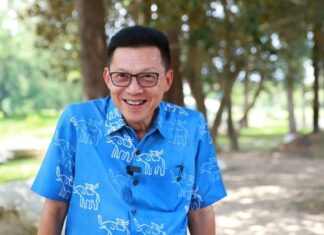
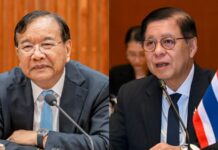
Vice Foreign Minister Russ Jalichandra

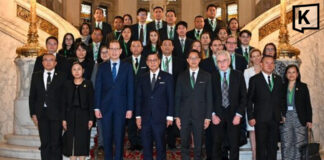
When Vice Foreign Minister Russ Jalichandra invited about 10 select Thai journalists to hear an update on what the Ministry and the government were doing regarding the ongoing Thai-Cambodian conflict on Friday, 22 August 2025, he also allowed the press ample time for a Q&A session.

​Here are the questions asked by Khaosod English’s Pravit Rojanaphruk.

​Pravit: Some Thais believe the government and the armed forces, particularly the army, are not on the same page and are walking a different path on how to handle the Thai-Cambodian conflict. The army even organised its own trip for journalists working for a foreign news agency on Wednesday to see the border situation and used its own army interpreter, while one from the Foreign Ministry might have done a better job. There was also an unconfirmed rumour that when the ceasefire agreement was first decided in Malaysia, the Thai army had wanted the ceasefire to become effective after 48 hours, and not at midnight of that day, so it could properly finish its military operations. What’s your take?

​Russ: Good question. Next please! I do not agree [with using Army interpreters] but that’s not wrong. As for the question of whether the government is on the same page as the army, well, the Army has the duty to protect national sovereignty. If I confirm that we are one and together, will you believe me?

Advertisement

It’s an open interpretation. Our society is not a dictatorial society. Everyone has the right to think [for themselves]. We fight for democracy… but that’s the price we have to pay. If you ask me, I say we are heading in the same direction. But even at the Foreign Ministry, we do not always think the same 100 per cent. But in the overall picture, we are heading in the same direction. Everyone can think for themselves about the overall picture between the government and the armed forces.

​This was followed by an added comment from Ms Chayika Wongnapachant, an advisor to the Foreign Minister and a first cousin of PM Paetongtarn Shinawatra, who sat to the right of Russ.

​Chayika: Regarding the Ottawa Convention [on anti-landmines] and IHL (International Humanitarian Laws), including the [Cambodian] attacks on [Thai] hospitals, these are common points between the armed forces and the government. We may walk separately, but attack together.

​Russ: Regarding anti-personnel landmines, it’s a clear violation as it doesn’t discriminate between [soldiers] and civilians and children.

russ 4
Ms Chayika Wongnapachant, an advisor to the Foreign Minister (left) and Vice Foreign Minister Russ Jalichandra

​Pravit: Will the government’s attempt to take civil and criminal action against Cambodian Senate President Hun Sen under Thai laws, and possibly take the matter to international levels, undermine the fragile truce? Is it worth it?

​Russ: This is a good question. Next question please. Well, we must ask whether what [Hun Sen] did, that is leading to lawsuits, were truly crimes committed? When actions that appear to be unlawful have been committed, it would lead to the question: “Is the [Thai] government neglecting its duties to act in accordance with Thai laws?” It’s up to the [Thai] judicial process, whether the prosecutor thinks the court should accept the lawsuits. We will have to let the justice process handle it. The government cannot interfere. But if we do not act, the result could be dereliction of duty. The government cannot order the court to rule that [Hun Sen] is absolutely 100 per cent guilty. But if we don’t act, people may question whether [Hun Sen] is above [Thai] laws. Should we deviate from the principle of what is right? As for [the possibility of pursuing the case against Hun Sen at] the ICC [International Criminal Court], we are still at a stage where we are studying it. It’s not like we could suddenly petition the court and the court would just accept it. We must consider whether it falls into the [alleged crimes] or not and how many were killed by him… It does ruin the [ceasefire] atmosphere. That’s true. But we are proceeding in the right way.

​Pravit: How do you see Thai-Cambodian relations a year from now, and three years from now?

​Russ: Allow me to cite the Foreign Minister who said the people-to-people relations have been incited [to make people hate one another]. [Cambodia] is considering putting up a [an internet] single gateway where expressing opinion is not free. As for us, we are divided. But in Cambodia, social media is controlled. This is worrying. It’s terrible that people of both countries have to hate one another. The Ministry hopes the relationship can be adjusted, but you can’t clap with one hand. But it doesn’t mean we have to insist on continuing to be each other’s enemy forever. Instead of communication technology being used to promote understanding, it ends up being the opposite.

​Pravit: Regarding the Army’s admission of using white phosphorus against Cambodia, although it is not classified as a chemical weapon, some groups abroad and in Thailand have raised the alarm on the potential environmental and health impact on civilians. Will the government tell the army to avoid using it again if there is another conflict?

​Russ: It is not against international laws. If concerns have been raised, we will take it into consideration.

russ2

​Pravit: Recently, the Second Army Region Commander Lt Gen Boonsin Padklang publicly stated that Cambodians cannot be trusted and the chance of another round of military confrontation was 50/50. What is your view?

​Russ: [The Cambodian government] may say that Thailand cannot be trusted too. But whether they can be trusted or not, as long as they respect the rules and international laws, [that is fine]. But so far, they have not respected the rules much. They have violated a lot. We will need the international community to pressure them… Nevertheless, to say we do not trust them is pointless as we then cannot negotiate.”

​It was 3.50 pm and Russ was reminded by Chayika that he really had to go to another meeting. I tried again to get Russ to react to the Second Army Region Commander’s belief that the chance of another war was 50/50 but he really had to leave the room. Chayika told us however that if there were to be another clash, it wouldn’t be one using military weapons, “but from now on it will be assaults through information warfare.”

​Writer’s note:

​There was a bit of a heated debate at the very start of the Q&A session with Ms Khaek Kam Phaka, a well-known political commentator and influential supporter of the government.

​Kamphaka asked if the Vice Minister had any “correct” terms for the media to use to describe what was happening between Thailand and Cambodia, as she felt it wasn’t a war.

She gave examples like “compact clashes” and “temporary fighting.” Hearing that, I got a bit fired up. I told her that the government could use whatever manufactured terms it wanted, but it had no right to tell the media what to use. It’s the media’s prerogative to decide and describe what’s happening as they see fit. (Personally, I use the term “the undeclared 5-day war”). However, I also respect Kamphaka’s right to use whatever term she chooses.

​Ultimately, the Assistant Foreign Minister said: “Actually, it is a war… it’s an undeclared war.” He added that when Cambodia released the [Hun Sen-Paetongtarn clip], “it’s already was a declaration of war,” but that “there wasn’t an official declaration of war.”

Russ, a seasoned diplomat, also explained that in the 58 years of ASEAN’s existence, this was the first time an ASEAN member country had tried to change the government of another ASEAN member country.

Also, please not that my question about what Russ thought of the distrust by some Thais regarding the relationship between the Shinawatra family and the Hun family was not asked as Chayika told me it has nothing to do with the Vice Foreign Minister.

____