

















A Brief Conversation With Thai Army Spokesperson Maj Gen Winthai Suvaree at Thai-Cambodian Border

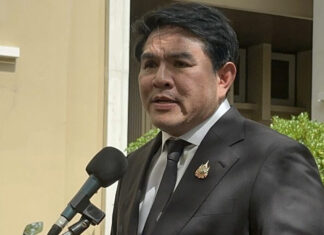
Royal Thai Army spokesperson Maj Gen Winthai Suvaree briefs international observers and media on details of Cambodian landmine evidence recovered by Thai soldiers along the border in Surin province on August 20, 2025. (Photo: Pravit Rojanaphruk)

It was Wednesday, 20 August 2025, nearly a month since the five-day undeclared war between Thailand and Cambodia ended in a fragile ceasefire after US President Donald Trump and ASEAN Chair, and Malaysian PM, Anwar Ibrahim, intervened. What followed for the past four weeks could best be described as a fierce battle to win the hearts and minds of the international community by both nations.

​On that day, a select group of a dozen Thai and foreign journalists working for international news agencies, foreign press, and English-language Thai press were invited on a trip to the Thai-Cambodian border. It was also the third day where ASEAN foreign military observers, led by the Malaysian Defence Attache at the Malaysian Embassy in Bangkok, Brigadier General Samsul Rizal Bin Musa, led a team of a dozen military staff and attaches from eight ASEAN nations (excluding Cambodia) to collect information about what happened and verify the facts during the five-day war.

​On the Thai Army’s side, the meeting on Day 3 was led by Army spokesperson Maj Gen Winthai Suvaree. They met early that morning at a meeting room inside Phanom Dongrak Hospital in Surin province, just 15 kilometres from the border, which was under attack by Cambodian rockets and sustained damage.

​Samsul and his team were handed a two-page briefing statement in English. Part of it read, “The Cambodian side did not only target the military area in Surin province but also attacked the civilian areas in Surin province. There were 7 civilians killed and 10 civilians injured, 102 houses destroyed, and three Buddhist temples damaged.”

Advertisement

​The chief of the ASEAN military observer team listened to the briefing and then thanked the Thai army for its “gentlemanly” manners, adding that he saw “human provocation” first hand when he visited An Ma Pass yesterday, where a Cambodian soldier on the other side of the border provoked the Thai side. He added that his team was not there to pin point which side was right or wrong.

​Samsul and his team then toured the site where a rocket fell, the damaged area at the hospital, and more.

​We were later transported to somewhere even closer to the border, where a Cambodian rocket failed to explode and would be detonated for all of us to see.

​A dozen anti-personnel landmines, which have been neutralised and were now safe, were also exhibited to the ASEAN Observers and journalists.

landmine cambodia
Royal Thai Army presents evidence of Cambodian landmines recovered by Thai forces to international observers and press in Surin province, August 20, 2025. (Photo: Pravit Rojanaphruk)

​It was there when I got the opportunity to question Winthai, who was courteous enough to recognise and acknowledge my presence first despite our less than smooth professional relationship. (Basically, after the 2014 military coup which was led by then Army Chief Gen PrayuthChans-o-cha, Winthai, then a Colonel, was made the junta spokesperson who publicly defended my two secret detentions without charges to the international press.

See my recollection in the American media outlet The Diplomat here.

​I hold absolutely no hard feelings against Maj Gen Winthai and proceeded to ask him, while I was holding these new anti-personnel landmines, as to how the Thai public could be certain that they were planted by Cambodians.

​He said that since Thailand is a signatory to the Ottawa Convention on anti-landmines, and if it had procured any, it would show in the official record.

​He added that due to diplomatic sensitivity, he would only say that these new landmines were made in a country from the former Soviet Union.

​Asking Winthai such questions may appear unthinkable to many Thai journalists who are already “on board”, so to speak, as part of “Team Thailand” during this ongoing conflict, but I felt I had to do so as our primary duty as members of the press is to serve the public, and not the country or the Thai army.

​Sensing that I was still not totally convinced, Winthai said to me: ​“No matter what, Cambodia will only say that these do not belong to them.”

​Our next and last stop was at a military outpost called Jueb Ta Moke inside a tropical jungle and right next to the Cambodian territory, which was at a lower level 200 metres down below.

​We were shown the spot where a Thai soldier stepped on a landmine and lost one of his lower legs on August 12, long after the ceasefire.

​The area is partly barricaded by three layers of razor barbed wire. The Thai army told Samsul that the Cambodians sneaked up to the Thai side and evaded the incomplete lines of barbed wire to plant not just one but a few landmines, with one still visibly active.

​The Malaysian general then interviewed an army officer who was right behind his colleague who stepped on the landmines, in private.

​While we were waiting, Winthai happened to be next to me again, and he said all this is about Cambodia’s domestic politics as they need an external enemy so Cambodians can forget about local politics, be distracted, and unite. “[Cambodians] were manipulated to hate Thailand.”

​Note: The writer would like to thank the Thai Army for the kind invitation.

______