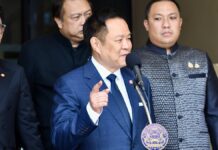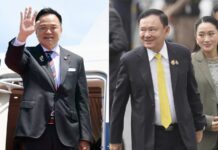


































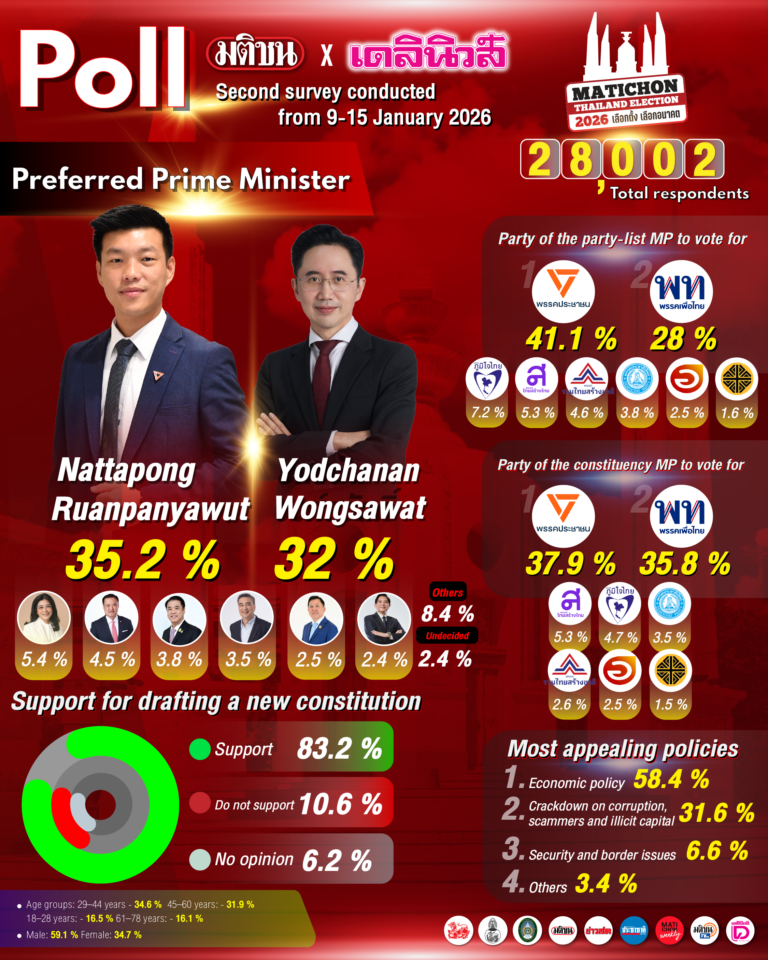
BANGKOK — A Matichon–Daily News poll ahead of the 8 February election shows Nattaphong Ruangpanyawut leading public preference for prime minister, followed closely by Yodchanan Wongsawat, according to results released on 23 January.
The survey was conducted via QR code on the two media outlets’ platforms between 9 January and the poll closing date, with 28,002 respondents taking part.
Asked who they would like to see as the next prime minister, Nattaphong ranked first with 35.2%, followed by Yodchanan on 32%. Sudarat Keyuraphan placed third with 5.4%, ahead of Anutin Charnvirakul (4.5%), Suriya Juangroongruangkit (3.8%), Abhisit Vejjajiva (3.5%), Jatuporn Buruspat (2.5%) and Peeraphan Saleerathavibhaga (2.4%). Those undecided accounted for 2.4%, while 8.4% chose other options.
On party-list voting, respondents favoured the People’s Party at 41.1%, followed by Pheu Thai (28%). Bhumjaithai ranked third with 7.2%, ahead of Thai Sang Thai (5.3%), United Thai Nation (4.6%), Democrat Party (3.8%), New Opportunity Party (2.5%) and the Economy Party (1.6%). Undecided voters stood at 1.7%, with 4.1% choosing other parties.
Asked why they would choose a party-list MP, a majority cited party policies (55.9%), followed by liking the party’s prime ministerial candidate (19.4%), confidence in the party leader (17.3%), satisfaction with candidate qualifications (5.4%) and other reasons (2%).
For constituency MPs, the People’s Party again led with 37.9%, narrowly ahead of Pheu Thai at 35.8%. Thai Sang Thai ranked third (5.3%), followed by Bhumjaithai (4.7%), Democrat Party (3.5%), United Thai Nation (2.6%), New Opportunity Party (2.5%) and the Economy Party (1.5%). Undecided voters accounted for 2.6%, with 4% choosing others.
The main factor influencing constituency votes was again party policy (52.3%), followed by candidate qualifications (17.6%), confidence in the party leader (15.4%) and preference for the party’s prime ministerial candidate (13%). Other factors made up 1.8%.
When asked which policy areas mattered most, respondents prioritised the economy (58.4%), followed by anti-corruption and crackdowns on scammers and illicit capital (31.6%), and security and border issues (6.6%). Other issues accounted for 3.4%.
The poll also found strong expected turnout, with 96.4% saying they intended to vote on 8 February, compared with 3.6% who said they would not.
On constitutional reform, 83.2% said they supported drafting a new constitution, while 10.6% opposed the idea and 6.2% expressed no opinion.