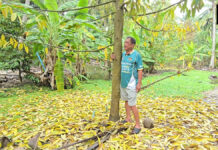






























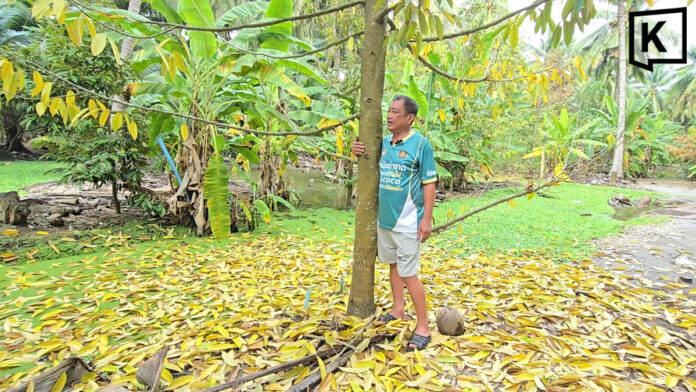
SAMUT SONGKHRAM — 8 October 2026, A durian farmer in Samut Songkhram was left heartbroken after floodwaters submerged his orchard for nine days, killing almost all of his 460 durian trees. As he walked through the damaged orchard, he embraced one of the dying trees, saying he had cared for each one “more than a child.”
The farmer, Ekkachai Thianchai, village headman of Ban Pramot subdistrict in Bang Khonthi district, said floodwaters began entering his orchard on 27 September and continued to rise. By 28 September, the water had covered the durian orchard up to the tops of the planting furrows.
By 7 October, the durian trees had been submerged for around nine days. Papaya plants were among the first crops to suffer damage, followed by the durian trees, which began showing yellowing and falling leaves before gradually dying.
Ekkachai said the biggest problem was that water levels in his orchard had remained high even as floodwaters in other areas began to recede.
“Durian trees are particularly vulnerable to prolonged flooding. When their roots are deprived of oxygen and absorb too much water, they develop a condition that farmers call ‘water suffocation’ before eventually dying,” he said.
Ekkachai estimated that almost all of his approximately 460 durian trees were certain to die, with only around 20 trees near the roadside still surviving. Trees that had begun producing new shoots also faced a risk of dying halfway.
Once the water recedes, the surviving trees will need to be pruned immediately, but he said it would still be uncertain whether they could recover.
The damage is estimated to be worth several million baht. The orchard had generated several million baht in annual income, but Ekkachai said the financial loss was not his biggest concern.
“What worries me more is the future of Samut Songkhram’s durian,” he said.
He fears the flooding could turn the province’s famous “three-water durian” into nothing more than a legend, as his orchard is not the only one affected. Durian growers in several parts of the province are facing similar damage.
He also expressed concern for pomelo orchards in the area, warning that if floodwaters do not recede within another three to four days, weakened roots could become vulnerable to disease, potentially causing more trees to die.
Regarding government compensation, Ekkachai said financial assistance could help to some extent, such as by purchasing new cuttings, but it could not make up for the years of time and investment required to rebuild an orchard.
“We learned our lessons around 1996, but this year, I have lost heart,” Ekkachai said.
The durian trees in his orchard are around eight years old. Many were planted and personally cared for by Ekkachai, while others came from cuttings that had been given to him as model plants. He has continuously invested in developing and maintaining the orchard over the years.
At one point during the interview, Ekkachai walked over to a durian tree that was dying and wrapped his arms around its trunk.
“I planted every tree with my own hands. I really feel sorry for them. I cared for them more than I cared for my own children. It’s such a waste,” he said, his voice trembling.
“I’ve lost heart. I can’t keep fighting. I can’t do this anymore. I’d rather do something else.”