
































Every three years, the OECD’s Programme for International Student Assessment, or PISA, runs a global study of 15-year-old students. It aims to test how well students can apply what they have learned in science, mathematics and reading to real-world problems. It also polls students on their learning environments.
More than 760,000 students took part in PISA 2025, representing about 33 million students in 91 countries and economies worldwide. As a result, it is among the most rigorous educational assessments in the world. Read the full global report here.
The good news for Thailand
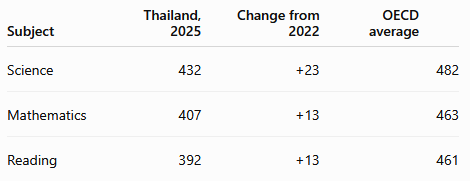
In 2025, Thailand’s PISA scores rose in all three core subjects, but remained well below OECD averages. Thailand’s full report.
Thailand scored 432 in science, 407 in mathematics and 392 in reading in PISA 2025, up 23 points in science and 13 points in both mathematics and reading from 2022.
Science was PISA 2025’s main focus. Thailand placed 53rd of 91 participating countries and economies by science score, up from 58th in 2022. The OECD does not publish a single overall PISA ranking.
In Thailand, 8,547 students, in 273 schools, completed the assessment, representing about 542,700 15-year-old students (an estimated 69% of 15-year-olds in Thailand).
Scores still below 2015 levels
Thailand’s improvement from 2022 reversed part of the losses seen in recent assessment cycles. However, the OECD said average scores remained below Thailand’s 2015 level in science and reading, and below its 2018 level in science.
The share of students with low performance also remains high. Here is the breakdown.
Science
In science, 59% of Thai students reached at least Level 2, the baseline level of proficiency used by PISA. The OECD average was 74%. At this level, students can recognise explanations for familiar scientific phenomena and use data to assess simple conclusions.
Only 1% of Thai students reached the highest science levels, Level 5 or 6, compared with 7% across OECD countries.
Math and Reading
Mathematics and reading were more concerning. Just 41% of Thai students reached Level 2 or above in mathematics, against an OECD average of 65%. The same 41% reached the baseline level in reading, compared with 69% across OECD countries.
Almost no Thai students reached the highest reading level, while 6% did so across OECD countries.
Compared with 2015, the proportion of Thai students performing below Level 2 increased by six percentage points in mathematics and nine percentage points in reading. In science, it fell by six percentage points.
Computational Problem-Solving
PISA 2025 also introduced a computational problem-solving assessment. It measured students’ ability to use digital tools to model problems, conduct experiments, analyse data and build or debug digital products.
Thailand scored 476 in this new assessment, below the OECD average of 500. Unlike the other categories, there is no historical performance to compare it to, but this metric may become increasingly relevant in the years to come if it becomes a mainstay for future PISA studies.
AI use common among Thai students
The survey also offered a snapshot of how Thai students use technology in school.
Students in Thailand reported spending an average of 2.2 hours a day using digital devices at school for learning, above the OECD average of 1.7 hours. They also reported 1.5 hours a day of leisure use at school, compared with an OECD average of 1.1 hours.
Some 51% of Thai students said they used AI chatbots to help them learn at least once a week, compared with 46% across OECD countries.
The OECD found that 41% used AI for preliminary research, 42% used it to summarise texts, and 41% used it to draft writing assignments. Only 4% said they never or almost never used AI chatbots for the schoolwork tasks covered by the survey.
The findings do not necessarily show that AI use improves or harms results. They do, however, show that AI tools are already part of many students’ study routines.
Thailand’s relative strengths
The PISA data found several promising signs beyond test scores:
- Students persevere. Eighty-one percent said they put in extra effort when work gets difficult, against an OECD average of 60%.
- They seek help. Thai students scored above the OECD average for help-seeking and goal-setting.
- Teachers are highly rated. Nine in 10 students said their science teacher took an interest in every student’s learning.
- Disadvantaged students show resilience. Seventeen percent reached the top quarter of science results within Thailand, compared with 12% across OECD countries.
Where Thailand falls short
The strongest warning signs were in basic learning and students’ outlook:
- Core skills: Thailand remained below the OECD average in science, maths, reading and computational problem-solving.
- Reading and maths: Only 41% of students reached the baseline proficiency level in each subject.
- Growth mindset: Just 36% believed intelligence can be developed through effort and feedback, compared with 69% across OECD countries.
- Belonging and opportunity: Thailand scored below the OECD average for sense of belonging at school and belief in social mobility.
- Resources: Nearly four in 10 students attended schools where principals said inadequate learning materials hindered teaching.
The contrast is striking: Thai students report persistence, supportive teachers and a willingness to ask for help, but those strengths are not yet producing strong foundations in reading, maths and science.
How Thailand Compares in ASEAN
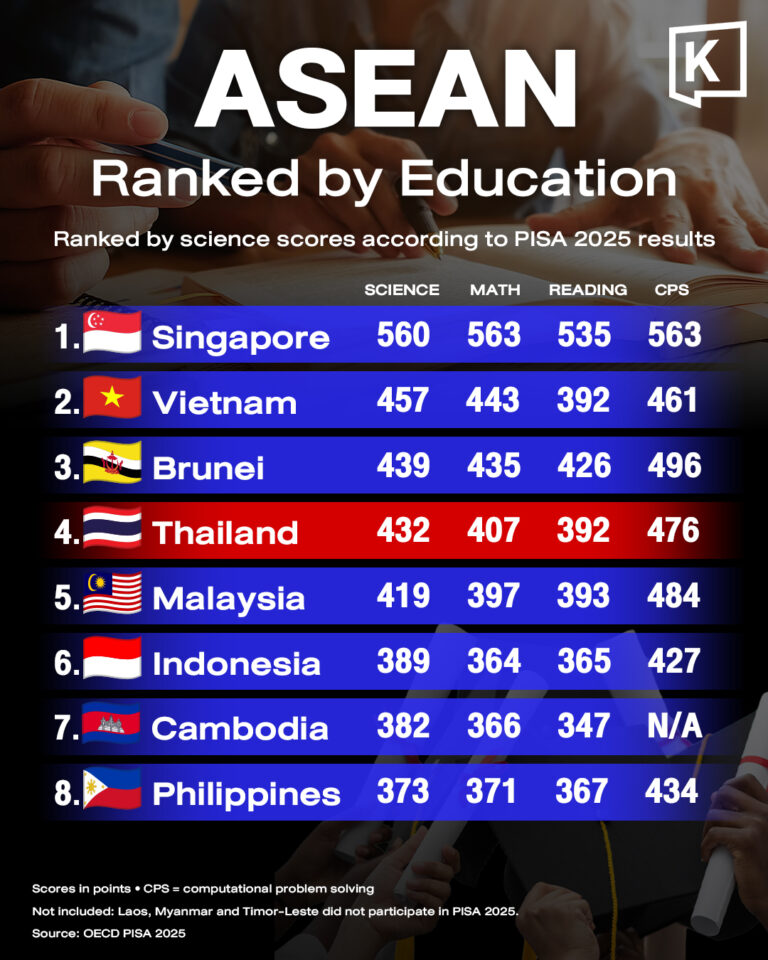
Thailand’s science score was 13 points behind Vietnam and seven behind Brunei, but 13 points ahead of Malaysia. Singapore remained far ahead of every other ASEAN participant and was second globally, behind only B-S-J-Z (China).
The comparison is not complete since three ASEAN members did not participate in the study, as well as the fact that there is no CPS data for Cambodia. Still, the results place Thailand in the region’s upper-middle group, while leaving a sizeable gap between Singapore and every other member.
In conclusion
Thailand’s PISA 2025 results offer cautious optimism. Scores improved in science, mathematics and reading while many countries saw declines. Thai students also reported persistence, resilience and strong support from teachers.
But the recovery is incomplete. Results remain below Thailand’s earlier levels in science and reading, and below the OECD average in all core subjects. Many students still lack basic reading and mathematics skills, while concerns remain over their sense of belonging at school and belief that they can improve their place in society.
The key question is whether Thailand can address shortages in staff and resources while building on students’ determination to improve learning outcomes. Much will depend on how the government translates these results into policy priorities and budget decisions.