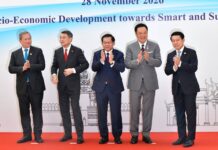







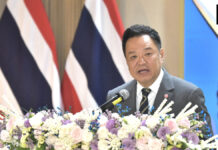



























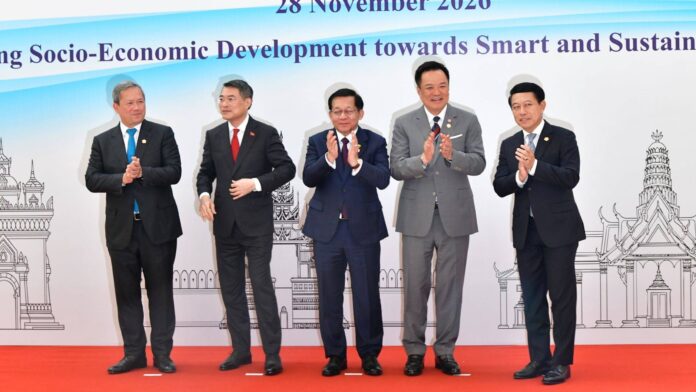
HANOI, Vietnam — Prime Minister Anutin Charnvirakul has called for closer cooperation among five ACMECS member countries to tackle cross-border water pollution, combat online scams and strengthen regional economic connectivity as Thailand prepares to assume the chairmanship of the grouping.
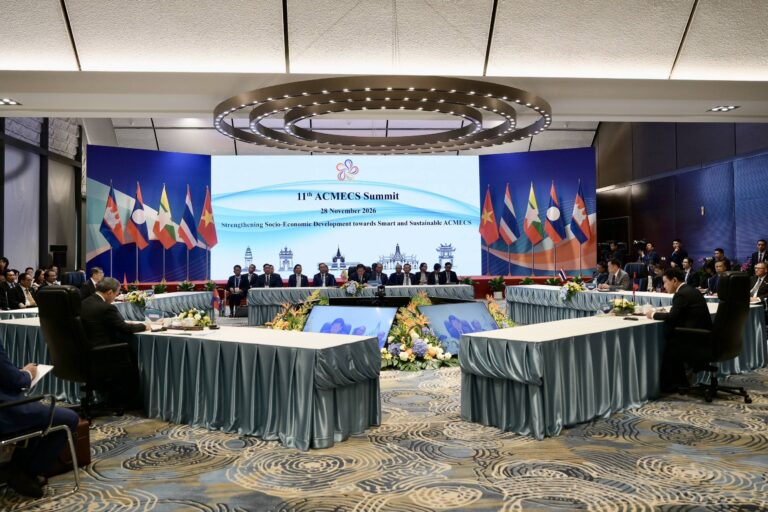
Speaking at the 11th Ayeyawady–Chao Phraya–Mekong Economic Cooperation Strategy (ACMECS) Summit at the Vietnam National Convention Centre in Hanoi on 28 November 2026, Anutin outlined three priorities for future cooperation under the theme of smart and sustainable economic and social development.
Anutin said that since Thailand initiated ACMECS in 2003, the framework had played an important role in promoting shared prosperity among neighbouring countries.
Amid growing competition between major powers affecting global trade and investment, he stressed that the five member countries must work together to shape the subregion’s development based on mutual trust and unity.
Cross-border water pollution
Anutin highlighted the urgency of addressing cross-border water pollution, which has affected more than 20,000 households and put over 100,000 rai (16,000 hectares) of agricultural land at risk.
He welcomed an agreement between Thailand and Myanmar to establish six water quality monitoring stations along the Kok and Sai rivers.
Thailand proposed that ACMECS work with relevant agencies, the Mekong River Commission and development partners to expand joint water quality monitoring, deploy technology to detect pollutants and develop cross-border early warning mechanisms.
Anutin also called for responsible mining practices to protect public health, water resources, livelihoods and food safety.
Regional connectivity and digital economy
The prime minister urged member countries to accelerate the completion of missing road and railway links to facilitate cross-border trade.
He also proposed using the new ACMECS Master Plan to help businesses access markets through digital platforms and adopt artificial intelligence (AI) to drive innovation and improve productivity.
Anutin stressed that greater economic connectivity must go hand in hand with regional security and public confidence.
Crackdown on online scams
Anutin highlighted Thailand’s efforts to combat transnational crime, including assisting and repatriating more than 10,000 people of nearly 50 nationalities following operations to dismantle online scam centres.
He also cited Thailand’s cooperation with the United Nations Office on Drugs and Crime (UNODC) to promote global efforts against online scams, as well as the launch of the Bangkok Blueprint to strengthen the financial sector’s ability to combat fraud during the IMF and World Bank Annual Meetings in Bangkok.
Thailand proposed establishing an ACMECS Taskforce on Online Scams to coordinate law enforcement operations and trace illicit financial flows across borders.
Thailand prepares to assume ACMECS chairmanship
As the incoming ACMECS chair, Thailand will prioritise completing a new master plan while maintaining the framework’s three pillars of cooperation and addressing emerging challenges, including water resource management, transboundary haze, transnational crime and digital transformation.
Thailand will also push for the establishment of the ACMECS Development Fund and strengthen the role of the ACMECS Secretariat to ensure effective implementation and monitoring of cooperation projects.
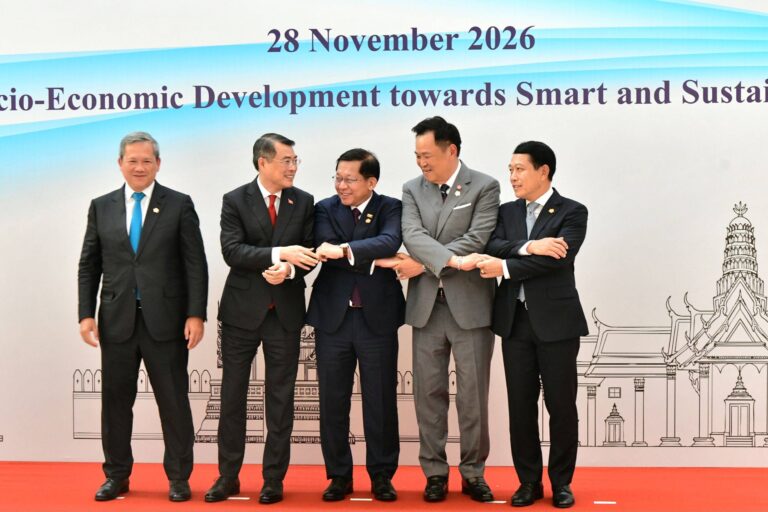
Anutin said Thailand would use ACMECS as a platform to expand South–South cooperation with development partners, including ASEAN member states and BRICS countries.
In 2028, when Thailand holds the chairmanship of both ACMECS and ASEAN, the country intends to use the opportunity to connect subregional cooperation with the broader ASEAN framework and advance the ASEAN Community Vision 2045.