




































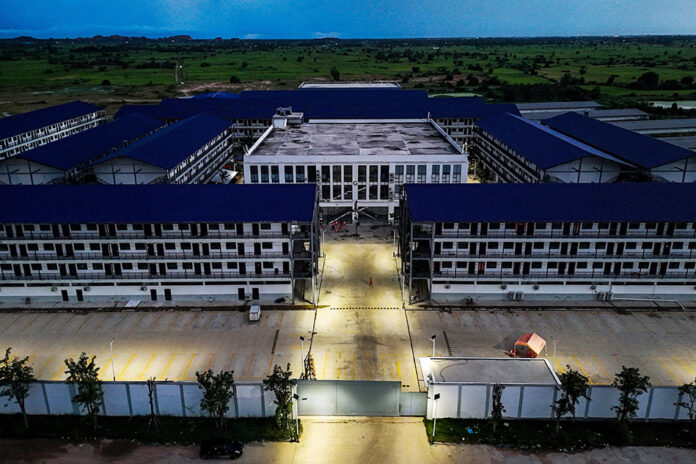
“ Online scam operations have proliferated in Cambodia since the COVID-19 pandemic, when the global shutdown saw many Chinese-owned casinos and hotels in the country pivot to illicit operations.
“Operating from industrial-scale scam centres, tens of thousands of workers perpetrate online romance scams known as “pig-butchering”, often targeting people in the West in a vastly lucrative industry responsible for the theft of tens of billions of dollars each year.”
From Al Jazeera, 18 October, 2025
“Abducted, trapped, forced to scam: inside Cambodia’s largest crime hub in Sihanoukville
The compounds, which often run their own canteens, are surrounded by armed guards and high concrete walls topped with barbed wire
“Rows of grey buildings with thick iron bars line the streets of Sihanoukville, about 250km (155 miles) southwest of Phnom Penh. Near the city’s Chinatown stands Cambodia’s largest so-called yuanqu – a slang term in Chinese criminal circles meaning “scam compound”, derived from yuanqu, or industrial estate.”
From The Korea Times via the South China Morning Post, 17 October 2025
By now, it doesn’t take a rocket scientist to see the obvious; it takes Cambodians with honesty to admit that the cruel and illegal scam operations in Cambodia are on an industrial scale, have gone out of control, and have gone too far.
In the end, it took the death by torture of a 22-year-old South Korean male student to wake up the South Korean public to demand an end to these transnational crimes which involve not only scamming but torture, human trafficking, organ harvesting and killings. And the Korean Government finally acted earlier this week, sending its Vice Foreign Minister to Phnom Penh, who met with Cambodian Prime Minister Hun Manet.
Suddenly, and with lightning speed, 64 Korean nationals arrested by the Cambodian authorities were deported back to Korea. As Korean Second Vice Minister Kim Ji-na visited the country, most scammers had fled in the nick of time.
As I type these words, the Cambodian Police insists that only 118 South Koreans are still unaccounted for in Cambodia, and not 330, as reported by The Korea Times. The figure 118 is indeed still a very large and disturbing number.
The most disturbing question remains: How could the Cambodian authorities for all these years allow these reportedly Chinese-led criminals to operate a vast network of scam centres when the size and feature of the centres, which resemble a concentration camp or a high-security prison, are not hiding deep in the tropical jungles and can be seen and easily spotted?
It’s undeniable that the Cambodian Government must be aware of their existence to some degree, as the scammer complexes are numerous and as large as actual prisons. The questions are: To what high level in the Cambodian government leadership is complicity involved? Why does the Chinese Government not seem serious, or even unusually quiet, about cracking down, even though the ringleaders are Chinese?
After all, Mr Chen Zhi, the Chinese-born tycoon, a former advisor to Cambodian leader Hun Sen, and alleged leader of a major cyber-crimes empire, the Prince Group, based in Cambodia, was born a Chinese, and the US and the UK have just seized 15 billion dollars worth of Bitcoin and London assets.
“The US justice department alleged people had been forcibly detained in the scam compounds connected to the group and made to engage in a range of fraudulent schemes that stole billions of dollars from victims in the US and globally,” wrote a report in The Guardian two days ago.
To what extent is Thailand involved? And how long will the Cambodian government be in denial and will the people tolerate living like this?
I feel sympathetic to ordinary Cambodian citizens who feel that their country’s good name has been severely tarnished by these scammers. All evidence points to a very high-level complicity in the Cambodian Government, however.
Given the low level of press freedom (and I am citing a report from the Paris-based Reporters Without Borders, or RSF) and limited political freedom there, I am not surprised that some educated young Cambodians took to social media to express their frustrations among friends.
“Cyberscam, if an adult can say sorry, I’m wrong and resolve to solve it from now on, surely it is the only positive thing we can do, rather than keep pushing the boat along the water and keep throwing devils at each other by ignoring the problem,” wrote one Cambodian on social media in English this week. “It’s not serious to say sorry, accept the mistake and start to solve it rather than continue being arrogant and not admitting being wrong; it will cause disaster in the end and be difficult to water down, as the Khmer saying goes: “prevention is better than cure”.”
The future of Cambodia will have to be decided by Cambodians, particularly young Cambodians, and we can only wish them well.
As for Thailand, it is undeniable that some influential figures in Thailand, possibly including politicians and military officers, may be involved or benefit from the scam centres, some of which are located not far from the Thai-Cambodian border. Thais should demand more from their government to solve the Thai-part of the crime network instead of expecting South Korea to help identify the culprits.
This morning, the Embassy of South Korea in Bangkok just issued a statement regarding another fake news story spread by a Thai press outlet, this time by Thansettakij.
”The Thansettakij article dated October 19 reported that “the Korean Prime Minister stated that seven Thai politicians are involved in a Cambodian scam case.” The Government of the Republic of Korea clarifies that this report is not factual. The Embassy of the Republic of Korea will take necessary measures against this fake news.”
To expect the South Korean government to name Thai politicians allegedly involved is not just forlorn but foolish – even if they know the names.
To this day, Korea hasn’t even dared to say which Cambodian politicians are linked, and probably never will. Korea will probably find other ways to pressure and punish Cambodia.
As for the Thai people, please use your judgment and stop sharing baseless, fake news just because you want it to be true. It’s embarrassing. No wonder many people are still victims of scammers. If something is too good to be true, it probably isn’t. Furthermore, the Korean media hasn’t even reported this story; it’s the Thai media that is imagining things.
Let’s help raise the level of media literacy and information awareness.
__________