


























31.8 C
Bangkok
Sunday, June 7, 2026
Home Blog Page 1085

Hymns Through Masks: Christians Mark Another Pandemic Easter

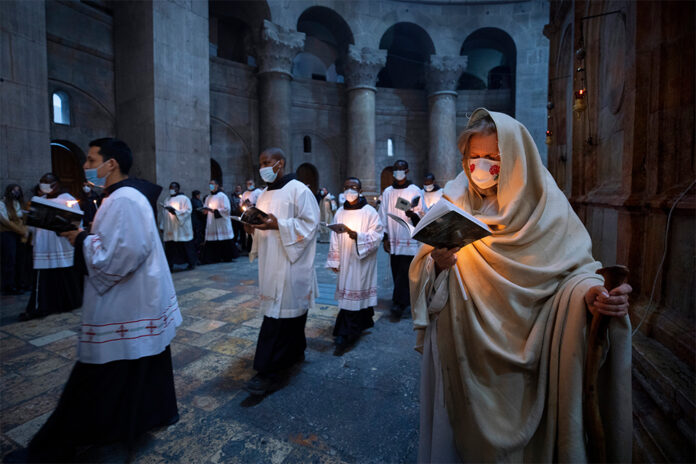
Priests circle the Edicule during Easter Sunday Mass led by the Latin Patriarch at the Church of the Holy Sepulchre, where many Christians believe Jesus was crucified, buried and rose from the dead, in the Old City of Jerusalem, Sunday, April 4, 2021. Photo: Oded Balilty / AP

VATICAN CITY (AP) — Christianity’s most joyous feast day was celebrated worldwide with the faithful spaced apart in pews and singing choruses of “Hallelujah” through face coverings on a second Easter Sunday marked by pandemic precautions.

From vast Roman Catholic cathedrals to Protestant churches, worshippers followed regulations on the coronavirus. In some European countries, citizens lined up on Easter for their turn to receive a COVID-19 vaccine.

In the Lombardy region of Italy, where the pandemic first erupted in the West, a hospital gave a traditional dove-shaped Easter cake symbolizing peace to each person waiting to get vaccinated. Many who came were in their 80s.

A soccer team in Lyon, France, opened its stadium as a vaccination center for the long holiday weekend. Some 9,000 people were expected to receive their shots there over three days as the French government tries to speed up vaccinations amid a fresh outbreak of infections.

In the Holy Land, travel restrictions and quarantine regulations prevented foreign pilgrims from flocking to religious sites in Jerusalem during Holy Week, which culminates in Easter celebrations. Pope Francis lamented that the pandemic has prevented some churchgoers from attending services.

At St. Peter’s Basilica, the 200 or so faithful allowed to attend looked lost in the cavernous cathedral. Normally, thousands would be at the Mass celebrated by Francis, and more than 100,00 would sometimes assemble outside in St. Peter’s Square to receive his Easter blessing afterward.

But this year, as in 2020, crowds are banned from gathering in Italy and at the Vatican. Francis delivered his noon Easter address on world affairs from inside the basilica, using the occasion to appeal anew that vaccines reach the poorest countries.

The pontiff sounded weary as he noted that pandemic measures have affected religious holiday traditions and kept some faithful from public worship.

“We pray that these restrictions, as well as all restrictions on freedom of worship and religion worldwide, may be lifted and everyone be allowed to pray and praise God freely,” Francis said.
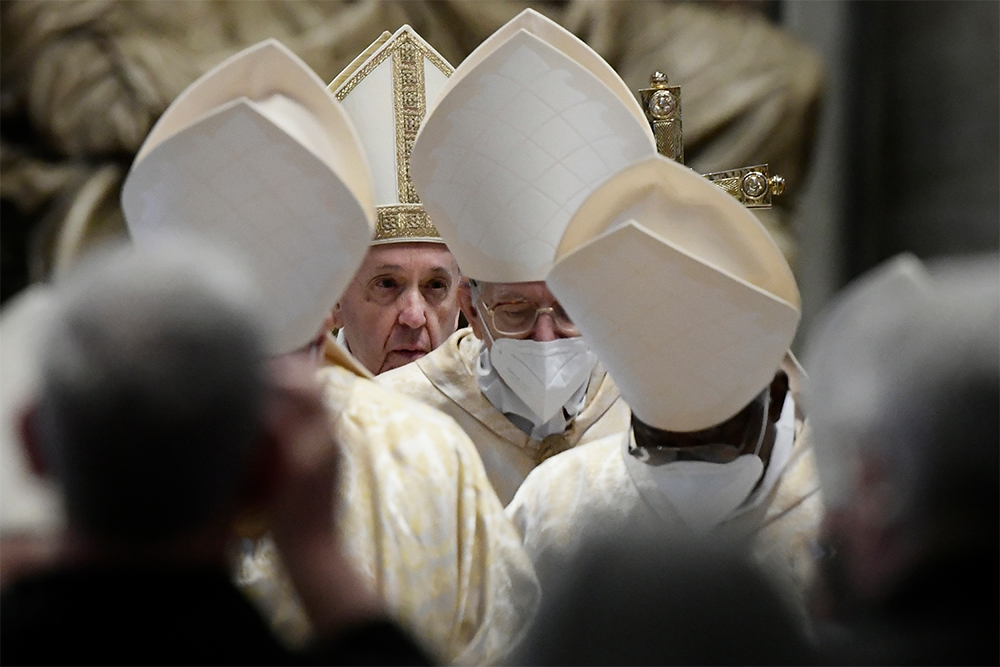
Pope Francis leaves after celebrating Easter Mass at St. Peter's Basilica at The Vatican Sunday, April 4, 2021, during the Covid-19 coronavirus pandemic. Photo: Filippo Monteforte /Pool photo via AP
Pope Francis leaves after celebrating Easter Mass at St. Peter’s Basilica at The Vatican Sunday, April 4, 2021, during the Covid-19 coronavirus pandemic. Photo: Filippo Monteforte /Pool photo via AP

In Syria, where a national vaccination program has yet to begin, churchgoers in the Lady of Damascus Church prayed for a way out of the economic and political crisis, only worsened by the pandemic.

“We came to the church for Easter so we get rid of the pandemic that we are in,” said Bassam Assaf. “Of course, we are not scared of coronavirus. It is the reality that we face, but it cannot stop us from coming and praying to God to take us out of this ordeal and help the world.”

A service at the Church of the Holy Sepulchre in the Old City of Jerusalem was celebrated by the senior Roman Catholic cleric in the Holy Land. That is the site where many Christians believe Jesus was crucified, buried and rose from the dead. Israel’s successful vaccination campaign has allowed reopening of many places, including religious sites.

The pandemic kept Seville’s Brotherhood of the Holy Resurrection from sending its ornate Easter float, bearing a towering statue of Jesus, through the streets of the Spanish city. Instead, the Brotherhood posted videos and old photos from their last procession, two years ago.

Some Pentecostal Christians in South Africa canceled a three-day retreat starting on Good Friday. On the hills overlooking Soweto, a Johannesburg township, Apostolic Pentecostals gathered in small groups Sunday to mark Easter.

In South Korea, Yoido Full Gospel Church, the country’s biggest Protestant church, allowed only about 2,000 people to attend Easter service, or about 17% of the capacity of the main building. Masked worshippers sang hymns and prayed as the service was broadcast online and by Christian TV channels.

Intent on tamping down weeks of surging infections, the Italian government ordered people to stay home for the three-day weekend except for essential errands. Premier Mario Draghi’s government did allow one visit to family or friends per day in residents’ home regions over the weekend, which includes the national holiday on Monday.

Italy permits religious services in the pandemic if capacity is limited and masks are worn. But early on, the predominantly Roman Catholic country’s many churches were open only for individual prayer.

Hundreds of Catholics gathered in the mammoth Cathedral of St. Paul in St. Paul, Minnesota, for the Easter Vigil service Saturday evening. Every other pew was kept empty and masks were mandatory. Still, the solemn liturgy marked a new, hopeful beginning for the congregation after a turbulent year.
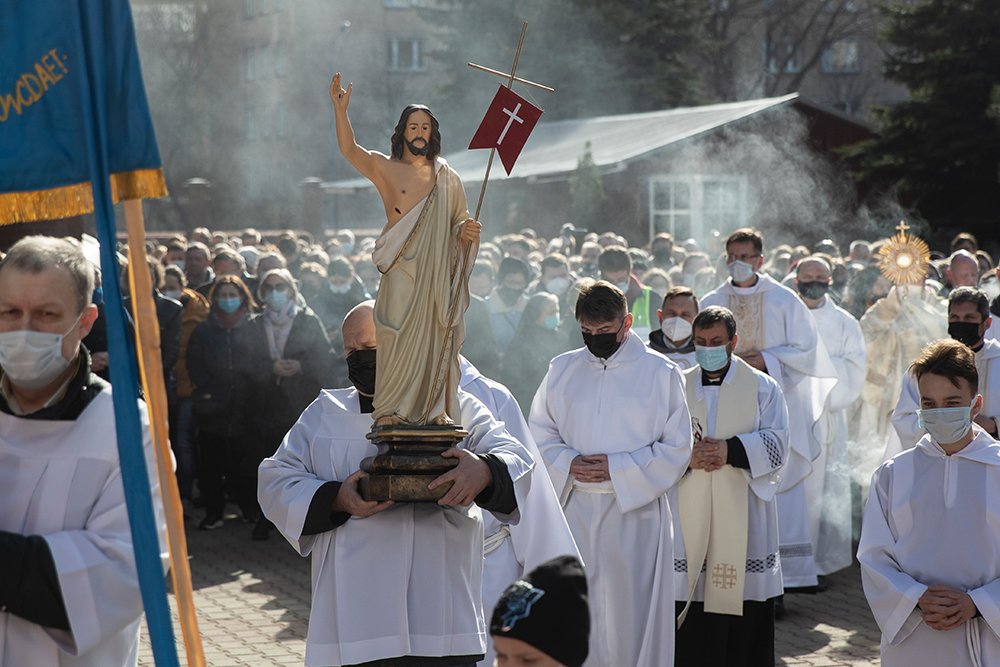
Catholic priest carries a statue of Jesus Christ as he walks in religious procession during the Holy Easter celebration in the Cathedral of the Immaculate Conception in Moscow, Russia, Sunday, April 4, 2021. Photo: Pavel Golovkin / AP

After all-virtual Easter services last year, St. Patrick’s Cathedral in New York City was at half-capacity for Sunday’s Mass. Worshippers spaced themselves out in the vaulted neo-Gothic cathedral, which can seat more than 2,000. The choir sang through masks.

In Detroit, Hartford Memorial Baptist Church opened for in-person Easter services for the first time in more than a year, with capacity limits and social distancing rules in place. The Rev. Charles Christian Adams told the Detroit Free Press that people need church, especially after the congregation lost at least 14 members to COVID-19.

Tonee Carpio said physically being in St. Vincent de Paul Church in Austin, Texas, meant a lot to her after services last year were offered only online. She said being in church helps keep her Filipino culture alive in her city, since some prayers are offered in her native Tagalog.

“When you’re inside a church, you become more solemn, you can focus on God,” she said.

In Florida, Eastgate Christian Fellowship in Panama City Beach hosted its annual sunrise service on the beach. The church had to scrap the service last year because all beaches were closed. Pastor Janelle Green estimated that about 400 people participated.

Robin Fox of Palm Bay, planned to spend Sunday driving her mother to Orlando to get a second dose of vaccine at a Federal Emergency Management Agency walk-up site.

“She’s getting that freedom on the same day that (people go to) church to celebrate Jesus being risen, so I said (to her), ‘it’s kind of like you’re being risen also,'” Fox said.

___

Story: Frances D’Emilio
Advertisement

Minorities in Myanmar Borderlands Face Fresh Fear Since Coup

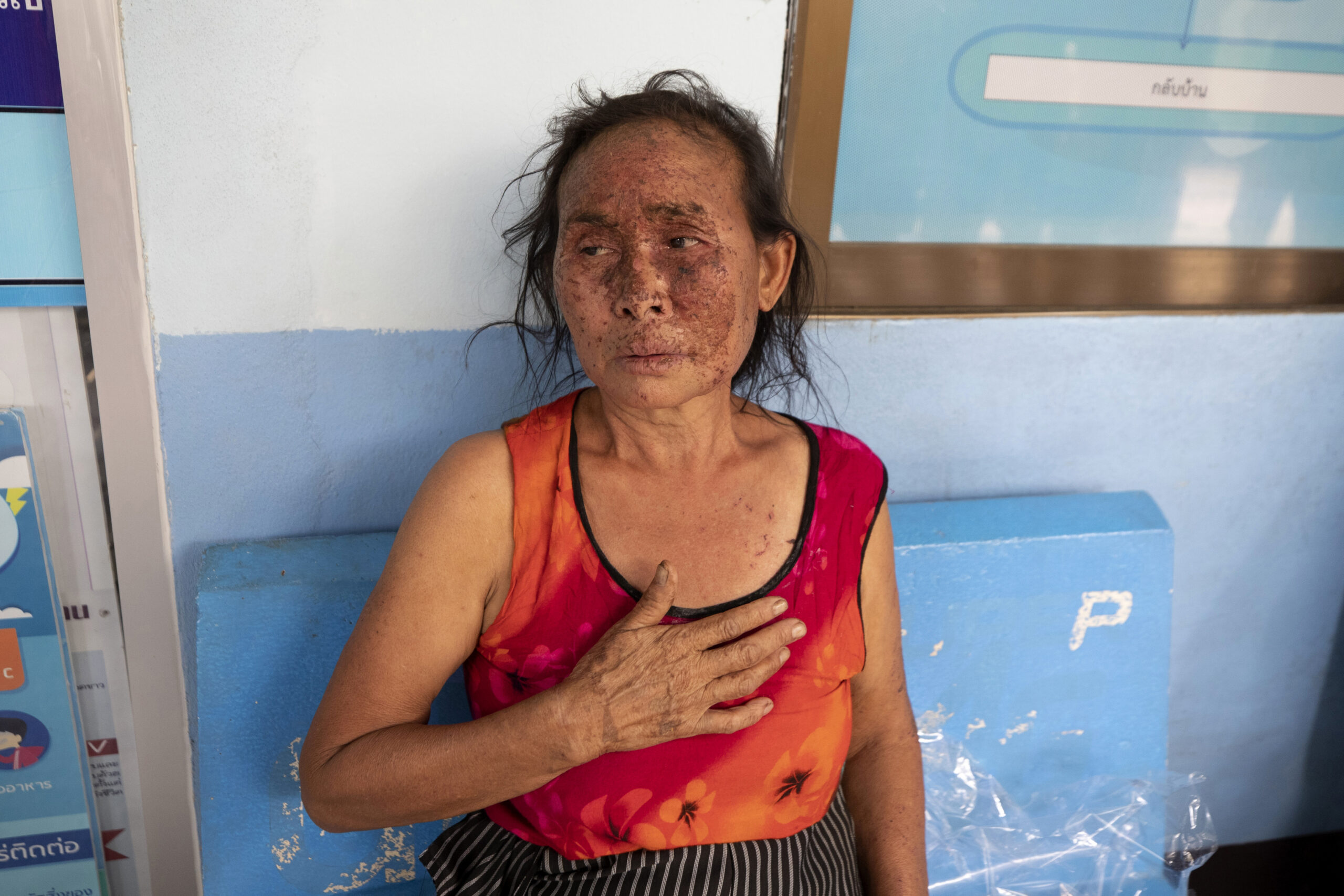
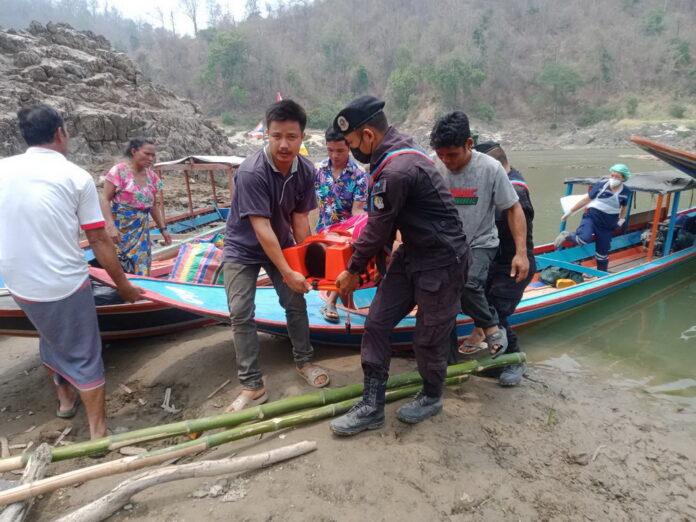
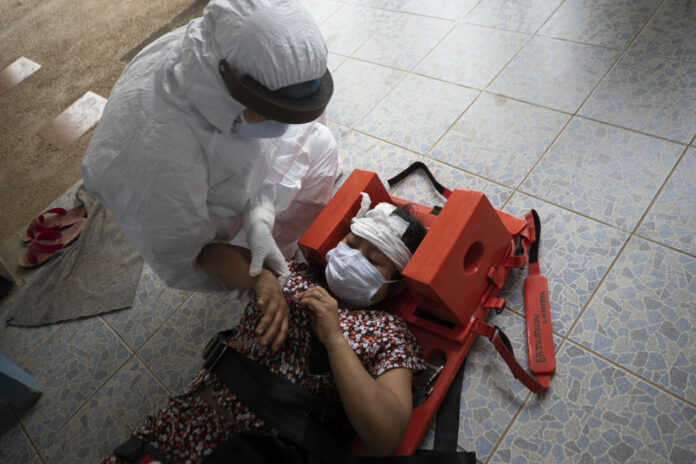
In this March 30, 2021, file photo, a health worker attends to an injured Karen villager from Myanmar as she and others arrive at Ban Mae Sam Laep Health Center in Mae Hong Son province, Thailand. Photo: Sakchai Lalit / AP File

JAKARTA (AP) — Before each rainy season Lu Lu Aung and other farmers living in a camp for internally displaced people in Myanmar’s far northern Kachin state would return to the village they fled and plant crops that would help keep them fed for the coming year.

But this year in the wake of February’s military coup, with the rains not far off, the farmers rarely step out of their makeshift homes and don’t dare leave their camp. They say it is simply too dangerous to risk running into soldiers from Myanmar’s army or their aligned militias.

“We can’t go anywhere and can’t do anything since the coup,” Lu Lu Aung said. “Every night, we hear the sounds of jet fighters flying so close above our camp.”

The military’s lethal crackdown on protesters in large central cities such as Yangon and Mandalay has received much of the attention since the coup that toppled Aung San Suu Kyi’s elected government. But far away in Myanmar’s borderlands, Lu Lu Aung and millions of others who hail from Myanmar’s minority ethnic groups are facing increasing uncertainty and waning security as longstanding conflicts between the military and minority guerrilla armies flare anew.

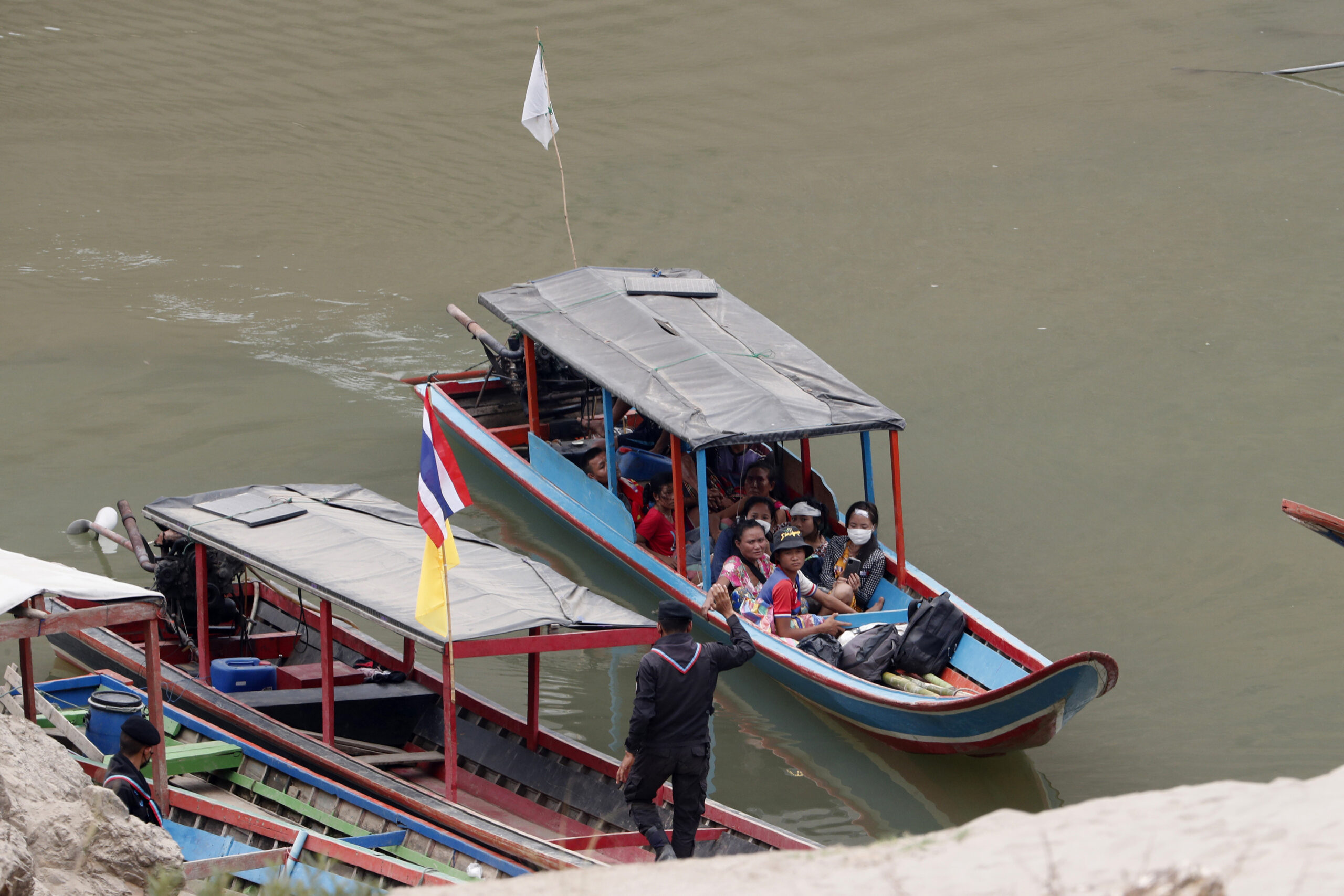
It’s a situation that was thrust to the forefront over the past week as the military launched deadly airstrikes against ethnic Karen guerrillas in their homeland on the eastern border, displacing thousands and sending civilians fleeing into neighboring Thailand.

Several of the rebel armies have threatened to join forces if the killing of civilians doesn’t stop, while a group made up of members of the deposed government has floated the idea of creating a new army that includes rebel groups. The U.N. special envoy for Myanmar, meanwhile, has warned the country faces the possibility of civil war.

Ethnic minorities make up about 40% of Myanmar’s 52 million people, but the central government and the military leadership have long been dominated by the country’s Burman ethnic majority. Since independence from Britain in 1948, more than a dozen ethnic groups have been seeking greater autonomy, with some maintaining their own independent armies.

That has put them at odds with Myanmar’s ultranationalist generals, who have long seen any ceding of territory — especially those in border areas that are often rich in natural resources — as tantamount to treason and have ruthlessly fought against the rebel armies with only occasional periods of ceasefire.

The violence has led to accusations of abuses against all sides, such as arbitrary taxes on civilians and forced recruitment, and according to the United Nations has displaced some 239,000 people since 2011 alone. That doesn’t include the more than 800,000 minority Rohingya who fled to Bangladesh to escape a military campaign the U.N. has called ethnic cleansing.

In this Tuesday March 30, 2021, file photo, an injured Karen villager from Myanmar rests at Ban Mae Sam Laep Health Center in Mae Hong Son province, northern Thailand, after they crossed Salawin river on a boat. Photo: Sakchai Lalit / AP File

Since February anti-coup protests have taken place in every border state, and security forces have responded much as they have elsewhere with tear gas, rubber bullets and live ammunition. But residents and observers say the post-coup situation in geographically isolated borderlands has been made worse by increased skirmishes between the military and armed ethnic organizations jockeying for power and territory.

Lu Lu Aung, who hails from the Kachin ethnic group, said she participated in protests, but stopped as it was now too dangerous. She said Myanmar security forces and aligned militias recently occupied their old village where they planted crops and no one left the camp because they feared they would be forced into work for the army.

“Our students can no longer continue the schooling and for the adults it’s so much difficult to find a job and make money,” she said.

Humanitarian aid for civilians in the borderlands — already strained by the pandemic as well as the inherent difficulty outside groups face operating in many areas — has been hard it since the coup as well.

Communications have been crippled, banks have closed and security has become increasingly uncertain, said the director of a Myanmar-based organization supporting displaced persons who spoke on condition of anonymity for security reasons.

“There is no more humanitarian help and support,” she said.

In eastern Karen State, where the airstrikes have displaced thousands, there are concerns that the arrival of rainy season could exacerbate a humanitarian situation already made difficult by reports that Thailand has sent back many of the civilians who fled. Thailand has said those who went back to Myanmar did so voluntarily.

Yet there are parts of the country’s borderlands that have hardly been impacted by the coup.

In Wa State, a region bordering China and Thailand that has its own government, army and ceasefire agreements with the Myanmar military, videos being shared online show life going on as usual, including the rollout of a coronavirus vaccination campaign.

Near Bangladesh in coastal Rakhine State, where the Rohingya were driven from and where violent clashes with the Arakan Army group have been ongoing for years, the junta last month removed the group from its list of terrorist groups, raising hopes a lowering of hostilities. The Arakan Army, unlike a number of other armed groups, had not criticized the coup.

The group, however, since released a statement that declared its right to defend its territory and civilians against military attacks, leading some to fear a fresh escalation in fighting.

In this March 30, 2021, file photo, Karenni villagers from Myanmar arrive on a boat with an injured person as they evacuate to Ban Mae Sam Laep Health Center in Mae Hong Son province, northern Thailand. Photo: Sakchai Lalit / AP File

Other armed groups have issued similar statements. Some such as the Karen National Union have provided protection for civilians marching in anti-coup protests.

Such actions have contributed to the calls for a “federal army” bringing together armed ethnic groups from across the country. But analysts says such a vision would be hard to achieve due to logistical challenges and political disagreements among the groups.

“These groups are not in a position where they can provide the support against the Myanmar military needed in urban centers with large populations, or really too far outside their own regions,” said Ronan Lee, a visiting scholar at Queen Mary University of London’s International State Crime Initiative.

Despite the uncertainty of what’s to come, some minority activists say they have been heartened since the coup by the increased focus on the role ethnic groups can take in Myanmar’s future. They also say there appears to be greater understanding — at least among anti-coup protesters — of the struggle minorities have faced for so long.

“If there’s any silver lining in all of this, that’s it,” said one activist, who spoke on condition of anonymity because of fears for their safety.

___

Story: Victoria Milko

Advertisement

Work With a Google Partner SEO Agency

Brands who are new to digital marketing and want to advance quickly in this unfamiliar territory can help themselves by teaming up with a Google Partner SEO agency.

Google partner agencies have earned a badge signifying them as experts in the skills and experience necessary to optimize websites to their full potential and provide a high level of digital marketing services.

Google has created this badge system to promote the responsible and correct use of all the tools Google provides to digital marketers. Once an SEO agency has earned the Google Partner badge, they’re eligible for special training, insights and a higher level of support from Google.

Stay a Step Ahead of the Competition

When you choose to team up with a Google Partner agency, you can rest assured that your partner will always have updated information the moment Google releases it. Updates can affect how site rankings are calculated, and having this information before your competition can help your brand exceed them in the rankings.

Your SEO agency will have a special relationship because of its partner status. They’ll have a direct line of communication with knowledgeable representatives of Google in your region of the world. This direct line means that they’ll receive valuable insights and additional tips on the best way to proceed after a Google upgrade is announced. These tips won’t be available to a non-partner agency, so your agency will have a head start in making any needed changes to your website and practices.

Better Level of Services

Your brand will also enjoy a higher and better level of the many services offered by an SEO and digital marketing agency. Google rewards badges to agencies they recognize as providing expert services in the digital arena. Google Partners enjoy regular access to training courses that explore new and innovative discoveries in the digital field as well as refresher courses that keep the member’s skill levels razor-sharp.

When a new product is launched by Google, these partners also receive training in using the product to the best advantage of their clients. Your SEO agency will always be up to date on all the products offered by Google. This means that you’ll always have a head start over competitors who don’t have access to a Google Partner agency, and you’ll stay one step ahead of them in utilizing the digital marketing tools.

Wealth of Experience

The badge awarded to the SEO agency by Google symbolizes that the agency’s members have been working in SEO and digital marketing for some time and know all the ins and outs of the business. Any agency can apply for a badge, but they’re only awarded to agencies that have satisfied several criteria that demonstrate thorough knowledge and experience in the digital skills needed to excel in the field.

Your agency must have met the Google Ad spend requirements representing an everyday use of the Google Ads platform. They must have also attained a measure of both agency and client growth that demonstrates a superior level of achievement.

Only a few agencies in Bangkok can meet the requirements of a Google Partner. They are your best bet to partner with in your brand’s new venture into the world of digital marketing.

Advertisement

Man Rams Car Into 2 Capitol Police; 1 Officer, Driver Killed

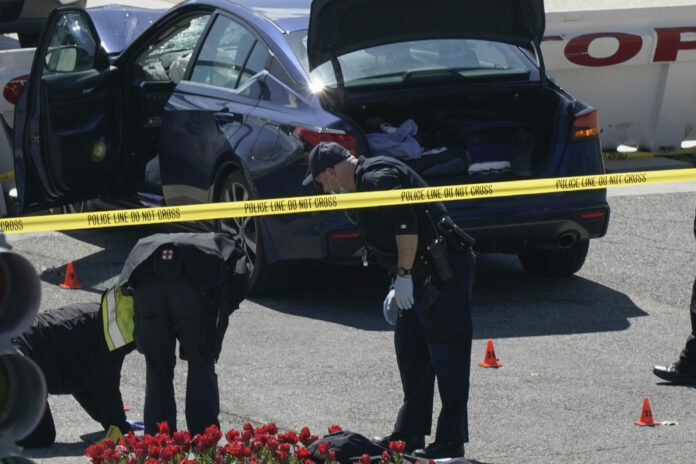
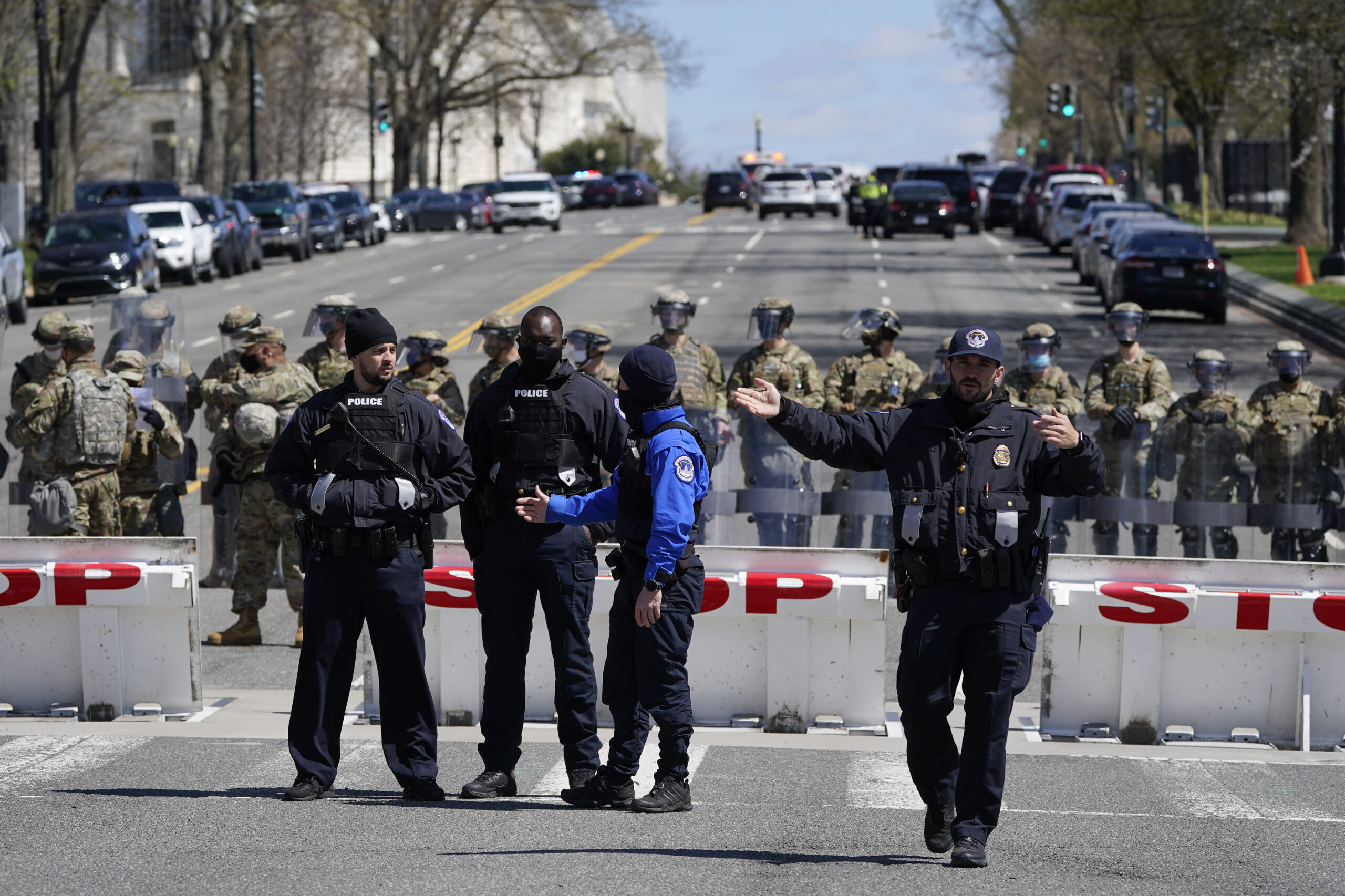
U.S. Capitol Police officers investigate near a car that crashed into a barrier on Capitol Hill near the Senate side fo the U.S. Capitol in Washington, Friday, April 2, 2021. Photo: J. Scott Applewhite / AP

WASHINGTON (AP) — A Capitol Police officer was killed Friday after a man rammed a car into two officers at a barricade outside the U.S. Capitol and then emerged wielding a knife. It was the second line-of-duty death this year for a department still struggling to heal from the Jan. 6 insurrection.

Video shows the driver of the crashed car emerging with a knife in his hand and starting to run at the pair of officers, Capitol Police Acting Chief Yogananda Pittman told reporters. Authorities shot the suspect, who died at a hospital.

“I just ask that the public continue to keep U.S. Capitol Police and their families in your prayers,” Pittman said. “This has been an extremely difficult time for U.S. Capitol Police after the events of Jan. 6 and now the events that have occurred here today.”

Police identified the slain officer as William “Billy” Evans, an 18-year veteran who was a member of the department’s first responders unit.

Two law enforcement officials told The Associated Press that investigators initially believed the suspect stabbed one of the officers, but it was later unclear whether the knife actually made contact, in part because the vehicle struck the officers with such force. The officials were not authorized to publicly discuss the investigation and spoke on condition of anonymity.

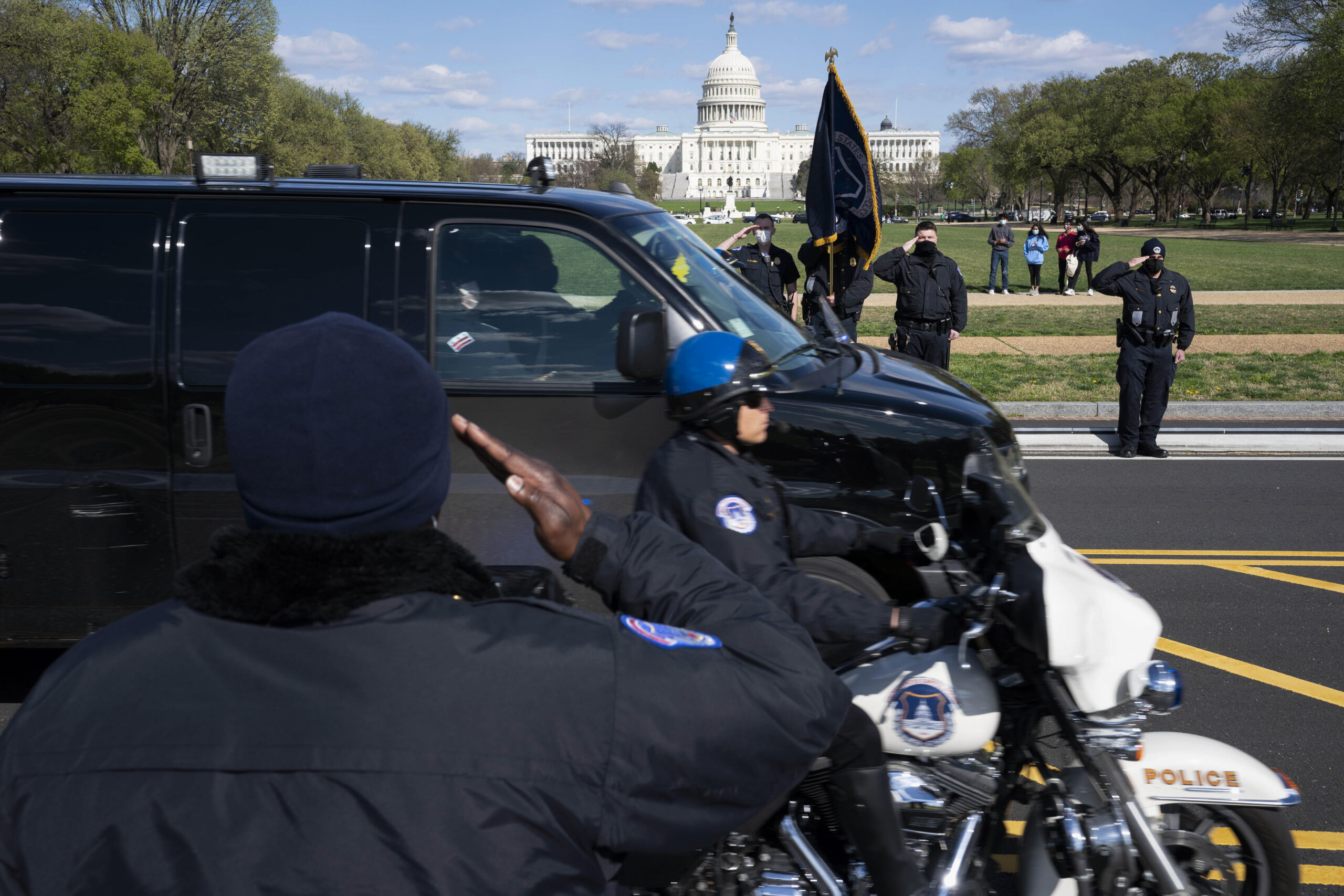
With the U.S. Capitol in the background, U.S. Capitol Police officers salute as procession carries the remains of a U.S. Capitol Police officer who was killed after a man rammed a car into two officers at a barricade outside the Capitol in Washington, Friday, April 2, 2021. Photo: Jose Luis Magana / AP

Authorities said there wasn’t an ongoing threat, though the Capitol was put on lockdown for a time as a precaution. There was also no immediate connection apparent between Friday’s crash and the Jan. 6 riot.

Law enforcement officials identified the suspect as 25-year-old Noah Green. Investigators were digging into his background and examining whether he had any mental health history as they tried to discern a motive. They were also working to obtain warrants to access his online accounts.

Pittman said the suspect did not appear to have been on the police’s radar. But the attack underscored that the building and campus — and the officers charged with protecting them — remain potential targets for violence.

Green described himself as a follower of the Nation of Islam and its founder, Louis Farrakhan, and spoke of going through a difficult time where he leaned on his faith, according to recent messages posted online that have since been taken down. The messages were captured by the group SITE, which tracks online activity.

“To be honest these past few years have been tough, and these past few months have been tougher,” he wrote. “I have been tried with some of the biggest, unimaginable tests in my life. I am currently now unemployed after I left my job partly due to afflictions, but ultimately, in search of a spiritual journey.”

President Joe Biden said in a statement that he and his wife were heartbroken to learn of the attack and expressed condolences to Evans’ family. He directed flags at the White House to be lowered to half staff.

The crash and shooting happened at a security checkpoint near the Capitol typically used by senators and staff on weekdays, though most were away from the building for the current recess. The attack occurred about 100 yards (91 meters) from the entrance of the building on the Senate side of the Capitol. One witness, the Rev. Patrick Mahoney, said he was finishing a Good Friday service nearby when he heard three shots ring out.

The Washington region remains on edge nearly three months after a mob of insurrectionists loyal to former President Donald Trump stormed the Capitol as Congress was voting to certify Biden’s presidential win.

Five people died in the Jan. 6 riot, including Capitol Police officer Brian Sicknick, who was among a badly outnumbered force trying to fight off the intruders seeking to overturn the election. Authorities installed a tall perimeter fence around the Capitol and for months restricted traffic along the roads closest to the building, but they had begun pulling back some of the emergency measures. Fencing that prevented vehicular traffic near that area was only recently removed.

Evans was the seventh Capitol Police member to die in the line of duty in the department’s history, according to the Officer Down Memorial Page, which tracks deaths of law enforcement. In addition, two officers, one from Capitol Police and another from Washington’s Metropolitan Police Department, died by suicide following the Jan. 6 attack.

Almost 140 Capitol Police officers were wounded in that attack, including officers not issued helmets who sustained head injuries and one with cracked ribs, according to the officers’ union. It took hours for the National Guard to arrive, a delay that has driven months of finger-pointing between that day’s key decision makers.

Members of the U.S. Capitol Police stand guard near the scene of a car that crashed into a barrier on Capitol Hill in Washington, Friday, April 2, 2021. Photo: Patrick Semansky / AP

Capitol Police and National Guard troops were called upon soon afterward to secure the Capitol during Biden’s inauguration and faced another potential threat in early March linked to conspiracy theories falsely claiming Trump would retake the presidency.

“Today, once again, these heroes risked their lives to protect our Capitol and our country, with the same extraordinary selflessness and spirit of service seen on January 6,” House Speaker Nancy Pelosi said in a statement. “On behalf of the entire House, we are profoundly grateful.”

The U.S. Capitol complex was placed on lockdown for a time after Friday’s shooting, and staffers were told they could not enter or exit buildings. Video showed Guard troops mobilizing near the area of the crash.

Video posted online showed a dark colored sedan crashed against a vehicle barrier and a police K-9 dog inspecting the vehicle. Law enforcement and paramedics could be seen caring for at least one unidentified individual.

___

Story: Michael Balsamo, Nomaan Merchant and Colleen Long

Advertisement

Opinion: Let Us Not Lose Our Humanity on Myanmar Issue

An injured Karen villager from Myanmar is transported across the border to a hospital on the Thai side in Mae Hong Son province on March 30, 2021.

When your next door neighbours are crying out for help, fleeing from their home for safety, what should you do?

It seems the answer is obvious but for some Thais it’s not.

Will you ignore, shun them, or even say it’s none of your business? This is the dilemma some Thais and the Thai government of Gen. Prayut Chan-ocha are facing as Myanmar killings continue two months after the Feb. 1 military coup. Over 500 people have been slain by the Burmese junta who are facing a fierce resistance from many citizens.

Dear Thai citizens, this is a moral question that we all collectively as a society must face. What shall we do?

Shall we just turn a blind eye and say this is none of our business? Or shall we rise above the occasion and lend our next-door neighbours whom we share the longest common border with – at 2,401 kilometres – a helping hand on humanitarian ground?

The fact is, it’s appalling to learn that not a few Thais advocate the former, particularly after some 2,000 to 3,000 Karens crossed the Salween River into the Thai border at Mae Hong Son province’s Sob Moey District last weekend. Some were sent back, or “returned home” voluntarily after 48 hours or so, depending whether you believe the Thai government or the Thai and foreign journalists.

On social media, Twitter in particular, some Thais freely advocate a selfish stance that we cannot afford to help, or shouldn’t even bother to help. They argue with others calling for Thais to be humane.

Some of those who say the Thai government and Thai people shouldn’t help even cited the fact that Thailand is not a party to the 1951 Refugee Convention, thus have no specific legal framework for protecting asylum seekers.

“You need to be knowledgeable before inviting the enemies into your house. The Kingdom of Thailand is not a party to the 1951 Refugee Convention and the 1967 Protocal so we have the ‘right’ to discriminate for the sake of our nation and people’s interests. In the past, we’d helped adequately already,” Twitter user @vnomenon replied to me on Tuesday after I called for Thais to lend a helping hand and be generous to those from Myanmar in need for and condemn the Thai government for not doing enough.

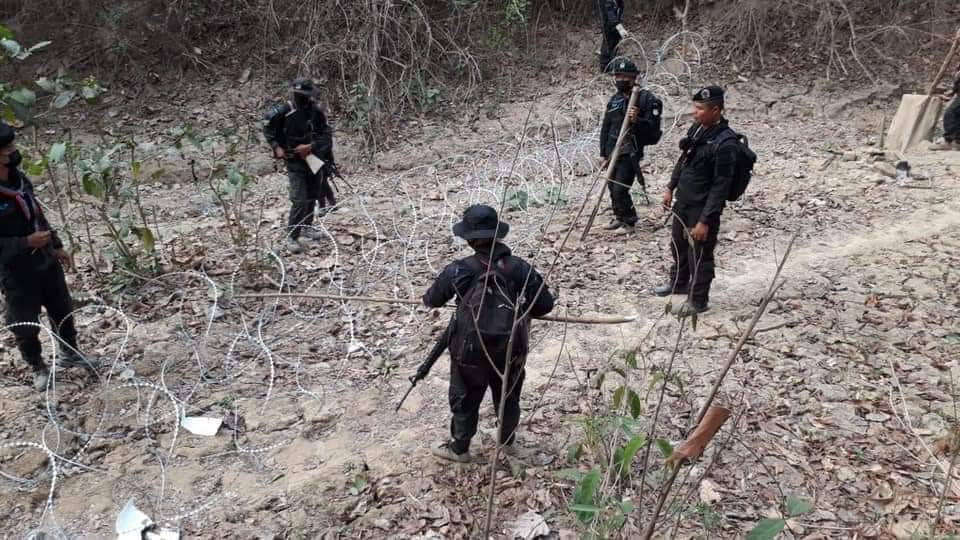
Images of razor wires have spread and been confirmed as authentic and a question arose whether some of the 3,000 who fled into Thailand were pushed back or not.

Security officers set up razor wires at the Thai-Myanmar border in Mae Hong Son province.

My reply to the Thai Twitter user was convention or no convention, this is first and foremost a humanitarian issue.

Let us not lose our humanity to the narrowly defined “national interests.”

Others were not convinced. Twitter user @Noona_Infinity wrote: “See Europe as an example. People who seek asylum there don’t work. They flee the camps and commit crimes. Please don’t call me mean but I love my country.”

Then there was a columnist on Thansettakij business news site writing an article with the headline, “Myanmar Crisis is an Opportunity for Thai Businessmen.”

Need I say more?

Politics in Myanmar is certainly complicated, with a dozen armed ethnic groups, racism against Rohingya people, geopolitics and more. Let one thing be clear, however. This is the time for the Thai people to be more selfless and less selfish. This is the time for Thais to prove that we are a humane society and will do what we can, despite our limited means, to help our neighbours in distress, fleeing from danger if not death.

On Tuesday, with the debate rages, PM Prayut reassured reporters that Thailand “won’t push back refugees” fleeing Myanmar into the kingdom. This is a good sign but I will take his word with a big grain of salt as it was the same Prayut who told reporters repeatedly that he won’t stage a coup only to have done it in May 2014.

It is also the same man who after the coup wrote a song with a lyric “asking for a little more time” in power as a junta leader only to end up staying in power for nearly five years and until now after the 2019 elections where the new election rules were written by his chosen men and women.

If you’re not convince about Prayut’s trustworthiness, or lack thereof, consider the fact that Thailand became the first nation to unofficially welcome a foreign representative of the Burmese junta, while the estimate 3 to 4 million Burmese in Thailand are now told not to protests at the Myanmar Embassy in Bangkok or the local U.N. Office, citing COVID-19 emergency decree.

In Japan, a country hit harder by COVID-19, Burmese demonstrators were still allowed to protest and I watched it taking place live in the Okayama, west of Japan.

What’s more, Thai immigration police put posters along the Thai-Myanmar border with six leading anti-Myanmar coup figures on a watch list.

“They may cross the border into Thailand to continue anti-Myanmar-government resistance,” part of the text on the poster read. One of the six who appeared on the poster was the Burmese permanent representative to the United Nations Kyaw Moe Tun who openly criticized the coup in Feb at the U.N. General Assembly.

How shameful and disgusting was that poster? If that’s not enough, less than two weeks ago, mysterious 700 sacks of rice were found left on the Thai-side of the Thai-Myanmar border in Mae Hong Son province.

Prayut again eventually acknowledged the Thai government allowed Thai merchants to buy supplies for the Burmese junta (who slaughter its own people as best they could in order to remain in power). The supplies, according to Prayut, were to be delivered across the border on “humanitarian grounds.”

Also, Thailand was among the only 12 nations which sent a representative to attend the murderous Myanmar Armed Forces Day celebrations a week ago. On that day, over a hundred people were killed while the Thai representative cheers on the Bumese junta.

This occurs as defense chiefs of a dozen countries, including the U.S., U.K., Japan and even South Korea, issued a joint statement condemning the Burmese junta’s atrocities. Is there a better word than “disgusting”? Prayut defended the decision, citing the need to maintain a “communication channel” with the Burmese generals.

Then by Friday, local media in Thailand including Thai-language Khaosod, reported that 46 Karens fleeing air strikes walked for five hours to the border and tried to cross Salween River into Thailand but were prevented from doing so.

The Thai and foreign media, and concerned Thais must keep a close eye on Prayut and his men and make sure he keeps his word. Allowing seven injured Karens to be hospitalized in Thailand on Tuesday was a good start but as the storm rages in Myanmar, we must be resolute in insisting on putting humanitarian principles first before national interests.

If we succeed, and God speeds us, we and others shall look back decades from now with no shame and say Thais did not shy away from helping their Burmese neighbours when the time came to show who we are.

Advertisement

Taiwan Prosecutors Probe Train Crash That Killed 51

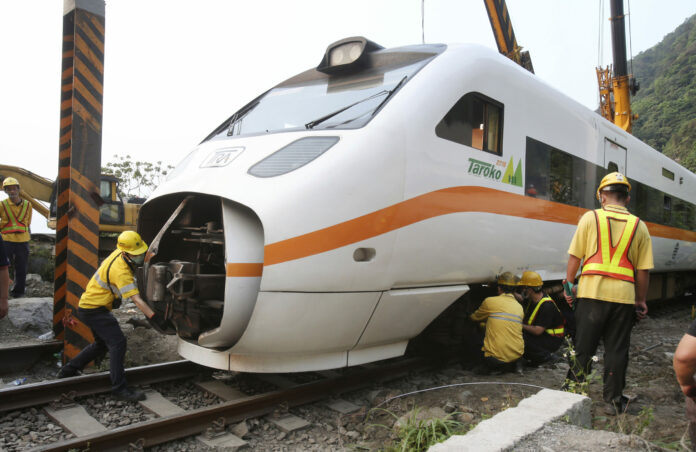
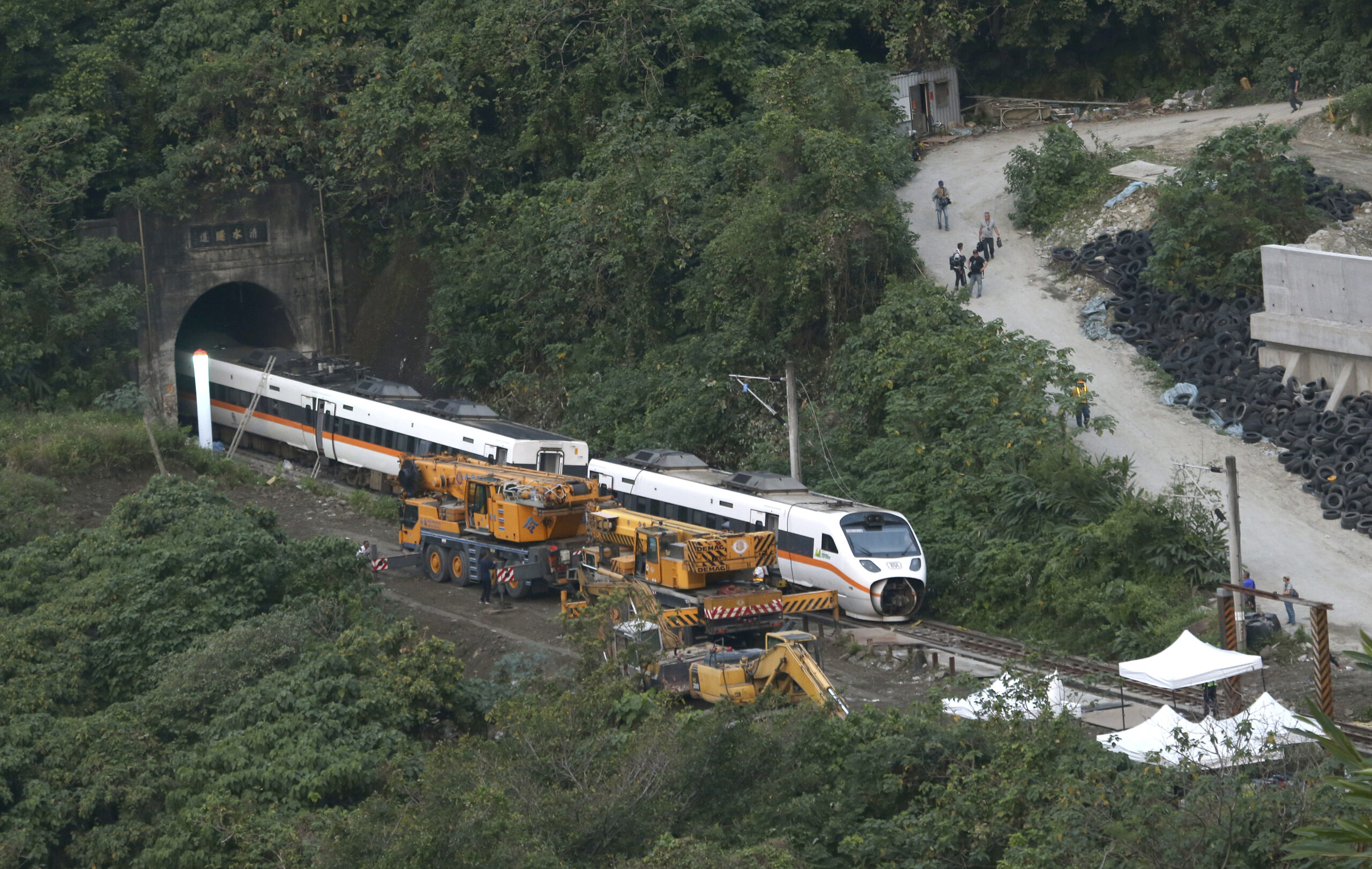
Rescue workers remove a part of the derailed train near Taroko Gorge in Hualien, Taiwan on Saturday, April 3, 2021. Photo: Chiang Ying-ying / AP

HUALIEN COUNTY, Taiwan (AP) — Prosecutors in Taiwan said Saturday they questioned the owner of an unmanned truck that rolled onto a rail track and caused the country’s worst train disaster in decades that killed 51 people and injured 146, though no charges have been filed.

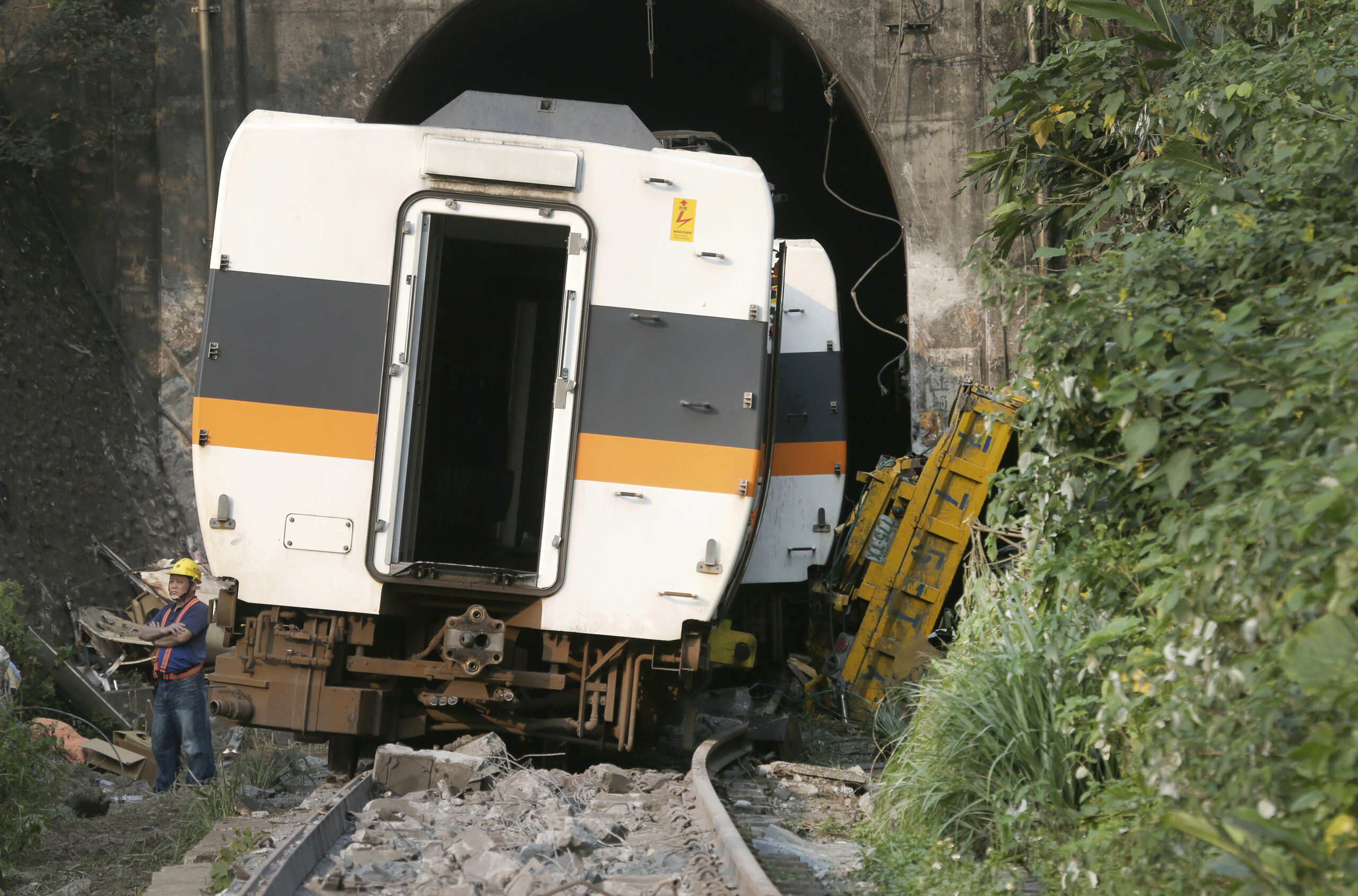
The train was carrying 494 people at the start of a long holiday weekend on Friday when it smashed into the construction truck that slid down a hillside above the tracks, the Taiwan Railways Administration said. Many passengers were crushed just before the train entered a tunnel, while some survivors were forced to climb out of windows and walk along the train’s roof to safety.

The truck’s emergency brake was not properly engaged, according to the government’s disaster relief center.

The district prosecutor’s office in eastern Hualien County, where the train derailed, confirmed it had interviewed the truck owner, among others, but was not ready to file charges. Prosecutorial staff were visiting a mortuary Saturday to examine the bodies, office spokeswoman Chou Fang-yi said.

President Tsai Ing-wen was due to visit the site later Saturday.

“We have asked the Transportation Safety Committee to conduct a strict investigation of the accident, and after fully clarifying the cause of the accident, we will explain it to everyone,” Tsai told reporters Friday.

“We’re asking passengers to forgive us for any delays,” she said.

Rescue workers remove a part of the derailed train near Taroko Gorge in Hualien, Taiwan on Saturday, April 3, 2021. Photo: Chiang Ying-ying / AP

Transportation Minister Lin Chia-lung said repairs will be accelerated.

“When such a thing happens, I feel very sorry and I will take full responsibility,” Lin said after touring the site.

Taiwan Railways Administration chief Chi Wen-chung said his team had successfully removed the first derailed carriage out of the site.

Two large construction cranes could be seen drawn up next to the train, as workers examined and removed some parts in a remote wooded cliff area on the island’s east coast.

Repair work also was underway on the tracks including the tunnel where part of the eight-car train crashed. The operation should be done within a week, said Weng Hui-ping, head of the railway administration’s news group. During the repairs, all east coast trains will run on a track parallel to the one damaged in the accident, causing delays of 15 to 20 minutes, he said.

A worker stands in front of the derailed train near Taroko Gorge in Hualien, Taiwan on Saturday, April 3, 2021. Photo: Chiang Ying-ying / AP

The National Fire Service confirmed the death toll — which included the train’s young, newly married driver and the assistant driver — and said more than 100 people were injured. The government’s disaster response center said it was the worst rail disaster in 73 years.

Train travel is popular during Taiwan’s four-day Tomb Sweeping holiday, when families often return to hometowns to pay respects at the gravesites of their elders.

Taiwan is a mountainous island, and most of its 24 million people live in the flatlands along the northern and western coasts that are home to most of the island’s farmland, biggest cities and high-tech industries. The lightly populated east where the crash happened is popular with tourists, many of whom travel there by train to avoid mountain roads.

___

Story: Ralph Jennings and Johnson Lai

Advertisement

CP Foods Moves up One Tier on the Latest Business Benchmark on Farm Animal Welfare

Charoen Pokphand Foods PCL (CP Foods) has improved its score to Tier 3 on the latest version of Business Benchmark on Farm Animal Welfare (BBFAW) report, showing significant development in the areas of Innovation and Leadership as well as Performance Reporting and Impact.

The Business Benchmark on Farm Animal Welfare (BBFAW) is the leading global measure of farm animal welfare management, policy commitment, performance and disclosure in 150 leading companies from around the world. The companies are ranked into six tiers based on their performances.

According to the 2020 report launched on 30th March 2021, CP Foods is now included in the Tier 3 where animal welfare’s policy is “established but there is work to be done”. It was listed on the Tier 4 on the 2019 announcement. Also, CP Foods is the only Thai company listed on the prestigious benchmark.

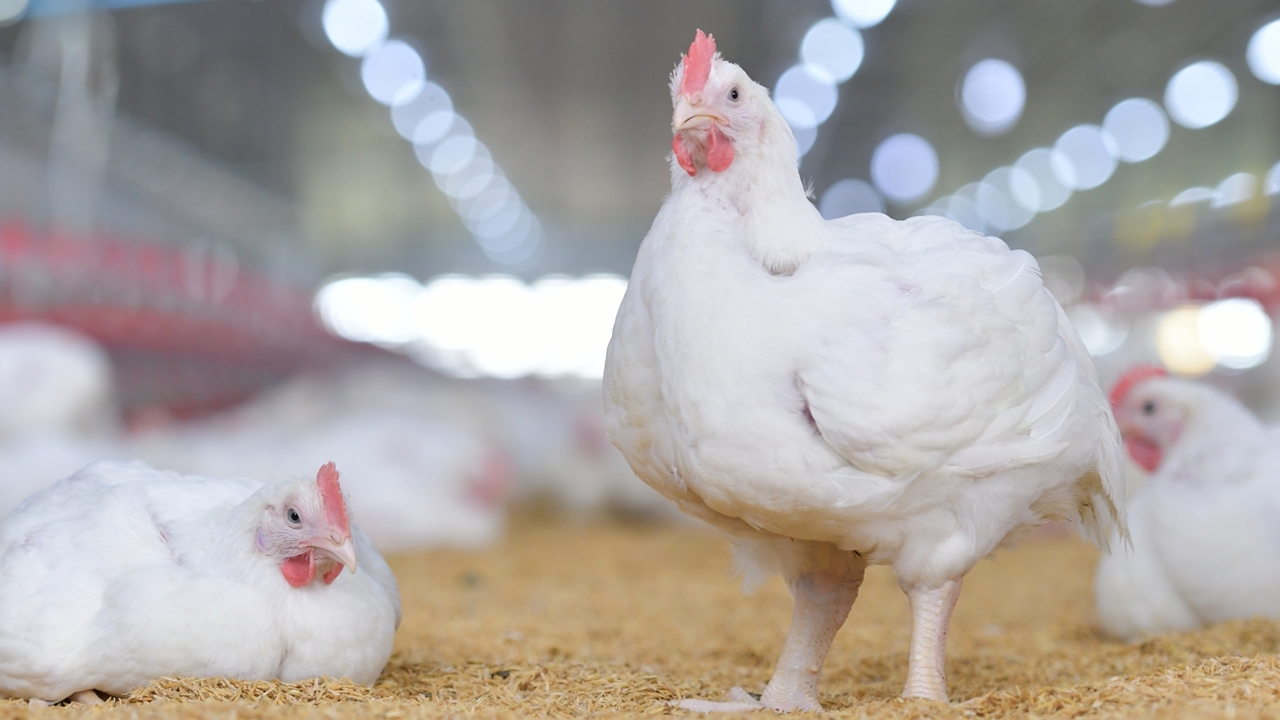
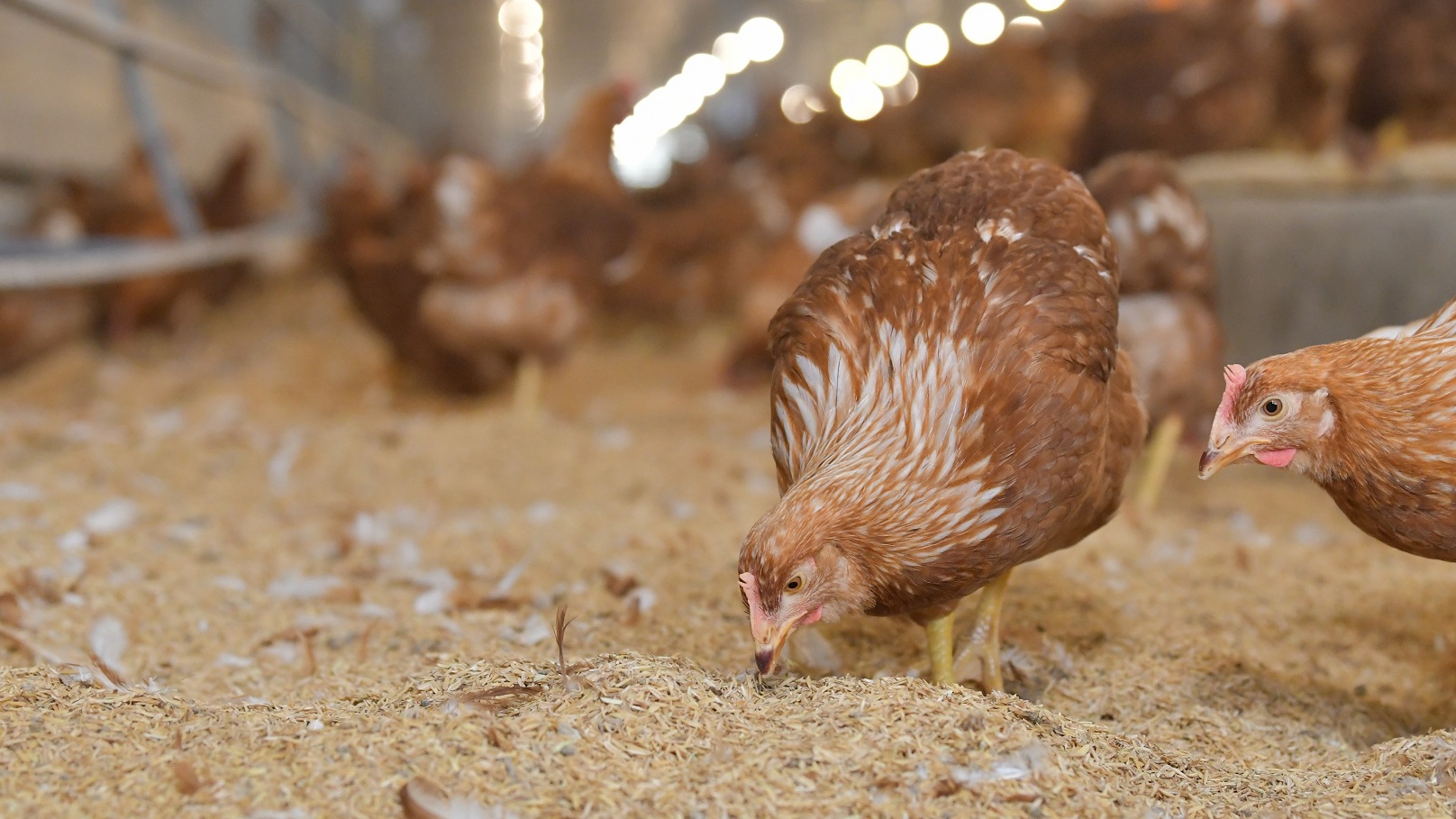
The improvement is thanks to CP Foods’s investment on smart farming system to support production efficiency while promoting animal welfare on broiler farms. For example, at a smart poultry farm, anemometers, thermal scan cameras, ammonia (NH3) meters, carbon dioxide (CO2 meters and automatic height adjusting feeding and watering tools were installed. These tools can be controlled by a computer system and IP cameras. Meanwhile, the database from farm monitoring can be used for analysis and further developed into Big Data for future development.

CPF31 0

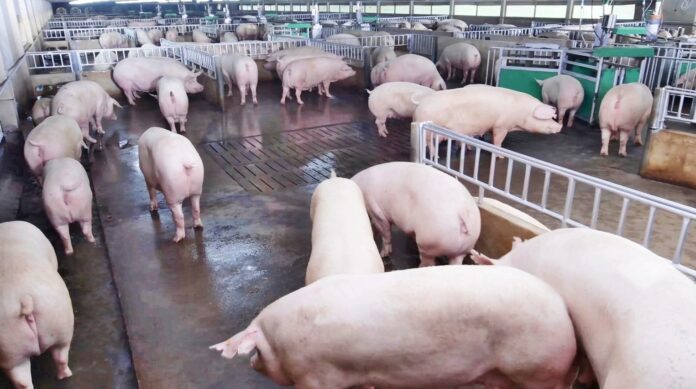
In swine business, CP Foods’ staffs have taken a role as a member of the 3Ts-Alliance (Teeth, Tails and Testicles), organized by the World Animal Protection. The objective of the initiative is to reduce pain in swine in the global swine industry through gathering knowledge and experience from relevant experts around the world.

Recently, it has made a new benchmark for egg industry in Thailand. CP Foods’ Wang Somboon Farm is the first farm that is certified by Thailand’s Department of Livestock Development’s for its cage-free farming practices.

Besides humane practices, CP Foods has also done well on performance reporting. It reports on the proportion of swine that is free from mutilations and tail docking, welfare outcomes, and proportion of cage-free laying hens in its egg operation.

With a vision to be a “Kitchen of the World”, CP Foods has a global policy on animal welfare in line with Five Freedoms of Animal Welfare to ensure that farm animals will be free from hungry and thirsty, discomfort, pain, injury and disease, fear and distress, and being able to express normal behavior.

thumbCage Free 1592883381 0

Advertisement

Court Overturns Order to Fine Yingluck 35.7 Billion Baht Over Failed Rice Scheme

A file photo of former PM Yingluck Shinawatra.
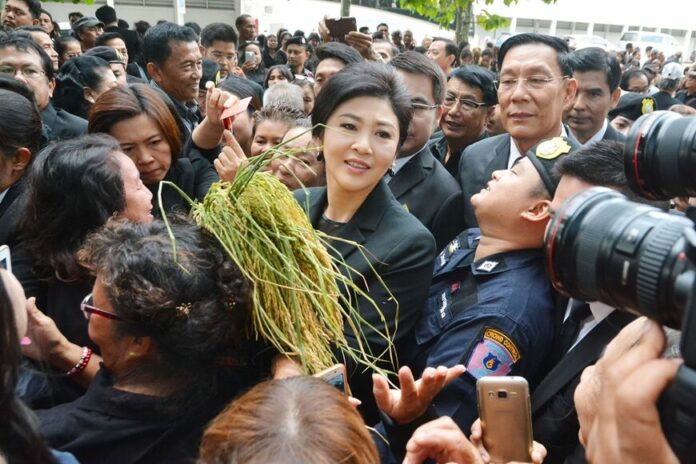
FILE - Former Thailand's Prime Minister Yingluck Shinawatra arrives at the Supreme Court for last day of the hearing in Bangkok, Thailand, July 21, 2017. (MATICHON Photo)

BANGKOK — The Administrative Court on Friday repealed the military government’s order to fine former PM Yingluck Shinawatra for 35 billion baht over her loss-ridden rice subsidy program.

The court found the order issued by the finance ministry in 2016 lacks legal standing since the ministry had failed to show any clear evidence of Yingluck, whose government was overthrown in a 2014 coup, was responsible for the financial damages done to the state. It also said that the corruption happened at the operational level.

Deputy PM Wissanu Krea-ngam said the authorities will stop seizing Yingluck’s assets for the meantime while filing an appeal. Properties worth less than one percent of the total fine have either been froze or confiscated from Yingluck so far, he added.

“It’s fine because the case is still ongoing,” Wissanu said. “Since the court has given the verdict, we will stop asset seizures and make an appeal to the Supreme Administrative Court. It now depends on the finance ministry to decide what to do next.”

Yingluck fled Thailand in 2017, shortly before she was found guilty on charges of negligence over the same rice-pledging initiative. She was sentenced in absentia to five years in prison and a warrant was issued for her arrest, which Yingluck’s Pheu Thai Party and her supporters decried the sentence as politically motivated.

Asked whether the Administrative Court’s verdict would contradict the conviction handed earlier by the Supreme Court, Wissanu said he could not tell.

“I don’t know,” Wissanu said. “If the court of first instance doesn’t find her guilty, we can make an appeal.”

Warong Dechgitvigrom, leader of royalist Thai Phakdee Party who petitioned the national anti-graft commission to investigate the program when he was a Democrat MP in 2012, said he was surprised by the ruling.

“Yingluck might be aware of irregularities in the transactions,” Warong said. “The government should make an appeal immediately.”

The program was meant to help farmers to sell rice at a higher price by offering them to take their rice as a mortgage in exchange for loans at a fixed price, though it was engulfed by allegations of corruption and ended up in a loss as high as 536 billion baht, according to the junta’s inquiry committee.

Related stories:

FAQ: The Rice Program and Yingluck Trial Explained

Advertisement

7 Hong Kong Democracy Leaders Convicted as China Clamps Down

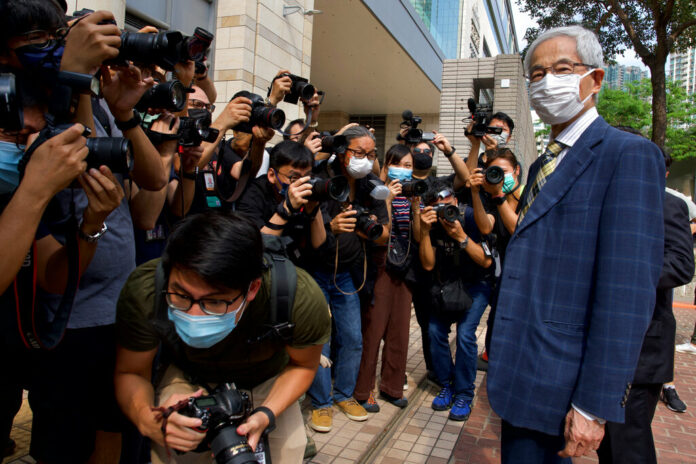
Pro-democracy lawmaker Martin Lee, right, arrives at a court in Hong Kong Thursday, April 1, 2021. Photo: Vincent Yu / AP

HONG KONG (AP) — Seven of Hong Kong’s leading pro-democracy advocates, including a media tycoon and an 82-year-old veteran of the movement, were convicted Thursday for organizing and participating in a march during massive anti-government protests in 2019 that triggered a crackdown on dissent.

The verdict was the latest blow to the flagging democracy movement as the governments in Hong Kong and Beijing tighten the screws in their efforts to exert greater control over the semi-autonomous Chinese territory. Hong Kong had enjoyed a vibrant political culture and freedoms not seen elsewhere in China during the decades it was a British colony. Beijing had pledged to allow the city to retain those freedoms for 50 years when it took the territory back in 1997, but recently it has ushered in a series of measures that many fear are a step closer to making Hong Kong no different from cities on the mainland.

Jimmy Lai, the owner of the outspoken Apple Daily tabloid; Martin Lee, the octogenarian founder of the city’s Democratic Party; and five former pro-democracy lawmakers were found guilty in a ruling handed down by a district judge. They face up to five years in prison. Two other former lawmakers charged in the same case had pleaded guilty earlier.

According to the ruling, six of the seven defendants convicted on Thursday, including Lee and Lai, carried a banner that criticized police and called for reforms as they left Victoria Park on Aug. 18, 2019, and led a procession through the center of the city. The other defendant, Margaret Yee, joined them on the way and helped carry the banner.

Police had given permission for a rally at Victoria Park but had rejected an application from the organizer, the Civil Human Rights Front, for the march.

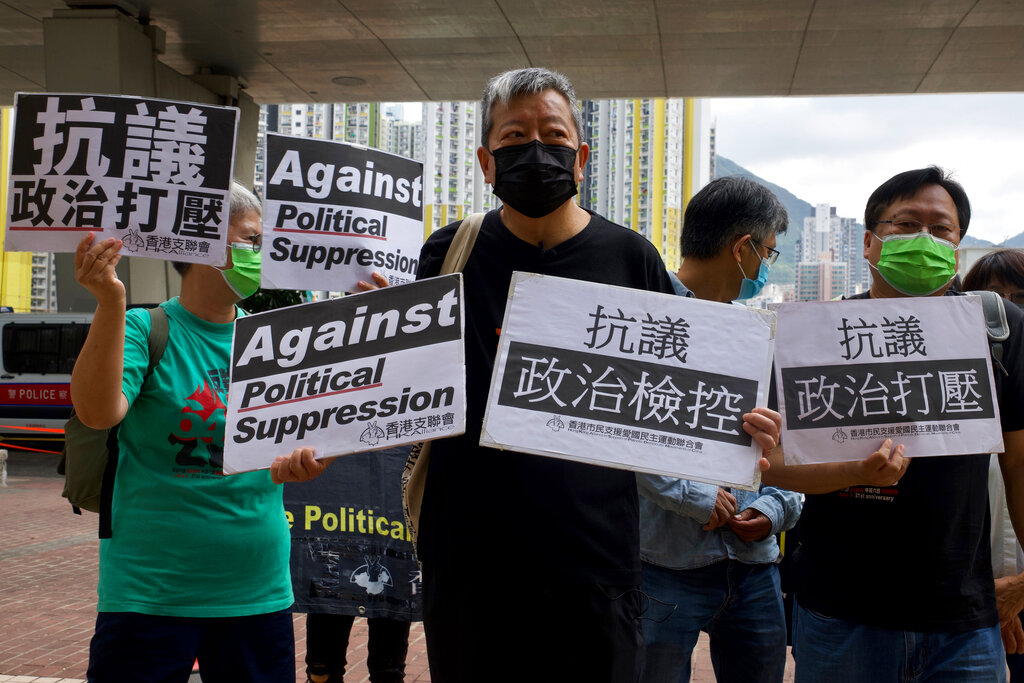
Pro-democracy activist Lee Cheuk-yan, center, holds placards as he arrives at a court in Hong Kong Thursday, April 1,2021. Photo: Vincent Yu / AP

Organizers estimated that 1.7 million people marched that day in opposition to a bill that would have allowed suspects to be extradited to mainland China for trial — a measure that infuriated Hong Kongers who cherish their distinct justice system and sparked months of demonstrations that sometimes led to violent clashes between protesters and police.

The legislation was eventually withdrawn, but the fuse was lit, and the protesters’ demands expanded to include calls for full democracy. Instead, Beijing has responded by cracking down even harder on dissent, including a new national security law and changes last month that will significantly reduce the number of directly elected seats in Hong Kong’s legislature. As a result of the clampdown, most of Hong Kong’s outspoken activists are now in jail or in self-exile abroad.

“Their conviction is yet another example of Beijing eroding Hong Kong’s freedoms and failing to live up to its international obligations,” White House press secretary Jen Psaki said. The U.N. chief’s spokesman, Stephane Dujarric, said U.N. Secretary-General Antonio Guterres “has repeatedly said there should be no prisoners of conscience in the 21st century, and he’s always underscored the right to peaceful assembly.”

Former lawmaker Lee Cheuk-yan, who was among those convicted Thursday, expressed disappointment in the verdict, saying he and his fellow residents have the constitutional right to march. Lee is known for helping to organize annual candlelight vigils in Hong Kong on the anniversary of the bloody crackdown on pro-democracy protests in Beijing’s Tiananmen Square in 1989.

“We are firm that we have the right to assemble,” he said. “It is our badge of honor to be in jail for walking together with the people of Hong Kong.”

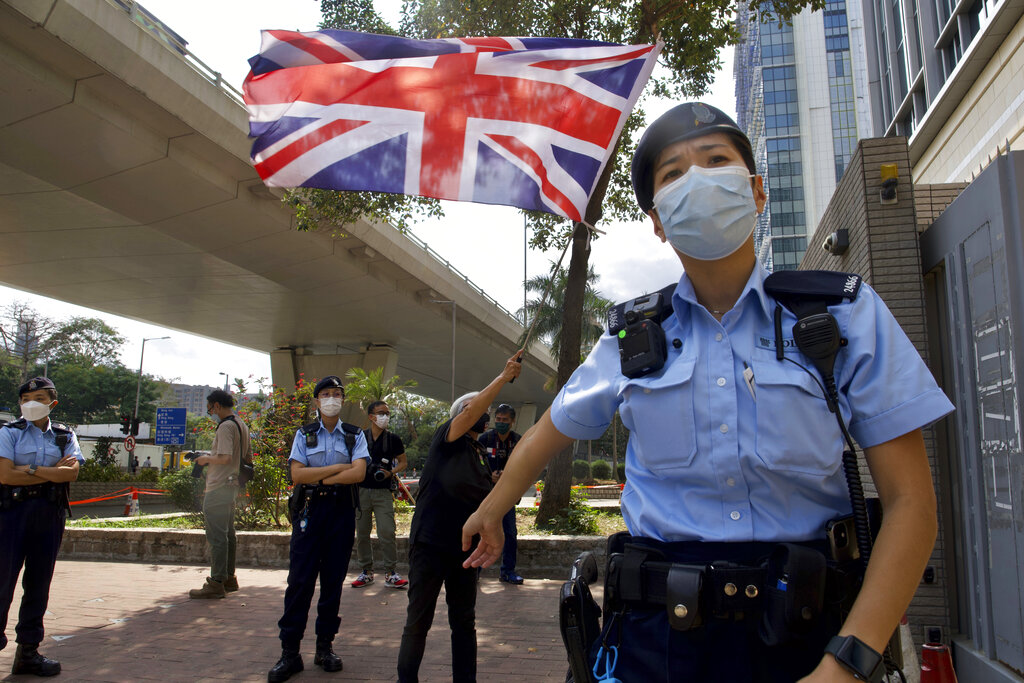
A pro-democracy supporter waves a British flag as police officers stand guard outside a court in Hong Kong Thursday, April 1, 2021. Photo: Vincent Yu / AP

Six of the nine defendants in the case have been released on bail on the condition they do not leave Hong Kong and they hand in all their travel documents. They are due back in court on April 16, where mitigation pleas will be heard before sentencing.

Lai is among those who remains jailed on other charges, including collusion with foreign forces to intervene in the city’s affairs, a new crime under the national security law imposed on the city in 2020 by the central government in Beijing.

The law has put a chill on dissent, all but quashing public protest, which was already diminished because of the COVID-19 pandemic. Authorities have used the sweeping legislation to arrest prominent pro-democracy advocates. They have also detained activists on other charges, such as participating in illegal assemblies.

Lee, a former lawmaker, has been an advocate for human rights and democracy in the city since the former British colony was returned to China in 1997, though he disagreed with the violent tactics adopted by some of the protesters in 2019.

Ahead of Thursday’s court session, some of the defendants and their supporters gathered outside the court, shouting “Oppose political persecution” and “Five demands, not one less,” in reference to demands by democracy supporters that include amnesty for those arrested in the protests as well as universal suffrage in the territory.

Advertisement

Thailand Reduces Quarantine, Paperwork for Vaccinated

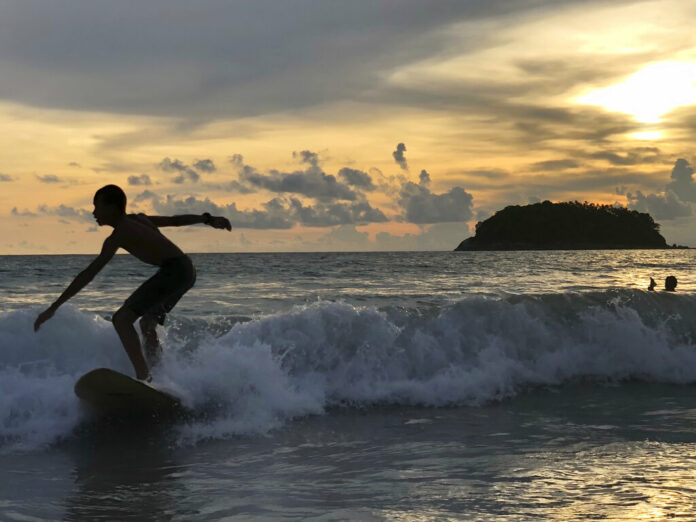
A surfer catches a wave as the sun sets over Kata Beach on the resort island of Phuket, Thailand on Sunday, May 26, 2019. Photo: Adam Schreck / AP

BANGKOK (AP) — Thailand on Thursday began halving the quarantine time for vaccinated visitors as a first step to allowing inoculated people into the country without the need to isolate.

The pandemic has devastated Thailand’s tourism industry, a key income earner, but strict border measures have left the country relatively unscathed.

Tanee Sangrat, the spokesperson of the Ministry of Foreign Affairs, said that travelers — Thais and non-Thais — are no longer required to have fit-to-fly documents issued by Thai consulates from Thursday. Foreigners, however, still have to show a negative COVID-19 test result.

He said that people who are certified to have been vaccinated will be allowed to spend seven days in special quarantine hotels, compared to the previous 14 days. Unvaccinated people have to spend 10 days in quarantine unless they arrive from one of 11 countries — all in sub-Saharan Africa — in which case they have to do the full two weeks.

He said that those vaccinated must have certificates approved by Thai FDA and/or the World Health Organization. Thailand has approved seven vaccines including Sinovac, AstraZeneca, Johnson & Johnson, Pfizer and Moderna.

Thailand hopes to first fully reopen the island of Phuket, its most popular destination, by July 1 for vaccinated visitors without quarantine. But they will be required to spend a certain time, possibly up to a week, on Phuket before they are allowed to travel elsewhere in Thailand.

Businesses on the island hope to vaccinate most residents until May — an ambitious goal given the slow pace of vaccinations in the country.

Thailand has essentially been closed to foreign visitors for a year, and kept infections and deaths low. It has reported 28,889 confirmed cases with 94 deaths. On Thursday, it had 26 new cases.

Advertisement

Hot News

LATEST NEWS

Bangkok
overcast clouds
31.8 ° C
33.3 °
30 °
76 %
4.5kmh
100 %
Sun
32 °
Mon
36 °
Tue
38 °
Wed
35 °
Thu
35 °