






























31.6 C
Bangkok
Tuesday, June 9, 2026
Home Blog Page 1099

Thailand Races Ahead in the Global Digital Revolution

Facilitated by easier access to high-speed internet, the rise of Thailand’s vibrant digital industry over recent years has been underpinned by the rich creativity and strong entrepreneurial spirit of Thailand’s tech-savvy digital generation. At the forefront of this brave new digital world, Thailand has seen its economy consistently prove its readiness to embrace the new opportunities presented by the global digital revolution.

Supported by the country’s active development of its ICT infrastructure, Thai business are increasingly adopting digital tools such as AI, cloud computing and next generation digital platforms to enhance their efficiency. Meanwhile, mobile and real-time digital activities such as e-commerce, fintech and online entertainment are readily embraced as part of Thai people’s changing lifestyles.
The readiness of ICT facilities to support local and regional digital connections along with the country’s steadfast development of its digital industry have enabled Thailand’s startup community to flourish and drive its software and hardware industries. This trend along with the country’s strategic geographical location at the centre of Southeast Asia have positioned the country as one of the world’s top investment destinations.

Committed to driving investment in digital transformation, Thailand is pursuing six key strategies: 1) efficient digital infrastructure; 2) digital business promotion; 3) the creation of equitable access through digital technology; 4) digital government; 5) workforce development and 6) improved trust in digital business1.

Through efforts such as improving the efficiency of its ICT capacity, carrying out regulatory overhauls and offering e-government services, Thailand’s competitiveness in terms of attracting investment in digital industries has increased, as is confirmed in various international rankings and indices. Thailand’s ranking on the World Economic Forum’s Global Competitiveness Index 4.02 in 2019 was 38th out of 140 countries, making it the 3rd highest ranked country from the 10-member Association of South East Asian Nations (ASEAN) behind Singapore and Malaysia. The country was also ranked a respectable 40th out of 63 countries on the International Institute of Management Development’s World Digital Competitiveness Ranking, with grades of “outstanding” for mobile broadband subscribers, high-technology exports and financial services3. Meanwhile, Thailand’s ranking on the United Nations’ e-Government Development Index 2020 improved to 57th from its previous 68th out of 193 countries in 2019, again placing it as the 3rd highest ranked country in ASEAN after Singapore and Malaysia4.

5G and Friendly Regulations Advancing Digital Readiness

Thailand is firmly among the frontrunners in ASEAN in terms of adopting 5G technology, with auctions held in February 2020 having enhanced and accelerated the country’s capacity for deep technology such as AI, cloud computing, machine learning and Big Data5.

In terms of connectivity, the country is constructing a new international submarine cable system, adding to the six submarine cable lines that are already operational. This will not only strengthen internet links between Thailand and the Asia Pacific but will also upgrade the internet capacity around border areas connecting Cambodia, Laos and Myanmar to boost Thailand’s leading digital position in the region.

As part of the efforts to improve the investment climate for the digital industry, Thailand has revamped its regulatory framework related to digital activities during the past few years, such as through the Electronic Transactions Act, Personal Data Protection Act, Thailand Cybersecurity Act and Computer Crime Act.

As a result of proactive development of its ICT facilities and regulatory environment, Thailand currently has one of the world’s largest consumer bases for e-commerce and fintech mobile banking. According to the Global Digital Report 2019 conducted by social media management platform Hootsuite and global agency WeAreSocial, Thailand has 92 million mobile subscribers, 133% penetration, and 55 million active mobile internet users. The country was ranked top globally for internet banking service access, at 74% of the population, and the fifth globally for e-commerce, with 80% of the country’s total internet users shopping online. Only Indonesia, China, Germany and UK ranked higher.

Besides investing in hard infrastructure projects, the Thai government is pursuing a plan to provide a vibrant digital business ecosystem that supports entrepreneurship and SMEs in the digital economy. Located in the EECd zone6 of the Eastern Economic Corridor (EEC) at Chon Buri Province and managed by the Digital Economy and Promotion Agency (DEPA), the Digital Park houses a state-of-the-art data centre, digital innovation testbed and IoT Institute, all aimed at serving digital global players and digital biz innovators. Another initiative is True Digital Park, which serves a centre for digital innovations and startup operations. Managed by the National Innovation Agency (NIA) and the corporate sector, True Digital Park is considered the largest startup park in Southeast Asia.

Flourishing Market for Startups

To accelerate the digital transformation of Thailand’s financial sector, the Bank of Thailand has pursued a multi-pronged approach to drive the adoption of digital platforms at consumer, corporate and international levels. The central bank’s e-payment platform, called “PromptPay”, which ties user accounts to their ID or phone number, was created in 2017 and has 55 million user IDs registered and 20 million transactions recorded per day at peak. E-commerce and mobile banking have grown significantly during the COVID-19 pandemic as people have increasingly adopted cashless transactions in keeping with social distancing practices. The use of digital technologies in banking services has also incorporated biometrics and facial recognition systems for identification.

At the business level, the central bank and the Ministry of Finance launched a peer-to-peer (P-2-P) lending platform in early 2020 which allows individual lenders to be matched with individual borrowers. This fintech solution is aimed at strengthening startups and the small and medium-sized enterprise (SME) sector.

The central bank is also developing its infrastructure to support e-banking and fintech in the future. This includes the introduction of the new financial transaction reporting standard of ISO 20022 which will facilitate e-invoicing and e-factoring along with helping businesses to make better use of customers’ financial transaction data.

Further supporting the burgeoning digital technology and the strong Thai entrepreneur environment, the Thai government has rolled out numerous measures to create a vibrant startup ecosystem, through funding, incubating and accelerator programs along with tax and non-tax incentives. The NIA aims to propel Thailand into the world’s top 20 startup nations by 2021 with a target of becoming an established startup hub in Southeast Asia by boosting the scale of startup investment to US$10-100 million per deal and increasing the government market for startups to US$ 850 million per year. The Thai government is pushing ahead with its legislation process of accommodative laws, including the Startup Act to facilitate the founding of local and international startups through tax incentives and foreign shareholders, and the Regulatory Sandbox Act7 to allow safe experimentation of innovative pilot ideas.

BOI Promoting Investment Across Digital Industry

To further strengthen the ecosystem of the digital industry, Thailand’s Board of Investment (BOI) is currently promoting the digital industry with a focus on four groups, namely software, infrastructure, technology development, and startups. In providing different incentive packages as well as facilitating the registration of startups for the incentives, the BOI is supporting these four groups through the following measures:

• Software development and digital services such as software applications, games, IoT, Big Data and AI through a Corporate Income Tax exemption of 5-8 years.

• Digital Infrastructure such as cloud services, submarine cables, data centres, Maker Space, fabrication centres, and digital parks through Corporate Income Tax exemption of 5-8 years. Co-working spaces will receive non-tax incentives.

• Digital Technology Development for the development of targeted technology transfers in cooperation with academic researchers and development institutions through a ten-year Corporate Income Tax exemption. Projects located in promoted zones are entitled to an additional two-year tax exemption and those located in the Eastern Economic Corridor will be entitled to an additional 1- to 3-year exemption but no more than 13 years.

• E-commerce companies will be entitled to only non-tax incentives. However, smart distribution centres will be entitled to up to eight years of Corporate Income Tax exemption on revenue derived from the distribution of goods.

1 https://www.onde.go.th/view/1/home/EN-US

2 http://www3.weforum.org/docs/WEF_TheGlobalCompetitivenessReport2019.pdf
3 https://www.imd.org/wcc/world-competitiveness-center-rankings/world-digital-competitiveness-rankings-2019

4 https://publicadministration.un.org/egovkb/Portals/egovkb/Documents/un/2020-Survey/2020%20UN%20E-Government%20Survey%20(Full%20Report).pdf

5 https://www.bangkokpost.com/thailand/pr/1989231/thailand-mdes-depa-huawei-open-5g-ecosystem-innovation-center-to-boost-digital-transformation

6 https://eeco.or.th/en/promotional-zone

7 https://www.nxpo.or.th/th/en/sandbox-act-and-guideline/

Advertisement

UN Human Rights Office Says 18 Killed in Myanmar Crackdown

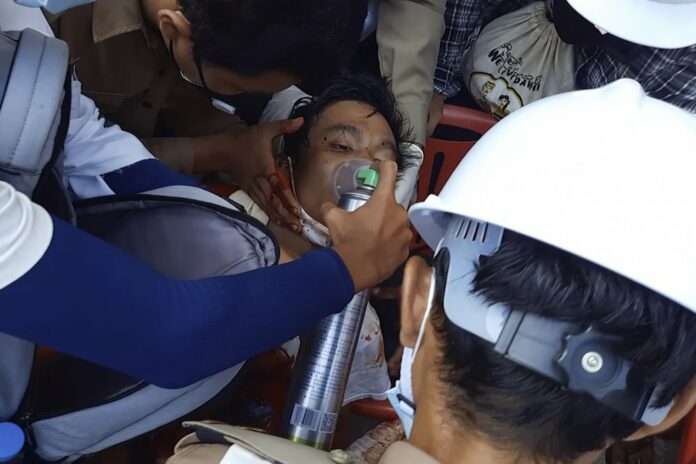
In this image from a video, medics attend to a man in a street in Dawei, Myanmar Sunday, Feb. 28, 2021. The man appeared to be a wound in his upper chest. (Dakkhina Insight via AP)

YANGON, Myanmar (AP) — Security forces in Myanmar opened fire and made mass arrests Sunday as they sought to break up protests against the military’s seizure of power, and a U.N. human rights official said it had “credible information” that 18 people were killed and 30 were wounded.

That would be the highest single-day death toll among protesters who are demanding that the elected government of Aung San Suu Kyi be restored to power after being ousted by a Feb. 1 coup.

“Deaths reportedly occurred as a result of live ammunition fired into crowds in Yangon, Dawei, Mandalay, Myeik, Bago and Pokokku,” the U.N. Human Rights Office said in a statement referring to several cities, adding that the forces also used tear gas, flash-bang grenades and stun grenades.

“We strongly condemn the escalating violence against protests in Myanmar and call on the military to immediately halt the use of force against peaceful protesters,” its spokesperson Ravina Shamdasani was quoted saying.

1000 3 34
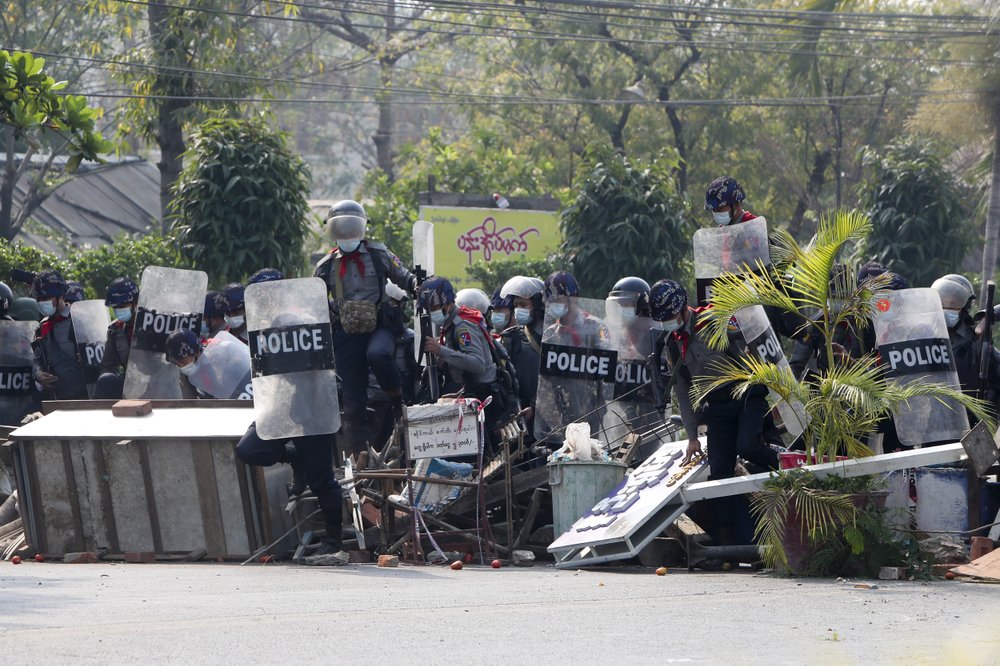
Myanmar riot police crossing blockage during a protest against the military coup in Mandalay, Myanmar, Sunday, Feb. 28, 2021. (AP Photo)

An Associated Press journalist was taken into police custody on Saturday morning while providing news coverage of the protests. The journalist, Thein Zaw, remains in police custody.

The Democratic Voice of Burma reported that as of 5 p.m. in Myanmar, there had been 19 confirmed deaths in nine cities, with another 10 deaths unconfirmed. The independent media company broadcasts on satellite and digital terrestrial television, as well as online.

DVB counted five deaths in Yangon and two in Mandalay, the largest and second-largest cities.

It registered five deaths in Dawei, a much smaller city in southeastern Myanmar that has seen tens of thousands of protesters nearly every day since the coup. Witnesses said Sunday’s march was also large and people were determined not to be driven off the streets.

Confirming the deaths of protesters has been difficult amid the chaos and general lack of news from official sources, especially in areas outside Yangon, Mandalay and the capital of Naypyitaw. But in many cases, photos and video circulated showed circumstances of the killings and gruesome photos of bodies.

1000 5 19
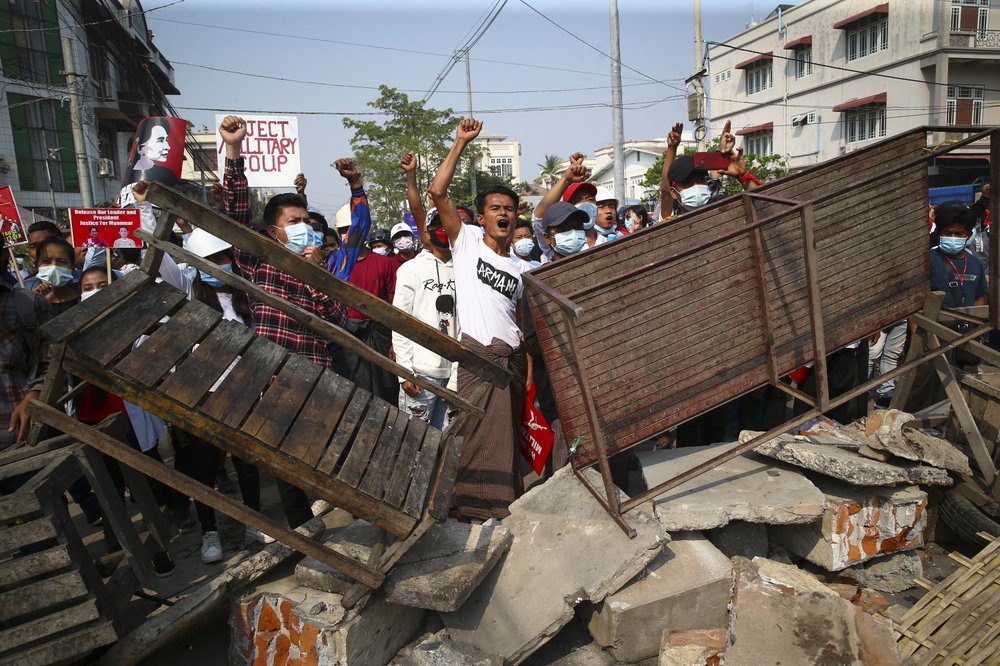
Protesters shout slogans as police arrive during a protest against the military coup in Mandalay, Myanmar, Sunday, Feb. 28, 2021. (AP Photo)

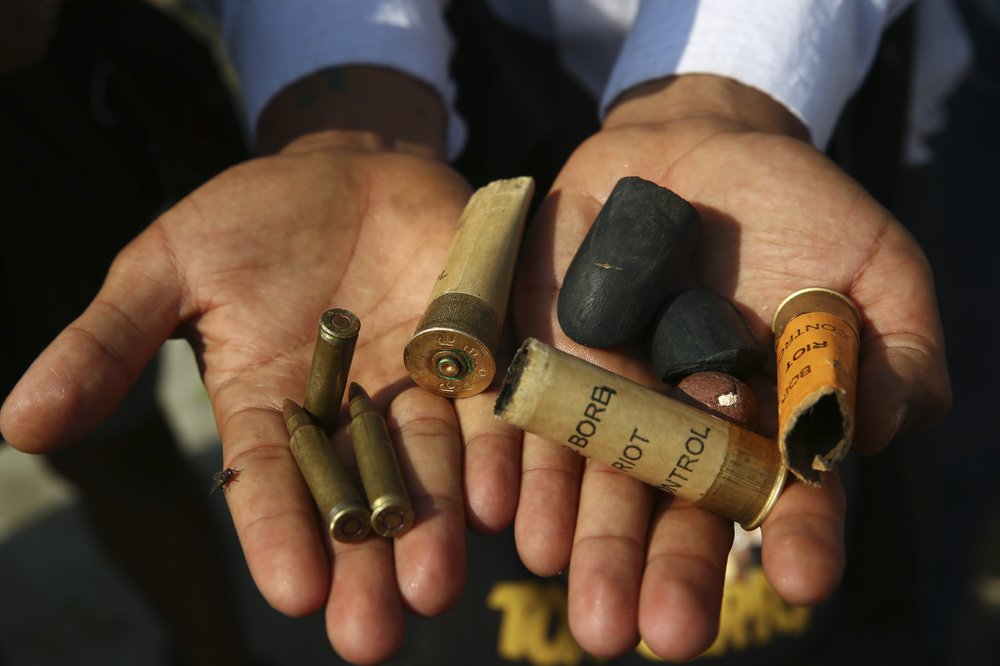
Gunfire earlier had been reported during protests in Yangon, as police also fired tear gas and water cannons while trying to clear the streets. Photos of shell casings from live ammunition used in assault rifles were posted on social media.

Initial reports on social media identified one young man believed to have been killed. His body was shown in photos and videos lying on a sidewalk until other protesters carried him away.

In Dawei, local media reported at least three people were killed during a protest march, supported by photos and video. Photos on social media showed one wounded man in the care of medical personnel.

Before Sunday, there had been eight confirmed reports of killings linked to the army’s takeover, according to the independent Assistance Association of Political Prisoners.

The Feb. 1 coup reversed years of slow progress toward democracy after five decades of military rule. Suu Kyi’s National League for Democracy party would have been installed for a second five-year term in office, but the army blocked Parliament from convening and detained her and President Win Myint, as well as other top members of Suu Kyi’s government.

1000 14 19
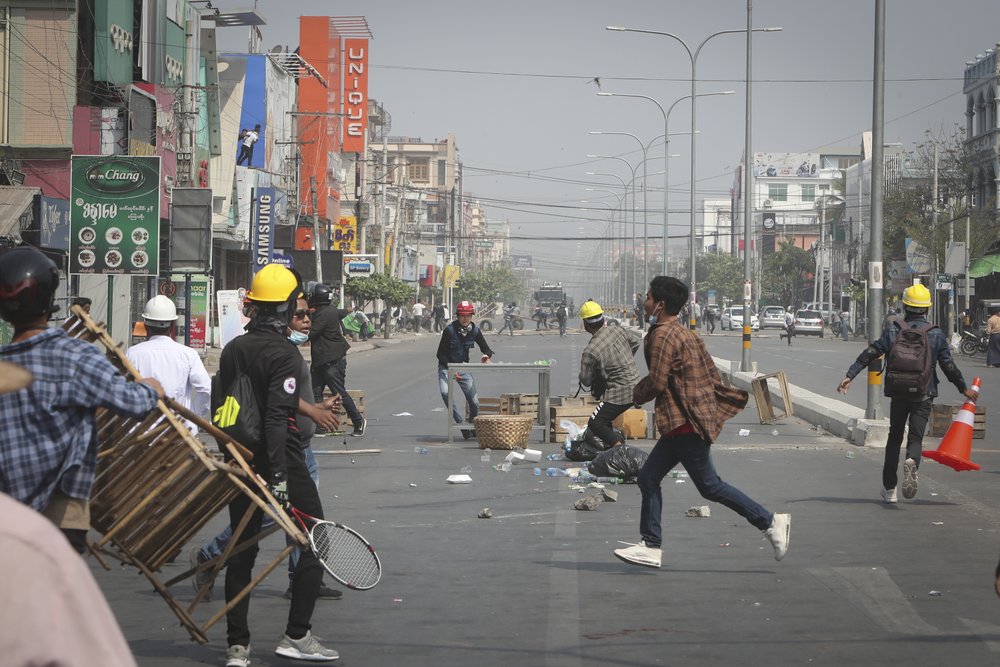
Protesters rush to try to block the road as police arrive during a protest against the military coup in Mandalay, Myanmar, Sunday, Feb. 28, 2021. (AP Photo)

On Sunday morning, medical students marched in Yangon near the Hledan Center intersection, which has become the gathering point for protesters who then fan out to other parts of the city.

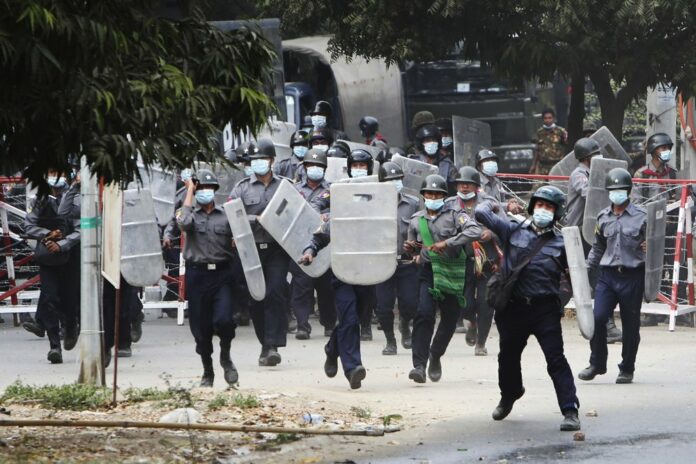
Videos and photos showed protesters running as police charged at them, and residents setting up makeshift roadblocks to slow their advance. Some protesters managed to throw tear gas canisters back at police.

Nearby, residents were pleading with police to release those they picked up from the street and shoved into police trucks to be taken away. Dozens or more were believed to be detained.

“The world is watching the actions of the Myanmar military junta, and will hold them accountable,” said Phil Robertson, deputy Asia director for New York-based Human Rights Watch. “Live ammunition should not be used to control or disperse protests and lethal force can only be used to protect life or prevent serious injury.”

1000 10 7
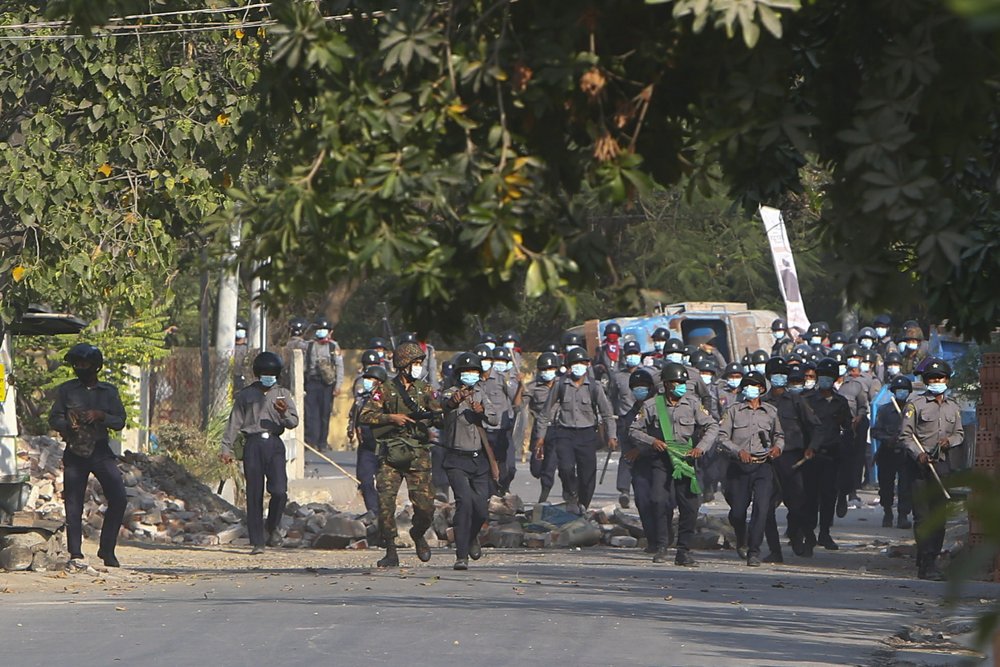
Myanmar riot police with shields cross the blockages set up by protesters during a protest against the military coup in Mandalay, Myanmar, Sunday, Feb. 28, 2021. (AP Photo)

Security forces began employing rougher tactics on Saturday, taking preemptive actions to break up protests and making scores, if not hundreds, of arrests. Greater numbers of soldiers also joined police.

Many of those detained were taken to Insein Prison in Yangon’s northern outskirts, historically notorious for holding political prisoners.

According to the Assistance Association of Political Prisoners, as of Saturday, 854 people had been arrested, charged or sentenced at one point in relation to the coup, and 771 were being detained or sought for arrest.

The group said that while it had documented 75 new arrests, it understood that hundreds of other people were also picked up Saturday in Yangon and elsewhere.

Advertisement

Opinion: Thai Gov’t’s Risky Gamble on Myanmar Junta

Police charge forward to disperse protesters in Mandalay, Myanmar on Saturday, Feb. 20, 2021. (AP Photos)

The Thai government on Wednesday controversially became the first administration to welcome the Burmese junta’s foreign minister abroad in Bangkok on Wednesday. The not-so-stealth visits became apparent despite hours of Thai Foreign Ministry bureaucrats refusing to confirm the news.

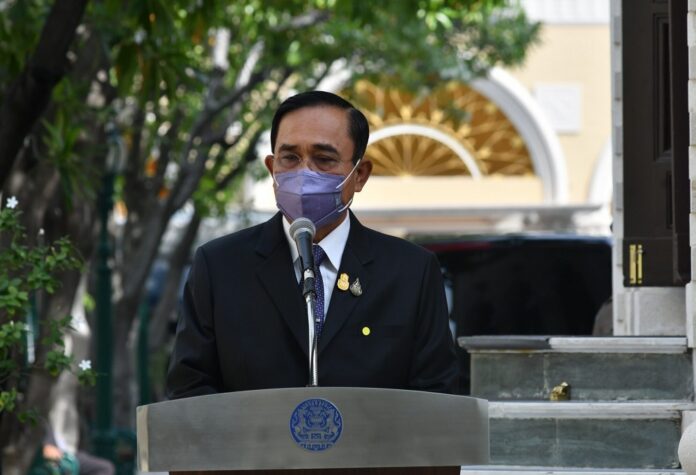
Foreign media reported about it and even Myanmar’s state media broadcasted the photo of Prime Minister Gen Prayut Chan-ocha receiving retired army colonel Wunna Maung Lwin, the Burmese junta’s foreign minister in Bangkok.

A state-owned English-language Burmese newspaper, The Global New Light of Myanmar, even stressed on its headline that the visit was “at the invitation” of the Thai PM, thus using the meeting as a propaganda tool of the Burmese junta desperate for a veneer of legitimacy.

This is sending a clear but wrong signal to future coup makers in the region that Thailand, or at least the Prayut regime, has no qualm welcoming representatives of a coup maker from the region. After all, Prayut was once a coup maker seeking a veneer of legitimacy in the international arena as well.

Earlier, Thai Foreign Minister Don Pramudwinai and Indonesian Foreign Minister Retno Marsudi also met the Burmese junta’s minister.

You can look at this diplomatic overture both ways. First as an earnest attempt to rein in the Burmese junta’s penchant for violence and repression. Second, as a way to maintain Thailand, Indonesia and the Association of Southeast Asian Nations, or ASEAN, relevance in light of what’s happening in Myanmar over the past few weeks and prevent more headaches for other ASEAN member states such as possible large outflow of refugees.

The line between diplomatically trying to restrain the Burmese generals and that of in effect giving it a de facto endorsement is very thin indeed. I believe no matter what’s the intention, Thailand and Indonesia have made the wrong move that citizens of both countries could not be proud of.

This is partly due to the fact that the battle for the control of Myanmar is far from over and no public attempts have been made to meet with those from the other side of the political conflicts.

Hundreds of thousands of Burmese are still out on the streets daily and not just in Yangon and Mandalay but other cities as well. It also happened just days after the fatal shootings of three anti-junta demonstrators. The death toll is now seven.

There’s no denying that Indonesian Foreign Minister, who held a 20-minute talk with the Burmese rep and Don later issued expressed concerns and cautions.

“We asked all parties to exercise restraint and not use violence… to avoid casualties and bloodshed,” Marsudi was quoted by the AP as telling a news conference after her return to Jakarta. The Indonesian foreign minister also emphasized the need for dialogue, reconciliation and trust-building, according to the same report.

What about Thailand? Thailand shares a common border of 2,401 kilometer long with Myanmar and hosts an estimated three to four million Burmese, mostly migrant workers. The kingdom sits in a strategic and possibly perilous position.

From a self-serving nationalistic point of views, Thais should only concern themselves with possible influx of political refugees and maintaining ties with whoever is in power, illegitimately or not.

Realpolitik dictates that Thailand try to ensure whatever little influence it has on Myanmar disregard of how illegitimate the regime in Naypyitaw may be.

Prayut, himself a former junta leader, naturally felt more comfortable dealing with a foreign junta after all. FM Don also served as foreign minister under an illegitimate military regime when Prayut was still running the show as junta leader, or leader of the National Council for Peace and Order.

This means Thai citizens cannot expect the Thai government to behave in a way that they could be proud of. In fact, upon learning about the meeting, I feel ashamed as a Thai and sorry for the Burmese people still trying their best and risking lives to overthrow the Burmese junta.

I would like to express a sense of contrition. No, I am sorry and please accept my apology that the Thai government behaved this way and refused to recognize the voices of the voters in Myanmar which was made explicit last November. The Thai government betting on the Burmese junta was nothing short of a shameful move.

The Thai government doesn’t fully represent Thailand, however. And this is where the people-to-people relations should come into play. It’s time for concerned Thai citizens to do whatever they can to redeem the goodwill of the Burmese people in this trying time. They can also try to pressure the Thai government to behave more responsibly also it may be futile.

Or we can simply sit and watch ASEAN eventually turning into a full-fledged Association of Southeast Asian Autocratic nations.

Advertisement

Prayut Postpones Inaugural COVID Jab, Cites ‘Paperwork Issue’

PM Prayut Chan-ocha speaks to reporters at Government House on Dec. 23, 2020.

BANGKOK — The inaugural shot of COVID-19 vaccine will not be administered to PM Prayut Chan-o-cha as planned due to missing paperwork for the AstraZeneca vaccine shipment, a source at Government House said.

Prayut was scheduled to receive the inaugural jab on Sunday, but the source said the much publicized stunt will no longer take place, since regulators have yet to receive necessary documents from AstraZeneca for domestic use.

Although the Food and Drug Administration said it greenlit the vaccine’s use in Thailand back in January, the shipment was sent to Thailand on Wednesday via South Korea and therefore required additional paperwork, according to the source. 

An official at the Secretariat of the Prime Minister also confirmed that PM Prayut will not be receiving the shot tomorrow, without citing any reason.

Thailand has received 200,000 doses of vaccine developed by Sinovac and 117,000 from AstraZeneca so far.

Healthcare officials already ruled out the possibility of Prayut receiving a shot by Sinovac, since the lot is only reserved for those under the age of 60 due to health concerns. The Prime Minister is 66, well above the threshold.

The vaccine drive, using Sinovac doses, is expected to kick off on Monday, more than 2 weeks behind the original schedule pledged by the government. Those eligible for the first round of inoculation include frontline health workers, vulnerable populations in provinces with high numbers of coronavirus infections, and hospitality workers.

The government pandemic center reported 72 new confirmed infections on Friday, bringing the total virus tally to 25,764, with 83 fatalities.

Advertisement

Opinion: The Everyday Terror of Life Under Myanmar’s Coup Regime

The author attending an anti-coup protest in Yangon, Myanmar. Image: Courtesy.

Note: The author of this op-ed is a resident of Yangon who has been active in the anti-coup movement. He has asked to remain anonymous due to fears of repercussion from the authorities. 

I open my eyes, and see the sun shine through my window. “Phew. Thank god it’s already morning. The military didn’t come arrest me last night,” I think to myself.

Dates and days have become blurred in a life under a military dictatorship. Instead, every day is a day of protesting and resisting.

Like many friends of mine, I am not able to work at all. I am not able to focus on anything – anything other than protesting on the streets, writing to journalists, or sharing information on social media.

Although the military junta has banned Facebook, Instagram and Twitter, almost everyone gets around that using VPNs. The military itself was posting news and announcements on their Facebook pages – even though the regime has blocked access to Facebook throughout the country.

20210217 091841 copy
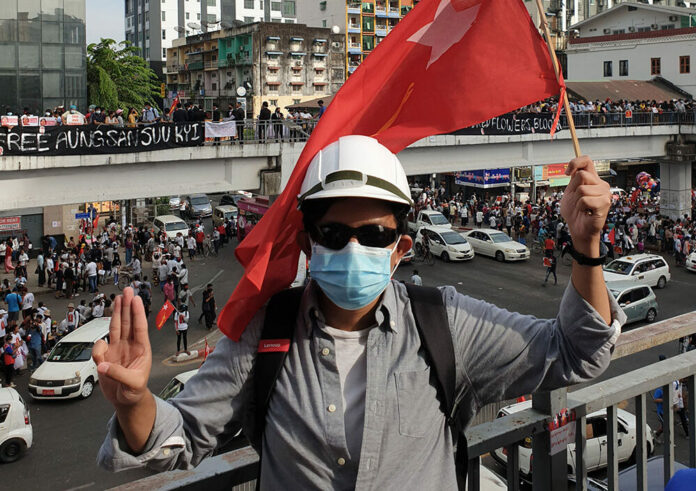
An image of the anti-coup protest in Yangon, Myanmar, taken by the author. Image: Courtesy.

Fortunately, Facebook has permanently banned all military accounts on the platform on Wednesday (I hope the military didn’t pay for an annual VPN subscription).

The protest movement in Myanmar is a grassroots movement. With no leader, its decentralized nature means everyone is able to participate. With my friends and I, we normally go around the entire city – by foot – joining protests at different sites.

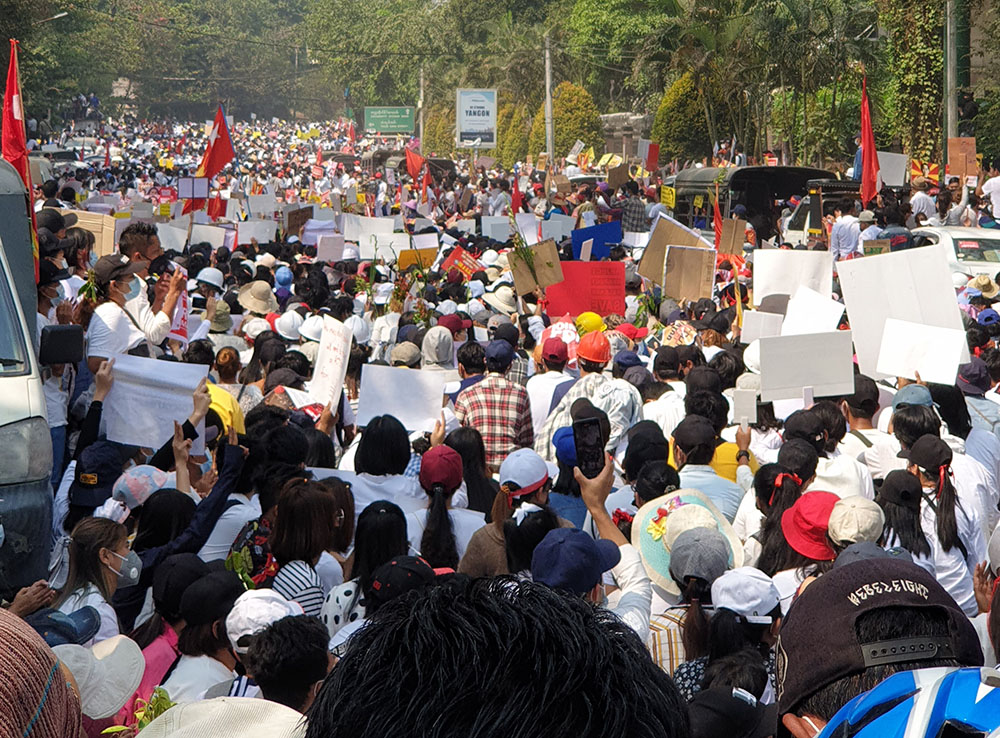
The nation saw the largest demonstrations with millions participating around the country for the 22222 protests – on the 22nd of the 2nd month of 2021. The atmosphere was hopeful, and jubilant.

Many people were donating food and water to protestors. All you needed to do was to show up at a protest site. Lunch, coffee, drinks, snack, ice-cream: all taken care of by generous citizens. Buses and cars are parked everywhere with signs that read “Free Ride.”

1000 3 33
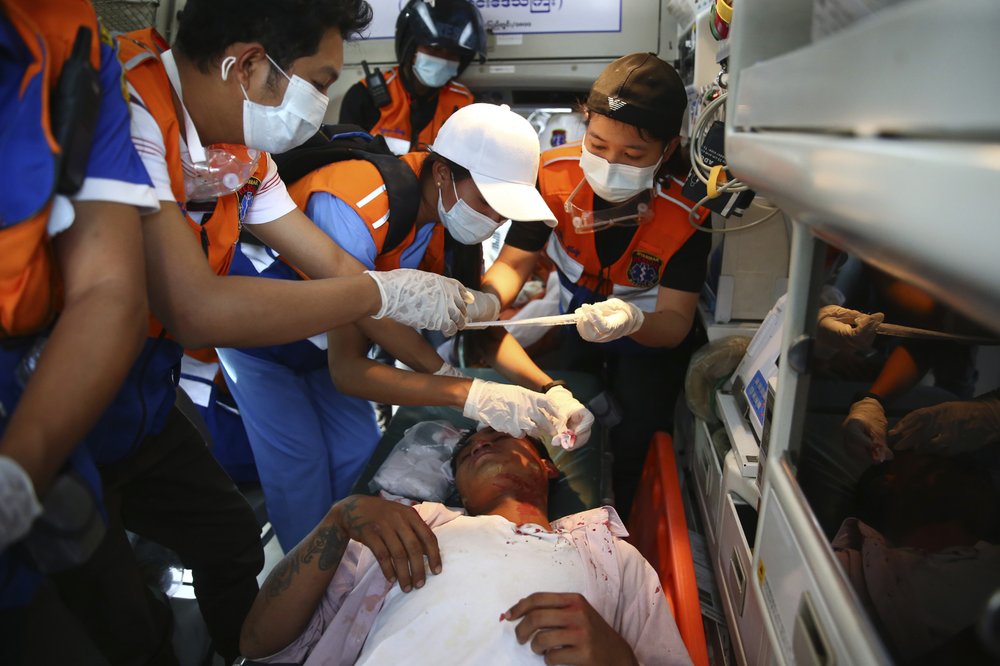
Paramedics tend to an injured protester during a demonstration against the military coup in Mandalay, Myanmar, Friday, Feb. 26, 2021. (AP Photo)

My friends and I hailed a taxi to go protest in front of the Chinese Embassy. It was about a 3 km walk from where we were, and we wanted to go there quickly because some famous actors and actresses were going to be there.

I asked the taxi driver, “How much?” He replied, “Pay whatever you want, or don’t pay at all. I just want you to keep protesting.”

As the sun sets and a day comes to a close, darkness descends and fear rules the streets. Every night there is a curfew from 8 pm until 4 am. People will say to each other: “Be careful. The dogs are coming out tonight.”

And by dogs, they refer to the police, military, and their gang of thugs who lurk in the streets to terrorize residents. Military-paid criminals are dropped into neighborhoods by police vehicles and ambulances burn people’s houses, attack people with metal rods, stab innocent pedestrians, and poison water supplies.

Top: A video of junta supporters attacking demonstrators in Myanmar. 

This barbarity may surprise people watching the news from all over the world. But it does not surprise us.

Their behavior fit the very definition of terrorism: the use of violence and intimidation in pursuit of a political aim. The junta’s eventual aim is the subjugation of its people.

This tactic was used exactly 33 years ago, during the 1988 Uprising. The situation back then was worse, with the public becoming extremely violent. Things are different now. With social media, citizens have been able to reassure each other that non-violence is our biggest weapon.

The best revenge is not to do what they do. The best vengeance is to do what they did not.

20210222 104449
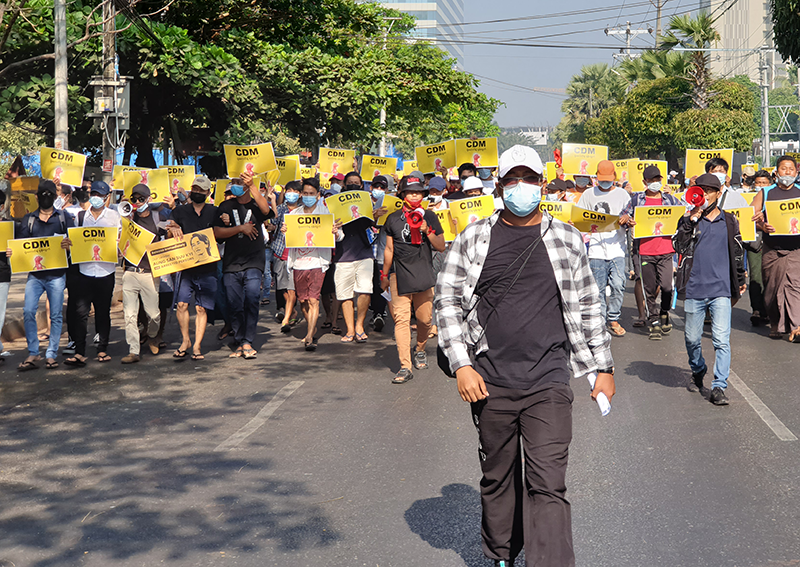
An image of the anti-coup protest in Yangon, Myanmar, taken by the author. Image: Courtesy.

In response to the thuggery, residents have banded together, seting up neighborhood watches and street barricades. Because there is an internet blackout every night from 1am to 9am, it’s become harder to share news on social media and warn each other of the dangers in the darkness.

But the regime may have forgot that social media is new; revolution is old. At the sight of criminals, residents would hit pots, pans – any object that makes noise – to alert their neighbors.

Within minutes, hundreds of people would come out to help the neighborhood watch find and capture these criminals. Then, the residents have to hold these criminals until morning before handing them over to the police.

But tragedy always finds its way into our neighborhoods. Just last week, a 36-year-old man was gunned down by the police, a bullet to the head.

1000 14 18
A protester show bullets, shotgun shells and rubber bullets used by security forces during a demonstration against the military coup in Mandalay, Myanmar, Friday, Feb. 26, 2021. (AP Photo)

Video footage also shows police on a pickup truck with a machine gun at the site of the shooting. This is not police work; this is terrorism.

But even as I write, darkness has descended upon the day. Friday, February 26 marks the first day of crackdown against protestors in Yangon. At this moment, police are beating up protestors, and shooting tear gas and live ammunition.

My social media is flooded with videos and livestreams of police breaking up protesters without warning. Bystanders have been arrested just because. Those who escape into shops and shopping malls have been chased inside by the police.

Now, there is darkness even before the sun sets.

But this shroud of darkness has hung over Southeast Asia for far too long. From Thailand to Myanmar, and Singapore to Philippines, the ghost of authoritarianism has haunted us since our birth. This crisis gives us an opportunity to unite.

Top: A video of a crackdown on anti-coup protest in Myanmar. 

This is an opportunity to cast away the yoke of tyranny from this region.

The people of Myanmar and the people of Thailand are separated by distinct cultures, histories and language. But we are united in our common struggle for democracy and freedom. We are united in our desire to live free from fear. We are united in our desire to live in a prosperous, democratic nation.

To that end, we are inviting netizens around Southeast Asia and beyond to come out on the streets tomorrow, Feb. 28, and make a show of solidarity with the struggle for democracy in Myanmar. Let us show the world that our common desire for a democratic rule will not be restricted by any borders.

Dear Thai neighbors, we need your voice, perhaps more than ever.

Advertisement

Suthep and Aides Granted Bail, 2 Days After Sedition Verdict

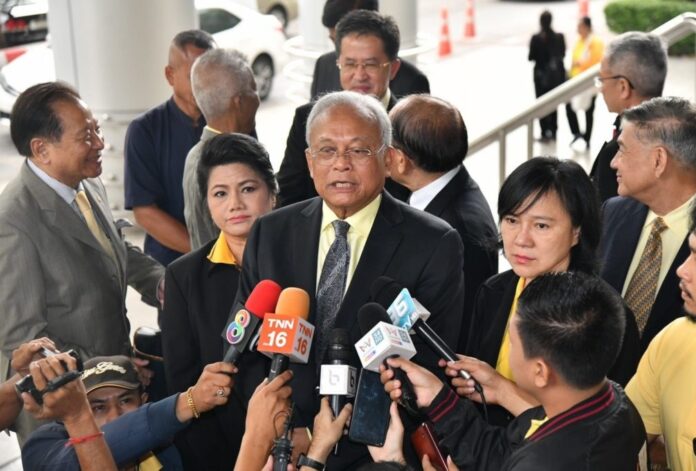
Suthep Thaugsuban speaks to reporters at the Criminal Court in Bangkok on May 14, 2019.

BANGKOK — An appeal court on Friday approved a temporary release for former deputy PM Suthep Thaugsuban and seven other defendants found guilty earlier this week of inciting sedition against the elected government.

Suthep and seven of his lieutenants who campaigned alongside him during the “Shutdown Bangkok” street protests in 2013 and 2014 were deemed to pose no flight risk by the Court of Appeals. Their bond was set at 800,000 baht each.

The eight defendants were set to be released later today from Bangkok Remand Prison. Suthep and others are seeking to appeal the verdict, which sent them to jail on Wednesday on a number of charges, including insurrection and suppressing an election.

Those convicted in Wednesday’s verdict include three former Cabinet members who now lost their post: Digital Economy Minister Buddhipongse Punnakanta, Education Minister Nataphol Teepsuwan, Deputy Transport Minister Thaworn Senneam.

They also include politicos Issara Somchai, Chumpol Julsai, Samdin Lertbut, and former monk activist Buddha Issara, who is now known by his secular name Suwit Thongprasert.

Suthep served as the Deputy Prime Minister from 2008 to 2011. He was also the Deputy Chairman of the pro-establishment Democrat Party.

The eight defendants were leaders of a group called the People’s Committee for Absolute Democracy With the King as Head of State, which is known in its official English name as the People’s Democratic Reform Committee, or PDRC.

The movement led the demonstrations against the elected government of then-Prime Minister Yingluck Shinawatra from late 2013 through May 2014. The protesters seized government buildings, shut down intersections, and sometimes clashed with the police and counter demonstrators.

At Suthep’s behest, the movement also blocked the snap election called by Yingluck. Suthep and other leaders say an unspecified number of reforms must be implemented before a new election can be held.

Instability caused by the street protests led to the army under Gen. Prayut Chan-o-cha staging a coup in 2014 and keeping power until 2019. Up to 27 people were killed in the months of sometimes-violent protest.

Related stories:

Monarchy Reform Activists Denied Bail for 3rd Time

Advertisement

Japanese Journalist Detained in Myanmar While Covering Protest

Image: Mizzima News.

TOKYO (Kyodo) — A Japanese freelance journalist was detained in Myanmar’s largest city Yangon on Friday while covering an anti-coup protest there, local media reported.

He is believed to be Yuki Kitazumi. The Japanese Embassy in Yangon is trying to ascertain the identity of the detained man.

Continue reading the story here

Advertisement

McConnell Says He’d Support Trump if He Wins 2024 Nomination

President Donald Trump, left, hugs Senate Majority Leader Mitch McConnell of Ky., right, as he comes up on stage during a campaign rally in Lexington, Ky., Monday, Nov. 4, 2019. (AP Photo/Susan Walsh)

WASHINGTON (AP) — Less than a month after excoriating Donald Trump in a blistering floor speech, Senate Minority Leader Mitch McConnell said Thursday that he would “absolutely” support the former president again if he secured the Republican nomination in 2024.

The Kentucky Republican told Fox News that there’s still “a lot to happen between now” and the next presidential election.

“I’ve got at least four members that I think are planning on running for president, plus governors and others,” McConnell said. “There’s no incumbent. Should be a wide open race.”

But when directly asked if he would support Trump again were he to win the nomination, McConnell responded: “The nominee of the party? Absolutely.”

McConnell’s remarks underscore an awkward balancing act he sought to maintain since Trump lost the election, reflecting the reality that McConnell’s own path back to power in the Senate hinges on enthusiasm from a party base that still ardently supports Trump.

McConnell’s comments precede an annual gathering of conservative activists that this year is expected to showcase Trump’s vise-grip hold on the GOP base.

Trump, along with most other leading 2024 presidential prospects, is set to address the Conservative Political Action Conference, which will be held in Orlando this year because of coronavirus restrictions. McConnell, a regular at the annual conference, will not be on the program following his condemnation of Trump.

Shortly after voting to acquit Trump at his second impeachment trial, McConnell delivered a scalding denunciation of Trump from the Senate floor, calling him “morally responsible” for the Jan. 6 attack on the U.S. Capitol. In turn, an angry Trump blistered McConnell as a “dour, sullen and unsmiling political hack.”

The 36-year Senate veteran had an expedient relationship with Trump while he was in office. He made a habit of saying little about many of Trump’s outrageous comments.

But together they secured key Senate victories, such as the 2017 tax cuts and the confirmations of three Supreme Court justices and more than 200 other federal judges.

Their relationship soured after Trump’s denial of his Nov. 3 defeat and relentless efforts to reverse the voters’ verdict with his baseless claims that Democrats fraudulently stole the election.

It deteriorated further last month, after Republicans lost Senate control with two Georgia runoff defeats they blamed on Trump, followed by the attack on the Capitol by Trump supporters. The day of the riot, McConnell railed against “thugs, mobs, or threats” and described the attack as “this failed insurrection.”

Still, McConnell likes to pride himself on playing the “long game,” which was the title of his 2016 memoir. And his comments on Thursday may yet prove prescient.

Recently, Republican Sen. Mitt Romney of Utah, a longtime Trump opponent, predicted the former president would win the nomination if he ran again.

“I don’t know if he’ll run in 2024 or not, but if he does, I’m pretty sure he will win the nomination,” Romney said during an online forum hosted by The New York Times.

Advertisement

Former National Park Chief Removed for Burning Down Karen Village

A file photo of Chaiwat Limlikhit-aksorn.

BANGKOK — An anti-graft agency on Thursday announced that a former national park director committed malfeasance for ordering the violent eviction of Karen families nearly a decade ago and ordered him to leave his post.

The investigation was launched after Chaiwat Limlikhit-aksorn, who served as the director of Kaeng Krachan National Park in Phetchaburi at the time, was accused by community rights activists of engineering the destruction of over a hundred Karen homes inside the forest in 2011.

The Office of Public Sector Anti-Corruption Commission said Chaiwat, who is now serving as the head of the environmental protection office in Pattani province, will be removed from the public office while legal actions are taken against him.

“The commission will forward the case to his parent agency, the Royal Forest Department, where they will launch a disciplinary procedure against Chaiwat,” the commission said in a statement. “The case will also be forwarded to the state prosecutors for indictment.”

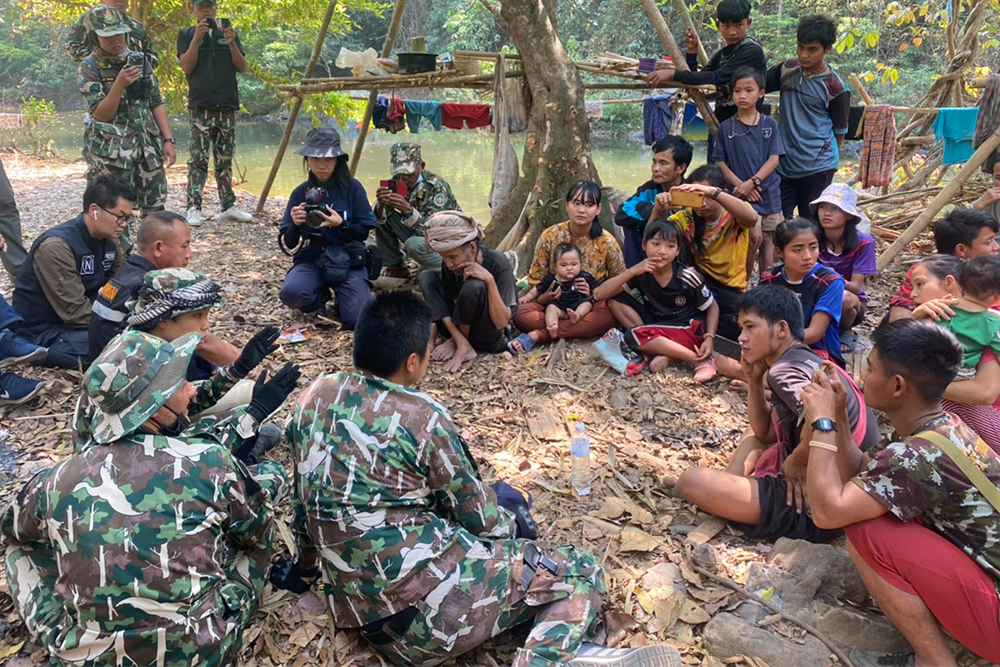
Park rangers negotiate with the remaining Karen villagers inside Kaeng Krachan National Park on Feb. 24, 2021.

The forest is home to Karen communities who settled on the land before the national park was established in 1981. Despite evidence that the settlement predated the law, the authorities accused the Karen villagers of encroaching on protected land and damaging the forest with their shifting cultivation practices.

The threats to remove the Karens from their ancestral homeland were finally carried out in 2011, when a group of six park rangers led by Chaiwat evicted them and set about 100 of their houses on fire, the anti-graft agency said.

The community’s spiritual leader Ko-ee Mimee and five villagers filed a case against Chaiwat a year later, in 2012. The administration court in 2018 ordered the national park department to pay 50,000 baht to each of the Karen in compensation of their destroyed homes, though it rejected Karens’ request to return to the national park.

Chaiwat also stands accused of involvement in the disappearance of activist Porlajee “Billy” Rakchongcharoen, who went missing in 2014 after he was briefly detained by Chaiwat and several officials in the national park.

He denied the allegations, insisting that he only held Porlachee for questioning for several hours and released him afterward.

The missing activist was confirmed dead in 2019 after investigators found bone fragments belonging to Porlajee inside an oil drum submerged in a lake inside the national park.

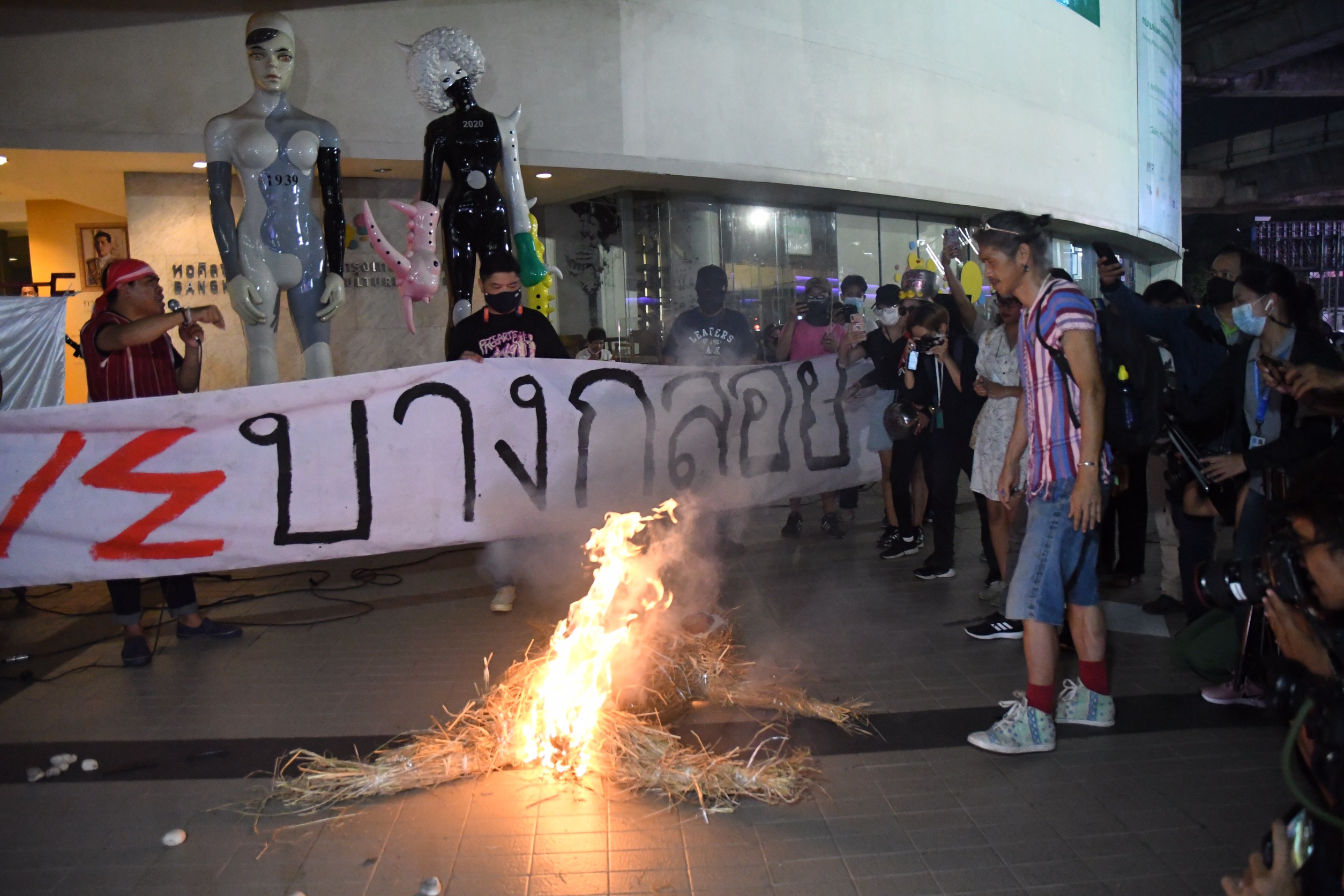
An activist sets fire to an effigy of environmental minister Varawut Silpa-archa during a protest in front of the Bangkok Arts and Cultural Center on Feb. 22, 2021.

Despite multiple serious accusations against them, Chaiwat and his aides were never brought to prison as they were released on bail. The court case against them is still ongoing.

The plight of Karen villagers was brought to attention in recent days after the authorities mounted another eviction campaign against the remaining Karen families on Monday.

Rallies were held in Bangkok and Chiang Mai on the same evening to demand environmental minister Varawut Silpa-archa to keep his promise to withdraw security forces from the village.

Officials said 13 villagers voluntarily left the forest after negotiations, while the rest 21 people refused to relocate.

Advertisement

13 Provinces to Get Vaccines First; Lowkey Welcome for AZ Doses

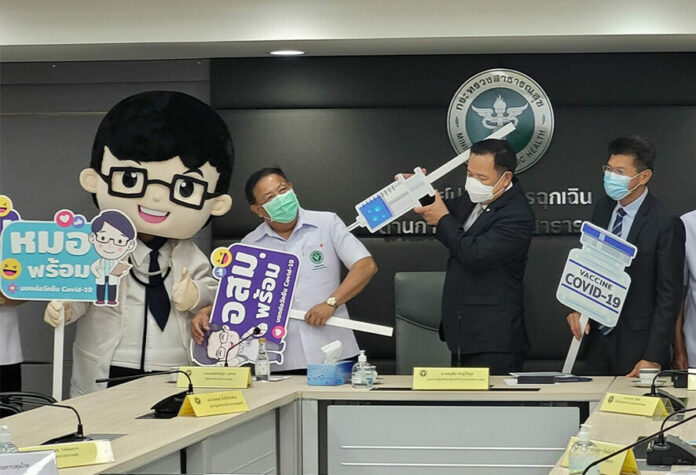
Health minister Anutin Charnvirakul holds a syringe prop during a press conference at the Ministry of Public Health on Feb. 25, 2021.

BANGKOK — Samut Sakhon, Bangkok, and Pathum Thani are among the first provinces to begin vaccinating its health workers and vulnerable populations against COVID-19 by next month, officials said Thursday.

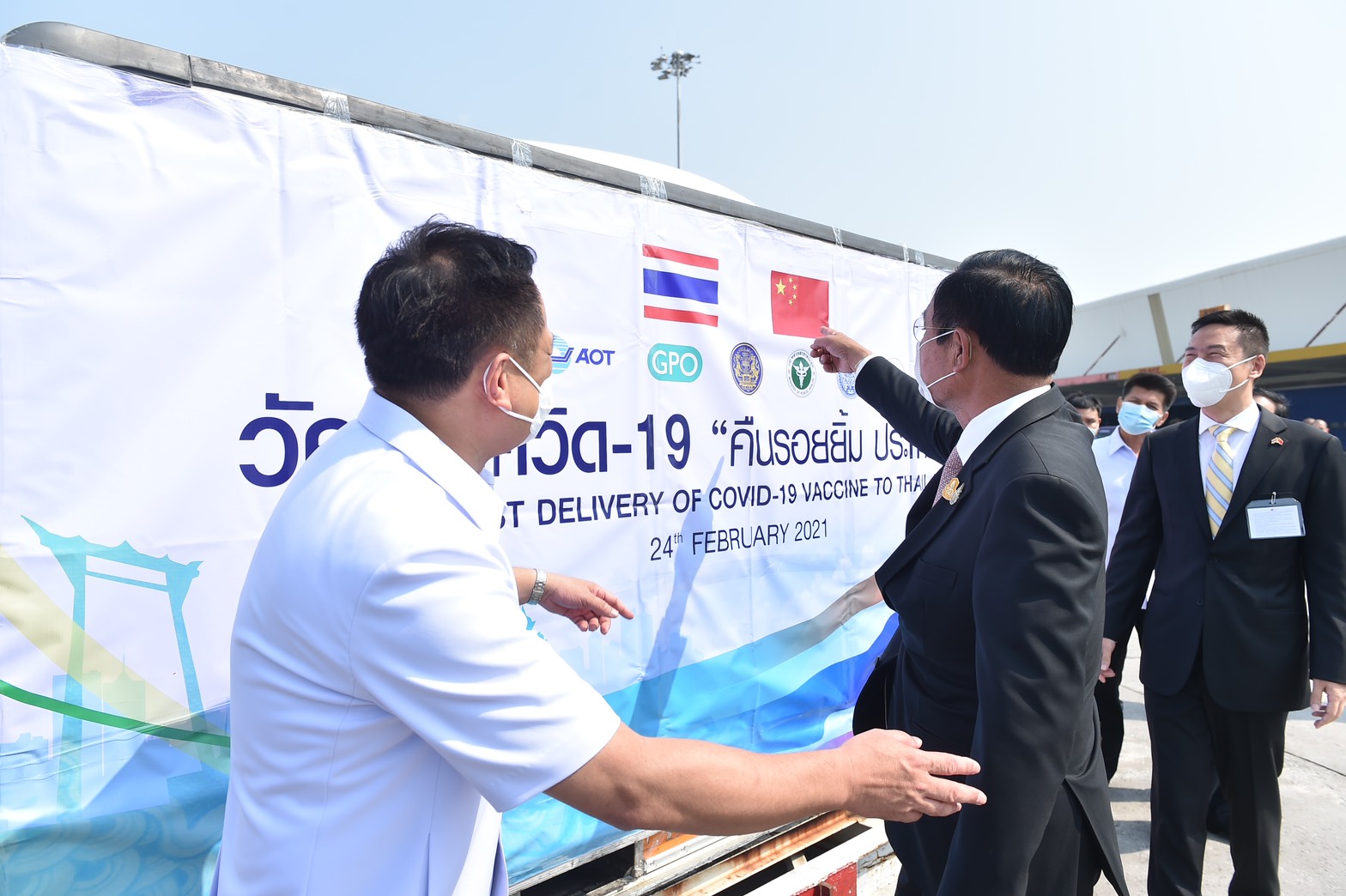
The first shipment of 200,000 doses of vaccine developed by Chinese firm Sinovac arrived in Bangkok on Wednesday amid an elaborate welcoming ceremony presided over by PM Prayut Chan-o-cha and the Chinese ambassador. The pandemic response center said the vaccines will go straight to the provinces hardest hit by the outbreak as soon as they pass quality inspections.

“Health workers, including the Aor Sor Mor village health volunteers, will get the vaccines first,” the center’s spokeswoman Apisamai Srirangsan said.

“Each province will also allocate vaccines to officials who are close to the patients such as defense or interior officials who oversee quarantine facilities, and airport officials who screen incoming passengers. Vulnerable populations, especially those who have underlying diseases, will also be prioritized.”

According to the health ministry, a total of 169,000 doses will be distributed to Samut Sakhon, western districts of Bangkok, Pathum Thani, Nonthaburi, Samut Prakan, Tak’s Mae Sot district, Nakhon Pathom, Samut Songkhram, and Ratchaburi, where they will be used to inoculate health workers and vulnerable populations.

Health minister Anutin Charnvirakul, PM Prayut Chan-o-cha, and acting Chinese ambassador Yang Xin during the welcoming ceremony for Sinovac vaccines at Suvarnabhumi Airport on Feb. 24, 2021.

Another 14,700 doses will be sent to the four provinces popular among foreign travelers, which include Chonburi, Phuket, Surat Thani’s Samui Island, and Chiang Mai, in a bid to reopen the country for tourism. The remaining 16,300 doses will be put in a reserve stockpile.

Health minister Anutin Charnvirakul said at a news conference that the government will not charge any fee for the vaccine.

“The vaccines are for every Thai citizen and everyone residing in Thailand,” Anutin said. “If anyone claims that the vaccines have to be paid for, they will be prosecuted without exception.”

A Secretive Delivery

Today’s daily briefing by the government’s pandemic center made no mention of the 117,000 doses of AstraZeneca vaccines, which also arrived at Suvarnabhumi Airport on the same day as their Chinese counterparts.

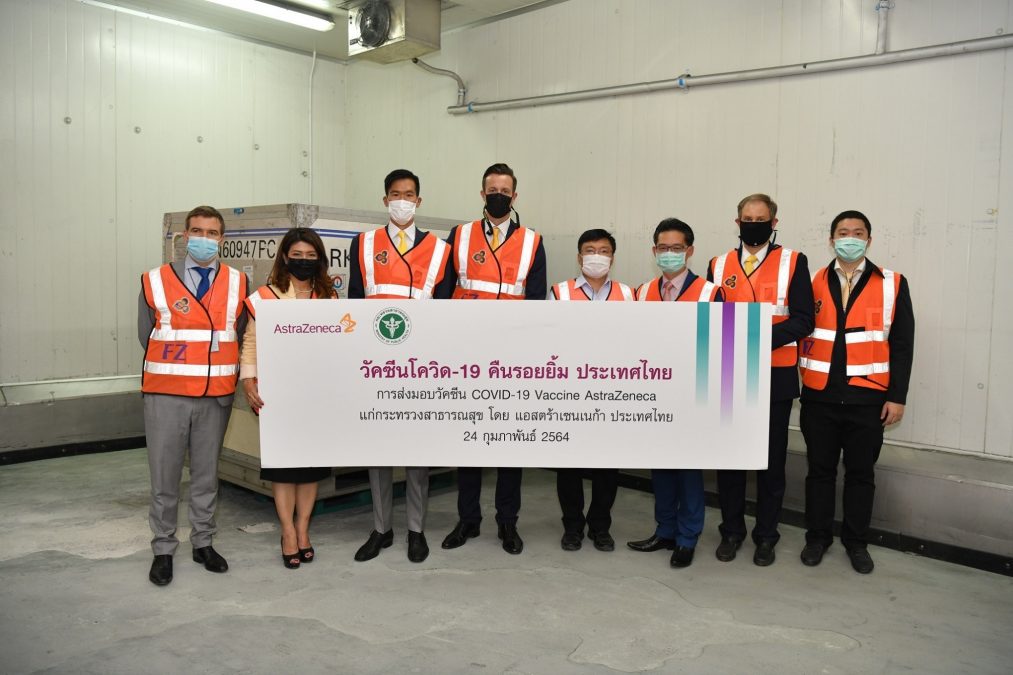
In a handout photo released by AstraZeneca, only a handful of company’s representatives and health officials were present at their photo op that marks the batch’s arrival on Wednesday’s afternoon – a stark contrast to the fanfare and pomp afforded to the Sinovac shipment, which featured luminaries like PM Prayut, Anutin, and acting Chinese ambassador Yang Xin.

AstraZeneca's representatives and health officials take a photo with the container containing Thailand's first shipment of AstraZeneca vaccines on Feb. 24, 2021.
AstraZeneca’s representatives and health officials take a photo with the container containing Thailand’s first shipment of AstraZeneca vaccines on Feb. 24, 2021.

The British pharmaceutical told Khaosod English that it has no plans to hold a welcome ceremony, since the vaccines are currently being inspected by health authorities.

“There will be no ceremonies,” AstraZeneca’s spokesperson for Thailand said. “The vaccines arrived in Thailand Wednesday’s afternoon and were transferred directly to a warehouse. They will be inspected by health authorities and will be issued a lot release certificate.”

AstraZeneca vaccines were previously slated to arrive in Thailand on Valentine’s Day, but it was delayed following the vaccine supply dispute between the company and the European Union, according to Anutin.

Speaking to reporters today, Anutin credited health officials for negotiating with the British company to secure the doses for Thailand, though he was evasive when asked where the first 117,000 doses originated from.

However, photos circulated online show that the shipment flew from Seoul’s Incheon Airport, where AstraZeneca has a production plant.

“That’s not the point,” Anutin said. “Health officials made every effort to negotiate for the imported doses. This will clear out accusations that we have procured the vaccines slowly and there is no backup plan.”

The arrival of AstraZeneca doses was also unexpected. When health minister Anutin announced last week that the first shipment of vaccines would land in Thailand on Feb. 24, he said it would only consist of the jabs made by Sinovac.

He only revealed that the shipment would also contain AstraZeneca’s vaccine less than 24 hours before the expected delivery. Anutin said he kept it secret because he “didn’t want to cause further drama.”

The 117,000 doses from AstraZeneca were meant to “fill in the gap” of Thailand’s vaccine supply chain before a local manufacturer can start the vaccine production per a technology agreement with the British firm.

Up to 61 million doses of the AstraZeneca-developed vaccine will be produced domestically by Siam Bioscience, a company wholly owned by the Crown Property Bureau, the government said. Production is said to start in June.

Advertisement

Hot News

LATEST NEWS

Bangkok
overcast clouds
31.6 ° C
31.6 °
29.4 °
68 %
3.1kmh
100 %
Tue
35 °
Wed
34 °
Thu
34 °
Fri
28 °
Sat
31 °