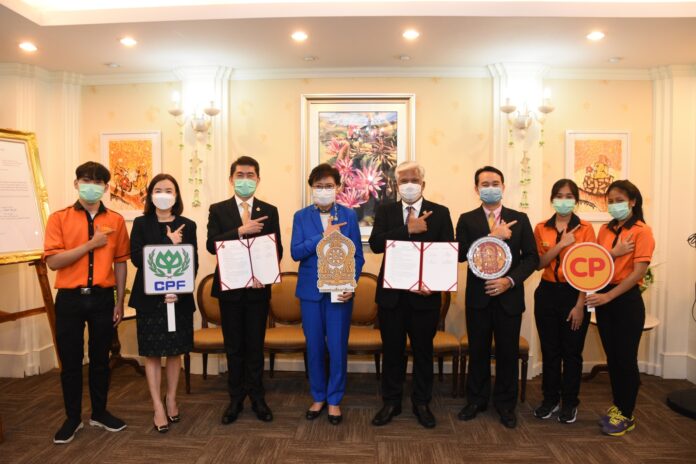
The Ministry of Education’s Office of the Vocational Education Commission (OVEC) has signed a memorandum of understanding (MoU) with Charoen Pokphand Foods PCL. (CPF), under which “CPF Jump Start” Project will be launched to equip vocational students with skills and experiences necessary for their future careers.
“CPF Jump Start – First Professional Step” is a pilot project of their collaborative effort, to churn out desirable human resources for the business and industrial sectors in support of the country’s economic development. The curriculum is jointly designed for students in vocational to higher vocational levels as well as those pursuing a bachelor’s degree in technology and operations.
The MoU signing ceremony at OVEC’s office was presided over by Deputy Education Minister and Acting Education Minister Khunying Kalaya Sophonpanich. Signing the MoU were Dr. Suthep Kaengsanthia, Secretary of the Office of Vocational Education Commission, and Mr. Prasit Boondoungprasert, Chief Executive Officer of CPF.
Khunying Kalaya stressed that the MoU marked a historic and significant collaboration, whereby a leading company is contributing knowledge, experiences and technology and engaged in course designing and implementation.
“My admiration goes to CPF for its emphasis on education, particularly when the country requires contribution from all parties. CPF’s supports will benefit our endeavor and will inspire other companies and entrepreneurs and other industries to follow suit. That two organizations synergize their strengths and jointly develop human resources will speed up the development process and leapfrog Thailand’s education progress. This will support the country’s competitiveness and produce the resources that better meet market demands. The effort will buoy the economy and energize further economic development,” Khunying Kalaya said.
Mr. Prasit added that as a leading agro-industrial and food conglomerate with the upstream to downstream supply chain (Feed-Farm-Food), CPF sits on vast knowledge and business management expertise. Under the ‘3-Benefit’ principles to create prosperity for the country, society and the Company, CPF seeks deeper engagement in improving practical skills.
“CPF Jump Start – First Professional Step” is aimed at improving the quality of vocational education. CPF’s knowledge will be transferred to vocational students in various patterns. Under a dual education pattern, vocational students studying the subjects that are related to CPF’s operations throughout the supply chain will be trained by relevant departments and earn training hours or grades based on their performance. The educational pattern allows systematic training, which will not only equip the students with professional skills but also soft skills in working with others. The students will thus directly benefit from the training. CPF is eyeing to replicate the project at other educational institutions.
In addition, CPF has launched the “CPF Top Dish” project, whereby students wanting to become a restaurant owner in the New Normal era gain supports to create Cloud Kitchen. Under the “School Farm and Farm School” project, knowledge on modern agriculture is shared through smart farming technology under the objective to produce exemplary farmers.
“I hereby thank the Office of Vocational Education Commission for this opportunity that allows CPF’s engagement with education development. I’m confident that “CPF Jump Start – First Professional Step” will efficiently bring about benefits to vocational students,” Mr. Prasit said.
At the ceremony, Dr. Suthep praised CPF’s attention to vocational education and supports to improve vocational students’ capability and professional skills through training opportunities. CPF also involves with course designing and recruitment of students for the dual education and training. The opportunities to learn from experts, familiarize themselves with modern technology at a leading company and earn extra income during school breaks are extended to vocational and higher vocational students as well as undergrad students pursuing degrees in technology or operations in food, nutrition, retailing, agricultural and related fields.
“I believe that OVEC and CPF’s collaborative effort will deliver benefits to vocational education, so that quality personnel can be produced and drive the national development forward,” Dr. Suthep said.
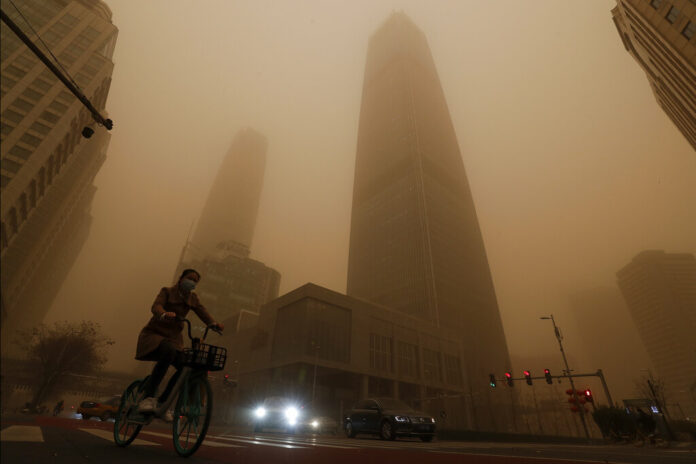
A cyclist and motorists move past office buildings amid a sandstorm during the morning rush hour in the central business district in Beijing, Monday, March 15, 2021. The sandstorm brought a tinted haze to Beijing's skies and sent air quality indices soaring on Monday. Photo: Andy Wong / AP
BEIJING (AP) — China’s capital and a wide swath of the country’s north were enveloped Monday in the worst sandstorm in a decade, leading to the cancelation of hundreds of flights.
Skyscrapers in the center of Beijing appeared to drop from sight amid the dust and sand. Traffic was snarled and more than 400 flights out of the capital’s two main airports were canceled before noon.
Such storms used to occur regularly in the springtime as sand from western deserts blew eastwards, affecting areas as far as northern Japan.
Massive planting of trees and bushes in fragile areas has reduced the storms’ intensity, but the expansion of cities and industries has put constant pressure on the environment throughout China.
The National Meteorological Center forecasted the sand and dust would affect 12 provinces and regions from Xinjiang in the far northwest to Heilongjiang in the northeast and the eastern coastal port city of Tianjin.
“This is the most intense sandstorm weather our country has seen in 10 years, as well as it covering the broadest area,” the center said in a post on its website.
It wasn’t clear if the storm was related to a recent general decline in air quality despite efforts to end Beijing’s choking smog.
The ruling Communist Party has pledged to reduce carbon emissions per unit of economic output by 18% over the next five years. Environmentalists say China needs to do more to reduce dependency on coal that has made it the world’s biggest emitter of climate changing gasses.
A woman walks her dogs during a sandstorm in Beijing, Monday, March 15, 2021. The sandstorm brought a tinted haze to Beijing’s skies and sent air quality indices soaring on Monday. Photo: Ng Han Guan / AP
Beyonce accepts the award for best R&B performance for "Black Parade" at the 63rd annual Grammy Awards at the Los Angeles Convention Center on Sunday, March 14, 2021. Photo: Chris Pizzello / AP
NEW YORK (AP) — Beyoncé and Taylor Swift had a historic night at the Grammys, where the top four awards were won by female acts.
Swift became the first female performer to win album of the year three times and Beyoncé, with her 28th win, became the most decorated woman in Grammy history. She also ties Quincy Jones for second place among all Grammy winners.
H.E.R. won song of the year and Billie Eilish picked up record of the year, telling the audience that best new artist winner Megan Thee Stallion deserved the honor.
Though women have won all top four awards in the past – including Eilish’s sweep last year – it marked the first time four separate and solo women won the top four honors.
“We just want to thank the fans,” said Swift, who won the top prize with “folklore” and previously won album of the year with her albums “Fearless” and “1989.”
Beyoncé walked into the show with 24 wins and picked up four honors, including best R&B performance for “Black Parade,” best music video for “Brown Skin Girl” as well as best rap performance and best rap song for “Savage,” with Megan Thee Stallion.
“As an artist I believe it’s my job, and all of our jobs, to reflect time and it’s been such a difficult time,” Beyoncé said onstage as she won best R&B performance for “Black Parade,” which was released on Juneteenth.
She went on to say she created the song to honor the “beautiful Black kings and queens” in the world.
She added: “I have been working my whole life … This is such a magical night.”
Beyoncé is only behind the late conductor Georg Solti, who is the most decorated Grammy winner with 31 wins.
But Beyoncé didn’t only make history, her whole family did. The royal family of music all won honors Sunday: Jay-Z picked up his 23rd Grammy, sharing the best rap song win with his wife since he co-wrote “Savage.” And 9-year-old Blue Ivy Carter — who won best music video alongside her mother — became the second youngest act to win a Grammy in show’s 63-year history. Leah Peasall was 8 when The Peasall Sisters won album of the year at the 2002 show for their appearance on the T Bone Burnett-produced “O Brother, Where Art Thou?” soundtrack.
Megan Thee Stallion, who won three honors, also made history and became the first female rapper to win best rap song. She’s also the fifth rap-based act to win best new artist.
She sang “cardigan” and “august” from “folklore,” as well as “willow” from “evermore,” and was joined by the collaborators who helped her make the albums, Jack Antonoff and Aaron Dessner, who both won album of the year with Swift.
Taylor Swift poses in the press room at the 63rd annual Grammy Awards at the Los Angeles Convention Center on Sunday, March 14, 2021. Photo: Jordan Strauss / Invision / AP
Silk Sonic, aka Bruno Mars and Anderson Paak, also performed, bringing a throwback R&B vibe to the show with their smooth new single, “Leave the Door Open.” Dua Lipa, who won best pop vocal album, proved her pop star status with a performance of her hits “Don’t Start Now” and “Levitating,” where she was joined by the DaBaby, who was an all-star during his own performance of his guitar-tinged rap hit “Rockstar,” flipping the song for an exceptional live rendition featuring R&B singer Anthony Hamilton, a skilled violinist and background singers.
Country singer Mickey Guyton – the first Black woman nominated for best country solo performance – gave an impressive performance of her song “Black Like Me,” which she released last year as police brutality continued to devastate Black families and the coronavirus ravished Black America disproportionately. Lil Baby, joined by Killer Mike and activist Tamika Mallory, gave a political performance that impressed.
“Black Parade” joined a list of songs honoring that Black experience that won Sunday, including H.E.R.’s protest anthem “I Can’t Breathe” and Anderson Paak’s “Lockdown,” which was released on Juneteenth like “Black Parade.”
Other performers Sunday included Billie Eilish, Cardi B, Bad Bunny, Miranda Lambert, Maren Morris and Harry Styles, who won best pop solo performance for the hit “Watermelon Sugar.”
“To everyone who made this record with me, thank you so much,” said Styles, the first member of One Direction to win a Grammy.
Host Trevor Noah kickedoff the show telling jokes about the coronavirus pandemic and the year that was 2020. He was live from downtown Los Angeles, with attendees wearing masks and sitting, socially distanced, at small round tables.
Double winners included H.E.R., Fiona Apple, Kaytranada and late performers John Prine and Chick Corea.
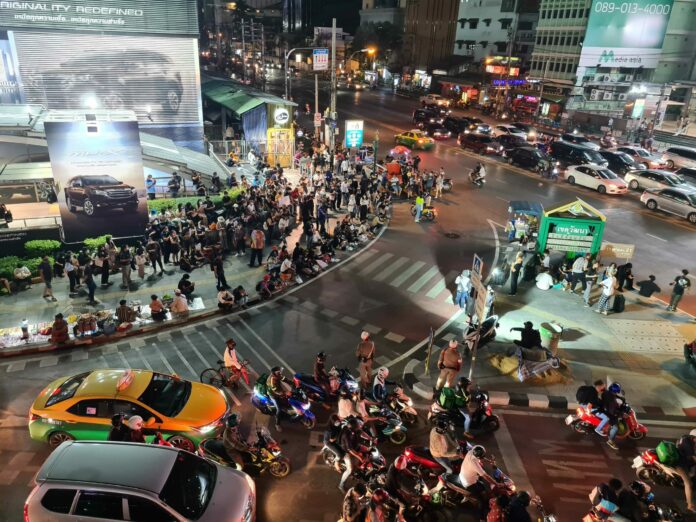
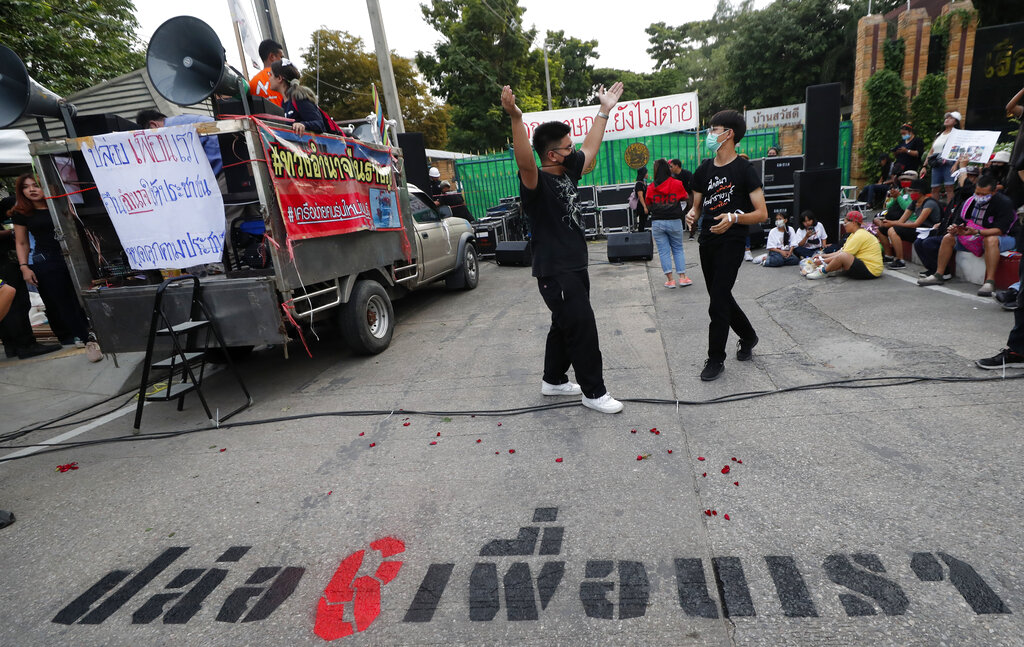
Anti-government protesters at the Asok Intersection on March 11, 2021.
It’s an undeniable fact that recently, the number of monarchy-reform, anti-government demonstrators have dropped significantly compared with last year.
Since the protesters returned to the streets earlier this year, the number seems never to exceed 3,000 people max. On Tuesday, a day after three protest leaders were indicted for royal defamation and denied bail, the crowd of black-clad demonstrators in front of the Criminal Court in Bangkok was no more than 300.
Yes, no more than 300. I did not miss one or two digits.
While the reasons for this is debatable, I believe a combination of factors were responsible for the repeated low turnout compared to tens of thousands that showed up repeatedly last year.
First and the most obvious is the ongoing spread of coronavirus and its devastating impact on the Thai economy. Put simply, it has become more taxing for the demonstrators, mostly university students and still dependent on their parents financially, to come out and protest every week or even more frequently than that.
The second factor is fear. With eight protest leaders now in pre-trial detention for lese-majeste charges and 57 more awaiting for decision by the prosecutors in the near future, the chance of them spending at least a few years in prison is real. Some key protesters are facing either lese-majeste charges or sedition, while those who remain free are now checking the prospect of seeking political asylum abroad.
Lese majeste fugitive Nuttigar Woratunyawit, who fled Thailand in 2017, confirmed to me on the phone from the U.S. last week after she managed to gain political asylum status that she was asked by some about how to flee the kingdom.
She warned young Thai activists that “fleeing for asylum isn’t traveling for sightseeing or studying abroad. It’s leaving the country that you were born in, and once you get out, you can never go back. It’s a one-way ticket.”
This is a tough decision and each political activist now facing charges will have to make. The lese-majeste law carries a maximum imprisonment term of 15 years per count while it’s 7 for sedition.
No one can be in Thai prison, notorious for its low sanitary conditions and congestion, on behalf of another. But to flee means to try to start a new life abroad as a second-class citizen, if not third-class, on a foreign soil. This includes having to learn a new language and adapt to a new environment.
Third factor is infighting. I have lost count who is blocking others on Facebook due to their moderate political differences. For example, some people look down on others who are not calling for an outright abolition of the lese-majeste law as not brave or unenlightened. Debate about non-violent struggle and its merits is also raging, with others casting doubt on the merits of both violence and peaceful struggle.
As if that wasn’t enough, the fifth factor is doubts within the movement, and that some mole may have been planted within the inner circle. As I type these words, there have been incriminations and counter-incriminations made to the point where confusion and distrust reign. Public donations to various groups that have never been made transparent have also led to allegations of possible fraud.
Those refusing to reveal the total donation amount received argue that donors never had any problem with the how the money was spent so there’s no need to declare. Some even argue that to declare the finances in detail would put donors at risk. Then there are some who believe that at least a figure related to the alleged donation fraud may in fact be a mole sent by the state.
Next is the hardline tactics adopted by some protesters including the burning of the images of the king in public as occurred last Saturday night in front of the Criminal Court. This could potentially alienate those who may merely want monarchy reform instead of a Republic of Thailand. In fact, within the movement, the republican strand versus those merely want monarchy reforms are becoming too visible to ignore.
If all these were not enough, then there’s fatigue and a sense of hopelessness by some. They feel that after a year, despite the level of criticisms against the monarchy pushed through the political glass ceiling, some of those pushing it are under pre-trial detention, one after the other.
They have to try to come out of their echo chamber, seriously reflect, and not lose hope, however.
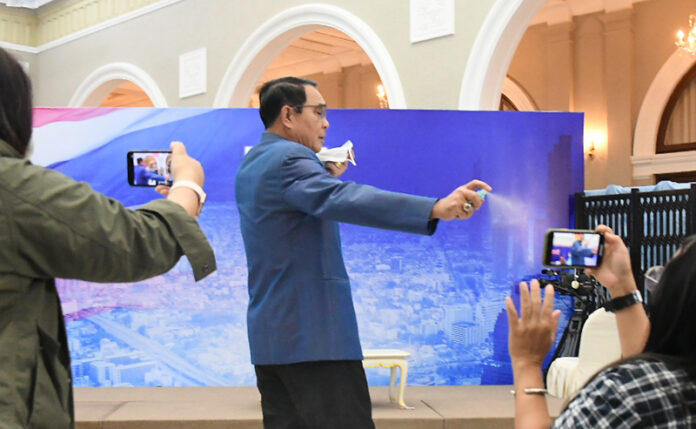
Gen. Prayut Chan-o-cha sprays reporters with sanitizer at Government House March 9, 2021.
BANGKOK — Gen. Prayut Chan-o-cha apologized Friday for spraying reporters with alcohol while being questioned by the press earlier in the week.
At the Royal Thai Police Headquarters Friday, Prayut apologized for spraying reporters with sanitizing alcohol after the Tuesday cabinet meeting.
“Usually I joke around with reporters like this. I won’t do it again and will follow the rules. Sorry, I guess,” he said.
When pressed on the fact that international news outlets picked up on the story, the general changed his tone to a ngonone – a mix of pouty disappointment.
“Well, who was the one who distributed that footage? I was just teasing you. I’ve resolved never to joke around with you again. End of story,” he said angrily.
If you get alcohol into your eyes, you should flush your eyes as soon as possible after contact.
Popular Facebook parenting page “Take Kids With Us” wrote on Friday that Prayut’s behavior is an example of how pooyai in Thai society bully people in less senior positions under the guise of a joke.
“Pooyai” means adults, but it can also refer to influential people or individuals that demand respect from those inferior to their standing.
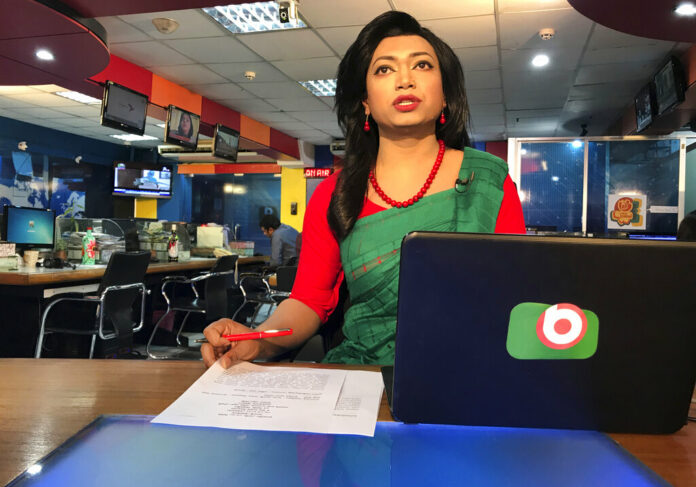
Bangladesh's first transgender news anchor Tashnuva Anan Shishir reads news bulletin , in Dhaka, Bangladesh, Tuesday, March 9, 2021. Photo: Al-emrun Garjon / AP
DHAKA, Bangladesh (AP) — A Bangladeshi satellite television station has hired the country’s first transgender news anchor, saying it hopes the appointment will help change society.
Tashnuva Anan Shishir, who previously worked as a rights activist and actress, debuted on Dhaka-based Boishakhi TV on Monday, International Women’s Day. She read a three-minute news bulletin, and after finishing cried as her colleagues applauded and cheered.
“I was very nervous, I was feeling so much emotional, but I had in my mind that I must overcome this ordeal, this final test,” Shishir, 29, said in an interview Tuesday.
In her early teens, she began to live publicly her female identity. She said family members, relatives and neighbors started teasing her and she was bullied and sexually exploited.
She started feeling that it was impossible to continue living and attempted suicide, she said.
The worst thing that happened was that her father stopped talking to her, saying she was the reason that her family was losing face, Shishir said.
“I left home,” she said.
She moved from her family’s house in a southern coastal district to live a solitary life in the capital, where she underwent hormone therapy, worked for charities and acted with a local theater group. In January, she began studying public health at a Dhaka university, which she is continuing alongside her job at the TV station.
Bangladesh officially has more than 10,000 transgender people, but activists say the actual number is much higher in the nation of more than 160 million people. The LGBT community faces social isolation, sexual abuse and other forms of harassment. Finding employment is very difficult, and many live by begging or selling sex.
Since 2013, the government of Prime Minister Sheikh Hasina has allowed transgender people to identify themselves as a separate gender. They were given voting rights in 2018.
Some changes are already visible.
In November, a charity group opened Bangladesh’s first Islamic school for the transgender community.
Boishakhi TV said it wanted to be part of the changes and has hired a second transgender person in its drama department.
“Our prime minister has taken many steps for the transgender people. Encouraged by such steps, we have appointed two transgender people, We want the attitude of society to change through these appointments,” said Tipu Alam Milon, the station’s deputy managing director.
___
Story: By Julhas Alam. This story was first published on March 10, 2021. It was updated on March 12, 2021, to correct by removing the anchor’s former name and conforming to AP style.
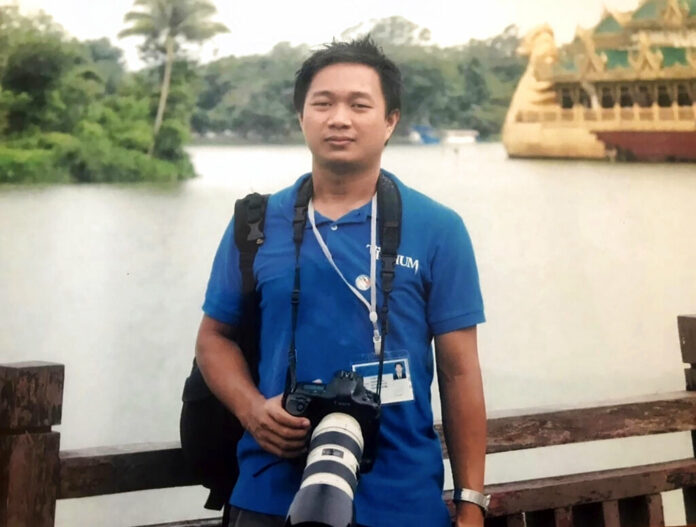
This undated family file photo provided on Wednesday, March 3, 2021 shows Associated Press journalist Thein Zaw in Yangon, Myanmar. Photo: Thein Zaw family via AP
YANGON, Myanmar (AP) — A court in Myanmar is scheduled to hold a hearing on Friday for an Associated Press journalist detained while covering demonstrations against the military’s seizure of power last month. He is facing a charge that could send him to prison for three years.
Thein Zaw, 32, was one of nine media workers taken into custody during a street protest on Feb. 27 in Yangon, the country’s largest city, and has been held without bail.
His hearing Friday comes at the end of his initial remand period, and his lawyer, Tin Zar Oo, said ahead of it that she expected the court to schedule another hearing. She plans to submit her power of attorney as Zaw’s lawyer and perhaps try to apply for bail.
Thein Zaw has not been seen by his lawyer or any of his family members since his arrest. Tin Zar Oo said visits at Insein Prison, where he is being held, are not allowed because of coronavirus concerns, so his family has been dropping off food and supplies for him at the gate.
According to the independent Assistance Association for Political Prisoners, 38 journalists have been detained since the military took over Feb. 1, ousting the elected government of Aung San Suu Kyi. Nineteen are still incarcerated.
The group says it has verified the detentions of more than 2,000 people as well as 69 deaths.
The military regime has attacked the press in other ways as well. This week it canceled the licenses of five local media outlets that had extensively covered the protests. Mizzima, Democratic Voice of Burma, Khit Thit Media, Myanmar Now and 7Day News have continued operating after they were barred from broadcasting or publishing on any media platform.
Thein Zaw was arrested as he was photographing police, some of them armed, charging down a street at anti-coup protesters. A video shows that although he stepped to the side of the street to get out of their way, several police rushed over and surrounded him. One put him in a chokehold as he was handcuffed and then taken away.
Insein Prison in northern Yangon is notorious for housing political prisoners under previous military regimes. Hundreds of protesters detained in the past week, many of them students, are also being held there.
Thein Zaw and at least six other members of the media have been charged with violating a public order law that could see them imprisoned for up to three years, according to his lawyer and the Assistance Association for Political Prisoners.
The Associated Press has called for his immediate release.
“Independent journalists must be allowed to freely and safely report the news without fear of retribution,” Ian Phillips, AP vice president for international news, said after the arrest. “AP decries in the strongest terms the arbitrary detention of Thein Zaw.”
Many press freedom organizations have joined the call for the release of the detained journalists.
“These charges are a obvious effort to intimidate Myanmar’s journalists into silence and prevent them from reporting on the junta’s increasingly violent crackdown on the protests against its illegitimate rule,” said Scott Griffen, deputy director of the International Press Institute, headquartered in Vienna. “We call on the authorities to immediately drop these groundless charges, and release Thein Zaw and all other detained journalists.“
The U.S. government, in addition to criticizing the coup and the violence of Myanmar’s security forces, has shown support for the cause of press freedom in the Southeast Asian nation.
“We condemn the attempted media blackout and efforts to silence the voices of the people by revoking the licenses of several local media organizations,” U.S. State Department spokesperson Ned Price told reporters in Washington on Thursday. “We are deeply concerned about the increasing attacks on the freedom of expression, including for members of the press. We call for the release of journalists and for all others who have been unjustly detained.”
Even during Suu Kyi’s time in office, journalists were often sued for their reporting.
In the highest-profile case, two journalists working for the Reuters news agency were arrested in 2017 while working on a story about the military violence directed at Myanmar’s Rohingya minority, more than 700,000 of whom fled to Bangladesh for safety. They were accused of illegally possessing official documents, although they argued that they were framed because of official opposition to their reporting.
They were convicted and sentenced to seven years behind bars before being freed in 2019 in a mass presidential pardon.
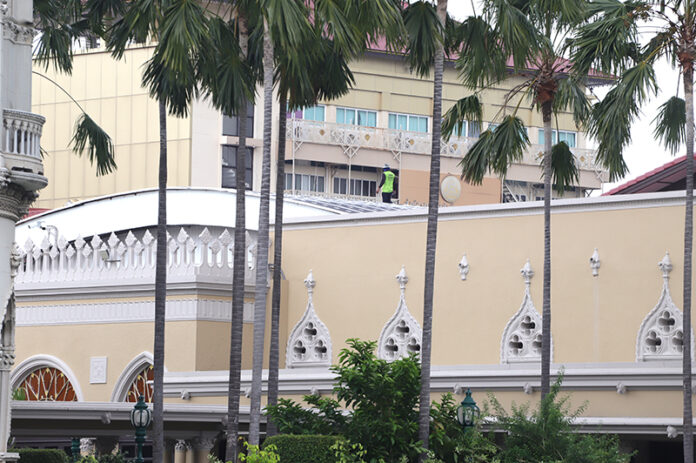
A repairman on the roof of Government House for repairs on March 11, 2021.
BANGKOK — Thursday was the first day of repairs of a leaky roof at Government House – which will cost taxpayers a whopping 6 million baht.
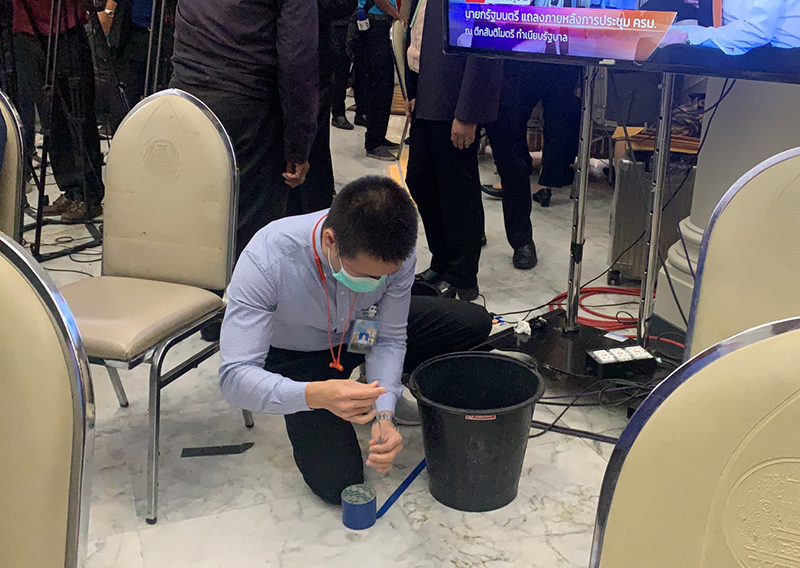
Soldiers from the Post Engineer Department laid down tarps at Santi Maitri Building inside the Government House complex as the first step to fix the leaky ceiling.
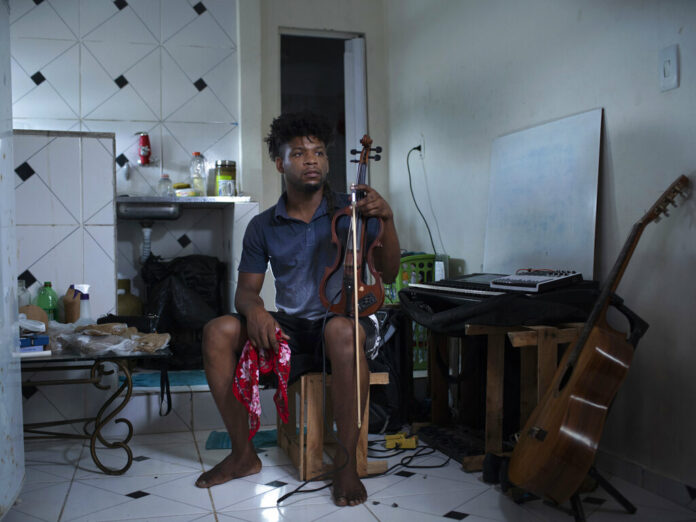
Mauricio Vivet poses for a photo with his violin at home, Dona Marta slum, Rio de Janeiro, Brazil, Saturday, March 6, 2021. Photo: Silvia Izquierdo / AP
One year into the COVID-19 pandemic, the world has seen death, economic hardship and anxiety on an unprecedented scale. But it has also witnessed self-sacrifice, courage and perseverance.
In India, Brazil, South Africa and other places around the globe, people are helping others and reinventing themselves.
“I’ve been adaptable, like water,” said a woman whose dream of becoming a U.S. boxing champion was dealt a blow by the crisis, though not necessarily a knockout punch.
Their voices and images can inspire, even though the future is as uncertain for them as it is for everyone else.
THE VIOLINIST
Mauricio Vivet’s talent as a violinist had earned him a route out of a slum in Rio de Janeiro. As a teen, he played classical music in the streets for money. He got noticed and received a scholarship to a prestigious music school.
After graduation, Vivet earned a living by playing at events and giving lessons. He moved out of the neighborhood and planned to open a music studio.
COVID-19 put a stop to all that. Concerts, weddings and other events were canceled. Vivet, 27, now struggles just to pay for food. He left his apartment and moved back to his mother’s house in the favela.
Vivet’s biggest fear is not having money to provide for his 4-year-old son, Angelo.
Vivet has gone back to square one.
On a recent day, he carefully wrapped his violin in a red cloth, placed it inside a battered black suitcase and made his way to Ipanema Beach. There, he sat on a stone bench and played his violin, the sweet notes amplified by a speaker. Passersby stopped to listen. Some dropped money into the red cloth.
“It is the only stage that I have, the only thing that they have not prohibited,” Vivet said. “It’s the only way I can make money.”
THE BOXER
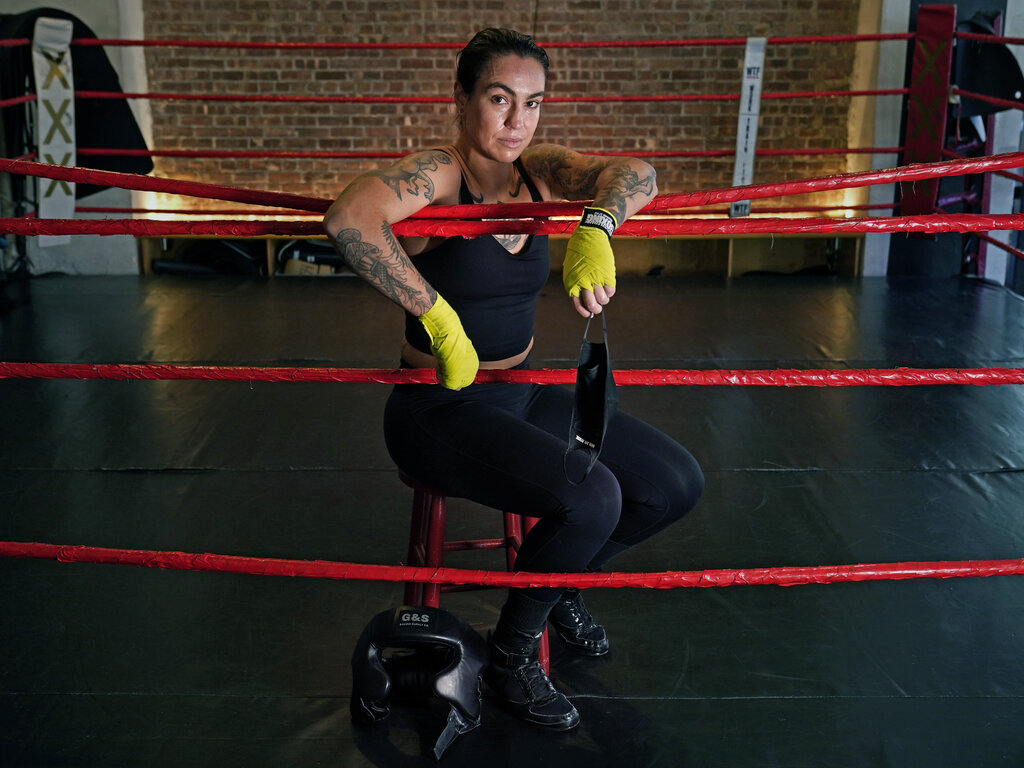
Melody “Mel” Popravak, a boxer, poses for a portrait at Work Train Fight boxing gym, Friday, March 5, 2021, in New York. Photo: Kathy Willens / AP
On a recent day, Melody “Mel” Popravak was in a boxing gym in New York City, her arms tattooed, her hands wrapped in yellow tape. Three years ago, she started boxing and was a finalist in two national tournaments.
After the shutdown, she trained in a friend’s garage.
“I’m determined not to give up and to continue to move on to be a professional boxer,” the 35-year-old said.
She has also started an online personal training company where she gives tips on staying in shape.
“I’m checking in with people all over the country who are going through various situations related to COVID,” she said. “I think I’ve been staying strong. I’ve been adaptable, like water, melding into the situation.”
THE BURIAL WORKER
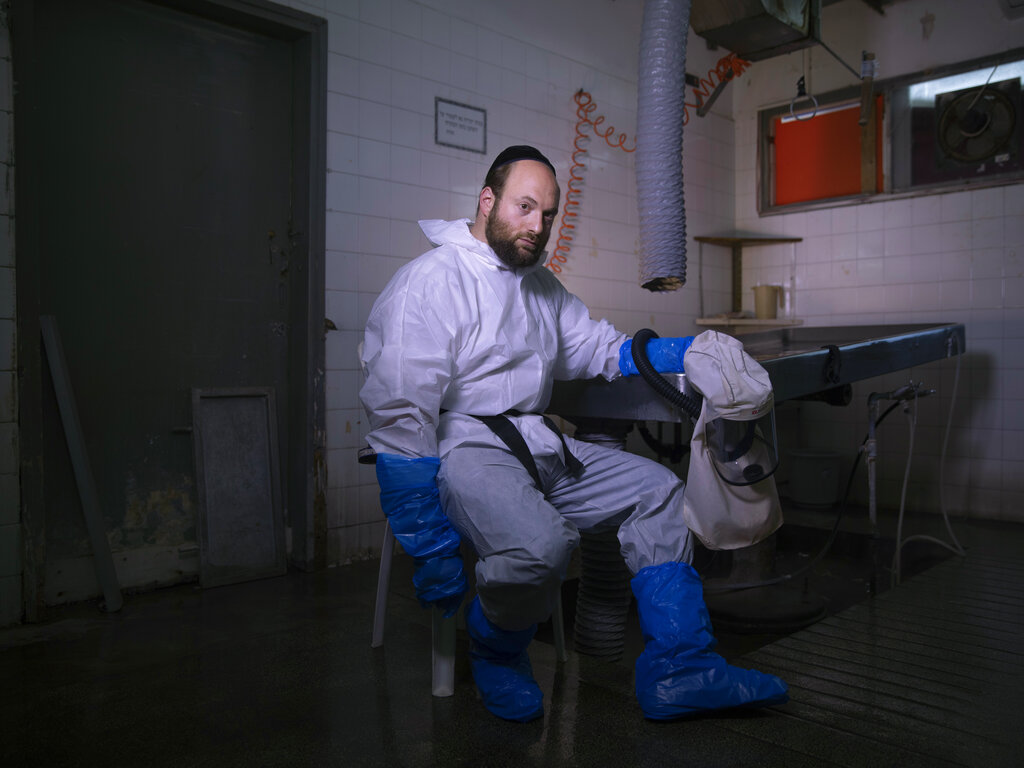
Yehuda Erlich, a worker with Israel’s official Jewish burial society, poses for a photo at a morgue in the central Israeli city of Holon, near Tel Aviv, Tuesday, March 2, 2021. Photo: Oded Balilty / AP
Yehuda Erlich, a worker with Israel’s official Jewish burial society, remembers the first signs that coronavirus had arrived: empty streets and deathly silence. Then a surge of deaths overwhelmed his morgue, with bodies placed in the corridor.
“I really hope we are nearing the end,” Erlich said of the pandemic.
THE STRICKEN DOCTOR
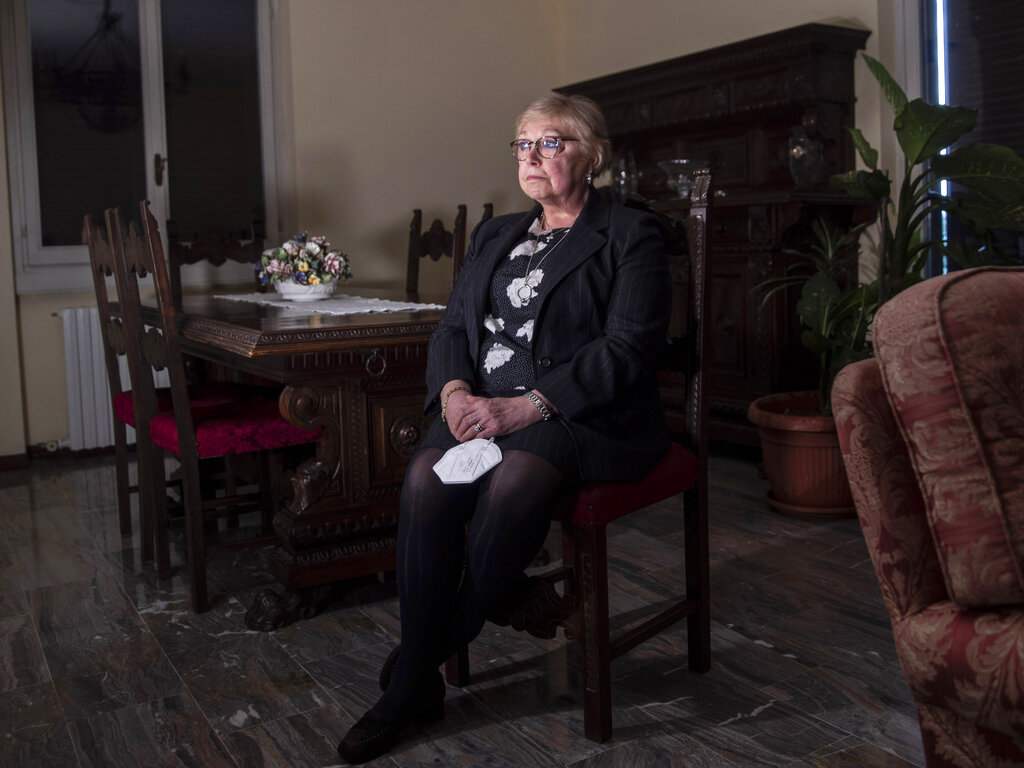
Gabriella Formenti, a doctor from the village of Tavernola Bergamasca in northern Italy, poses at her home Monday, March 8, 2021. Photo: Luca Bruno / AP
Near the beginning of the pandemic, Gabriella Formenti, a doctor from the village of Tavernola Bergamasca in northern Italy, started feeling exhausted and had a high fever. Hit by the virus, she wound up intubated in an intensive care unit.
Eventually she woke up but could move only her head, having lost muscle mass. Today, Formenti undergoes rehabilitation and is often out of breath and weak. Forced by her condition to retire, she greatly misses her patients.
“This disease emphasized, even more, how close they are to me emotionally and personally,” she said. “They even celebrated when I came back home. They all came to see me and helped me. ”
THE ACTRESS
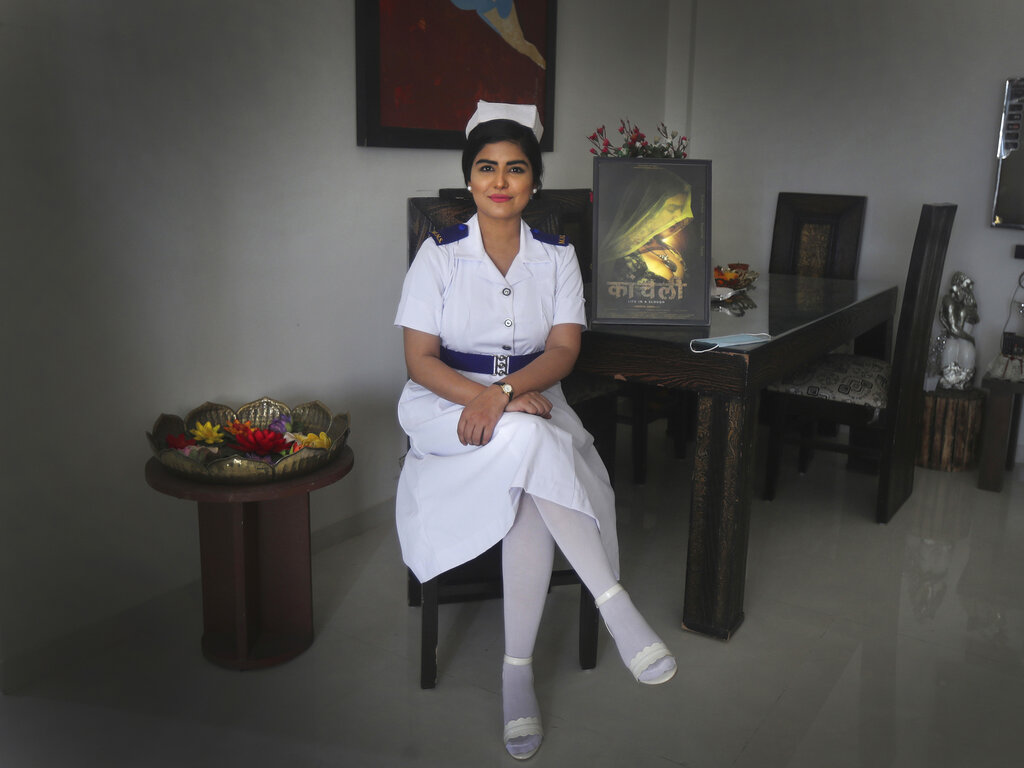
Shikha Malhotra, a Bollywood actress and nurse, poses for a photo sitting next to a poster of her in a Bollywood film at her apartment in Mumbai, India, Wednesday, March. 3, 2021. Photo: Rafiq Maqbool / AP
Shikha Malhotra is a Bollywood actress whose Instagram feed highlights her film and TV projects. During the pandemic, they have also featured her as a nurse.
It is a real-life role that Malhotra, who has a nursing degree, has taken on while volunteering at a crowded Mumbai hospital. Mumbai was one of the worst-hit cities in India, the country with the second-highest caseload of COVID-19 in the world.
“I am first a nursing officer, then an actress,” Malhotra said at her home, wearing a white nurse’s uniform, a white cap over her luxuriant black hair. Next to her was a poster of a movie she starred in.
After working in a COVID-19 ward for months, she became infected, spent a month alone in the hospital recovering, then suffered a stroke that paralyzed the right side of her body.
“It was a big setback for me,” the 25-year-old said, tears streaming down her face as she recalled believing that she would never walk again. She recovered and plans to continue her acting career while also staying ready to serve as a nurse whenever she is needed.
“Seeing life and death in the hospital changed me,” Malhotra said. “I became a more mature person, more grounded. Seeing the people in pain, every single second now I thank God for all that I have.”
THE CENTENARIAN
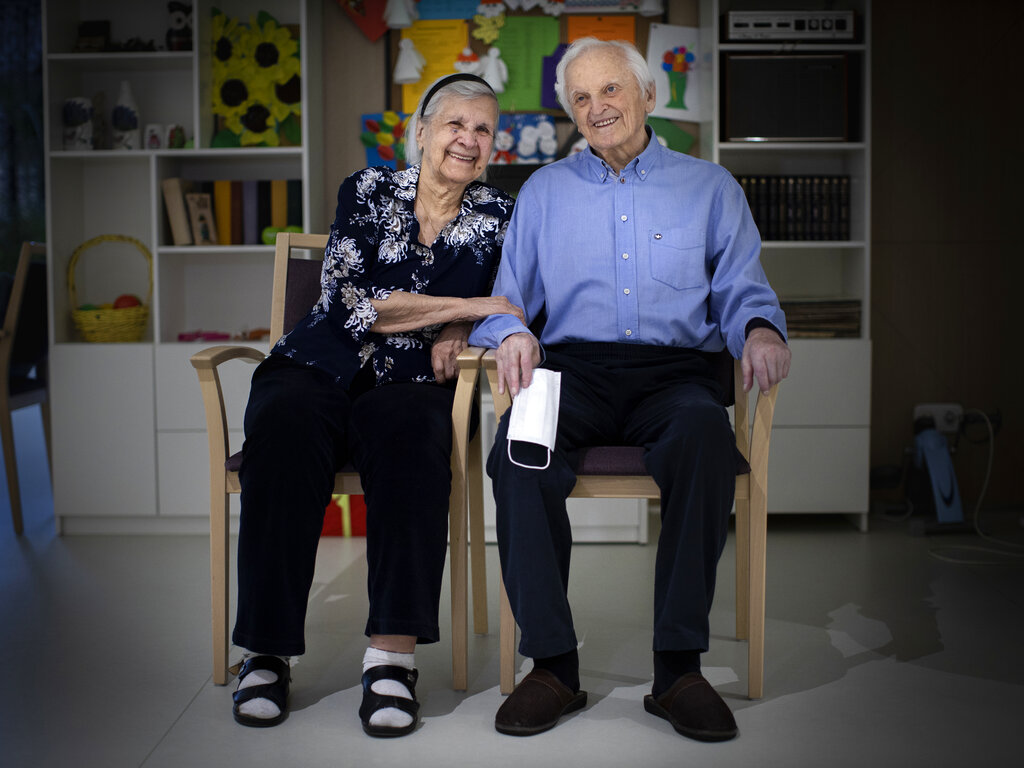
Boris Novikov poses for a photo with his wife, Yelena, at a senior care center just outside Moscow, Russia, Friday, March 5, 2021. Photo: Alexander Zemlianichenko / AP
At 101, Boris Novikov is one of the oldest survivors of COVID-19 in Russia.
A decorated World War II veteran, Novikov was hospitalized with oxygen support. Now recovered, he celebrated his birthday last week at a senior care center near Moscow, where he lives with his wife, Yelena, 93. They have been together 70 years.
Novikov told a visitor he feels “excellent.”
“We can’t complain about anything, for now at least,” his wife added. “We’re living it day by day.”
THE VACCINATOR
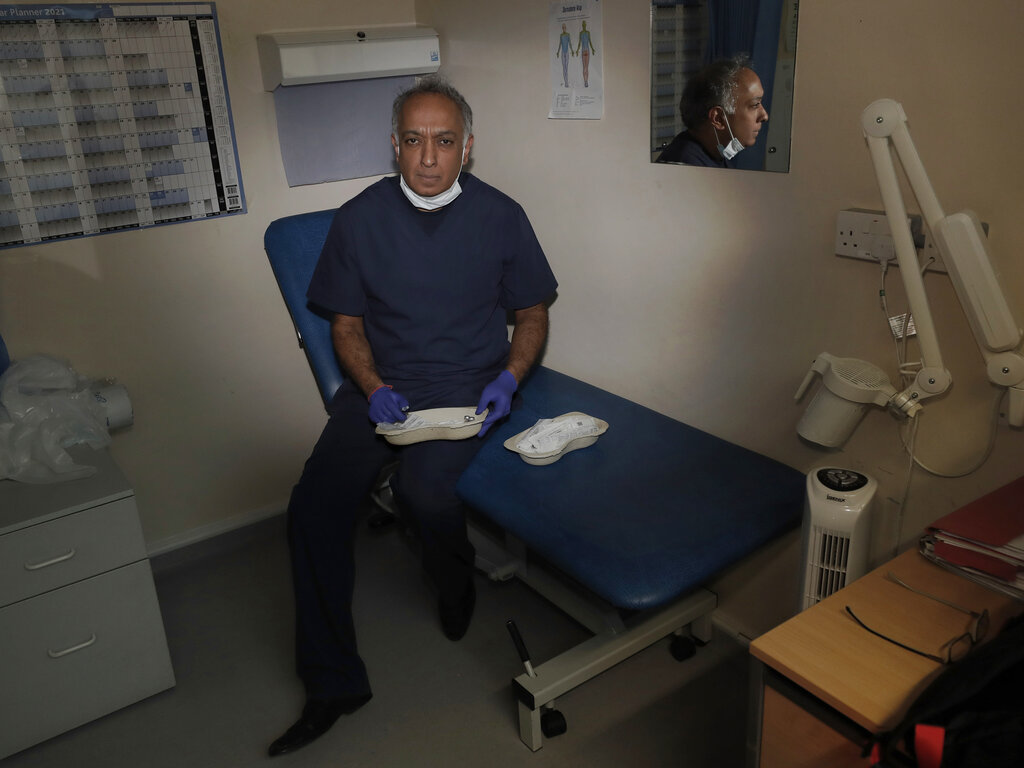
Dr. Anil Mehta poses for a photograph as he prepares syringes at his practice in Northeast London, Wednesday, March 3, 2021. Photo: Frank Augstein / AP
Dr. Anil Mehta has been going with his small team of physicians and nurses to homeless centers in London to offer free COVID-19 vaccinations. The team has vaccinated hundreds of people.
“It makes sense to focus energy on groups that are underrepresented and those most reluctant to go to their doctors,” he said.
Mehta is driven by a desire to help everyone get back to normal as quickly as possible.
“Our lives have been turned upside down in the past year,” he said. “This is the most important thing any of us doctors have done in our lives.”
THE TOUR GUIDE
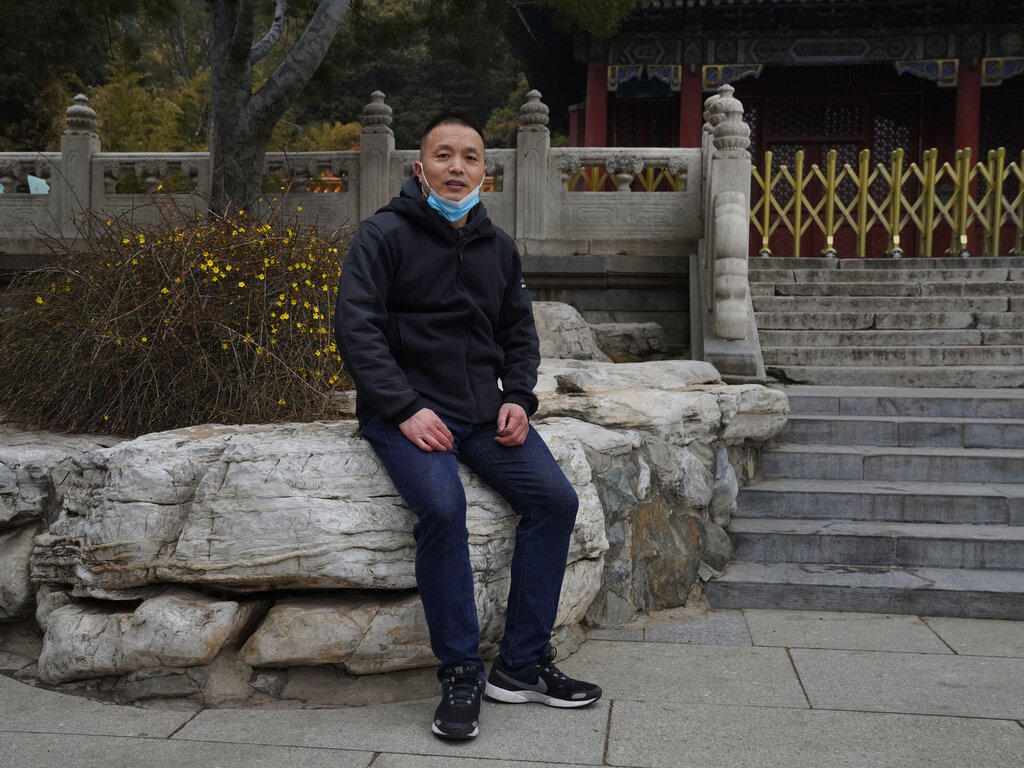
Shi Jinjie, a tour guide in Beijing, poses for a photo at the Jingshan park in Beijing on Friday, March 5, 2021. Photo: Ng Han Guan / AP
Shi Jinjie, a tour guide in Beijing, saw a 90% drop in business last year because of the pandemic. But he is confident domestic tourism will make a comeback very soon.
Already, a few customers are trickling in. He showed them around a park featuring centuries-old pavilions.
“Is Jingshan beautiful?” he asked them. As he took their photo, they responded: “Beautiful!”
THE RESEARCHER
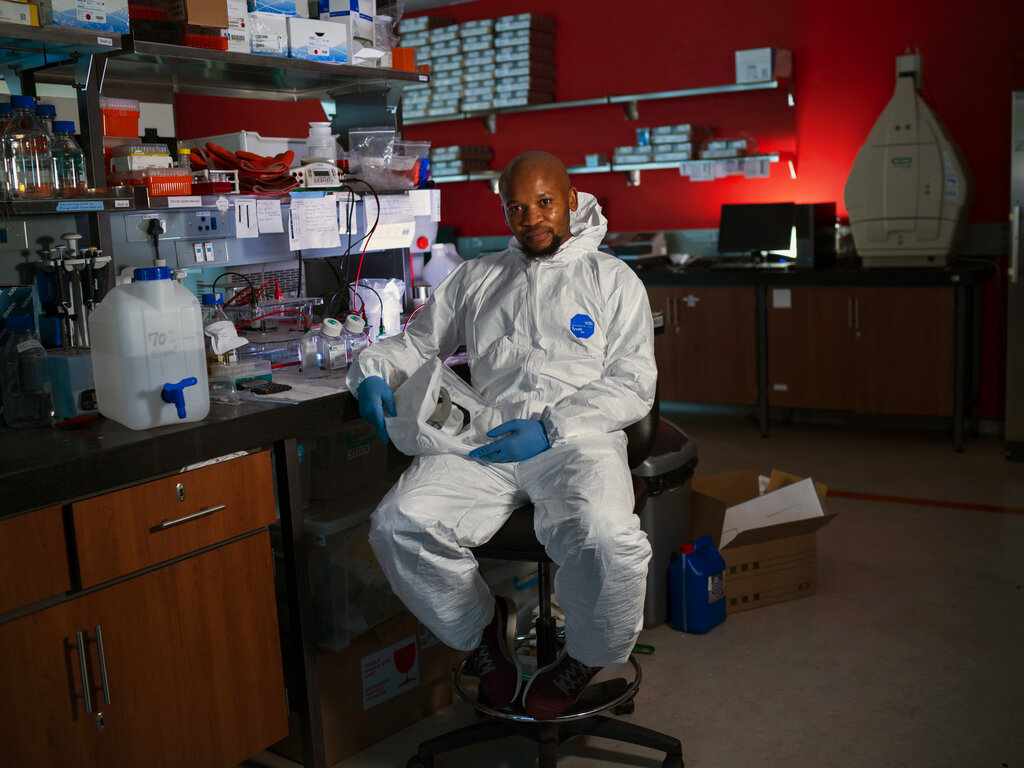
Sandile Cele, a doctoral candidate at the University of Kwazulu-Natal, poses in a lab Thursday, March 4, 2021, Durban, South Africa. Photo: Jerome Delay / AP
Sandile Cele was pursuing a doctorate at the University of Kwazulu-Natal in South Africa when the pandemic hit, creating an obvious research topic.
He made a splash when he figured out how to grow the South African variant of the coronavirus in the laboratory. That enabled the lab to test it and discover that people previously infected with COVID-19 don’t produce antibodies against the mutant version, which has spread to numerous countries.
Cele, 33, said it is every graduate student’s dream “to have a project for your Ph.D. that’s going to have so much impact in the world.”
THE BLAST VICTIM
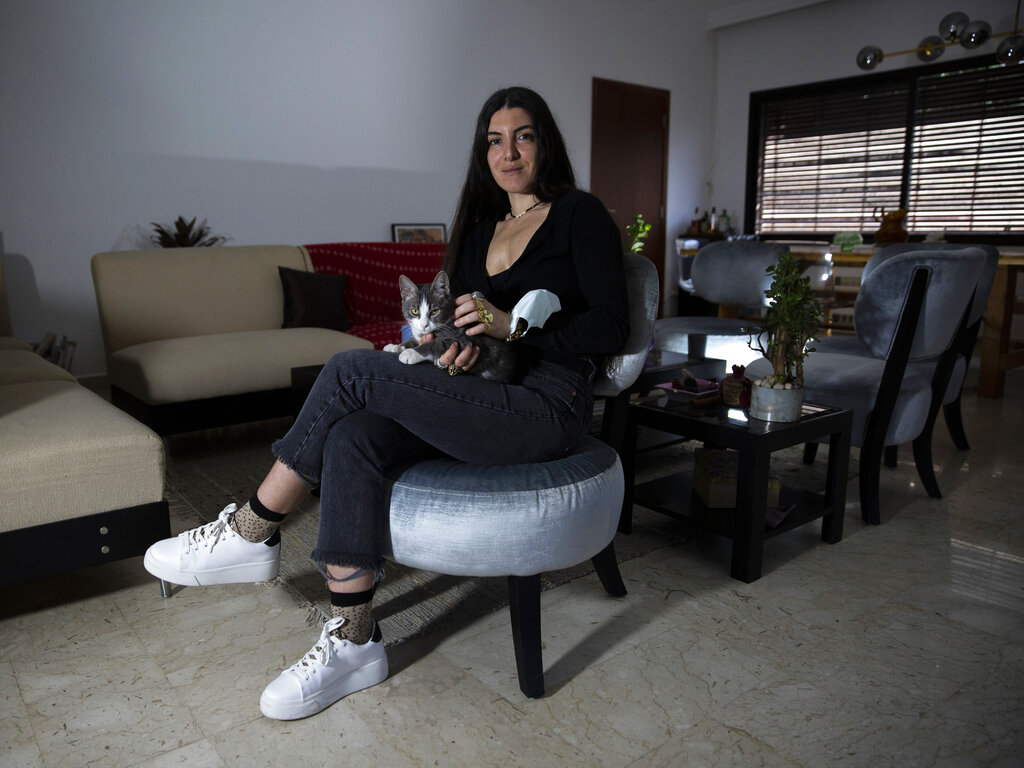
Angelique Sabounjian, 40, poses for a photograph at her home in the town of Antelias, north of Beirut, Lebanon, Monday, March 8, 2021. Photo: Hassan Ammar / AP
On Aug. 4, Angelique Sabounjian was at a coffee shop in Beirut when a thunderous explosion at a warehouse containing a chemical commonly used as fertilizer rocked the city, blowing out windows and cutting Sabounjian’s face. She bled profusely.
On that day, she also became infected with the coronavirus.
“Catching corona and being in that isolation really helped me realize I was crying all day, every day, and I think I needed that,” she said. “I needed to have that release in some way.”
THE SURVIVOR
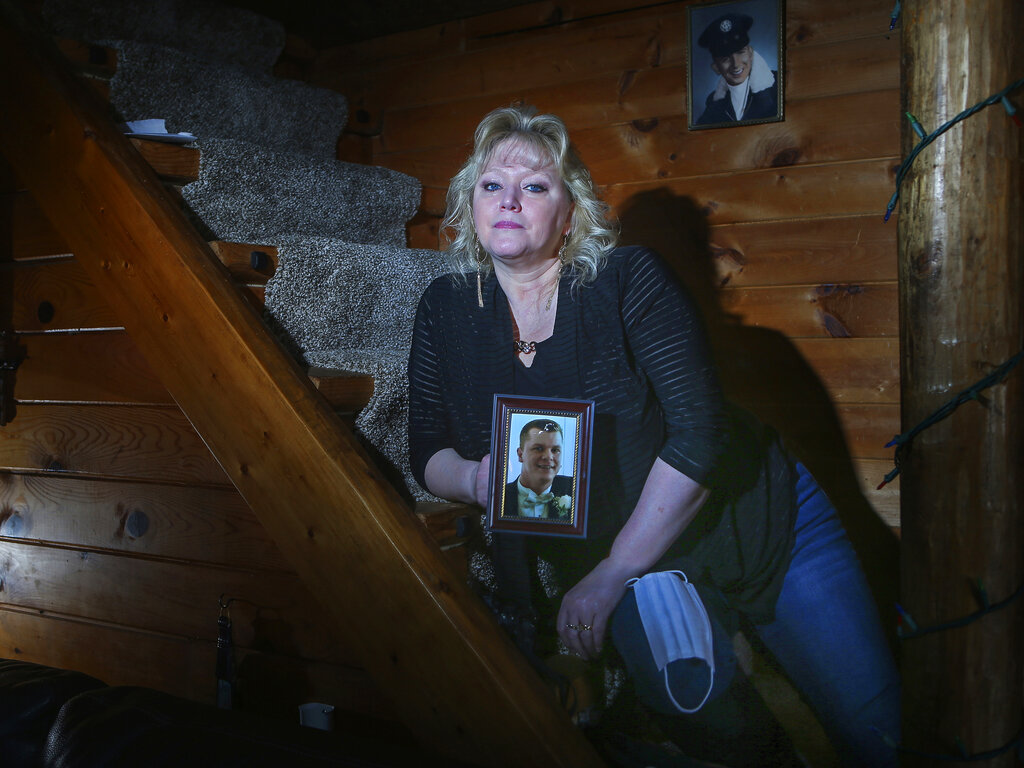
Cynthia Archambault poses with photos of her late brother Daniel Remillard, in hand, and father Ronald Remillard in Woonsocket, R.I., Friday, March 5, 2021. Photo: Stew Milne / AP
Cynthia Archambault, of Woonsocket, Rhode Island, lost her brother Daniel Remillard and her father, Ronald Remillard, to COVID-19 within an hour of each other.
“It’s left a really big gaping hole in all of our hearts,” she said.
THE SOLDIER
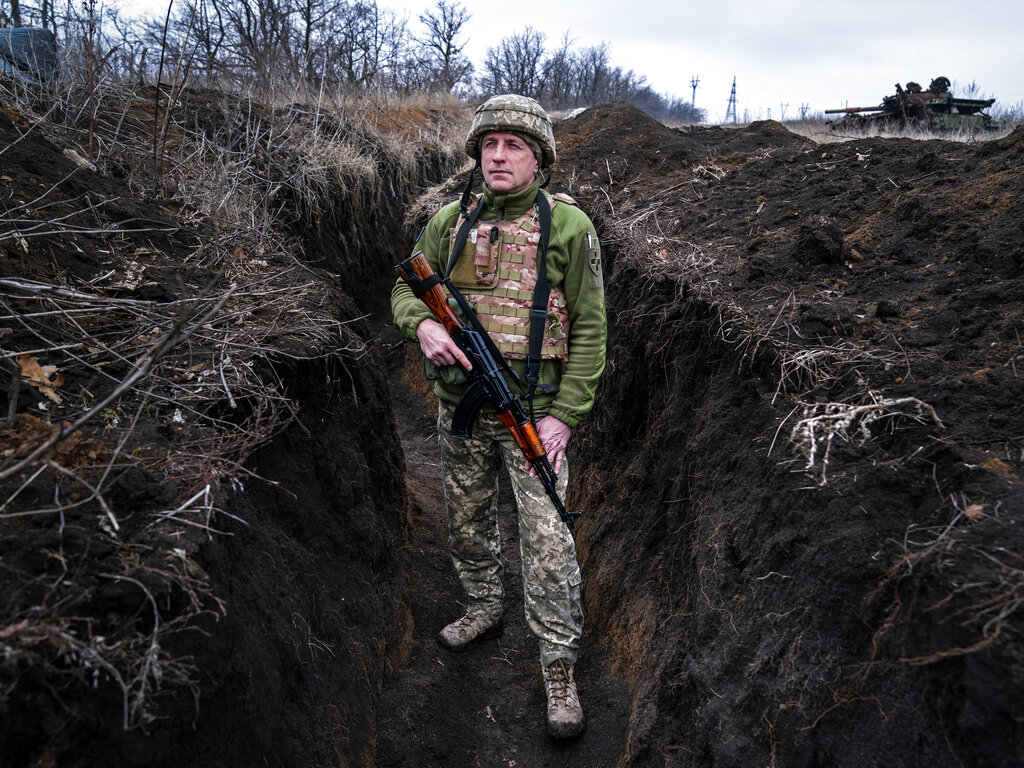
A Ukrainian serviceman, who asked to be identified only by his call sign, Kram, stands at his post in the town of Krasnohorlivka east of Kyiv, eastern Ukraine, Friday, March 5, 2021. Photo: Evgeniy Maloletka / AP
In a front-line trench, the soldier in eastern Ukraine faces two enemies: the Russian-backed separatist rebels and the coronavirus that threatens to infiltrate the ranks.
“We are used to living with dangers,” said the soldier, who asked to be identified only by his call sign, Kram. “The pandemic has become another stress for me.”
___
Story: Andrew Selsky. Associated Press journalists Rafiq Maqbool in Mumbai, India; Lucas Dumphries in Rio de Janeiro; Kathy Willens in New York; Bram Janssen in Durban, South Africa; Sylvia Hui in London; Alexander Zemlianichenko in Moscow; Evgeniy Maloletka in Krasnohorlivka, Ukraine; Fay Abuelgasim in Beirut; Maria Grazia Murru in Tavernola Bergamasca, Italy; Borg Wong and Caroline Chen in Beijing; Laurie Kellman in Holon, Israel; and Stew Milne in Woonsocket, Rhode Island, contributed to this report.
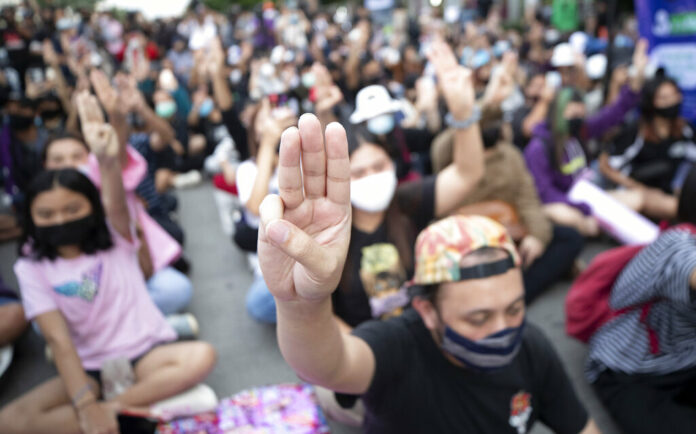
In this Oct. 23, 2020 file photo, pro-democracy activists flash three-fingered salutes outside Bangkok Remand Prison, in which some of the activists are kept, in Bangkok, Thailand. Photo: Sakchai Lalit / AP
BANGKOK (AP) — Thailand is considering an expansion of prison space as it arrests more political prisoners, the justice minister said Wednesday.
Somsak Thepsuthin said Bangkok Remand Prison and Klong Prem Central Prison, where most recently detained political prisoners are held, become congested when families and supporters come to visit.
“Therefore, we are discussing finding a larger area that can accommodate more people for everyone’s convenience,” he told reporters. He denied speculation that a separate new prison would be built for political prisoners.
“Everyone should be treated equally,” Somsak said.
The legal aid group Thai Lawyers for Human Rights recently said at least 382 people, including 13 minors, are facing charges related to political demonstrations and expressing political views from July 2020 through the end of last month.
A student-led pro-democracy movement took hold last year that is calling for Prime Minister Prayuth Chan-ocha and his government to step down, the constitution to be amended to make it more democratic and the monarchy to be reformed to make it more accountable.
In this Oct. 23, 2020 file photo, pro-democracy activists flash three-fingered salutes outside Bangkok Remand Prison, in which some of the activists are kept, in Bangkok, Thailand. Photo: Sakchai Lalit / AP
When the protests became more critical of the monarchy, the authorities stepped up their prosecutions of activists. More than 60 of the people cited by the Thai Lawyers for Human Rights have been charged under the lese majeste law, which makes defaming the monarchy punishable by up to 15 years in prison per incident.
On Wednesday, the Criminal Court sentenced a 22-year-old man to 4 1/2 years in prison for violating the Computer Crime Act by creating several accounts on Facebook on which he allegedly made nine posts criticizing the monarch in April 2020.
The man, a waiter, had his sentence halved from the original nine years because he pleaded guilty, a standard practice in Thai courts.
The Department of Corrections website says Bangkok Remand Prison holds 3,195 prisoners, while Klong Prem Central Prison accommodates 7,009.