


























33.9 C
Bangkok
Friday, June 26, 2026
Home Blog Page 1141

As Abortion Reform Nears Reality, Backlash From Catholic Church Begins

Activists stage a rally in front of the Parliament to call for abortion rights on Jan. 25, 2021.

BANGKOK — The Senate on Monday endorsed a bill that would legalize abortion up to the 12th week of pregnancy in compliance with a historic court rule – a move condemned by the Catholic Church leadership as “an immoral law.”

The amendment to the Criminal Codes aims to cement the legal protection for women seeking to terminate their pregnancy. Lawmakers hope the change will come into effect by Feb. 12, a deadline mandated by the Constitutional Court, even as the Church is launching a last ditch effort to stop its passage.

“Today’s session is historic,” Senator Kamnoon Sitthisamarn said on Monday. “We will try to wrap up the debate within one day so that the law could become effective within Feb. 12.”

The Senate eventually completed all of its three sessions required for debating a legislation by Monday night. The amendment is now pending an announcement on the Royal Government Gazette to become effective.

While abortion rights advocates say the new law would save countless women from illegal and often deadly procedures, senior officials of the Catholic Church are urging the faithfuls to oppose the effort, which they see as an infringement on “the rights of unborn children.”
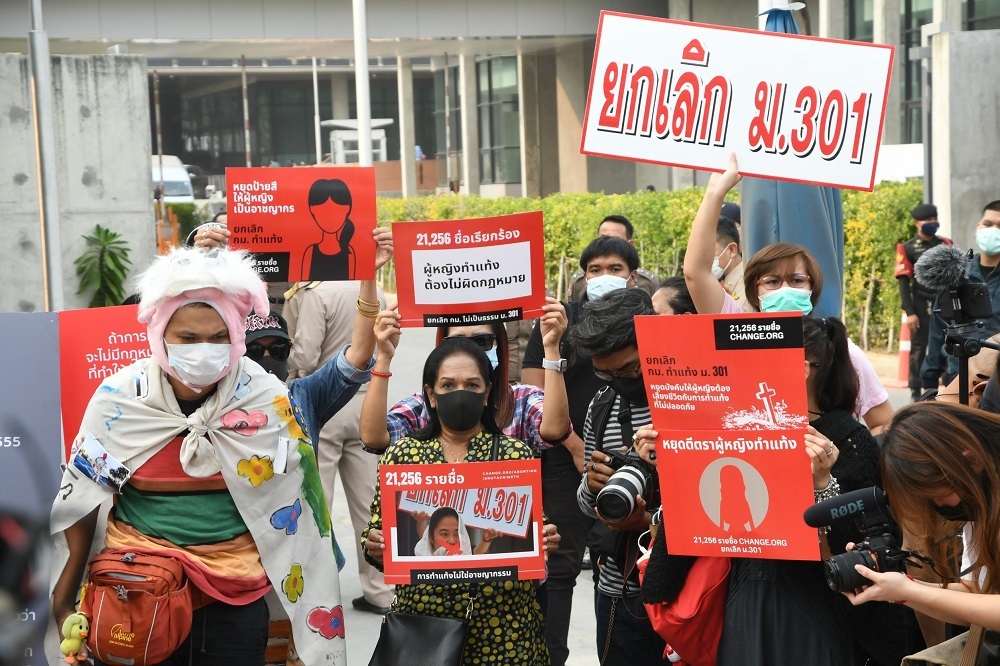
Activists stage a rally in front of the parliament to call for abortion rights on Jan. 25, 2021.

“People get abortions because they want to get around the problem, they don’t want to solve the problem,” Fr. Pairat Sriprasert, director of pastoral care at the Catholic Bishop Conference of Thailand, said by phone.

“Our standpoint is clear. We oppose all forms of abortion since we hold that life is born after a zygote is formed,” Pairat said. “We must think about the rights of the unborn children as well.”

He continued, “People may argue that women want to get an abortion because they’re not ready to raise a child or are financially unstable, but there are solutions to these problems.”

About 1 percent of Thai population follows Christianity, though Roman Catholics are formally recognized as a faith group by the Thai state.

Priests have begun gathering signatures from churchgoers for a petition that urges the lawmakers to reconsider the bill. The Church also launched campaigns to raise public awareness of the Catholic’s view on abotion. Multiple Catholic organizations are set to meet on Thursday and hold a public discussion on why overturning the abortion ban is in violation of their religious dogma.

But Pairat conceded that he is not expecting the decision to be overturned.

“We will not go as far as staging a protest,” Pairat said. “But we will keep standing up for our belief. Although the law may eventually pass, the conscience prevails in this world. Actions have to be taken even though we are outnumbered in this Buddhist’s majority country.”

Key leaders of the Buddhist faith, which often preaches against abortions and views it as a maternal sin, have remained largely silent on the legal amendment. No major Buddhist groups have staged any public effort to protest the procedure either.

Unconstitutional

The bill passed by the Senate on Monday repealed Article 301 of the Criminal Codes, which criminalizes almost all cases of abortion, as well as holding the doctors who perform them liable to prosecution.

Under the law, which was passed in 1956, women found guilty of terminating their pregnancy face up to three years in prison. The maximum jail term is raised to five years for doctors who assisted them.

But a landmark verdict handed down in November by the Constitutional Court rules that Article 301 violates women’s rights to their life and body. The court also recommended that the article be amended accordingly within 365 days.

Safe and legal abortions were possible prior to the court’s verdict, thanks to a clause under Article 301 that allowed doctors to perform the operation if the women’s “mental health” is at risk, but pro-abortion activists argued the grey area did not offer enough protection for both women and doctors.

“The Universal Declaration of Human Rights states that everyone is born free, that’s clear enough,” Supecha Baotip, an activist from Tamtang, an abortion advocacy group, said in an interview. “There should be no law forbidding access to medical services.”
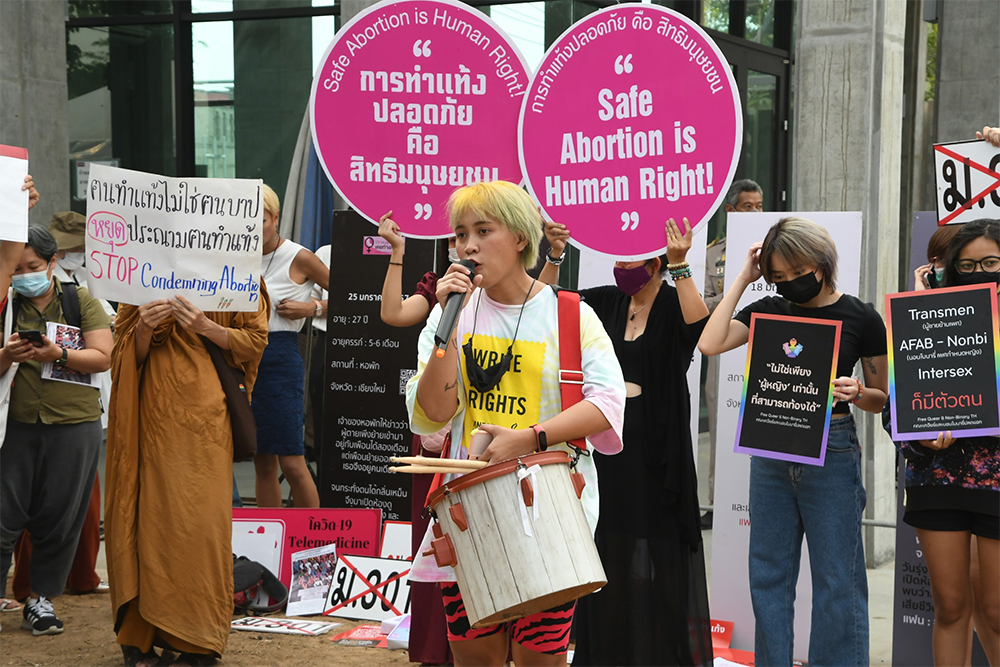
Activists stage a rally in front of the parliament to call for abortion rights on Jan. 25, 2021.
Activists stage a rally in front of the Parliament to call for abortion rights on Jan. 25, 2021.

It was Tamtang who filed a legal challenge to Article 301, which eventually led to the historic ruling by the Constitutional Court.

Supecha added, “I want everyone to understand that it is necessary for some women to undergo the procedure. No one else knows best except themselves.”

The amendment to Article 301 sailed through the Lower House without any significant opposition, with 276 MPs voted in favor, eight against, and 54 abstained. The proposed text of the amended law stated that women have the rights to abortion within 12 weeks of pregnancy.

Supecha said she understands concerns expressed by religious groups about the abortion law, but she warned that women’s lives would be at risk if the ban is not overturned.

“I understand that it’s their beliefs, but if you close the door, women will go through the window,” said Supecha. “We can’t really stop them by criminalizing abortions, but we can offer them a safe access to the procedure with this bill. This helps save lives and solve women’s problems.”
Advertisement

Japan Virus Surge Linked to Gov’t Travel Campaign, Study Finds

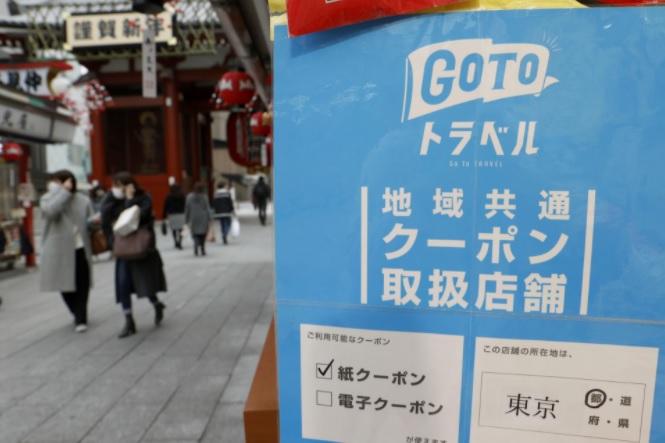
A poster for the Japanese government's "Go To Travel" subsidy program is seen in Tokyo's Asakusa tourist area on Dec. 11, 2020. (Kyodo)

TOKYO (Kyodo) — The number of travel-associated novel coronavirus cases in Japan increased by nearly seven times after the government began a subsidy program aimed at promoting domestic tourism in July, a recent study found.

“Although the second epidemic wave in Japan had begun to decline by mid-August, enhanced domestic tourism may have contributed to increasing travel-associated COVID-19 cases,” Kyoto University researchers Hiroshi Nishiura and Asami Anzai said in the study, published Thursday in the Journal of Clinical Medicine.

Continue reading the story here

Advertisement

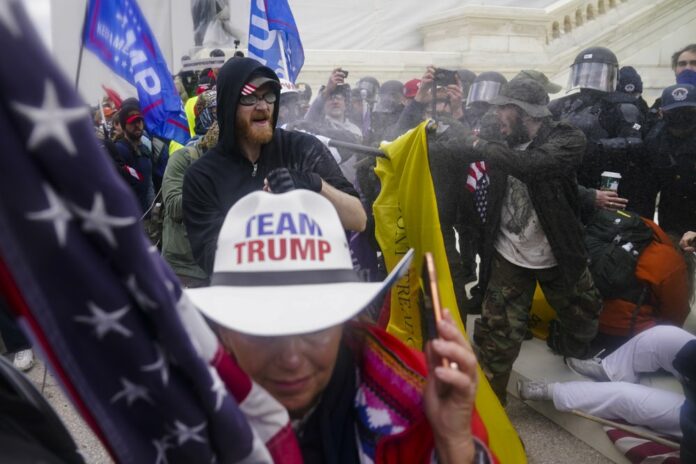
‘This Is Me’: Rioters Flaunt Involvement in US Capitol Siege

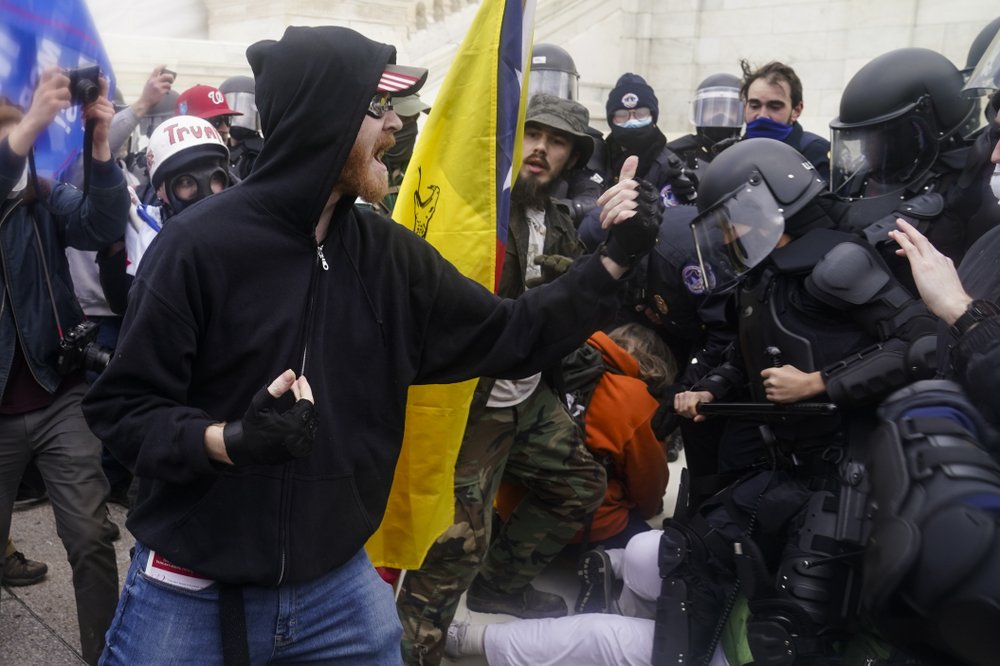
In this Jan. 6, 2021, file photo, Trump supporters try to break through a police barrier at the Capitol in Washington. (AP Photo/John Minchillo, File)

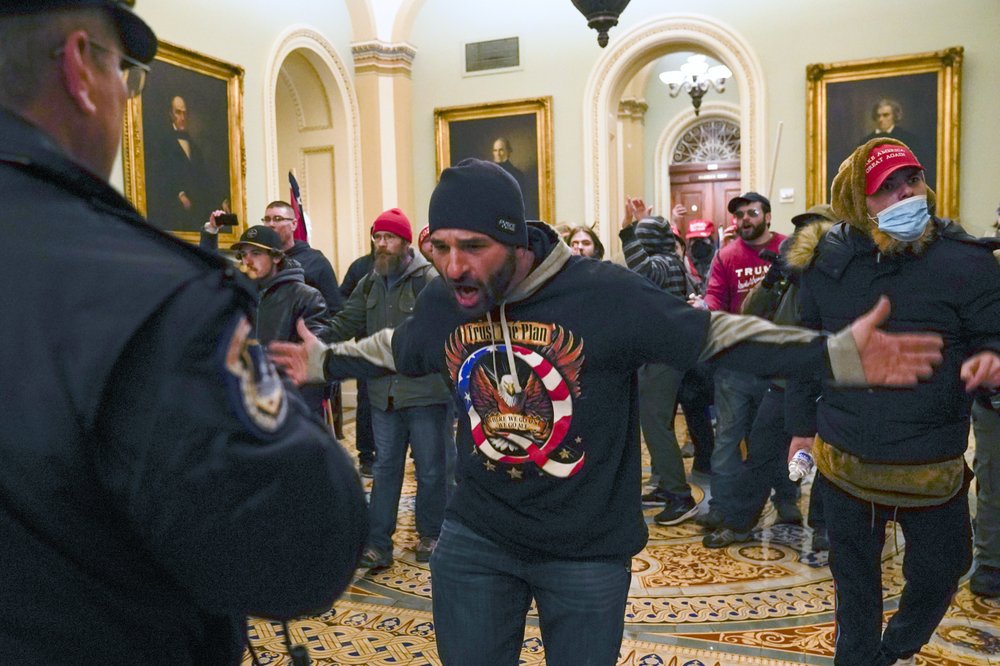
WASHINGTON (AP) — These suspects weren’t exactly in hiding.

“THIS IS ME,” one man posted on Instagram with a hand emoji pointing to himself in a picture of the violent mob descending on the U.S. Capitol. “Sooo we’ve stormed Capitol Hill lol,” one woman texted someone while inside the building. “I just wanted to incriminate myself a little lol,” another wrote on Facebook about a selfie he took inside during the Jan. 6 riot.

In dozens of cases, supporters of President Donald Trump downright flaunted their activity on social media on the day of the deadly insurrection. Some, apparently realizing they were in trouble with the law, deleted their accounts only to discover their friends and family members had already taken screenshots of their selfies, videos and comments and sent them to the FBI.

Their total lack of concern over getting caught and their friends’ willingness to turn them in has helped authorities charge about 150 people as of Monday with federal crimes.

But even with the help from the rioters themselves, investigators must still work rigorously to link the images to the vandalism and suspects to the acts on Jan. 6 in order to prove their case in court. And because so few were arrested at the scene, the FBI and U.S. Marshals Service have been forced to send agents to track suspects down.

1000 6 3
Trump supporters gesture to U.S. Capitol Police in the hallway outside of the Senate chamber at the Capitol in Washington, Wednesday, Jan. 6, 2021. (AP Photo/Manuel Balce Ceneta)

“Just because you’ve left the D.C. region, you can still expect a knock on the door if we find out that you were part of criminal activity inside the Capitol,” Steven D’Antuono, the assistant director in charge of the FBI’s Washington office, said earlier this month. “Bottom line — the FBI is not sparing any resources in this investigation.”

In the last few weeks, the FBI has received over 200,000 photos and video tips related to the riot. Investigators have put up billboards in several states with photos of wanted rioters. Working on tips from co-workers, acquaintances and friends, agents have tracked down driver’s license photos to match their faces with those captured on camera in the building.

In some cases, authorities got records from Facebook or Twitter to connect their social media accounts to their email addresses or phone numbers. In others, agents used records from license plate readers to confirm their travels.

More than 800 are believed to have made their way into the Capitol, although it’s likely not everyone will be tracked down and charged with a crime. Federal prosecutors are focusing on the most critical cases and the most egregious examples of wrongdoing. And they must weigh manpower, cost and evidence when charging rioters.

A special group of prosecutors is examining whether to bring sedition charges against the rioters, which carry up to 20 years in prison. One trio was charged with conspiracy; most have been charged with crimes like unlawful entry and disorderly conduct.

Many rioters posted selfies inside the Capitol to their social media accounts, gave interviews to news outlets describing their experience and readily admitted when questioned by federal investigators that they were there. One man created a Facebook album titled “Who’s House? OUR HOUSE” filled with photos of himself and others on Capitol grounds, officials said.

1000 10 10
In this Jan. 6, 2021, file photo, Trump supporters try to break through a police barrier at the Capitol in Washington. (AP Photo/John Minchillo, File)

“They might have thought, like so many people that work with Trump, that if the president tells me to do it, it’s not breaking the law,” said Michael Gerhardt, an expert on impeachment and professor at the University of North Carolina School of Law.

Others made blunders, like a Houston police officer, who denied he went into the Capitol, then agreed to let agents look at the pictures on his phone. Inside his deleted photos folder were pictures and videos, including selfies he took inside the building, authorities said. Another man was wearing a court-ordered GPS monitor after a burglary conviction that tracked his every movement inside the building.

A retired firefighter from Long Island, New York, texted a video of himself in the Capitol rotunda to his girlfriend’s brother, saying he was “at the tip of the spear,” officials said. The brother happened to be a federal agent with the State Department’s Diplomatic Security Service, who turned the video over to the FBI. A lawyer for the man, Thomas Fee, said he “was not part of any attempt to take over the U.S. Capitol” and that “the allegation is that he merely walked through an open door into the Capitol — nothing more.”

Another man who was inside the Capitol was willing to rat out another rioter who stole House Speaker Nancy Pelosi’s lectern and emailed the video to an FBI agent, even signing his own name to it. “Hello Nice FBI Lady,” he wrote, “Here are the links to the videos. Looks like Podium Guy is in one of them, less the podium. Let me know if you need anything else.”

In another case, a man was on a flight leaving D.C. two days after the riot when he kept shouting “Trump 2020!” and was kicked off. An airport police officer saw the man get off the plane and the man was booked on another flight.

1000 4 7
Trump supporters gather outside the Capitol, Wednesday, Jan. 6, 2021, in Washington. (AP Photo/John Minchillo)

Forty-five minutes later, the officer was watching a video on Instagram and recognized the man in a group of rioters. The man, who was wearing the same shirt as the day he stormed the Capitol, was arrested at the airport, authorities said.

Even defense attorneys have acknowledged that the evidence poses a problem for them.

“I’m not a magician,” said an attorney for the man seen in a photo carrying Pelosi’s lectern. “We’ve got a photograph of our client in what appears to be inside a federal building or inside the Capitol with government property,” he told reporters.

Police at the Capitol planned only for a free-speech demonstration and were overwhelmed by the mob that broke through and roamed the halls of the Capitol for hours as lawmakers were sent into hiding. Five people died in the melee, including a Capitol police officer who was struck in the head with a fire extinguisher.

Trump was impeached after the riot on a charge of “inciting violence against the government of the United States.” Opening arguments will begin the week of Feb. 8. He is the first president to be twice impeached and the first to face a trial after leaving office.

Unlike criminal cases, impeachment trials do not have specific evidence rules so anything said and done that day can be used. And several of the people charged have said in interviews with reporters or federal agents that they were simply listening to the president when they marched to the Capitol.

___

Richer reported from Boston.

Advertisement

Experience Good Travel with Marriott Bonvoy in Asia Pacific

Newly launched pilot program set to allow guests to forge connections with local communities for meaningful travel across Asia Pacific whether at home or abroad

HONG KONG, 26 January 2021 – Marriott International today announces the launch of Good Travel with Marriott Bonvoy, a program offering meaningful travel across Asia Pacific. Against the backdrop of the global pandemic, and with travelers increasingly aspiring to make a positive impact on the communities they visit whether locally or abroad, the program aims to create opportunities for guests to forge first-hand connections with local communities and the environment during their stay, promoting both cultural understanding and positive change.

2 4

Good Travel with Marriott Bonvoy kicks off today with a pilot at 15 Marriott International hotels across Asia Pacific, offering curated purpose-driven experiences that focus on three distinct pillars: Environmental Protection which aims to support the resiliency of the natural environment due to environmental degradation, pollution and climate change; Community Engagement which aims to create a positive impact in the communities where Marriott International properties operate through cultural education or volunteerism, and Marine Conservation which aims to restore and preserve marine ecosystems and species.

3 2

As a global industry leader, Marriott’s sustainability and social impact platform, Serve 360: Doing Good in Every Direction, guides the company’s commitment to make a positive and sustainable impact wherever it does business, delivering value for associates, customers, owners, the environment, and communities around the world in support of the United Nations Sustainable Development Goals (SDGs). Marriott International is committed to be an enabler of positive connections, bringing the benefits of good travel to its guests, associates, and communities in Asia Pacific.

From mangrove conservation in Fiji, coral transplanting and restoration in Okinawa and Maldives, beach cleanups in Sanya and Busan, to food redistribution in Bali, Good Travel with Marriott Bonvoy provides guests with the opportunity to contribute meaningfully as they explore and build deeper connections in their local communities at home or as they venture overseas when travel resumes.

4 1

“One of the growing trends we’re observing is how conscious guests are of their personal impact on the destinations they visit. The launch of Good Travel with Marriott Bonvoy aspires to shift the way vacations are perceived – from pure leisure to value-adding opportunities to learn more about the natural environment and forge new connections with the local community,” said Bart Buiring, Chief Sales and Marketing Officer of Marriott International Asia Pacific. “Our ambition is to expand the program to most of our Asia Pacific leisure destinations over time, and be ready to welcome guests with meaningful travel experiences once travel returns.”

5

From emphasizing human rights protections and working with leading non-profits to reducing our environmental impact and operating sustainable hotels, Marriott continues to prioritize efforts to serve its communities, the planet, and people worldwide. In 2020, support and engagement with communities where Marriott International hotels operate in showed no signs of slowing. From donating essential items to providing special rates and stays for frontline workers, associates from hotels across Asia Pacific volunteered over 200,000 hours to serve most needy communities. With a growing footprint of more than 800 properties and 24 brands in Asia Pacific, the company is in a strong position to provide meaningful experiences at home and abroad, partnering with travelers to drive a positive change.

To learn more please visit www.marriottbonvoyasia.com/goodtravel

6

List of 15 pilot hotels:

  1. The Ritz-Carlton, Nanjing
  2. JW Marriott Marquis Hotel Shanghai Pudong
  3. W Guangzhou
  4. The Sanya EDITION
  5. Sheraton Grand Zhengzhou Hotel
  6. Sheraton Hong Kong Tung Chung Hotel
  7. JW Marriott Mussoorie Walnut Grove Resort & Spa
  8. W Bali – Seminyak
  9. Sheraton Grand Bangalore Hotel at Brigade Gateway
  10. The Ritz-Carlton, Okinawa
  11. Sheraton Maldives Full Moon Resort & Spa
  12. JW Marriott Phuket Resort & Spa
  13. Fiji Marriott Resort Momi Bay
  14. The Westin Denarau Island Resort Fiji
  15. Fairfield by Marriott Busan Songdo Beach
Advertisement

Samut Sakhon Finds 900 New Cases, Governor Remains in ICU

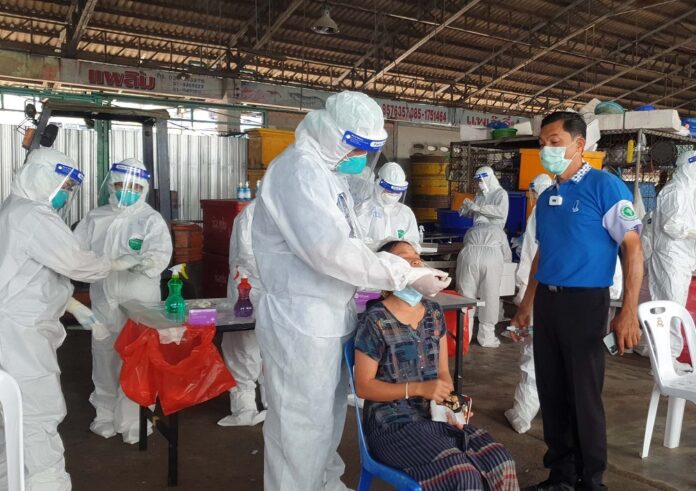
Health workers in Samut Sakhon province test residents for coronavirus during a case-finding operation on Jan. 22, 2021.

SAMUT SAKHON — More than 900 people were found infected with the coronavirus in Samut Sakhon province, local officials said Monday. 

Samut Sakhon Public Health Office said a total 914 new cases were discovered in the past 24 hours. A vast majority of them, 844, were registered during a case-finding operation. At least 795 of them are migrant workers, the statement said. 

The latest surge brings the total number of confirmed cases in Samut Sakhon province to 6,555 since the new outbreak was first identified in December. 

A health official answering the hotline for active case-finding operations in Samut Sakhon said that most of the new patients are workers in a factory, although she declined to name which one. 

The coastal province remains one of the epicenters of the outbreak, along with the four eastern provinces of Chonburi, Trat, Rayong, and Chanthaburi. 

The Samut Sakhon Governor himself has been infected with the coronavirus. Gov. Veerasak Vijitsaengsri remains in critical condition at Siriraj Hospital, where doctors recently found severe inflammation inside his lungs. 

“The tracheotomy has made his care easier, since we can more easily remove phlegm. More air is going into his lungs,”  Siriraj’s medicine faculty dean Prasit Watanapha told reporters. 

Two new virus fatalities were reported in Thailand on Monday: a 61-year-old U.K. national who fell ill in a quarantine facility shortly after arriving in Thailand, and a 56-year-old Thai woman who reportedly contracted the virus from her husband, who worked at a seafood market in Samut Sakhon.

Advertisement

Censure Debate Over Prayut’s Handling of Virus Slated for Feb. 16

A file photo of PM Prayut Chan-o-cha.

BANGKOK — Prime Minister Gen. Prayut Chan-ocha said on Monday that he is prepared to defend himself in the upcoming no-confidence debate slated to take place in February.

Representatives of the opposition camp said they plan to grill Prayut and his Cabinet over their alleged mismanagement in the coronavirus crisis in the censure debate, which will begin on Feb. 16. Prayut said he’s confident that the government will have answers for every question raised by the critics.

“I’ve seen you [the media] making such a big deal of the debate,” Prayut told reporters at Government House. “I’ll let the Parliament take its course, because I respect the Parliament. They have the authority to do so, so let them do it. My job is to explain myself.”

Schedules of the censure debate, including the date for the votes to be cast in the no-confidence motion, are still being discussed by the two sides, said Pheu Thai MP Suthin Klangsaeng.

“We have agreed that it’ll begin on Feb. 16,” Suthin, who also serves as the opposition whip, said by phone. “But we haven’t negotiated about the date of the vote yet. They give us four days. We want six. We’ll have to talk again, but it won’t take long.

Read: 1st Vaccine to Be Handed Out on Valentine’s Day, But Questions Remain

Suthin said he’ll be one of the 15 Pheu Thai MPs leading the charge against Prayut and nine of his Cabinet members.

They include Public Health Minister Anutin Charnveerakul, who came under fire for his handling of the outbreak, as well as Deputy Premier Gen Prawit Wongsuwan, who is the leader of the ruling Phalang Pracharath Party.

In the letter submitted to House Speaker Chuan Leekpai earlier today, the opposition said a no-confidence motion is necessary because of the government’s failure to contain the coronavirus pandemic, revive the economy, and defend freedom of expression.

The document also accused Prayut’s government of “damaging good relations between the monarchy and the public” by “using the monarchy as an excuse to deepen the division in the society,” possibly a reference to the ongoing crackdown under the draconian royal defamation law.

Prayut and his ministers are expected to survive the no-confidence motion, since the coalition continues to command the House majority.

But the debate, which is typically broadcast live on TV stations and news platforms, will be the most high profile challenge to Prayut’s administration at the time political gatherings remain banned under the Emergency Decree.

Another major opposition party, Move Forward, will field at least 10 MPs to address the Parliament during the censure debate, according to Move Forward MP Wiroj Lakkhanaadisorn, who aimed to highlight Prayut’s streak of autocracy.

“Prayut is used to being a dictator,” Wiroj said by phone. “The habit often makes his administration incompetent.”

Wiroj added that he and his party are well aware that the Prayut and other ministers will certainly win the no-confidence vote when it is called, but said the debate will be helpful in educating the public on why Prayut failed them.

“We will ignite the discussions and win by presenting facts,” the politician said.

A similar sentiment was expressed by another opposition leader, Seri Ruam Thai Party chairman Sereepisuth Temeeyaves.

“The people will decide who the winner would be,” Sereepisuth said by phone. “Please don’t look at the scores, but look at the content.”

The former police commissioner said he’ll focus on the government’s failure to close down illegal gambling dens, which led to coronavirus clusters in several provinces.

Related stories:

Thailand in Pandemic: Remembering the Good, the Bad and the Ugly

Advertisement

Literature Teacher in Ang Thong Puts on a Show for Online Classes

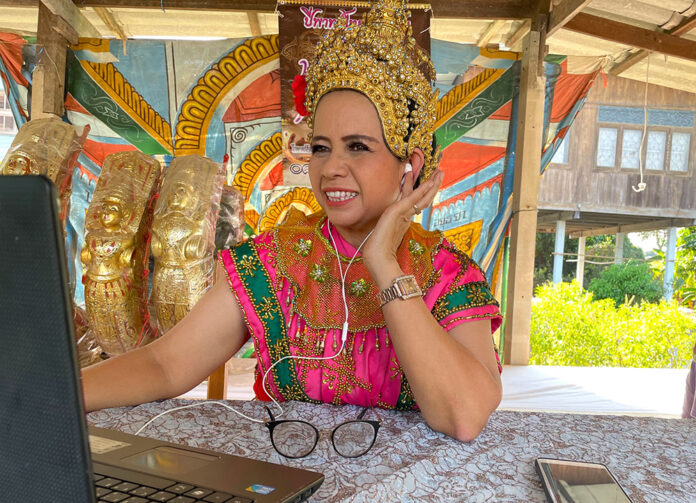
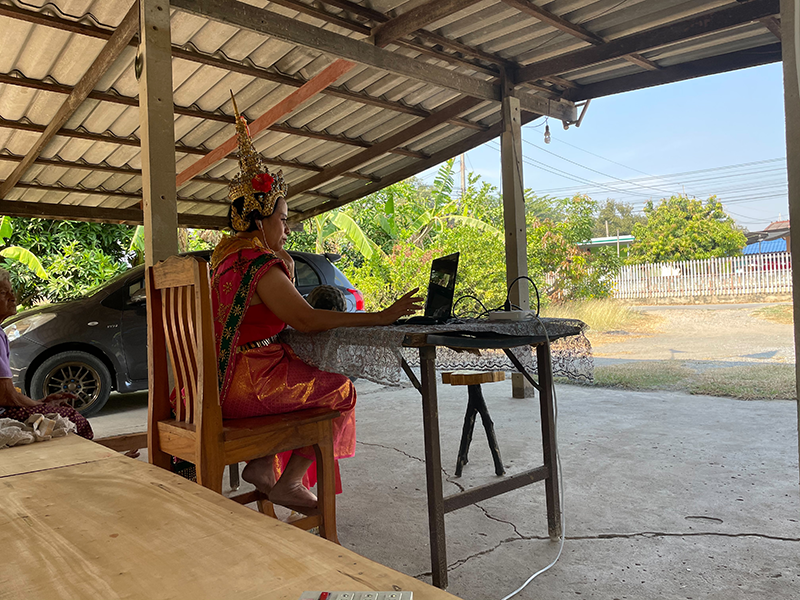
Vanida Sayawong teaches her fifth-grade students online in Ang Thong in a video posted to her Facebook on Jan. 23, 2021.

ANG THONG — While the rest of the world languishes in ratty Tshirts and sweatpants for Zoom calls, a teacher in the central province of Ang Thong does not dabble in such half-measures.

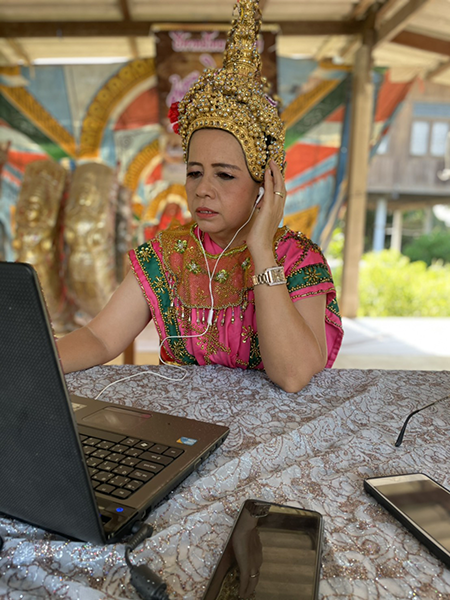
For her online classes, Vanida Sayawong, who teaches Thai literature to fifth-graders, goes as far as donning a full Thai dance costume with multiple elaborate masks and headgear.

“See, I can dress up like this because I’m at home. I can’t wear this to school. I need to let it out and wear this,” Vanida said to her students while teaching online. She posted a video of her teaching to her Facebook on Saturday.

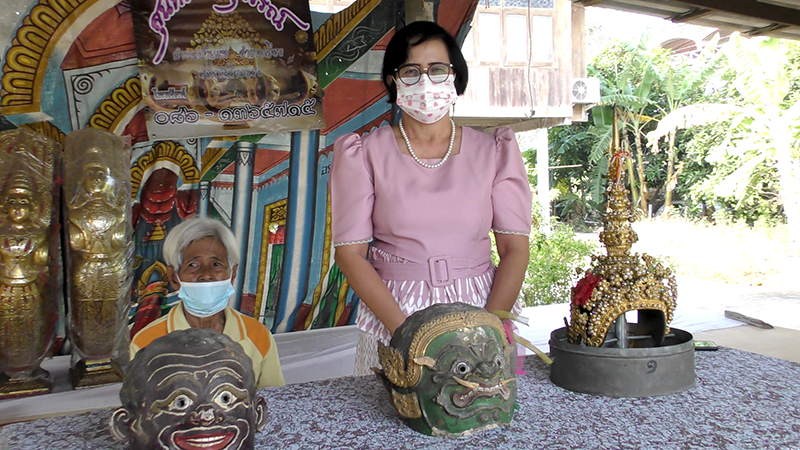
Vanida teaches at Wat Ton Son Municipal 1 School. Her parents are theater troupe owner and a piphat band member. Vanida participated in the troupe as she grew up, and eventually graduated in Thai dance.

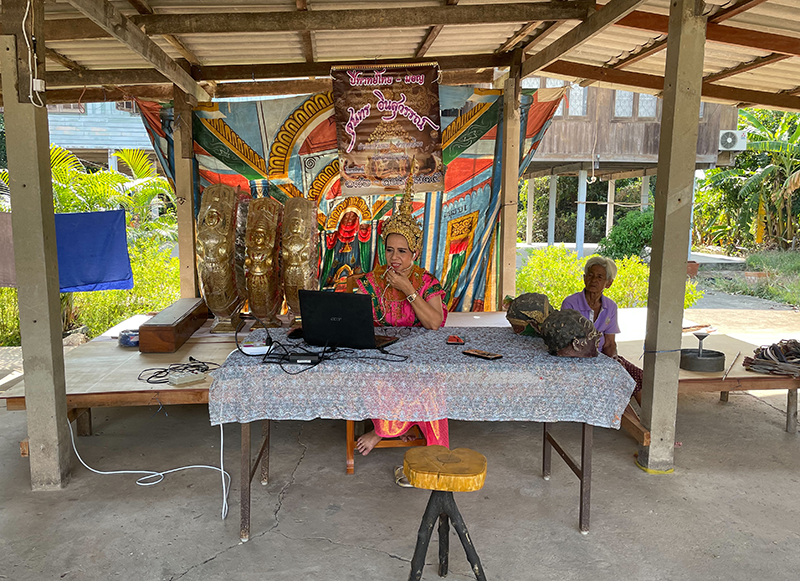
While teaching online at home, she eyed her mother’s old lakorn chatri sets and costumes in front of a house and decided to use them to spice up her lessons on the Sang Thong folktale.

Schools remain closed in 28 provinces since the shutdown was announced in early January amid a second wave of COVID-19 outbreak.

Although the government is set to ease a number of restrictions, there is no plan to reopen schools on the horizon.

2 UCIBVEy copy 7 nJjc9Q4 copy 4 lPrC9W8 copy

Vanida, standing, with her family’s collection of theater masks.
Advertisement

1st Vaccine to Be Handed Out on Valentine’s Day, But Questions Remain

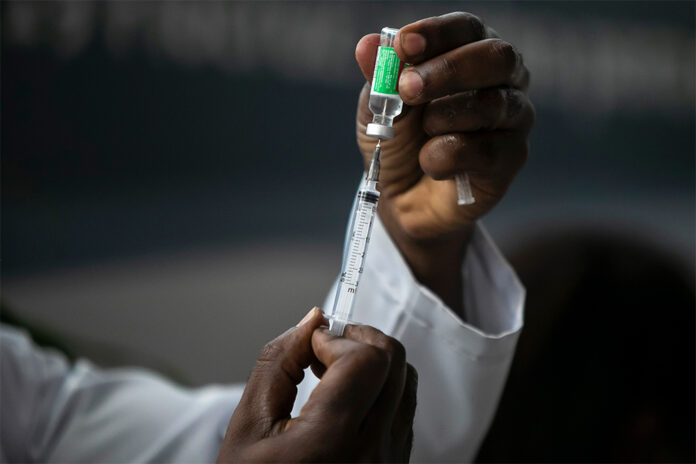
A healthcare worker prepares a dose of the Oxford-AstraZeneca vaccine for COVID-19, at the Oswaldo Cruz Foundation headquarters in Rio de Janeiro, Brazil on Jan. 23, 2021.Photo: Bruna Prado / AP

BANGKOK — Thailand’s long awaited vaccination program against COVID-19 will officially start on Valentine’s Day, a senior health official said Monday, as the country reported two new deaths from the coronavirus.

The first group to be inoculated with vaccines jointly developed by British-Swedish pharmaceutical AstraZeneca and Oxford University will include frontline health workers like doctors and nurses – as well as certain government leaders, for promotional purposes.

“Feb. 14 is the planned date,” Tawee Chotpitayasunondh, an expert at the National Communicable Disease Committee, said by phone. “There are still a lot of factors to be considered, but we want to administer the vaccines as soon as they arrive.”

Thailand has ordered 61 million doses of AstraZeneca vaccine, which was approved for emergency use by the Food and Drug Administration last week.

‘We Can’t Be Picky’: Doctors Urge People to Get Vaccinated for Herd Immunity

Although most of the doses will be produced domestically by Siam BioScience, a company wholly owned by the palace, the government is set to import 200,000 doses of AstraZeneca vaccine from abroad to fill the gap before local production could be rolled out in May.

The first shipment of 50,000 doses is expected to arrive next month, health minister Anutin Charnvirakul said on Wednesday. The rest of the shipment is set to arrive in March and April, he added.

Tawee also hinted that some of the jabs will be reserved for certain senior government officials to raise public confidence in the vaccine, though he refused to name names.

“There will be a promotional campaign,” Tawee said. “But healthcare workers will certainly be prioritized.”

It remains unclear how the first group will be selected for inoculation. Government officials previously said “vulnerable groups” in five provinces of Samut Sakhon, Chonburi, Trat, Rayong, and Chanthaburi would be given a priority due to the severity of the local outbreak.

20201224 1244480 8
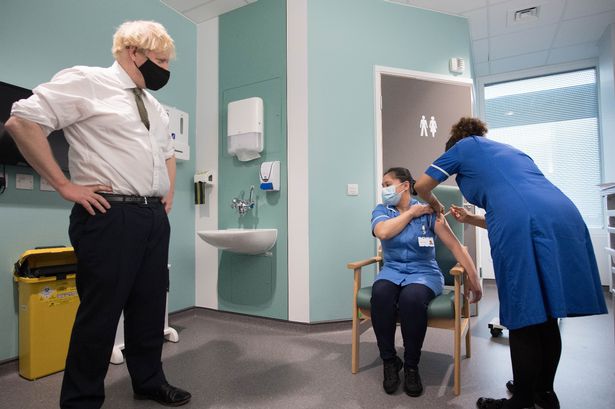
Britain’s Prime Minister Boris Johnson watches as nurse Jennifer Dumasi is injected with the Oxford-AstraZeneca Covid-19 vaccine, during a visit to view the vaccination programme at the Chase Farm Hospital in north London, Monday Jan. 4, 2021, part of the Royal Free London NHS Foundation Trust. (Stefan Rousseau/Pool Photo via AP)

Apart from AstraZeneca vaccines, the government also placed order on two million doses of vaccine developed by Chinese pharmaceutical Sinovac.

Health officials had said earlier this month that the first 200,000 doses of Sinovac vaccines will be shipped to Thailand by the end of February – but the Thai FDA has yet to grant an approval for its use, despite the ever narrower timeframe.

Thailand reported two new deaths from the coronavirus on Monday, along with 187 new cases of infection.

The country’s 74th victim to die from the virus was identified as a 61-year-old British citizen who fell ill whilst staying at a quarantine facility. The 75th victim was a 56-year-old woman who reportedly contracted the virus from her husband, who worked at a seafood market in Samut Sakhon province, pandemic response center spokeswoman Apisamai Srirangsan said in a news conference.

The country’s total tally of coronavirus infections now stands at 13,687.

Advertisement

Lawyer Questions Police Integrity as Lese Majeste Cases Rise to 56

Pro-democracy activist Chonthicha “Kate” Jangrew speaks to reporters on May 22, 2019.

BANGKOK — Pro-democracy activist Chonthicha “Kate” Jangrew became the latest person to be charged with defaming the monarchy – an offense that has seemingly turned into a political weapon against government critics.

Speaking on the phone Monday morning before reporting to the police, Chonticha urged the international community to keep up the pressure on the ongoing crackdown under Article 112 of the Criminal Codes, aka lese majeste. As many as 56 people are now charged under the offense in a spate of just three months, her attorney said.

“People around the world are watching the enforcement of Article 112,” the activist said. “The use of the law is embarrassing the Thai government even more. I’d like to invite the international community and organizations to keep a close watch on this matter.”

Chonticha, who led numerous protests against the government in 2020, predicted that more lese majeste complaints would be lodged in the near future against those calling for reforms of the monarchy.

Read: Questioning Vaccine Transparency? That’s Royal Insult, Gov’t Says

“The cases will just keep rising,” she said. “We also have to question the monarchy, why they let the case number increase.”

The activist said she received the police summons informing her that she was charged with Article 112 on Thursday, but the document did not specify what alleged wrongdoing she might have committed. Chonticha is one of the leaders behind the protest movement that sought to oust PM Prayut Chan-o-cha, draft a more democratic charter, and reform the royal institution.

Lese majeste bans threats or insults made toward the King, Queen, Regent, and Heir Apparent. Violators face up to 15 years in jail, per count.

But the head of Thai Lawyers for Human Rights, a group that’s representing lese majeste suspects in court, said police appear to accept any royal defamation complaints against the dissidents regardless of the circumstances.

“We’ve seen that it’s a problem. The police accepted every complaint,” Yaowalak Anuphan said. “We have to question the police. The police claim that they receive the complaint, so they must proceed with it, [but] Article 112 is now a political weapon. It’s very sweeping.”

The attorney also warned such arbitrary and indiscriminate use of lese majeste will eventually erode the public trust in the law enforcement.

“Eventually, Article 112 will become a law without rules,” Yaowalak said.

Police spokesman Col. Kissana Phathanacharoen was not available to comment as of press time Monday.

The use of lese majeste was absent for several years, until it made a return in November, shortly after PM Prayut Chan-o-cha said the authorities would use every available law in the book to punish those accused of insulting His Majesty the King.

Some democracy advocates have been charged with multiple counts of lese majeste, which could land them in lengthy jail terms. For instance, Rayong-based activist Panupong “Mike” Jadnok will hear the seventh lese majeste charge pressed against him later today, his lawyer said.

In Lampang province, five people also reported themselves to police over lese majeste charges, the Thai Lawyers for Human Rights Group reports.

Advertisement

Virus Restrictions: Gov’t to Debate Extending Dine-In Hours

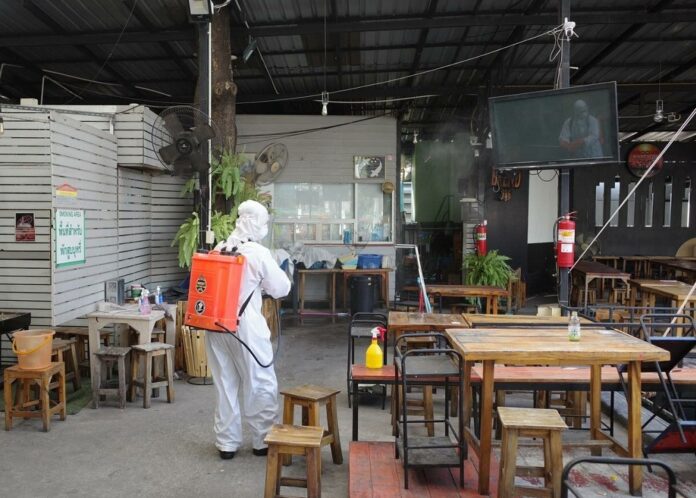
Workers disinfect a restaurant in Bangkok on Jan. 5, 2021.

BANGKOK— Dine-in services may be soon extended beyond the current closure time of 9pm mandated by the government’s coronavirus response center, pending a Cabinet approval.

The COVID-19 Situation Administration Center said it will propose the extension to the Cabinet when it convenes for a meeting on Tuesday.

The move came a day after Thai Chamber of Commerce chairman Klin Sarasin said on Sunday that the relaxed measures would help revive restaurant businesses.

The proposal makes no mention of serving alcohol in restaurants, which has been prohibited since the dine-in service restriction was imposed on Jan. 4.

Thanakorn Kupjit, sec-gen of the Thai Alcohol Beverage Business Association, said that the government should reconsider the ban.

“Not only does the ban affect alcohol sales, but it also adversely affects restaurants by decreasing their earnings,” Thanakorn said. “Allowing food to be served with alcohol will crease more income for the entire country.”

Related stories:

Bangkok to Ban Dine-In Services From 9pm to 6am

Advertisement

Hot News

LATEST NEWS

Bangkok
broken clouds
33.9 ° C
36.6 °
33.8 °
65 %
4.7kmh
52 %
Fri
36 °
Sat
36 °
Sun
37 °
Mon
37 °
Tue
36 °