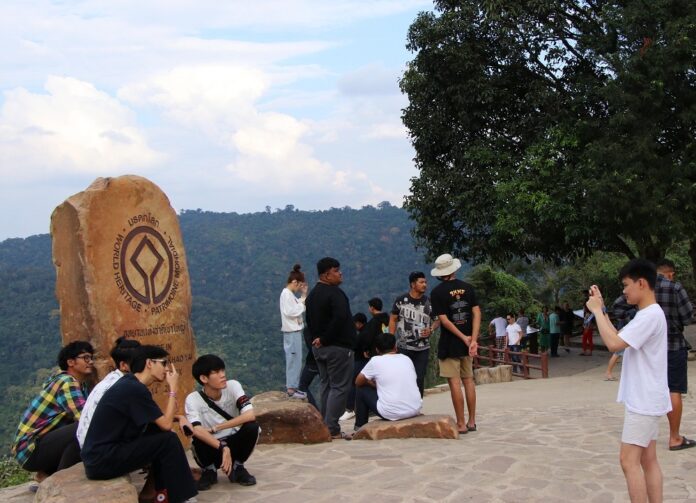
A file photo of tourists in Khao Yai National Park.
BANGKOK — A popular travel subsidy program met an abrupt end on Tuesday after the government put it on an indefinite hold, citing discoveries of corruption and bribery among participating hotels.
Over 300 hotels are under investigation for overstating the cost of accommodation and making up ghost bills in order to file for bogus reimbursement from the government, officials said. The news was a blow to many hotel operators who were hoping the subsidy would encourage travels in the peak month of December.
“This was a good project which led to unexpected uptick in tourists arrivals. But what should we do now?” Kitti Tiessakul, an advisor to the Federation of Northern Tourism Associations, said by phone. “It’s a shame because the package resuscitates the economy.”
Kitti, who is also a hotelier himself, also warned that tourism in the northern region during the New Year holidays will definitely suffer without some version of the stimulus.
The first phase of the 22-billion baht “We Travel Together” was launched in July as a bid to revive domestic tourism amid the coronavirus pandemic and border shutdowns. Its second phase was supposed to launch on Wednesday, just in time for the New Year season, and last until April.
The program allowed registered Thai travelers to reimburse 40 percent of hotel costs, capped at 3,000 per night, as well as bills of restaurants and shops of 600 baht per day. Air tickets can also be reduced by 40 percent, up to 3,000 baht per round trip.
But the Tourism Authority of Thailand suspended the project on Tuesday and announced probes into 312 hotels for falsifying their financial records. The investigation will also look into 200 shops and restaurants suspected of similar wrongdoing.
“We don’t know when it will be reintroduced yet,” Tourism Authority of Thailand governor Yutthasak Supasorn on the phone Tuesday. “We will take legal actions against them to the fullest.”
The governor said he doesn’t know yet what the exact legal penalty will be handed out to business operators and individuals found guilty of fraudulent practice.
However, a prominent trade representative said the suspension of “We Travel Together” is unnecessarily penalizing the entire industry, which is already struggling to survive amid the global pandemic.
“What’s happening is that our expected bookings have been immediately affected,” said Bundarik Kusolvityalat, a board advisor of the Thai Hotel Association, whose membership includes 900 hotels around the kingdom.
“I want them to act quickly and make things clear. Without this scheme, some hotels will not be able to get any booking.”
Bundarik acknowledged that there were some cases of fraud in the program; some hotels marked up their bills as high as 7,000 baht per night even though their normal nightly rates were slightly over 1,000 baht, she said.
But she also urged the tourism authorities to relaunch the campaign “within days” to ward off any potential damages; the first phase of “We Travel Together” alone was responsible for at least 5 million hotel bookings around Thailand, while the second phase, which is now on hold, is expected to bring another 1 million bookings.
“I hope [travelers] will still get to spend their vacation time happily,” Bundarik said.
Tourism authorities estimate Thailand will lose 1.69 trillion baht in revenues due to the travel restrictions amid the pandemic this year.
A banner proclaiming that "communism does not equal dictatorship" published by Free People group.
BANGKOK — Sympathizers of the umbrella organization behind the ongoing pro-democracy protests are left bewildered on Tuesday by its public defense of communist ideologies.
Coming hot on the heels after the controversial debut of its new logo – which bears an uncanny resemblance to the hammer and sickle – the Free People group, formerly called Free Youth, made yet another wave on social media by proclaiming that “communism does not equal dictatorship.”
“When we think of communism, many people see it as a wicked ideology,” a statement released by Free People on Monday said. “They may think of authoritarian countries like China or North Korea, but the true meaning of communism is not the same as what the capitalist propaganda is showing. It’s the name for the economic democracy system which the despotic capitalists are afraid of.”
The same statement also said “the Blue Party does not equal democracy, likewise, communism does not dictatorship,” referring to the Democrat Party, which supports the government of PM Prayut Chan-o-cha.
Pro-establishment activist Warong Dechgitvigrom, who’s often accused the opposition of disloyalty to the monarchy, said the latest message made him wonder what goals the activists are really aiming for.
“I’m confused,” Warong said in an interview. “At first they said they wanted democracy, then they later revealed that they wanted to abolish monarchy and establish a republic, and now they are calling for communism.”
He added, “I’m truly baffled. I spent the whole night reading it over and over.”
But while hardline royalists like Warong are expected to oppose Free People’s activities in general, many staunch supporters of the movement are also dismayed by its flirting with communism.
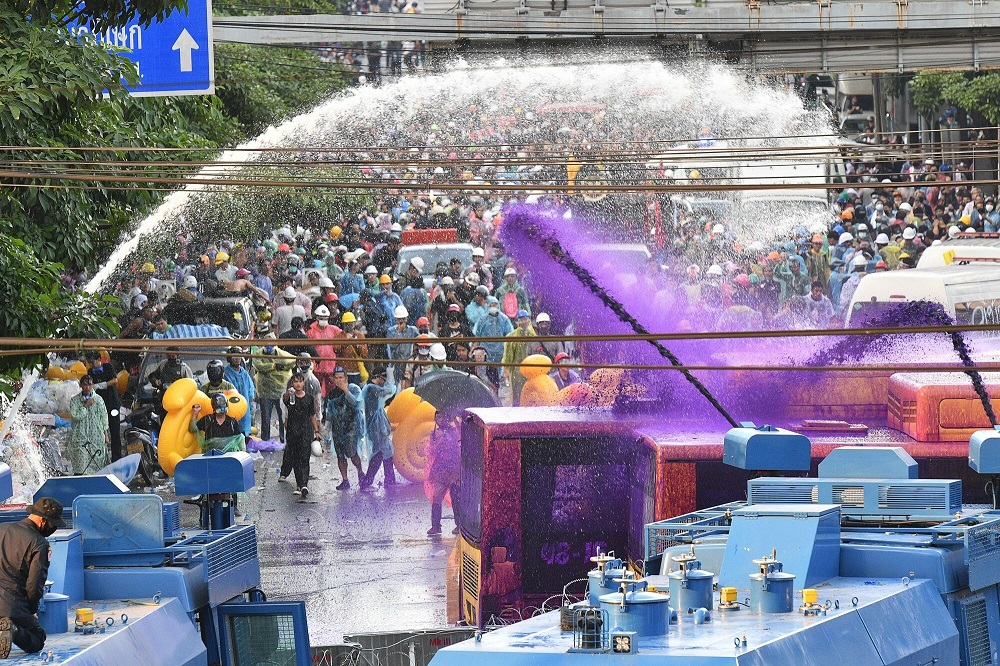
Police launch water cannons at pro-democracy protesters close to the Parliament on Nov. 17, 2020.
Anti-government campaigner Sasiphat “Karn” Pongpraphapan, who’s attended many protests over the past months, challenged those behind the rebranding to come clear about it onstage.
“Do you want communism or not?” Sasiphat wrote online Tuesday. “Those low class intellectuals and cunt-face progresive academics who only brag on Facebook, I dare you to talk on a public stage. Don’t chicken out if you really believe in it.”
Free People co-founder Tattep “Ford” Ruangprapaikitseree has remained silent since the campaign ridden with communist rhetorics was launched under the name “Restart Thailand.” Several statements released by the group suggest it will merge the existing three demands into one, which is yet to be revealed.
Tattep could not be reached for comments as of publication time, but another key leader of the group said in a previous interview that the use of communist symbolism is purely coincidental.
Free People co-founder Tattep “Ford” Ruangprapaikitseree is seen under police custody on Aug. 26, 2020, for organizing anti-government protests.
Parit “Penguin” Chiwarak, a pro-democracy leader who organizes a separate network of activists, distanced himself from the Free People’s statement. Parit said his group, United Front of Thammasat and Demonstration, is not associated with Free People.
“It’s their right to call for communism, but it’s not what my group … is calling for,” Parit said in an interview. “When I broke the ceiling and made demands for monarchy reform, it’s what the people want. Therefore, I’d like to ask those behind this campaign to see whether the people agree with it or not.”
He said future protests will continue to pursue the three demands, which include PM Prayut’s resignation, charter amendments, and monarchy reforms.
“I have no problem with the number of demands, but they must reflect what people want,” Parit said. “We fight in our way, they can fight in their own way.”
‘China Isn’t Communist’
Much of the nine-paragraph long manifesto published by Free People on Monday suggests that communism is an antidote to the horrors of capitalism.
“Many people are saying that only the fight against political tyrants is enough, but then why should we fight for democracy if our workplace is still under dictatorial control, oppressing capitalists, and poor working conditions? Laborers receive unfair wages and have no right to say anything.”
The statement was also plastered over an image of a red rose – the internationally recognized symbol of socialist movements.
“It is true that communist revolutions in the 20th century failed, and when one mentions communism, many intellectuals attack it as a failed ideology – a ghost that’s been [dead] long ago, or mutated into a dictatorship like China,” it said. “We often attack China for its communism, even though China is in essence a capitalist superpower.”
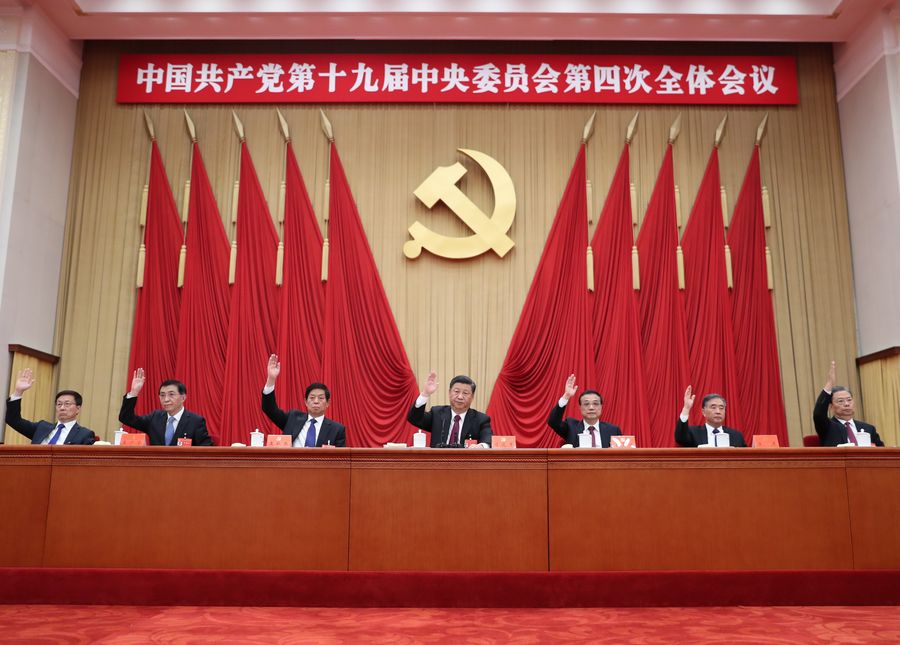
Xi Jinping, Li Keqiang, Li Zhanshu, Wang Yang, Wang Huning, Zhao Leji and Han Zheng attend the fourth plenary session of the 19th Central Committee of the Communist Party of China (CPC) in Beijing, capital of China, on Oct. 31, 2019. (Xinhua/Ju Peng)
“Why don’t we view capitalism as a failed system, like how we branded communism?” the post went on.
Wasana Wongsurawat, an expert on modern Chinese history at Chulalongkorn University, said it remains debatable whether communism is equal to communism, since the vocabulary used by the Free People is largely vague.
“Some countries are ruled by a single Communist Party, while some countries have the Communist Party elected to rule the country under the democratic system,” Wasana said. “We have to see what they’re talking about. Is it the party or the ideology?”
Warong, the hardline monarchist, said he agreed that the issue of inequality needs to be addressed, though he balked at the solutions presented by the Free People.
“The fight must be for the people,” Warong said. “I’m okay with their calls for equality, but I don’t believe that communism is a solution to the problem. You can see that 90 percent of the people on Facebook disagree with the post. They’re real users and not part of the Information Operations.”
BANGKOK — Government officials on Tuesday promised a raft of measures to tackle the worsening air pollution in the capital – including enforcing a ban on open-air burning that’s virtually never enforced.
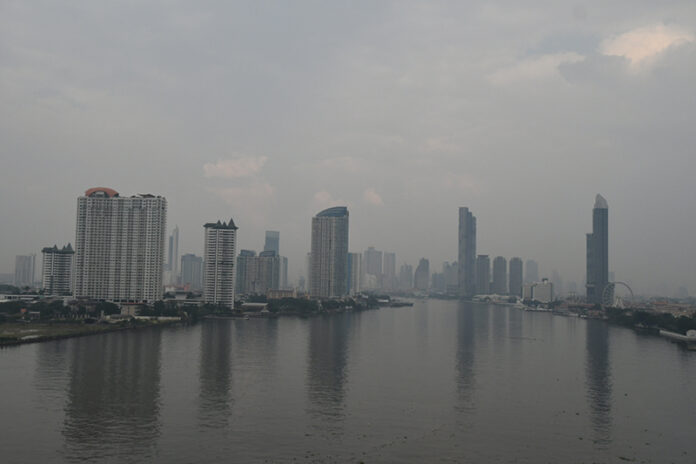
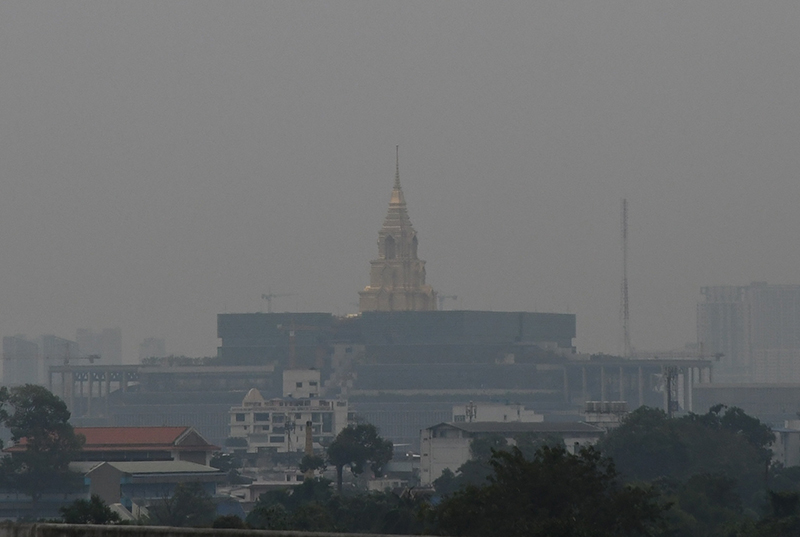
Density of PM 2.5 particles reached an “unhealthy” level in at least 14 districts of Greater Bangkok this morning, Pollution Control Department director Attapol Charoenchansa said in a news conference.
Unfavorable weather conditions were partly to blame for the toxic smog, Attapol said, but the government will also try to put an end to open-air burning of crops and trash in provinces close to Bangkok “until Thursday.” Checkpoints will be set up to catch vehicles emitting black smoke, especially diesel vehicles more than 15 years old.
“We will go to the next level in dealing with the problem. We will do even more checks,” Attapol said.
Keep your masks on! Much of Bangkok lives under a haze of PM 2.5 on Monday. Prolonged exposure to the pollutants can damage your lungs and respiratory system. #Thailand#KE#PM25pic.twitter.com/vAO4xzNBk9
Attapol said that if the PM 2.5 situation does not improve, the government will consider extending the burning ban. Motorists with diesel cars should also refill their vehicles with low-sulfur fuel, the director said.
A Ban That’s Never a Ban
Experts say main sources of PM 2.5 smog in Bangkok are motor exhaust, industrial pollution, and dusts carried by winds from widespread burning of cash crops, such as corn and sugarcane, outside the city.
Open-air burning is illegal under a number of central and local legislations, including Article 220 of the Criminal Codes, which carries a maximum punishment of seven years in prison, but those laws are rarely enforced, an operator at the Pollution Control Department hotline said.
“For example, if someone burns their own field and no one files a complaint, then that’s it, it’s just left to burn,” she said. “But if a neighbor is inconvenienced by the burning, then they might file a complaint.”
Even then, fines and punishments are usually decided by the local municipalities, and cases are unlikely to go to court. Another officer at the Pollution Control Department said that some local officials simply allowed farmers in their jurisdictions to burn the crops without any penalty.
PM 2.5 haze over Bangkok on Dec. 14, 2020.
And when the authorities do put their foot down on the burning – goaded on by public outrage – their efforts are known to backfire. Soon after officials in Phrae announced a zero tolerance policy on open air burning in 2019, many put their fields to torch before the ban could come into effect, causing even more pollution.
The economic slump caused by the coronavirus pandemic also saw a number of industrial plants turning to cheaper and more polluting sources of fuel, like coal and other fossil fuels, said Greenpeace Thailand director Tara Buakamsri.
And since many factories do not have their own equipment to measure their PM 2.5 output, observers can only gauge the pollution levels through the amount of particles in the air.
“In Bangkok the dust levels fluctuate heavily. On some days, the sky is clear but on other days the dust is so heavy that close-range visibility is really bad,” Tara said by phone Tuesday. “That’s because the sources of the PM 2.5 dust didn’t lessen at all.”
City of Life?
No one knows how long the smog will last. Health officials on Tuesday warned Bangkok residents to wear masks at all times when staying out and avoid all outdoor activities, such as exercises, if possible.
Those with sensitive skin conditions could develop rashes, while breathing in excessive PM 2.5 can also irritate the nose and throat.
The Air4Thai website run by the Pollution Control Department lists all parts of Bangkok as the site of hazardous pollution that affects one’s health.
Air quality is especially bad in the central districts of Samphanthawong, Pathum Wan, Khlong San, Dusit, and Bang Phlat, as well as Bang Sue and Laksi in the north, and Nong Khaem and Bang Bon to the southwest.
IQ Air also registered high PM 2.5 levels in all of Bangkok, with the worst pollution recorded in Lat Phrao at 222 AQI, or “very unhealthy.”
Attapol, the pollution control director, said that deputy PM Prawit Wongsuwan has ordered all relevant departments to work together and tackle the PM 2.5 problems.
They include the City Hall, the police, and the interior, environment, transport, and public health ministries.
Correction: An earlier version of this story misquoted the Pollution Control Department director as saying that motorists with diesel vehicles should refill their tanks with petrol. In fact, he was referring to low-sulfur diesel fuel. We regret the error.
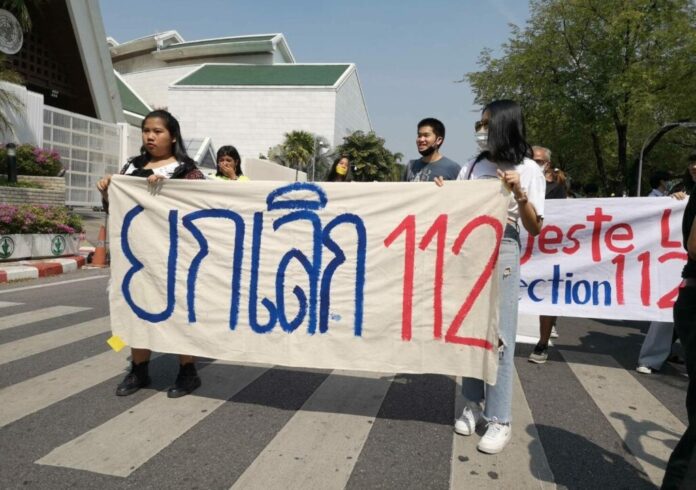
Demonstrators call for abolition of lese majeste offense in front of the United Nations office in Bangkok on Dec. 10, 2020.
BANGKOK — A woman was charged with royal defamation, or lese majeste, for allegedly mocking the monarchy by wearing a traditional Thai dress to a protest, her lawyer said Tuesday.
Pro-democracy activists slammed the move as yet another example of sweeping interpretation of the draconian law, which carries a maximum penalty of 15 years in jail. The woman, identified by her attorney as Jatuporn Sae Ung, was charged after she wore a pink silk dress and appeared on a parody “fashion catwalk” organized by protesters.
“It’s an interpretation and not the reality,” lawyer Yaowalak Anuphan said. “The lese majeste law has become politicized,”
Jatuporn was one of the demonstrators who participated in the satirical fashion show held on Silom Road in late October.
Her appearance on the catwalk was greeted by the protesters who prostrated and chanted “Long live Your Majesty!” several times – a gesture seen by many as a mocking reference to Her Majesty the Queen.
Media reports said another person who showed up at the activists’ fashion show in a crop top was also charged with lese majeste. He was reportedly summoned to acknowledge the charge with Yannawa Police on Thursday.
Due to legal concerns, Khaosod English cannot elaborate on both cases.
At least 25 people have been charged over the past month under the lese majeste law, which made a return after a hiatus lasting for several years, according to Anon Chawalawan, a legal officer at iLaw, a law reform advocacy group.
Anon said very little is known about those cases until the accused parties report themselves in person to the police and hear why they were charged.
“The person could be accused of engaging in sarcasm. Could that be construed as defamation and damaging the honour of the Queen?” Anon said.
Although the text of lese majeste charge only covers “threats or insults” made to the King, the Queen, the Heir Apparent, and the Regent, the law is often expanded to include any action or remark deemed critical of the monarchy.
Lese majeste trials sometimes take place in secrecy, and the mainstream media are discouraged from reporting about the cases.
But at least one man is taking action against the law, which has been denounced as authoritarian by human rights watchdogs. Ekachai Hongkangwan, an activist who once served a prison term for lese majeste, petitioned the Office of the Attorney General on Monday urging them not to forward any royal insult cases to the court.
“At least half of the cases could be dropped,” said Ekachai. “The case about dressing up in costume was nonsense. Have they gone mad?”
The activist also suspected that the law enforcement might have been under pressure to press lese majeste charges by some higher powers.
“I think the police didn’t want to process it but were instructed to do so,” Ekachai said.
“This should not be an offense, dressing up in Thai traditional dress and having people chant ‘long live!’,”
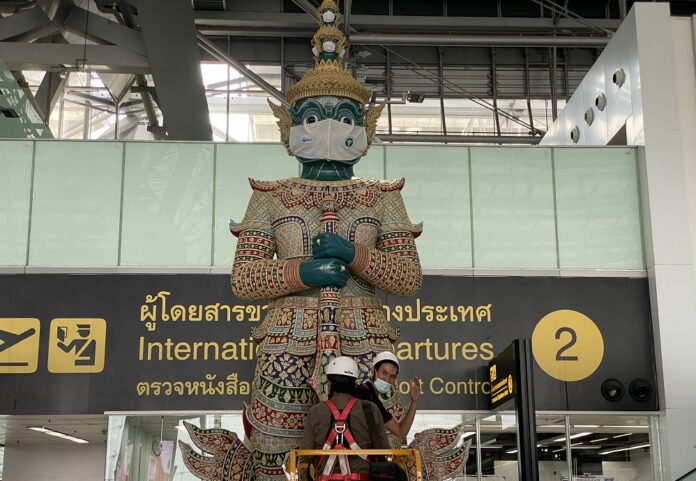
Workers put masks on statues of mythical giants at Suvarnabhumi Airport on Dec. 14, 2020, in a campaign that urges travelers to wear facemasks.
BANGKOK (Xinhua) — Thailand’s Deputy Prime Minister and Public Health Minister Anutin Charnvirakul on Monday urged the Thai people to strictly adhere to social distancing and other health guidelines against COVID-19 in celebrating the upcoming New Year season.
Anutin said the authorities will not stop people from organizing or participating in New Year celebrations and countdown events, but people will be required to strictly observe the COVID-19 restrictions.
The anti-pandemic measures call for all New Year revellers to have their body temperature checked for fever, wear face masks, wash their hands with alcoholic gel and literally keep a distance among themselves, the public health minister said.
Meanwhile, Anutin said authorities of the northeastern province Nakhon Ratchasima, where a big concert was held in vicinity of Khao Yai National Park over the weekend, are yet to take legal action against the concert organizers for extending the open air performances by eight hours.
Many of the concert’s audience failed to wear face masks and ignored the social distancing rule, according to the minister.
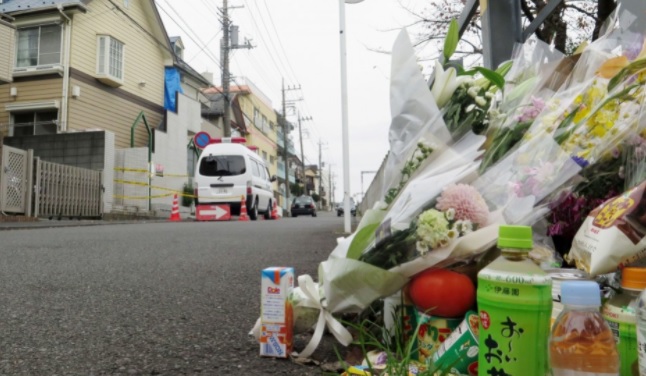
Flowers and drinks are seen on Nov. 20, 2017 on a street near the apartment complex in Zama, near Tokyo, where nine dismembered bodies were found in late October at the home of suspect Takahiro Shiraishi. (Kyodo
TOKYO (Kyodo) — A Japanese court on Tuesday sentenced a man dubbed Japan’s “Twitter killer” to death for the 2017 serial murders of nine people who posted suicidal thoughts on social media.
Takahiro Shiraishi, 30, was found guilty in the high-profile case by the Tachikawa branch of the Tokyo District Court of murdering, dismembering and storing the bodies of the nine in his apartment near Tokyo.
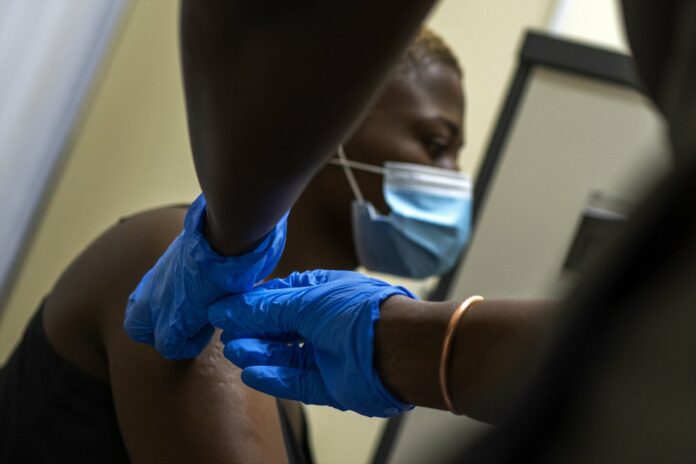
Thabisle Khlatshwayo, receives her second shot at a vaccine trial facility for AstraZeneca at Soweto's Chris Sani Baragwanath Hospital outside Johannesburg, South Africa, Monday Nov. 30, 2020. (AP Photo/Jerome Delay)
NEW DELHI (AP) — With Americans, Britons and Canadians rolling up their sleeves to receive coronavirus vaccines, the route out of the pandemic now seems clear to many in the West, even if the rollout will take many months. But for poorer countries, the road will be far longer and rougher.
The ambitious initiative known as COVAX created to ensure the entire world has access to COVID-19 vaccines has secured only a fraction of the 2 billion doses it hopes to buy over the next year, has yet to confirm any actual deals to ship out vaccines and is short on cash.
The virus that has killed more than 1.6 million people has exposed vast inequities between countries, as fragile health systems and smaller economies were often hit harder. COVAX was set up by the World Health Organization, vaccines alliance GAVI and CEPI, a global coalition to fight epidemics, to avoid the international stampede for vaccines that has accompanied past outbreaks and would reinforce those imbalances.
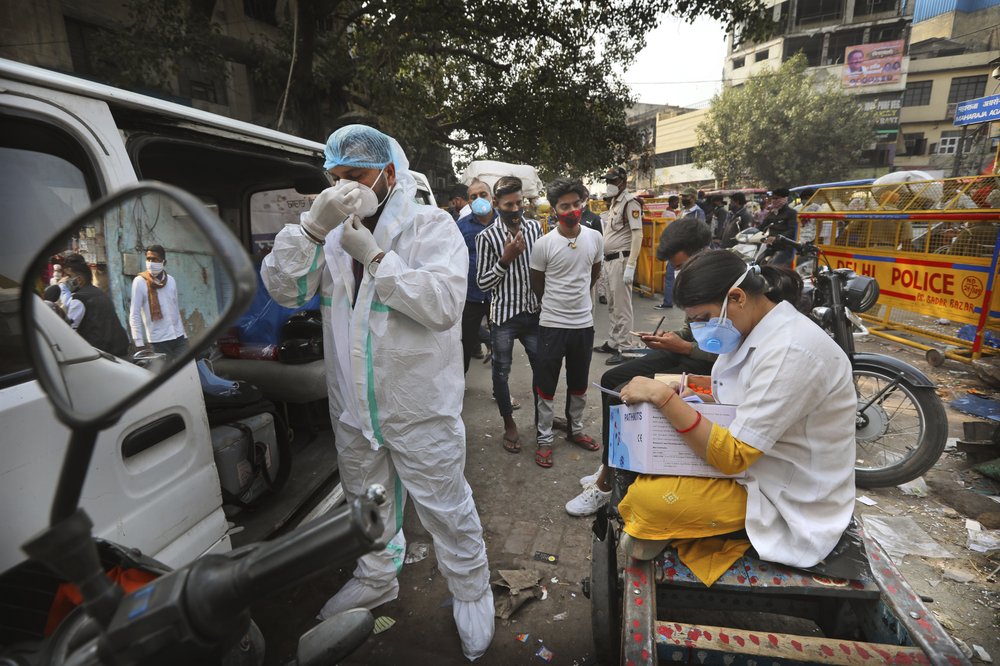
A health worker gets ready to take samples from people to test for COVID-19 as another registers them at a marketplace in New Delhi, India, Thursday, Nov. 19, 2020. (AP Photo/Manish Swarup)
But now some experts say the chances that coronavirus shots will be shared fairly between rich nations and the rest are fading fast. With vaccine supplies currently limited, developed countries, some of which helped fund the research with taxpayer money, are under tremendous pressure to protect their own populations and are buying up shots. Meanwhile, some poorer countries that signed up to the initiative are looking for alternatives because of fears it won’t deliver.
“It’s simple math,” said Arnaud Bernaert, head of global health at the World Economic Forum. Of the approximately 12 billion doses the pharmaceutical industry is expected to produce next year, about 9 billion shots have already been reserved by rich countries. “COVAX has not secured enough doses, and the way the situation may unfold is they will probably only get these doses fairly late.”
To date, COVAX’s only confirmed, legally binding agreement is for up to 200 million doses, though that includes an option to order several times that number of additional doses, GAVI spokesman James Fulker said. It has agreements for another 500 million vaccines, but those are not legally binding.
The 200 million doses will come from the Serum Institute of India, the company that will likely make a large portion of the coronavirus shots destined for the developing world. CEO Adar Poonawalla says it has a confirmed order for 100 million doses each of a vaccine developed by Oxford University and AstraZeneca and one from Novovax.
“We don’t have anything beyond that in writing,” he told The Associated Press. “If they want more, they’ll have to place more orders.”
He said the lack of commitment from COVAX will mean a much longer wait for people in developing countries. Poonawalla also noted that his company’s first priority would be making shots for India, which has suggested it wants at least 300 million vaccines. It’s likely India would not be able to take all of those at once, but a big order could delay the distribution of vaccines for other parts of the developing world, Poonawalla said.
Potentially further slowing down the process is that neither the AstraZeneca vaccine nor the Novovax one has been licensed by any regulatory agency yet — and any injection distributed by COVAX will likely need WHO approval. COVAX does not have any supplies of the two vaccines that appear to be most effective so far — the Pfizer-BioNTech shot and the Moderna one.
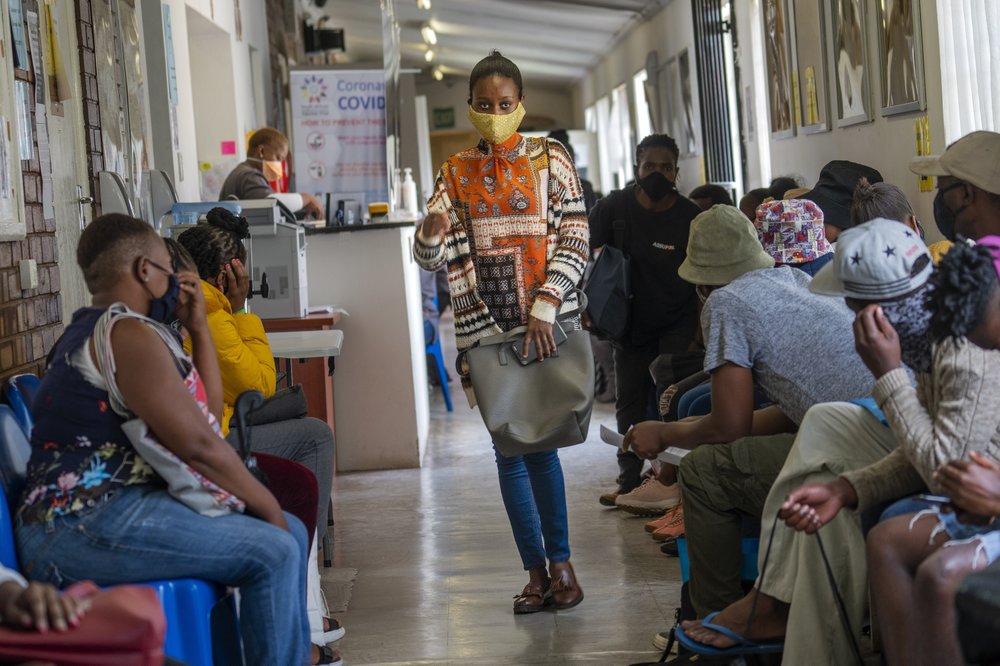
Volunteers wait to be checked at a vaccine trial facility for AstraZeneca at Soweto’s Chris Sani Baragwanath Hospital outside Johannesburg, South Africa, Monday Nov. 30, 2020. (AP Photo/Jerome Delay)
Still, GAVI said they “aim to start rolling out safe and effective vaccines to COVAX (member countries) at scale within the first and second quarters of the New Year.”
Even with vaccines in hand, the rollouts will take many months, even in rich countries, and many developing ones are facing serious logistical challenges that will add to delays, noted Dr. Gagandeep Kang, an infectious diseases expert at the Christian Medical College at Vellore in southern India.
Even senior officials at the WHO have acknowledged privately that attempts to fairly allocate vaccine through the initiative are flawed, despite publicly lauding its success.
“The whole call for global solidarity has mostly been lost,” said Dr. Katherine O’Brien, WHO’s vaccines chief, during a recent internal discussion, a recording of which was obtained by the AP.
Asked to clarify her remarks, O’Brien said in an email that “every country should have access to COVID-19 vaccines, as early as feasible.”
Adding to COVAX’s difficulties, O’Brien noted at a news conference this month that it was still $5 billion short to buy the doses it’s planning to obtain next year.
According to a report GAVI issued ahead of a meeting this week, the alliance itself concluded that the risk COVAX will fail is “very high,” saying it was “established in record time and has to navigate unchartered territory.”
But John Nkengasong, director of the Africa Centers for Disease Control and Prevention, criticized Western countries for buying up the global vaccine supply “in excess of their needs while we in Africa are still struggling with the COVAX (effort).”
With no certainty about which shots would work, governments scrambled in recent months to sign multiple deals to ensure their citizens would have at least some COVID-19 injections. Canada, for example, bought nearly 200 million vaccines — enough to cover its population of 38 million about five times over.
Nkengasong called the idea that people in rich countries would get immunized while Africans go without “a moral issue.”
Beyond the ethics, experts note that failing to protect people in the developing world will leave a reservoir of coronavirus that could spark new outbreaks at any time.
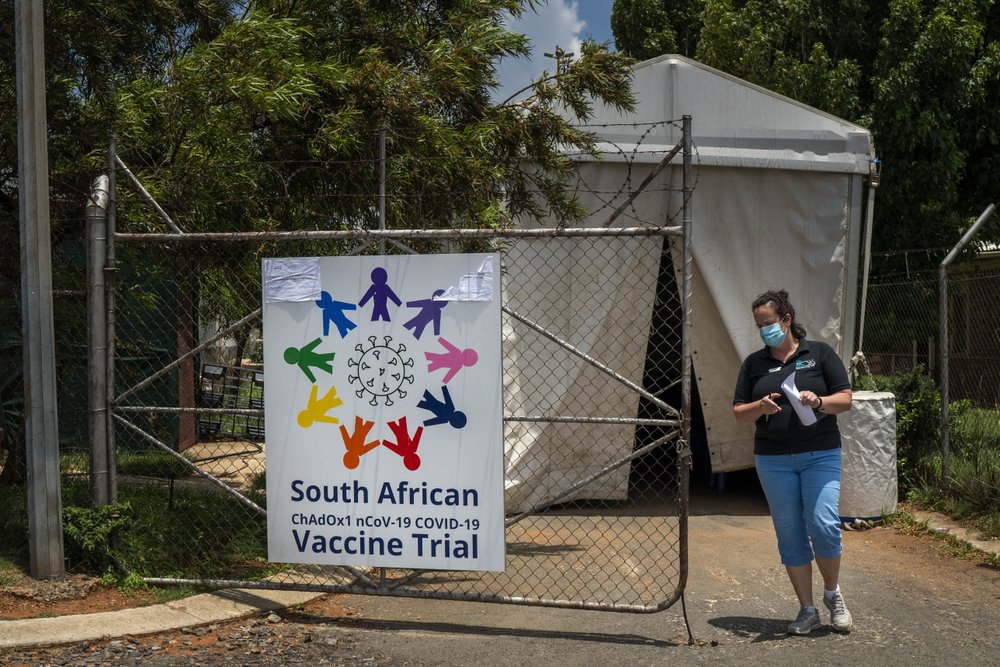
A researcher walks out of a COVID-19 vaccine trial facility at Soweto’s Chris Sani Baragwanath Hospital outside Johannesburg, South Africa, Monday Nov. 30, 2020. (AP Photo/Jerome Delay)
Amid fears COVAX can’t deliver, some developing countries are pulling out entirely or seeking their own private deals. Earlier this month, the tiny Pacific island nation of Palau announced it was abandoning the initiative and would get donated vaccines from the U.S. instead. Other low and middle-income countries, including Malaysia, Peru, and Bangladesh, have stayed in the initiative but also recently inked their own deals with drugmakers as a Plan B.
Anban Pillay of the South African Ministry of Health said that joining COVAX was just a stop-gap measure before signing bilateral deals with pharmaceutical companies.
Kate Elder, vaccines policy adviser at Doctors Without Borders, said “it’s increasingly looking like the ship has sailed on equitable vaccine distribution” — and GAVI, WHO and others need to discuss how to increase vaccine manufacturing.
To that end, South Africa and India have asked the World Trade Organization to waive some provisions regulating intellectual property rights to make it easier for manufacturers in poor countries to make COVID-19 drugs and vaccines. But many rich countries are reluctant to do that.
As more countries in the West authorize the vaccine, “the difference between people in rich countries getting vaccinated and the lack of any vaccines for the developing world will become quite stark,” said Anna Marriott, health policy manager at Oxfam. “And it will only prolong the pandemic.”
___
Cheng reported from Toronto. Associated Press writers Cara Anna in Nairobi; Lori Hinnant in Paris; Julhas Alham in Dhaka, Bangladesh; Victoria Milko in Jakarta, Indonesia; Eileen Ng in Kuala Lumpur, Malaysia; and Krishan Francis in Colombo, Sri Lanka, contributed to this report.
Charoen Pokphand Foods PCL (CP Foods) was ranked Thailand’s best employer according to Forbes’ World’s Best Employer 2020, reflecting its standout performance in making a world class work environment.
Forbes in collaboration with Statista, a leading market research firm, surveyed 160,000 full-time and part-time workers across 58 countries in an effort to rank the world’s best corporations. In this year, four Thai companies were listed, including CP Foods (Ranked No. 248, highest in Thailand), HANA Microelectronics (Ranked No. 263), PTT (Ranked No. 476) and Thai Airways (Ranked No. 673).
The criteria included, willing to recommend the company to friends and family, public image, economic footprint, talent development, gender equality as well as Covid-19 response.
CP Foods strives to be “Home for Happiness for its employees. As a result, it has continuously developed and retain its “Talents” by promoting leadership skills and career enhancement of all employees throughout their time of employment.
The company ensures workplace safety and promoting employee well-being, in accordance with the Safety, Health, Environment and Energy Policy, and review the performance every year to improve emergency management. Benefits and welfare are also being reviewed by both the company and welfare committee that represented by employees annually.
To cultivate innovation in workplace, the company has developed employees to be innovators according to the TRIZ approach. At present, the company has around 1,020 innovators throughout the organization.
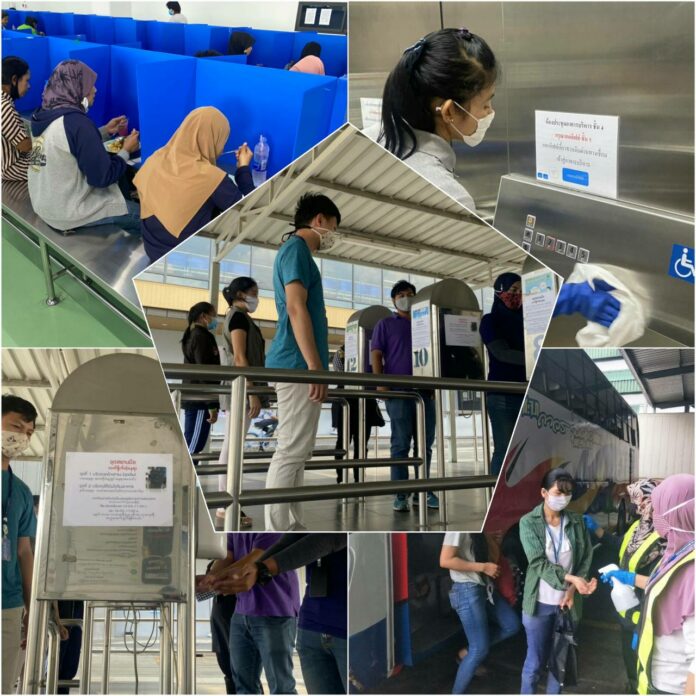
During Covid-19 outbreak, CP Foods is the very first company in Thailand to announce health and safety measures against COVID-19 outbreak throughout the supply chain to ensure the wellbeing of all workers and food safety. The measures focused on implementing social and physical distancing at workplace, starting from increasing number of employee shuttle service, sanitation schedule, a walk-through body temperature scanner, and automation in an effort to reduce human contact.
Also, CP Foods initiated a delivery service for the employees returning from abroad to home quarantine as well as providing up-to-date consulting for all employees, including migrant workers.
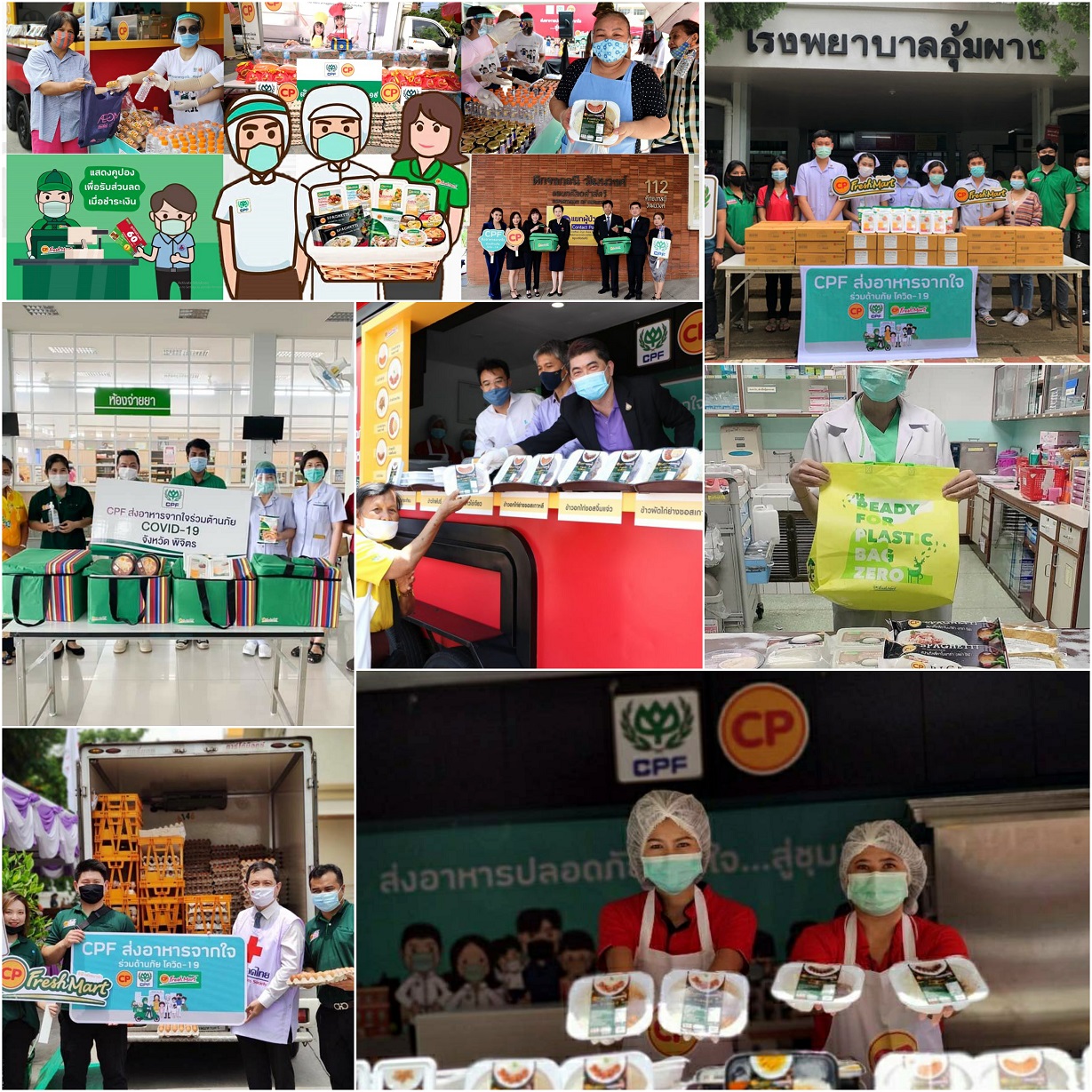
As a good corporate citizen, the company made multiple covid-19 relief efforts such as “Food from the heart against COVID-19” project to support frontline staffs as well as “Safe Food from heart to community”, delivered free ready-to-eat meals to people in need.
The International Labour Organization (ILO)estimates that there are currently 11.6 million documented migrant workers residing in South-East Asia and the Pacific subregion and nearly half of them or about 5.2 million are women. Many of those women migrant worker working in domestic work, entertainment, seafood processing, electronics manufacturing, garment manufacturing and construction sector. For instance, In Thailand, there are approximately 3.9 million migrant workers from Cambodia, Lao PDR, Myanmar, and Vietnam, who are playing a key role in Thai society.
Despite their positive contribution, the public support for migrants does not seem favourable.
A survey of the public attitudes towards migrant workers in Malaysia, Japan, Thailand and Singaporeconducted by the ILO and UN WOMEN reveals that 40 percent of respondents believed that migrant workers are a “drain” on the economy and 53% believed that there is no demand for low-skilled migrant workers. In fact, migrant workers are making crucial contributions to Thailand as well as their countries of origin. Many countries in the region, including Thailand, rely on migrant workers for the functioning of their economies. Many of them fill local labour shortages where nationals do not want those jobs. In 2017, it was reported that migrant workers contributed between 4.3 – 6.6 percent of gross domestic product (GDP) in Thailand.
Despite their crucial contributions to the economies and societies of both origin countries and Thailand, migrant workers, especially women, frequently experience negative attitudes, discrimination, exploitation, and sometimes violence during the migration process. These challenges are rooted in gender inequality and reflect the myth around migrant workers, especially women migrant workers.
The outbreak of Coronavirus is causing even further impact to migrant workers in many countries, including Thailand, as many of them have experienced violence, unfair job termination, and inability to access essential services. Women migrant workers, in particular, experience gender-based violence. As a result, women migrant workers are more at risks of exploitation, abuse and violence.
What is the cause of violence against migrant workers and how to solve it?
Lack of direct interaction with migrant workers, public attitudes towards them is often shaped by false information, negative or one-sided portrayals in the media. It results in misperceptions of the role they play in the society which can condone discrimination and even violence against women migrant workers. The ILO-UN Women study reveals that 77 percent of the public in Thailand believed that crime rates had increased due to migration. In reality, there is no evidence or information to conclude that migrant workers are more likely to commit crimes than local residents.
Consistency, the latest study made by the Safe and Fair Programme and UNICEF on the attitude of Thai youth towards migrant workers shows that 30 percent of the youth thought that migrants who have experienced violence should not receive help from the government if they have undocumented migration status.
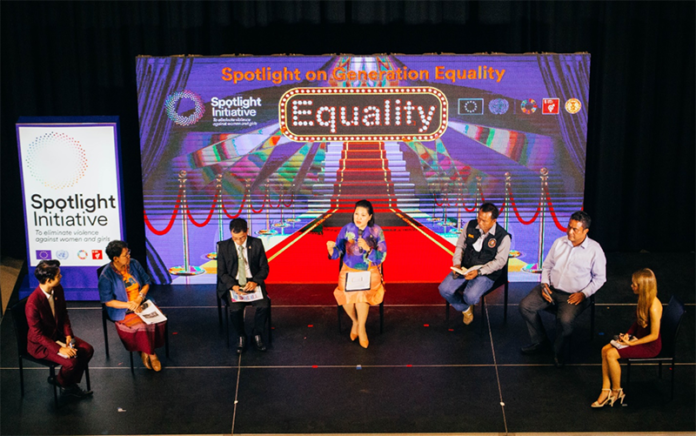
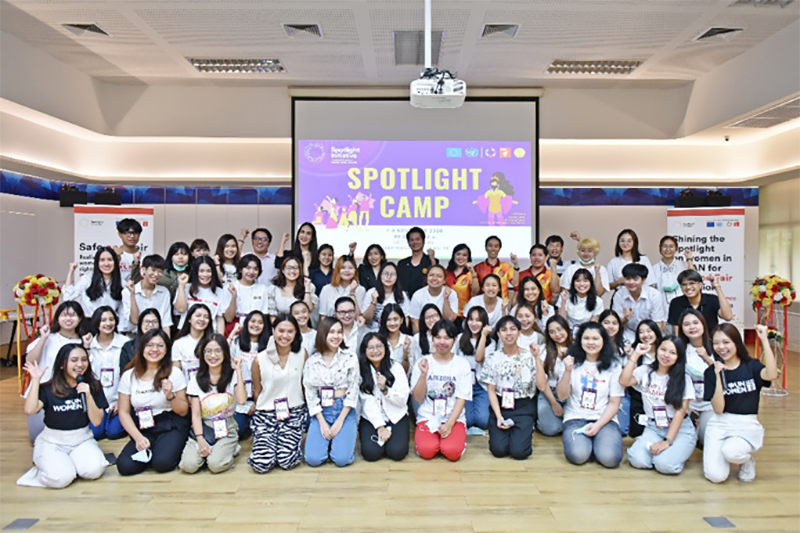
Realizing that knowledge and understanding about women migrant workers among groups of people in different sectors are key to eliminate discrimination and violence against women migrant workers, and to achieve the SDG 5 – Gender Equality, SDG 8 – Decent Work, SDG – 10 Reducing Inequality, and SDG 16.2 – Stopping Abuses, Human Trafficking and Social Security, The joint ILO-UN WOMEN Safe and Fair Programme, as part of the EU-UN Spotlight Initiative, organized a campaign “Spotlight on Generation Equality”, to engage the youth as the agent of change.
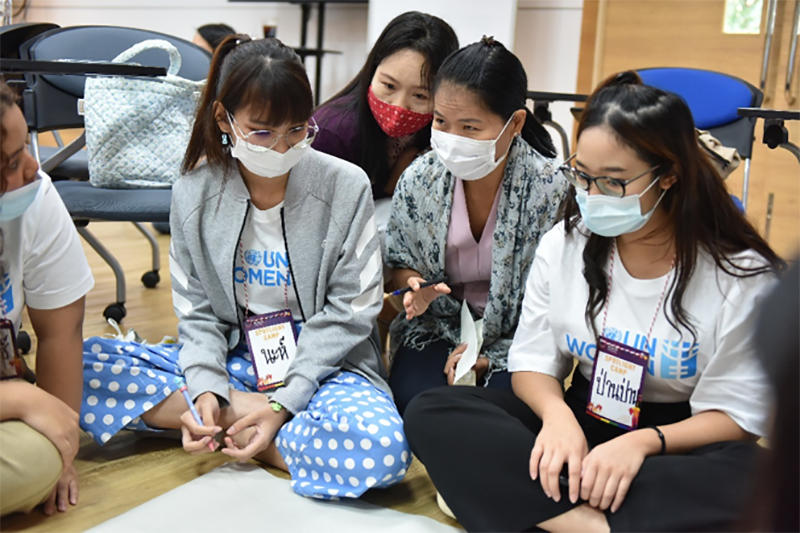
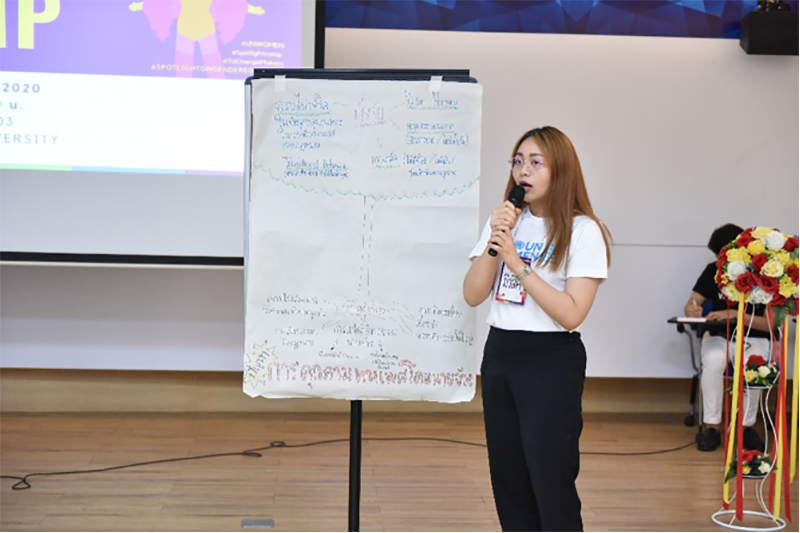
Thammasat University (TU) is considered the first university in Thailand that has the policy to prevent and respond to violence against women. The university has organized activities to promote and raise awareness among students about gender equality and ending violence against women, such as holding special lecturing on gender equality, organizing a public forum to exchange views on violence against women migrant workers, and organizing “Spotlight Training Camp” for 50 young leaders. The latter event allowed students to work with women migrant workers directly and create a project to tackle the issues of violence against women migrant workers. The ideal proposal should be extended for practical use in the future.
New generation for social change
Zanii,one of Myanmar women migrant workers who participated in the project, said that most of Myanmar migrant workers come to work in Thailand with the hope for a better life. Her migration experience has been positive. However, “language” was a barrier for her, especially during the early days in Thailand. She did not understand Thai and unable to communicate with the employer or Thai colleagues and felt neglected for sometimes, but now her Thai is improved.
“It is my pleasure to work with students for formulating a project to tackle violence against women migrant workers. I have learnt that students have a good point of view and creativity toward problem-solving. I believe that the new generation or next leaders would make some changes for society in the future,”
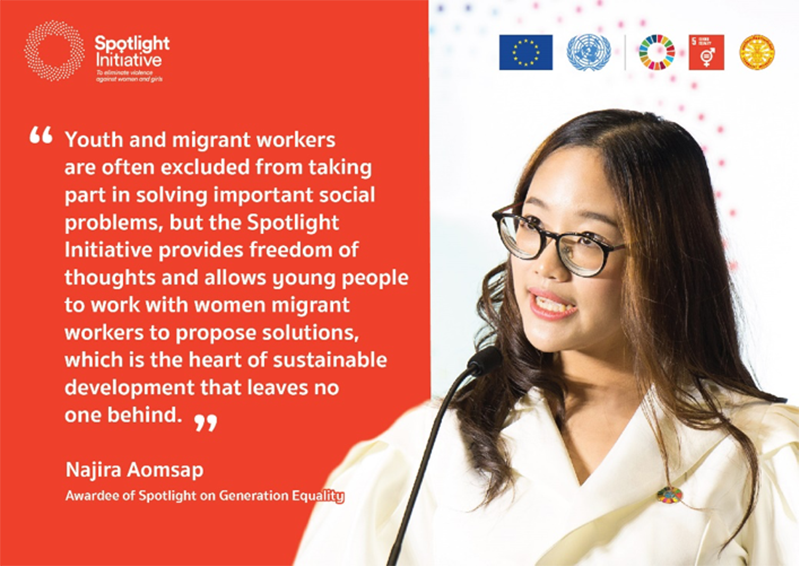
Najira Aomsap, one of the TU students participating in the project, said her views on migrant workers have changed after participating in the “Spotlight Training Camp”. After she talked and worked with women migrant workers, she realized that they suffered from violence more than she thought. She hopes her project could help ease the problem and be extended in practical in the future.
“Youth and migrant workers are often excluded from taking part in solving important social problems, but the Spotlight Initiative provides freedom of thoughts and allows young people to work with women migrant workers to propose solutions, which is the heart of sustainable development that leaves no one behind.”
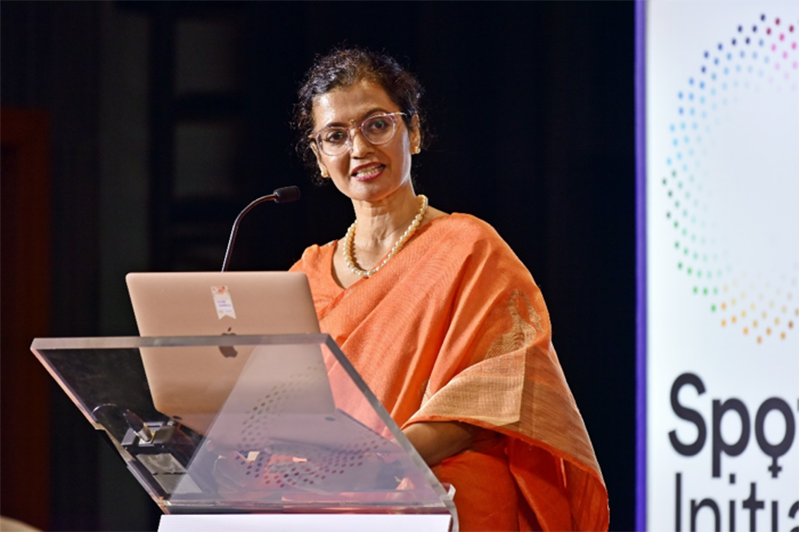
Deepa Bharathi, Chief Technical Adviser, Safe and Fair Programme, ILO, said the campaign focuses on the collaboration of women migrant workers and youngsters to work on solutions that will eradicate violence against women including women migrant workers. Conceptual work on sustainable development created by participants and TU students will not leave any behind.
“Thammasat University students joining the project have obtained awareness, knowledge, and abilities to help stop violence against women migrant workers as well as to change attitudes of people towards migrant workers. It will eliminate the root cause of discrimination and violence against women and women migrant workers. The move will help strengthen sustainable development.”
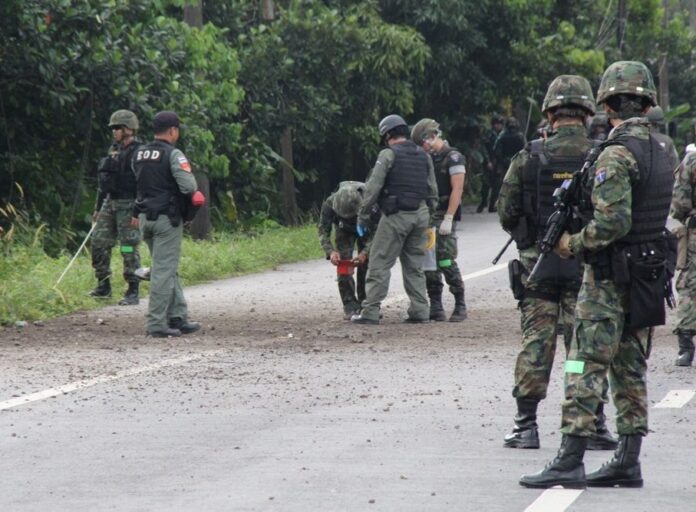
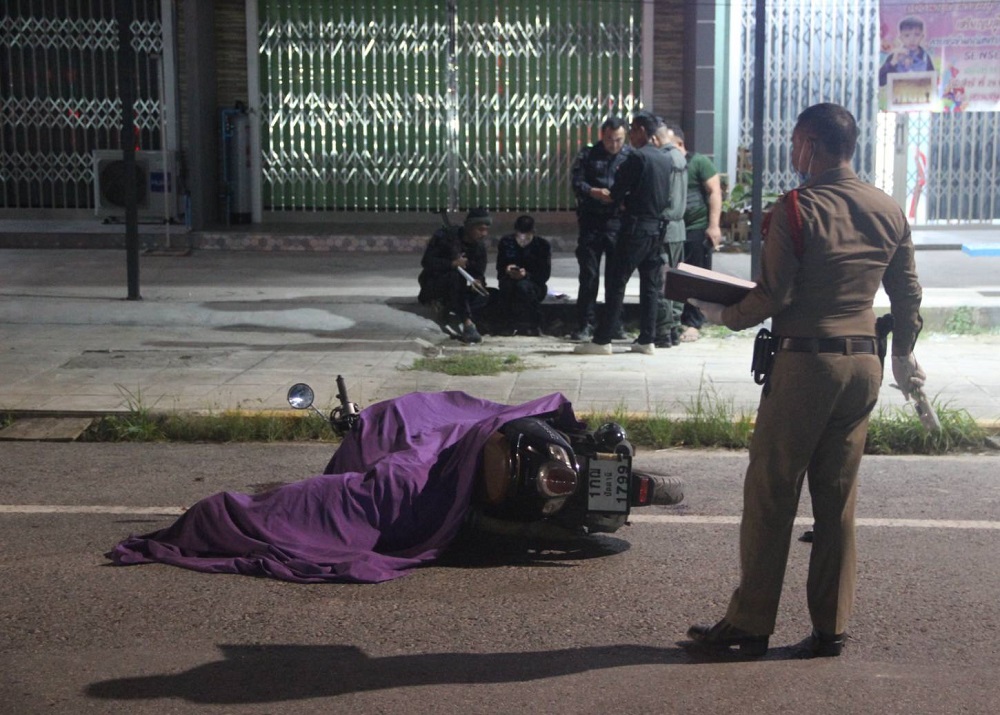
Security officers inspect the site of an EOD attack in Pattani province on Feb. 12, 2016.
BANGKOK — Separatist campaign in Thailand’s southernmost provinces saw fewer attacks, deaths, and injuries throughout 2020, a small respite that experts attribute to peace dialogues and – strangely enough – coronavirus.
Data compiled by independent observers suggest 2020 was among the least deadly years for the southern border provinces since secessionist violence broke out in 2004, though the trend was somewhat undercut by recent fatal shootings that killed a police officer and an official last week.
Those familiar with the unrest interviewed for this story said the decrease in deaths and injuries this year is due to several factors, most notably a pledge by a major militant group that it would “cease operations” during the COVID-19 pandemic.
“This is a big factor for fewer incidents,” Rakchart Suwan, chairman of a group called Buddhist Network for Peace, said. “I have talked with the local people, they joked that they want the COVID situation to last for a long time, since there are barely any [attacks] during COVID.”
The BRN is considered to be the largest of the several groups vying to revive the state of Patani, an independent sultanate annexed by Bangkok in the early 20th century that once occupied what is now the provinces of Pattani, Yala, and Narathiwat.
The conflict, fueled by ethnic and religious enmity, has killed at least 7,000 people, most of them civilians, according to human rights watchdogs.
Security officers at the site where a policeman was assassinated by unidentified gunmen in Pattani province on Dec. 7, 2020.
In a statement, the BRN said its cessation of hostilities was made on humanitarian grounds for the sake of efforts to contain the virus outbreak. Some also suspect it was a psychological campaign to achieve a moral high ground.
“The dissidents don’t want to make the matter worse,” said Tayudin Osman, who teaches at Yala Rajabhat University’s Faculty of Humanities and Social Sciences.
“They know that if they stage attacks during that period of time, when people were already suffering from [the pandemic], they could lose support,” he went on. “The COVID-19 outbreak was a big problem.”
The BRN is often blamed for gun attacks and car bombs in the region, targeting security officers and civilians alike. The organization is believed to have engineered a string of bombings that killed four victims during the Mother’s Day holidays in 2016, a shopping mall car bomb wounding 50 people in 2017, and a raid on a security checkpoint in 2019 which left 15 dead.
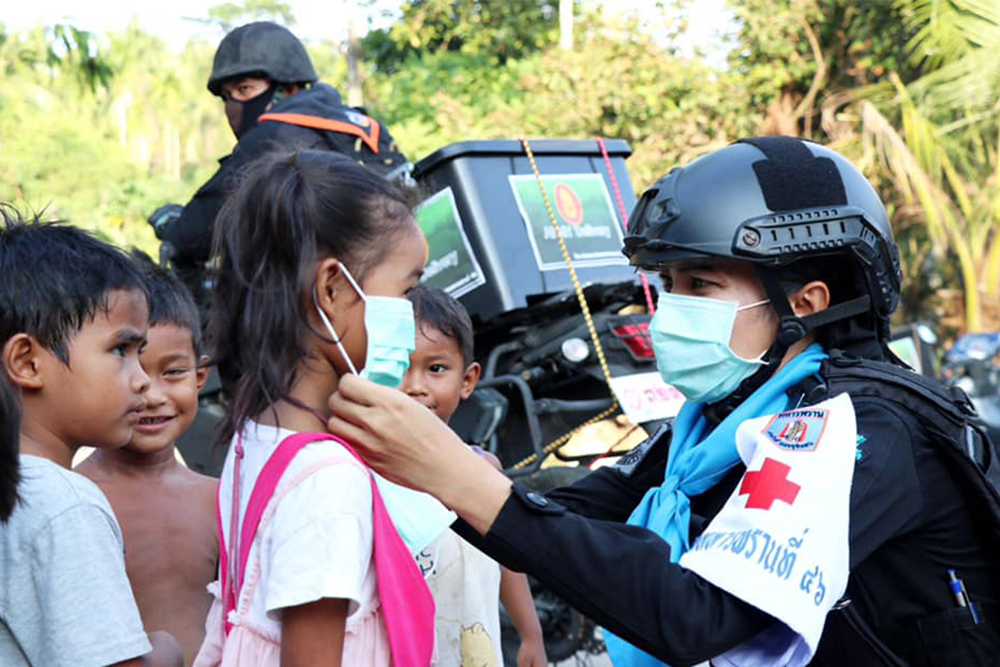
A member of paramilitary rangers in Narathiwat province puts on a face mask to a girl during a humanitarian operation on May 11, 2020.
A car bomb that injured 25 people in front of Yala’s government office in March was also linked to the BRN, though large scale attacks seem to have stopped since its pledge was announced in April, suggesting that the group might have held up its bargains.
But a spokesman for the Internal Security Operations Command, a government agency tasked with quelling the unrest, said the absence of major attacks was more likely due to logistic challenge posed by the pandemic.
“They lack a freedom of movement that would allow them to hide in the neighboring country, because of the lockdown measures,” Col. Pramote Prom-in said. “That’s why it’s harder for them to stage attacks.”
Pramote also credited the lull in violence to aggressive operations by security forces that scoured insurgent hideouts from the southern jungles and mountains, and a lack of support from local people for the separatists.
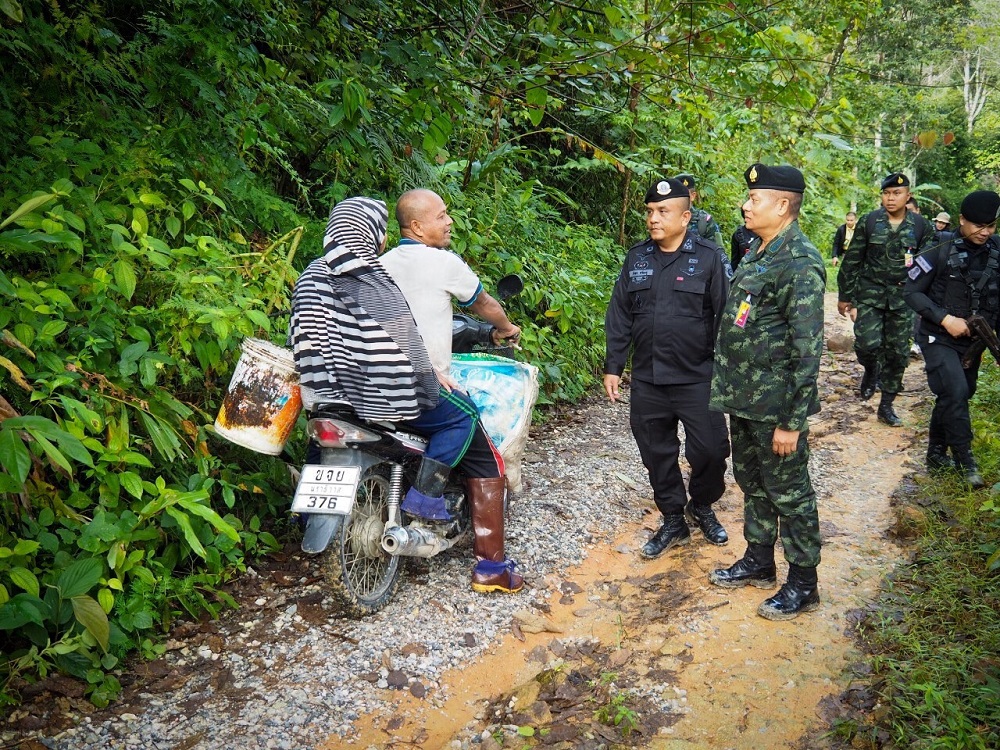
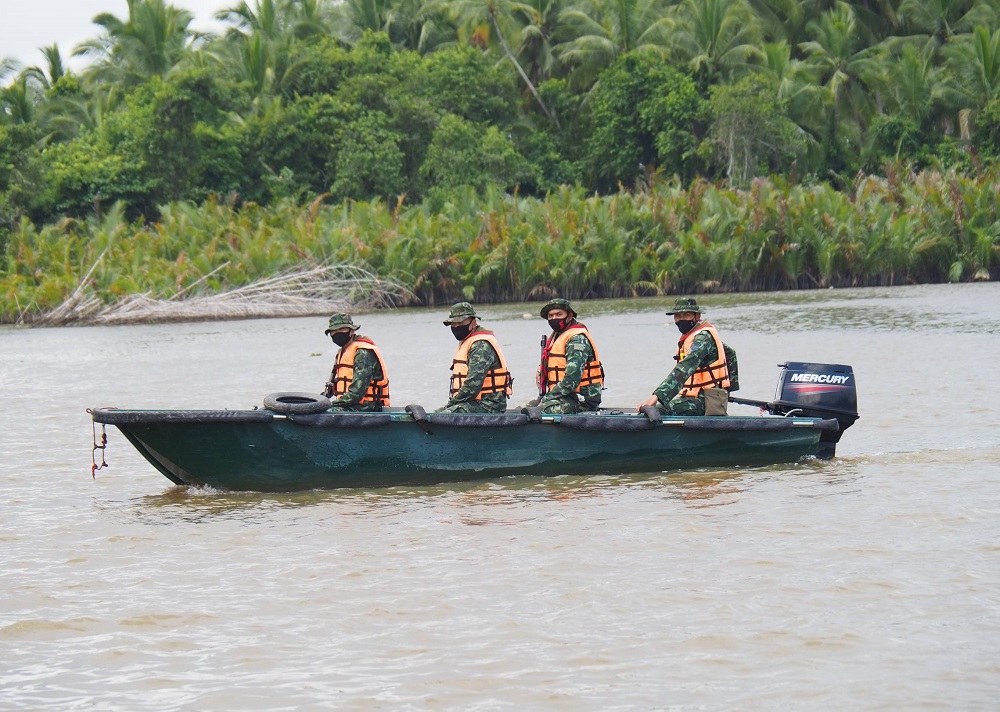
Soldiers talk with locals during a patrol in Narathiwat province on Dec. 13, 2020.
“I think part of it is because the public has grown weary of violence,” he said.
A director of an organization that monitors violence in the region said the virus has contributed to a relatively peaceful year for southern Thailand.
But he also worried that it may also sabotage a long-term quest for peace, since border restrictions have disrupted the dialogues between the two sides, which typically took place in Malaysia.
“Although the COVID-19 pandemic led to fewer violent incidents, it forced the peace dialogues to a halt,” Srisompob Jitpiromsri, who runs Deep South Watch, said. “The dialogue parties can’t travel to Malaysia. Foreign observers can’t travel either. Everything is suspended. It’s a problem right now.”
Fewer Losses
Deep South Watch has been compiling data of attacks, clashes, and casualties associated with the separatist conflict in the southern border provinces, known colloquially as the Deep South.
Statistics collected by the organization cover the provinces of Pattani, Yala, and Narathiwat, as well as four districts in the neighboring province of Songkhla. Latest available data for 2020 is from October.
They show that the number of “incidents” – which could be anything from gun attacks, EODs, police raids, and clashes between insurgents and security forces – throughout 2020 has decreased from the previous year.
The months of March and April 2019 recorded 50 and 34 incidents, respectively, whereas the same months in 2020 saw 24 and 19 incidents. The same trend can be seen in May (17), June (17), and July (22), when compared with the previous year – 32 in May 2019, 43 in June 2019, and 40 in July 2019.
However, incidents in the latter months of September and October – when the data was last collected – appear to have outnumbered the same period in 2019. The surge seems to coincide with the return to normalcy across Thailand as the coronavirus threats somewhat subsided.
Perhaps more reassuring for peace advocates in the region is the number of monthly death tolls, which have dropped significantly throughout 2020.
February saw a gap as much as 10 deaths compared to the same month in 2019. The same gap was noted in April and widened to 13 in July; the rest of the year also saw a drop in fatalities.
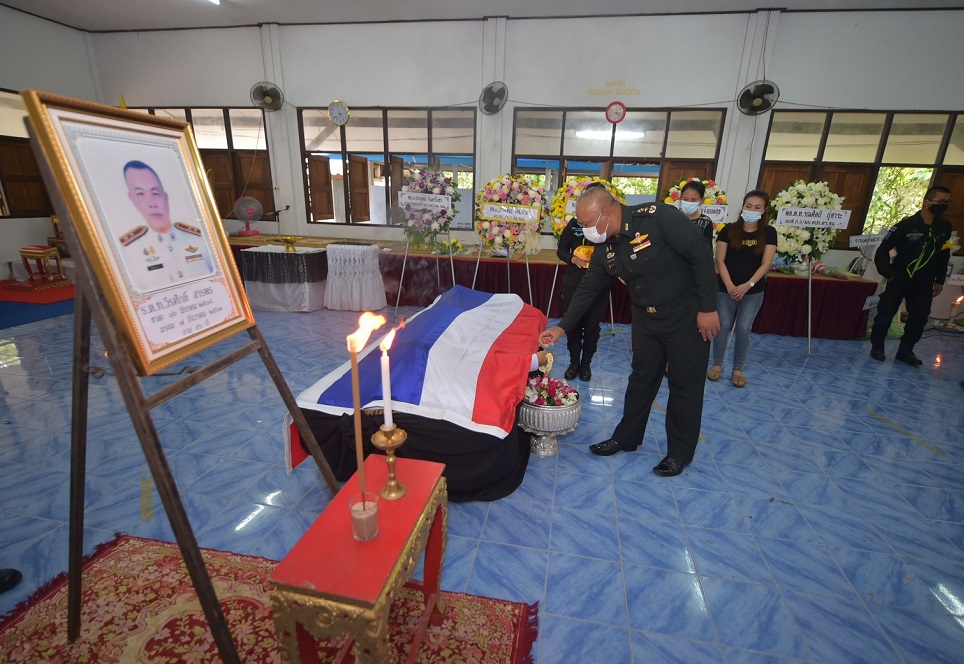
A funeral of Weerasak Saraporn, a policeman who was killed by suspected insurgents on Dec. 7, 2020.
But the conflict remains a bloody business for the Deep South. Just last week, on Dec. 7, a policeman was gunned down by assailants armed with assault rifles in Pattani. The gunmen stole the victim’s handgun before fleeing the scene.
Four days later, on Friday, a deputy kamnan was shot dead inside his home in Yala province. Security officers suspect the separatists were responsible for both attacks.
A junior administrative officer was also killed in a drive-by shooting in Pattani province in late November.
“It might have led to a mutual acceptance that if there are fewer incidents, the dialogues could continue, until a success can be achieved some day,” Tayudin, the scholar from Yala Rajabhat University, said.
If anything, the hint of peace seen throughout 2020 underscores the need for consistent negotiations, said Srisompob, the Deep South Watch director.
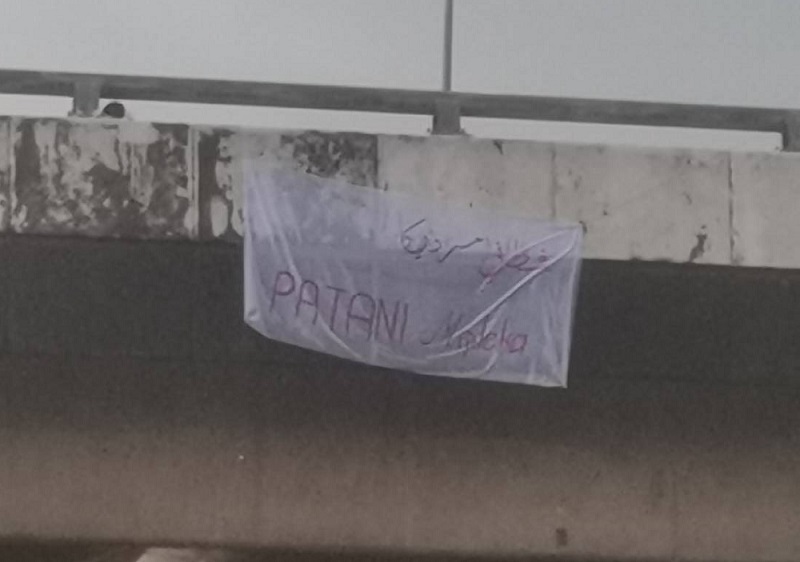
A sign advocating independence for Patani is seen hanging on a road in Yala on Nov. 27, 2020.
“Peace dialogue is an important thing that everyone must push for, because if there is no negotiation, unrest could escalate again,” Srisompob said. “If talking stopped, there would be a risk, because no one knows what could happen next.”
Pateemoh Pohitaedaoh, the chairwoman of We Peace, a volunteer group that assists women who lost loved ones in the Deep South violence, said she hopes both sides remain committed to dialogues as means of resolving their differences.
“There have been fewer incidents, but it doesn’t mean violence has disappeared altogether,” Pateemoh said. “That’s why a negotiation is a hope for a lot of people living here.”
Such dialogues are capricious. It is not legally binding, and never recognized as a formal peace negotiation between the two sides – who are vaguely addressed as Party A and Party B in the procedures.
A military patrol in Narathiwat province on Nov. 15, 2020.
Col. Pramote of the Internal Security Operations Command said his agency supports the government’s bid for dialogues with the separatists. Rakchart, the leader of Buddhist Network for Peace, likewise endorses negotiation as a favorable solution for the ongoing conflict.
But Pateemoh from We Peace said she hopes more voices from women would be heard in the next round of discussions between the two sides, in order to advance protection of women’s rights and encourage more participation from women in local governance.
“Each commission should consider quota for women’s seats, because I think not only men should be seeking a solution, but women should be involved as well,” Pateemoh said.
“If a commission has 10 members, there should be at least three women. If there’s only one woman, she wouldn’t have the courage to speak out.”