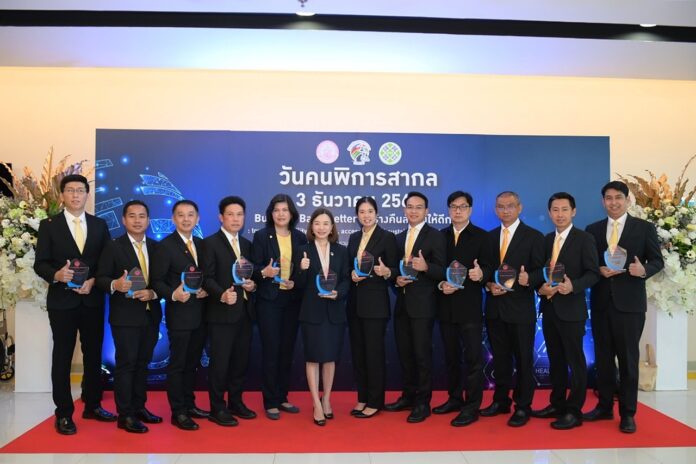
The Ministry of Social Development and Human Security granted the Outstanding Disability Employer 2020 plaque to Charoen Pokphand Foods PLC (CP Foods) and its twelves subsidiaries as an acknowledgement for the company’s contributions to the disability community.
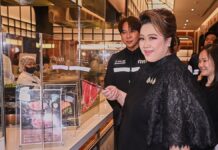
CP Foods’ representatives led by Ms.Pimonrat Reephattanavijitkul, Executive Vice-President for Human Resources, received the prestigious recognitions from Social Development and Human Security Minister Juti Krairiksh, making it the fourth consecutive year.
Ms. Pimonrat noted that CP Foods fully back the government’s efforts to promote a quality of life for disabled people. Therefore, the company is providing them access to equal job opportunity and stable income. It is also giving an opportunity for them to be self-reliance, being able to take care of their family and the community that they are living in.
“CP Foods has established Diversity and Inclusion Policy Statement to synergize the work force and bring together the rich mix of people with different gender, generation, culture, backgrounds, experience, perspective and practices, creating a driving force for sustainable growth of its business as well as the society,” she said.
Currently, CP Foods has 786 people with disabilities’ working with the company in three types of employment. First of all, 183 disabled persons are working in its operations nationwide. Secondly, 584 disabled people are hired by the company to work on a community program in their own hometown, supporting various activities in local schools, temples, local administrative offices and etc. Lastly, the company provides 19 of them concession to sell products within the company’s facilities.
She added that hiring the people with disabilities allow them to be self-dependent. As a result, they have become valuable members of both company and society that they work with and being able to bring out the best potential within them. This effort is also in line with Sustainable Development Goal 8 to promote decent work and economic growth.
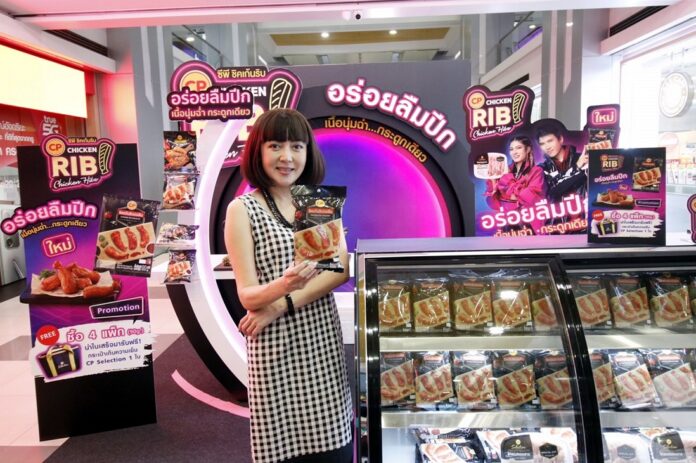
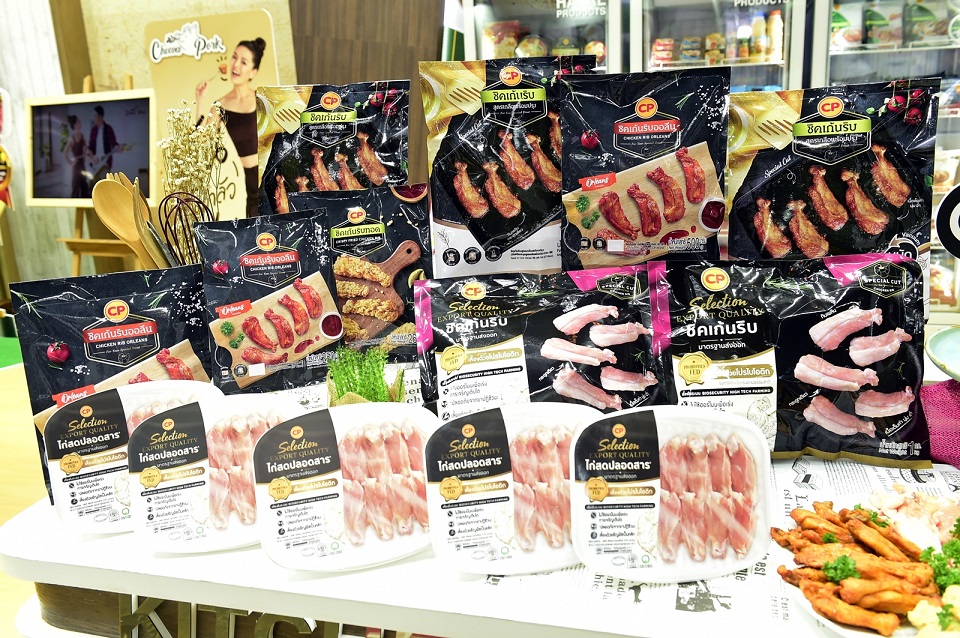
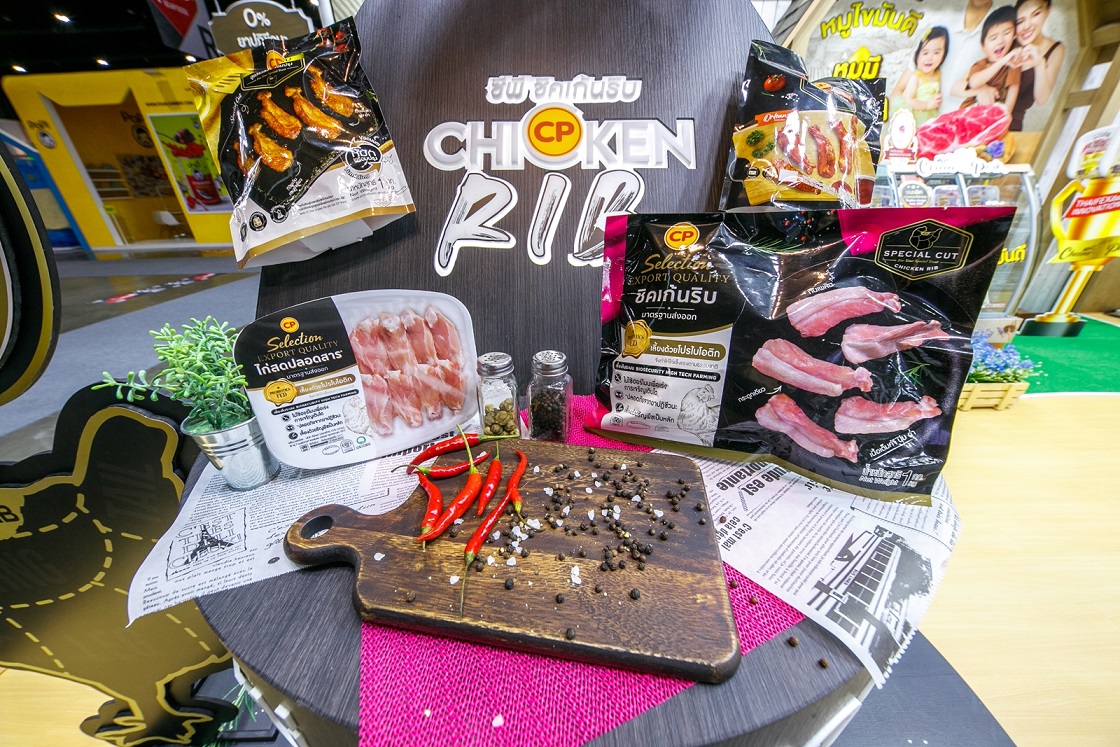
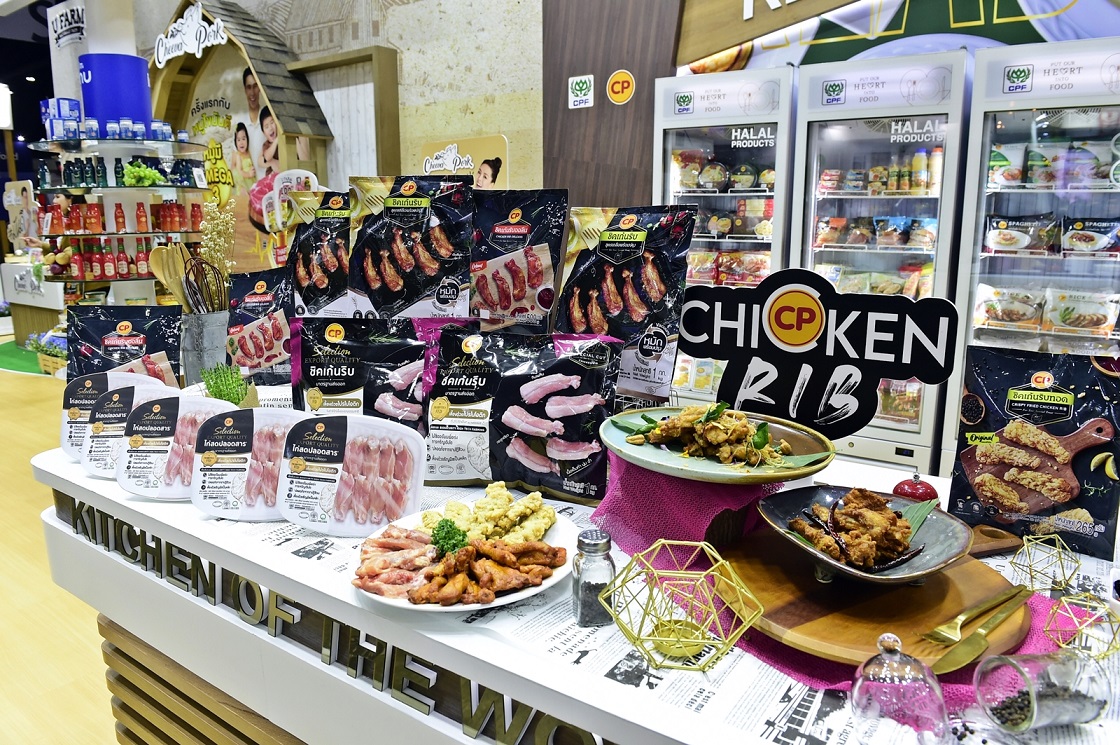
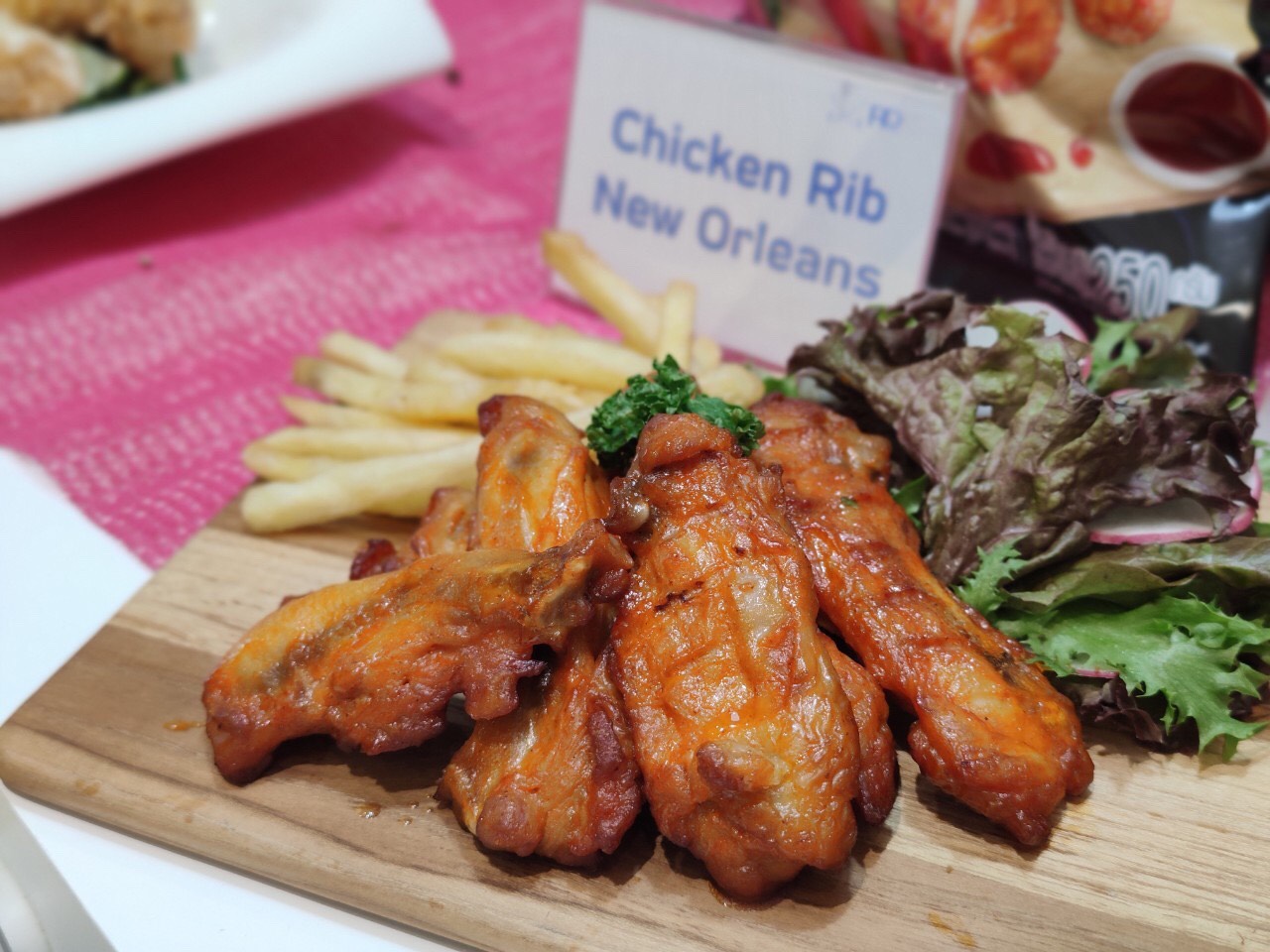
Charoen Pokphand Foods PCL (CP Foods) is set to export its “Chicken Rib”, a healthy special cut chicken product, across Asian markets in response to a growing demand for a healthy food from safe production in the region.
“CP Foods is the first company in Thailand that make this Special Cut. With a single thin bone, it is easy to grab like a mid-joint wing, but tender, meaty and juicy like a thigh. Chicken Rib is also antibiotics-free, making it a healthy food choice. This product will give a new experience to the consumers in Thailand and across Asia,” Ms. Anarkawee Chooratn, Senior Vice President at CP Foods, said.
The product is now available in supermarkets, restaurants and other retailers in Thailand. For overseas, the product is already exported to China and Japan. CP Foods plans to export this premium product to Singapore, South Korea, Hong Kong and other Asian markets in the near future, citing growing demand for healthy foods as a main driver.
Ms. Anarkawee explained that COVID-19 outbreak has accelerated trends for cooking at home. As a result, the consumers are looking for delicious ready-to-cook products that is worth the price. Moreover, their health becomes their biggest concern. Subsequently, nutrition and food safety are the utmost importance, especially among Asian consumers, when choosing ingredients.
To meet such growing demands, Chicken Rib is made from animal raised with biosecurity high tech farming in closed system, air-conditioning, and computerized farm under internationally accepted animal welfare standards, namely, Five Freedoms of Animal Welfare – freedoms from hunger and thirst; discomfort; pain; and injury; and freedom to express normal behavior.
In there, the chickens are fed with probiotics and high quality feed from the company’s own feedmills. These farming practices help enhancing the chickens’ physical and mental health during their time at the farm. As a result, CP Chicken Rib is free from antibiotics and growth hormone.
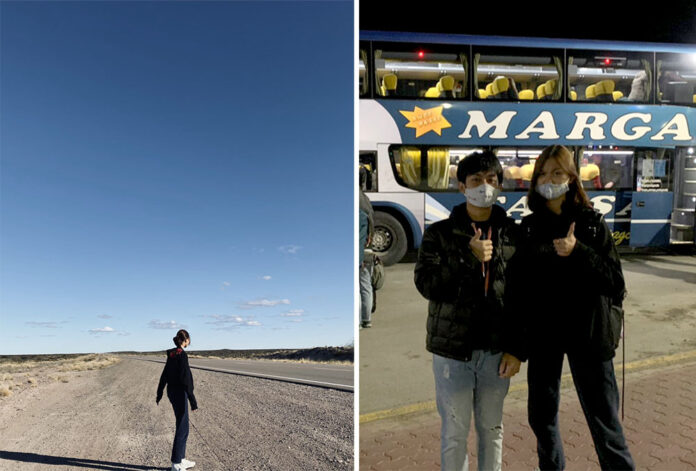
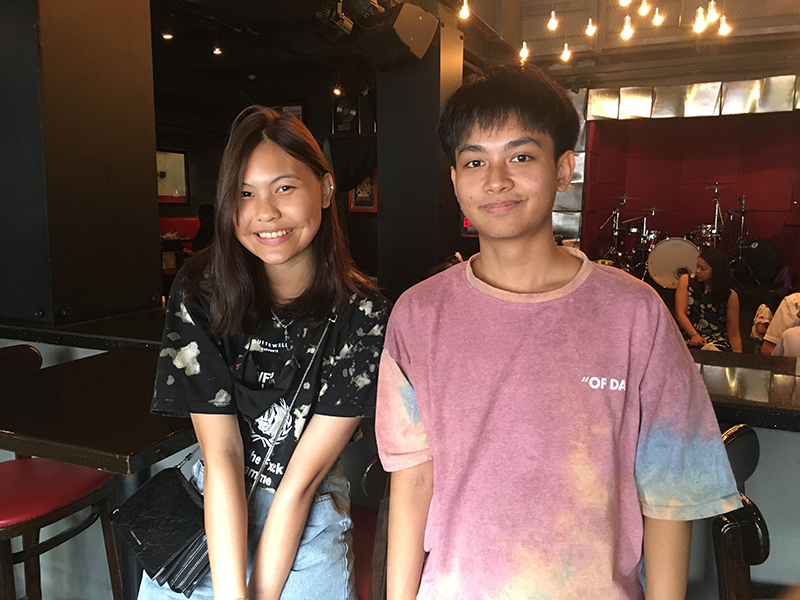
Left: Pimthichar on April 13, 2020 in Pichi Mahuida in Rio Negro province. Right: Thanakorn and Pimthichar in Ushuaia on April 11, as they are about to begin their journey home.
BANGKOK — Two Thai exchange students were dancing the tango to Latin beats and visiting a lake at Argentina’s southernmost tip when they were told to drop whatever they were doing, pack their bags, and head back to Thailand.
It was in April, and the coronavirus pandemic that began in Asia has spread to South America, shutting down domestic and international borders. Thanakorn “Spain” Jongwattanaudom, 17, and Pimthichar “Naai” Kummuang, 15, would end up on a journey spanning almost two months over a distance of 24,000 kilometers – most of the time without stopping overnight for a rest due to travel restrictions.
“I was crying, since my eight months with my host family ended so suddenly,” Thanathorn said in a recent interview. “I think of them as my real family. I was their son.”
Thanakorn and Pimthichar were part of about 128,000 Thai nationals repatriated since the coronavirus struck the world in January. But while most of the returnees’ experiences involve bureaucratic nightmares and boarding a flight back to their homeland, for Thanathorn and Pimthichar it was an epic overland journey like none other.
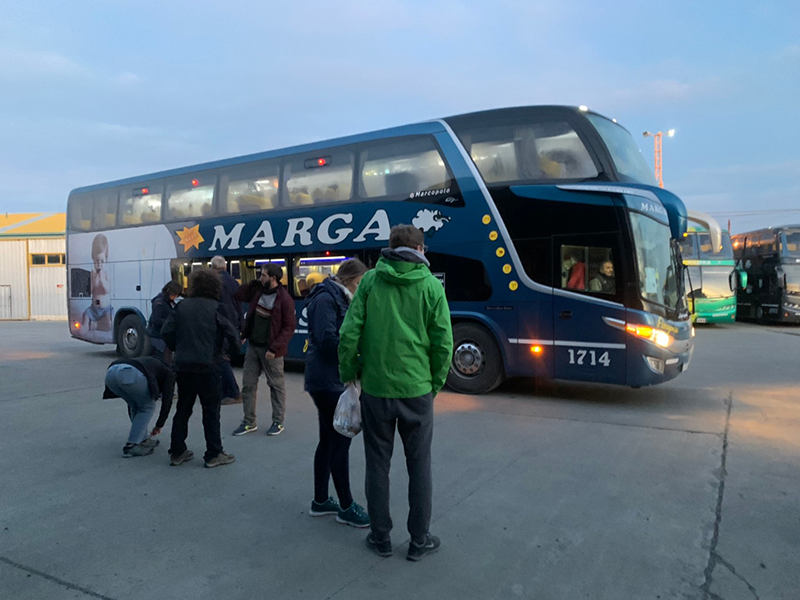
Together they traveled on buses and ferries – all local airports were shut down – passing through some of Argentina’s most far-flung regions before they could fly home. And since they were foreigners, Thanakorn and Pimthichar were not allowed to stay the night in any Argentine province.
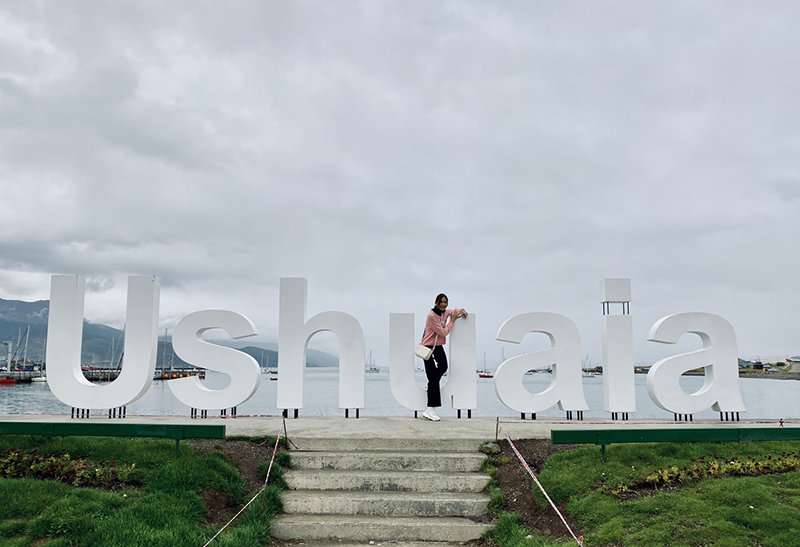
The two teens were placed in Argentina earlier this year by AFS, a popular foreign exchange program. Pimthichar was studying in the world’s southernmost city of Ushuaia. Thanakorn was put in Tolhuin, about 100 kilometers away.
Thanakorn said he “became like the fourth son” for host parents Mario and Javier, who had three sons Hector, 18, Jose, 16, and Theo, 5.
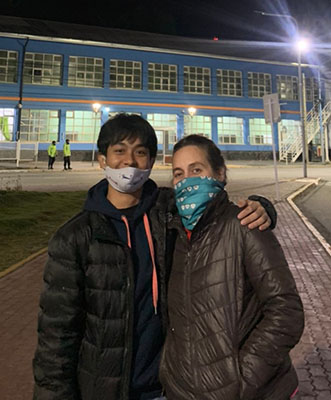
Pimthichar with a friend in Ushuaia.
The family often did home renovations or played hockey and volleyball at the local sports club or drove to Lake Fagnano together.
The blooming friendship with his adopted Argentianian family was cut short on April 12, when the Thai Embassy in Buenos Aires told him to leave immediately for Thailand. Devastated by the abrupt farewell, Thanakorn quickly packed a few mate cups and bombilla straws to remember the family.
He left at 3am Sunday on a bus packed with about 50 other exchange students – Thanakorn was the only Asian – to link up with Pimthichar in Ushuaia, who received a similar notice to leave.
Thanakorn in Tolhuin, Argentina as he is about to leave for Buenos Aires on April 11, 2020.
The bus set off, straining against the harsh winds of the Southern hemisphere’s approaching winter.
‘Just Land and Sky’
Thanakorn and Pimthichar traveled on the bus north into Chile, then around noon boarded the ferry at the narrowest water crossing in the Strait of Magellan at Primera Angostura.
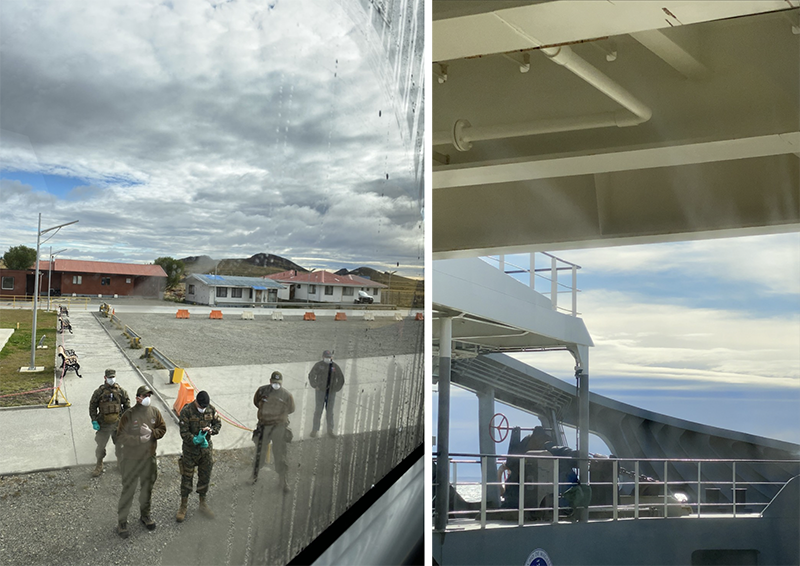
The students waited, shivering in the cold air as the bus was disinfected, before pulling through into Argentina again.
Their first day of the non-stop journey clocked at around 566 kilometers in Santa Cruz province, near Rio Gallegos city. Two drivers rotated every several hours as the students caught whatever sleep they could.
“As far as the eye could see, there was just land and sky, going on forever,” Pimthichar recalled parts of her desolate bus ride.
The phone signal was almost absent, and as the journey pummeled north, both Pimthichar and Thanakorn wept. She felt disappointed that her once-in-a-lifetime opportunity had been cut short, while Thanakorn felt a real sense of separation in having to leave his host family.
A photo taken by Thanakorn during his bus journey in Argentina.
They traversed through Chubut and Rio Negro provinces in their second day of nonstop travel April 13, clocking about 2,300 kilometers so far.
After another rough night on the bus, the students approached Buenos Aires at 9:30am April 14. Weary and bus-worn, the students had completed a non-stop journey of 3,246 kilometers in a little over two days. Thanathorn had spent about 3,348 kilometers by car, including the first leg of his trip.
To compare, the distance between Los Angeles and New York is 4,501 kilometers, and a driving route from Luang Prabang to Singapore through Thailand is 3,190 kilometers.
But their troubles were far from over. Thanakorn, Pimthichar, and the handful of other Thai students were put in an indefinite quarantine at a hotel by the Thai Embassy staff, who worked frantically to find a flight home for the returnees.
The students were told they could not set one foot outside the hotel until it was to get on a flight home. No one knew when that would happen.
“We kept getting false hope about when we would be able to get home, whereas the German students went home soon after,” Thanakorn said.
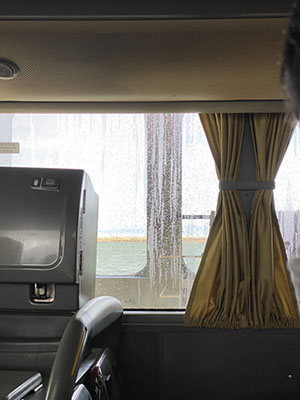
Photos from inside the bus during the ferry crossing into Chile.
Wait and Wait Some More
The diplomatic staff did not only have to struggle with the mass cancellations of international flights, but also navigated through rigid and nearly impossible criteria set by the government in Bangkok.
Requirements include fit-to-fly certificates issued by local doctors at a time when many hospitals were already overwhelmed. Some flights were secured, only to be cancelled later.
Pimthichar’s view from inside the bus.
The students didn’t have any laptops with them. So they entertained themselves by walking as far as the lobby, and gazing out the windows at Buenos Aires citizens who at that time were not practicing social distancing yet. The country soon counted over 10,000 cases, mostly in the capital.
“We played cards and anything we could get our hands on since we had literally nothing left to do,” Pimthichar, who had become used to snowboarding and hiking in Ushuaia, added, “We couldn’t get any fresh air, either.”
Finally, after 34 days inside the hotel, the Thai students were able to leave on May 18.
Packing their bags at 3am, the students rushed to catch a Latam flight from Ezeiza International Airport in Buenos Aires to Guarulhos International Airport in Sao Paulo, Brazil. The group was joined by a Thai chef and students evacuated from Uruguay. From there, they flew across the ocean towards the Netherlands.
The bus is disinfected in Rio Gallegos.
Although they were relieved that they found a flight that would bring them back to Thailand, that part of the journey was ironically the most dangerous for Thanakorn and Pimthichar.
“This was the scariest part. No one was practicing social distancing and the plane was fully packed. Everyone was kissing in the airport, and there seemed to be no fear of the virus,” Pimthichar said.
“But the Thai embassy people told us to be very careful, wear masks, and wipe anything we touched with alcohol,” she continued. “We were told that if one of us was careless, we could infect and endanger our 50 other friends.”
Some slept, some stayed awake through the whole flight out of paranoia. Upon landing in Amsterdam, the students rushed out of the plane and into the arms of Thai embassy employees who were waiting for them with a care package that included face masks, Dutch candy, and a box of chicken krapao with rice, topped with a fried egg and nuggets.
“It tasted like the best krapao I had ever eaten in my life,” Pimthichar said.
Pimthichar in Ushuaia.
There and Back Again, Hopefully
The final push was a Royal Dutch Airlines flight at 5:30pm the same day, destination: Bangkok. Pimthichar and Thanakorn recalled it was practically an empty flight, with only 50 people onboard.
Finally, on May 20 at 9:30am, their 38-day journey spanning about 23,982 kilometers – or about 60 percent of the Earth’s circumference – came to a relatively happy ending. The group went into quarantine and were released without anyone having contracted the coronavirus.
Pimthichar in Ushuaia.
Today, Thanakorn and Pimthichar are back at their Thai schools, their exchange program having been gutted.
“I really feel like my personality has changed. I think I’m a lot stronger and more decisive because of the journey,” Pimthichar said. “I feel so small, and the world is so huge and far.”
In his Bangkok home, Thanakorn has brought back a piece of South America with him. To cure his heartache, he picked up a habit of sipping mate through bombilla straws and occasionally cooking chipa baked cheese rolls and reviro fried dough.
Both of them said they hoped to be back when the world returned to normalcy.
“There’s still so many places I haven’t gone and I want to go to them all, especially back to Tierra del Fuego,” Pimthichar said.
“I will make it back to my host family one day, but it might take a while,” said Thanakorn.
Argentina has recorded up to 1.4 million infection cases, with at least 39,305 fatalities, as of publication time. The grim figures are a far cry to Thailand, which counts about 4,000 total cases and 60 deaths.
Pimthichar and Thanakorn, safe and sound in Bangkok in August 2020.
Progressive Movement group leader Thanathorn Juangroongruangkit campaigns on behalf of his allies for the election elections in Ang Thong on Dec. 3, 2020.
BANGKOK — Election Commission sec-gen Jarungvith Phumma on Thursday denied the criticism that the agency appears to be neglecting the local elections for administrative posts across Thailand, set to take place on Dec. 2.
Critics charged that the commission is not campaigning enough for people to go vote, the long awaited election is not getting much publicity, and no debate is planned for candidates to show their visions in public forums. Jarungvith countered that his detractors fail to see the real situation on the ground.
“You must go to the provinces to see what’s happening,” Jarungvith said. “We have cells in each province and they are campaigning.”
He also confirmed that no debates will be held by the Election Commission, since there is no budget to support them. The commissioner said he expected that up to 70-75 percent of eligible voters would cast their votes.
Residents outside Bangkok will elect the chief executives of their respective Provincial Administrative Organization (PAO) and its council members on Dec 20 – the first such vote since local elections were suspended by coup leaders in 2014.
Pongsak Chanon, advisor of We Watch, a poll watch group, said he’s worried that the level of awareness in the upcountry may be too low.
“I am concerned about the campaign to educate the electorate to make them understand the importance of local elections,” Pongsak said. “Unlike national elections, the EC is not campaigning to make the society aware. The local elections were made to become unimportant.”
He added, “Well, this may be partly due to attention given to the on-going anti-government protests by the media. I fear that an opportunity is being lost.”
“We Watch will do what we can to help campaign for people to go out and vote,’’ Pongsak said.
Klaikong Vaidhyakarn is an executive committee member of Progressive Movement which is fielding nearly a thousand candidates in the local elections in 42 provinces. He urged the Election Commission to promote the elections more by holding publicity activities.
“Public relations through the media is rather limited. The Election Commission must answer this,” Klaikong said. “What the EC should do now is to campaign for people to go vote. Many work in other provinces and there’s no early voting at this time.”
He said another point of potential confusion is the two ballot papers to be used on the day of voting: one ballot for PAO chief executive and another for members of provincial administration organization council.
Uncertain Future
The Progressive Movement itself is under an ongoing investigation by the Election Commission for its association with the now-disbanded Future Forward Party.
The commission accused the group of breaching election laws by posing as a political party. Jarungvith said he has assigned a team to study whether there are sufficient causes to charge the Progressive Movement leaders; a recommendation will be made within 20 days.
But Klaikong denied that Progressive Movement, led by Future Forward’s former chairman Thanathorn Juangroongruangkit, is breaking any laws.
“Many local groups are fielding candidates as well and they are not political parties either,” Klaikong said. “We don’t cite any political party in our activities. We are not a political party.”
In February, Thanathorn and 16 other Future Forward executives, including Klaikong, were banned from holding political office for 10 years per a court verdict that found the party guilty of violating election laws.
The court said Future Forward breached voting laws by accepting a 191 million baht loan from Thanathorn, who was also the party founder. The loan was considered a donation in excess of 10 million baht allowed to be made to a political party within a period of one year under the law.
If the Progressive Movement is found guilty of misrepresenting itself as a political party, violators could face up to three year imprisonment term and a fine up to 60,000 baht. The group leaders could also be banned from politics for five years.
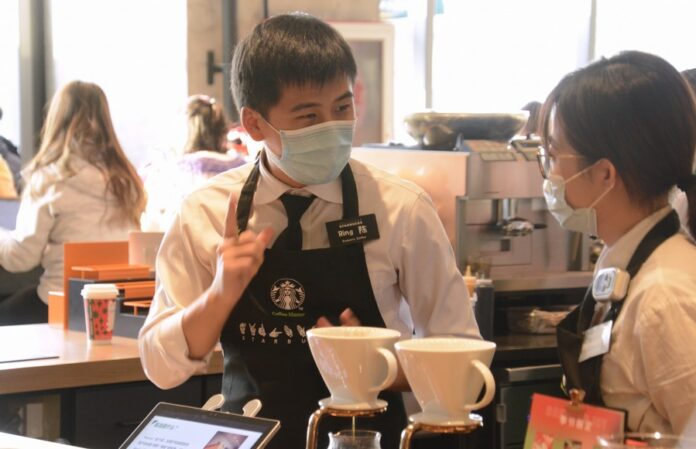
Chen Zizhong (L), a hearing-impaired barista, communicates with a colleague in sign language about coffee making at the Starbucks Beijing Xitieying Wanda signing store in Beijing, capital of China, Dec. 3, 2020. (Xinhua/Li Xin)
BEIJING (Xinhua) — Chen Zizhong, 27, clad in a brand-new black apron, won the coveted title of “coffee master” among his colleagues in Beijing’s one and only Starbucks signing store.
The hearing-impaired barista works with a mix of hearing and hearing-impaired staff. The staff refer to each other as “partners,” which reflects the close bond that helps them during peak rush hours.
Starbucks has a total of six signing stores worldwide, which are made up equally of hearing and hearing-impaired staff. Among them, two are based in the Chinese mainland. The Starbucks Beijing Xitieying Wanda signing store, where Chen landed his job, opened in September 2020 and is the first of its kind in Beijing.
Tackle Problems Head-On
Cabinets groaning with mugs and canvas sacks display souvenirs printed with images of hand signs and gestures, while a low cakes and pastries display case makes way for communication between baristas and customers in sign language. Display screens with order details always face the customers, and portable tablet computers with built-in voice assistance provide the hearing-impaired baristas with ease in face-to-face communication.
Flanking the counter, the corner for activities is decked out with soundproof foam to safeguard a relatively quiet environment for the hearing-impaired baristas.
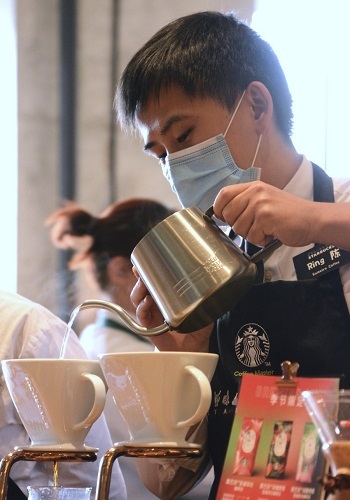
Chen Zizhong, a hearing-impaired barista,makes coffee at the Starbucks Beijing Xitieying Wanda signing store in Beijing, capital of China, Dec. 3, 2020. (Xinhua/Li Xin)
However, the delicate designs of the cafe are quite hard to spot by a busy passerby. “When customers are wearing their masks and ask me for some napkins, misunderstandings can easily take place,” Chen said. Those scenarios are where his hearing partners can step in and help.
Chen Fangqi, the cafe manager, has worked with Starbucks since 2009. “This is the quietest Starbucks I have ever encountered,” she said, adding that she used to work in a cafe inside the Beijing South Railway Station, among the busiest branches in Beijing.
The coffee shop in the railway station has a high volume of customers. The only hearing-impaired employee spends his shift preparing drinks in order to avoid possible issues communicating with customers.
“Our interpretation of equality is not about lowering our standards to favor the minorities, but offering equal job opportunities and upward mobility for impaired citizens,” said the manager.
No compromise in standards means an uphill struggle for the disabled. Copying the same drink recipe dozens of times from their dog-eared notebooks patched up with tape is commonplace for hearing-impaired baristas as it is the most efficient way for them to learn.
It will not be easy for Chen Zizhong to qualify as a coffee master.
Basic knowledge of various coffee beans sold in the store and day-to-day practices to make pour-over coffee are only snags, but hosting coffee lectures with customers face to face can be a daunting task.
Chen used to spend his days in a 9-to-5 job hunched over a desk, but feeling the absence of human interaction, he applied for a new career with Starbucks.
“After years working with screens, I’d like to move onto something that brings me face-to-face interaction to help improve my speaking ability,” he said. “Though it can be hard for me, I want equality for everyone.”
Refuse To Go Silent
At first, the hearing-impaired baristas tend to turn to those without impairment for a quick-fix when they run into troubles. Now, they are encouraged to use writing pads as a supplementary communication tool with customers.
After eight hours of work, Chen Zizhong often goes to hospitals to help those with hearing impairments visit doctors as a translation volunteer.
“The disabled and other partners are not two pieces of a puzzle. The merging of their worlds needs patience and communication,” said Chen Fangqi, noting that the hearing-impaired are also raring to engage in the world and to be of service to society.
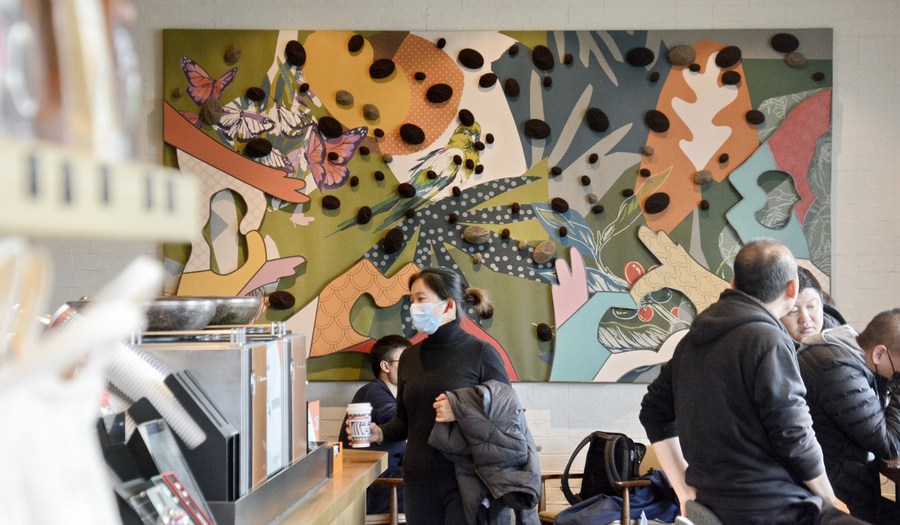
Customers are seen at the Starbucks Beijing Xitieying Wanda signing store in Beijing, capital of China, Dec. 3, 2020. (Xinhua/Li Xin)
With growing customer traffic and the clatter of coffee machines, each hearing-impaired staff member has been given an electronic watch connected to the ovens that vibrates and flashes to alert busy baristas when the food being heated is done. Such technology solutions are catching up with the quotidian needs of the disabled. Functions including timing and calling for help are expected to be added in the near future.
Every Sunday afternoon, the signing store also holds a class to teach sign language to customers. Chen Fangqi also learned some in daily conversation with her hearing-impaired colleagues.
Currently, more than 120 baristas with hearing impairments are working in Starbucks nationwide, and the number is expected to grow as the company plans to open more specialized cafes like these in China’s major cities such as Hangzhou and Shanghai.
In the store, a huge painting designed by a hearing-impaired artist hangs on the wall. Inside one of the wool balls in the painting, which resemble coffee beans, hides one of Chen Zizhong’s wildest dreams — “I hope to become a Starbucks store manager someday.”
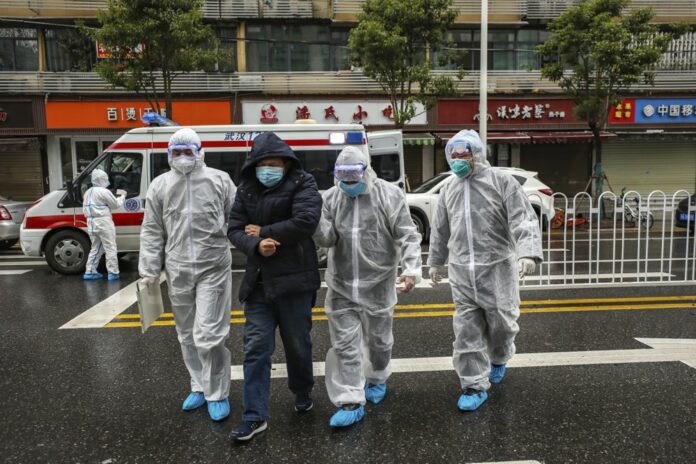
In this Sunday, Jan. 26, 2020 file photo, medical workers in protective gear help a patient near an ambulance in Wuhan in central China's Hubei Province. (Chinatopix via AP, File)
WUHAN, China (AP) — In the early days in Wuhan, the first city struck by the virus, getting a COVID test was so difficult that residents compared it to winning the lottery.
Throughout the Chinese city in January, thousands of people waited in hours-long lines for hospitals, sometimes next to corpses lying in hallways. But most couldn’t get the test they needed to be admitted as patients. And for the few who did, the tests were often faulty, resulting in false negatives.
The widespread test shortages and problems at a time when the virus could have been slowed were caused largely by secrecy and cronyism at China’s top disease control agency, an Associated Press investigation has found.
The flawed testing system prevented scientists and officials from seeing how fast the virus was spreading — another way China fumbled its early response to the virus. Earlier AP reporting showed how top Chinese leaders delayed warning the public and withheld information from the World Health Organization, supplying the most comprehensive picture yet of China’s initial missteps. Taken together, these mistakes in January facilitated the virus’ spread through Wuhan and across the world undetected, in a pandemic that has now sickened more than 64 million people and killed almost 1.5 million.
China’s Center for Disease Control and Prevention gave test kit designs and distribution rights exclusively to three then-obscure Shanghai companies with which officials had personal ties, the reporting found. The deals took place within a culture of backdoor connections that quietly flourished in an underfunded public health system, according to the investigation, which was based on interviews with more than 40 doctors, CDC employees, health experts, and industry insiders, as well as hundreds of internal documents, contracts, messages and emails obtained by the AP.
The Shanghai companies — GeneoDx Biotech, Huirui Biotechnology, and BioGerm Medical Technology — paid the China CDC for the information and the distribution rights, according to two sources with knowledge of the transaction who asked to remain anonymous to avoid retribution. The price: One million RMB ($146,600) each, the sources said. It’s unclear whether the money went to specific individuals.
In the meantime, the CDC and its parent agency, the National Health Commission, tried to prevent other scientists and organizations from testing for the virus with their own homemade kits. In a departure from past practice for at least two epidemics, the NHC told Wuhan hospitals to send virus samples — from which tests can be developed — only to central labs under its authority. It also made testing requirements to confirm coronavirus cases much more complicated, and endorsed only test kits made by the Shanghai companies.
These measures contributed to not a single new case being reported by Chinese authorities between Jan. 5 and 17, even though retrospective infection data shows that hundreds were infected. The apparent lull in cases meant officials were slow to take early actions such as warning the public, barring large gatherings and curbing travel. One study estimates that intervention two weeks earlier could have reduced the number of cases by 86 percent, although it’s uncertain whether earlier action could have halted the spread of the virus worldwide.
When tests from the three companies arrived, many didn’t work properly, turning out inconclusive results or false negatives. And technicians were hesitant to use test kits that would later prove more accurate from more established companies, because the CDC did not endorse them.
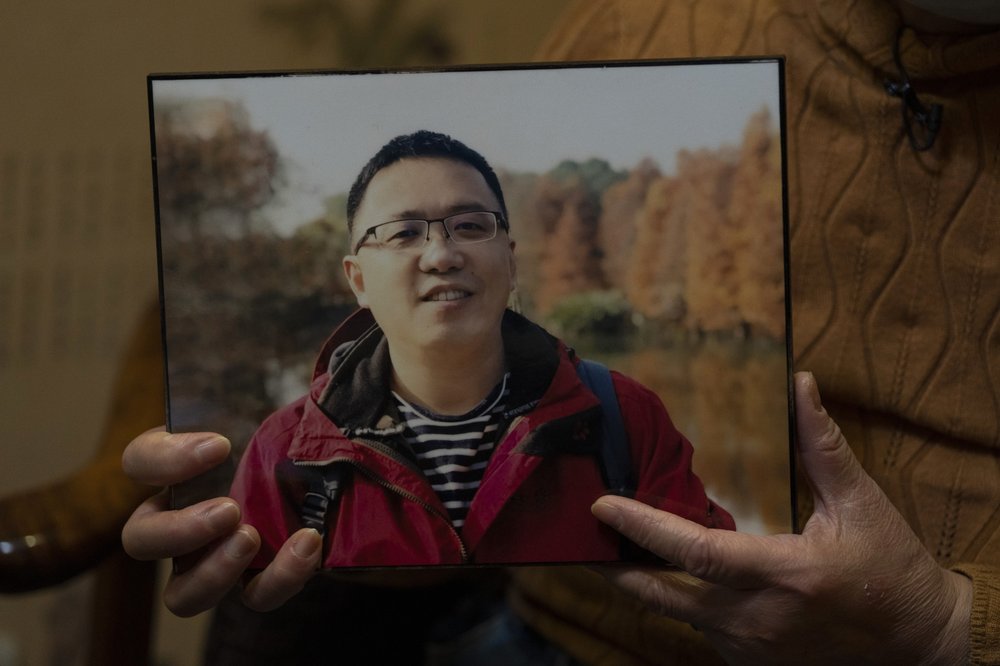
Zhong Hanneng holds a photo of her son, Peng Yi, and talks about his difficulties in getting tested for COVID-19, eventually dying from the disease, in Wuhan in central China’s Hubei province on Saturday, Oct. 17, 2020. (AP Photo/Ng Han Guan)
With few and faulty kits, only one in 19 infected people in Wuhan was tested and found positive as of Jan. 31, according to an estimate by Imperial College London. Others without tests or with false negatives were sent back home, where they could spread the virus.
Days after he first started coughing on Jan. 23rd, Peng Yi, a 39-year-old schoolteacher, waited in an eight-hour line at a Wuhan hospital. A CT scan showed signs of viral infection in both his lungs, but he couldn’t get the test he needed to be hospitalized.
When Peng finally got a test on Jan. 30, it turned out negative. But his fever wouldn’t drop, and his family begged officials for another test.
His second test, on Feb. 4, turned out positive. It was too late. Weeks later, Peng passed away.
“There were very, very few tests, basically none….if you couldn’t prove you were positive, you couldn’t get admitted to a hospital,” his mother, Zhong Hanneng, said in a tearful interview in October. “The doctor said there was nothing that could be done.”
China was hardly the only country to grapple with testing, which varied widely from nation to nation. Germany, for example, developed a testthat became the World Health Organization gold standard days after the Chinese government released genetic sequences on Jan. 12. But in the U.S., the CDC declined to use the WHO design and insisted on developing its own kits, which turned out to be faulty and led to even longer delays than in China.
Other countries also had the benefit of learning from China’s experience. But China was grappling with a new pathogen, and it wasn’t yet clear how bad the pandemic would be or how many tests would be needed.
“It was very early,” said Jane Duckett, a professor at the University of Glasgow examining the Chinese government’s response to the coronavirus. She said the government was “just trying to figure it out.”
Still, the hiccups and delays in China were especially consequential because it was the first country to detect the virus.
“Because you have only three companies providing testing kits, it kept the capacity of testing very limited,” said Yanzhong Huang, a senior fellow for global health at the Council on Foreign Relations. “It was a major problem that led to the rapid increase in cases and deaths.”
China’s foreign ministry and China’s top medical agency, the National Health Commission, did not respond to requests for comment.
“We did a brilliant job, we worked so hard,” said Gao Fu, the head of China CDC, in a videoconference in July. “Unluckily, unfortunately, this virus we are facing, it’s so special.”
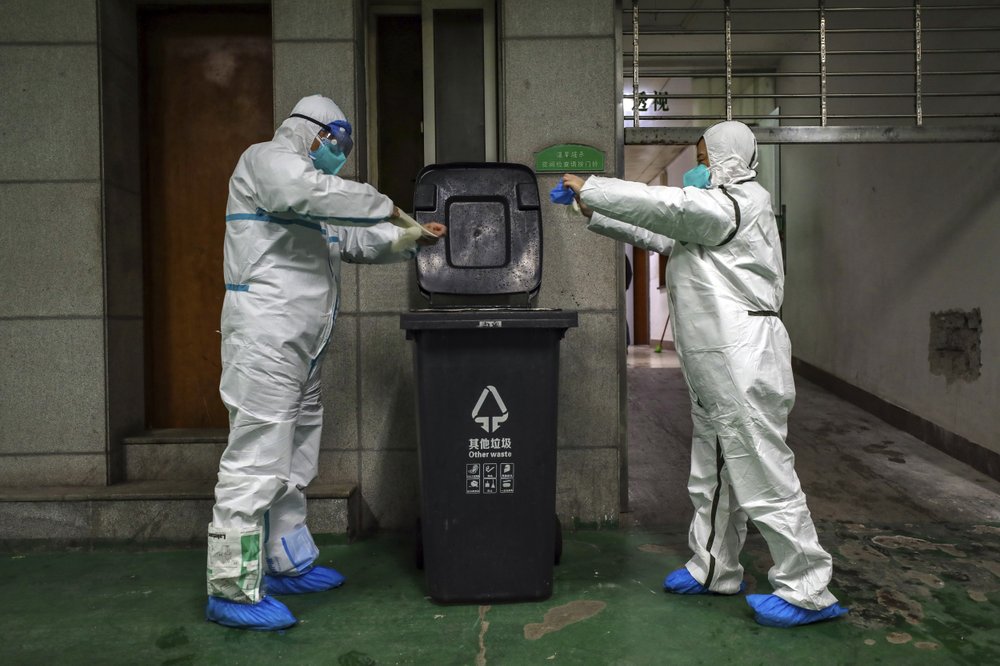
In this Sunday, Jan. 26, 2020, file photo, ambulance crew members dispose of protective gear in Wuhan in central China’s Hubei Province. (Chinatopix via AP, File)
__________
None of the first three diagnostics companies tapped to make test kits for the biggest pandemic in a century were well-known in the industry. For one engineer from a Wuhan-based diagnostics firm, the Shanghai competitors popped out of nowhere “like bamboo shoots” – all the more so because his company had the factories and expertise to produce testing kits in the city where the virus was first detected.
“We were surprised, it was very strange,” the engineer said, declining to be named to speak on a sensitive topic. “We hadn’t heard about it at all, and then suddenly there’s test kits from certain companies you have to use, and you can’t use ones from anyone else?”
BioGerm was officially founded just over three years ago in a conference room, where the CEO mulled how to survive in a small and crowded market for test kits. GeneoDx had fewer than 100 employees, according to Tianyancha, a Chinese corporate records database – compared to competitors that employ hundreds or even thousands of staff.
But what the companies lacked in resources or experience, they made up for in connections.
Company posts, along with hundreds of internal emails and documents obtained by The Associated Press, show extensive ties between the three companies and top China CDC researchers in Beijing and Shanghai. Chinese regulators barred AP attempts to obtain credit reports on the companies, saying they were classified as “confidential enterprises” during the outbreak.
Despite China’s efforts over the years to reform public health and push for open bidding in a competitive marketplace, medical companies still cultivate personal relationships with officials to secure deals, according to seven executives from different competitors. Under President Xi Jinping, China has cracked down on corruption, but industry insiders say a lack of firm boundaries between public and private in China’s health system can create opportunities for graft.
It’s unclear whether the agreements between the China CDC and the three test kit companies violated Chinese law.
They raise questions around potential violations of bribery laws, along with rules against abuse of authority, self-dealing and conflicts of interest, said James Zimmerman, a Beijing-based corporate attorney and former chairman of the American Chamber of Commerce in China. Even amid the uncertainty of the pandemic, “there is no excuse for the flow of cash from these companies to the CDC,” he said.
Chinese bribery laws also state that any financial transaction has to be recorded and documented clearly. The AP was unable to ascertain whether the agreements between the CDC and the Shanghai companies were documented, but a CDC employee with access to some of the agency’s finances said there was no record of them.
Despite the questions around bribery, other experts caution that the state may have designated the three companies to make test kits under special laws on the procurement of emergency goodsduring major natural disasters. The Chinese government is pushing to cultivate domestic companies focused on emergency response technologies, including test kits, to protect its national interest.
“Things will be different in the middle of a crisis,” said Lesli Ligorner, a Beijing-based attorney specializing in anti-corruption law. “Anything affecting the national interest can be deemed to be of utmost importance for special regulations… I wouldn’t be so quick to rush to judgement.”
Funding for the China CDC has stagnated in recent years, and researchers there often earn far lower wages than in the private sector. Many employees have departed for private sector jobs over the past decade, draining its labs of talent.
Among those who left was BioGerm’s founder, Zhao Baihui, the former chief technician of the Shanghai CDC’s microbiology lab. Emails and financial records obtained by the AP show that Zhao first started BioGerm’s predecessor through an intermediary in 2012, while she was still at the Shanghai CDC. In the next five years, she sold thousands of dollars’ worth of test kits to her own workplace through the intermediary even as she herself was at times in charge of purchasing, internal emails, records and contracts obtained by the AP show.
After quitting the CDC in 2017, Zhao spearheaded lucrative contracts with government officials – such as one worth 400,000 RMB ($60,000) with Shanghai customs officials where her husband worked, and another worth 55,500 RMB ($8,400) with CDC officials in Shanghai’s Pudong district, the emails and contracts show. Zhao declined to speak when reached by phone, and did not respond to an emailed request for comment.
Another of the three companies, GeneoDx, enjoyed special access because it is a subsidiary of the state-run firm SinoPharm, which is managed directly by China’s cabinet. Before the outbreak, GeneoDx largely imported kits and acquired foreign technology to expand its business rather than develop its own products, according to company posts and a China CDC employee familiar with its operations.
In October 2019, GeneoDx co-organized an internal CDC training conference on emerging respiratory diseases in Shanghai. Tan Wenjie, the CDC official who ran the training, was later put in charge of developing test kits, according to an internal document the AP obtained. In November, the company won a contract to sell 900,000 RMB ($137,000) worth of test kits to Tan’s institute.
GeneoDx did not respond to requests for comment or interviews. The National Health Commission did not respond to a request for a comment or an interview with Tan.
Also in attendance at the invitation-only event was BioGerm, as well as other companies that used the conference to promote their products, blurring the line between the government and the private sector. China CDC staff were invited to join a BioGerm group on WeChat, a Chinese messaging application, which CEO Zhao later used to sell coronavirus test kits, according to a CDC employee and a screenshot seen by the AP.
The last company, Huirui, is a longtime partner with Tan, the CDC official in charge of test kits. Its founder, Li Hui, coauthored a paper with Tan on coronavirus tests in 2012 and “jointly developed” a test kit for the MERS outbreak in 2015 with Tan’s institute.
In an interview, CEO Li said the CDC routinely contracted with his company to make emergency testing chemicals. He said Tan’s lab at the China CDC had contacted him on Jan. 4 or 5 to make testing chemicals for the coronavirus based on CDC designs. He denied any personal relationship with Tan or any payments to the CDC.
“We’ve been working with the CDC to respond to emerging new diseases for about ten years, not just for a day or two, it’s normal,” Li said.
Their connections situated the three little-known companies in prime position in January, when a then-unknown pathogen was about to sweep the country and the world and change their fortunes.
Shanghai-based testing kit company BioGerm presents a booth at a trade fair in Nanchang in eastern China’s Jiangxi province on Friday, Aug. 21, 2020. (AP Photo/Dake Kang)
_________
The first step in making test kits is to get samples of the virus and decode its genetic sequence. This leads to test designs, essentially a recipe for the tests.
In the past, such as with H7N9 in 2013, the China CDC sent test designs to laboratories across the country just days after identifying the pathogen. It also shipped along the chemical compounds needed – in effect the ingredients – for hospitals and CDC branches to mix their own test kits as soon as possible.
At first it looked like the China CDC was using the same playbook this time. The CDC had found the genetic map, or genome, of the virus by Jan. 3. By the next day, under CDC official Tan, the Emergency Technology Center at its Institute for Viral Disease Control had come up with test designs.
But this time, the government held back information about the genome and test designs. Instead, the China CDC finalized “technology transfer” agreements to give the test designs to the three Shanghai companies, according to four people familiar with the matter. The selection process was kept secret.
The CDC did not have the authority to altogether prevent other scientists with competing agencies and companies from getting samples through back door routes and coming up with their own test recipes. But it tried to stymie such efforts and stop testing from being carried out.
For example, Dr. Shi Zhengli, a renowned coronavirus expert at the Wuhan Institute of Virology, obtained patient samples on her own, found the genome from them and came up with a test by Jan. 3, according to a slideshow presentation she gave in March. But her lab fell under the jurisdiction of a competing agency to the CDC, the Chinese Ministry of Science and Technology. The CDC barred her from obtaining more samples and testing for cases.
“There’s no open collaboration mechanism,” said a public health expert who often works with the China CDC, declining to be named for fear of damaging relations there. “Everyone wants their turf.”
Provincial CDC staff were told that instead of testing and reporting cases themselves, they had to send patient samples to designated labs in Beijing for full sequencing, a complicated and time-consuming procedure. Otherwise, the cases would not be counted in the national coronavirus tally.
“It was absolutely abnormal,” said a CDC lab technician, who declined to be identified out of fear of retribution. “They were totally trying to make it harder for us to report any confirmed cases.”
In secret evaluations of test kits on Jan. 10, the CDC also approved only those from the three Shanghai companies, according to internal plans and instructions obtained by the AP.
The Chinese government finally made its genomes public on Jan. 12, a day after another team published one without authorization. That opened the door for more companies to make their own test kits. However, China’s top health agency, the National Health Commission, still urged medical staff to buy the test kits from Huirui, BioGerm and GeneoDx that the CDC had validated, according to internal instructions obtained by the AP.
The evaluations and selections of test kits were conducted with the knowledge and direction of China’s top health official, Ma Xiaowei, according to a CDC post on Jan. 13.
On Jan. 14, Ma held an internal teleconference to order secret preparations for a pandemic, as AP earlier reported. After that, China’s health authorities relaxed the requirements to confirm cases and started distributing the CDC-sanctioned test kits. BioGerm began taking orders from provincial CDC staff across the country on WeChat, a Chinese social media application.
“We’ve been entrusted by the national CDC to issue kits for you,” Zhao said, according to a screenshot of one of the group chats obtained by The Associated Press.
“Quick! Give me, give me,” said one staffer in the Sichuan CDC.
In this Jan. 24, 2020, file photo released by China’s Xinhua News Agency, a medical worker attends to a patient in the intensive care unit at Zhongnan Hospital of Wuhan University in Wuhan in central China’s Hubei Province. (Xiong Qi/Xinhua via AP, File)
But the kits from GeneoDx kept showing inconclusive results, the CDC technician told the AP, and eventually her superior ordered her to toss them aside. The kits from Huirui were also unreliable, and the only ones that worked consistently were from BioGerm, she said.
“The quality was not good. Bad, poor quality,” said a public health expert familiar with the matter, who declined to be identified to avoid damaging ties with the China CDC. “But because they had a collaboration with the (CDC) Institute for Viral Disease Control and… they paid a million yuan, they were on the list.”
BioGerm’s test kits were more dependable in part because they used chemicals from Invitrogen, a subsidiary of U.S. biotech giant Thermo Fisher. Huirui and GeneoDx used their own mixes instead, with more unreliable results.
Much larger competitors, including Chinese genetics giant BGI and Tianlong, developed their own kits in January, which were later found to be more effective than those made by the Shanghai companies. But those test kits weren’t endorsed by the China CDC.
“No test protocol, no primers and probes, then of course there’s no way to confirm cases,” said another China CDC employee who declined to be identified for fear of retribution. “And then, all of a sudden, you tell all the CDCs: purchase from these companies, now go for it. Then – chaos and shortage. Valuable time wasted.”
Chen Weijun, BGI’s chief infectious disease scientist, also said the early products recommended by the China CDC had “quality problems.” When asked why the China CDC selected the three Shanghai companies, Chen demurred.
“You better ask the CDC this question,” said Chen, who collaborated with CDC researchers to publish the first paper on the virus. “But actually, everyone understands what’s going on, why this happened, right? You can reach your own conclusions, right?”
____________
A day after the first test kits finally arrived in Wuhan on Jan. 16, the case count began to rise again. But test kits were scarce. Some other cities in the same province didn’t get kits until Jan. 22, and even those were often flawed.
Samples from 213 patients in February using GeneoDx tests suggested a false-negative rate of over 30 percent, a study by Shenzhen doctors found. A March clinical trial report showed that among the test kits certified at the time, GeneoDx was the worst performer, followed by BioGerm. In general, the rate of false negatives for COVID tests varies widely, from 2% to more than 37%.
Philippe Klein, a French doctor who treated foreign patients in Wuhan during the outbreak, estimated that about 20 percent of the tests turned up false negatives. Still, he said, delays in producing accurate tests kits are natural at the start of an outbreak.
“The Chinese did a lot in a short time,” Klein said. “It was a new test, so in the beginning, there was a lack of tests, of course.”
Zhao Baihui, center right, CEO of Shanghai-based testing kit company BioGerm, shakes hands after signing a partnership agreement during a corporate event at a trade fair in Nanchang in eastern China’s Jiangxi province on Saturday, Aug. 22, 2020. (AP Photo/Dake Kang)
On Jan. 22, the National Health Commission quietly removed the names of the three Shanghai companies from its coronavirus guide as preferred distributors. After the Chinese government ordered Wuhan shut down on Jan. 23, the three companies faced massive logistical hurdles to getting their tests in.
On Jan. 26, officials set up a fast-track “green channel” for companies to get their test kits approved. The National Medical Products Administration approved test kits from seven companies, including BioGerm and GeneoDx but not Huirui. Li, Huirui’s CEO, said it was because his company was inexperienced in obtaining regulatory approvals for commercial tests.
But it took time for other companies to ramp up production and ship tests in, leaving Wuhan struggling to meet demand into early February and depriving many residents of treatment.
Peng died on Feb. 19. His mother now passes the days gazing blankly out her window, sobbing and lighting candles in his memory.
“In the eyes of officials, he was like a grain of sand or a blade of grass. But in our home, he was our sky, he was our everything,” Zhong said. “Without him, we can never be happy again.”
The same pandemic that killed Peng brought the Shanghai test kit companies and related scientists fame and fortune.
In September, Tan, the China CDC researcher in charge of developing test kits, was appointed the inaugural directorof a new National Novel Coronavirus Center. In a nationally televised ceremony, GeneoDx’s parent firm won plaudits from President Xi for “outstanding” contributions in the struggle against COVID-19, including developing a test kit.
Huirui has expanded and is now selling commercial test kits for the first time — not in China, but in Latin America, CEO Li said. And the pandemic has allowed BioGerm to “stand out,” reaching its business targets much faster than planned, said top marketing executive Guo Xiaoling at a trade show in late August at a five-star hotel.
“Because of the epidemic, 2020 has been a really special year,” Guo said. “The country and the economy suffered major damage. But for our nucleic acid diagnostics industry, this year has actually been a bonus.”
___
Associated Press journalists Emily Wang in Wuhan, Maria Cheng in London and Robert Bumsted in South Orange, New Jersey, contributed to this report.
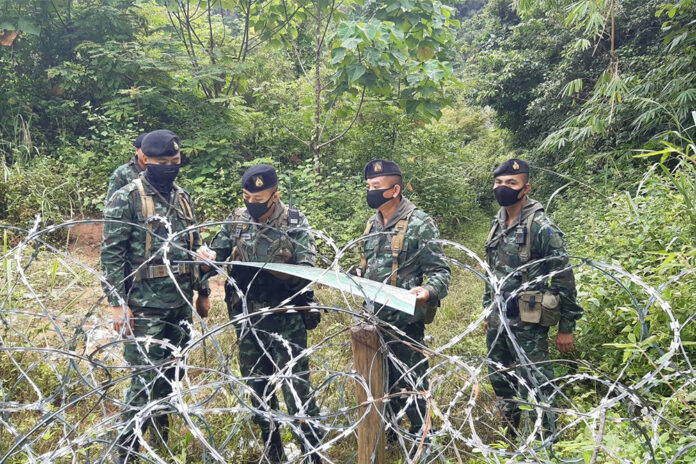
Security officers patrol the Thai-Myanmar border in Prachuap Khiri Khan province on Dec. 3, 2020.
BANGKOK — Health minister Anutin Charnvirakul on Thursday slammed a group of returnees who snuck across the Thai-Myanmar border and later found infected with the coronavirus, calling them “selfish.”
Six new cases were reported Wednesday in five provinces including Bangkok. They were all Thai nationals who entered the kingdom illegally from Myanmar’s border town of Tachileik, according to the Disease Control Department.
Hundreds of people are believed to have come into close contact with the group, but Anutin maintained the situation is well under control.
“We can keep the infections under control. We can track down the patients,” Anutin said. “I ask those returning from Tachileik to show their spirit and come to get tested at hospitals. We’re also telling Thais who still reside in Tachileik to sign up and come back through an appropriate channel.”
He added, “We’re willing to take care of them. If anyone is found infected, they will be treated, if not, they will spend 14 days in quarantine. But those people are selfish. They avoided the quarantine.”
Four other cases were also found over the past few days, bringing the total number of infected to ten, all of them women. Sophon Iamsirithavorn, director of the health ministry’s communicable disease division, said they had either worked or visited nightclubs in Tachileik before crossing the border through an unauthorized channel.
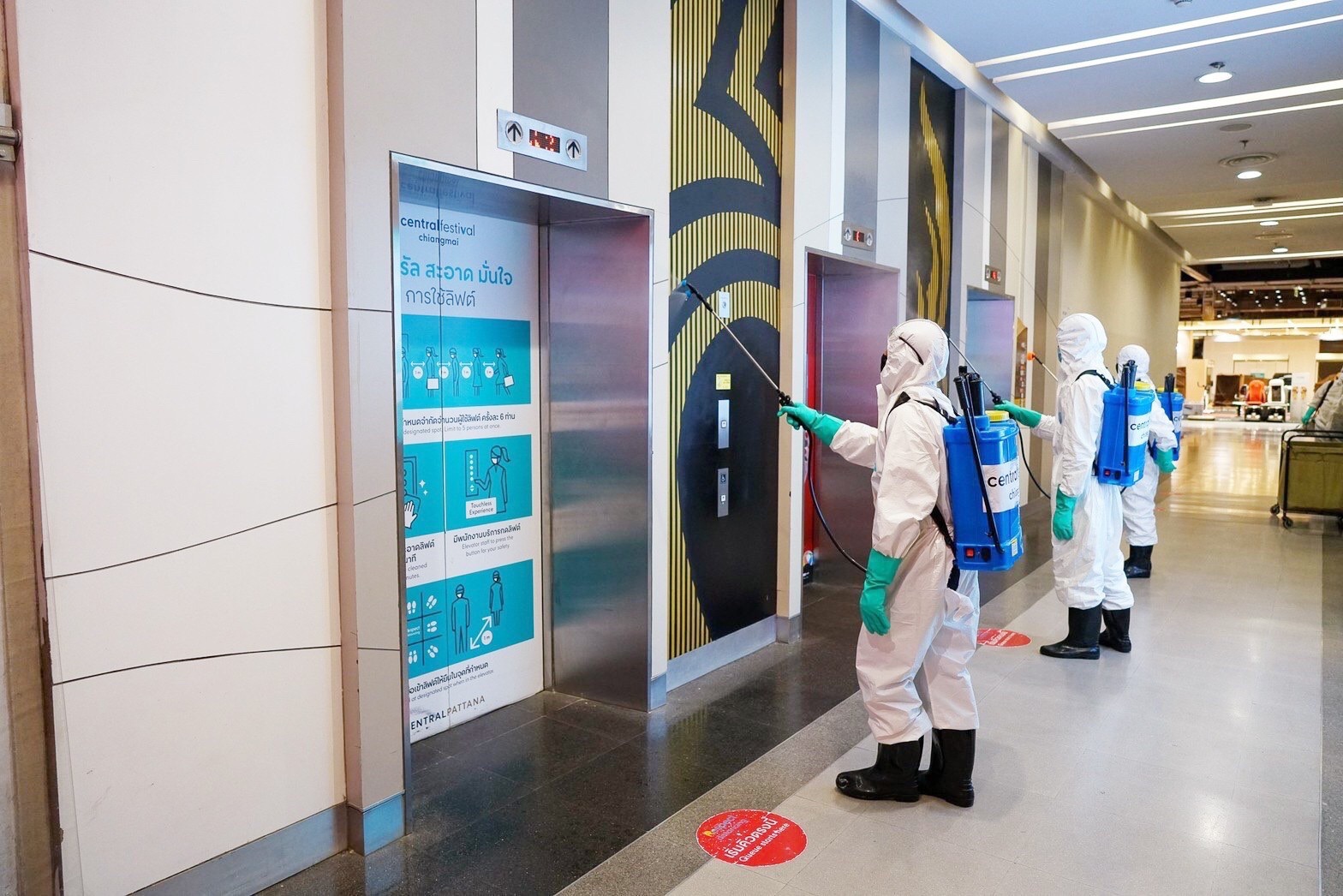
Workers spray disinfectants at a shopping mall in Chiang Mai province.
One of the ten new patients had attended the crowded “Farm Festival on The Hill” concert at Singha Park in Chiang Rai province on Nov. 29, according to the Disease Control Department.
Another patient, a 21-year-old woman, crossed into Thailand on Nov. 28 before boarding a Nok Air flight to Bangkok on the same day. She fell ill and went to see a doctor the next day, where she was tested positive for coronavirus.
Up to 699 people have come in contact with the returnees, head of the Disease Control Department Opas Kankawinpong said, though he added that no one has tested positive so far.
There is also no need to reintroduce lockdown measures at this time, health ministry perm-sec Kiattiphum Wongrajit said.
“It’s unnecessary to impose lockdown in provinces where the patients were found,” Kiattiphum said. “If there’s no positive result within seven days, we will consider there’s no infection to other groups of people. If there’s no positive result within 14 days, we will declare the situation safe.”
Three of the patients tested positive in Chiang Mai, another three in Chiang Rai, and one each in Phayao, Phichit, Ratchaburi, and Bangkok, officials said.
Government spokesman Anucha Burapachaisri said PM Prayut Chan-o-cha has ordered every border province to step up patrols along the border to prevent illegal crossings. Authorities will also take legal actions against any undocumented returnees without exception, he said.
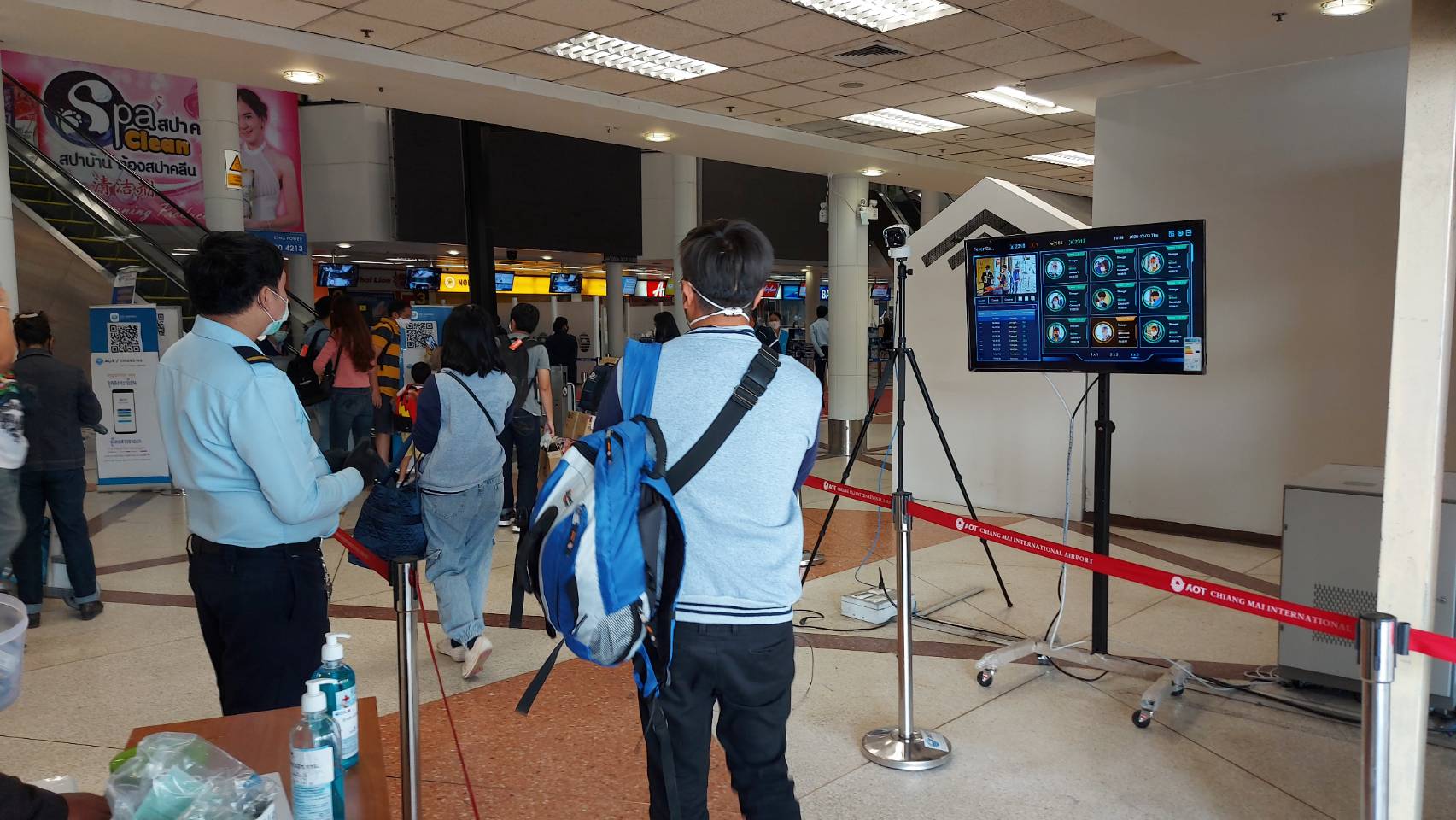
Passengers get their temperature checked at Chiang Mai Airport.
Prayut himself has blamed anti-government protests in Bangkok for the lax border control. He said security officers were mobilized from the provinces to maintain order in the capital while the protests were ongoing.
As of Thursday, 147 infected patients are being treated at hospitals, while 3,832 patients have recovered. The country’s cumulative case of infection now stands at 4,039.
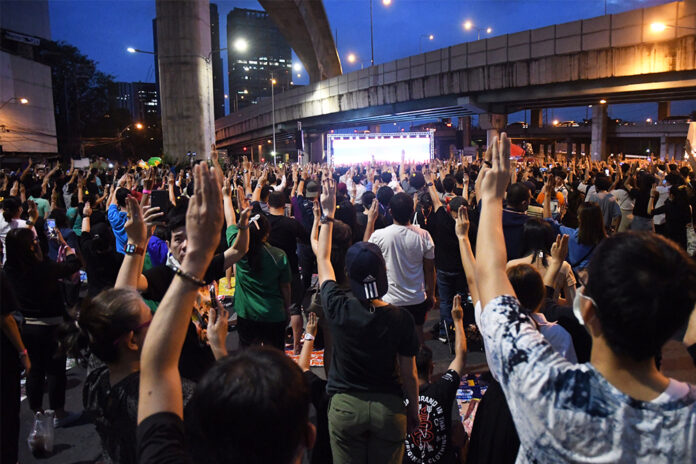
Anti-government protest at Lat Phrao Intersection on Dec. 2, 2020.
BANGKOK — The split between the protesters’ security network deepened after one of the guards was caught on camera kicking a vehicle close to Wednesday’s anti-government protest.
The guard in question was said to belong to a Redshirt guard group, who consists mostly of supporters of ex-PM Thaksin Shinawatra. Police said the motorist was planning to file charges. The incident also drew condemnation from a major donor of the protests.
“Every guard unit, every team, understands and cooperates with the protocol except the Redshirt guard unit,” activist and actress Intira “Sai” Charoenpura wrote online.
“When we asked them to submit their names, they viewed it as if we were wary and infringing on them,” Intira continued. “I don’t know what else to say except I want to ask them to return the self-issued armbands and join the rallies as a protester.”
Another key activist, Pakorn Pornchewangkurn, also said the misbehaving guard belongs to the Redshirt security group, who was not formally part of the protest organizers.
“This is what we have done so far: we stripped the perpetrator of his armband and asked him to leave the protests,” Pakorn wrote online.
Members of the Redshirt guards were manning one of the roadblocks close to Lat Phrao Intersection on Wednesday when a man reportedly removed a traffic cone installed by the protesters and attempted to drive through the rally site.
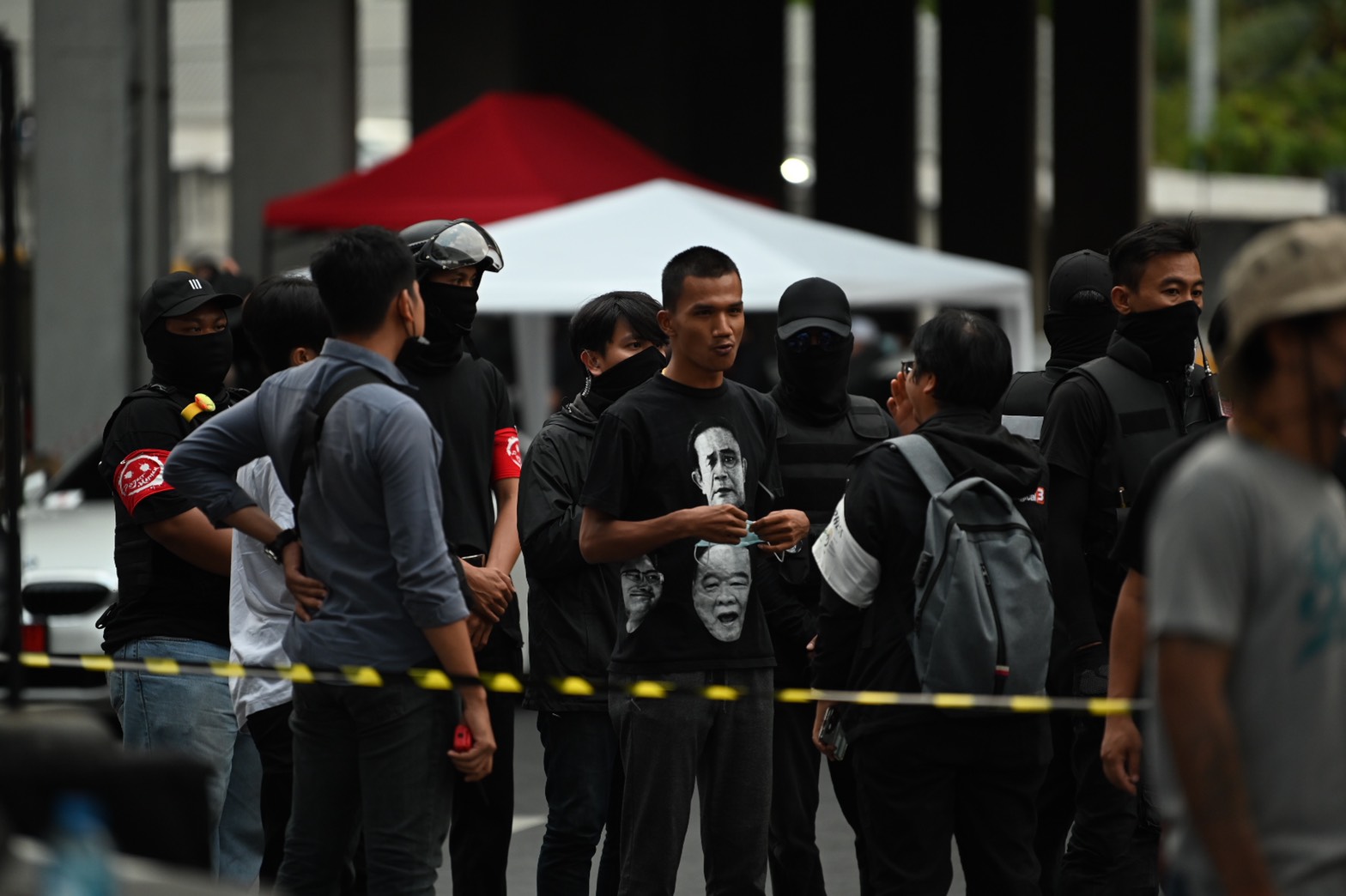
In the video that went viral, one of the guards can be seen kicking a car after it drove through the roadblock. Other guards, some of them clad in balaclava, then surrounded the car and questioned the driver’s intention. The unidentified driver said he wanted to head to the Victory Monument to pick up his children.
Sombat Tongyoi, the leader of the Redshirt guard unit involved in the incident, apologized for the guard’s action, but he also lashed out at comments made by Intira and Pakorn.
“Tell me straight, are the Redshirt guards so bad?” Sombat wrote on his Facebook. “I’m working and what else do you want from me or my team?”
Protesters’ security details stand guard next to protest leader Panupong “Mike” Jadnok at the protest on Dec. 2, 2020.
Deputy Bangkok police chief Piya Tawichai said the motorist has filed a complaint against the guard.
“A peaceful assembly is constitutional rights, but if the protest guards harm members of the public and properties, it is illegal actions and they must be prosecuted,” Piya said. “This case is personal wrongdoing. One victim has filed a complaint with the police.”
Security Matters
Debates soon followed online, pitting those who agreed with the Redshirt guards’ action and those who believed they should have been more patient.
“While the Redshirts are saying that they are supporting the youths, those intellectuals are pushing them out,” user @padkaprao_ tweeted. “The Redshirt guards had to kick the car because they were concerned about the safety of the demonstrators.”
“I’m not standing on the guards’ side,” user @JunePeop tweeted. “They obviously did wrong. They have no right to do that even though the car was breaking through. How can we be sure of our safety if the guards couldn’t control themselves?”
The incident is yet another sign of the growing rift among the pro-democracy activists, some of whom are worried that unregulated security details at rally sites could prove counterproductive to the movement.
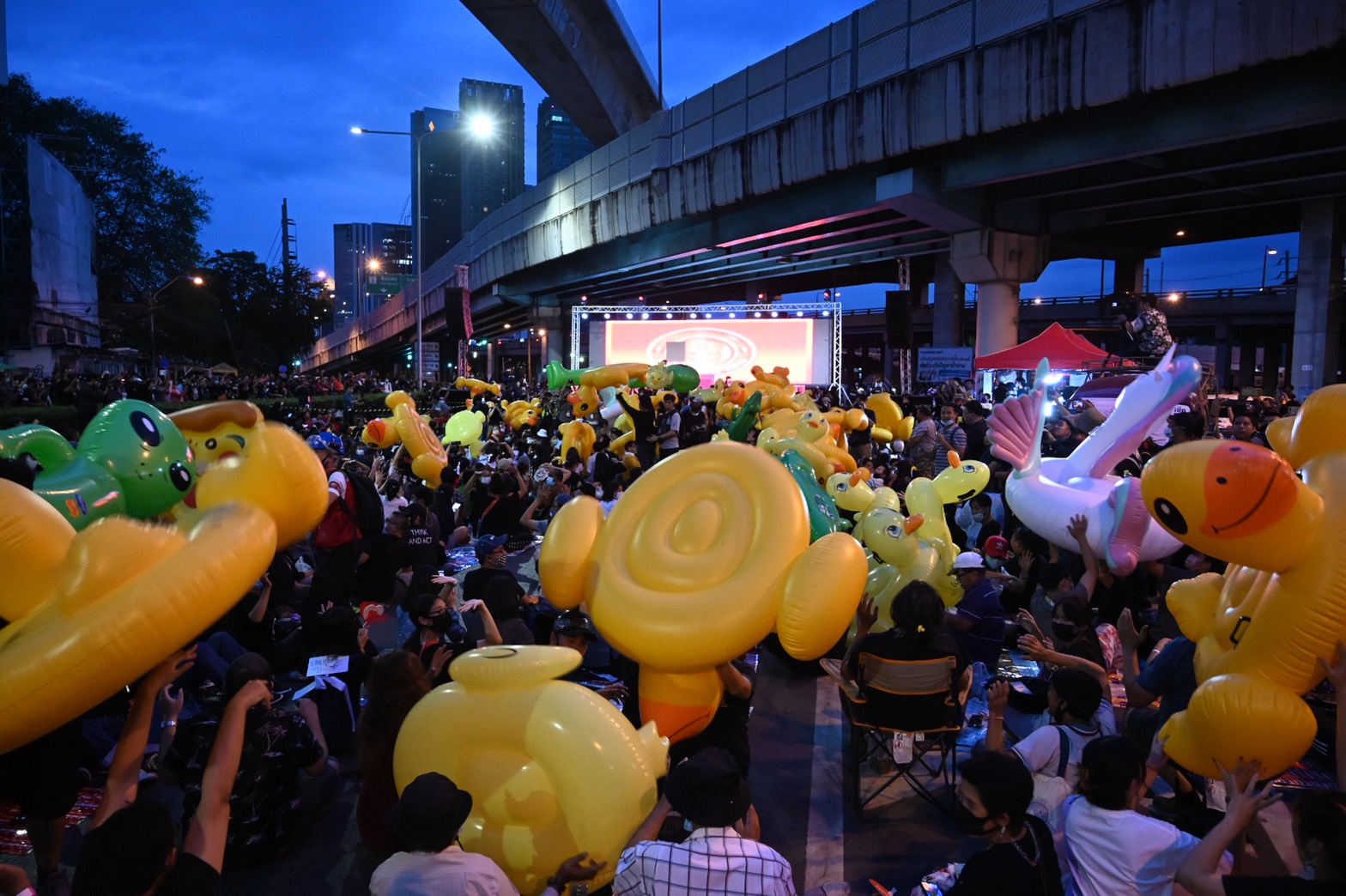
Rubber ducks being passed to the main stage during the protest on Dec. 2, 2020.
One of the largest groups of security guards, We Volunteer, already ceased their operations after one of their members was reportedly assaulted by another guard unit while trying to verify their identification.
The situation is complicated by the fact that up to 19 guard units were present at Wednesday night’s protest – many of them with their own command structures and organizations.
Protest leader Panupong “Mike” Jadnok attempted to bring a sense of order by asking all of the protesters’ volunteer guard units to submit their names to him, although it is unclear how many will comply.
A leader of the “Guard Coalition for the People,” an umbrella organization for the protest security network, said the two sides should communicate more.
“I understand that Inthira has a good intention to save the public image of the guards, while Sombat might have expressed his opinion with anger,” Kitpiwat Sriboonruang said.
Asked what the guards should do in a similar scenario, Kitpiwat said they should ask the motorists where they want to go. If their destination is inside the rally site, then they should be allowed to pass through the checkpoint.
“Indeed, it may cause troubles for motorists, but we’re doing it to pressure the government,” said Kitpiwat, whose group counts about 1,000 members. “However, it doesn’t mean that the roads are completely shut, motorists can still get to their home or workplace within the protest site.”
Yesterday’s protest at Lat Phrao Intersection concluded shortly after midnight without any further incident. The demonstrators have yet to reveal their target for the next protest.
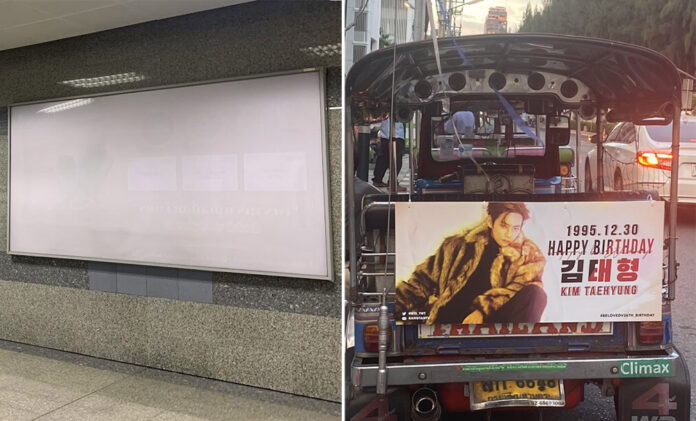
Left: An empty billboard at an MRT station. Photo: Matichon. Right: A tuk-tuk ad wishing Kim Tae-Hyung, or V of BTS, happy birthday. Photo: Baristmtle / Twitter
BANGKOK — Some K-pop fandoms are no longer posting happy birthday ads on two of Bangkok’s most popular transit systems in retaliation for shutting down their services during pro-democracy protests last month.
The move is expected to be a blow for BTS Skytrain and MRT subway enterprises, whose lucrative ad business had reaped millions of baht from Thai fans of Korean pop stars in recent years. A fandom of BTS (the boy band, not the skytrains) led the trend by announcing that they were placing ads on tuk-tuks instead.
“The uncles are really happy. At least we get to help them a bit,” user @Nuna_vmin tweeted.
The user also posted screenshots of a chat with a tuk-tuk driver who said the ad revenue from BTS fans – also known as ARMY – helped him afford infant formula for his children.
In a follow-up interview, @Nuna_vmin said tuk-tuks will also help add a touch of Thailand to the birthday congratulation messages for her idols.
“Tuktuks show Thainess, and whoever sees it will think of Thailand,” she said. “ I hope the artists will be able to see it and know that it’s from us Thai fans.”
Thai K-pop fans often bought billboards and placed ads on skytrain and subway stations to celebrate the birthdays of their favorite singers – or ‘bias’ in K-pop jargon – raising their profiles in public eyes.
Renting smaller billboards and light boxes on the subway systems cost about 20,000 – 40,000 baht per month, while larger ones can cost up to 60,000 baht monthly. Tuktuk ads cost considerably less, ranging in the thousands of baht.
There are currently 24 tuktuks with BTS ads on the streets, according to ARMY member @Nuna_vmin.
Fake Love for Customers?
A number of fandoms boycotted the ad space on BTS and MRT stations after the two services repeatedly shut down their operations for hours at a time when pro-democracy rallies took place in Bangkok.
The shutdown did not only cause headaches to commuters in the capital, but also prevented some demonstrators from entering or leaving rally sites.
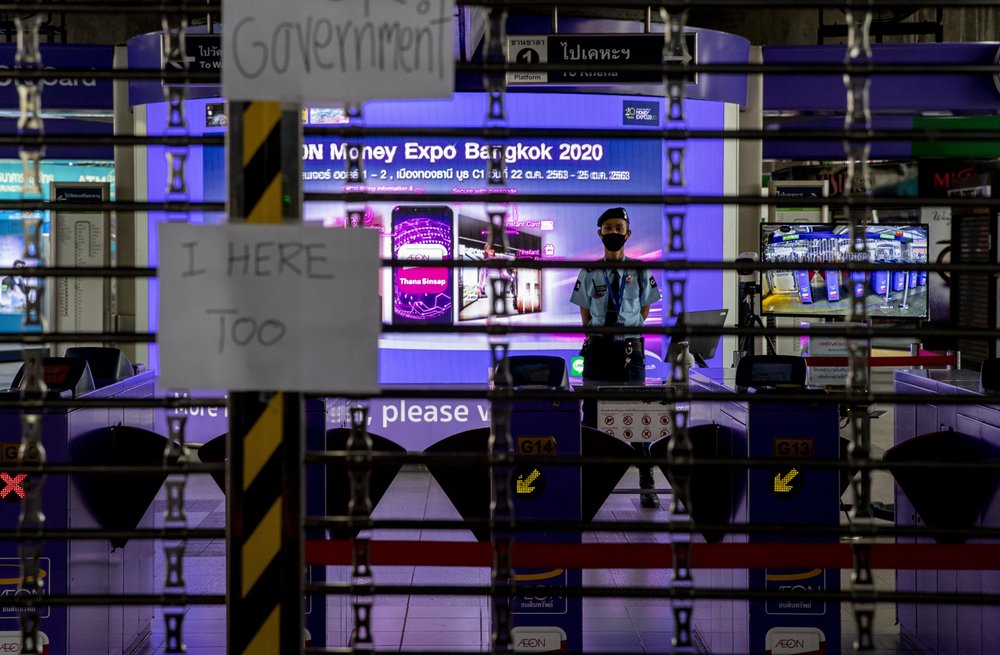
A security guard stands watch as placards against shutting down mass transport systems hang at Asoke BTS station in Bangkok, Thailand, Sunday, Oct. 18, 2020. (AP Photo/Gemunu Amarasinghe)
“During the protest, when everybody needed to go home, the BTS and MRT always closed, even though many fandoms … bought billboards with them,” Natsu, a 27-year-old fan of Korean supergroup BTS, said in an interview.
In the most notorious case, many protesters had to seek refuge in Chulalongkorn University when police cracked down on their rally on Oct. 16, as they could not use the BTS and MRT services to go home. Some stragglers were also arrested.
“I was furious when they closed the trains,” said Natsu, who has donated to several ad campaigns in the past. “It was difficult to travel. I had trust in them that even though the BTS was closed, at least the MRT would be open.”
Natsu said he supported the idea of buying up ads on the back of tuk-tuks instead of giving money to big corporations.
“I feel like it’s a way of spreading the wealth, not just with one company with lots of capital,” Natsu said. “So [ordinary people] would get more ways of earning income that they didn’t think they would get.”
K-pop fandoms in Thailand have been involved in activism since the latest wave of pro-democracy protests broke out in October. In that month, different groups of fanclubs raised millions of baht for the demonstrations.
Their prominence on social media also helps raise awareness about the protests and share the news about the political situations without having to rely on traditional media.
Tourists at a New Year fair in Nakhon Phanom, Dec. 23, 2019.
BANGKOK (Xinhua) — Thailand’s Ministry of Finance on Wednesday announced that the Thai cabinet had greenlighted another 43.5 billion baht (1.438 million U.S. dollars) package to boost domestic consumption and local travel, as Thailand is still reeling from a flagging economy triggered by COVID-19.
About 22.5 billion baht (744 million U.S. dollars) will be offered to 5 million new consumers, at 3,500 baht (115 U.S. dollars) each, under the current co-payment scheme, said Pornchai Theeravet, advisor to the ministry’s Fiscal Policy Office (FPO).
Pornchai said that the 10 million consumers who had already signed up would get a further 500 baht (16.53 U.S. dollars).
The new package would be given in small amounts from January to March, while 1,500 baht (49.60 U.S. dollars) would be offered to some 14 million low-income earners.
Pornchai said that the 43.5 billion baht (1.438 million U.S. dollars) package is intended as a New Year gift to Thai people who are still struggling to purchase goods and travel within the country.
“The extra money in their pockets will ease some of their financial woes, as well as spur the local economy,” said Pornchai.
Meanwhile, Finance Minister Arkhom Termpittayapaisith suggested that the Thai economy will need at least two years to recoup the 9 percent of the gross domestic product (GDP) lost to the pandemic crisis.
The minister said the Thai economy would have expanded by around 3 percent this year if the pandemic crisis did not erupt.
The pandemic crisis will make the economy contract by around 6 percent in 2020, therefore there is a 9 percent gap that needs to be recuperated, Arkhom said.