BANGKOK — A celeb known for his fundraising efforts to help rural communities struck by natural disasters said Monday he has left his charity work to focus on protecting the Royal Family from what he described as “evil anti-monarchists.”
Actor turned philanthropist Bin Banluerit announced his departure from the Ruamkatanyu Foundation on Facebook Live, a day after he drew controversy on social media by lashing out at young people who demand reforms of the monarchy and accused them of undermining the royal institution.
“I will not let these evil people do anything to the monarchy,” he said, taking off his Ruamkatanyu uniform to reveal a yellow shirt underneath. “I will fight for the monarchy and Thais who love the King.”
Bin had been a member of the rescue foundation for 34 years. An actor by career, Bin is also known for raising donations to those in need with Ruamkatanyu. In September 2019, he raised more than 355 million bahtfor flood relief efforts.
“The people who raised the middle finger at the royal motorcade, I will slap them if I face them. If it was your parents’ car, what would you do if they raised the finger? I’m angry,” Bin said, visibly upset. “Three fingers is fine. But raise one finger, and you’ll get what’s coming to you.”
Bin had said earlier in a Sunday interview on Amarin TV with his twin brother Ekapan “Tide” Banleurit that he disagreed with the ongoing protests that seek to reform the monarch.
“Your 10 reforms are impossible,” Bin said. “Do not challenge the silent majority. You are challenging people who love the King, the Lord of the Land. There are tens of millions of people who are ready to come out. Do not touch him.”
Bin said touching on the monarchy was “not Thai behavior. It’s the behavior of foreigners who weren’t born here.”
He also threatened to slap demonstrators who display any rude gesture to members of the Royal Family.
“Those anti-monarchists talk about this and that and never listen to reason,” he said. “I would never hurt children or old people, but if done in front of me I will slap them and pay the fine.”
Bin was referring to the royal motorcadecarrying Queen Suthida and Prince Dipangkorn, which drove through a group of protesters in front of Government House on Oct. 14.
Police shielded the public from coming into contact with the motorcade, which arrived without warning. Many in the crowd flashed the three-finger salute and heckled the vehicles, though several reportedly raised the middle finger as well.
Three activistshave been charged with “assaulting Her Majesty the Queen” following the incident. They face life in prison if convicted.
“I’ve never gone to any protests, not Yellowshirts, not Redshirts. My only protest stage is for the King,” Bin said.
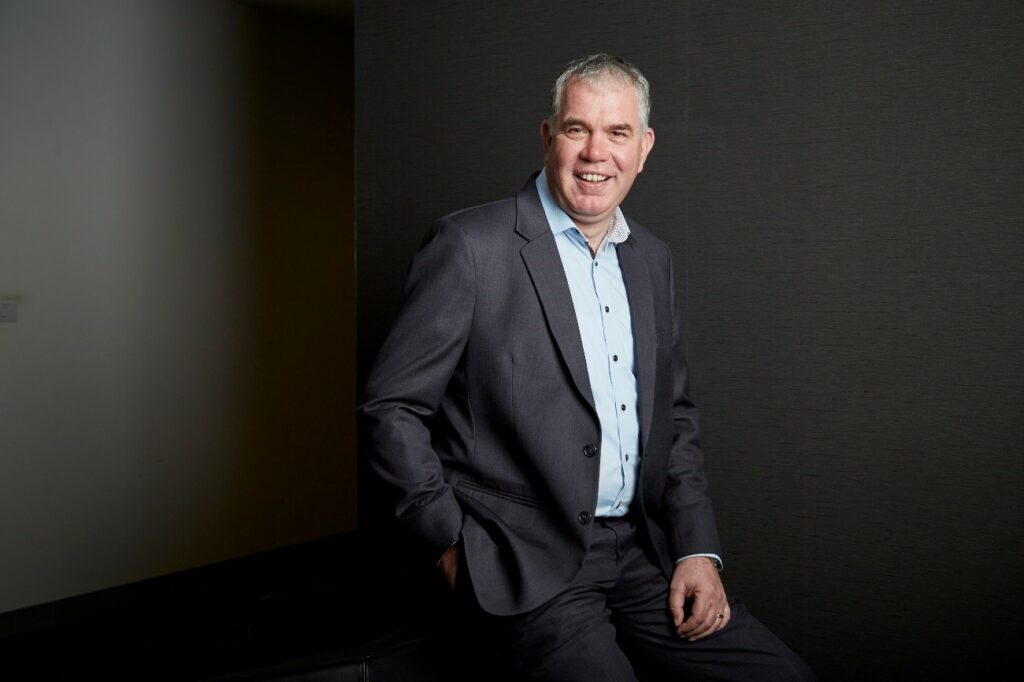
A file photo of Bin Banluerit.
The philanthropist also said he “had no problem with” student protests, but unless they touched upon or mentioned the nation, religion, and monarchy.
“What, you want to take the king out and have a president? That’s crazy rambling,” he said.
Bin said he decided to quit the Ruamkatanyu Foundation since management had asked him not to come out and make any political statement.
“I can’t stand it. Why are you going to the German Embassy today?” Bin said of the march on Monday. “I think 80 percent of these children have no idea what they’re doing.”
Bin also had his own moments with the Royal Family in October 2017, when His Majesty the King Rama appointed him as a representative in a kathin ceremony at Wat Hua Lamphong in Bangkok.
A news report on the Oct. 26, 2020, demonstration to the German Embassy by MCOT. Image. YouTube.
BANGKOK — A state-owned media corporation on Tuesday announced an early retirement program for its employees in an attempt to cope with massive losses – the latest media agency in Thailand to feel the pain from the pandemic slump.
MCOT, a state enterprise that operates TV channels as well as the Thai News Agency, said in a statement that as many as 300 employees have signed up for the offer, which comes with a cash payout of 35 times the latest salary they received.
“MCOT will select applicants who meet the criteria [for the early retirement],” the statement said. “We affirm that this program is not a layoff, but a voluntary participation by employees.”
An executive said earlier this month that the corporation is seeking to slash staff numbers down to 700, from the current roster of 1,300.
In a memo shared within the company, MCOT director Sirote Ratanamahatana said the decision was made in response to the financial crisis suffered by the company, and was approved by the Ministry of Finance, who owned the company’s shares.
“The Digital Disruption resulted in the persistent decrease of television viewers and radio listeners. Advertising revenues dry up,” Sirote wrote. “And the latest factor is the coronavirus situation, which led to an uncontrollable and endless impact on the economy.”
Sirote also said the staff reduction will be accomplished by voluntary resignation, but the policy will not affect the current salaries.
The coronavirus pandemic is a bane to many media agencies already struggling with the digital and social media revolution in Thailand, which saw a sharp drop in TV and radio consumption in recent years.
Revenues in the media industry shrank by 20 percent in the first seven months of 2020 compared to the same period last year, according to a report by Media Intelligence survey firm.
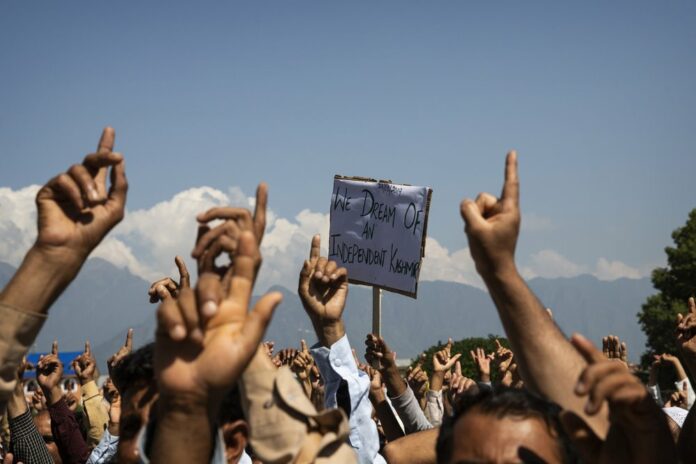
Kashmiri men shout freedom slogans during a protest against New Delhi's tightened grip on the disputed region, after Friday prayers on the outskirts of Srinagar, Indian controlled Kashmir, Aug. 23, 2019. The image was part of a series of photographs by Associated Press photographers which won the 2020 Pulitzer Prize for Feature Photography. (AP Photo/Dar Yasin)
By Asim Iftikhar Ahmad, Pakistan’s ambassador to Thailand
For its eternal beauty and serenity, Kashmir has for ages been called a paradise. Unfortunately, this heaven on earth is now one of the world’s most oppressed and brutalized places.
Illegally occupied and heavily militarized, Kashmir is in the news sadly for atrocities, killings and human rights violations rather than its charm and splendor and its loving people. A disputed territory and a conflict zone for decades, Kashmir is also known as the nuclear flashpoint of the world.
People often ask what was the Jammu & Kashmir dispute about, and how could it be resolved. A short yet precise answer to that is ‘self-determination’. The genesis of the Kashmir issue was in the right to self-determination of the Kashmiri people. The solution to the dispute also lies in the exercise of that very right.
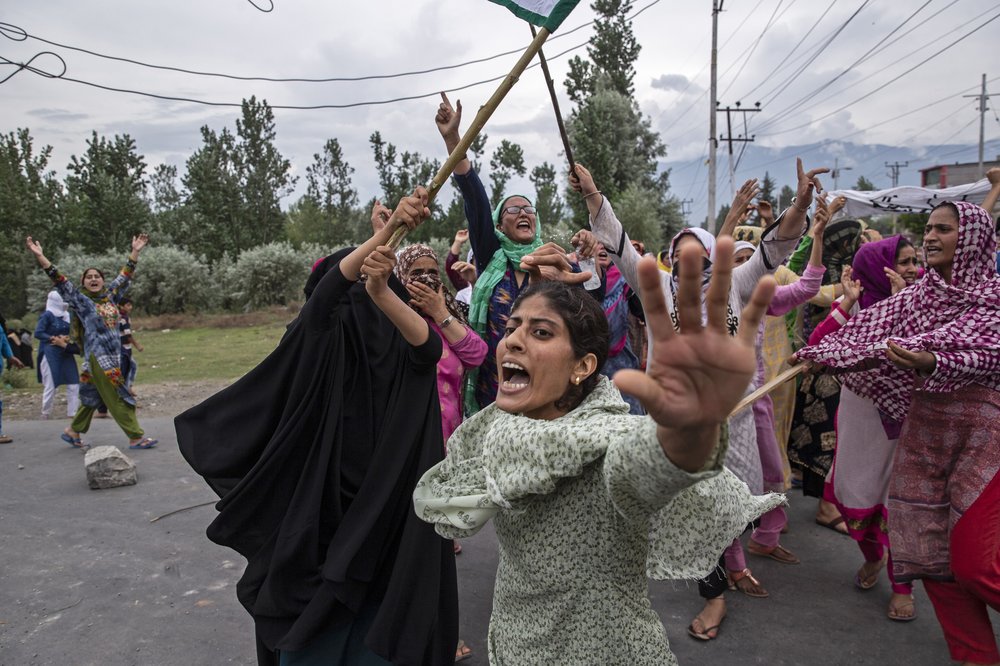
Women shout slogans as Indian policemen fire teargas and live ammunition in the air to stop a protest march in Srinagar, Indian controlled Kashmir, Aug. 9, 2019. (AP Photo/Dar Yasin)
Yes, the State of Jammu & Kashmir has been the subject of a territorial dispute between India and Pakistan ever since the two countries gained independence from British rule in 1947. The dispute has an international character in that it has been on the agenda of the United Nations Security Council (UNSC) since 1948.
Over the course of years, UNSC adopted several resolutions to promote a peaceful settlement of the dispute. The crux of those resolutions was the right to self-determination, wherein the Security Council stipulated that the final status or the question of accession of Jammu & Kashmir to either India or Pakistan was to be decided by the will of the Kashmiri people expressed through the democratic method of a plebiscite to be held under the auspices of the UN.
It cannot get clearer than that. Kashmiri people’s right to determine their own future was therefore enshrined and guaranteed by the UN. And to start with, it was endorsed and accepted by both India and Pakistan.
So why has the issue remained unresolved? That is because India backtracked on its commitments. Fearing that given the free choice, Kashmiris would never join India, it refused to let the UN plebiscite take place. For over 72 years, India has illegally and forcibly occupied Jammu and Kashmir against the wishes of the Kashmiri people, and in flagrant violation of the Security Council resolutions.
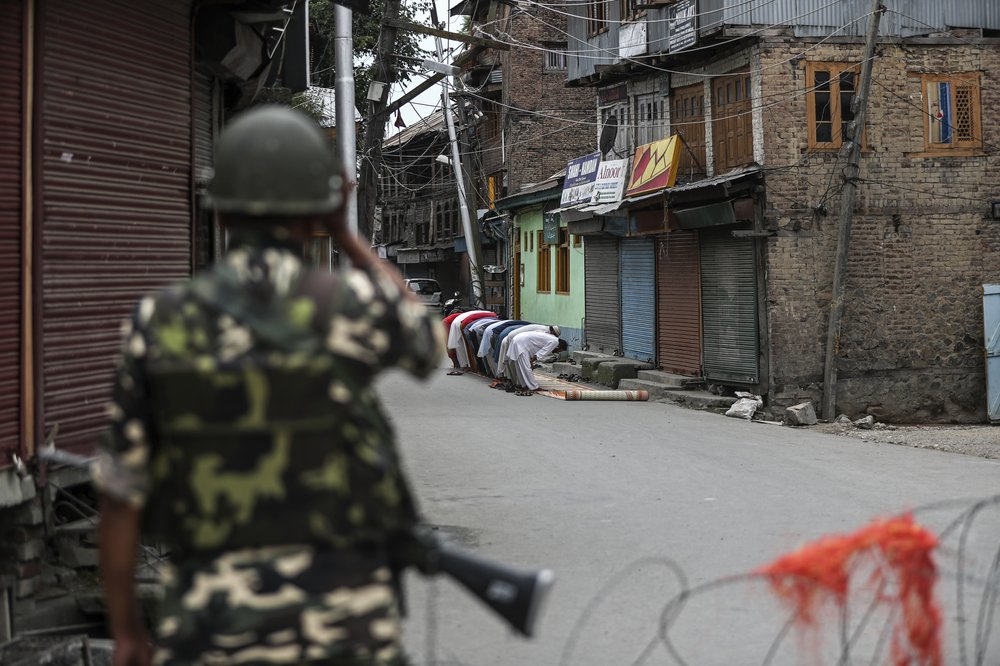
An Indian paramilitary soldier stands guard as Kashmiri Muslims offer Friday prayers on a street outside a local mosque during curfew like restrictions in Srinagar, India, Aug. 16, 2019. (AP Photo/Mukhtar Khan)
Then on 5 August last year (which Arundhati Roy termed as India’s Day of Shame), India sought to change the status of the occupied territories illegally and unilaterally. With over 900,000 troops, it imposed a military siege on 8 million Kashmiris, incarcerated the entire Kashmiri political leadership, and abducted and detained incommunicado thousands of Kashmiri youth.
Curfew, total communications blackout and denial of access to international media and observers, created a climate of impunity in which use of brute force, human rights violations, imposition of collective punishment, enforced disappearances and extra-judicial killings of innocent Kashmiris has continued unabated.
Kashmiri media and those daring to raise their voice have been systematically harassed and intimidated. Nevertheless, the atrocities have been well documented by the UN High Commissioner for Human Rights, mechanisms of the Human Rights Council, civil society and human rights organizations including Human Rights Watch and Amnesty International whose office was recently closed down in India.
The military siege is being followed by India’s moves to change the demographic structure of Kashmir, a blatant attempt to obliterate the distinct Kashmiri identity and to undermine the UN plebiscite. All these actions are in violation of the UN Charter, Security Council resolutions and international law, particularly the 4th Geneva Convention according to which altering the demographics of an occupied territory is a war crime.
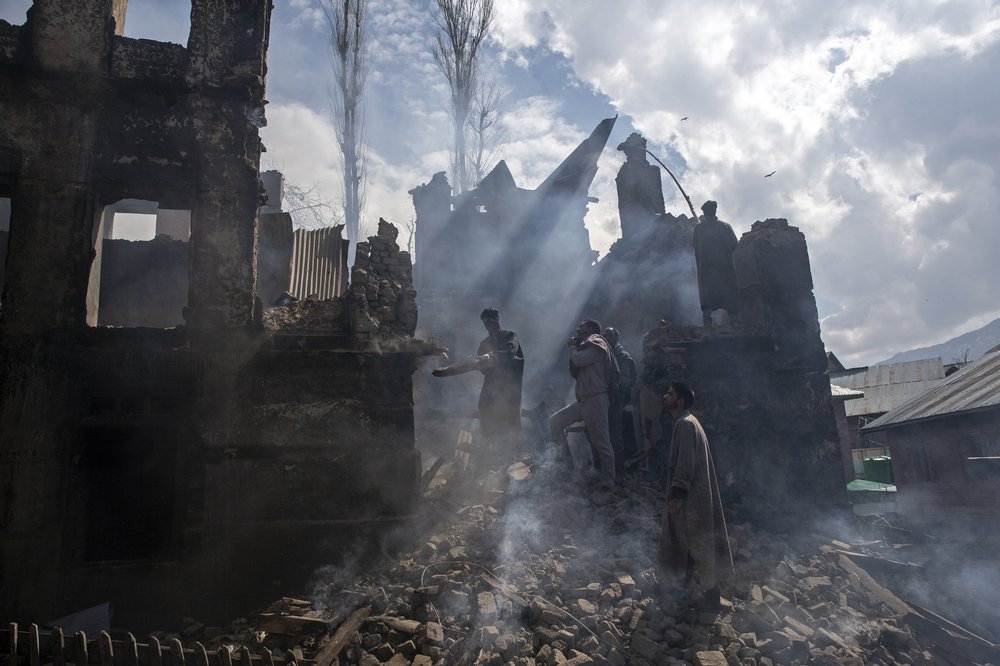
Kashmiri men dismantle a portion of a house destroyed in a gunbattle in Tral village, south of Srinagar, Indian controlled Kashmir, March 4, 2019. (AP Photo/Dar Yasin)
It is evident that the Kashmiri people will never submit to Indian occupation and oppression. Their struggle is for a just cause i.e. self-determination that has been sanctioned by the UN. We are asked about Pakistan’s position on Jammu & Kashmir. It is clear.
The government and people of Pakistan are fully committed to support the Kashmiri people in their legitimate demand for self-determination. More than that, Pakistan’s position is completely in line with the UN position on Kashmir that represents international legitimacy and international law.
That is what distinguishes Pakistan’s approach on this issue vis-à-vis India’s manifest disregard and breach of UNSC resolutions on Kashmir.
Consequences of the unresolved Kashmir dispute are grave and multi-dimensional, from the threat to peace and security, to the humanitarian crisis and human rights violations. It is also the major stumbling block for regional cooperation and development, holding back Asia’s great promise.
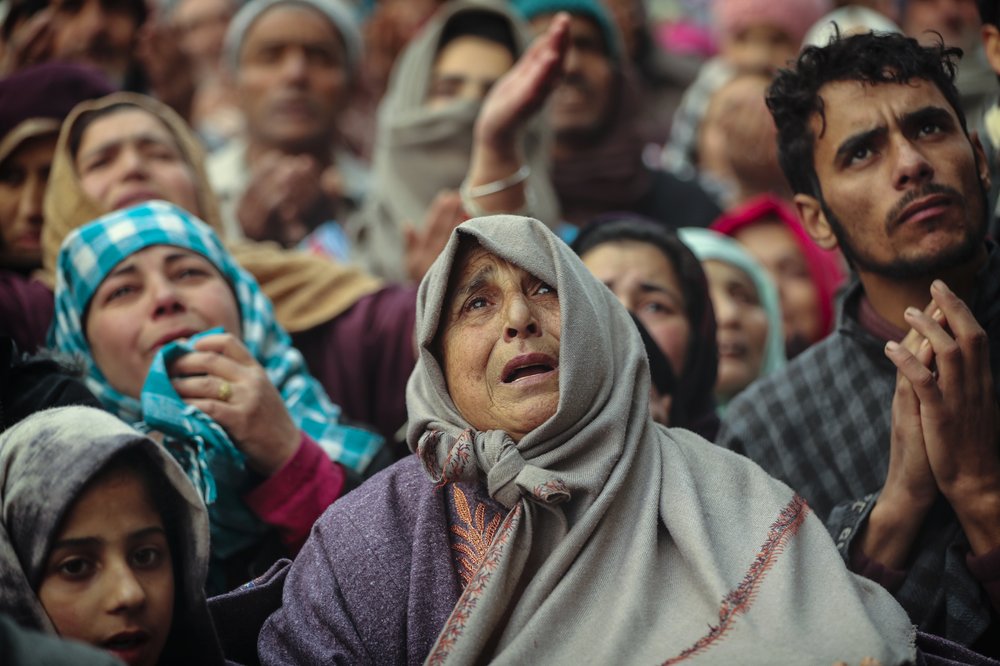
Kashmiri Muslim devotees offer prayer outside the shrine of Sufi saint Sheikh Syed Abdul Qadir Jeelani in Srinagar, Indian controlled Kashmir, Dec. 9, 2019. (AP Photo/Mukhtar Khan)
In the interest of durable peace and stability in South Asia, the Jammu & Kashmir dispute must be resolved peacefully on the basis of international legitimacy. To this effect, the UN Security Council has to shoulder its Charter responsibility and secure the implementation of its own resolutions.
The international community must also play its due role to impress upon India to rescind its illegal actions, end the military siege and human rights violations, and agree to resolve the Jammu & Kashmir dispute in accordance with the relevant UNSC resolutions.
Kashmiri people have seen too much suffering. They have waited for far too long. It is time to end the illegal occupation of over seven decades. The best possible peaceful and legal way of doing that is to enable the people of Kashmir to exercise their right to self-determination as promised to them by the UN Security Council.
Let the people decide their own future. Let Kashmir speak.
About the author Asim Iftikhar is the Ambassador of the Islamic Republic of Pakistan to Thailand. A career diplomat, Asim also served as the Minister of the Permanent Mission of Pakistan to the United Nations from 2012 to 2014.
BANGKOK — Once in a rare full moon, Loy Krathong and Halloween falls on the same fateful night – so pick your poison for 2020 and whether you want your dreams or nightmares to come true.
Here’s a list for things to do this Loy Krathongloween on Saturday:
No, I Actually Want to Float Krathong
Zip between 10 piers along the Chao Phraya via free shuttle boat to visit temples, support locals’ shops, and visit historic areas of Old Bangkok from Oct. 29 to 31 at the “River Festival Thailand 2020.”
Stops include Wat Pho, Wat Arun, Tha Maharaj, lesser-known temples, as well as riverside tourist spots like Asiatique and Lhong 1919. Iconsiam mall’s festival runs Tuesday through Sunday, and will have ice krathongs (despite the term, they are not drugs) and biodegradable krathongs for people to float.
Bangkok Metropolitan Authority will hold a Loy Krathong celebration by Khlong Oang Ang
A Halloween-themed Loy Krathong will take place at Chulalongkorn University’s pondin the city center.
Those going upcountry for the weekend may want to stop by Sukhothai Historical Park, where Loy Krathong Festival will be hosted from Oct. 23 to Nov. 1, with light and sound shows from Tuesday through Saturday. Free entry.
No, I Actually Want to Be Scared
On Halloween night, the Bangkok Hiking Meetupwill camp on a remote campsite close to where the Lauda Air Flight 004 crashed in 1991 in Suphan Buri and killed all 213 passengers – the deadliest aviation tragedy in Thai history.
Local hikers say they have seen foreigners dressed in business clothes walking around the crash site. Price: 4,800 baht for a three-day trip.
Halloween at Bangkok 1899
Trade for a Halloween costume last-minute at the Bangkok 1899’s Halloween eventwhich will include a clothing swap, pumpkin carving, face painting, and a barbecue.
Horror Movie Trivia
Aesop’s Bangkok is holding a trivia night for horror film buffs on Thursday at 7:30pm. Free entry, and winners will receive cash prizes or food vouchers.
Family-Friendly Halloweens
Here’s a list of Halloween events suitable for the kids:
Halloween Monsters Party at K-Village, Oct. 31 from 3pm to 9pm. Trick-or-treating, carnival games, and a Halloween market expected.
Untz, untz, untz goes the beat while the Bangkok bourgeoisie dress up as nurses, witches, and Mae Naak on Halloween night.
Stranger Bar’s resident drag queen M Stranger Fox is throwing a “Halloween Hallo Queens” party on Saturday 8pm and will feature drag queens Gisele, Srimala, Jai Sira, and Natalia Pliacam.
Latino Halloween Party at Mojjo Rooftop Party, free flow drinks 699 baht from 7pm to 9pm
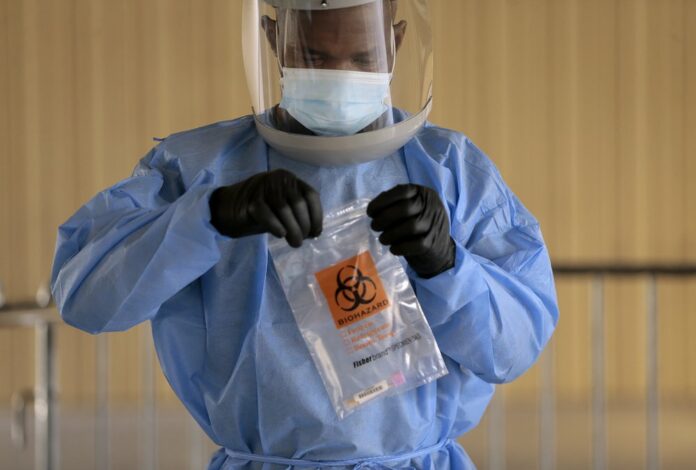
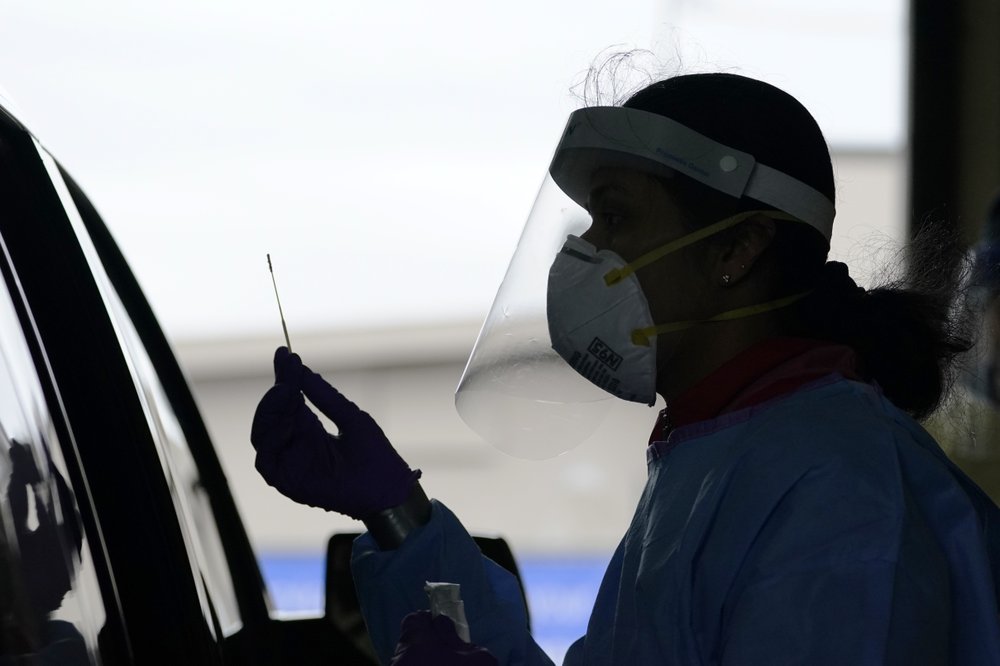
Divine Ayong seals a test in a biohazard bag after collecting a sample Monday, Sept. 21, 2020, at The University of Texas at El Paso's Fox Fine Arts building in El Paso, Texas. (Mark Lambie/The El Paso Times via AP)
BOISE, Idaho (AP) — Deaths per day from the coronavirus in the U.S. are on the rise again, just as health experts had feared, and cases are climbing in practically every state, despite assurances from President Donald Trump over the weekend that “we’re rounding the turn, we’re doing great.”
With Election Day just over a week away, average deaths per day across the country are up 10% over the past two weeks, from 721 to nearly 794 as of Sunday, according to data from Johns Hopkins University. Newly confirmed infections per day are rising in 47 states, and deaths are up in 34.
Health experts had warned that it was only a matter of time before deaths turned upward, given the record-breaking surge in cases engulfing the country. Deaths are a lagging indicator — that is, it generally takes a few weeks for people to sicken and die from the coronavirus.
Michael Osterholm, a University of Minnesota expert on infectious diseases who warned over the summer of a fall surge, said what’s happening now is a confluence of three factors: “pandemic fatigue” among people who are weary of hunkering down and are venturing out more; “pandemic anger” among those are don’t believe the scourge is a real threat; and cold weather, which is forcing more Americans indoors, where the virus can spread more easily.
“When you put those three together, we shouldn’t be surprised what we’re seeing,” Osterholm said.
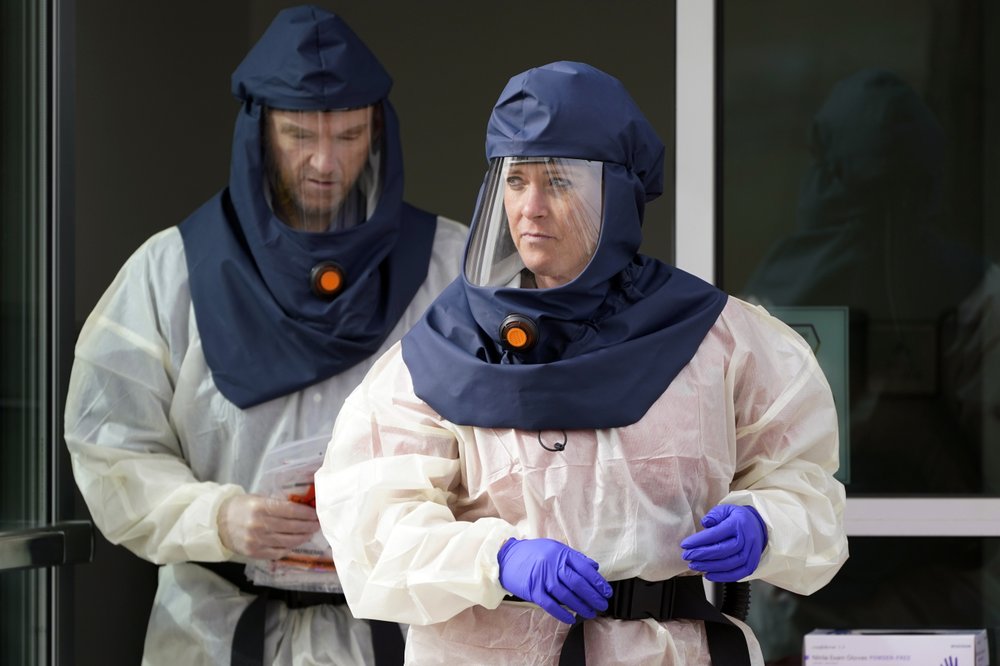
In this Oct. 23, 2020, file photo, Salt Lake County Health Department public health nurses look on during coronavirus testing outside the Salt Lake County Health Department in Salt Lake City. (AP Photo/Rick Bowmer, File)
The virus is blamed for more than 8.6 million confirmed infections and over 225,000 deaths in the U.S., the highest such totals in the world.
Deaths are still well below the U.S. peak of over 2,200 per day in late April. But experts are warning of a grim fall and winter, with a widely cited model from the University of Washington projecting about 386,000 dead by Feb. 1. A vaccine is unlikely to become widely available until mid-2021.
The seven-day rolling average for daily new cases hit a record high on Sunday of 68,767, according to Johns Hopkins, eclipsing the previous mark of 67,293, set in mid-July. The U.S. recorded more than 80,000 new cases on both Friday and Saturday — the highest marks ever — though testing has expanded dramatically over the course of the outbreak, making direct comparisons problematic.
The true number of infections is thought to be far higher because many Americans have not been tested, and studies suggest people can be infected without feeling sick.
On Wall Street, stocks had their worst day in more than a month, amid the surging caseload and mounting doubts that Washington will come through with more relief for the economy before Election Day. The S&P 500 slid 1.9% Monday, while the Dow Jones Industrial Average shed 650 points, or 2.3%.
On Monday, the White House coronavirus response coordinator spent the day looking around North Dakota’s capital city and proclaimed the COVID-19 protocols to be the worst she’s seen in her travels around the country.
Dr. Deborah Birx, whose tour has taken her to nearly 40 states, said she found the absence of face coverings and the lack of social distancing in Bismarck “deeply unfortunate” and a danger.
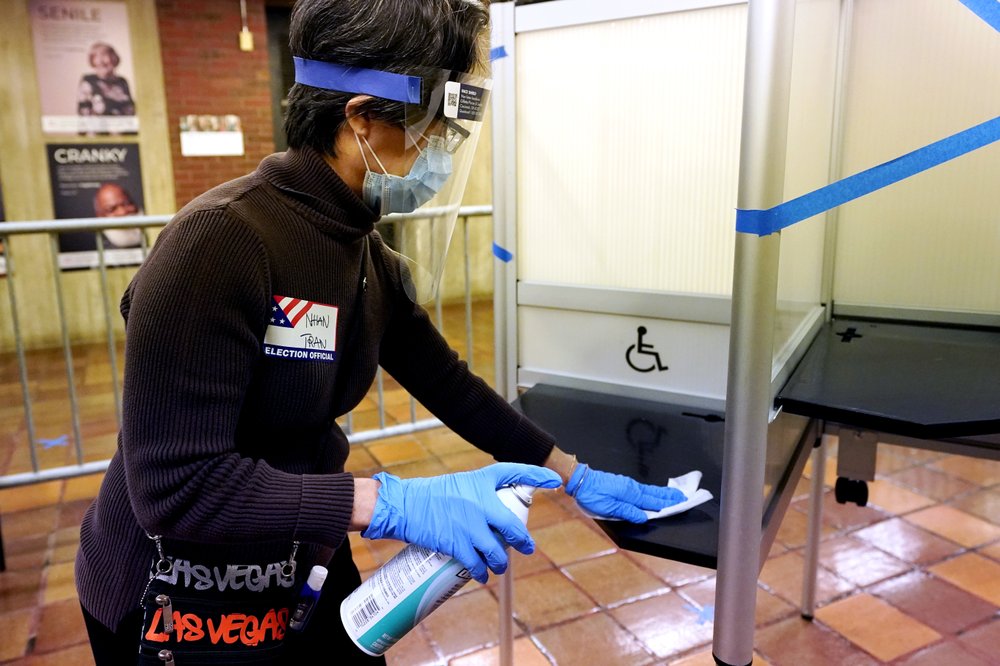
Election official Nhan Tran wipes down a voting booth at Boston City Hall during early in-person voting, Monday, Oct. 26, 2020, in Boston. (AP Photo/Elise Amendola)
“Over the last 24 hours as we were here and we were in your grocery stores and in your restaurants and frankly even in your hotels, this is the least use of masks that we have we seen in retail establishments of any place we have been,” Birx said. “And we find that deeply unfortunate because you don’t know who’s infected and you don’t know if you’re infected yourself.”
In the Texas border city of El Paso, authorities instructed people to stay home for two weeks and imposed a 10-p.m.-to-5-a.m. curfew because of a surge that has overwhelmed hospitals. The state is converting part of the city’s civic center into a hospital.
“We are in a crisis stage,” El Paso County Judge Ricardo Samaniego, the county’s top elected official, as he issued the stay-at-home order over the weekend.
On Monday, the county reported a record high in daily cases, with 1,443, and 853 patients hospitalized because of the virus, up from 786 a day earlier. The state has provided over 900 medical personnel to El Paso, some of whom will staff the convention center site.
Just last week, Trump during the last presidential debate downplayed the virus’ effect in the Lone Star State, saying: “There was a very big spike in Texas, it’s now gone.”
Trump said repeatedly over the weekend that the country is “rounding the turn.” His remarks came amid another outbreak in the White House inner circle. Several close aides to Vice President Mike Pence tested positive, including his chief of staff.
In Idaho, where large numbers of residents resist wearing a mask, Republican Gov. Brad Little on Monday ordered a return to some restrictions to slow the spread of the virus as rising cases put a strain on the hospital system.
Little’s directive limits indoor gatherings to 50 people, urges businesses to encourage employees to work from home, among other steps.
Idaho’s positivity test rate is fourth-worst in the nation. St. Luke’s, with hospitals in southwestern and central Idaho, is reporting that 20% of hospitalized patients are suffering from COVID-19. Its hospital in Twin Falls has postponed elective surgeries and are sending children in need of medical care to Boise, about 125 miles away.
Primary Health Medical Group, the largest independent medical group in Idaho, has had to close two of its 19 urgent care clinics in southwestern Idaho because of sick or quarantined staff. The clinics are a buffer keeping hospital emergency rooms in the region from getting clogged with patients not needing emergency-level care.
Oklahoma is one of the states consistently breaking records for new cases, and the strain is being felt in hospitals. Bed space is running out, and an equally daunting problem is a shortage of nursing staff.
In this Oct. 23, 2020, file photo, University of Washington research coordinator Rhoshni Prabhu holds up a swab after testing a passenger at a free COVID testing site in Seattle. (AP Photo/Elaine Thompson)
Dr. Sam Ratermann, director of the hospitalist program at INTEGRIS Grove Hospital in Grove, Oklahoma, said patients are being transferred from “hospital to hospital across the state” for lack of beds.
“Even when we have open ICU beds across the state, we don’t have staff to fill them,” Ratermann said. “There’s going to be a point where there’s no beds and we can’t even care for our local citizens.”
The University of Minnesota’s Osterholm has been predicting the darkest days will be in the weeks or months ahead. He said he expects increased competition for drugs and shortages of hospital specialists, N95 masks and other protective gear.
A strong national response plan was needed, along with consistent messaging that emphasized mask wearing and other preventive measures, Osterholm said.
“But our response has been… I don’t know what our response has been,” he said.
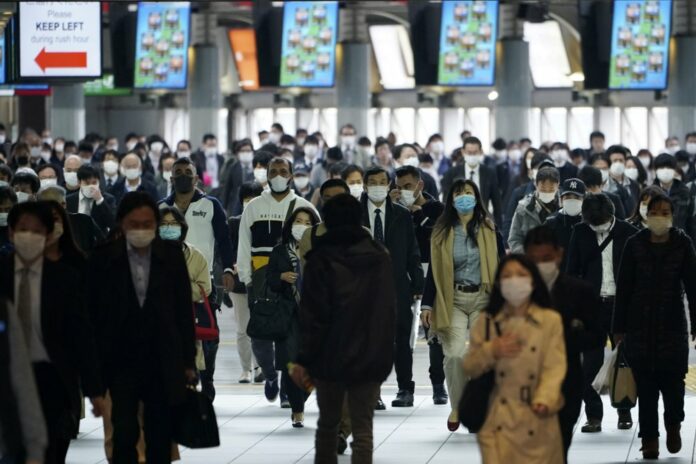
A station passageway is crowded with commuters wearing face mask during a rush hour in Tokyo Monday, April 27, 2020. (AP Photo/Eugene Hoshiko)
TOKYO (Kyodo) — The Japanese government on Tuesday approved a bill to pay all the costs of administrating a vaccine against the novel coronavirus to all residents and to compensate suppliers in the event any serious side effects occur.
The bill to amend the current vaccination law is in line with Prime Minister Yoshihide Suga’s pledge to secure coronavirus vaccines for all people in the country in the first half of next year. His government is aiming for its enactment during the current Diet session through Dec. 5.
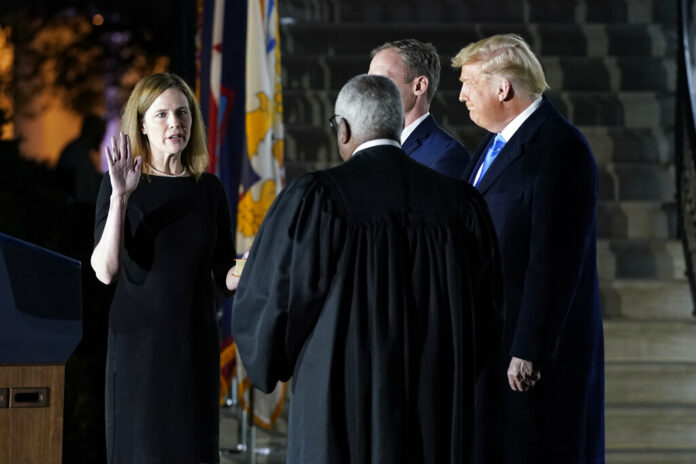
President Donald Trump watches as Supreme Court Justice Clarence Thomas administers the Constitutional Oath to Amy Coney Barrett on the South Lawn of the White House in Washington, Monday, Oct. 26, 2020, after Barrett was confirmed by the Senate earlier in the evening. Photo: Patrick Semansky / AP
WASHINGTON (AP) — Amy Coney Barrett was confirmed to the Supreme Courtlate Monday by a deeply divided Senate, with Republicans overpowering Democrats to install President Donald Trump’s nominee days before the election and secure a likely conservative court majority for years to come.
Trump’s choice to fill the vacancy of the late liberal icon Ruth Bader Ginsburg potentially opens a new era of rulings on abortion, the Affordable Care Act and even his own election. Democrats were unable to stop the outcome, Trump’s third justice on the court, as Republicans race to reshape the judiciary.
Barrett, 48, will be able to start work Tuesday, her lifetime appointment as the 115th justice solidifying the court’s rightward tilt.
“This is a momentous day for America,” Trump said at a primetime swearing-in event on the South Lawn at the White House, before Justice Clarence Thomas administered the Constitutional Oath to Barrett before a crowd of about 200.
Barrett told those gathered that she believes “it is the job of a judge to resist her policy preferences.” She vowed, “I will do my job without any fear or favor.”
Monday’s vote was the closest high court confirmation ever to a presidential election, and the first in modern times with no support from the minority party. The spiking COVID-19 crisis has hung over the proceedings. Vice President Mike Pence declined to preside at the Senate unless his tie-breaking vote was needed after Democrats asked him to stay away when his aides tested positive for COVID-19. The vote was 52-48, and Pence’s vote was not necessary.
“Voting to confirm this nominee should make every single senator proud,” said Senate Majority Leader Mitch McConnell, fending off “outlandish” criticism in a lengthy speech. During a rare weekend session he declared that Barrett’s opponents “won’t be able to do much about this for a long time to come.”
Barrett is expected to take the judicial oath administered by Chief Justice John Roberts in a private ceremony Tuesday at the court to begin participating in proceedings.
Underscoring the political divide during the pandemic, the Republican senators, most wearing masks, sat in their seats as is tradition for landmark votes, and applauded the outcome, with fist-bumps. Democratic senators emptied their side, heeding party leadership’s advice to not linger in the chamber. A Rose Garden event with Trump to announce Barrett’s nomination last month ended up spreading the virus, including to some GOP senators who have since returned from quarantine.
Pence’s presence would have been expected for a high-profile moment. But Senate Democratic leader Chuck Schumer and his leadership team said it would not only violate virus guidelines of the Centers for Disease Control and Prevention, “it would also be a violation of common decency and courtesy.”
Democrats argued for weeks that the vote was being improperly rushed and insisted during an all-night Sunday session it should be up to the winner of the Nov. 3 election to name the nominee. However, Barrett, a federal appeals court judge from Indiana, will be able swiftly start hearing cases.
Speaking near midnight Sunday, Sen. Elizabeth Warren, D-Mass., called the vote “illegitimate” and “the last gasp of a desperate party.”
Several matters are awaiting decision just a week before Election Day, and Barrett could be a decisive vote in Republican appeals of orders extending the deadlines for absentee ballots in North Carolina and Pennsylvania.
The justices also are weighing Trump’s emergency plea for the court to prevent the Manhattan District Attorney from acquiring his tax returns. And on Nov. 10, the court is expected to hear the Trump-backed challenge to the Obama-era Affordable Care Act. Just before the Senate vote began, the court sided with Republicans in refusing to extend the deadline for absentee ballots in Wisconsin.
Trump has said he wanted to swiftly install a ninth justice to resolve election disputes and is hopeful the justices will end the health law known as “Obamacare.”
During several days of public testimony before the Senate Judiciary Committee, Barrett was careful not to disclose how she would rule on any such cases.
She presented herself as a neutral arbiter and suggested, “It’s not the law of Amy.” But her writings against abortion and a ruling on “Obamacare” show a deeply conservative thinker.
Sen. Lindsey Graham, R-S.C., the chairman of the Judiciary Committee, praised the mother of seven as a role model for conservative women. “This is historic,” Graham said.
Republicans focused on her Catholic faith, criticizing earlier Democratic questions about her beliefs. Graham called Barrett “unabashedly pro-life.”
At the start of Trump’s presidency, McConnell engineered a Senate rules change to allow confirmation by a majority of the 100 senators, rather than the 60-vote threshold traditionally needed to advance high court nominees over objections. That was an escalation of a rules change Democrats put in place to advance other court and administrative nominees under President Barack Obama.
Republicans are taking a political plunge days from the Nov. 3 election with the presidency and their Senate majority at stake.
Only one Republican — Sen. Susan Collins, who is in atight reelection fight in Maine — voted against the nominee, not over any direct assessment of Barrett. Rather, Collins said, “I do not think it is fair nor consistent to have a Senate confirmation vote prior to the election.”
Trump and his Republican allies had hoped for a campaign boost, in much the way Trump generated excitement among conservatives and evangelical Christians in 2016 over a court vacancy. That year, McConnell refused to allow the Senate to consider then-President Barack Obama’s choice to replace the late Justice Antonin Scalia, arguing the new president should decide.
Most other Republicans facing tough races embraced the nominee who clerked for the late Scalia to bolster their standing with conservatives. Sen. Thom Tillis, R-N.C., said in a speech Monday that Barrett will “go down in history as one of the great justices.”
But it’s not clear the extraordinary effort to install the new justice over such opposition in a heated election year will pay political rewards to the GOP.
Demonstrations for and against the nominee have been more muted at the Capitol under coronavirus restrictions.
Democrats were unified against Barrett. While two Democratic senators voted to confirm Barrett in 2017 after Trump nominated the Notre Dame Law School professor to the appellate court, none voted to confirm her to the high court.
In a display of party priorities, California Sen. Kamala Harris, the Democratic vice presidential nominee, returned to Washington from the campaign trail to join colleagues with a no vote.
No other Supreme Court justice has been confirmed on a recorded vote with no support from the minority party in at least 150 years, according to information provided by the Senate Historical Office.
___
Story: Lisa Mascaro. Associated Press writers Mary Clare Jalonick, Andrew Taylor, Mark Sherman, Zeke Miller and Aamer Madhani in Washington and Kathleen Ronayne in Sacramento, Calif., contributed to this report.
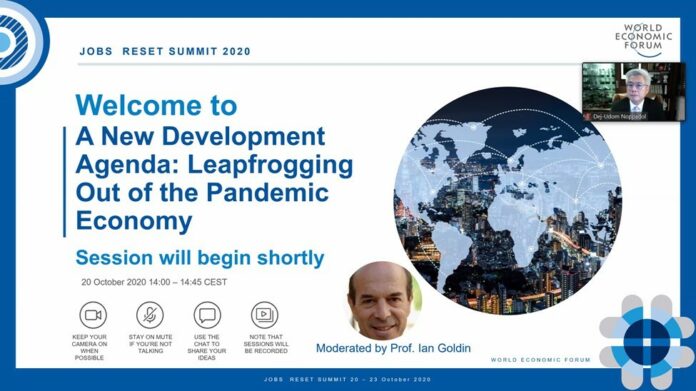
October 27, 2020 – Recently Mr Noppadol Dej-Udom, Chief Sustainability Officer of Charoen Pokphand Group Co., Ltd., joined the online panel discussion titled “A New Development Agenda: Leapfrogging Out of the Pandemic Economy”, organized by the World Economic Forum as part of the Jobs Reset Summit 2020, presenting experience of C.P. Group in handling the impacts of the ongoing Covid-19 pandemic as well as providing insights into post-crisis global economic development strategy.
In addition to Mr Noppadol, who represented a multinational business that operates across the globe, the diverse panel of leaders from multiple sectors included Debora Revoltella, Director of the Economics Department of the European Investment Bank, Fatoumata Ba, Founder and Managing Director of Janngo Capital, and Alfred Hannig, Executive Director of the Alliance for Financial Inclusion (AFI). The discussion was moderated by Ian Goldin, Professor of Globalization and Development at the University of Oxford.
The panelists discussed about the global challenges to achieve the Sustainable Development Goals (SDGs) by the year 2030, and the need to “leapfrog” out of the present economic crisis caused by the ongoing Covid-19 pandemic.
Mr Noppadol presented C.P. Group’s experience in working closely with the government and civil society sectors to mitigate the impact of the healthcare crisis, in line with the Group’s “Three-Benefit Principle” which include the consideration of benefits to the nations, the communities, and finally the business returns. For example, the Group announced a global policy not to lay off any employee during the Covid-19 crisis, and opened up additional 28,000 positions in various subsidiaries in Thailand. The Group provided food assistance to people under quarantine and medical staff, as well as built a surgical mask factory to supply healthcare workers. He also responded to questions about the private sector’s role in economic development in developing countries, stressing the needs for multi-sector collaborations in investing for the future.
“The United Nations estimated that we need to invest about 3.3 to 4.5 trillion US dollars per year to achieve the SDGs by 2030. To handle such large investment, I think it is vital that all sectors come together to share resources as well as to share the risks,” said Mr Noppadol. He added “businesses also need to evolve with the growing complexity of the development challenges. In the past, development work implemented by private sector alone, or in public-private partnership arrangement, often look at individual projects and initiatives to address particular needs. This kind of focused projects will still be needed, but the new realities also require a more comprehensive approach, such as development of an ecosystem or enabling mechanisms.”
Other distinguished panelists provided strategies for post-Covid economic development. Ms Revoltella of the European Investment Bank, highlighted Europe’s focus on impact investing for environmental sustainability and transformation of the job market to match the changing demographic character of Europe’s population. Ms Ba from Janngo Capital pointed out that Africa has been particularly hard hit by the pandemic economically, losing $60 billion a month since its outbreak and suffering massive job loss. “E-commerce could create a net 3 million jobs in Africa by 2025” she said, adding that a lot of investment is needed to unlock the potential of online economy and enhance women’s participation in driving local economic growth. Mr Hannig from Alliance for Financial Inclusion argued that microfinance can go a long way when it comes to women, especially, in the Global South – and that mobile money accounts can vastly facilitate both access to and servicing of microlending.
C.P. Group Chief Sustainability Officer referred to the role of the business sector during the World Wars, in which virtually all companies and factories were involved in producing war materials. In comparison, the current Covid-19 pandemic is a common enemy that requires collective effort of all parties to combat. Similarly, other global challenges such as climate change, biodiversity losses, international and social conflicts, also pose existential threat to humanity. Professor Goldin concurred with Mr Noppadol’s comparison and expressed hope that the world will learn useful lessons from the current pandemic, as it did from the Second World War, which led to the establishment of multinational frameworks that seek to promote peaceful resolution of conflicts and enhanced multilateral collaborations.
PM Prayut Chan-o-cha takes photo of an opposition MP during the Parliament special session on Oct. 26, 2020.
BANGKOK — A leading opposition lawmaker on Monday chose to leave a parliamentary debate after he refused to withdraw his quotation of a popular insult adopted by pro-democracy protesters.
While addressing the Parliament earlier today, Seri Ruam Thai Party chairman Sereepisut Temiyavet mentioned that he’s heard many protesters using the term “I Hear Too” in recent weeks – a disparaging slang that references PM Prayut Chan-o-cha’s nickname, Tuu.
“Whenever the students assemble, in bars, restaurants, schools, there’s a song saying I Hear Too,” Sereepisut said.
House Speaker Chuan Leekpai immediately interrupted him and told Sereepisut to withdraw the remark, since it’s considered an insult.
“It’s inappropriate. It references other individuals,” Chuan chided the lawmaker.
“My nickname is also Tuu!” Sereepisut offered a defense. “I didn’t curse at anyone at all … I only quoted the students.”
Chuan continued to insist on his instruction for Sereepisut to withdraw the term. In reply, the MP shut off his mic and stormed off.
Chuan then told a parliamentary clerk to describe the encounter in the official record as “use of a sarcastic word.”
“Ai Hia Tuu” is a derogatory term that can be heard in many recent anti-government protests, though the word is often written in a relatively innocent style as “I Hear Too.”
There’s also a version of the Thai pop song “1 2 3 4 5” played at the rallies. Instead of singing “I love you,” as mandated in the original lyrics, the demonstrators shouted “Ai Hia Tuu” at the top of their lungs.
The Parliament began a special session Monday, supposedly to address tensions as pro-democracy protests drew students and other demonstrators into the streets almost daily demanding PM Prayut’s resignation.
Only 450 of the total of 731 members of both lower and upper houses had signed in for the meeting. The non-voting session is expected to last two days.
Note: Portions of the article were amended per instruction from Khaosod management.
Paris, 21 October 2020: Mazars, the international tax, audit and advisory firm, unveils the new global brand identity of Mazars Group in over 90 countries and territories, reflecting its aspiration to bring totally different dimensions of services to the audit, tax and advisory market, and reaffirms its commitment to building a fair, prosperous and sustainable world.
Hervé Hélias, CEO & Chairman of Mazars Group, said: “The rebranding is to reflect the Group’s achievements in the steady, balanced growth and successful business expansion. With our strong position in the marketplace, in the last fiscal year (2018/2019), Mazars Group recorded revenues of €1.8 billion, up 10.4% (excluding Forex impact of +0.2%) compared to the previous exercise. The increase in revenues was supported by a robust 9.0% organic growth, reflecting Mazars’ continuous business growth that turns it into an international group of companies. Presently, Mazars operates businesses in over 90 countries and territories, having more than 40,000 employees around the world.
This international expansion is reflected in the geographic spread of the Group’s revenue sources: more than a third of Mazars’ fee income now comes from outside Europe. Asia-Pacific enjoyed the highest growth rate of 22.6% in 2018/2019, and this region now represents approximately 15% of Mazars total revenues.
“Today, we work with nearly 2,000 Public Interest Entity (PIE) clients around the world on their audit; 30% of the listed companies in France are our customers, and in China, we serve almost 140 large-listed companies. At the same time, we serve over 50,000 privately owned and family businesses, from private clients and start-ups to mature international clients.”
At present, despite audit represents nearly 50% of its activity, Mazars still keeps on developing its range of services in accounting, tax, legal, consulting and financial advisory. The diversity of expertise enhances its capability to help clients navigate the increasingly complex of markets regulatory challenges nowadays.
For Thailand business, Rob Hurenkamp, Managing Partner of Mazars in Thailand, said the company aims to be the fifth largest audit firm in Thailand in 2024 from the sixth at present.
In terms of income, Mazars in Thailand aims for average annual revenue and customer growth rate of approximately 11%, equal to the growth rate last year, which is higher than the industry average.
“Our advantage is our expansion strategy as we stretch to other countries as an integrated partnership with the local businesses with joint management with partners in every country. The strategy enables the Mazars network to closely collaborate to serve clients with maintaining our international standards across the globe. While the other players focus on granting a license and let them all being individual, hence, our networks are more agile.” Said Mr Rob.
Mr Rob added that to win over the Big 4, which accounts the market shares of 95%, is not an easy task. But the company sees a gap in the market where Mazars can slide in. “As the Big Four businesses are large and operate individually, allowing Mazars to fill the gap in the market.”
During the COVID-19 challenges, Rob said all businesses around the world were affected more or less. However, there are always opportunities in a time of crisis, he added.
Some businesses such as tourism and related are hit the hardest, while digital and communication are growing significantly. Therefore, the entrepreneurs may be looking for new businesses with high growth potential due to the pandemic. He suggested that in the meantime, companies need to adapt during the hardship periodically. In the acute phase, cash flow is the key, then following by the business restructuring phase, with focusing on business reviving strategic plan.