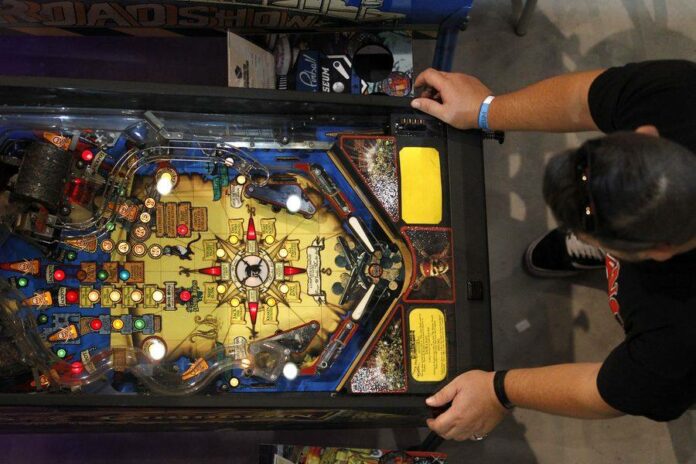
BEIJING (Xinhua) — China has issued a regulation to eliminate gambling content from gaming machines and devices, according to the Ministry of Culture and Tourism Thursday.
The ministry said the regulation will forbid gaming machines and devices from having gambling functions, such as maximizing returns with small wagers by setting betting odds. Gambling devices that automatically decide results, such as slot machines, are also prohibited.
It calls on gaming machine makers to explore the values of fine traditional Chinese culture, advance core socialist values and develop games with independent intellectual property, reflecting the national spirit in a healthy and positive manner.
Electronic gambling devices set at entertainment and business operation venues should not be open to juveniles under the age of 18 outside of statutory holidays, according to the document.
Gambling machines and devices include electronic gambling devices that operate in casinos and other commercial venues and offer contents improper for people under 18 years old to use independently or for a long time, as well as other games and devices, read the regulation.
Those who seriously violate the regulation will be put on a blacklist for the cultural market, according to the ministry.
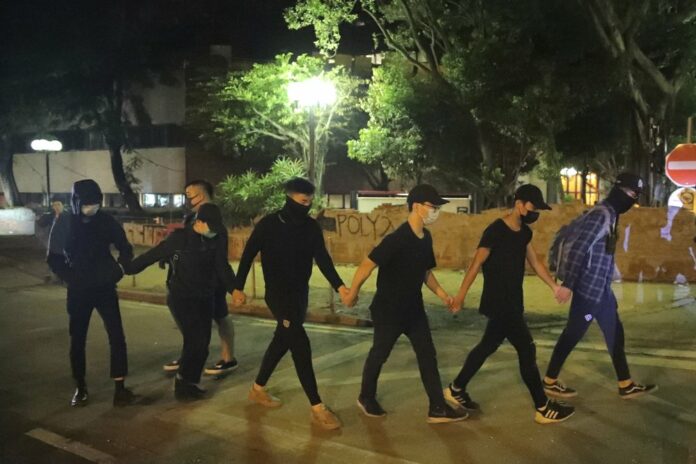
Protesters surrender themselves to police outside the Hong Kong Polytechnic University campus in Hong Kong, Friday, Nov. 22, 2019. (AP Photo/Kin Cheung)
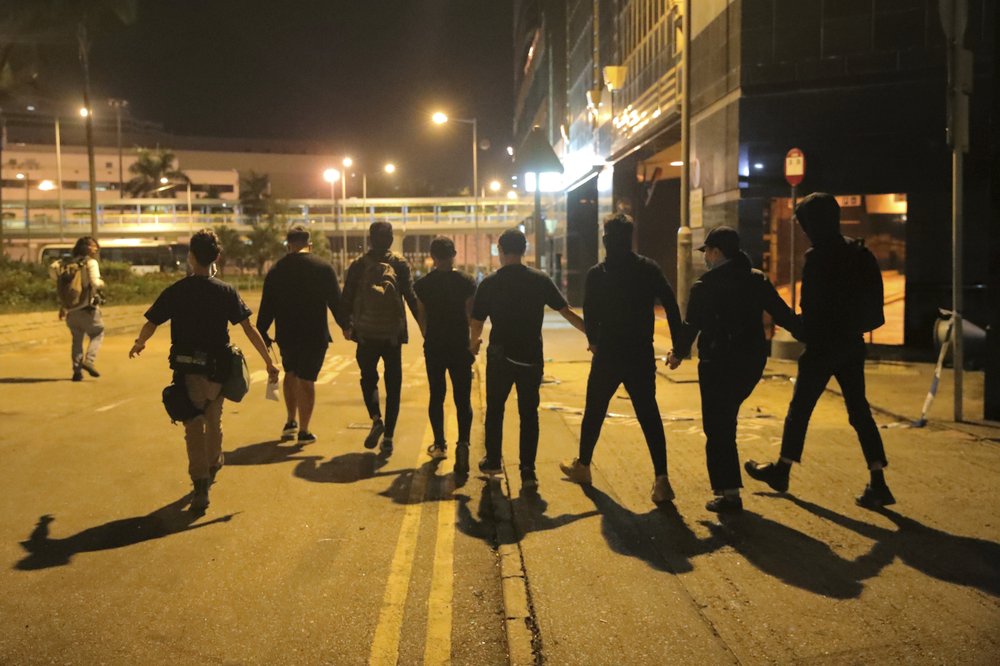
HONG KONG (AP) — Six masked protesters surrendered early Friday morning in Hong Kong, bringing to about 30 the number that have come out in the past day from a university campus surrounded by police.
The group emerged from a campus entrance and held hands as they walked toward a checkpoint around 3 a.m. Five wore the black clothing favored by the movement and the other was in a blue checked shirt.
Most of the protesters who took over Hong Kong Polytechnic University last week have left, but an unknown number remain inside. Police are arresting all the adults. Those under 18 can go home but may face charges later.
The anti-government protesters battled with police and blocked the nearby approach to a major road tunnel, which remains closed.
Protesters surrender themselves to police outside the Hong Kong Polytechnic University campus in Hong Kong, Friday, Nov. 22, 2019. (AP Photo/Kin Cheung)
It was the latest bout in more than five months of unrest in the semiautonomous Chinese territory. Protesters are demanding fully democratic elections and an investigation into alleged police brutality in suppressing the demonstrations.
Anti-government rallies were held in at least two places Thursday night. Riot police kept watch, exchanging heated words with some, but there were no major clashes ahead of district council elections on Sunday.
Protesters fear that the government could cancel the elections because of the unrest. City leaders have said they want to go ahead with the vote but warned that violence could make it impossible to hold a fair and safe election.
The election is seen as a bellwether for public support for the protests.
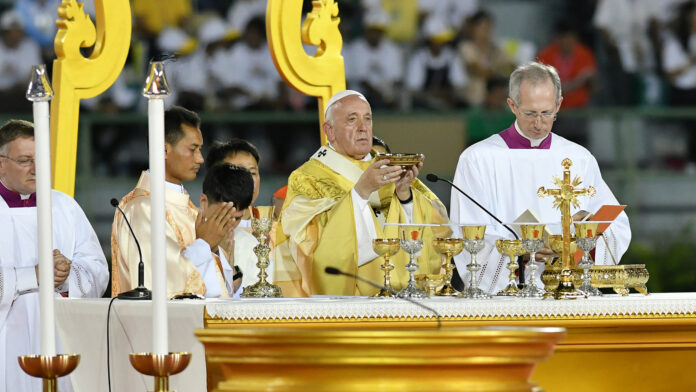
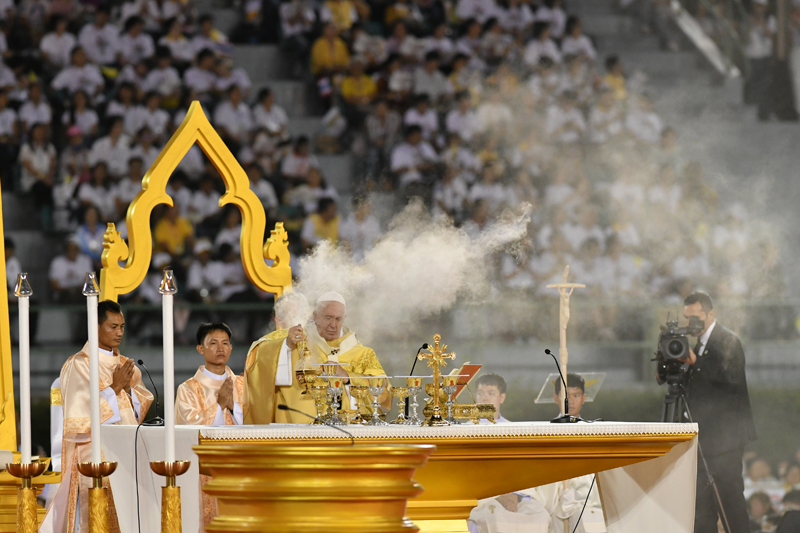
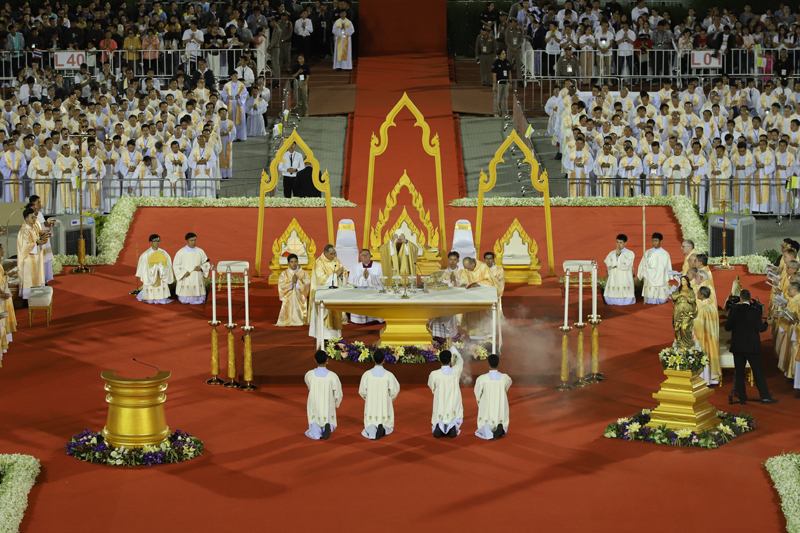
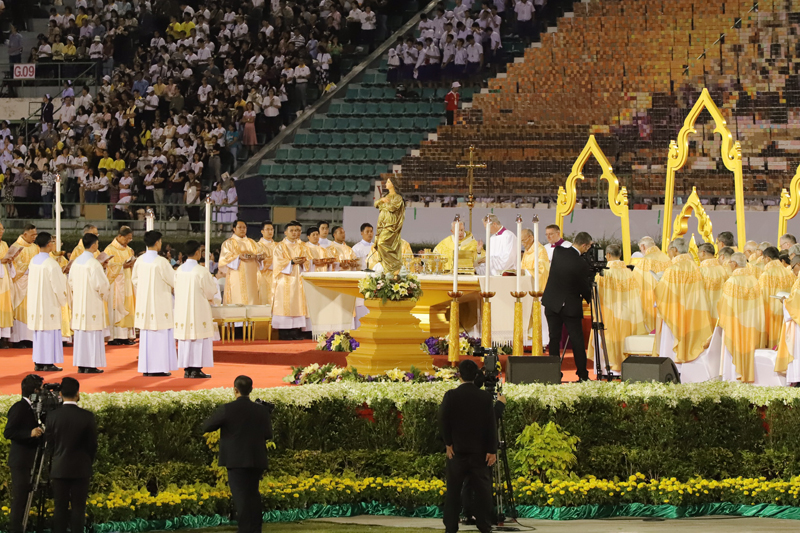
Pope Francis during the public mass at the National Stadium on Nov. 21, 2019.
BANGKOK — At his first public mass in Thailand, Pope Francis called upon communities to embrace and aid the exploited people, such as victims of sex trafficking, drug addiction, and refugees.
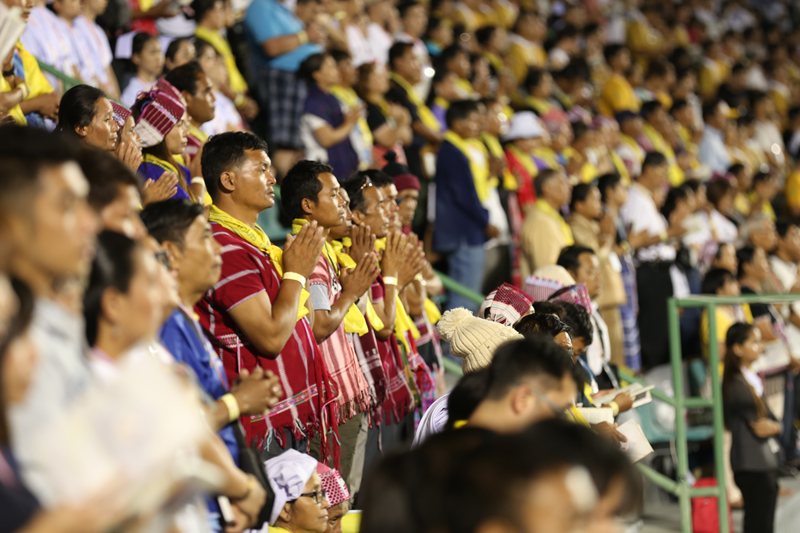
At a public mass attended by approximately 60,000 people in the National Stadium, Pope Francis preached that subaltern of society should be a part of God’s family.
“I think of children and women who are victims of prostitution and human trafficking, humiliated in their essential human dignity. I think of young people enslaved by drug addiction and a lack of meaning that makes them depressed and destroys their dreams,” he said.
“I think of migrants, deprived of their homes and families, and so many others, who like them can feel orphaned, abandoned…I think also of exploited fishermen and bypassed beggars,” His Holiness continued. “All of them are part of our family.”
The Pope compared this to the Biblical account of Jesus’ true relatives in Matthew 12:48, where Jesus said that whoever does the will of His Father in heaven was his family, while connecting it to the inauguration of the Catholic Church in Thailand by the “missionaries who first set foot in these lands.”
“By hearing the Lord’s word and responding to its demands, they came to realize they were part of a family much larger than any based on blood lines, cultures, regions, or ethnic groups. …they set out in search of a family they did not yet know,” Pope Francis said. “This enabled them to discover the many Thai ‘mothers and brethren’ who were still absent from their Sunday table.”
The Pope’s visit marks the 350th anniversary of the Mission de Siam in 1669, when two first missionaries arrived in the Kingdom of Ayutthaya.
“Without that encounter, Christianity would have lacked your face. It would have lacked the songs and dances that portray the Thai smile, so typical of your lands,” he said.
In a message addressed to the citizens of the Buddhist-majority nation – where only about 0.5 percent of Thais, or approximately 350,000 people, are Catholic – he said that “evangelization is not about gaining more members or about appearing powerful” but about sharing “God’s merciful and healing embrace” which in turn “makes us one family.”
The Hail Mary used in today’s mass was recited in five languages: Thai, English, Italian, French, and Vietnamese. One prayer in the mass was in pakagno, the language of an ethnic group.
Among the crowd was Thanin Santhanavanich, a Saint Louis Hospital doctor who volunteered as a First Aid responder. A devout Catholic, he brought his rosary and attended the mass with rapt attention.
“I feel delighted that he paid a visit to this unlikely destination as Thailand is a Catholic minority country,” he said. “A couple of years ago I had to go to Myanmar just to see him because I didn’t believe he’s gonna come to us.”
Comparing to Pope John Paul II’s visit in 1984, which he also got a chance to attend, Thanin said this occasion is more spectacular and well-organized.
The public mass concluded with a spectacular dance involving 800 students from seven Catholic convent schools, featuring naga and Phi Ta Khon to represent the cultures of Thailand’s four regions.
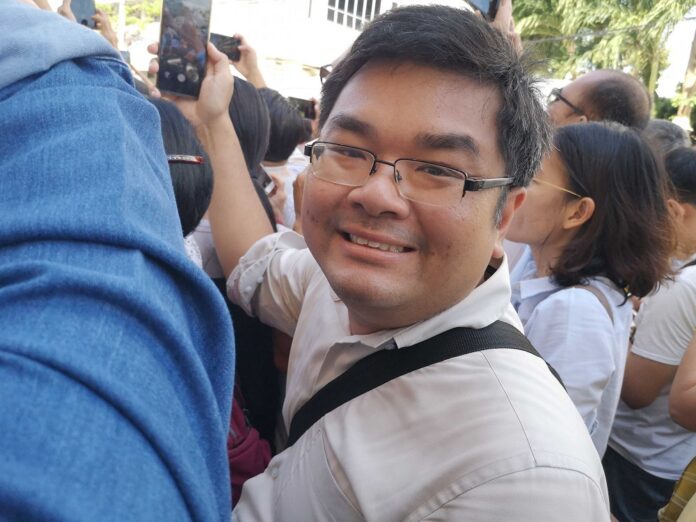
Banchaporn Boonlert-aree, a Buddhist, waits to see the Pope because he read about the papacy's crucial role in European history.
BANGKOK — Not everyone cheering at Pope Francis while he left a historic Buddhist temple in Bangkok on Thursday morning is Catholic.
Public school teacher Banchaporn Boonlert-aree, 34, is a Buddhist. But he looks as excited as others, if not more, as he waits for Pope Francis to reemerge out of Ratchabophit Temple after holding an interfaith dialogue with the spiritual leader of Thai Buddhism.
“I learned that the papacy played a vital role since the Middle Age in Europe. It is a very important position and we learn in the textbooks,” Banchaporn explained.
Another Thai waiting among the crowd is a Hindu.
Wannasin Srisaket, 21, is a fourth year history student at the nearby Silpakorn University. He accompanied his Catholic friend to catch a glimpse of the Pope because it’s a rare occasion, possibly once in a lifetime.
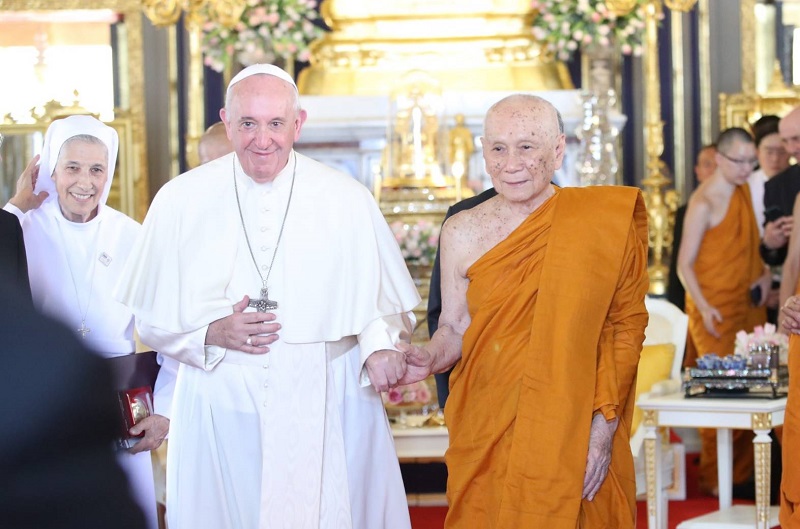
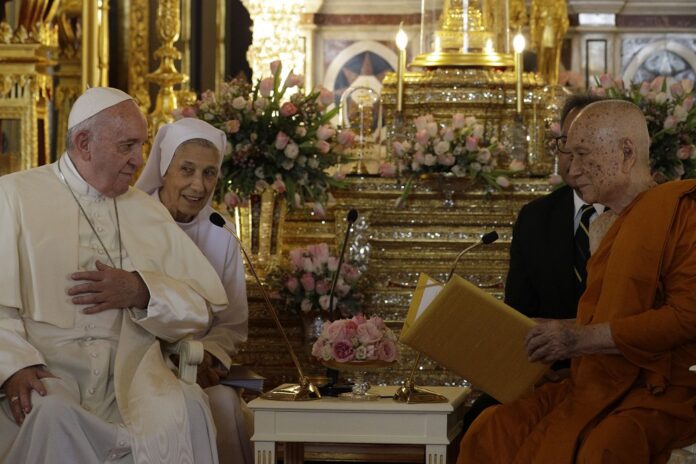
Pope Francis and Supreme Patriarch Ariyavongsagatanana together at Ratchabophit Temple in Bangkok
He believes that Christianity is a good religion and it teaches people to love others.
“I also want to see how the head of the Catholic Church looks like in flesh,” Wannasin said.
Inside the temple, Pope Francis invited the Supreme Patriarch and Thailand’s Buddhists to work together with Christians for the poor and the environment.
Some Catholics interviewed today acknowledge there’s still a large gap of mutual understanding between the two faiths. Thai public schools tend to teach only Buddhism, while Catholic private schools don’t offer lessons about Christianity to its Buddhist students.
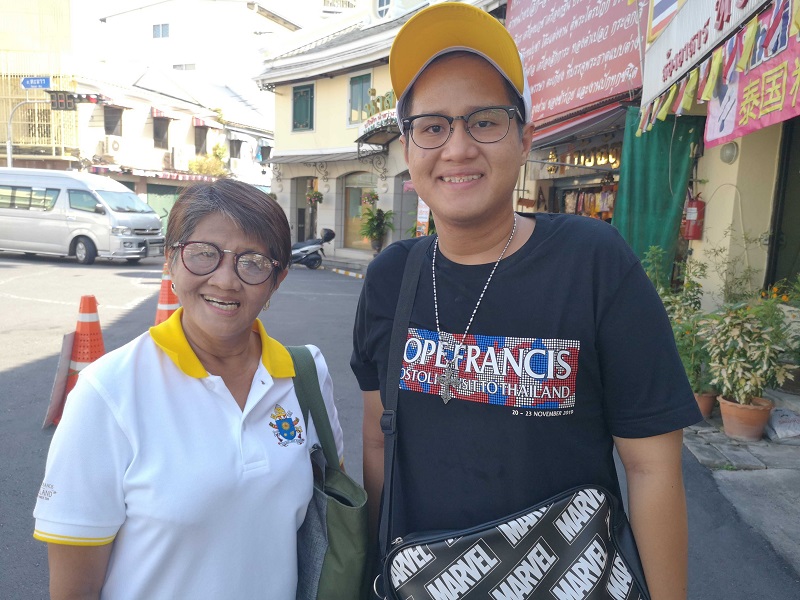
Noppawit Chatarasophon, 27, a Catholic and government official at Human Development Ministry, said that he learned nothing about Christianity and other major religion when he was a student at the prestigious Suan Kularb Wittayalai School in Bangkok.
“I only learned about Buddhism. There should be teachings about other religions as well,” Noppawit said.
While Noppawit said relations between Buddhists and Christians are generally good and peaceful, he complained of some bias among Thai Buddhists who make up over 93 percent of the population.
Noppawit and his mother.
“Some have bias about [the existence of] God. It’s a belief and we should not infringe on one another,” Nappawit, who converted from Buddhism to Catholicism 10 years ago said.
Father Joseph Anucha Chaiyadej, director of mass media center of Catholic Bishop Conference of Thailand, said Catholic schools don’t want to force Buddhist students or students of other faith to learn about Catholicism.
“The schools teach students of various faiths to be a good follower of his or her faith,” Father Joseph said, “To proselytize aggressively is a double-edge sword. We do not resort to a hardcore method although we do not bar [Buddhist] students who may be interested.”
Even without formal lessons on Christianity, Father Joseph said, Thai Buddhist students at Catholic schools can still become familiar with the faith by learning about the deeper meaning of religious days like Christmas, which are typically celebrated in these schools.
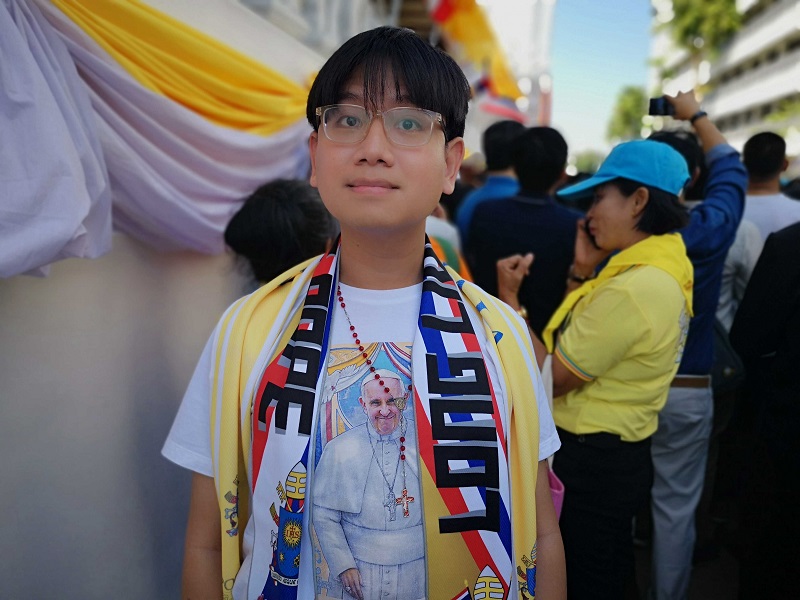
Yotsathon Hantaweewattana, 33, is another Catholic waiting to greet the Pope outside the temple. A freelance researcher, Yotsathon said besides learning more about other religions, some Thais should also work together between different faiths for the greater good.
“We should talk about the strength of each religion and promote the common good and work such as helping refugees as all religions teach people to do good,” he said, wearing a white T-shirt with the image of the pope.
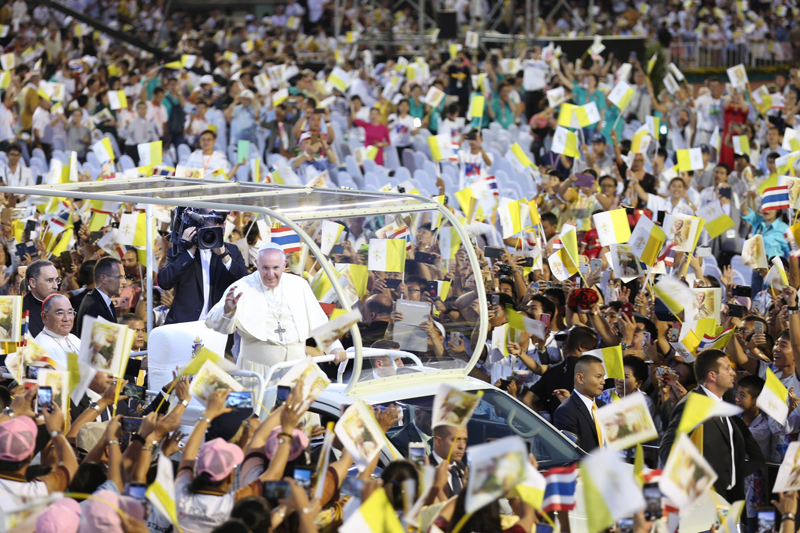
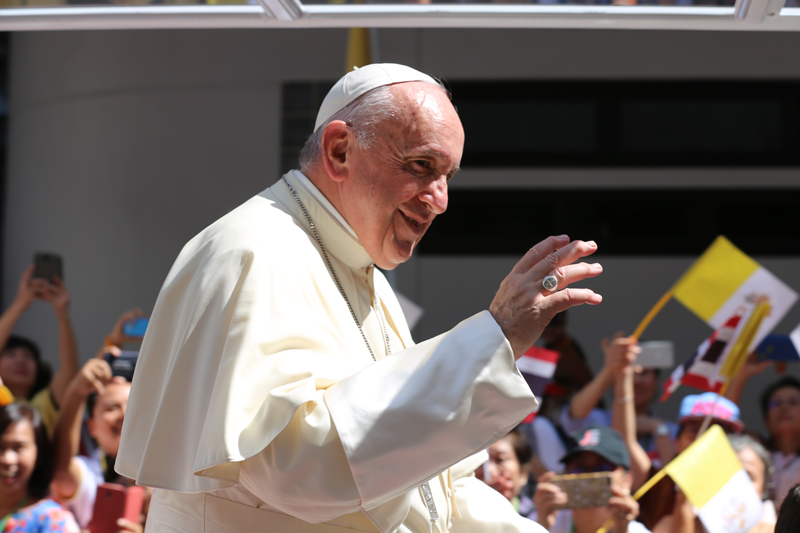
BANGKOK — Pope Francis’ first public appearance in Thailand was met by about 5,000 Catholics from Thailand and other nations held up flags and clutched rosary beads, shouting in unison, “Viva il Papa Francisco!”
The Pope smiled and waved at them as he made his way into St. Louis Hospital, where he blessed patients and applauded the medical staff for their commitment to saving lives. It was the first stop in Thailand’s visit that the Pope got to mingle and interact with members of the public – the human touch that came to define his papacy.
“You carry out one of the greatest works of mercy, for your commitment to healthcare goes far beyond the simple and praiseworthy practice of medicine,” The Pope said in a speech. “It is about welcoming and embracing human life as it arrives at the Hospital’s emergency room, needing to be treated with the merciful care born of love and respect for the dignity of each human person.”
Francis added that work in healthcare can be “burdensome and tiring” and people often “work in extreme circumstances,” so therefore it was important that medical staff stick together as a community, especially in ministry.
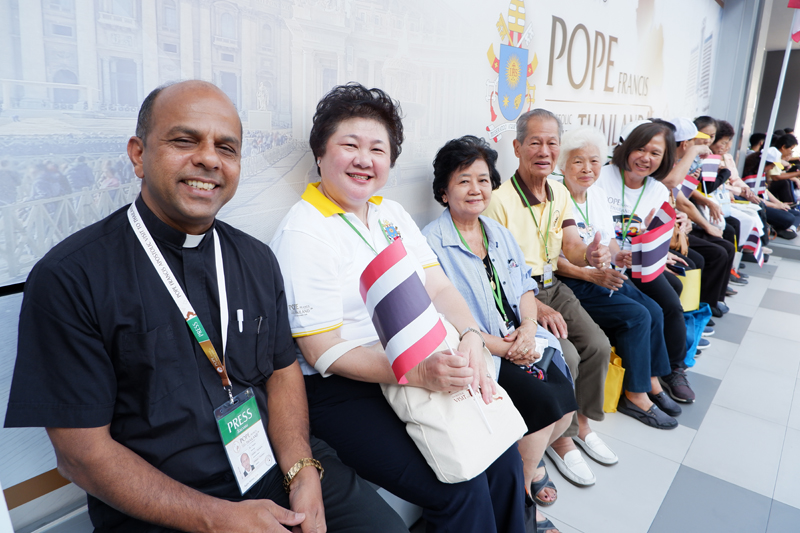
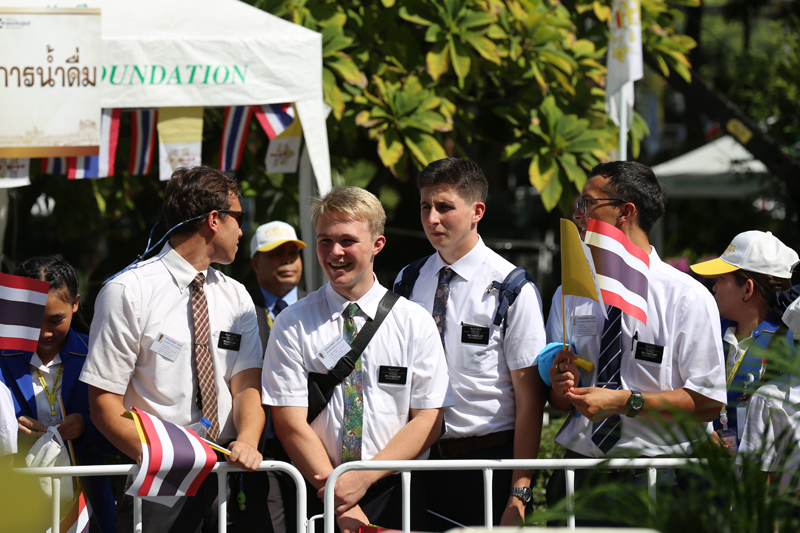
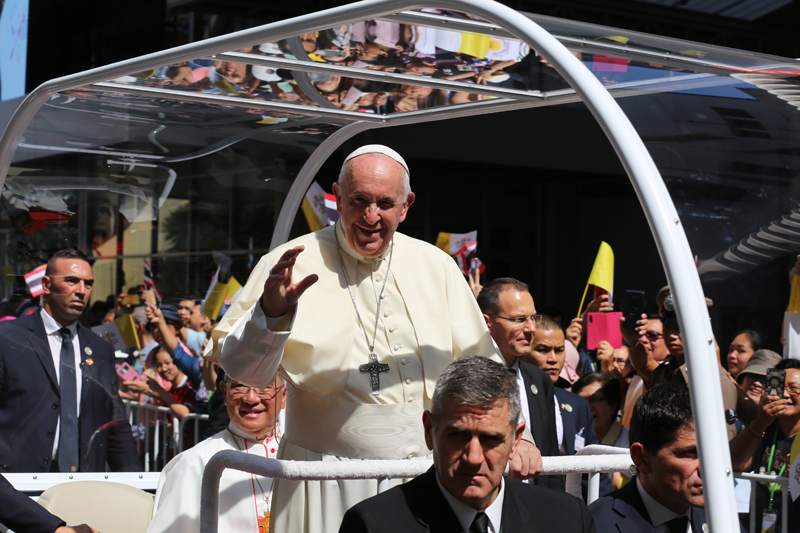
Outside the hospital, the crowd cheered and waved the Vatican and Thai flags as Pope Francis rolled past on his open-air vehicle. It’s a diverse assembly of the young and the old, Thais and foreigners, and even non-Christians, who said they’re touched by the visit nonetheless.
Gift, 20, a student from St. Louis College, was assigned to the front row waving the Holy See flag. Given a chance to be very close to the Pope, she said she was excited and impressed with the Catholic teachings on love and mercy.
Skip to 5.20 minute mark to see the Pope gliding past Khaosod English correspondents.
Another student from the same college, Tirattah Suklom, 18, said she was so overwhelmed by the proximity that she almost teared up.
“I could really feel his mercy,” Tirattah said. “To me, all religions teach us to be good people.”
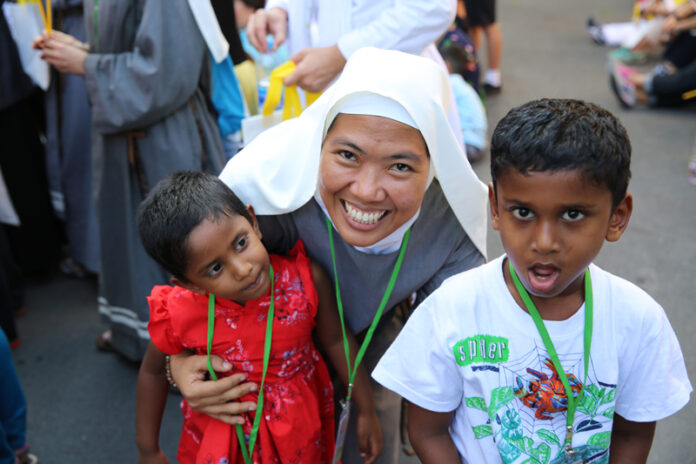
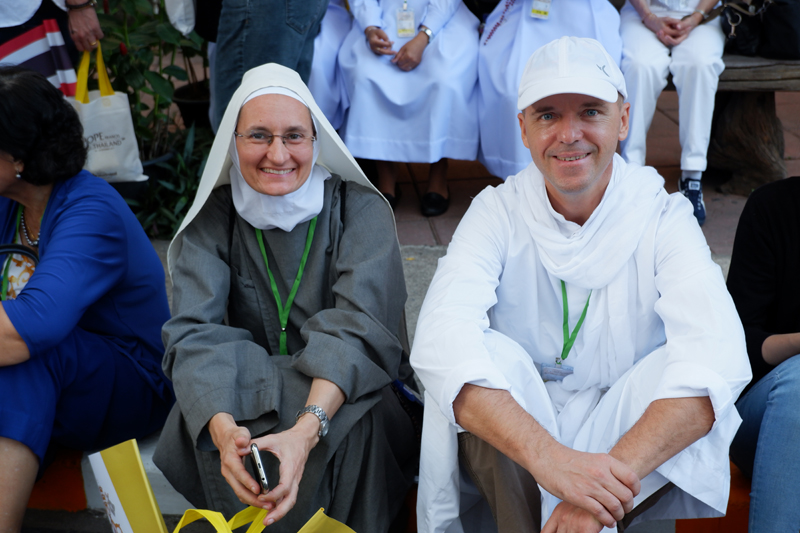
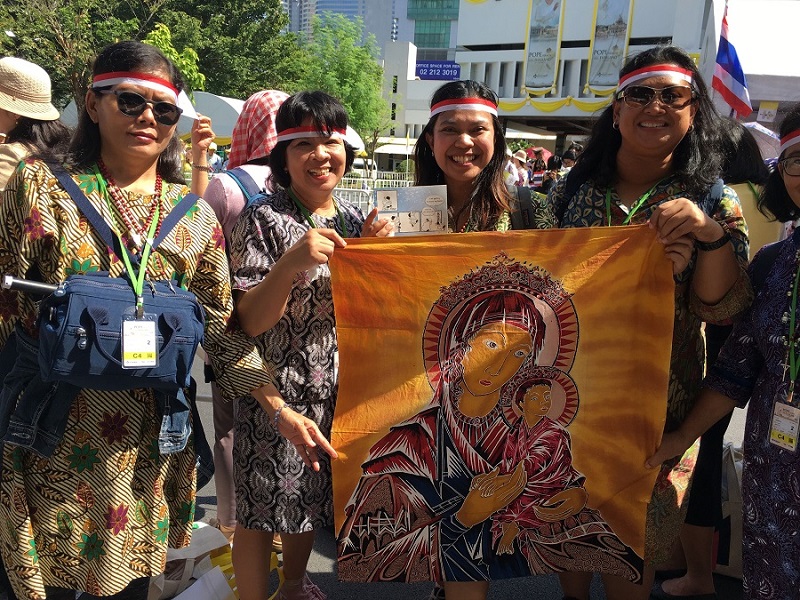
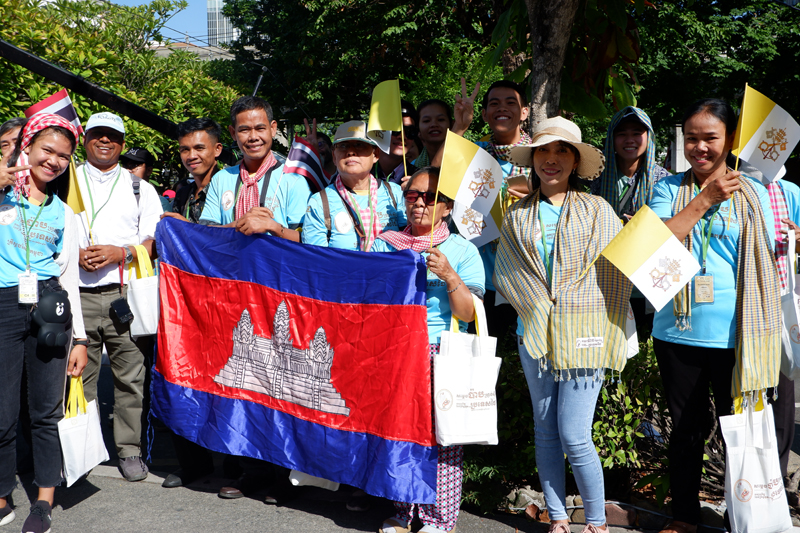
A group of Indonesian faithfuls held up the image of Madonna and Child made from local batik. Blue-shirted Cambodians, who brought along their national flag, said they were 160 in number. Sister Blandine Mentre, a French nun from the order of the Sister of Maria Stella Matutina, came with a group of 14 from her church in Vietnam.
Sister Blandine Mentre, left, talks to a reporter at St. Louis Hospital
“I think he is very brave to come here,” Mentre said. She said Vietnam and the Vatican hadn’t finalized talks for the Pope to come there yet.
One Thai Catholic woman from the southern province of Trang, who told Khaosod English in a live interview that she came all the way up to Bangkok just to see His Holiness.
“I feel blessed and delighted for this once in a lifetime opportunity, she said. “I pray for many things, especially for my family.”
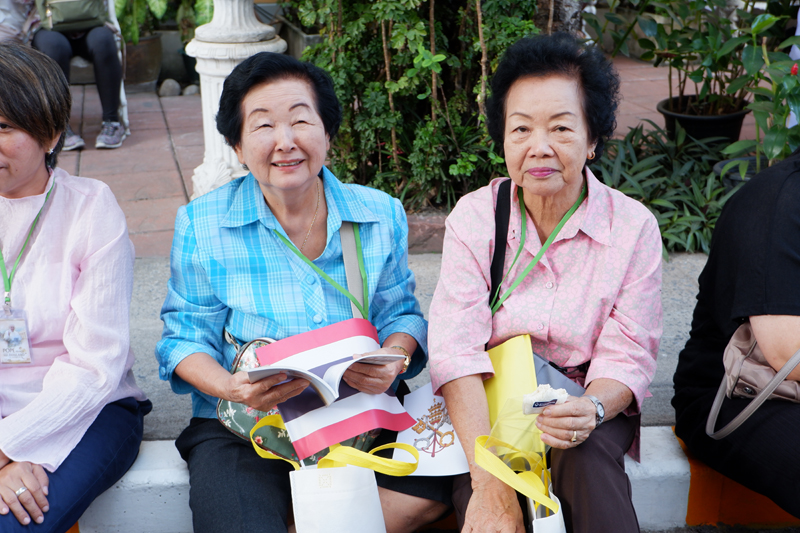
Ubon Suchin, 74, and Jinda Harintranon, 75.
One of the many Thai Catholics who came for their once-in-a-lifetime chance to see the pope was Ubon Suchin, 74, and her friend Jinda Harintranon, 75. The two parishioners of Paklad Church in Samut Prakan arrived at 6am, and at around 9am were sitting on the sidewalk to rest their feet.
“My own grandmother came from China to Samut Prakan, and the church really helped her out when she immigrated. She converted, and ever since our family has been Catholics,” Ubon said. “I want to see him so much, especially since I didn’t have the chance to see Pope John Paul II when he came.”
A group of Catholic Indonesians hold up a batik cloth with the Virgin Mary and Jesus on it.
Ubon said she regularly prayed for Pope Francis’ health.
Another Thai Catholic said she journeyed all the way from the southern province of Trang just to see His Holiness.
“I feel blessed and delighted for this once in a lifetime opportunity, she said. “I pray for many things, especially for my family.”
While her hometown has a small number of Catholics – in fact, figures show there are only 7,678 Catholics in the entire southern diocease – she said she did not encounter any problem alongside the Buddhists.
The woman said she even participated in Buddhist rites such as the Kathina robe offering ceremony (tod kathin).
A group of Cambodian Catholics.
“People come to ask me sometimes why I can’t do this or that, but I’m fine with joining Buddhist community activities and fundraising,” she said.
Thanya Ousswarugse, christened as Agnes, is a 62-year-old who regularly attends mass at Carmelite Monastery Bangkok. Today she was wearing a T-shirt with a cartoon of Pope Francis on a tuk tuk. Throughout her Catholic life, Thanya said, she’s had to explain some parts of her faith to Buddhists, but it wasn’t a big problem.
“Sometimes I have to explain why we fast for Lent and why it’s different from Muslims and their fasts, but people nowadays understand more than before,” she said. “I can participate in Buddhist holidays, I just have to tell the other people there that I won’t worship other idols.”
Thanya added, “But if my name is included in a tod kathin fundraising, then I think I’m just doing charity.”
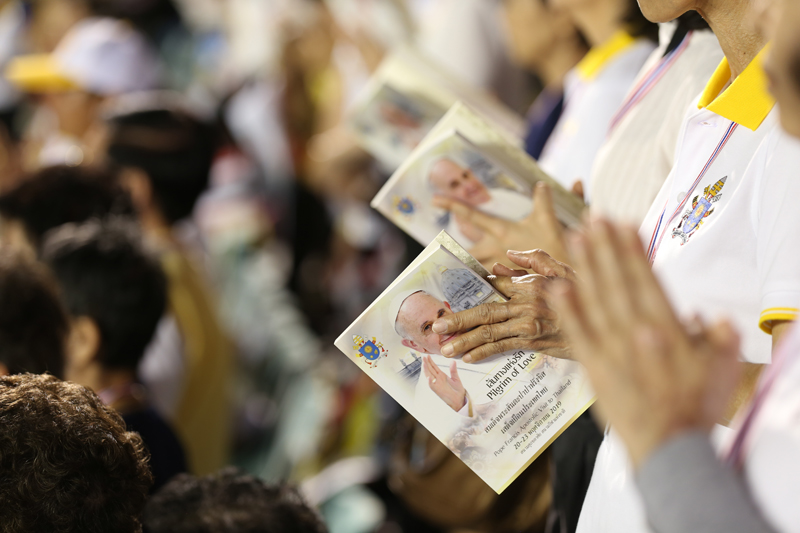
Freebies handed out to the worshipers include small cloth bag with either a Vatican City or Thai flag, a sandwich, bottle of water, a booklet about Pope Francis’ visit to the hospital, and rosary beads that officials said were blessed by the Pope himself.
The Holy See delegates also presented an image of the Virgin Mary With the Child to the hospital as a gift. The artwork was styled after the famed painting by Italian artist Lorenzo d’Alessandro di San Severino.
In return, the Pope was given a 19th century trilingual dictionary compiled by the hospital founder Archbishop Louis Vey.
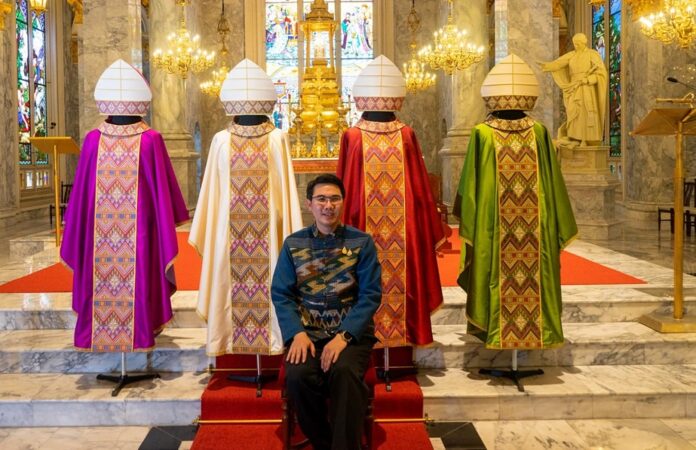
Thai designer Athiwat Chuenwut poses for photos with the four holy vestments he designed for Pope Francis. Image: Athiwat Chuenwut / Facebook
BANGKOK — Four papal outfits made by a Thai designer were delivered to Pope Francis by the Thai government as a gift to mark his visit to the kingdom on Thursday.
The four holy vestments come in what designer Athiwat Chuenwut called “Thai Tone” – four traditional colors of Thai craftsmanship that resemble the Western counterpart of white, red, green, and violet. Each tone also matches the four liturgical colors required for Catholic masses throughout the year.
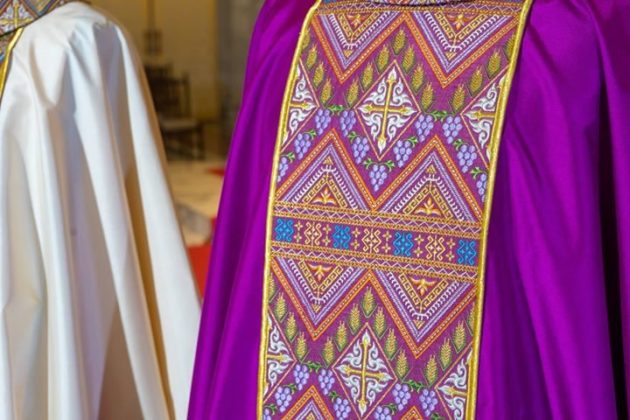
In an interview with Art and Culture magazine, Athiwat said he used silk from the northeastern region of Thailand for the garments as a homage to seven Catholics murdered there in 1940.
Apart from Catholic symbols like the cross, wheat, and grapevines, Athiwat added traditional Thai textile patterns to the outfits for the sake of local touch.
Athiwat is the same artist behind holy vestments presented to Pope Francis when he visited Myanmar in 2017 and held a Holy Sunday mass at St. Peter’s Basilica in 2018.
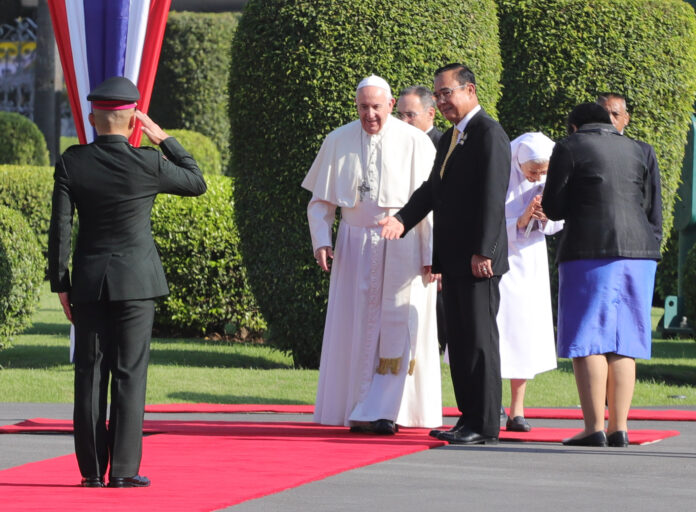
Pope Francis accompanied by his cousin Ana Rosa Sivori arrives for a welcome ceremony at the Government House courtyard, Thursday, Nov. 21, 2019, in Bangkok, Thailand. (AP Photo/Gregorio Borgia)
BANGKOK (AP) — Pope Francis called for migrants to be welcomed and for women and children to be protected from exploitation, abuse and enslavement as he began a busy two days of activities in Thailand on Thursday.
Francis pleaded for action against one of the region’s greatest scourges, human trafficking to fuel the forced labor and sex trade industries, as he began a weeklong visit to Asia.
He praised the Thai government’s efforts to fight human trafficking in a speech delivered at host Prime Minister Prayuth Chan-ocha’s Government House offices. But he appealed for greater international commitment to protect women and children “who are violated and exposed to every form of exploitation, enslavement, violence and abuse.”
He called for ways to “uproot this evil and to provide ways to restore their dignity.”
“The future of our peoples is linked in large measure to the way we will ensure a dignified future to our children,” he said.
The United Nations considers Thailand a key trafficking destination as well as a source of forced labor and sex slaves, who are trafficked at home or abroad. The U.N. anti-trafficking agency says migrants come from Laos, Myanmar, Cambodia or Vietnam, with Cambodian women and children in particular trafficked to beg in Thai cities.
The U.S. State Department has faulted Thailand for failing to fully crack down on traffickers who induce young Thai girls into pornography, as well as the exploitation, including via debt bondage, of migrant workers in commercial fishing enterprises.
The Thai government has insisted it has made significant progress in cracking down on human trafficking and has vowed continued cooperation with international bodies to improve.
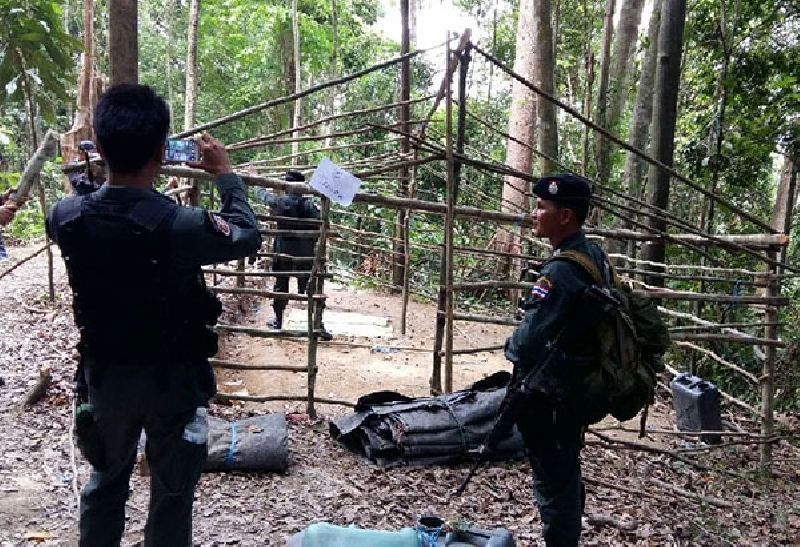
Security forces inspect a just-abandoned jungle stockade where human traffickers kept captives under dire conditions in this 5 May, 2015, file photo.
Francis has made the fight against human trafficking one of the cornerstones of his papacy, calling it a crime against humanity. Under his express wishes, the Vatican has hosted several conferences on eradicating trafficking, featuring women freed from forced prostitution. And during his papacy, an international network of religious sisters, Talitha Kum, has gained greater prominence following decades of quiet efforts to rescue women from traffickers.
While Thailand has a tradition of taking in migrant laborers and sheltering people fleeing from danger in neighboring countries, it also has a checkered history of deporting foreigners who are in the country illegally, even if they are recognized by the United Nations as refugees who are fleeing persecution.
In addition, up until it signed an agreement with the U.N. refugee agency this year, Thailand held child asylum-seekers in detention centers.
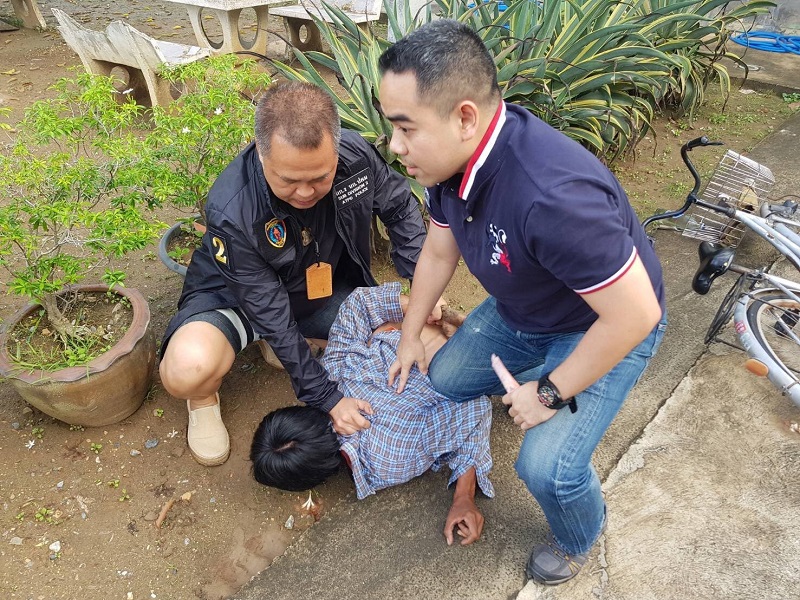
Police arrest a suspected human trafficker on Sep. 16, 2019, and rescued 15 women from forced sex work in Saraburi province.
In his comments made alongside Thai authorities, Francis thanked the country for its historical role welcoming migrants from across the region, who are drawn to Thailand for economic opportunities. But he said all countries must do more to resolve the conflicts that fuel the “tragic exodus” of forced migration.
“May every nation devise effective means for protecting the dignity and rights of migrants and refugees, who face dangers, uncertainties and exploitation in their quest for freedom and a decent life for their families,” he said.
Francis had a busy schedule on his first full day of activities of his weeklong tour, which will also take him to Japan.
Pope Francis, left, and his cousin, Sister Ana Rosa Sivori visit the Supreme Buddhist Patriarch at Was Ratchabophit Sathit Maha Simaram Temple, Thursday, Nov. 21, 2019, in Bangkok, Thailand. (AP Photo/Gregorio Borgia)
BANGKOK (AP) — Pope Francis is committing the Catholic Church to working more with Thailand’s majority Buddhists to launch projects to care for the poor and the environment.
Francis made the pledge during a meeting Thursday with the supreme Buddhist patriarch at the Wat Ratchabophit temple. It was the second time a pope has called on the spiritual leader of Thailand’s Buddhists, after St. John Paul II visited the temple in 1984.
There are fewer than 400,000 Catholics among Thailand’s 65 million people, yet Francis said they nevertheless have enjoyed freedom in their religious practice.
He called for increasing charitable initiatives to improve fraternity and to help the poor “and our much-abused common home.”
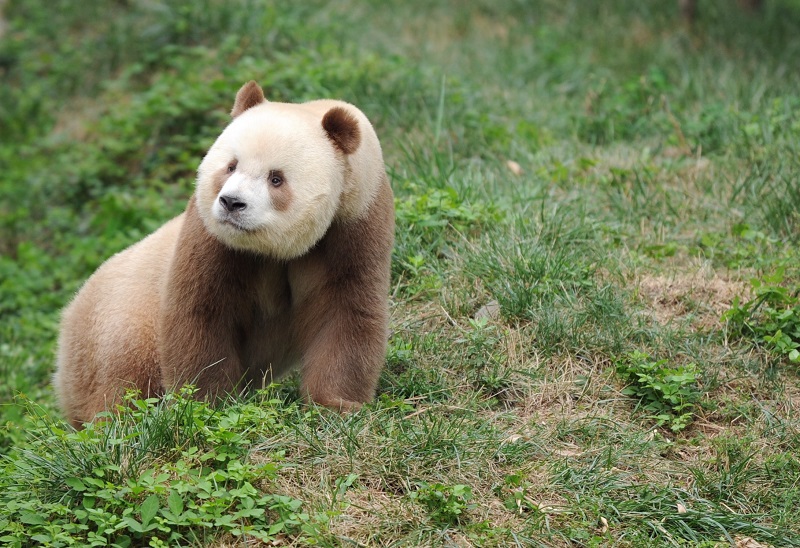
Qizai, a rare brown and white giant panda, eats bamboo shoots at Shaanxi rare wild animals rescuing and raising research center in Xi'an, northwest China's Shaanxi Province, Sept. 7, 2018. (Xinhua/Zhang Bowen)
XI’AN (Xinhua) — A ceremony was held Wednesday at the Qinling research center of giant panda breeding in northwest China’s Shaanxi Province, to celebrate the adoption of the world’s only captive brown giant panda.
The male brown-and-white panda Qizai (meaning “7th son”), born in 2009, was adopted by Pandas International, a Denver-headquartered non-profit organization co-founded by Suzanne Braden and Diane Rees in 2000, which aims at ensuring the preservation and propagation of the giant panda.
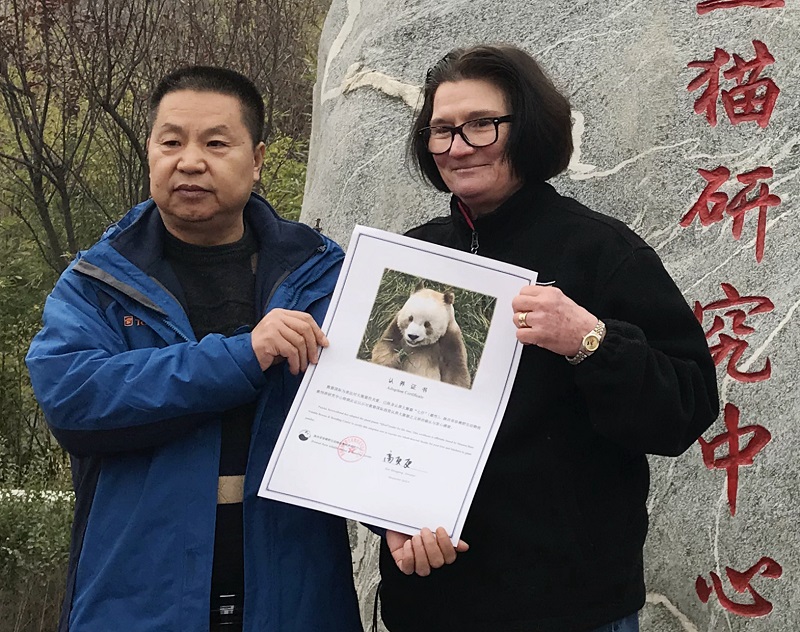
Granting the adoption of Qizai shows the appreciation for Pandas International, which has been donating vaccines, lab instruments, baby panda cribs and milk powder to the center and helping with its daily work, the research center said.
Qizai at Shaanxi rare wild animals rescuing and raising research center in Xi’an, northwest China’s Shaanxi Province, Sept. 7, 2018. (Xinhua/Zhang Bowen)
The world’s first brown panda was discovered in 1985 in the Qinling Mountains. All recorded photographs of wild brown pandas were taken in the area, with one specimen in the Changqing National Nature Reserve in the province’s Yangxian County last March.
The research center also expects more international and domestic organizations and individuals to participate in panda conservation.
Gao Genggeng (L), vice director of the Qinling research center of giant panda breeding, and Suzanne Braden, responsible person of Pandas International, present the adoption agreement in Xi’an, northwest China’s Shaanxi Province, Nov. 20, 2019. (Photo provided to Xinhua)
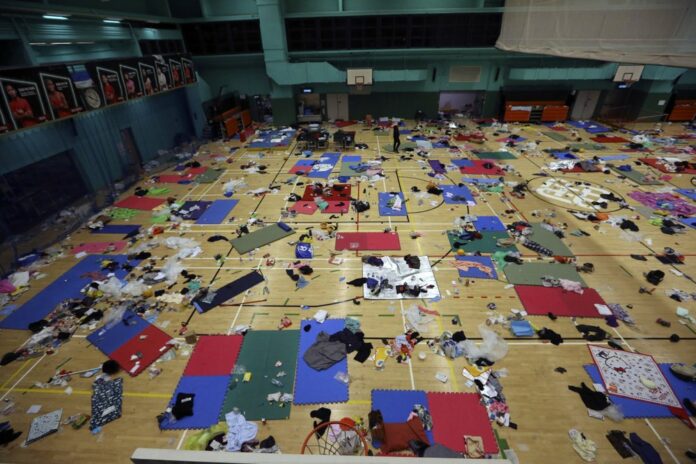
Belonging of protesters are left in the campus of the Polytechnic University in Hong Kong, Wednesday, Nov. 20, 2019. (AP Photo/Ahmad Ibrahim)
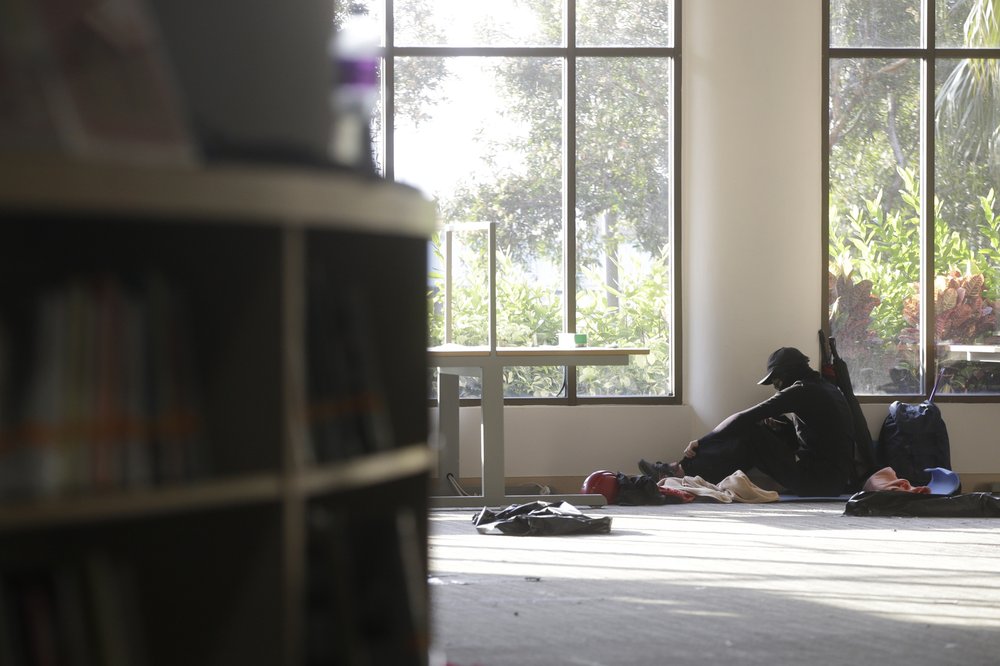
HONG KONG (AP) — A small but determined group of protesters remained inside a Hong Kong university campus Thursday, resisting pleas to turn themselves in to police.
At least a few dozen were believed to still be at Hong Kong Polytechnic University, the holdouts from a much larger group that occupied the campus for several days and battled police last weekend.
Hong Kong’s anti-government protests are in their sixth month. Protesters, who believe China is increasing control over the semiautonomous territory, are demanding fully democratic elections and an investigation into allegations of police brutality in suppressing their demonstrations.
The government has rejected those demands and said violence must stop before any dialogue can begin.
A protester checks a mobile phone at the campus of the Polytechnic University in Hong Kong Thursday, Nov. 21, 2019. A small group of protesters refused to leave Hong Kong Polytechnic University, the remnants of hundreds who took over the campus for several days. (AP Photo/Achmad Ibrahim)
The U.S. Congress approved legislation late Wednesday to sanction officials who carry out human rights abuses and require an annual review of the favorable trade status that Washington grants Hong Kong.
President Donald Trump is expected to sign it into law, which is sure to anger China.
Chinese foreign ministry spokesman Geng Shuang said earlier that the legislation interferes in China’s internal affairs and violates international law and basic norms governing international relations.
Around the city, commuters experienced long lines and delays on morning trains, as some stations remained shut and tracks and other facilities damaged from earlier protests.
The approach road to a road tunnel under Hong Kong’s harbor has been largely cleared of debris from the protests, but it remained closed because of damage. Protesters at Polytechnic, which overlooks the tunnel approach, set fires in the toll booths last week, leaving them burned out.