






























33.3 C
Bangkok
Sunday, June 21, 2026
Home Blog Page 1471

Vietnamese Families Grieve 39 Essex Lorry Deaths

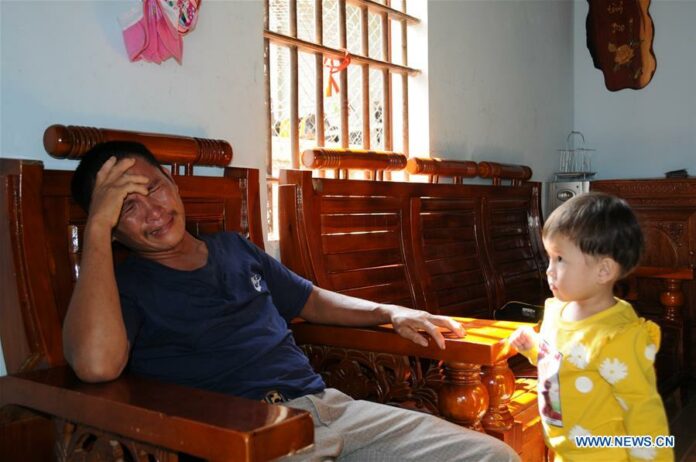
Cao Huy Thanh's elder brother (L) grieves as his daughter looks on in Vietnam's central Nghe An province, Nov. 8, 2019. Thanh, who was among the 39 Vietnamese nationals found dead in a lorry in Essex, Britain, was the breadwinner of a family with four children. Photo: Tao Jun / Xinhua

VINH, Vietnam (Xinhua) — Cao Huy Thanh’s old run-down house is nestled deep into a narrow and winding road covered with big bushes and trees, a typical landscape of rural Vietnam.

Extra tables and chairs have been prepared for guests coming to send condolences to the family of the 37-year-old, who was among the 39 Vietnamese nationals found dead in a lorry in Essex, Britain.

The sound of adults talking and grieving was well mixed with the innocent laughter of small children inside the 40-square-meter house. Occasionally, a family member disrupted the conversation to turn to the living room to check the altar set up on Nov. 5 for Thanh.

Incense, candles and offerings were well-arranged around the portrait picture of the ill-fated man on the altar, which stood opposite to his wedding photo taken seven years ago.

“We are waiting for my husband’s body to be repatriated home so my four children can see their father for the last time,” said his wife Thai Thi Giang, patting on her 11-month-old kid.

The 25-year-old told Xinhua that she got a phone call from the Vietnamese Ministry of Foreign Affairs at 7:00 p.m. on Nov. 7, confirming that her husband was among the 39 victims in a container in Britain.

Her worst nightmare has come true – she lost her beloved husband, the breadwinner of the family of six to the perilous journey to Britain.
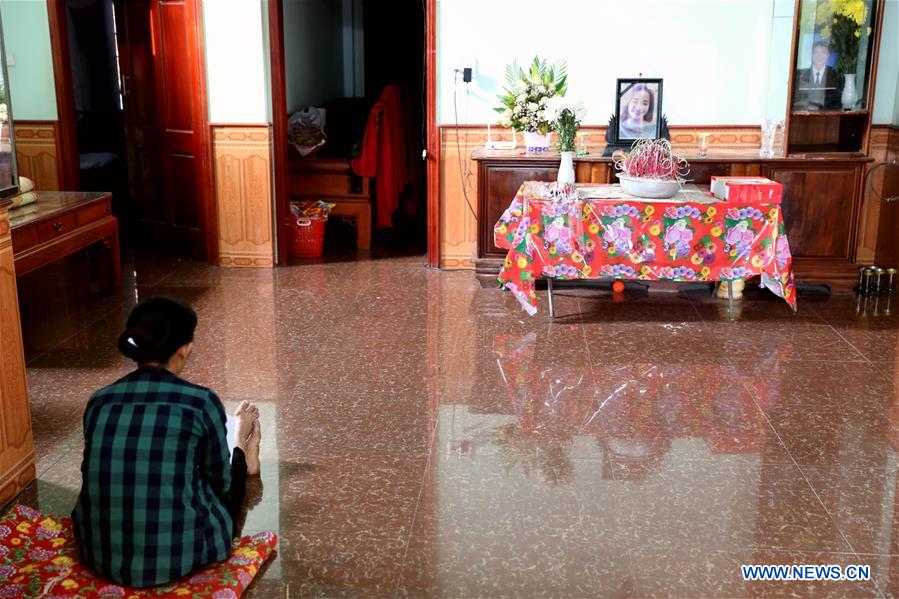
Photo taken on Nov. 8, 2019 shows an altar set up for Bui Thi Nhung at her home in Vietnam's central Nghe An province. The 19-year-old was among the 39 Vietnamese nationals found dead in a lorry in Essex, Britain. Her family is waiting for her body to be repatriated home. Photo: Wang Di / Xinhua
Photo taken on Nov. 8, 2019 shows an altar set up for Bui Thi Nhung at her home in Vietnam’s central Nghe An province. The 19-year-old was among the 39 Vietnamese nationals found dead in a lorry in Essex, Britain. Her family is waiting for her body to be repatriated home. Photo: Wang Di / Xinhua

DREAMS FIZZLE

Living in a rural village in Dien Ngoc commune, Dien Chau district of Vietnam’s central Nghe An province where fishing is the only thing unskilled people could do for a living, Thanh earned barely 200,000 dong (8.7 U.S. dollars) a day. The money was barely enough to cover the daily costs of the family of six.

In March 2019 when his fourth child was five months old, Thanh waved goodbye to his family, believing a better life was waiting for him abroad after paying 120 million dong (5,200 U.S. dollars) to go to work in Romania through a labor export company.

The harsh reality of life abroad soon broke Thanh’s dream. He could not cover the daily expenses by doing “the physically tough job with low-paid wage” for a meat processing factory in Romania. He then asked his family to pay more for his trip to Germany where he worked in a restaurant with his childhood friend Cao Tien Dung, who was also among the 39 people found dead in a lorry in Essex last month.

“His last phone call home was on October 22. He told me that he would travel to Britain but didn’t mention how he would get there and what job he would do. He asked our family to prepare money for the trip,” Giang told Xinhua while embracing her youngest son in her arms.

“Yet he never called me back,” she said while looking down with signs of weariness, hopelessness and deep despair.

Thanh’s family got a loan of nearly 600 million dong (26,100 U.S. dollars), secured on their house, to fund his trips from Vietnam to Romania and then Germany.

His dream about a better future for the family bitterly turned into an inconsolable loss, a crippling debt and an uncertain future for the family.

“Without him, I don’t know how we can manage raising all the four kids, repaying the debt and paying monthly interest rate. I don’t know what to do with our life now,” Thanh’s mother said in grief.

Victims and their families had not been fully aware that their investment in an illegal immigration trip was a life-and-death gamble.

“Thanh is the first in our family to go to work abroad. If we had known about the risks, we would have never let him go that way,” said Thanh’s father-in-law, adding that he was worried how his jobless daughter could live on with such a great loss.

WORKING ABROAD FOR BETTER INCOME

In the nearby Yen Thanh district, the passing of 26-year-old Nguyen Dinh Tu, breadwinner of the family and father of two small children, also turned his family’s life upside down.

“His wife was devastated and fell ill these days,” Tu’s sister-in-law said. In recent days, the newly-built house without much furniture of Tu has been frequented by neighbors and relatives who came to share condolences with the family.

Some 500 meters away is 19-year-old Bui Thi Nhung’s house which was echoed with the sad rhythms of Bible verses that her family members, neighbors and relatives sang to pray for her.

The family has set up a small altar for their ill-fated daughter – the picture of the young girl with radiant eyes and a warm smile was placed in the center and candles and a vase of fresh white chrysanthemum were put on two sides.

In the memories of her beloved ones, Nhung was “a cheerful yet thoughtful and responsible child.”

“She had always put the family’s needs above her own,” said Bui Thi Phuong, sadly taking a look at the picture of her younger sister on the altar.

Two years ago, her father died of cancer and the family had to struggle to repay the debt they borrowed for the treatment fee. Living in a commune where about 75 percent of the working population work abroad, Nhung chose to go abroad with the hope for a better future and freeing her family from the loans.
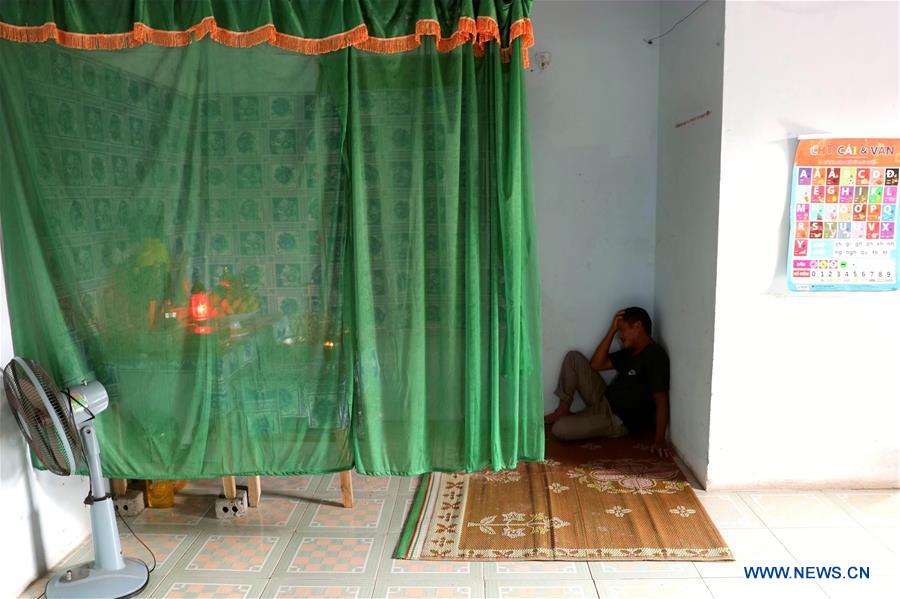
Cao Huy Thanh's elder brother grieves in front of Thanh's altar in Vietnam's central Nghe An province, Nov. 8, 2019. Photo: Wang Di / Xinhua
Cao Huy Thanh’s elder brother grieves in front of Thanh’s altar in Vietnam’s central Nghe An province, Nov. 8, 2019. Photo: Wang Di / Xinhua

According to Nguyen Thi Hong, a local resident of Do Thanh commune who is at her 50s, people here rely mostly on rice farming for a living. After harvesting season, there is no job to do so some go to Hanoi or Ho Chi Minh City to find jobs.

Many families use low-interest loans borrowed from state credit funds to send their children to work abroad, Hong said.

Do Thanh commune is well-known as one of the most affluent localities in the central Nghe An province thanks largely to labor export, according to Vietnam News Agency.

Previously, people in this commune and surrounding areas had a difficult life because they could barely rely on planting rice and potatoes in the barren land. But in the past 20 years, there has been a movement of going to work in countries including Russia and Germany, among others, Nguyen Manh Ha, chairman of the commune’s People’s Committee was quoted as saying by the news agency.

With a population of fewer than 15,000, the commune currently has nearly 1,500 people working in foreign countries. Some families have two or more members working abroad.

High-rise houses and even villas have sprung up across the village. Many families have higher income and people’s livelihood in Do Thanh commune has improved, local media reported.

The central Nghe An province, hometown of 21 out of the 39 Vietnamese victims, has more than 60,000 people working abroad, the highest number in the country. The province defines labor export as one of the key ways to create jobs and reduce poverty.

NO MORE SUCH TRAGEDIES

The list of the 39 Vietnamese victims in the Essex lorry tragedy was announced by the Vietnamese Ministry of Public Security here on Friday.

After British authorities’ confirmation of the 39 dead in the Essex lorry, Vietnam has dug into measures to bolster labor export management, so such “serious humanitarian tragedy” would not happen again.

Currently, 400 businesses in Vietnam are licensed to send Vietnamese workers abroad. In the past three years, more than 300,000 people have been sent to work in South Korea, Japan, and Malaysia, among others, according to Minister of Labor, Invalids and Social Affairs Dao Ngoc Dung.

Local people should go to work overseas via legal channels and not attempt illegal and perilous journeys, he added.

As a criminal investigation for organizing, brokering illegal immigration and residence in foreign countries is underway, the criminals will be brought to justice and illegal immigration will also be tightened to prevent similar tragedies from happening again.
Advertisement

Australia State Declares Fire Emergency After 150 Homes Lost

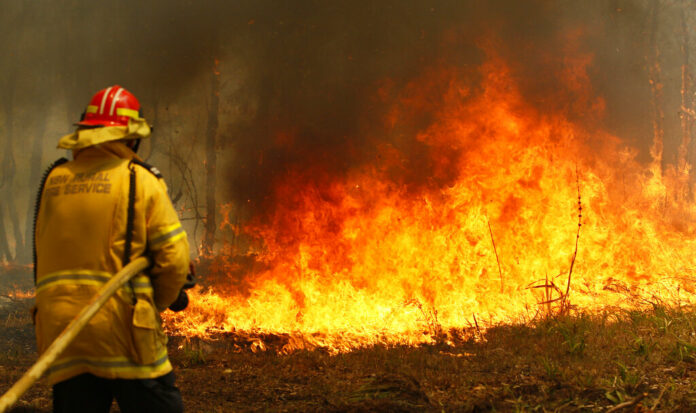
Firefighters work to contain a bushfire along Old Bar road in Old Bar, Saturday, Nov. 9, 2019. Wildfires razing Australia's drought-stricken east coast have left two people dead and several missing, more than 30 injured and over 150 homes destroyed, officials said Saturday. Photo: Darren Pateman / AAP Image via AP

CANBERRA, Australia (AP) — Australia’s most populous state declared a fire emergency on Monday with worsening conditions expected after wildfires have already claimed three lives and more than 150 homes.

New South Wales state Emergency Services Minister David Elliott said residents were facing what “could be the most dangerous bushfire week this nation has ever seen.”

Fires in the state’s northeast have razed more than 850,000 hectares (3,300 square miles) of forest and farmland since Friday.

Fire conditions are forecast to be worse on Tuesday than they were at the peak of the current fire emergency on Friday.

“The catastrophic weather conditions mean that things can change very quickly,” Premier Gladys Berejiklian told reporters in Sydney.

“You might think you’re OK and a few minutes later you won’t be. Please heed all the messages you receive. Tomorrow (Tuesday) is not the day to be complacent,” she added.

Catastrophic fire danger has been declared for Sydney and the Hunter Valley region to the north on Tuesday with severe and extreme danger across vast parts of the rest of the state.

“Catastrophic is off the conventional scale,” Rural Fire Service Commissioner Shane Fitzsimmons said.

The weeklong declaration of a state of emergency gives the Rural Fire Service sweeping powers to direct any government agency to conduct or refrain from conducting any of its functions. It can order the immediate shutdown of essential utilities including gas and electricity in fire-declared areas and can close roads and take possession of any property in the course of an emergency response.

The annual Australian fire season, which peaks during the Southern Hemisphere summer, has started early after an unusually warm and dry winter.

Story: Rod McGuirk

Advertisement

Cambodia’s Exiled Opposition Leader Makes It Part Way Home

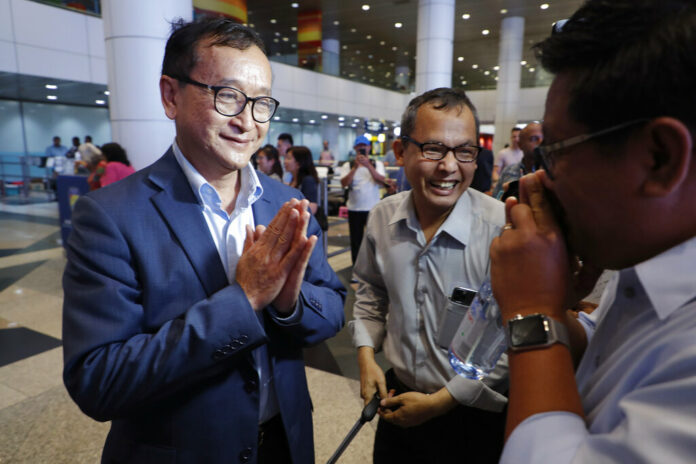
Cambodia's exiled opposition leader Sam Rainsy, left, greets supporters as he arrived at Kuala Lumpur International's Airport in Sepang, Malaysia Saturday, Nov. 9, 2019. Sam Rainsy landed in Kuala Lumpur in a bid to return to his homeland after Thailand had earlier blocked him from entering. Photo: Vincent Thian / AP

KUALA LUMPUR, Malaysia (AP) — Cambodia’s exiled opposition leader Sam Rainsy arrived in Malaysia, making partial progress in his quest to return to his home country to try to oust long-serving Prime Minister Hun Sen.

Although he failed to make it to Cambodia on Saturday — the country’s Independence Day — he told reporters in Kuala Lumpur, “I will go back home, of course. It is my right. And also my duty.”

Hun Sen’s authoritarian government has vigorously opposed the return of Sam Rainsy and fellow members of the banned Cambodia National Rescue Party and declared they would be arrested immediately if they made it onto Cambodian soil.

In a video posted Saturday morning before he boarded a flight from Paris, Sam Rainsy told supporters: “Our victory is getting nearer and nearer. The change of regime through the democratic means will soon arrive and be accomplished.”

In what may be a possible turnaround in the Cambodian government’s position, its influential deputy prime minister and interior minister, Sar Kheng, said on his Facebook page Saturday, “As of now, there is not any announcement by the Cambodian government to bar culprit Sam Rainsy and his colleagues from entering the country.”

Sar Kheng said Sam Rainsy — who has several convictions with prison sentences to serve along with charges pending for several other alleged offenses — can return as an ordinary person but will have to face due justice. Sam Rainsy considers the legal actions political persecution.

It was unclear if Sar Kheng’s Facebook post represents government policy. Cambodia’s long holiday weekend runs through Tuesday.

Sam Rainsy spoke to reporters briefly on his arrival in Kuala Lumpur, saying he had been invited by Malaysian lawmakers to meet with them on Tuesday. He declared that his visit was private and that he was grateful to the Malaysia authorities.

His comments appeared to sidestep the issue of whether he was interfering with Cambodia’s internal affairs while on Malaysian soil. Malaysia and Cambodia are both members of the Association of Southeast Asian Nations, which maintains a policy of noninterference in each other’s affairs. Malaysia and Thailand have both hindered the free movement of opposition party leaders, drawing criticism from human rights groups.

Prime Minister Mahathir Mohamad said earlier in the week that Malaysia doesn’t want to be used as a base for political activists or interfere in the affairs of other countries.

“Keep up the hope. We are on the right track. Democracy will prevail,” Sam Rainsy said. “Democracy has prevailed in Malaysia, democracy will prevail in Cambodia. We look up to Malaysia as our model to strengthen democracy in a peaceful way.”

In Cambodia on Saturday, Hun Sen and constitutional monarch King Norodom Sihamoni attended a celebration ceremony at Independence Monument in Phnom Penh, the capital.

Hun Sen and his ruling Cambodian People’s Party have a stranglehold on power, which was ensured when Cambodia’s high court dissolved the Cambodia National Rescue Party in late 2017 for allegedly treasonous activities.

The action was seen as a political ploy to ensure victory by Hun Sen’s party in the 2018 general election by eliminating the only credible opposition group. Sam Rainsy’s party had mounted an unexpectedly strong challenge in 2013 elections.

But he and his colleagues face an uphill battle.

An effort Sam Rainsy made Thursday to fly from Paris to Thailand — Cambodia’s western neighbor — was thwarted when Thai Airways refused to let him board. Thai Prime Minister Prayuth Chan-ocha had said earlier that he would be barred from entering Thailand.

Inside Cambodia, scores of opposition supporters have been arrested in the past few weeks.

Security in Phnom Penh was heavy and especially high Saturday at the border checkpoint at Poipet in the country’s northwest, where Sam Rainsy and his top party leaders had announced that they and their supporters would be crossing from Thailand. Traffic to the checkpoint as well as across the border was limited, with Cambodian migrant workers in Thailand reportedly barred from entry.

Other top party members fled into exile after the 2017 crackdown on all opposition to Hun Sen, which also included the shuttering of virtually all critical media and the arrest of the party’s other co-founder, Kem Sokha. He was charged with treason, based on his links to a U.S. pro-democracy organization, and is under strict house arrest.

___

Peck reported from Bangkok. Associated Press writers Sopheng Cheang in Phnom Penh, Cambodia, and Eileen Ng in Hong Kong contributed to this report.

Story: Syawalludin Zain and Grant Peck

Advertisement

Forbidden City Alone Justifies a Trip to Beijing

BEIJING — You cannot even begin to grasp the grandeur of Beijing’s Forbidden City unless you enter through its mighty gates and see it for yourself.

And believe me when I say the landmark alone is enough a reason to visit Beijing at least once in a lifetime, especially if you are a history or architecture buff.

As the name suggests, the 720,000-sqm complex was once the seat of power of the Ming (1368-1644) and Qing dynasties (1644-1912), staffed by an army of eunuchs and off-limit to commoners unless they had the privilege of being invited by the imperial court. Throughout China’s turbulent history, it came close to an annihilation by Western, Japanese, and Communist forces. Nowadays it is open to millions of tourists.

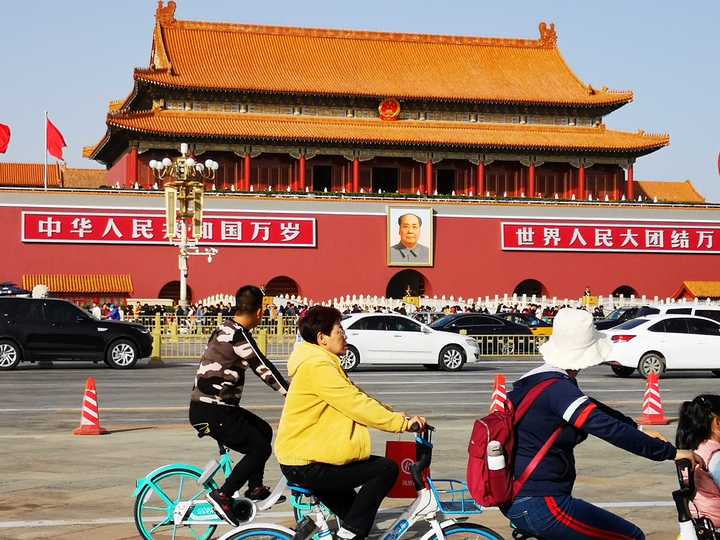
My first impression before entering the Forbidden City, completed in 1420, is the massive scale of the outer gate, called Tiananmen, or the Gate of Heavenly Peace.

Image2 1

The fortress-like gatehouse is adorned with a huge portrait of Mao Zedong. The Chairman stood on its balcony 70 years ago to proclaim the founding of the People’s Republic. This is the same gate that overlooked the 1989 mass protest that attempted to bring about democracy and reforms before it was put down by the military, leading to debatable number of deaths.

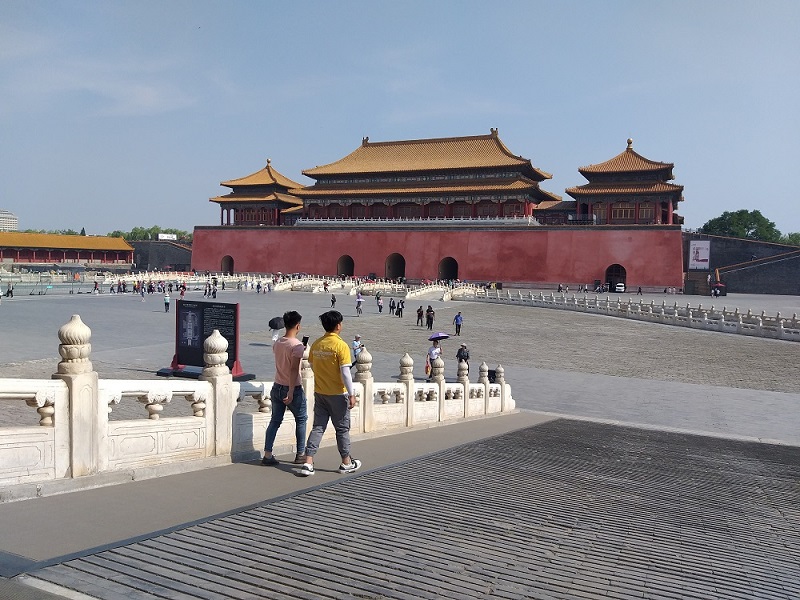
Entering the first, second and third massive gates of the Forbidden City, one cannot help but feel humbled and awed by the experience.

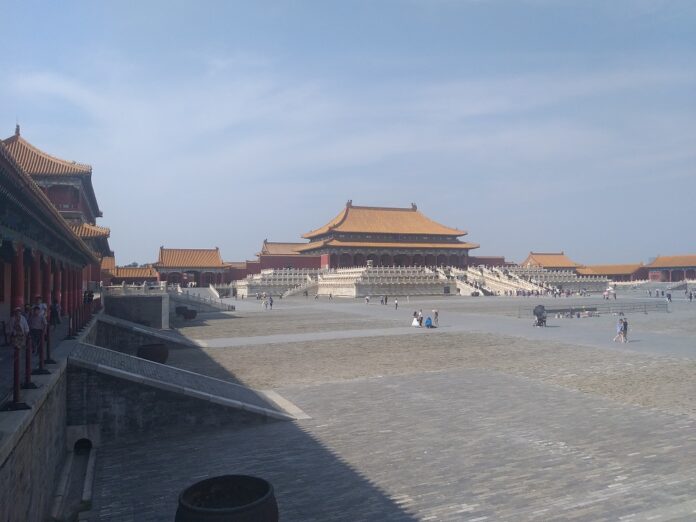
At the center of the Forbidden City, and after a considerable stroll, is the Hall of Supreme Harmony, the largest hall in the palace. Those who have seen the classic “The Last Emperor” would immediately recognize the sight.

img 20191020 162705

Pause here admire the colored ceilings and ornate dragon throne from a distance. This must be done in competition with a throng of other tourists, mostly Chinese. Yet stand there as long as you can to imbibe in the atmosphere.

If you can, use binoculars to admire the imperial Chinese architecture. Notice the roof guardians in odd number of figures believed to protect the buildings from fire.

Our guide, supplied by the China’s Ministry of Foreign Affairs, told us that there used to be 9,999 rooms inside the Forbidden City. The emperors were thought to be semi-divine, but only the truly divine beings in heaven have 10,000 rooms, according to traditional beliefs.

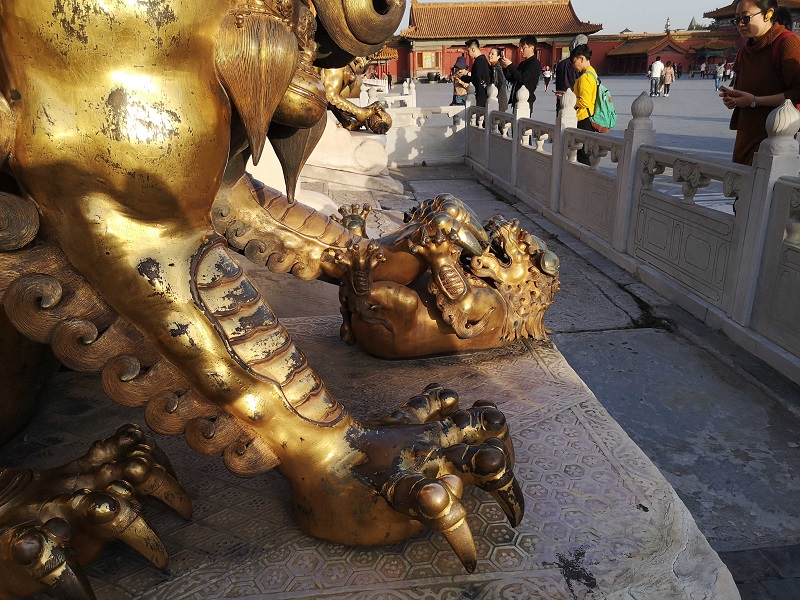
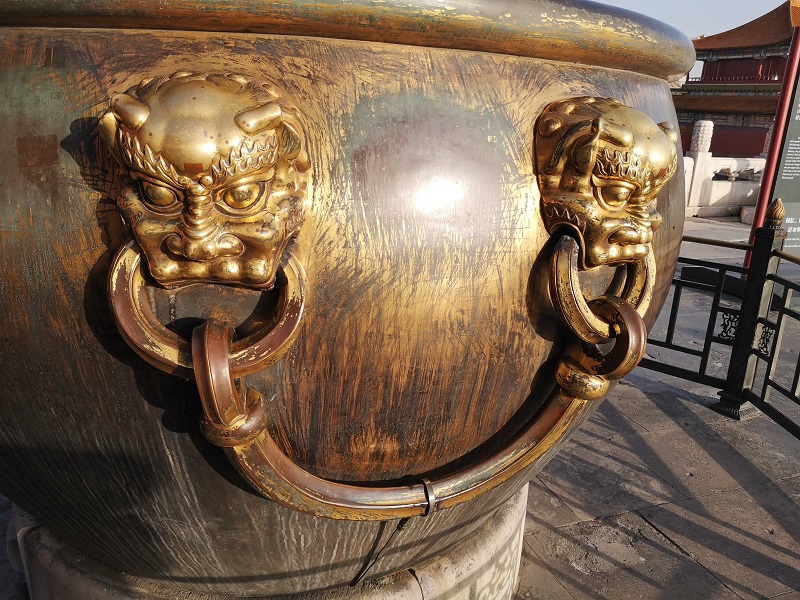
Bronze Chinese lions, such as the two guarding the front of the Gate of Supreme Harmony, are simply exquisite and filled with an aura of power. A careful observation would reveal that one is male and another female; the male holds a ball beneath its left paw while the female caresses a lion cub.

1572492349193 1

There are bronze water receptors, used to store water in case there’s a fire inside the city. The guide said the marks of damages on the vessels were caused by Japanese invaders during the occupation of Beijing.

One should also simply sit and admire the majesty of the palace, built by a labor of 1 million people over a period of 14 years. I wonder how many died, and how many of them were willing participants in the grand project.

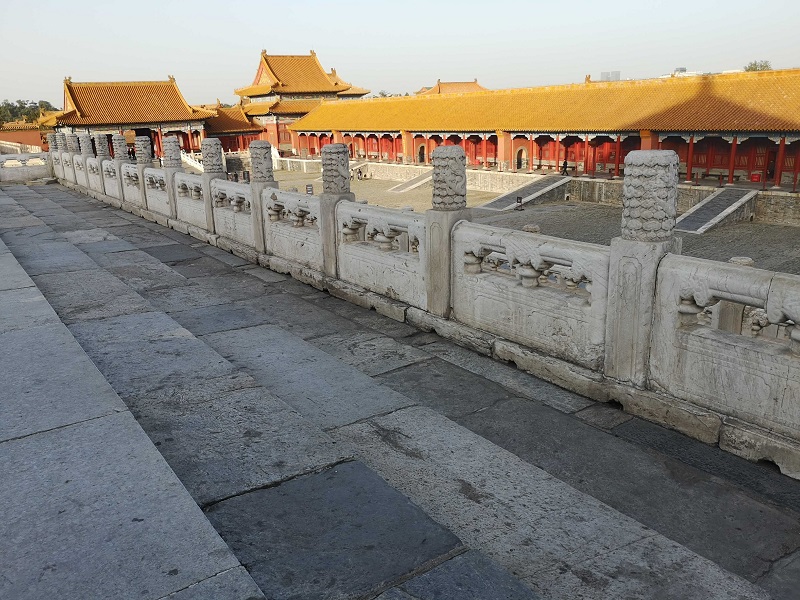
Whichever direction you look, you will find yourself surrounded by delicate architecture and artisan craft, even though most of its treasures are long gone, with the better of the collection kept at the National Palace Museum located 1,721 km away in Taipei.

The treasures, consisting of some 650,000 items, were evacuated to the southern island due to fear of being looted by the Japanese army during its invasion of Beijing in 1937. Having visited the museum in Taipei myself, I must say a trip there is also a must for a Sinophile.

75237550 2113904095377417 230874081505837056 o 1

The fact that the Forbidden City itself is still standing is almost a miracle on its own. In 1860, during the humiliating Second Opium War, it was nearly burned down by the British and French troops who toyed with the idea while encamped in front of Tiananmen.

‘Fortunately,’ they eventually decided to loot and burn down the Summer Palace in northern Beijing instead.

The palace again came close to destruction when the Cultural Revolution reached its height of frenzy in 1966. At the time, 4,922 out of 6,843 designated places of historical interest were already trashed or vandalized by the Red Guards, and they soon set their sights on the most iconic landmark of Chinese feudalism.

Upon hearing about a planned attack on the Forbidden City, however, Premier Zhou Enlai sent troops there and ordered the gates closed, effectively sparing its fate.

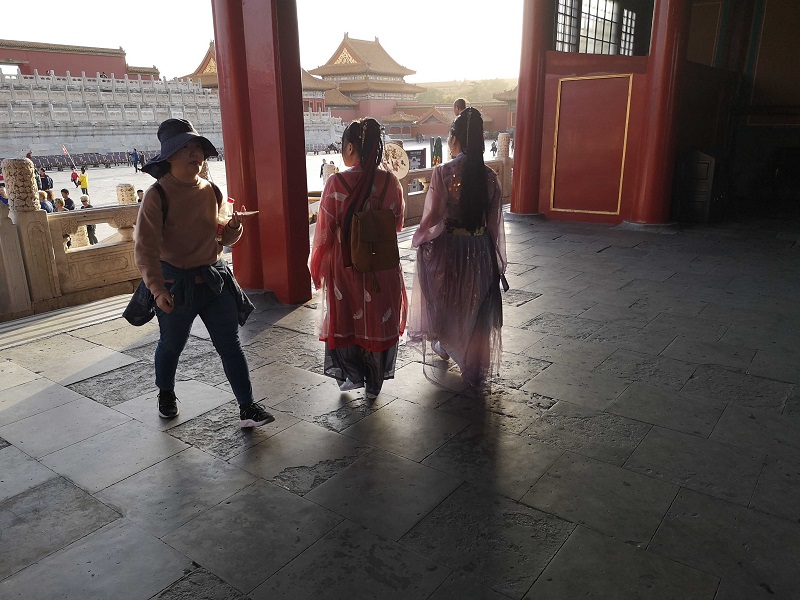
The Red Guards are a distant past. By contrast, during my visit the palace is full of young Chinese dressed up in traditional hanfu costumes and taking photos for their social media.

img 20191020 162649

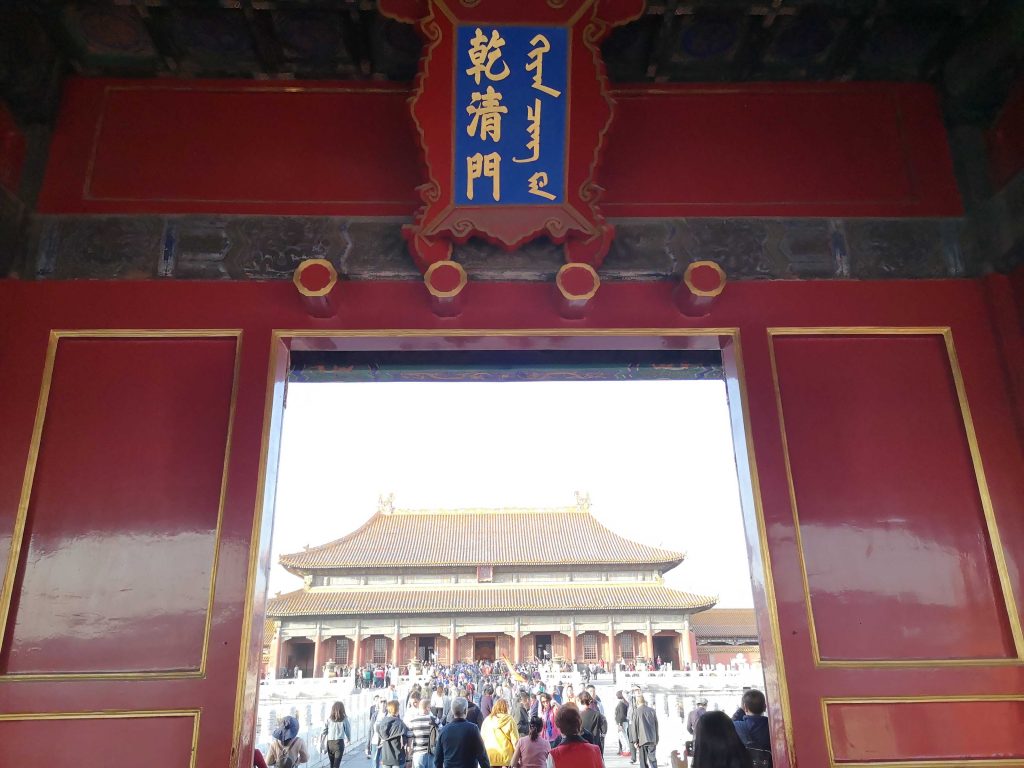
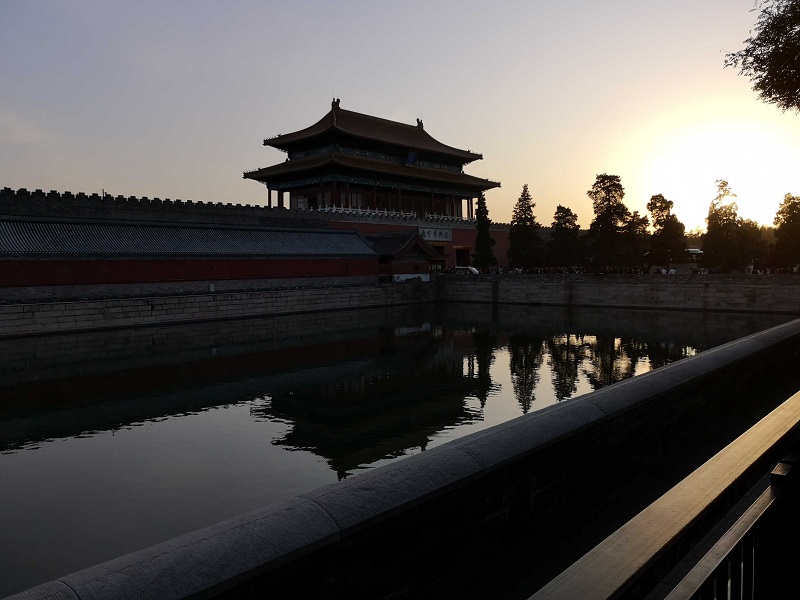
As I exit the Forbidden City through the last gate, the Gate of Divine Prowess, I noticed the blue tablet on the gate written both in Chinese and Manchurian scripts. Apparently when the Qing emperors were in power, Manchurian women of certain young age and class would have to be sent to the palace through this backgate to be selected to serve the emperor.

Such feudal practice is no more. The emperors are gone for a long time now, although more recently Hong Kong pro-democracy activist Joshua Wong brought back the medieval term, branding Chinese paramount leader President Xi Jinping as “Emperor Xi”.

The writer would like to thank the Chinese Embassy in Bangkok, the Ministry of Foreign Affairs of the People’s Republic of China, and the guide for a tour of the Forbidden City.

img 20191020 160459

20190611 152530

img 20191020 165950

Advertisement

Opinion: Prayuth’s War on ‘Fake News’ is Doomed to Fail

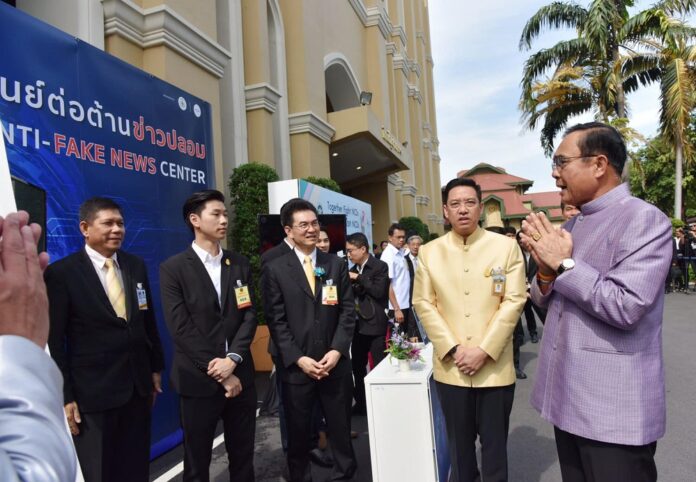
PM Prayuth Chan-ocha visits an exhibition about the government's Anti-Fake News Center on Oct. 29, 2019. Image: ข่าวจริงประเทศไทย / Facebook.

Five years of censorship and intimidating people from making critical political expression under the junta are now succeeded by a “truth center.”

The truth center, formally called Anti-Fake News Center, is real enough. With an annual fund of 60 million baht and working under the Digital Economy and Society Ministry, it pledges to dispel fake news on social media within hours after they were posted, with help from artificial and human intelligence.

If we look at it positively, the center, which was officially launched on Nov. 1, will tell us netizens what is real and what is false. This might prove useful when it comes to snake oil, fraudulent facial cream sold online, or the latest ponzi scheme.

In fact, most of their recent works focus on busting glaringly obvious bogus claims related to health – that warm pineapple juice can cure cancer, that mouthwash can eliminate pimples, or that boiled potatoes make your face look younger. One particularly serious fake news story, claiming that the government is forcing students to stop praying to Buddha, was also listed as fake.

But many fear that they will also try to tell us what is true, and what is false on other matters, too.

My suggestion is they should try to stay away from trying to dictate truth and falsehood true or false when it comes to politics and society.

If they do not, they will soon discover that its efforts are futile, its existence is redundant. Online citizens, particularly those from the younger generation, have moved on from relying on the state to tell them what to believe about politics.

Top: Footage of what the center looks like.

Five years of televised monologue by then junta leader Prayuth Chan-ocha on prime time TV every Friday attracting abysmal viewership should have offered a lesson. Government officials said the situation improved somewhat after celebrity figures made guest appearances on the program, but that didn’t say much about the regime’s popularity.

Young people believe they are old enough to decide by themselves what is real or false. And it’s not just about news, but about what they are being told about the state of Thai society, including even taboo topics like the monarchy.

How else could we explain the phenomena of hashtag trending on Twitter that offered starkly more critical appraisal of the news than the mainstream media, such as the one million tweets discussing the recent downfall of Noble Royal Consort Sineenat Wongvajirapakdi?

It speaks volumes about how social media users feel that the traditional mass media (and the state-controlled media) were not giving enough critical information and analysis regarding the incident compared to Western news outlets.

Naturally, it has fallen to social media users to bypass Thai media’s self-censorship, and broaden the discussion and analysis by themselves.

One Western media personality wrote on Facebook on Tuesday upon learning about the government anti-fake news facility: “The center is set up like a war room, with monitors in the middle of the room showing charts tracking the latest ‘fake news’ and trending Twitter hashtags.”

I say good luck to the center, but such method in controlling political narrative and people’s thoughts is irrelevant in today’s world. These actions, including the requirement that free wifi users at café register their identity, will be pointless in the long run, only to serve as proof that the state is becoming increasingly paranoid and insecure.

The state is no longer in control of the plot. Even the mainstream mass media’s influence is dwindling in the face of the rise of social media and online influencers. Netizens increasingly consume news in a more tailored, on-demand, interactive and deliberative fashion.

The top-down approach of “we tell you what to believe is fake or real” is without efficacy and so very last-century.

The Anti-Fake News Center will really have to try much harder to attract the attention of young social media users, a population with little or no loyalty to any news agencies, and a very short attention span.

Advertisement

Prayuth Grants Himself Power to Impose Curfew on Deep South

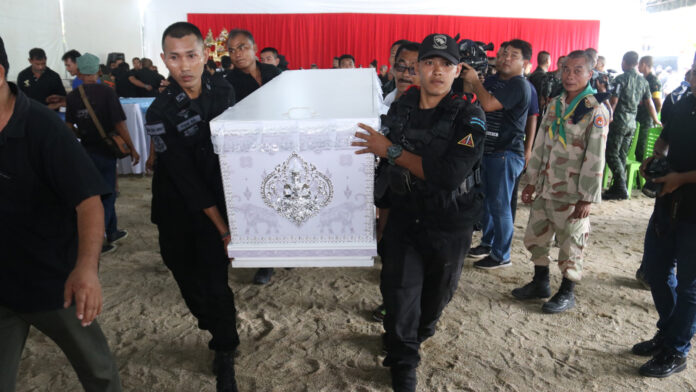
A Nov. 7, 2019, photo of a funeral of one of the 15 people killed in checkpoint attack in Yala province.

BANGKOK — Prime Minister Prayuth Chan-ocha granted himself an authority to impose curfew on certain areas of the restive southern border provinces as the head of a government counterinsurgency agency.

The order delegates the decision of declaring curfew to the director of the Internal Security Operation Command, a position held by PM Prayuth. The measure is intended to “prevent, contain, and manage the situation in the area where there are threats to national security in an orderly and effective manner.”

Although the announcement did not mention any specific cause for changes, it came days after an attack at a security checkpoint in Yala that killed 15 people on Tuesday night.

PM Prayuth told reporters he is not planning to impose any curfew, but said some areas might be closed for investigations into the raid.

“I will try to make it short for measures announced in the order,” Prayuth said. “I don’t want the suspects to cross over to other areas.”

The order was signed by Prayuth himself and published in the Royal Government Gazette website. Apart from the power to declare curfew, the order also permits director and other appointed executives of the Internal Security Operations Command, or ISOC, to prevent individuals from entering or leaving venues related to security operations.

Government officials will also be required to assist ISOC authorities and its operations, though the order does not mention punishments should they refuse.

The order will be effective from Dec. 1, 2019 to Nov. 30, 2020 and will only cover Mae Lan district of Pattani province, Betong district of Yala province, Su-ngai Kolok, Sukhirin, and Si Sakhon districts of Narathiwat provinces, and Chana, Na Thawi, Thepha, and Saba Yoi districts of Songkhla province.

Advertisement

Why Thai Muslims Don’t Celebrate Loy Krathong (But Christians Do)

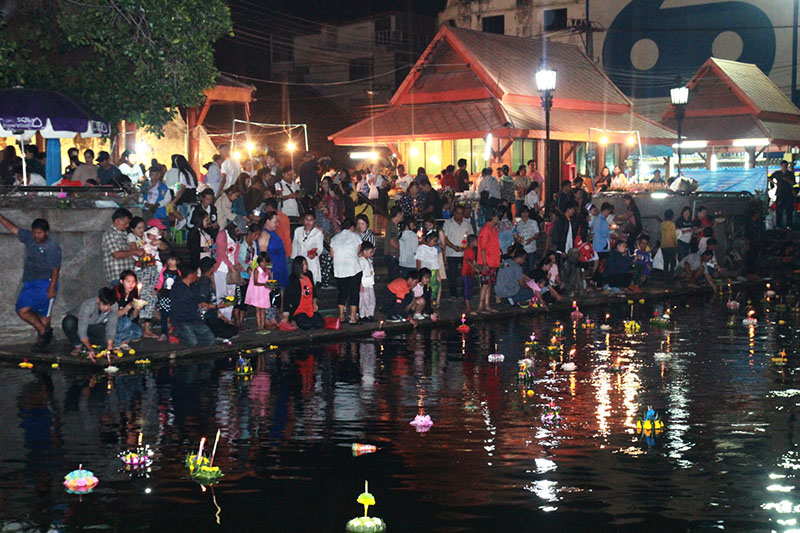
Promotional models pose for photos at a government event promoting Loy Krathong festival in Bangkok on Oct. 30, 2018.

As revelers around the country are gearing up for Monday’s Loy Krathong festival, the day means nothing to about five million Thais who would be absent on that night.

To the country’s second largest religious group, the river festival is empty of meaning, and to pay homage to it through gaiety is profane. Celebrating Loy Krathong remains a taboo for Muslims – a dogma enforced by the highest Islamic authority which many young Muslims interviewed for this story said they intend to follow.

“I do not celebrate Loy Krathong. As Islam is a monotheistic religion, we believe in one God,” Noorulhuda Chalermthai, 26, said in an interview. “The purpose of Loy Krathong, from what I have known is, to pay respect and worship the goddess of water.”

Another Muslim, 21-year-old Pitchaya Vimonthammawath, echoed a similar message, “My family and friends told me that it’s not for us, and not our place or business, but for Thai Buddhists.”

On the other hand, followers of another major monotheistic religion in Thailand – Christians – said they had no issues with Loy Krathong, albeit having minor reservations about some gestures in the ritual that could be seen as acts of idolatry.

In a country where religions and animistic superstitions are mixed beyond recognition, and whose calendar is peppered with holidays inspired by multiple faiths, it is forgivable to forget that Loy Krathong is deeply rooted in Hinduism. The colorful krathongs are tributes to the Indian goddess of water, Ganga, which Thais call Phra Mae Kongka.

IMG 0604 copy

Due to the tradition’s ties with divine worship, Islamic clerics banned participation in the holiday, said Wisut Binlateh, an official from the Sheikul Islam Office, who wields authority on matters of Islamic beliefs.

“We don’t believe in other gods or goddesses who rules over mountains and rivers,” Wisut said in an interview. “There is only one God who we believe in, who created everything.”

The traditional belief that one can drive away past transgressions, or bad karma, by floating a boat made of banana stalk also goes agaisnt Islam’s tenets concerning forgiveness.

“If we have sins or karma, it’s from our actions. The only way to ask for forgiveness from Allah, and to do good,” he said. “You can’t just float away your sins.”

‘Not Going to Loy Krathong’

A 2018 census by National Statistics Office of Thailand found that 5.4 percent of the Thai population is Muslim, or around 3.7 million people. Many of them are in the southern region, where they make up almost 30 percent of the population.

To preserve their religious belief in a society where up to 93.5 percent of the population follows Buddhism, many Muslims often take to social media every year when Loy Krathong is around the corner to remind each other not to participate.

“Islam doesn’t have Loy Krathong tradition,” reads one popular message that’s been widely reposted by Muslims on Facebook.

“Not going to Loy Krathong, because we are Muslims,” reads another banner, shared over 500 times.

In a reply to a Facebook thread debating who one should invite as a date to Loy Krathong festivals, a Muslim user wrote, “Never had this problem. Islam doesn’t have Loy Krathong anyway.”

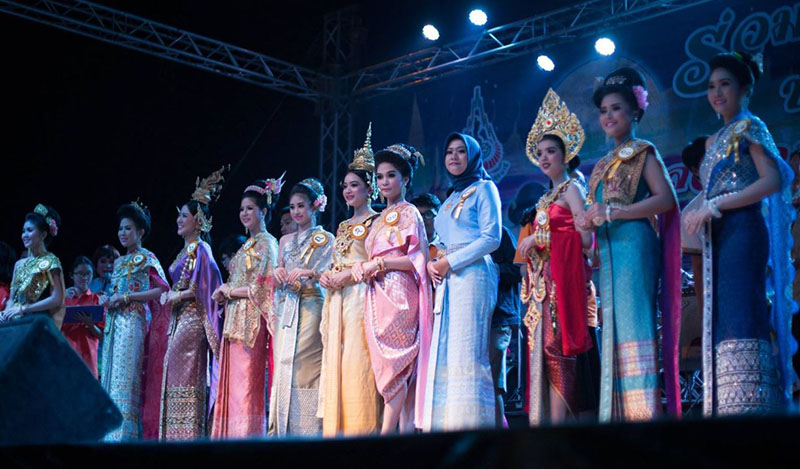
“Nang Noppamas” contestants at the 2018 Loy Krathong festival at Suranaree University of Technology. Photo: Suranaree University of Technology

Even without these reminders, ignorantia juris non excusat – Muslims cannot claim they didn’t know it was a taboo, Wisut from Sheikul Islam Office said.

“Muslims can’t just say go and then later say they didn’t know about what loy krathong really means, or just go along with fads and trends,” he said.

Bukhari Alkaremi, 33, works a TV station dedicated to broadcasting Islamic teachings. He said Buddhists may see Loy Krathong as a purely cultural matter, but to him it is different.

“If it’s related to other faiths, Muslims cannot participate, even if it’s part of the culture,” he said. “To participate is to accept the rituals.”

It’s not just Loy Krathong either: Muslims also cannot participate in other festivals with religious roots, such as Christmas, Buddhist Lent, and even the New Year. Celebrations are only allowed on Eid al-Fitr and Eid al-Adha, called Eid Lek (“small Eid”) and Eid Yai (“big Eid”) in Thai, respectively.

Can Christians Do It?

On the other hand, Loy Krathong is a non-issue for Christians in the kingdom. A Catholic priest and a Protestant pastor said they recognize a distinction between culture and faith.

“We can fully separate the culture from Buddhism, and go to the festivals in a celebratory nature. We can just be sitting around quietly if they’re doing chants,” Vissanu Thanya-anan, who holds a position in the Catholic Bishops’ Conference of Thailand, said in an interview.

He added, “Culture is culture, religion is religion. Appreciation of water isn’t limited to one religion. Everyone treasures the country and culture they’re born in.”

“Although a Christian has no obligation to go, of course they can go to to enjoy the festival with family and friends,” said Thongchai Pradabchananurat, the founder of New Vision Church in Bangkok. “Don’t go if you don’t want to, but there’s no need to berate others for going and ruin the mood for everyone else.”

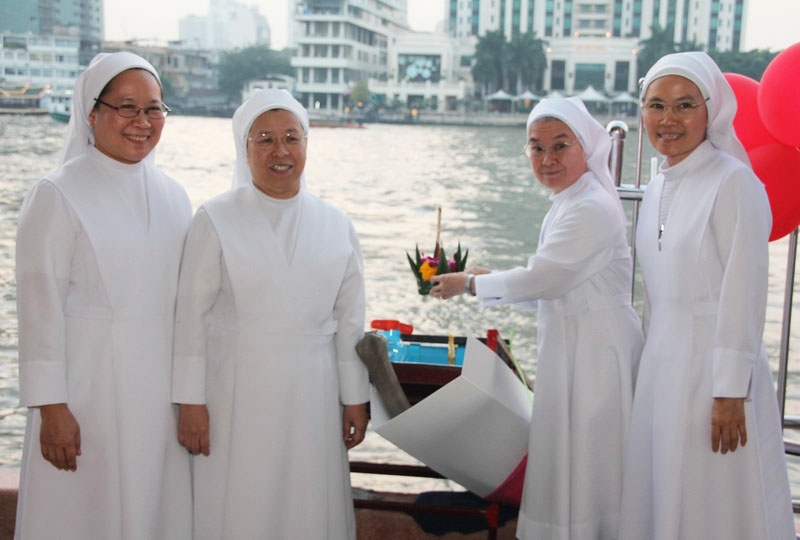
Nuns attending Loy Krathong festival held on Nov. 21, 2010 at Assumption Convent School in Bangkok. Photo: Assumption Convent School

Christians are a minority population, amounting to 1.1 percent according to a 2018 census, or around 617,000 Thais, with almost equal numbers of Catholics and Protestants.

Just as Thailand imports different influences, whether from Brahmin or animist origins, the local branch of Christianity also adopts some of the ‘Thainess’ as well, Vissanu said. “We can wai or even graab,” he said, referring to the acts of paying respect and prostrating.

Thongchai the pastor is also one of the editors of booklet series called “Can Christians Do It?” – which offers advice to Thai Christians on navigating religious holidays in Thailand like Loy Krathong and Songkran.

For the booklet on Loy Krathong, the book suggests praying to God while floating a krathong, or putting a small cross in the krathong instead of joss sticks, which are considered to be a religious objects used to venerate spirits. Still, Thongchai believes there’s nothing sinful per se about attending the festival.

“Muslims are more strict and inflexible, and do not go out of the Qu’ran so they won’t attend Loy Krathong or get involved at all,” he said. “Their concern is on purity.”

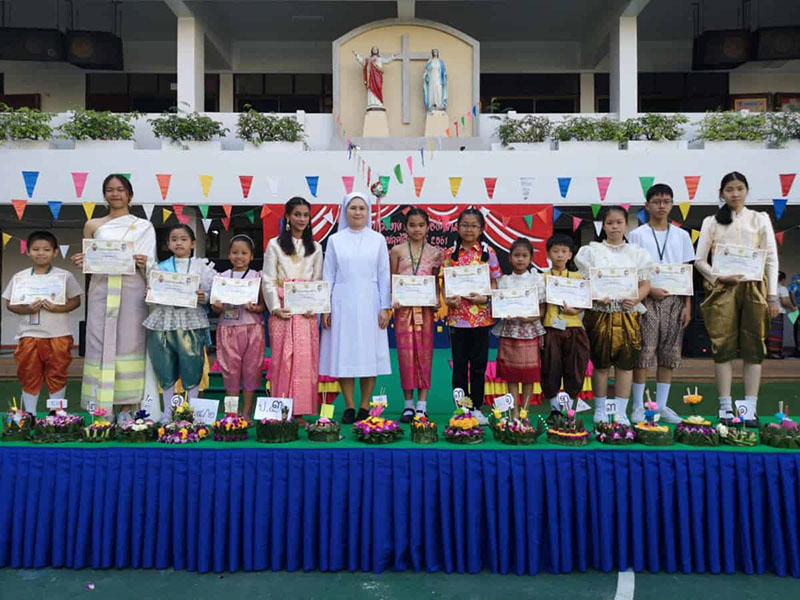
A loy krathong event at Hathainiramon School. Photo: Hathainiramon School

Purity and Harmony

Indeed, critics of Islam in Thailand – from secular liberals to Buddhist hardliners – often take issue with what they see as Thai Muslims’ resistance to integration, which they say could lead to conflicts and widen societal gaps.

Their concern is shared by a number of younger Muslims, who attempt to strike a balance between spiritual purity and social harmony in the Buddhist-majority nation. One of them is a popular Muslim preacher on social media who goes by the name Matty Ibnufatim Hamady.

In a Facebook post that drew over 4,500 reactions, Matty said Muslims should be culturally sensitive even when discussing celebrations or festivities that they had no intention of joining.

“If we can’t participate, then we should stay silent. If we see Chinese people celebrating Chinese New Year and post ‘Muslims say no to Chinese New Year’ then their Chinese friends will feel bad,” he wrote. “No Muslims would like it if we see someone posting ‘Buddhists say no to Hari Raya Day.’”

IMG 0227 copy

Several people interviewed for this story, like Bukhari and Pitchaya, also said they know some Muslims who do attend Loy Krathong festivals.

“Some people just see it as a party, or a cultural tradition,” said Pitchaya, a communication arts student in Bangkok.

Bukhari, who lives in a “melting pot” of mosque neighborhood close to Khaosan Road, said his experience taught him that participation in religious festivities isn’t necessary for building good ties. Instead, Muslims can always attend non-religious activities like sports and cleanups with members of other faiths.

“Buddhists respect us if we don’t participate, such as in Loy Krathong or Songkran,” he said.

Wisut, the cleric from the Sheikul Islam Office, suggested a similar solution.

“You shouldn’t go to the festival at all, because none of it is okay,” he said. “But afterwards, if people invite you to clean up the river, you can and should go, because it’s something good to do for the community.”

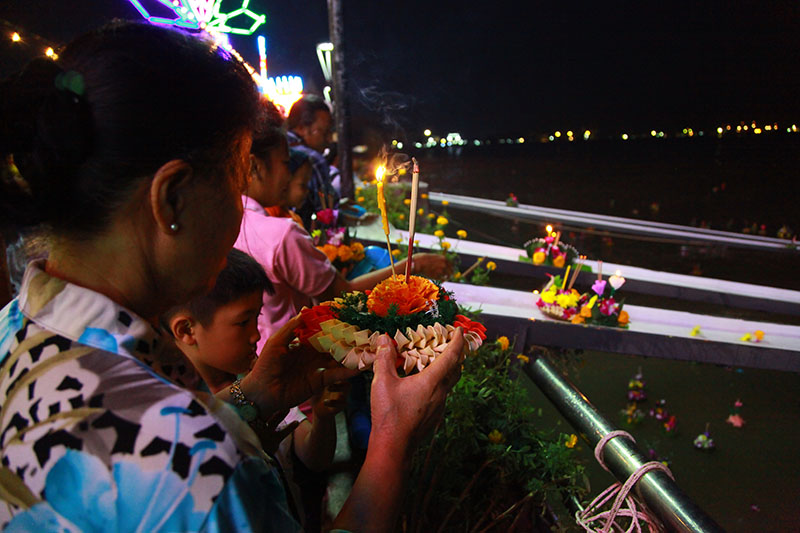
Photo: Wat Prayurawongsawas Waraviharn

Related stories: 

Islamic Authority Says Muslim Mourners Can’t Wear Black or Prostrate Themselves

Islamophobia in Thailand Irrational and Dangerous: Scholars

Advertisement

Keep Calm: ‘Nakri’ Storm and ‘Bulbul’ Cyclone Unlikely to Affect Thailand

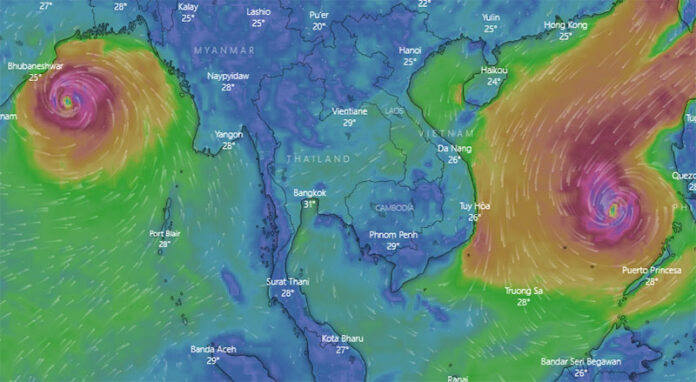
Image: Windy
Image: Windy

BANGKOK — Sandwiched between two storms on the globe, Thailand is in a safe haven against a tropical storm and a cyclone, according to Thai meterologists.

Neither tropical storm Nakri, which is approaching the southern Vietnam coast, or Cyclone Bulbul, scheduled to hit Bangladesh and India, will significantly impact Thai weather, the Thai meteorological department said Friday afternoon.

Thai travellers to Vietnam, India, and Bangladesh should take note and monitor local weather conditions.

Nakri won’t have a large impact on Thai weather except for additional showers in the North and Northeast through Tuesday. Rains from China may pepper said region Nov. 13 to 15, meteorological department director Phuwiang Prakummin said.

Meanwhile, nationwide temperatures are expected to dip 2C to 4C, with 70 percent of rain showers in the south. Bangkok is expected to see lows of 21C to highs of 33C, with a slim chance of rain.

Advertisement

Hermit Accused of Raping 15-Year-Old Daughter

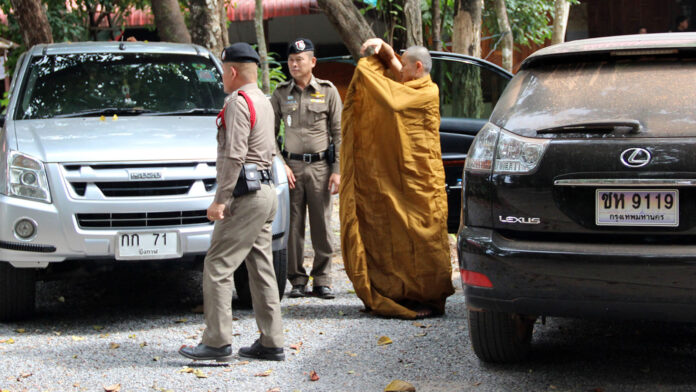
A hermit, who goes by the name Paiboon, being taken to Bueng Kan city patriarch by the police on Nov. 7, 2019.

BUENG KAN — An ascetic forest hermit on Thursday denied police allegations that he raped and impregnated his teenage daughter.

Paiboon, 45, the head hermit of a monastery in Bueng Kan city, was charged with sexual assault of a minor Wednesday after his ex-wife told the police he repeatedly assaulted their 15-year-old daughter until she was pregnant.

Paiboon says he is innocent. During a ceremony to defrock him on Thursday, the suspect also refused to chant the phrase that would confirm his exit from monkhood.

“I refused to leave the monkhood because I’m innocent,” Paiboon said, “I didn’t rape my daughter as my ex-wife is saying. If someone does that to their very own daughter, that person is worse than a dog.”

According to the victim’s diary shown to the media by her family, the girl said she was assaulted by her father for at least three times over a period of one year, but she had to keep it a secret as his father had threatened to beat her and declare her a sinner if she told anyone about it.

The family did file a criminal complaint to the police on Oct. 27. They said the girl was acting unusual after she came back from visiting her father at the monastery. The girl reportedly confessed to the family and police that she had been raped by her father.

Medical diagnosis showed she was one month pregnant, police said.

Col. Sukrit Korruamkid from Bueng Kan city police said the hermit is in custody.

Sexually assaulting someone under 15 is punishable by 15 years in jail and a fine up to 30,000 baht. The punishment increases by a third if the crime is committed by close family members, like parents.

It’s latest case involving holy men and sexual assault to hit the Buddhist faith in recent months. In September, an abbot confessed to raping a 18-year-old girl before offering to pay her family 150,000 baht in return for them to withdraw the case, which the family agreed.

Hermit sages, or ruu see, spend their time meditating in the forest, developing their mystic arts, communicating with animals, creating natural remedies, imbuing artifacts and teaching devotees. The mystics considered themselves to be part of Buddhism and most of them were ordained into the monkhood.

Advertisement

Brian Hyland, Peggy March To Seal Bangkok With a Kiss This Dec.

Recent photos of Brian Hyland, left, and Peggy March, right.

BANGKOK — American legendary teen idols Brian Hyland and Peggy March will swing the capital with their sixties bubblegum pop this Dec.

The duo will take the stage together for the first time in Bangkok on Dec. 21 at Thailand Cultural Center.

Born in 1943, Brian Hyland was a musical prodigy whose comical hit “Itsy Bitsy Teenie Weenie Yellow Polkadot Bikini” soared to the top of the Billboard Hot 100 Chart in 1962 – when he was only at the age of 16. Two years later, his ballard “Sealed with a Kiss” reached the third rank on both the American and UK Singles Charts. His songs are still heard occasionally by young listeners in movies and TV shows nowadays.

Joining him in tune will be Peggy March, who is best known for her single “I Will Follow Him,” released in 1963. Although critics often remembered her as a one-hit wonder, her stardom continued to shine outside the US throughout the 1970s with German songs like “Mit 17 hat man noch Träume” and “Romeo und Julia.”

Tickets are on sale now starting from 800 to 2,500 baht via ThaiTicketMajor.

Advertisement

Hot News

LATEST NEWS

Bangkok
broken clouds
33.3 ° C
33.3 °
32.7 °
59 %
1.3kmh
70 %
Sun
36 °
Mon
37 °
Tue
36 °
Wed
37 °
Thu
36 °