31.1 C
Bangkok
Saturday, June 20, 2026
Home Blog Page 1492

More Victims, More Damage Found in Japan Typhoon Aftermath

A man carries household goods out of a flooded house in Motomiya, Fukushima prefecture, Japan Tuesday, Oct. 15, 2019. Photo: Kyodo News via AP

NAGANO, Japan (AP) — More victims and more damage have been found in typhoon-hit areas of central and northern Japan, where rescue crews are searching for people still missing.

Prime Minister Shinzo Abe told a parliamentary session Tuesday that typhoon-related deaths have risen to 53, with 20 others missing. Lawmakers prayed in silence for the victims before starting the session.

Typhoon Hagibis hit Japan’s main island Saturday, unleashing strong winds and dumping historic rainfall that caused more than 200 rivers in central and northern Japan to overflow, leaving thousands of homes flooded, damaged or without power.

Businesses appeared nearly back to normal in central Tokyo but paralyzed in Nagano and other hard-hit areas still inundated. Residents elsewhere started cleaning their houses.

Advertisement

3 Economists Who Study Poverty Win Nobel Prize

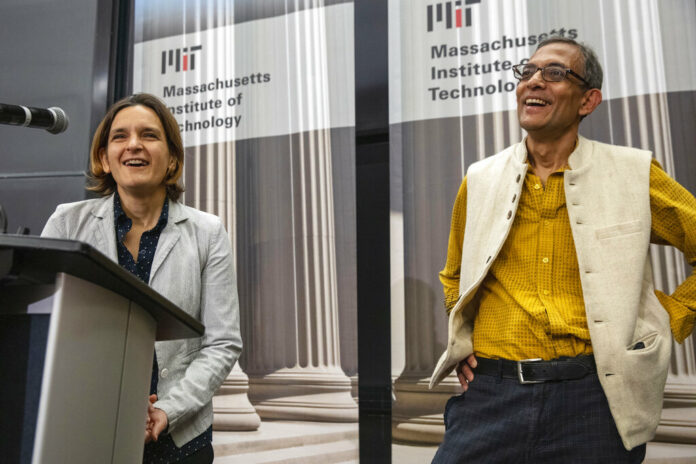
Esther Duflo, left, and Abhijit Banerjee speak during a news conference at Massachusetts Institute of Technology in Cambridge, Mass., Monday, Oct. 14, 2019. Banerjee and Duflo, along with Harvard's Michael Kremer, were awarded the 2019 Nobel Prize in economics for pioneering new ways to alleviate global poverty. Photo: Michael Dwyer / AP

STOCKHOLM (AP) — Two researchers from the Massachusetts Institute of Technology and a third from Harvard University won the 2019 Nobel Prize in economics on Monday for groundbreaking research into what works and what doesn’t in the fight to reduce global poverty.

The award went to MIT’s Abhijit Banerjee and Esther Duflo, and Harvard’s Michael Kremer. The 46-year-old Duflo is the youngest person ever to win the prize and only the second woman, after Elinor Ostrom in 2009.

The three winners, who have worked together, revolutionized developmental economics by pioneering field experiments that generate practical insights into how poor people respond to education, health care and other programs meant to lift them out of poverty.

“Without spending some time understanding the intricacies of the lives of the poor and why they make the choices they make … it is impossible to design the right approach,” Duflo told a news conference held by the Royal Swedish Academy of Sciences, which awarded the prize.

Their work in rural Kenya and in India, for instance, found that providing more textbooks, school meals and teachers didn’t do much to help students learn more.

Making the schoolwork more relevant to students, working closely with the neediest students and holding teachers accountable — by putting them on short-term contracts, for example — were more effective in countries where teachers often don’t bother showing up for work. The winners’ recommended program of remedial tutoring is now benefiting 5 million Indian children, the academy said.

Kremer and others found that providing free health care makes a big difference: Only 18% of parents gave their children de-worming pills for parasitic infections when they had to pay for them, even though the heavily subsidized price was less than $1. But 75% gave their kids the pills when they were free. The World Health Organization now recommends that the medicine be distributed for free in areas with high rates of parasitic worm infections.

Banerjee, Duflo and others found that mobile vaccination clinics in India dramatically increased the immunization rates compared to traditional health centers that often went unstaffed. The immunization rate rose further if parents received a bag of lentils as a bonus for vaccinating their children.

Banerjee and Duflo, who are married, also found that microcredit programs, which provide small loans to encourage poor people to start businesses, did little to help the poor in the Indian city of Hyderabad; studies in Bosnia-Herzegovina, Ethiopia, Morocco, Mexico and Mongolia, produced similar results.

Despite enormous progress, global poverty remains a huge challenge, the academy noted. More than 700 million people live in extreme poverty. Five million children die before age 5, often from diseases that can be prevented or cured easily and inexpensively. Half the world’s children leave school without basic literacy and mathematical skills.

Still, Kremer sounded a note of hope.

“It can often seem like the problems of global poverty are intractable, but over the course of my lifetime and career, the fraction of the world’s people living in poverty has dropped dramatically,” he said in a news release from Harvard. “Over the years, we have learned a lot about what works and what doesn’t work, and why. Governments and nonprofit organizations have become much more effective in addressing, and there is much wider recognition of how researchers and policymakers can work together in the fight against poverty.”

Duflo and Banerjee told a news conference at MIT they weren’t sure how to react when the Nobel committee woke them with the news of their win.

Duflo said that when the phone rang, she answered and was told it was an important call from Sweden.

She said her response was: “Well, since you’ve now woken me up, go ahead.”

Banerjee said the Nobel committee asked about getting one of them on a conference call, but “they said they wanted a woman, and I didn’t qualify” — so he went back to bed.

Kremer, who is in London, said he thought a message over Skype from a friend in Sweden asking to speak urgently was a scam. It was only then that it dawned on him what had happened. “I’m stunned,” he said.

Colleagues applauded the three winners.

“Well deserved!” tweeted French economist Thomas Piketty, author of a bestselling book on inequality.

“Fantastic decision!!” Max Roser, a University of Oxford researcher who founded the Our World in Data project, wrote on Twitter. “Even after two centuries of progress against global poverty I think it is clearly one of the very biggest problems in the world today.”

Duflo said receiving the Nobel was “incredibly humbling” while noting that the profession is not always welcoming for women.

“Showing that it is possible for a woman to succeed and be recognized for success I hope is going to inspire many, many other women to continue working and many other men to give them the respect that they deserve,” she said.

On a practical matter, Duflo told reporters that she and Banerjee, who have two young children, are like any other married couple trying to juggle kids and work.

Their children “believe they are the center of the universe, and they don’t accept kitchen table conversation” about weighty matters like economics, she said. That means the couple sneak in shop talk while they’re cooking meals or walking to work.

Banerjee’s mother, Nirmala Banerjee, also an economist, told news channel NDTV in India that the prize was unexpected.

“He has been trying to get economics away from the theoretical part, but using theory to understand the world as it is,” she said from her home in Kolkata. “The way it works, the way poverty is, the way people handle poverty.”

Banerjee frequently returns to India to contribute to the work of the Poverty Action Lab, an international research center he and Duflo co-founded in 2003. “This is huge for us,” Shobhini Mukerji, the South Asia branch’s executive director, told The Associated Press from New Delhi. “India is where the seeds were sown for their research.”

Banerjee this year advised India’s opposition party ahead of national elections in May about offering financial aid to the poor. He has also criticized Prime Minister Narendra Modi’s government about alleged political interference in statistical data and over a program to take cash out of the economy.

Modi congratulated Banerjee in a post on Twitter.

Only a few other married couples have won a Nobel — notably Marie and Pierre Curie, who took half of the physics prize in 1903.

Officially known as the Bank of Sweden Prize in Economic Sciences in Memory of Alfred Nobel, the award wasn’t created by the prize founder but by the Swedish central bank in 1968, with the first winner selected a year later.

With the glory comes a 9 million-kronor ($918,000) cash award, a gold medal and a diploma.

Last week, six Nobel prizes were given, in medicine, physics and chemistry plus two literature awards and the Peace Prize.

All but the winner of the Peace Prize receive their awards on Dec. 10 — the anniversary of Nobel’s 1896 death — in Stockholm. The winner of the Peace Prize receives the award in Oslo, Norway.

___

Story: Paul Wiseman, Aleksandar Ljubojevic and Steve Leblanc. Wiseman reported from Washington and LeBlanc from Cambridge, Massachusetts. Associated Press writers Jan M. Olsen in Copenhagen, Denmark; Emily Schmall in New Delhi; Cara Anna in Johannesburg and Sylvie Corbet in Paris contributed to this report.


Advertisement

Make Influencer Marketing Work for Your Brand

Influencer marketing has been around for ages. Once simply referred to as endorsements, this type of marketing has been transformed into a whole different ballgame with the worldwide explosion and popularity of social media.

But making it work for your brand takes careful research and development of a realistic strategy. While recruiting a major celebrity to sing the praises of your brand may seem like a good idea at first, it may not be the best way to spend your marketing budget. It also may not give you the results you were hoping for.

Targeting Your Influencers

This is why plenty of research and the development of a sound strategy is always the first step in creating a profitable influencer marketing campaign. Research provides you with the data necessary to whittle down your choices to the people who are most likely to both ramp up your brand’s awareness and increase sales.

Often, your research will point to micro and nano influencers as being the better choice than widely known celebrities.

Value of Micro and Nano Influencers

Micro and nano influencers are people who are knowledgeable about a certain industry. They have earned respect and a following on social media because of their ability to write well on specific industry-related topics.

These types of influencers may make their living as influencers or do it as a side-line. The best of them are active on several different social media platforms. This is important, particularly if your goal is to increase brand awareness rather than increase sales of a specific product or service. It will also stretch your marketing budget.

Picture2 e1571112308984

By engaging with an influencer who is well-known on several different platforms, you’ll be reaching more people and expanding your potential customer base. Instagram, Twitter, Facebook, and more recently, Line and Twitch are some of the platforms with which your influencer should be familiar and have an active presence.

Working Together with Your Influencer

Influencer marketing works best when done as a collaborative effort. This means that not only do you have to specify the goals you hope to achieve in partnering with an influencer, or, better yet, a series of influencers, but you also have to ensure that you’re both working off the same page.

Your influencer should agree to a contract and schedule of posts that is attainable for them. You should also make it known that your brand will analyse data on an ongoing basis to determine the effectiveness of the campaign.

Influencer Marketing Agencies Make Your Life Easier

Many brands who are new to this type of marketing turn to the experts for help in choosing their influencers, negotiating their services, and providing ongoing data to determine how well the campaign is going.

Partnering with a digital marketing agency that have experience with influencers provides you with the expertise to make the most of your campaigns. They regularly work with influencers across many industries.

They know what to expect and how to negotiate with them. They also can provide regular reports that will plainly demonstrate the effectiveness of your influencer campaign.

In Bangkok, Thailand, that digital marketing agency is Primal. Primal is the leading digital marketing in the country. We have the proven ability to conduct influencer marketing campaigns that will provide your brand with the results you need to grow your brand awareness and increase your sales.

Advertisement

K-Pop ‘f(x)’ Star Sulli Found Dead at 25

SEOUL, South Korea (AP) — South Korean pop star and actress Sulli was found dead at her home south of Seoul on Monday, police said.

The 25-year-old was found after her manager went to her home in Seongnam because she didn’t answer phone calls for hours, said Kim Seong-tae, an official from the Seongnam Sujeong Police Department.

Kim said that there were no signs of foul play and that police did not find a suicide note.

“The investigation is ongoing and we won’t make presumptions about the cause of death,” said Kim, adding that security camera footage at Sulli’s home showed no signs of an intrusion.

In a statement sent to reporters, SM Entertainment, Sulli’s agency, said her death was “very hard to believe and sorrowful.”

Sulli’s legal name is Choi Jin-ri. She began her singing career in 2009 as a member of the girl band “f(x)” and also acted in numerous television dramas and movies.

She was known for her feminist voice and outspokenness that was rare among female entertainers in deeply conservative South Korea. She recently appeared in a TV show and spoke out against online backlash she received over her lifestyle.

Advertisement

Opinion: Is Khanakorn a Selfless Judge, or a Fraud?

Court of Justice sec-gen Sarawut Benchakul visits Yala judge Khanakorn Pianchana in hospital on Oct. 6, 2019. Image: Court of Justice.

A single bullet fired by a judge in what looks like an attempted suicide has raise many unsettling questions.

Judge Khanakorn Pianchana shot himself in the stomach last Friday in the courtroom in Yala province moments after he acquitted five men of murder.

“Return verdicts to judges. Restore justice to the people. My words may be light as a feather but the heart of a judge is solid like a mountain..,” Khanakorn wrote at the end of his 25-page verdict before he shot himself.

Within minutes of the news coming out, many praised the judge as a selfless defender of justice. Some Thais have nearly forsaken a belief that there exists a higher ideology to die for.

Others who cast doubt on the true independence and fairness of the Thai justice system, a system which almost automatically recognized ‘successful’ coups as valid and coup leaders as legitimate to rule sees a glimmer of hope in Khanakorn’s desperate action.

The judge apparently shot himself in the courtroom in a protest against what he described as an attempt to pressure him to convict the five accused without sufficient evidence.

ผู้พิพากษา คณากร
Court of Justice sec-gen Sarawut Benchakul visits Yala judge Khanakorn Pianchana in hospital on Oct. 6, 2019. Image: Court of Justice.

Many thought he wouldn’t survive but hours later, the judge made it, and he is currently in a stable condition.

Soon enough, some Thais have cast doubt as to the sincerity of the judge. They questioned whether it was a stunt in an attempt to discredit the judiciary.

A number of netizens asked why, if Khanakarn really want to sacrifice his life for a higher cause as claimed, he didn’t shoot himself in the head. This they argued, means in fact it was a mere stunt by a charlatan who is part of an anti-government and anti-establishment conspiracy.

As I type these words, the Judicial commission has since Monday set up a judicial subcommittee tasked with investigating the matter which includes the alleged interference by senior judges as alleged by Khanakorn with findings to be submitted within 15 days.

While we wait, it’s worth asking why some would hold such a dark views of reality as to think that the judge was just acting?

How much is it worth to accept a bribe for shooting oneself in the chest, thus almost certainly ruining his career as a judge?

The fact that defendants were Thai-Malay Muslims may also play a role as conservative Thais tend to perceive them with suspicion for wanting to break the Deep South away from the rest of Thailand.

Some on social media even went as far as to suggest that Khanakorn is just setting himself a stage to enter politics, joining parties like Future Forward which is rather sympathetic to the plights of Thai-Malay Muslims in the Deep South.

Whatever the truth, it’s abundantly clear that there are people who have lost the belief in selflessness. In their eyes, any selfless act, on the verge of taking one’s life for an ideology is simply not possible.

The death of a belief in selflessness and sacrifice among some Thais does not bode well.

These people not only think that there is such a thing as a higher goal in life and is suspicious of anyone exhibiting such trait.

When there is no longer a dream beyond making money, becoming famous, powerful and having a family, life is reduced to the mundane. And people simply succumb to their base temptations.

For those who have succumbed, they may not want to entertain the possibility that some may have refused to abandon a higher goal in life.

Advertisement

Luang Cave To Reopen As Tourist Attraction this Nov.

Varawut Silpa-archa taking a selfie with Wild Boars footballers and a group of dancers during the opening ceremony of the park’s sign on Oct. 10, 2019.

CHIANG RAI — A cave complex where 12 young footballers and their coach were trapped will reopen as a national park later this year, a minister said Thursday.

The plan was announced during the unveiling ceremony of the Thamluang Khunnam Nangnon National Park sign, though environmental minister Varawut Silpa-archa said the area would only officially become a national park next month, awaiting cabinet approval.

“The cave will be open to tourists within this year as we are now exploring the cave’s condition,” Varawut said. “Once it’s ready, tourists will be able to walk 100 to 200 meters down the cave to reach the first chamber.”

He said the cave’s natural condition would be preserved, so that foreigners can appreciate the actual beauty of Luang Cave. Varawut expected a surge in foreign tourists when a feature film about the rescue operation hit the screens next month.

All 370 pieces of equipment that were used during the rescue operation and left inside the caverns have been retrieved, and chief of national park department Thanya Netithammakun said some would be put on display once the cave reopens.

Despite the government’s pledge of 3.8 billion baht to redevelop the forest park to become a tourist attraction and national park last October, the plan has been delayed due to fund allocation problems.

Thanya said the park’s area, which will be expanded from 5,000 rais to 12,000 rais (1,920 hectares), has been surveyed and passed public hearing to become a national park. He is waiting for the ministry to seek approval from the cabinet.

Luang Cave attracted global attention last year when 12 young footballers and their coach were trapped within for 17 days by a flash flood. The epic rescue operation, which involved more than 10,000 officials and volunteers, was concluded successfully on July 10, 2018 when the last of the boys were brought out.

One volunteer, former SEAL team member Saman Kunan died during the rescue effort. A monument has been erected in front of the cave as a tribute to him.

Advertisement

Ethiopian PM Abiy Ahmed Wins Nobel Peace Prize

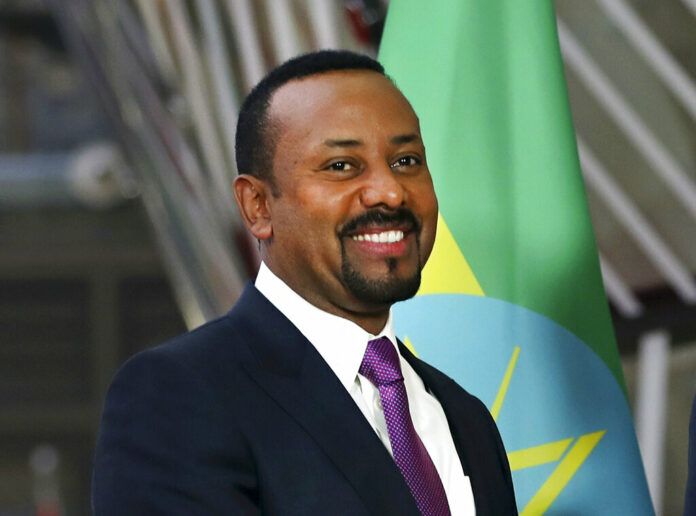
In this Thursday, Jan. 24, 2019 file photo, Ethiopian Prime Minister Abiy Ahmed at the European Council headquarters in Brussels. The 2019 Nobel Peace Prize was given to Ethiopian Prime Minister Abiy Ahmed on Friday Oct. 11, 2019. Photo: Francisco Seco / AP

OSLO, Norway (AP) — Ethiopian Prime Minister Abiy Ahmed has been awarded the Nobel Peace Prize for 2019 in recognition of his efforts to end his country’s long-running border conflict with Eritrea.

The Norwegian Nobel Institute on Friday also praised the “important reforms” that Abiy, Ethiopia’s leader since April 2018, has launched at home.

Chairwoman Berit Reiss-Andersen said some people may consider it too early to give him the prize, but “it is now that Abiy Ahmed’s efforts need recognition and deserve encouragement.”

Abiy, 43, took office after widespread protests pressured the longtime ruling coalition and hurt one of the world’s fastest growing economies. Africa’s youngest leader quickly announced dramatic reforms and “Abiymania” began.

In this Sunday July 15, 2018 file photo, Eritrean President Isaias Afwerki, second left, and Ethiopia's Prime Minister Abiy Ahmed, center, hold hands as they wave at the crowds in Addis Ababa, Ethiopia. Once official rivals, the leaders of Ethiopia and Eritrea have embraced warmly to the roar of a crowd of thousands at a concert celebrating the end of a long state of war. The 2019 Nobel Peace Prize was given to Ethiopian Prime Minister Abiy Ahmed on Friday Oct. 11, 2019. Photo: Mulugeta Ayene / AP
In this Sunday July 15, 2018 file photo, Eritrean President Isaias Afwerki, second left, and Ethiopia’s Prime Minister Abiy Ahmed, center, hold hands as they wave at the crowds in Addis Ababa, Ethiopia. Once official rivals, the leaders of Ethiopia and Eritrea have embraced warmly to the roar of a crowd of thousands at a concert celebrating the end of a long state of war. The 2019 Nobel Peace Prize was given to Ethiopian Prime Minister Abiy Ahmed on Friday Oct. 11, 2019. Photo: Mulugeta Ayene / AP

In a move that caused surprise in the long-turbulent Horn of Africa region, he said Ethiopia would accept a peace agreement with Eritrea, ending one of Africa’s longest-running conflicts.

Within weeks, Eritrea’s longtime leader, visibly moved, visited Addis Ababa and communications and transport links were restored. For the first time in two decades people could, long-divided families made tearful reunions.

The improving relations led to the lifting of United Nations sanctions on Eritrea, one of the world’s most reclusive nations. But Ethiopia’s reforms appear not to have inspired any in Eritrea, which has since closed border posts with its neighbor.

At home, Abiy offered one political surprise after another. He released tens of thousands of prisoners, welcomed home once-banned opposition groups and acknowledged past abuses. People expressed themselves freely on social media, and he announced that Ethiopia would hold free and fair elections in 2020. The country has one of the world’s few “gender-balanced” Cabinets and a female president, a rarity in Africa.

And for the first time Ethiopia had no journalists in prison, media groups noted last year.

The new prime minister also announced the opening-up of Ethiopia’s tightly controlled economy, saying private investment would be welcome in major state-owned sectors — a process that continues slowly.

But while Abiy became a global darling, speaking at the World Economic Forum in Davos, Switzerland, troubles arose at home.

A grenade was thrown at him during an appearance in the capital. A large group of soldiers confronted him in his office in what he called an attempt to derail his reforms. In a display of the brio that has won Abiy widespread admiration, the former military officer defused the situation by dropping to the floor and joining the troops in push-ups.

More troubling these days are Ethiopia’s rising ethnic tensions, as people once stifled by repression now act on long-held grievances. Some 1,200 people have been killed and some 1.2 million displaced in the greatest challenge yet to Abiy’s rule. Some observers warn that the unrest will grow ahead of next year’s election.

Abiy had been among the favorites for this year’s prize in the run-up to Friday’s announcement, though winners are notoriously hard to predict. The Nobel committee doesn’t reveal the names of candidates or nominations for 50 years.

Since 1901, 99 Nobel Peace Prizes have been handed out, to individuals and 24 organizations. While the other prizes are announced in Stockholm, the peace prize is awarded in the Norwegian capital, Oslo.

So far this week, 11 Nobel laureates have been named. The others received their awards for their achievements in medicine, physics, chemistry and literature.

With the glory comes a 9-million kronor ($918,000) cash award, a gold medal and a diploma. Even though the peace prize is awarded in Norway, the amount is denominated in Swedish kronor.

Story: Mark Lewis and Elias Meseret. Elias Meseret reported from Addis Ababa, Ethiopia. Cara Anna in Johannesburg, Jan M. Olsen in Copenhagen, Denmark, and Geir Moulson in Berlin contributed to this report.

Advertisement

Apirat Revives Red Scare in Epic Rant Against Opposition

Army chief Gen. Apirat Kongsompong speaks at a
Army chief Gen. Apirat Kongsompong speaks at a "lecture" on Oct. 11, 2019.

BANGKOK — Army commander Apirat Kongsompong on Friday stunned the nation with an 90-minute tirade on anti-government politicians and academics, in which he accused them of attempting to sabotage the country’s constitutional monarchy.

Although it was not the first time Gen. Apirat fired shots at the opposition, his fiery rhetoric and even invocation of Communist threats in today’s news conference took many observers of the armed forces by surprise. He led the charge by branding the opposition’s campaign to amend the current constitution as a stealth attack on the monarchy.

“You can amend any section you like, but I will not let anyone touch Section 1,” Apirat said, referring to the constitutional clause on Thailand as an indivisible kingdom. “What they really want is to touch the monarchy, but they just don’t say it openly.”

Read: Royalist Coup Leaders Honored at Army Hall of Fame

Although he did not mention the name, he appeared to be targeting Future Forward leader Thanathorn Juangroongruangkit, whose party is spearheading the ongoing campaign to amend the junta-drafted constitution.

At one point, he showed a picture of Thanathorn and Hong Kong activist Joshua Wong, albeit with Thanathorn blacked out for an unknown reason. Apirat said he suspects that the pair might be colluding in some ways.

“Wong came to Thailand several times,” the army chief. “I don’t know what they were discussing or conspiring about, but they seem to be supporting each other.”

He then lashed out at the opposition and painted them as a selfish group of opportunities who cannot be trusted.

“I ask who would you trust to solve national security problems,” Apirat said. “Do you want those politicians, academics, or businessmen born with a silver spoon in their mouths; who never face any hardships in their lives; who have Little Emperor Syndrome; the pretentious leftists to solve it?”

Apirat spoke in a news conference at the army headquarters styled like a lecture, complete with slideshows and an audience of soldiers, celebrity figures, and students – some of whom were visibly dozing off.

The event itself was titled “Our Homeland from a National Security Viewpoint.” According to a document released by the army, the lecture is part of its public relations operation.

“We want to raise awareness of the changing role of the army in national security dimension and instill patriotism and unity among the people,” the statement said.

98851 e1570802665205

In a move that struck some critics as an attempt to resurrect the ghosts of Red Scare from decades ago, Apirat also suggested the communist threat is not yet over, because there are some ex-communist guerrillas who transform themselves into scholars and try to stir up the youths.

With tears showing in his eyes, he recalled a memory of joining the military after witnessing his father, former army chief Gen. Sunthorn Kongsompon, wounded by Communist fighters.

“I want to be a soldier because I saw my dad shot by the communists while he was piloting a helicopter and protecting his nation,” Apirat said. “When the war was over, most of them turned themselves in, but some of them still have this ideology implanted in their heads.”

Though the event was billed as a lecture, no Q&A session was offered at the end.

Additional writing Teeranai Charuvastra

Related stories:

Army Revokes Order to Broadcast ‘Red Scare’ Song

Army Chief Recommends Netflix’s ‘The Great Hack’

New Army Chief Open to Staging Another Coup

Advertisement

Turn Into Kafka’s Giant Bug as Biennale Returns to Bangkok, Chiang Mai

“VRwandlung” Photo: Goethe-Institut Prague

BANGKOK — Franz Kafka’s seminal work “The Metamorphosis” is famous for its theme of animalism, alienation, and absurdity – where a man turns into a giant bug. Now you too can become Gregor Samsa, when you strap on a headset and become one at an upcoming arts festival.

That’s only one of the 14 art installations from 12 countries that are coming to the capital and Chiang Mai later this month for this year’s edition of the “Unfolding Kafka” Festival.

Set to run from Oct. 26 to Dec. 15, the festival will feature art exhibitions, installations, performances, and movie screenings in various disciplines interpreting the works of German-speaking Bohemian novelist Franz Kafka.

Choreographer Jitti Chompee, founder of the festival, said this year’s theme is “Kafka Zoo,” where he will “unleash Kafka’s creatures” and awake the debauchery of Bangkok’s art scene.

“At first, I was thinking about arts these days where everything is mixed with elements from different disciplines,” Jitti said. “When I was trying to relate the concept to Kafka’s works, I found that it’s like his crossbreed characters, which humans and non-humans are amalgamated into a single body.”

“This arouses new perspectives and reflects our own existential dilemmas,” Jitti added.

“Des Gestes Blancs” – Nov. 14-15, Hostbkk Theatre

Asked what would be his most anticipated show, he pointed out to “Des Gestes Blancs” (White Gesture) from France.

A father and his eight-year-old son, Sylvain Bouillet and Charlie Bouillet, will take to the stage and dance as if they are joshing around, touching on the complex emotions of parenthood and the inner child.

“It’s rare to see a father and a child on stage together, but what’s even rarer is that this show is time-sensitive to Charlie’s age,” Jitti said. “Its purity and tenderness makes the show very popular in Europe, and this will be their first performance in Asia.”

“Turning Solo” and “Blanc” – Nov. 20, Sodsai Pantoomkomol Center for Dramatic Arts

For serious aesthetes who rather prefer something abstract, Jitti recommended “Turning Solo” and “Blanc” from Germany and France.

The double bill highlights the interplay between performers, textiles, and space where the audience will see the process of various transformations.

For instance, in “Turning Solo,” Isabelle Schad will attempt to draw her self-portrait in a purely physical approach through choreography, whirling around while forcing her way out from clothing.

In “Blanc,” dancer Vania Vaneau joins the stage with guitarist Simon Dijoud to perform a theatrical piece based on their research into trances and transformations through shamanism and rituals.

“Blanc” reveals that that while a body has its limits, it is also endless in its potential and can be blurred between the real and the imaginary.

“Hard to be a God” – Dec. 6-7, Neilson Hays Library

Want something even more bizarre? Jitti suggested “Hard to be a God” from Portugal.

In this adults-only performance, the audience will be locked inside a café where they will observe artists John Romao and Romeu Runa clambering and trying to camouflage in various ways to reflect how pretentious contemporary life is.

“VRwandlung” – Nov. 16-Dec. 15, Goethe-Institut

Need to step away from the abstract transformations? VRwandlung” is the most straightforward interpretation of Kafka’s “The Metamorphosis.”

This virtual reality adventure allows audiences to step into the shoes of salesman Gregor Samsa, who wakes one morning to find himself transformed into a giant bug. In his new body, Samsa begins to question whether he’s becoming less human.

In addition to the performing arts, there will be screenings of Kafka-inspired films and art exhibitions. The details of all the programs can be found online.

Jitti said the festival is not exactly a tribute to the novelist and there is no need to read any of his works before coming to see the shows. Instead, he wants people to appreciate the art that Thai people rarely get to see.

“Don’t be afraid to come if you don’t have any ideas about Kafka,” Jitti said. “I’m also learned about him from shows.”

Tickets for “Unfolding Kafka” range from free to 800 baht, depending on the act. All-Access festival passes are also available at Ticketmelon for 4,000 baht each.

The festival will be held at various venues across the capital including the Goethe-Institut, Chulalongkorn University’s Sodsai Pantoomkomol Center for Dramatic Arts, Hostbkk Theatre, Jim Thompson House, Neilson Hays Library, Rose Hotel Bangkok, and the Siam Society.

In Chiang Mai, it will be held at Maiiam Contemporary Art Museum.

Jitti Chompee is best known blending animal movements in his works. In 2010, he founded the 18 Monkeys Dance Theatre where he works as a choreographer and director before spearheading the first edition of Unfolding Kafka in 2015.

Advertisement

Chinese Embassy, Army Chief Criticize Thai Politician’s Meeting With Joshua Wong

Image: Joshua Wong / Facebook

Update: Future Forward chairman Thanathorn Juangroongruangkit has responded to the criticism.

BANGKOK — Future Forward Party leader Thanathorn Juangroongruangkit’s recent appearance with Hong Kong activist Joshua Wong drew fierce backlash on Friday from the army commander and China’s mission in Bangkok.

Though neither named Thanathorn in their criticism, Wong posted a photo of himself with the billionaire-turned-politician on Oct. 6 when the two met in Hong Kong, where a protest against perceived Chinese influence entered its fourth month.

In its statement released last night, the Chinese Embassy warned Thai politicians not to associate themselves with what it called “separatists” in the China-ruled city.

“Some Thai politicians have contacted the group, which advocates separatism of Hong Kong from China, in a way which is deemed to be a serious offence and irresponsible,” the statement said.

“China hopes that these people are aware of the facts about the Hong Kong problem and exercise caution over getting involved in matters which are detrimental to Chinese-Thai friendship,” it added.

But Thanathorn said he had no intention to intrude on political situations in Hong Kong. Writing on Facebook, the politician said he chatted with the activist for five minutes and took a picture together after attending a forum in Hong Kong on Oct. 5.

“It was the first and only time I met Joshua Wong,” Thanathorn wrote. “I have never been involved in any political group in Hong Kong, and I have no intention to do so in the future. The mission of mine and the Future Forward Party is to build democracy and progress in Thai society.”

Thanathorn went on to say that he is committed to “one country, two systems” principle regarding Hong Kong. He also said he hopes expression of opinion in Hong Kong takes place on a non-violent basis, and he does not wish to see violence being committed against either the civilians or security officers.

The embassy’s remark was followed by a condemnation from army chief Apirat Kongsompong, who questioned whether the pair had engaged in some form of collusion.

“Hong Kong is an island [sic] and is part of China, but some Thai took a photo with Joshua Wong,” Apirat said while showing an image published by Wong – though with Thanathorn blacked out. “Wong came to Thailand several times. I don’t know what they were discussing or conspiring about, but they seem to be supporting each other.”

Apirat also raised concerns that Thai youngsters may be lured into political violence like what happened in the 2010 Redshirt protests.

“Hong Kong protesters are mostly youths. I ask, if one day you feel disappointed and someone brainwashed you to take the streets, would you come out?” Apirat asked. “Our city and country were burnt down in 2010, but they seem to forget about it because the truth has been systematically erased.”

In his Facebook post, Thanathorn rejected Apirat’s allegation that he was somehow related to the protests in Hong Kong.

“A single photograph of me and Joshua Wong was exaggerated out of proportion without any evidence. Some media and people, including a commander in the armed forces, tried to link me with unrest in Hong Kong in order to spread hatred in Thai society,” he said.

When questioned by reporters today, Deputy Prime Minister Prawit Wongsuwan said he believes relations between Thailand and China won’t be affected, because the matter only involves “one person.”

“But if there is indeed an impact [on relations], then his party must bear responsibility,” Prawit said, without naming anyone.

Thanathorn was in Hong Kong to participate in a forum organized by the Economist magazine. At the event, Thanathorn said he was partly inspired by Hong Kong democracy movement to form his own party to fight in parliament.

Additional reporting Tappanai Boonbandit

Advertisement

Hot News

LATEST NEWS

Bangkok
overcast clouds
31.1 ° C
33.3 °
31.1 °
72 %
4.5kmh
100 %
Sat
30 °
Sun
36 °
Mon
37 °
Tue
36 °
Wed
36 °