Bangkok, Thailand, 2 July 2019 – Bangkok Marriott Marquis Queen’s Park bringsmulti-cultural culinary experiences to “Australian Festival” at Goji Kitchen + Bar. Enjoy sumptuous buffet with selected Australian highlights during 5-14 July 2019. And savor the signature dishes from celebrity chefMichael Lambie on 12 -14 July.
The buffet restaurant Goji Kitchen + Bar at Bangkok Marriott Marquis Queen’s Park, Bangkok’s largest luxury hotel, offers multi-cultural cuisine from around the world in contemporary setting and mesmerizes patrons with theatrical live cooking in the open kitchen. This time around the restaurant is hosting Australian Festival with delectable dished in the buffet line prepared from Australia’s finest ingredients that include seafood items such as Tasmanian oyster, smoky bay oyster, coffin oyster, live blue swimming crabs from Queensland, Tasmanian salmon, sashimi and smoked Hiramasa king fish from Spencer Bay as well as barramundi and King Gorge whiting that is ideal for grilling, baking and barbecuing. From Spencer Bay are also high quality black and green mussels.
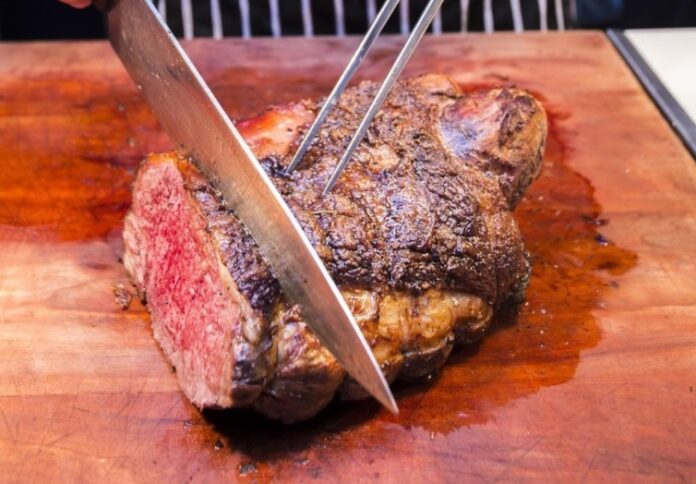
Meat lovers will get to taste premium cuts and meats from renowned cattle farms Rosedale and Stockyard that will be grilled, baked, stewed and transformed into meatballs for your enjoyment. For lamb, the festival will include white stripe lambs from the natural greens by the Victorian Mountain in the Southeast of Australia. Lamb dishes include grilled lamb and strew lamb leg among many others. If you’re looking for ostrich meat, the festival serves up high quality free-range ostrich meat in grilled dish and Australian-style burgers. Last but not least is the goodies from King Island, a small island between Tasmania and the mainland that is renowned for delicious cheeses.
At the Australian Festival between 12-14 July, Chef Michael Lambie of the renowned Lucy Liu Kitchen & Bar in Melbourne will also fly in to create five Asian-inspired signature dishes. Starting with Kingfish carpaccio with coconut foam and green chili where fresh kingfish is thinly sliced then seasoned Thai-style with lime and chili and coconut cream for extra creaminess. Next up is Pacific oyster with smoked ponzu dressing, a decent match of sizeable Pacific oyster and Japanese ponzu that delights with salty and sweet palate and slight smokiness. The third dish, inspired by street food in Beijing, is soft shelled crab Jianbing pancake roll where softshell crabs are deep-fried a la tempura, wrapped with Beijing flour with Vietnamese mint leaf then seasoned with Chinese hoi sin sauce and Malaysian sambal. From Korea is Korean spiced crispy pork hock, crispy pork served with apple kimchi and spicy hoi sin sauce to be enjoyed with Peking duck pancakes. Don’t miss out on the dessert, delectable Chocolate Dulce de Leche. All five menus will be added to regular buffet with no extra charge.
Enjoy selected Australian highlights on the buffet line at Goji Kitchen + Bar, Bangkok Marriott Marquis Queen’s Park, from 5 to 14 July 2019 at 18.00 – 22.00hrs. The dinner buffet costs
THB 1,498++ per person between Sunday – Thursday and THB 2,128++ per person on Friday and Saturday.
For more information and reservation, please contact +66 (0) 2 059 5999 or email [email protected].
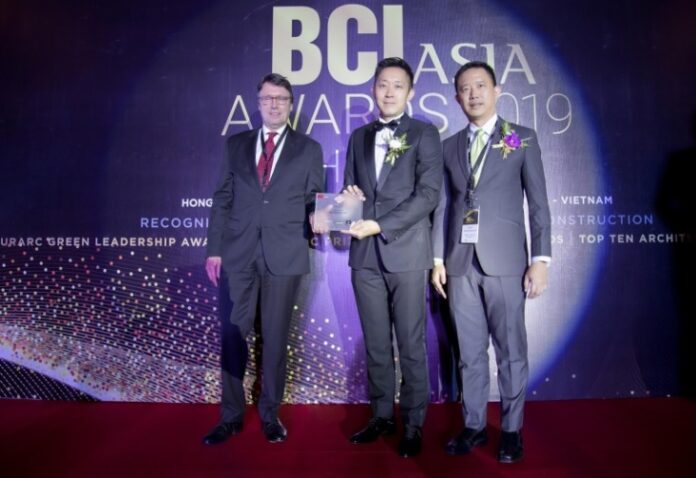
1 JULY 2019, BANGKOK – Major Development, the industry’s leader in luxury real estate, was recently awarded “BCI Asia TOP 10 Developer Awards 2019”, with Dr. Suriya Poolvoralaks, Managing Director of Major Development as the firm’s representative.
The award from BCI Asia, Asia Pacific’s center of construction-related information, and FuturArc Journal, is the mark of high quality given to real estate projects recognized by both the public and private sectors for their design aesthetics, construction excellence and environmental friendliness.
As a firm that receives this award for the third time, Major Development is recognized as the leader in prime quality real estate development. Awarded projects by Major Development include MUNIQ Langsuan, METRIS Rama 9 – Ramkumhaeng and Maven Resort Huahin.The 15th BCI ASIA AWARDS 2019 recognizes leaders within the architectural and building industries in Thailand, Hong Kong, Indonesia, Malaysia, the Philippines, Singapore and Vietnam. The award ceremony was recently held at the Grand Ballroom of Centara Grand at CentralWorld.
NARATHIWAT — A suspected wildlife trader was arrested Saturday in Narathiwat province after authorities raided his house and found five baby hornbills, a protected and endangered bird.
Border patrol police found five baby great Indian hornbills as well as one musk in the unregistered house of Muhama Hayima, 31, in Narithiwat’s Joh Airong district, said Narongpol Muekthong, director of the Sixth Wildlife Conservation Management Office in nearby Pattani province.
The arrest was prompted by a tip off about an alleged wildlife trader in the area.
Narongpol observed that the five birds were young enough to still be without feathers, indicating they were probably taken from their nest in a process where the mother was likely killed.
June and July is hatching season for hornbills, both a protected and endangered species in Thailand, the wildlife officer added.
Narongpol suspects that the birds were taken from Budo-Sungai Padi National Park in Rueso district of Narathiwat province.
“The baby birds… are mostly sent to areas like Bangkok, Ratchaburi and Nakhon Pathom provinces because people still like to raise wild birds. There is a risk that these birds may not survive, however. As for the price, they cost around 3,000 to 4,000 baht each,” said Narong, adding that more exotic types of baby hornbill could fetch 10,000 baht in the illicit market.
The five baby hornbills have been taken into care by wildlife officials and will be returned to the wild once they are mature enough.
Great Indian Hornbill or buceros homrai are known as nok nok in Thai. They can live up to 50 years, can grow up to 150cm in length, and are native to southern Thailand, the Malay Peninsula, Indonesia and West India. Mother birds usually lay no more than one or two eggs at a time, which take one month to hatch.
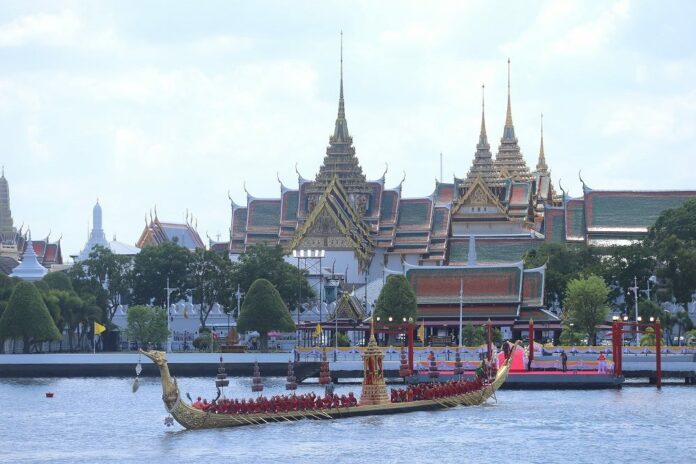
Sailors rehearse a royal barge procession on Chao Phraya River on April 30, 2019, in front of the Grand Palace. The actual procession is set to take place on Oct. 24, 2019.
Update: The procession is now postponed to Dec. 12
BANGKOK — A royal barge procession presided over by His Majesty the King will grace a Bangkok river on Oct. 24, the navy announced Friday.
The event, which will involve up to 52 elaborately crafted river barges and 2,200 seamen, is part of year-long celebrations of King Vajiralongkorn’s coronation. Navy commander Luechai Rutdit said ten rehearsals will take place on Chao Phraya River from Sunday onward.
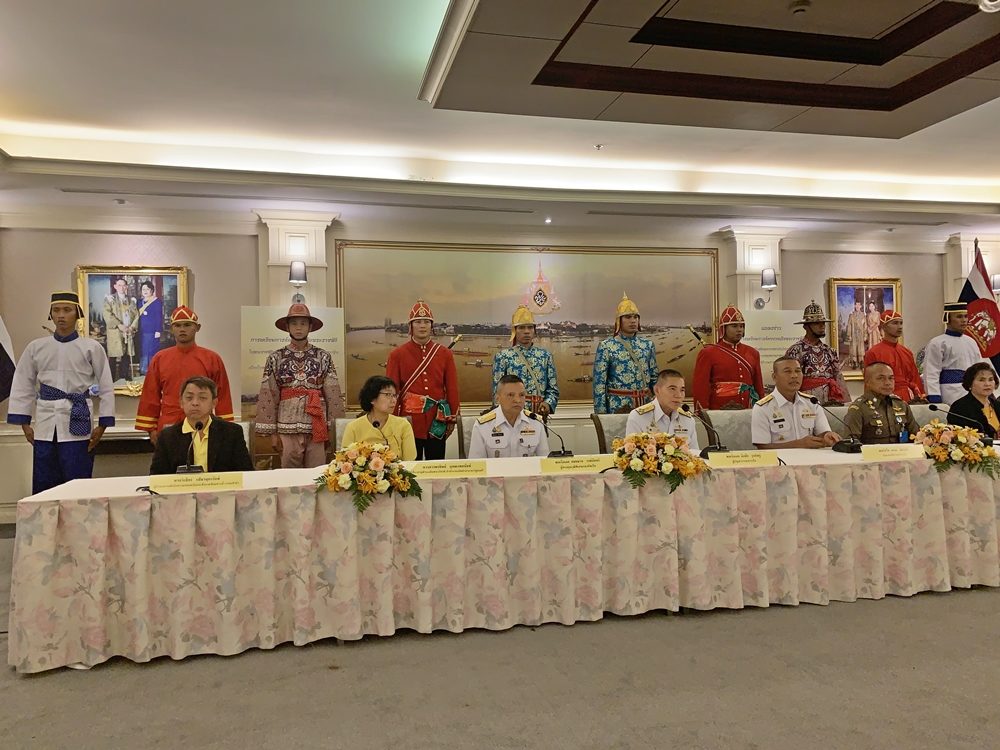
“I’d like to invite the public to admire his majesty, and the beauty and ancient civilization of Thailand,” Admiral Luechai said at a news conference. “Let me stress that no other country in the world is like us.”
The tradition of royal river processions dates back hundreds of years; the last procession took place in 2012 though the monarch at the time, King Bhumibol, was not personally present due to his failing health.
King Vajiralongkorn’s river journey on Oct. 24 will start at Tha Wasukri royal pier in Dusit district and end at Wat Arun Wanaram, aka the Temple of Dawn, on the western bank of the Chao Phraya River.
Rowers dressed in traditional garbs at the navy’s news conference on July 5, 2019.
Lee Yeol-eum with the giant clams in Law of the Jungle.
BANGKOK — A South Korean actress has been charged in southern Thailand with catching endangered giant clams while participating in a reality TV show.
Actress Lee Yeol-eum cheered as she caught the three giant shellfish in a Thai national marine park in March on the survival TV show “The Law of the Jungle.”Participants in the show then ate the clams. The episode aired on June 30.
Lee Yeol-eum with the giant clams in Law of the Jungle.
Thai authorities say the actress has been charged with hunting the protected clams, scientifically known as tridacna gigas, and could face up to four years in prison and a fine of up to 40,000 baht .
The show places South Korean celebrities into groups that are sent out to test their survival skills in remote locations.
The show’s broadcaster has apologized for the incident.
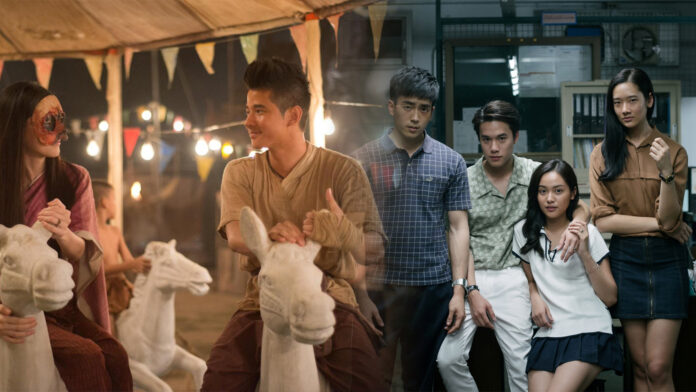
A still from “Pee Mak,” left. A still from “Bad Genius,” right. Photo: GDH 555
BANGKOK — There’s no magic formula behind Thailand’s highest-grossing films, says the studio behind “Bad Genius” and “Pee Mak.”
Making a hit movie is instead about the art of touching audiences, insisted both GDH (formerly GTH) cofounder Jira Maligool and head of script development Vanridee Pongsittisak at a Thursday discussion on ingenuity and film-making.
“The film has to touch the feelings of the audience in order to make a profit,” Vanridee said.
But that art, the pair philosophised, is about striking the right balance between the filmmaker’s personal interests and what might appeal to a mass audience.
Jira fundamentally believes that if filmmakers are fond of the film they are producing, audiences will probably feel the same. But in this simple philosophy for generating films with mass appeal is a daunting puzzle for filmmakers “who stand on top of the pyramid.”
Being on “top of the pyramid” refers to the fact that most filmmakers are graduates from the country’s prestigious Chulalongkorn University who “have distinguished tastes and lifestyles apart from the rest of the country,” said Jira, himself an alumnus.
“Directors can’t produce films that are outside their preferences, but they also have to make them appeal to everyone from the city center of Siam to the suburbs of Pak Nam in order to become commercially successful,” continued the studio co-founder.
Despite the insistence that there’s no magic ingredient for a successful film,
Ten of the nation’s 25 highest-grossing films are from GDH/GTH – with “Pee Mak” being the most commercially successful flick in Thai history. The studio claims that the 2013 comedy spin on a local horror legend earned a record-breaking 1 billion baht nationwide, though Thailand’s box office only records ticket sales in Bangkok and Chiang Mai.
At first, Jira and Vanridee fumbled their way to that fine balance between personal preference and mass appeal. They still feel their blockbuster successes were coincidences because they “didn’t really know what audiences wanted.” The pair did not have a particular target in their minds during the screenwriting process, but merely followed individual curiosity.
“The idea for Pee Mak came from Wan [Vanridee] questioning why Pee Mak had to run away from his wife when he found out she was a ghost. So we twisted the legend to make Pee Mak accept that his wife is a ghost to differentiate it from earlier adaptations. We also made it comedic,” Jira recalled the screenwriting process behind “Pee Mak.” “We never thought about adjusting the screenplay for grassroots audiences.”
Ideas for Thailand’s next potential blockbuster are floated around in the two-story house where the studio is based. Jira said ideas can be found anywhere but “you have to be able to see it as a dramatic plot.”
“Bad Genius was inspired from a short news piece I heard when I was running on a treadmill. The news was about an Asian student who was caught cheating in a standardized test. They sat the exam in an earlier time zone and told the answers to their counterparts sitting the same exam in a later time zone,” Jira said. “I called Vanridee immediately upon hearing that story.”
“Bad Genius” centers around highschool student and math whiz Lynn, who uses elaborate schemes to help rich, academically challenged students cheat on standardized exams.
The country’s second highest-grossing film, “I Fine..Thank You..Love You,” was galvanized when Jira overheard a tutoring session between an English teacher and a stugglish Thai student in a Starbucks. This common coffee-shop scene eventually earned the studio a whopping 300 million baht in 2014 because it touched the “fear of speaking English” mentality common among Thais.
“I Fine..Thank You..Love You” follows a Thai man who has been dumped by his Japanese girlfriend, Kaya, because he cannot speak speak English with her. In an attempt to win back her heart, Yim takes English classes with a teacher, who happens to a friend of Kaya.
Although many GDH/GTH titles have swept multiple awards from both domestic and international critics, Vanridee does not believe that her studio is influential enough to dictate the taste of Thai cinephiles.
“The only influence we have is changing their mindset to see that Thai film is a normal thing for moviegoers to watch,” said Vanridee, who didn’t watch any Thai films during her youth as she found them to be “not cool” compared to Western standards.
The studio is considered one of Thailand’s largest film studios, but it has about three releases per year, compared to rival Sahamongkol Film International who has more than five releases annually.
“We are slow filmmakers. Sometimes we spend a whole year just drafting the screenplay,” Vanridee said.
In 2015, GMM Tai Hub (GTH) dissolved after an internal dispute over taking the company public. GDH was founded in 2016 by two of three GTH shareholders who inherited GTH’s crews and resources.
GDH/GTH films can be watched on Netflix with English subtitles.
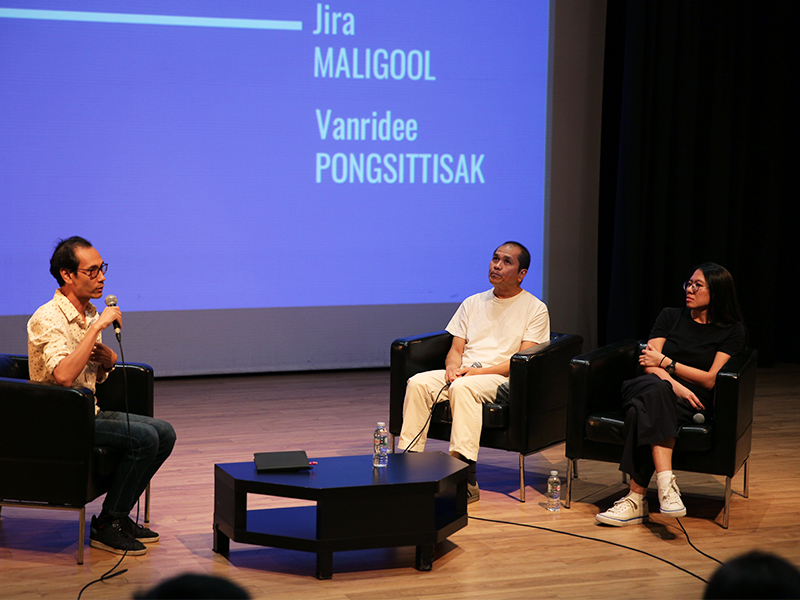
Jira Maligool, center, and Vanridee Pongsittisak, right during a panel held at Alliance Française Bangkok on June 4.
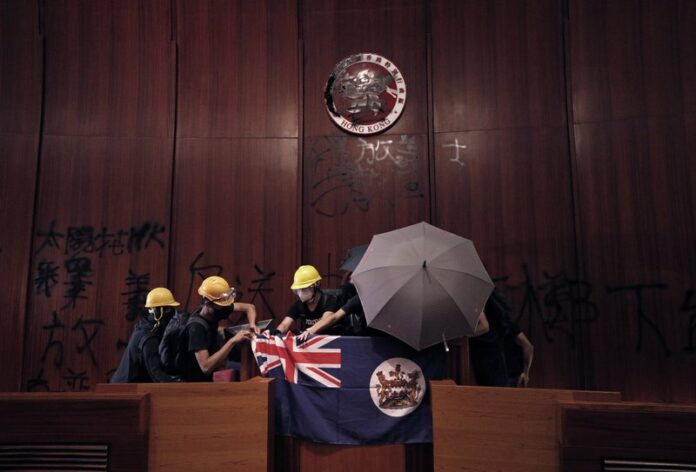
In this July 1, 2019, file photo, protesters put a Hong Kong colonial flag and deface the Hong Kong logo at the Legislative Chamber after they broke into the Legislative Council building in Hong Kong. (AP Photo/Vincent Yu, File)
LONDON — They smashed glass windows, sprayed rude graffiti and defaced Hong Kong’s official emblem with black paint. But of all the dramatic photos showing hundreds of young protesters storming the city’s legislative building this week, one image makes for particularly uncomfortable viewing in Beijing: The British colonial flag draped aloft a podium in the assembly’s chamber.
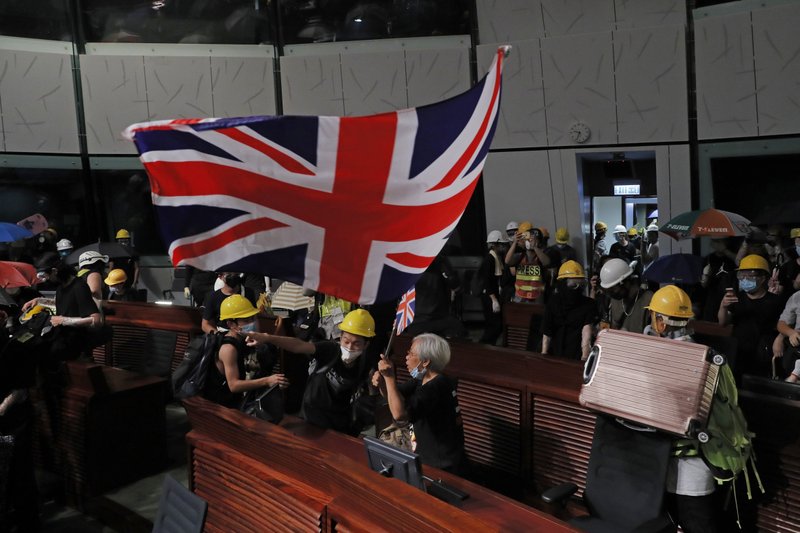
That’s not all. On a day supposed to celebrate the 22nd anniversary of Hong Kong’s return to the “motherland,” other protesters were pictured defiantly flying giant Union flags in the Legislative Council.
Why are some protesters — many of them millennials — harking back to a bygone colonial era, two decades after Britain handed the city over to China as a semi-autonomous territory?
“Does it really mean that people seriously want colonial rule again? No — but I don’t think there’s any dispute among protesters that British rule was better than what we’ve got after the handover, especially in recent years,” said Lam Yin Pong, a Hong Kong journalist.
“There might be some element of a rose-tinted lens. Perhaps some people are fantasizing about the ‘good old days,’” he added. “But what’s clear is that under colonial rule there was never a clear feeling of freedoms being gradually eroded, of a series of government actions completely against our interests.”
Hong Kong has been rocked by massive street protests and its most serious political crisis after its government tried to push through legislation that would allow suspects in crimes to be extradited to mainland China for trial. The proposed bills have triggered broader fears that China is chipping away at the freedoms and rights that Hong Kong was guaranteed for 50 years after its July 1, 1997, handover to Beijing rule under a “one country, two systems” deal.
Its constitution, the Basic Law, promised that Hong Kong voters should ultimately achieve universal suffrage, a goal that Beijing has pushed back indefinitely. That has long caused widespread resentment, especially among the city’s increasingly disenfranchised youth.
But Hong Kong never enjoyed democracy under 155 years of British rule either.
Governors at the time were appointed in London, and lawmakers were not directly elected to the Legislative Council until 1991. Most of parliament’s seats were either appointed or chosen by powerful professional groups. The city’s last British governor, Chris Patten, managed to push through democratic reforms only in the last years before his 1997 departure.
Even so, Britain was — and still is — widely seen in Hong Kong as a beacon of Western-style civil liberties and the rule of law, leaving a legacy of independent courts, a well-oiled civil service and institutions like an anti-corruption watchdog. The colonial years saw steady economic growth, and its free market policies meant the city flourished as one of the world’s leading business hubs.
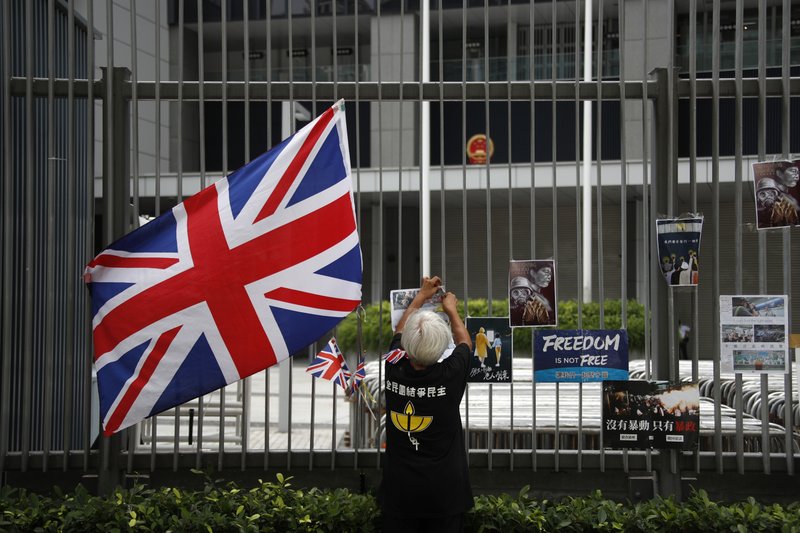
“I miss the British-Hong Kong government before 1997. The British helped us build a lot of things: separation of powers, our rule of law, our entire social system,” said Alexandra Wong, 63, a protester who’s often seen raising the Union Jack at demonstrations and carried one into the legislative building on Monday night. “What I can do is to hopefully encourage young people to continue to persist” in fighting for their rights, she said.
It helped that Patten and his administration showed a gift for connecting with the populace and are remembered fondly by many to this day.
“He projected complete commitment to the people. People could feel he wanted to be on their side,” said Leo Goodstadt, a British economics professor and chief policy adviser to the colonial government from 1989 to 1997.
By contrast, Patten’s Chinese successors all suffered dismal popularity ratings — none more so than current Chief Executive Carrie Lam. Recent polls show that under her leadership, trust in Beijing and feelings of identification with China have plunged. Lam’s administration is widely seen as inept and arrogantly out of touch with public sentiment, bulldozing through unpopular policies with no regard for widespread opposition.
Many in the city see police violence against protesters in recent weeks as marking a new low for a government seen to be oblivious to residents’ rights.
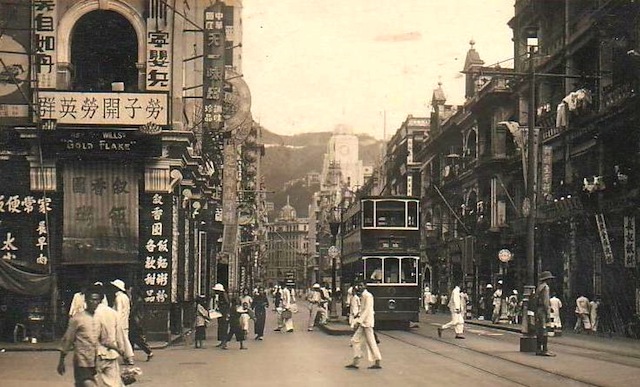
A 1920 photo of Des Voeux Road in British Hong Kong
“At least one million people have taken to the streets but they keep refusing to listen,” Lam said. “Never mind the British — any rational, civilized government would have backed off.”
Some say the protesters’ raising of the colonial-era and Union flags was a deliberate message for the world — especially Britain — to do more to uphold the democratic values they symbolize. Patten recently called for Britain to fulfil its “duty to help Hong Kong out of this dark moment.”
Both of Britain’s two leading prime ministerial candidates have made a point of stressing solidarity with Hong Kong’s protesters, and British media have featured the news prominently. Benedict Rogers, a human rights activist who heads the group Hong Kong Watch, said he’s been encouraged that the Hong Kong question is receiving much more attention in the British Parliament.
“We need to sustain this,” Rogers said. “Britain must take a lead in the international community and mobilize other countries to send a strong united message to allow Hong Kong’s freedoms to be preserved.”
It’s not clear, however, if the country has the appetite to take steps beyond offering words of concern and condemnation — or if the flags have had the opposite effect of hardening Beijing’s stance against the city.
In an escalating war of words, Foreign Secretary Jeremy Hunt, in the running to be Britain’s next leader, has warned China not to use the Hong Kong protests as a “pretext for repression.” He threatened “serious consequences” if China failed to honor the 1984 Sino-British Joint Declaration upholding Hong Kong’s high degree of autonomy — though he stopped short of spelling out any measures.
The Chinese foreign ministry shot back, dismissing Hunt’s comments as “shameless” posturing and meddling and mocked him for “basking in the faded glory of British colonialism.”
Kerry Brown, director of the Lau China Institute at King’s College London, said the question now is what America and Europe will do.
“Right now it’s mostly just rhetoric and it’s not likely to get to the situation where the U.K. can unilaterally do anything beyond the symbolic,” he said.
Certainly not everyone in Hong Kong sees things as better in the colonial days — though some believe that the more widespread political apathy back then is no bad thing compared to the turmoil today.
“Back in the day, there was no one involved in political issues, everyone was politically apathetic. … I don’t understand the reason why there are so many political demands after the handover,” said a Chinese medicine shop owner who gave only his surname, Chan. “Everyone can say anything now. I don’t see there is no freedom. The time when our government was British, I think we didn’t have that much autonomy.”
___
Associated Press journalists Katie Tam and Phoebe Lai in Hong Kong contributed to this report.
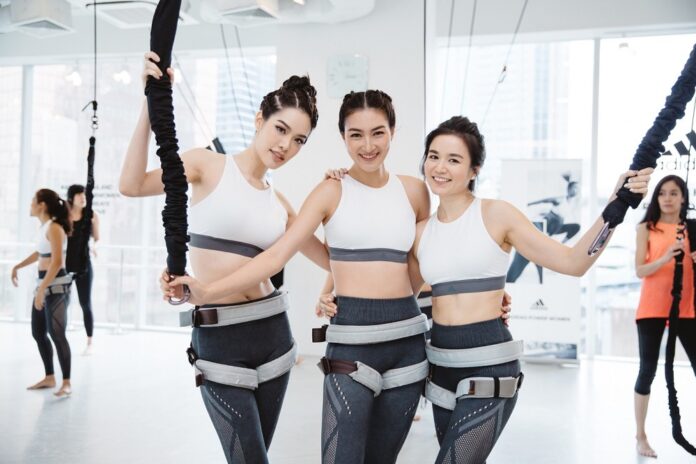
Celebrity actress Khemanit "Pancake" Jamikorn, middle, poses for a promotional image of Adidas exercise kit in Bangkok on June 13, 2017.
BANGKOK — Bangkok will host the 11th Asia Fitness Conference (AFC) in October amid a burgeoning fitness craze. But is fitness in Bangkok the preserve of the middle class and wealthy?
The conference from Oct. 10-14 will feature 200 different fitness classes, as well as what AFC organizer Suzanne Hosley bills as the “biggest Saturday night party of any fitness event in the world.”
The conference comes amid a blossoming fitness craze in Bangkok, with Hosley estimating that there are around 780 fitness studios in Bangkok alone. The AFC organizer has also noted the emergence of protein-rich food stalls at some more upscale BTS stations and the proliferation of 24-hour fitness centers.
An opening ceremony of the 11th Asia Fitness Conference
Hosley insists that AFC is for anyone into fitness, not just the well off – though a three-day pass will cost between 14,250-17,450 baht, or roughly the monthly earnings of a recent university graduate. The conference will be held at a park, rather than a posh gym.
“Exercise doesn’t have to happen in a gym. Lumpini [Park] is full, with a lot of younger people,” said Hosley.
Still, there are some signs that the fitness craze is trickling down in Thailand. Calling itself a “Thai-price gym,” for example, Chob Gym Fitness in Pattaya offers a day pass at 50 baht and charges only 3,600 baht in annual membership fees – many times less than those found in Bangkok’s upscale fitness centers.
The Bangkok-based Hosley says AFC is Asia’s biggest fitness conference, with last year’s gathering drawing attendees from 35 countries. This year the organizer expects over 4,000 visitors.
Future Forward Party leader Thanathorn Juangrungruangkit goes out for a run at Lumphini Park in Bangkok on Oct. 27, 2018.
The conference will introduce new workouts such as the PowerWave Games, which relies on a new training device, and new fitness instruments at reduced prices. Participants can also seek a tailor-made fitness regime according to DNA tests. Five types of certificates will be awarded to those who successfully complete fitness courses during the conference.
Those needing advice about fitness-related injuries can seek it at the event from Bumrungrad International Hospital’s Vitallife Wellness Center. The conference will also host a dance competition with all types of dance accepted – except one.
“No strippers,” said Suphatchaya Lattisophonkul, a dance school manager and a judge for the AFC 2019 dance competition.
A breakdown of participants at past AFCs shows that 53 per cent were personal trainers, 11 per cent fitness facility owners or managers, and seven per cent general fitness enthusiasts.
Junta chairman Prayuth Chan-ocha chairs a government meeting on July 4, 2019.
BANGKOK — In a sign that the incoming government coalition has reached a truce, a senior official said Friday the new cabinet has been submitted to His Majesty the King for endorsement.
Echoing an earlier pledge made by the junta chairman, Deputy Prime Minister Wissanu Krea-ngam said the next government will be in place before the month’s end. He declined to say who made the final cut.
“We expect everything will be done within July,” Wissanu said. “It’s in accordance with our roadmap.”
Wissanu did not mention how long King Vajiralongkorn will deliberate on the list.
The government was expected to submit the names to His Majesty the King as early as June, but infighting within the Phalang Pracharath Party over key cabinet posts prevented junta chairman Prayuth Chan-ocha from doing so.
Phalang Pracharath leaders said earlier this week that all disputes have been resolved.
Wissanu declined to disclose the names of new cabinet members today when questioned by reporters, saying he was not privy to the list.
“I don’t know,” the deputy prime minister said.
He also defended the lengthy delay between the March election and the formation of a new government. Wissanu said the old cabinet had to stay in power to welcome foreign delegates when they joined an international summit in Bangkok two weeks ago.
“If we had formed a new government before the ASEAN Summit, the new cabinet members would not have been able to prepare in time,” Wissanu said.
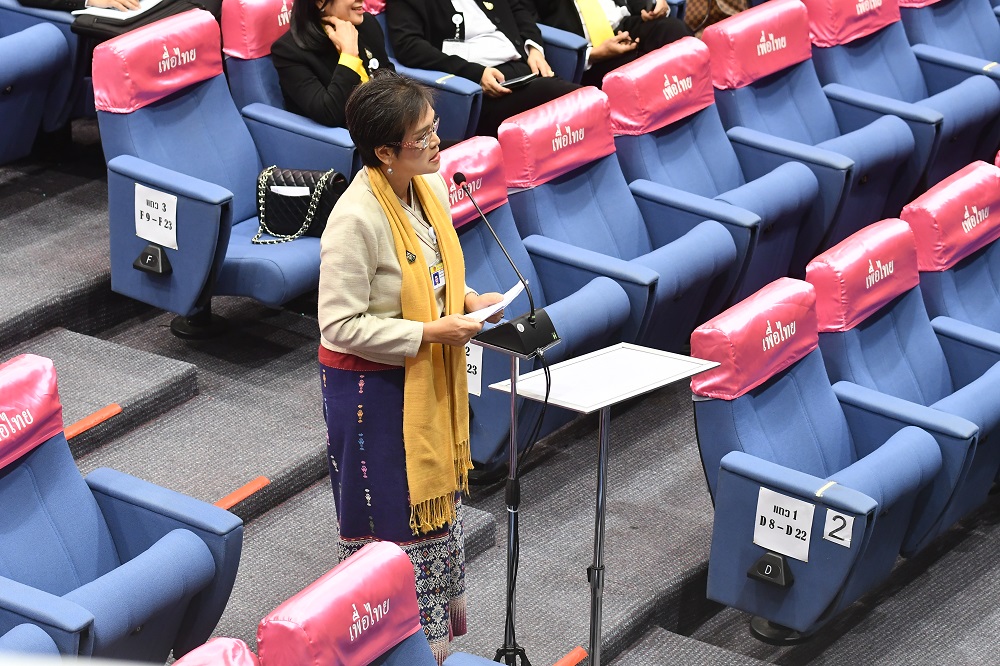
Future Forward spokeswoman Pannika Wanich at the parliament on July 4, 2019.
BANGKOK — Future Forward Party drew praise, criticism, and some head-scratching after its female MPs showed up for a parliamentary debate in traditional dress on Thursday.
In a colorful departure from the sea of black suits and yellow ties, the Future Forward lawmakers made a splash on social media with traditional northern garments. A representative of the group said she wants to highlight the diversity of Thai culture and promote regional products.
“I’ve liked these textiles since I was a kid, especially Thai fabric,” party spokeswoman Pannika Wanich told reporters at parliament. “Whenever I go somewhere, I buy garments from different places, because each place expresses its own culture.”
Pannika said her party picked northern dress to kick-off the initiative, which will expand to cover other traditional garment styles. The politician also invited other parties to join her campaign to promote local textiles.
“I’d like to invite MPs from other parties to dress up too. I think many people actually want to wear it,” Pannika said. “Many male MPs also want to dress up, but might still feel shy about it.”
The move won admiration from some on social media, who say it’s refreshing to see lawmakers embracing local cultures.
“Beautiful. This is a good example,” user Nichanan Siwasauksarun wrote in a news thread.
“I think it’s a good idea. It adds color to parliament and preserves Thai culture and tradition,” Chalerm Mahaprom wrote.
However, some also criticized the campaign as a political stunt, and questioned whether it was appropriate to turn a parliamentary session into a catwalk.
“The venue is not a place to organize a fashion show. They should have some common sense and humility,” user Virat Srianan wrote in the same news thread. “If they want to put on Thai dress, they can do so when there’s a cultural fair.”
“Parliament is a place to debate and discuss the people’s livelihood, not to show off fashion. Especially E Chor, she’s not pretty and acts disgusting,” Kasarapa Manacha commented, using a derogatory nickname for Pannika.
An opposition MP dressed in traditional outfit addresses the parliament on July 4, 2019.
Chief among the detractors is Phalang Pracharath Party MP Parina Kraikup, who accused the Future Forward lawmakers of breaching parliament dress codes.
In an online post, Parina – who has a history of toxic feuds with Pannika – said she will complain to the House Speaker about the violation.
But an official in charge of drafting parliament rules said the dress codes for current parliament sessions – which will only allow Western-style suits and royally bestowed outfits – have yet to be enacted.
The dress codes, along with other rules for MPs like salaries and office spaces, will be submitted to the House Speaker on July 11, regulation commission spokeswoman Thanikarn Pornpongsaroj said.
After the rules are formally enacted, MPs who wish to don traditional garments or any other outfits not permitted by the dress codes will have to seek permission from the House Speaker on a case by case basis, Thanikarn said.