32.2 C
Bangkok
Monday, July 6, 2026
Home Blog Page 1632

HM King Donates 2.4 Billion Baht to Hospitals

King Vajiralongkorn and Queen Suthida hand out the donations on May 8, 2019.

BANGKOK — His Majesty the King on Tuesday donated 2.4 billion baht to 27 public hospitals to purchase new medical equipment.

Part of the money came from public donations collected during the funeral of his late father, King Bhumibol Adulyadej, who passed away in 2016. Another source of the donation money came from a palace-organized fair called “Uen Ai Rak Khlai Kwam Nao” (“Winter’s Love and Warmth”) at Bangkok’s Royal Plaza.

Among the 27 hospitals to benefit in Bangkok are Vajira Hospital, King Chulalongkorn Memorial Hospital and Siriraj Hospital. Hospitals outside of Bangkok which received donations included Pattani Hospital in Pattani province and Nan Hospital in Nan province.

Advertisement

Jailed Activist ‘Pai Dao Din’ to be Freed Friday

A file photo of Jatupat 'Pai' Boonpattararaksa with his parents.

Update May 10, 2019: Jatupat ‘Pai’ Boonpattararaksa was freed at about 9.30am today.

BANGKOK — A student activist imprisoned for royal defamation will be released on Friday, May 10, his father said.

According to Viboon Boonpattararaksa, Jatupat ‘Pai’ Boonpattararaksa will be out of prison about a month earlier than prescribed in his jail sentence because he was eligible for a royal pardon granted by King Vajiralongkorn to mark his coronation.

“Good news. Pai Dao Din will be freed this upcoming May 10,” Viboon, who also serves as his son’s defense lawyer, wrote online. “Please share the news.”

Read: ‘Pai Dao Din’ and Yellowshirts Pardoned By King

Jatupat, a member of the civil rights group Dao Din, was sentenced in 2017 to two and a half years in prison for sharing a BBC biography of His Majesty the King, which the court said contained libelous remarks.

He was convicted under lese majeste, a draconian law that forbids criticism of the monarch. His sentence was originally due to expire in June.

The mass pardons granted by King Vajiralongkorn to 50,000 prisoners also freed five Yellowshirt leaders jailed for anti-government protests back in 2008.

Advertisement

German Show Apologizes for Mocking Thai Royal Wedding

A screencap of a SAT.1 Frühstücksfernsehen skit that offends many Thai royalists.

BANGKOK — A German TV show apologized on Tuesday night for lampooning the wedding ceremony of King Vajiralongkorn and Queen Suthida.

In a Facebook post, SAT.1 Frühstücksfernsehen offered an apology while maintaining it did not intend to insult Thai culture. The morning program segment, which aired last week, raised widespread anger on Thai social media. The German Ambassador also said he found it “offensive.”

“The morning show ‘SAT.1- Frühstücksfernsehen’ discussed the ceremony of the Thai King Maha Vajiralongkorn on Friday,” the program’s statement said. “Many viewers feel that the way the show discussed the issue was inappropriate and offensive.”

“The editorial department never meant to insult Thai culture in any way. If that happened nevertheless, we hereby apologize formally.”

The segment in question showed two hosts, Jochen Schropp and Marlene Lufen, discussing the royal wedding and making gestures deemed to be offensive by some Thais. Due to legal concern, Khaosod English is withholding full details of the show.

The brief skit sparked much fury on Thai social media, where many royalists slammed the German news agency for being insensitive to Thailand’s culture and monarchy. Calls for SAT.1 to apologize soon grew.

“Every country has its own culture. Thailand has a culture that’s different to Germany, so they shouldn’t mock it,” user Valentine Lovelove wrote in a comment thread. “Especially when it comes to His Majesty the King who we wholeheartedly worship, love and revere. They have no right to violate it.”

“His Majesty the King is above all else. Who are you to deride my country’s customs?” Ratda Sukseaw vented.

“Ban Germans from entering this country,” Smoot Ratpoltee suggested.

Some users demanded Thai authorities take action against the German Embassy in Bangkok, though the German Ambassador posted on Twitter that he also disagreed with the show.

“Many of you have asked me for my opinion about this morning’s show on German private television. I found it offensive,” Georg Schmidt wrote in Thai and English. “So did many viewers in Thailand and Germany.”

Any negative portrayal of the monarchy is not only taboo in Thailand, but criminalized under a royal defamation law called lese majeste. Violators face up to 15 years in prison.

But not everyone was outraged at the video, with some netizens saying Thais should not overreact to the joke.

“A precious culture yet so sensitive to mockery?” the page Rubnong Thailand wrote. “To people losing their shit right now: don’t let me see you mock the North Korean leader later.”

Advertisement

Royalists Find Future Forward’s Lack of Coronation Pic Disturbing

A file photo of Future Forward Party leader Thanathorn Juangroongruangkit

BANGKOK — Ultra-royalists accused a progressive party on Wednesday of disrespecting the monarchy because it did not change its Facebook cover photo to mark His Majesty the King’s coronation.

Future Forward failed to follow other parties in changing its feature photo to a banner praising King Vajiralongkorn, leading hardline royalists on social media to accuse the party of neglecting to honor the auspicious occasion. A spokeswoman for the party denied the allegations.

In a phone interview, Pannika Wanich referred a reporter to an interview she gave to another media agency yesterday, in which she said many members of her party joined in celebrations during the ceremony. The coronation lasted from Saturday May 4 to Monday May 6.

She declined to comment further, saying “this issue is now over.”

While other political parties last week changed their Facebook cover photos to banners congratulating King Vajiralongkorn on his coronation, Future Forward kept its cover photo featuring party leader Thanathorn Juangroongruangkit.

59022676 2459314314101492 6375607521863794688 o
A coronation banner posted by Pheu Thai Party.
54728233 2137768329632083 5368186345170665472 o
Future Forward’s cover photo

The break from common practice did not escape the attention of ultra-royalists, who soon accused the party of disloyalty.

“The Future Forward Party has shown its true colors whether or not it participated in the royal coronation. The public can see through it,” user Sedthawut Yuyen wrote in a comment thread. “Future Forward Party’s Facebook page did not present news about the royal coronation at all, unlike other political parties.”

“The entire party disrespects the monarchy,” user Areesri Palida added. “Their sec-gen disrespects and is trying to overthrow the monarchy. Their party leader also assists people who want to overthrow the monarchy.”

Ultra-royalists have levelled similar allegations against Future Forward before. The party was co-founded by secretary-general Piyabutr Saengkanokkul, a law scholar who used to campaign against the royal defamation law, or lese majeste.

Although Future Forward has insisted that it will not push for lese majeste reform or touch the monarchy if elected to power, the pledge failed to convince hardline royalists.

In early April, a group of 30 royalists filed a petition to the police, urging them to investigate Piyabutr on suspicions of harboring ill intent against the royal family. No formal investigation has been convened so far.

Advertisement

Court Affirms EC’s Power to Allocate Party-List Seats

A recount in Nakhon Pathom province on April 28, 2019.

BANGKOK — A top court on Wednesday ruled that the Election Commission has authority under the constitution to determine how to allocate MP seats.

In a 9-0 ruling, the Constitutional Court confirmed the commission has the power and responsibility to decide the method used to distribute 150 party-list seats in parliament.

The ruling could pave the way for the commission’s latest proposal to grant party-list seats to parties that failed to receive the minimum number of votes currently required by voting laws. The opposition parties have slammed the formula, saying it’s undemocratic and may favor small parties allied to the military regime.

Under the proposal, even minor parties with just over 30,000 votes will secure a party-list seat. The commission set the threshold at 71,000 votes before voters went to the polls in March.

A former member of the Election Commission has warned that such a proposal would go against the constitution and only lead to legal challenges.

“If the Election Commission does this and some party sues, it’s the right of the party to so,” Somchai Srisutthiyakorn said by phone today.

Somchai, who’s now a Democrat Party member, claimed the ruling does not give the commission a blank check to go ahead with its controversial new formula of equating 30,000 votes with an MP seat.

“They cannot [come up with a formula] that is against the constitution,” he said.

The threat of legal action already surfaced today. In a petition submitted to the commission, the Future Forward Party said it will file challenges if officials insist on the new quota.

Future Foward, which placed third in the March election, is set to lose up to eight seats if the proposed quota comes into effect.

Official election results for party-list MP seats are expected to be released by tomorrow.

Additional reporting Teeranai Charuvastra

Advertisement

Florida Woman Pulls Alligator From Yoga Pants During Stop

Not this one.

PUNTA GORDA, Fla. — Sheriff’s officials say a Florida woman pulled a small alligator from her yoga pants during a traffic stop.

The Charlotte County sheriff’s deputy stopped a pickup truck Monday afternoon after it ran a stop sign and 22-year-old driver Michael Clemons told him he and his 25-year-old passenger Ariel Machan-Le Quire were collecting frogs and snakes under an overpass. He gave the deputy permission to search bags in the truck.

When the deputy found 41 3-stripe turtles in the woman’s backpack, he asked if she had anything else. She pulled the 1-foot (0.3-meter) gator from her yoga pants.

Charlotte County Sheriff’s officials suggested an explanation on Twitter for the incident: “Not to be outdone by #FloridaMan, a #FloridaWoman pulled an alligator out of her pants.”

The Florida Fish and Wildlife Commission took over the investigation.

Advertisement

Chinese Scientists Try Brain Implants to Treat Drug Addicts

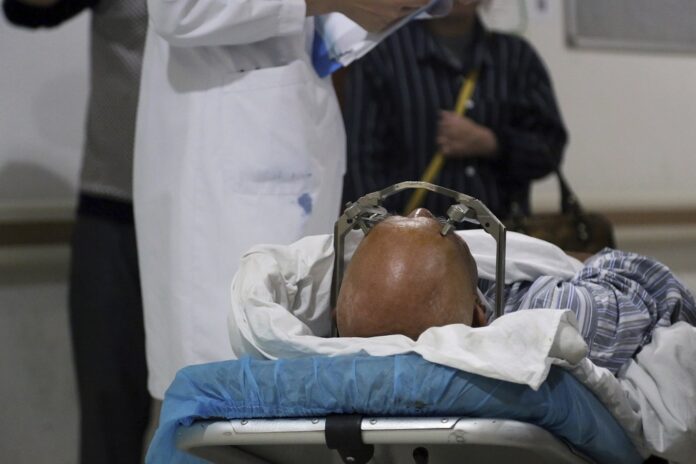
A stereotactic device presses into the head of a brain surgery patient at Ruijin Hospital's functional neurosurgery center in Shanghai, China on Monday, Oct. 29, 2018. (AP Photo/Erika Kinetz)

SHANGHAI — Patient Number One is a thin man, with a scabby face and bouncy knees. His head, shaved in preparation for surgery, is wrapped in a clean, white cloth.

Years of drug use cost him his wife, his money and his self-respect, before landing him in this drab yellow room at a Shanghai hospital, facing the surgeon who in 72 hours will drill two small holes in his skull and feed electrodes deep into his brain.

The hope is that technology will extinguish his addiction, quite literally, with the flip of a switch.

The treatment — deep brain stimulation — has long been used for movement disorders like Parkinson’s. Now, the first clinical trial of DBS for methamphetamine addiction is being conducted at Shanghai’s Ruijin Hospital, along with parallel trials for opioid addicts. And this troubled man is the very first patient.

The surgery involves implanting a device that acts as a kind of pacemaker for the brain, electrically stimulating targeted areas. While Western attempts to push forward with human trials of DBS for addiction have foundered, China is emerging as a hub for this research.

Scientists in Europe have struggled to recruit patients for their DBS addiction studies, and complex ethical, social and scientific questions have made it hard to push forward with this kind of work in the United States, where the devices can cost $100,000 to implant.

China has a long, if troubled, history of brain surgery on drug addicts. Even today, China’s punitive anti-drug laws can force addicts into years of compulsory treatment, including “rehabilitation” through labor. It has a large patient population, government funding and ambitious medical device companies ready to pay for DBS research.

There are eight registered DBS clinical trials for drug addiction being conducted in the world, according to a U.S. National Institutes of Health database. Six are in China.

But the suffering wrought by the opioid epidemic may be changing the risk-reward calculus for doctors and regulators in the United States. Now, the experimental surgery Patient Number One is about to undergo is coming to America. In February, the U.S. Food and Drug Administration greenlighted a clinical trial in West Virginia of DBS for opioid addicts.

Human Experiments

Patient Number One insisted that only his surname, Yan, be published; he fears losing his job if he is identified.

He said doctors told him the surgery wasn’t risky. “But I still get nervous,” he said. “It’s my first time to go on the operating table.”

Three of Yan’s friends introduced him to meth in a hotel room shortly after the birth of his son in 2011. They told him: Just do it once, you’ve had your kid, you won’t have problems.

Smoking made Yan feel faint and slightly unhinged. Later, he found meth brought crystalline focus to his mind, which he directed at one thing: Cards. Every time Yan smoked, he gambled. And every time he gambled, he lost — all told, around $150,000 since he started using drugs, he estimated.

His wife divorced him. He rarely saw his son.

Yan checked into a hospital for detox, moved to another town to get away from bad influences, took Chinese traditional medicine. But he relapsed every time. “My willpower is weak,” he said.

Last year his father, who had a friend who had undergone DBS surgery at Ruijin, gave him an ultimatum: Back to rehab or brain surgery. “Of course, I chose surgery,” Yan said. “With surgery, I definitely have the chance to get my life back.”

Before there were brain implants in China there was brain lesioning. Desperate families of heroin addicts paid thousands of dollars for unproven and risky surgeries in which doctors destroyed small clumps of brain tissue. Brain lesioning quickly became a profit center at some hospitals, but it also left a trail of patients with mood disorders, lost memories and altered sex drives.

In 2004, China’s Ministry of Health ordered a halt to brain lesioning for addiction at most hospitals. Nine years later, doctors at a military hospital in Xi’an reported that roughly half of the 1,167 addicts who had their brains lesioned stayed off drugs for at least five years.

DBS builds on that history. But unlike lesioning, which irreversibly kills brain cells, the devices allow brain interventions that are — in theory — reversible. The technology has opened a fresh field of human experimentation globally.

“As doctors we always need to think about the patients,” said Dr. Sun Bomin, director of Ruijin Hospital’s functional neurosurgery department. “They are human beings. You cannot say, ‘Oh, we do not have any help, any treatment for you guys.’”

Sun said he has served as a consultant for two Chinese companies that make deep brain stimulators — SceneRay Corp. and Beijing PINS Medical Co. He has tried to turn Ruijin into a center of DBS research, not just for addiction, but also Tourette syndrome, depression and anorexia.

In China, DBS devices can cost less than $25,000. Many patients pay cash.

“You can rest assured for the safety of this operation,” Yan’s surgeon, Dr. Li Dianyou, told him. “It is no problem. When it comes to effectiveness, you are not the first one, nor the last one. You can take it easy because we have done this a lot.”

In fact, there are risks. There is a small chance Yan could die of a brain hemorrhage. He could emerge with changes to his personality, seizures, or an infection. And in the end, he may go right back on drugs.

A Buzzing Drill

Some critics believe this surgery should not be allowed.

They argue that such human experiments are premature, and will not address the complex biological, social and psychological factors that drive addiction. Scientists don’t fully understand how DBS works and there is still debate about where electrodes should be placed to treat addiction. There is also skepticism in the global scientific community about the general quality and ethical rigor — particularly around issues like informed consent — of clinical trials done in China.

“It would be fantastic if there were something where we could flip a switch, but it’s probably fanciful at this stage,” said Adrian Carter, who heads the neuroscience and society group at Monash University in Melbourne. “There’s a lot of risks that go with promoting that idea.”

The failure of two large-scale, U.S. clinical trials on DBS for depression around five years ago prompted soul-searching about what threshold of scientific understanding must be met in order to design effective, ethical experiments.

“We’ve had a reset in the field,” said Dr. Nader Pouratian, a neurosurgeon at UCLA who is investigating the use of DBS for chronic pain. He said it’s “a perfectly appropriate time” to research DBS for drug addiction, but only “if we can move forward in ethical, well-informed, well-designed studies.”

In China, meanwhile, scientists are charging ahead.

At 9 a.m. on a grey October Friday in Shanghai, Dr. Li drilled through Yan’s skull and threaded two electrodes down to his nucleus accumbens, a small structure near the base of the forebrain that has been implicated in addiction.

Yan was awake during the surgery. The buzzing of the drill made him tremble.

At 4 p.m. the same day, Yan went under general anesthesia for a second surgery to implant a battery pack in his chest to power the electrodes in his skull.

Three hours later, Yan still hadn’t woken from the anesthesia. His father began weeping. His doctors wondered if drug abuse had somehow altered his sensitivity to anesthesia.

Finally, after 10 hours, Yan opened his eyes.

Body Count

According to the U.S. Centers for Disease Control and Prevention, more than 500,000 Americans died of drug overdoses in the decade ending in 2017 — increasingly, from synthetic opioids that come mainly from China, U.S. officials say. That’s more than the number of U.S. soldiers who died in World War II and Vietnam combined.

The body count has added urgency to efforts to find new, more effective treatments for addiction. While doctors in the U.S. are interested in using DBS for addiction, work funded by the U.S. National Institutes of Health is still focused on experiments in animals, not people.

At least two U.S. laboratories dropped clinical trials of DBS for treating alcoholism over concerns about study design and preliminary results that didn’t seem to justify the risks, investigators who led the studies told The Associated Press.

“The lack of scientific clarity, the important but strict regulatory regime, along with the high cost and risk of surgery make clinical trials of DBS for addiction in the U.S. difficult at the present time,” said Dr. Emad Eskandar, the chairman of neurological surgery at Albert Einstein College of Medicine in New York.

China’s studies have offered mixed results. Sun and his colleagues have published one case study, describing a heroin addict who fatally overdosed three months after getting DBS. But a separate pilot study published in January by doctors at a military hospital in Xi’an showed that five of eight heroin addicts stayed off drugs for two years after DBS surgery.

Based on those results, SceneRay is seeking Chinese regulatory approval of its DBS device for addiction, and funding a multi-site clinical trial targeting 60 heroin addicts. SceneRay chairman Ning Yihua said his application for a clinical trial in the U.S. was blocked by the U.S. Food and Drug Administration.

But in February, the FDA greenlighted a separate, pilot trial of DBS for four opioid addicts, said Dr. Ali Rezai, who is leading the study at the West Virginia University Rockefeller Neuroscience Institute. They hope to launch the trial in June, with funding from the National Institute on Drug Abuse.

The FDA declined comment.

“People are dying,” Rezai said. “Their lives are devastated. It’s a brain issue. We need to explore all options.”

‘You Came Too Late’

Two unsteady days after Yan’s surgery, doctors switched on his DBS device. As the electrodes activated, he felt a surge of excitement. The current running through his body kept him awake; he said he spent the whole night thinking about drugs.

The next day, he sat across from Dr. Li, who used a tablet computer to remotely adjust the machine thrumming inside Yan’s head.

“Cheerful?” Li asked as the touched the controls on the tablet.

“Yes,” Yan answered.

Li changed the settings. “Now?”

“Agitated,” Yan said. He felt heat in his chest, then a beating sensation, numbness and fatigue. Yan began to sweat.

Li made a few more modifications. “Any feelings now?”

“Pretty happy now,” Yan said.

He was in high spirits. “This machine is pretty magical. He adjusts it to make you happy and you’re happy, to make you nervous and you’re nervous,” Yan said. “It controls your happiness, anger, grief and joy.”

Yan left the hospital the next morning.

More than six months later, he said he’s still off drugs. With sobriety, his skin cleared and he put on 20 pounds. When his friends got back in touch, he refused their drugs. He tried to rekindle his relationship with his ex-wife, but she was pregnant with her new husband’s child.

“The only shame is that you came too late,” she told him.

Sometimes, in his new life, he touches the hard cable in his neck that leads from the battery pack to the electrodes in his brain. And he wonders: What is the machine is doing inside his head?


Advertisement

Trump Launches New Bid to Overhaul Immigration

WASHINGTON — Reviving a deeply contentious issue that has stymied both Congress and the administration, the White House launched a new bid Tuesday to overhaul a legal immigration system that President Donald Trump has long railed against.

Though similar efforts have failed to garner anywhere near the support necessary, Trump hopefully invited a dozen Republican senators to the White House to preview the plan, which was spearheaded by senior adviser and presidential son-in-law Jared Kushner.

It’s the result of an unusually methodical approach for an administration known for hastily written executive orders and Trump’s declarations by tweet. Kushner’s team has pulled in officials with experience in legislation-writing from outside the White House, including the Department of Homeland Security, to help with the drafting.

Still, the road to passage remains uphill. Democrats are likely to strongly disapprove of parts of the plan without significant concessions.

Kushner outlined two major ideas:

— A border security bill that would focus, in part, on modernizing ports of entry to make sure all people, vehicles and packages are scanned.

— A second package of immigration proposals that would create a more “merit-based” system to give preference to those with job skills rather than relatives of immigrants already in the country.

Under the plan, which does not address temporary visa categories, including for laborers, the same number of immigrants would be permitted to enter the country, but their composition would change.

The White House is also working with Sen. Lindsey Graham of South Carolina on additional legislation that would address the nation’s asylum system, in an effort to stem the flow of migrants across the border, according to a senior administration official, who spoke on condition of anonymity to outline the plan.

It’s just the latest effort by the Trump White House to push Congress to overhaul immigration laws that he has long complained compromise national security and depress American workers’ wages by allowing too many immigrants to compete for jobs. But Trump has also said the country needs more workers thanks to economic gains and has said that educated, skilled workers — especially those who graduate from American colleges — should be able to stay and work.

While Trump had previously rejected an earlier version of Kushner’s proposal, asking him to incorporate more border security measures, the senior official told reporters after the meeting Tuesday that Trump had signed off on the effort last week and it should now be considered “the President Trump plan.”

The White House is now seeking feedback and pressing for support from Republican lawmakers.

The official declined to say when more details would be unveiled or how the White House intended to get Democrats — who have yet to be briefed on the plan — on board.

Several GOP senators who attended the meeting did compliment the effort.

David Perdue of Georgia said Trump was “developing a platform for immigration that he can be for — and I was impressed.”

“The conversation was about border security and the immigration side — how to become much more effective at allowing the right kind,” he said.

Tom Cotton of Arkansas said he “heard large areas of agreement from everyone in the room.” He said he still needs to see details, but things are “moving in the right direction.”

Kevin Cramer of North Dakota called it a “good starting point” that could be appealing to Democrats in the right situation.

“I think the environment right now with the booming economy, workforce demands, a crisis at the border that’s no longer deemed manufactured presents an opportunity for discussion,” he said.

But Democrats were skeptical of a Republican-only effort that fails to incorporate Democratic priorities on immigration, including protecting young immigrants who were brought to the country as children and are now living in the U.S. illegally.

Rep. Pete Aguilar of California said he appreciated “our Republican senators weighing in on this issue, but if their solution is to cut legal immigration it’s a nonstarter for us.” He added, “We’ll see.”

And former Vice President Joe Biden, who is running for the Democratic nomination to challenge Trump, accused the president Tuesday of using immigration “to demonize people.”

“It isn’t who we are. We’re better than that,” Biden said as he kicked off a rally.

Any immigration plan is sure to face a challenge on Capitol Hill where lawmakers have struggled for decades to pass comprehensive immigration legislation. Conservative Republicans are likely to oppose a plan that does not cut rates of legal immigration, while Democrats have made clear they will not accept changes without new protections for “Dreamer” immigrants. Some Republicans, especially those from election swing states, would like to see protections for Dreamers as well, but that issue does not appear to be included in Kushner’s plan.

There has also been skepticism about Kushner’s involvement, given he has no previous background on the complex and controversial subject. But Kushner has spent months meeting with various Republican groups, hoping to put together a proposal that can unite party members, following the playbook he used to help pass bipartisan criminal justice reform legislation last year.

A previous attempt by Trump to reach a comprehensive immigration deal with Congress collapsed last year, and there is deep doubt in Washington that there is any appetite on Capitol Hill for a wide-ranging agreement.

Trump put immigration at the center of his presidential campaign, including a promise to build a wall along the U.S-Mexico border. He is expected to continue to hammer the issue in his re-election campaign as he tries to energize his base of supporters.

___

Associated Press writers Lisa Mascaro, Alan Fram and Darlene Superville contributed to this report.

Advertisement

Cop Busted for Trading Drugs 5 Months Before Retirement

Security officers surround Police Capt. Chainarong Oiphuthon at his home on May 7, 2019.

NAKHON PHANOM — A senior-ranking policeman’s career came to an ignominious end when he was caught in a drug bust on Tuesday, just five months before his scheduled retirement.

Police Capt. Chainarong Oiphuthon, 59, was arrested while possessing over 6,000 tablets of amphetamines and nearly 10 kilograms of marijuana at his home in Nakhon Phanom province, police said. The police captain stands accused of dealing drugs. He was caught in a sting operation.

Police said they also found four firearms at his residence with dozens of rounds.

Chainarong, who works as a crime investigator in the provincial police force, reportedly confessed to the crimes. He was set to retire in September.

Police told the media Chainarong imported the yaba from his mistress who lives across the border in Laos.

Advertisement

15 Cabinet Members Resign, Paving Way For Seats in Senate

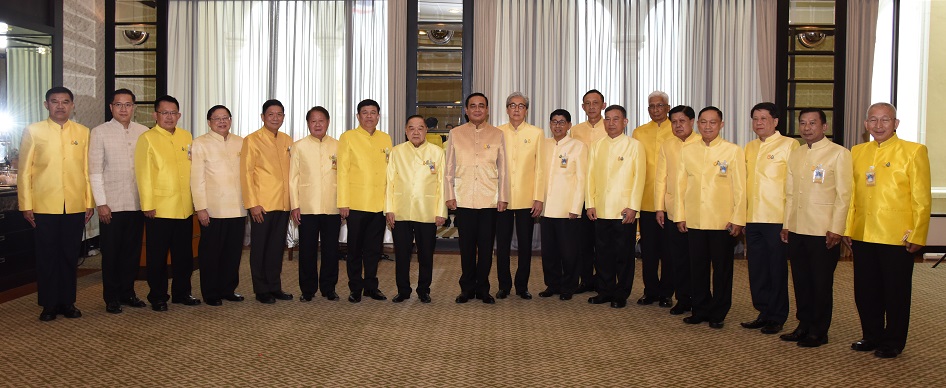
Junta chief Prayuth Chan-ocha with the 15 ministers at Government House

BANGKOK — Fifteen members of the cabinet quit on Tuesday amid speculation that the junta will appoint them as senators.

Prime minister and junta chief Prayuth Chan-ocha, who selected nearly all of the incoming 250 senators, met with the resigning ministers during a lunch break to accept their resignation letters and took a group photo.

Among the 15 are five generals and one police general. Their resignations are set to be effective either tomorrow or Thursday May 9.

785DAB01 0B2D 4CBD B0FF 5548C89C620E
Junta chief Prayuth Chan-ocha with the 15 ministers at Government House

Prayuth’s brother, Preecha Chan-ocha, also tendered his resignation as a member of the interim parliament on the same day.

The 15 cabinet members include Deputy Prime Minister and Justice Minister Air Chief Marshal Prajin Juntong, Deputy Prime Minister Gen Chatchai Sarikulya, PM Office Minister Suwaphan Tanyuvardhana, Natural Resources and Environment Minister Gen Surasak Karnjanarat, and Labor Minister Pol Gen Adul Saengsingkaew.

Others are Education Minister Teerakiat Jaroensettasin and his deputy, Gen Surachet Chaiwong, and Deputy Foreign Minister Veersak Futrakul. Social Development and Human Security Minister Gen Anantaporn Kanjanarat also resigned.

Some media reports have said that those close to the regime are slated to take new jobs in the next upper house – a claim that junta leaders declined to discuss earlier today.

Advertisement

Hot News

LATEST NEWS

Bangkok
overcast clouds
32.2 ° C
32.2 °
32.2 °
72 %
4.1kmh
100 %
Mon
32 °
Tue
35 °
Wed
31 °
Thu
32 °
Fri
31 °