

























36.1 C
Bangkok
Saturday, June 27, 2026
Home Blog Page 1670

Thai Men Want Fully Legal Weed – Women Less So: Poll

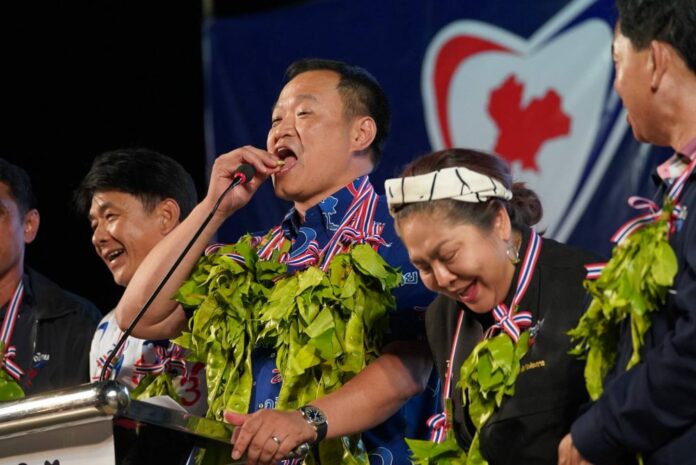
Bhumjaithai Party leader Anutin Charnvirakul, at center, at a Monday rally on Koh Lanta in Krabi province.

BANGKOK — Cannabis legalization is more of a winning issue with male voters than female who responded to a recent survey.

A wide majority of Thai men support the most ambitious pro-cannabis policies of a major political party, while that support falls to a minority of female voters, according to the results of a Super Poll survey released Tuesday.

Read: Thai Law: Foreigners and the Medical Marijuana Law, Explained

Men were somewhat more in favor. The pollster said 58.5 percent of men supported with pro-cannabis policies proposed by Bhumjaithai Party, which include full recreational legalization of marijuana. That support fell to 43.2 percent among working-age female respondents.

The poll neither publishes a margin of error nor discloses its selection methods. A representative said the surveys were conducted via face-to-face interviews, phone calls and email.
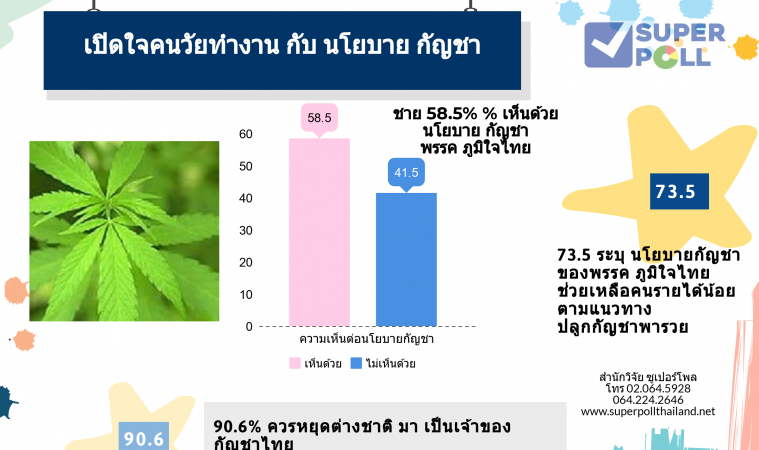
image big 5c872d4c7aea8

Near universal opposition existed to foreign ownership of Thai patents related to cannabis. Nine-in-10 of respondents agreed with rejecting non-Thai patent applications prior to the opening of the domestic market.

Read: Patents Reveal Foreign Pharma’s Secret Bid to Seize Thai Cannabis Market

By occupation, over half of farmers surveyed agreed with the cannabis policies espoused by Bhumjaithai – 51.8 percent. Even more enthusiastic were office workers at 71.4 percent.

The party, led by Anutin Charnvirakul, has proposed allowing every household to grow six plants that could only be sold to state agencies, estimating that it could generate 420,000 baht per family annually.

Read: High Stakes: Thai Party Plants Seeds for Pot Revolution

Super Poll Research Services is the project of Thammasat University sociology and architecture professor Noppadon Kannika. The poll was conducted between March 1 and March 11.

Related stories:

Thai Law: Foreigners and the Medical Marijuana Law, Explained

High Stakes: Thai Party Plants Seeds for Pot Revolution

Patents Reveal Foreign Pharma’s Secret Bid to Seize Thai Cannabis Market
Advertisement

Abhisit Coalition Waffling Draws Fresh Flak

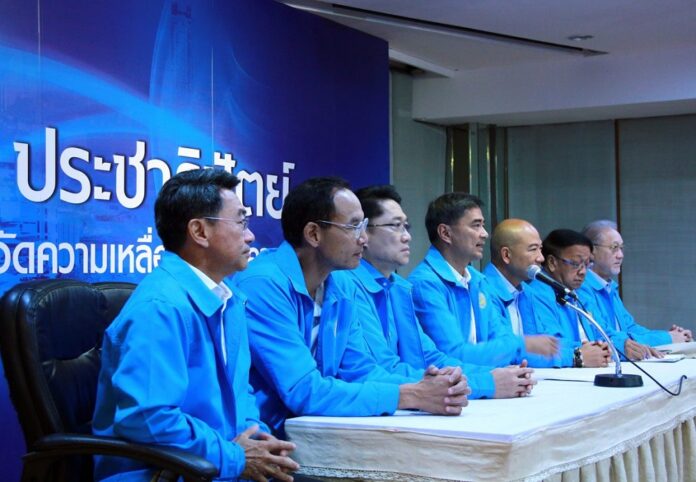
Flanked by other Democrat Party executives, chairman Abhisit Vejjajiva speaks at a Monday news conference at their offices in Bangkok.

BANGKOK — Treading a thin line after saying his party wouldn’t support the junta leader becoming prime minister after the election, Democrat Party leader Abhisit Vejjajiva has found himself in hot water for walking back his comments.

Hours after announcing his opposition to Prayuth Chan-ocha’s bid to remain in power, Abhisit said Monday his party is willing to form a coalition with the pro-junta Phalang Pracharat Party if it doesn’t insist Prayuth be PM. He also opened the door to a coalition with archrival Pheu Thai under certain conditions.

“I have not spoken about this in the past because I thought my stance was already clear,” Abhisit said. “But many debate forums want the politicians to debate about their stances … so I had to announce my stance clearly, so we won’t waste any more time.”

Read: Abhisit Rules Out Voting for Prayuth

The Democrat chairman also said he personally respects Prayuth’s contribution to the country during his tenure, but he believes the general should not serve another term.

“I cannot make decisions based on my personal relationship. I have to think of this country in a long term,” Abhisit said. “I insist that conflicts will certainly break out in the future if [Prayuth] holds on to his power. Gen. Prayuth would be at the center of the likeliest conflict to break out after the election.”

As for the Pheu Thai Party – which has bested the Democrats in every general election for nearly two decades – Abhisit said any partnership depended on it becoming free from the domination of a few people, an implicit reference to fugitive former premier Thaksin Shinawatra.

Abhisit announced his party’s conditions at a Monday news conference after releasing a video saying he “definitely will not support Gen. Prayuth Chan-ocha to be the next prime minister.”

Seeking to refine that position, he told reporters the party wants to form a government after elections with other partners as long as they don’t extend junta rule or engage in corruption.

Reactions were swift. The de facto head of the pro-junta Action Coalition for Thailand Party, Suthep Thaugsuban, asked from a Phuket rally stage last night which side Abhisit was on. He declared his party would never join a coalition with Thaksin-aligned Pheu Thai and accused Thaksin of buying his way into office and corruption.

A former Democrat for 37 years himself, Suthep said he was saddened to hear Abhisit speak. He said the party which he left as secretary general to lead anti-government street protests, was like his home.

“It means Abhisit is willing to join hands with Thaksin’s side. The words that Abhisit uttered, that [the party] won’t support Gen. Prayuth to become prime minister to extend his power are the exact words used by the pro-Thaksin camp. If you won’t support Prayuth, then who will you support?” Suthep said.

Pheu Thai Party MP candidate Watana Muangsook also criticized Abhisit for saying the party is willing to form a coalition with Phalang Pracharat only hours after saying he wouldn’t support Prayuth, who is the party’s PM candidate, as prime minister.

“If he is not confused, then he must be acting in a political soap opera,” Watana wrote online Tuesday morning.

At yesterday’s news conference, Abhisit rejected allegations that he was trying to have things both ways. The Democrats will only join hands with Phalang Pracharat if the latter has no intention of serving as a proxy for Gen. Prayuth’s ongoing influence, he said.

“I’m surprised to see that after I give my answers like this, some [Pheu Thai] supporters still say I didn’t make myself clear,” Abhisit said. “What I’m trying to stress is that if Phalang Pracharat still tries to perpetuate [Prayuth’s] power, then the Democrats will not invite them to a coalition.”

Advertisement

Innovative Fine Dining ‘Le Petit Chef’ Coming to Bangkok (Sponsored)

BANGKOK — For the first time in Thailand, a new, entirely innovative fine dining experience based around the culinary exploits of “Le Petit Chef” comes to the Embassy Room and invites you to embark on a unique culinary journey across the Silk Road in the footsteps of the legendary traveller Marco Polo. It involves a small chef in front of you on the table taking you through an immersive 3D animated culinary journey starting 27th March – 31st July, 2019 for four months.

Following its hugely successful launch in Dubai and the United Arab Emirates, Dinner Time Story takes guests on a journey in the footsteps of Marco Polo from Marseilles to Arabia, India, the Himalayas to China. All through using cutting edge 3D visual technology and effective storytelling through flavours, ingredients, sights, sounds and tastes. Chef de Cuisine Pierre Tavernier expresses, “We cook and create dishes every day to bring joy to our diners through fresh and sustainable produce and well-balanced flavours.  I am excited to be a part of something unique and provide our diners with a different dining experience and of course, a different kind of dining pleasure from the Embassy Room”.

Designed to allow groups to eat together, Dinner Time Story is all about sharing this unique experience using 3D visual technology to create an animated show placed on top of their table cloth, right under their knife and fork. As well as a tiny-sized chef moving around his table, muttering in French cooking up delicious concoctions, guests will experience birds, boats, and fire-breathing dragons fly over their plate as they embark on this unique visual culinary journey.

Balraj Pannu, Dinner Time Story’s producer, has paired together with Park Hyatt Bangkok to host  the world’s smallest chef for four months, and says the following with regards to the unique concept: “Unlike many other dining shows we have created our story around the food. We believe that the gourmet cuisine should be the main focus, with the story-telling aspect accentuating each dish while also keeping diners entertained and enchanted throughout their meal.”

“We are absolutely thrilled to be hosting and offering this dining experience for the first time in Bangkok.  It will bring something new for all to enjoy whether you are a foodie, a couple, a family and will even be a fantastic corporate experience as well as for those visiting the city. We welcome all guests to enjoy and embark on this journey while the show is here,” says Sebastian Krack, Director of Food & Beverage.

The original concept and character of Le Petit Chef was created in the studio of the Belgian artist collective Skullmapping, founded in 2010 by the award-winning filmmaker Filip Sterckx and owner Antoon Verbeeck. Visual Mapping, usually seen as huge video mapping projections at major events is now available in miniature in a more intimate atmosphere thanks to Le Petit Chef.

Le Petit Chef – in the footsteps of Marco Polo – is currently running shows 10 times a week at the private dining room of Embassy Room at Park Hyatt Bangkok starting from 27th March – 31st July, 2019. Weekly sessions include below available seatings:

Sundays –Wednesdays: 7:00 p.m. and Thursdays –Saturdays: 7:00 p.m. and 9:30 p.m.

Each journey includes a 5-course set dinner menu specially prepared by Chef de Cuisine Pierre Tavernier and a unique 3D animated journey:

JOURNEY A – THB 3,299++ per person food only

JOURNEY B- THB 3,999++ per person food only

WINE PAIRING THB 1,199++ per person

CHAMPAGNE & WINE PAIRING – THB 1,599++ per person

For reservations and group bookings, please visit lepetitchef.asia/parkhyattbangkok
#lepetitchefbkk

FB: facebook.com/embassyroom

IG: Instagram.com/embassyroom

Advertisement

Chiang Mai Tops World Pollution Charts

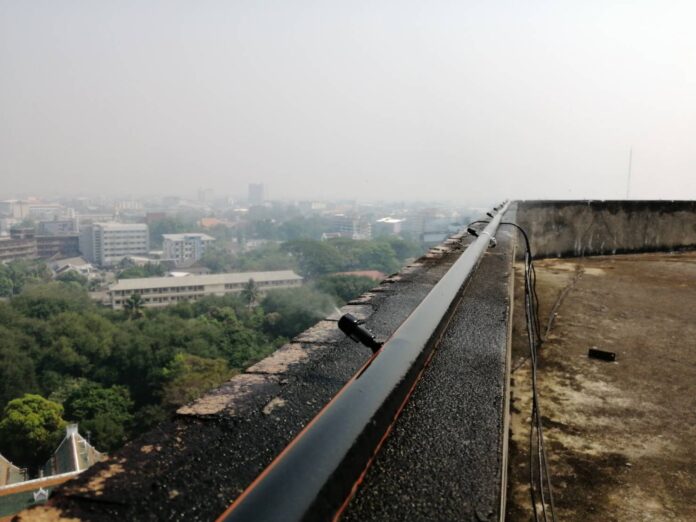
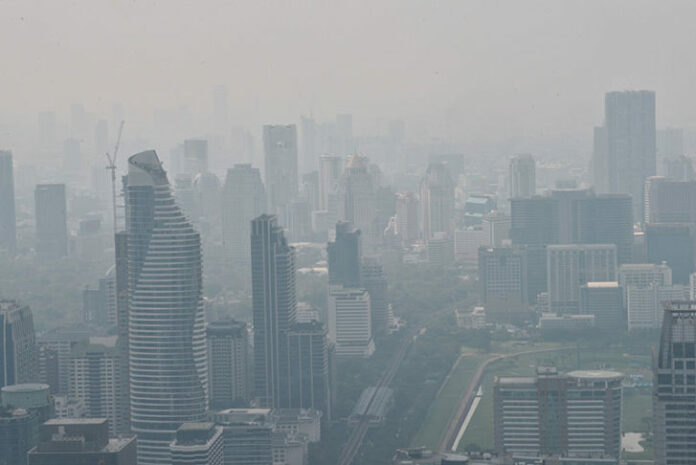
A nozzle sprays water from atop a building Monday in Chiang Mai as the city is covered with smog.

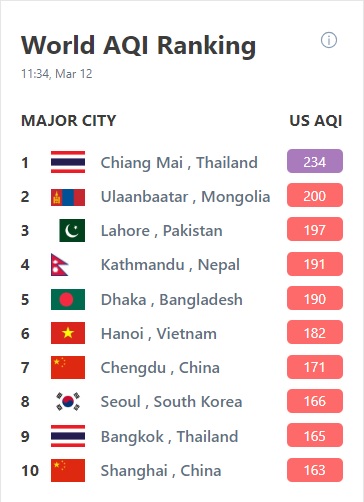
BANGKOK — Chiang Mai earned the dubious distinction of being the most-polluted city in the world Tuesday morning as air pollution continues to surge.

Image: Air Visual
Image: AirVisual

Chiang Mai’s air pollution index this morning spiked to the “very unhealthy” level of 234, with ultrafine particulate density nearly 180 micrograms per cubic meter, according to independent monitoring organization AirVisual. Bangkok was ranked the 9th most-polluted city, with average particle concentrations of 80 micrograms per cubic meter.

Read: Chiang Mai’s Foul Air No Priority to Bangkok, North Complains

Rounding out the top 10 were cities including Ulaanbaatar, Mongolia; Lahore, Pakistan; Kathmandu, Nepal; and Hanoi, Vietnam.

On Twitter, #PM25particles became the No. 1 trending hashtag in Thailand. Most comments complained about government inaction, though the problem in the north has persisted for years. PM2.5 particles are the smallest and most harmful type of air pollution.

Several northern provinces also saw air quality deteriorate. Pollution this morning rose to “unhealthy” levels in Nan, Lamphun, Lampang, Mae Hong Son and Prae.

A recent study by the University of Chicago found life expectancy in Thailand is shortened by over two years on average due to prolonged exposure to air pollution.

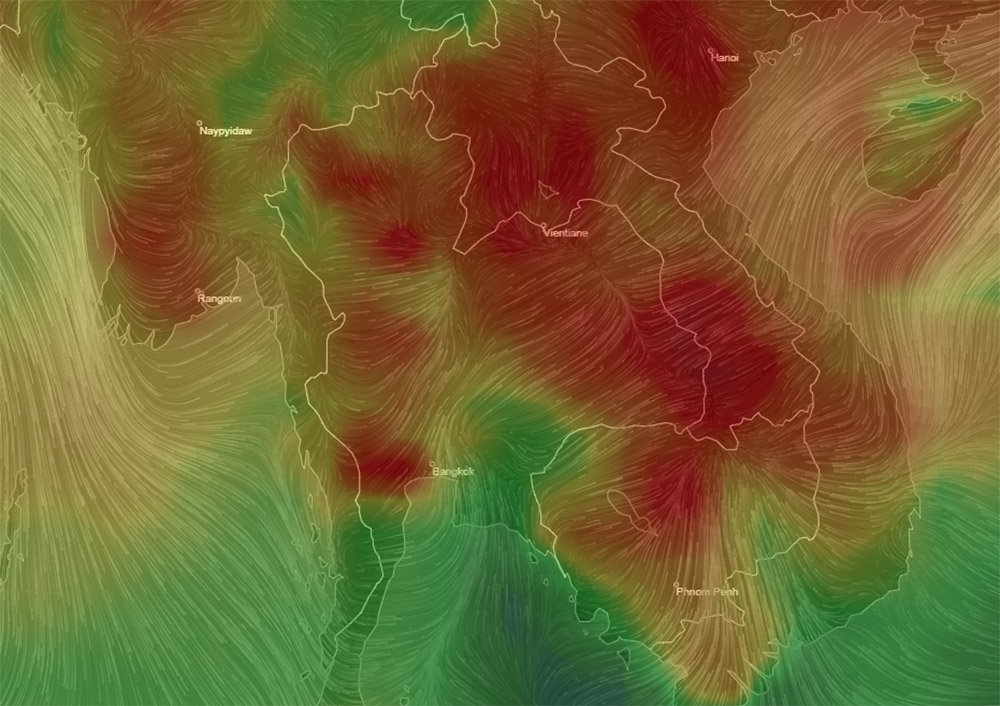
Darker red areas signify higher air pollution in a screenshot of a real-time map on Tuesday morning. Graphic: AirVisual

Related stories:

Breathe in Thailand and Die Up to 4 Years Sooner: Research

Smog Grounds Flights in Northern Thailand

Smog Surges Over Thailand’s Two Major Cities

As Bangkok Clears, Provinces Choke on Seasonal Smoke

Advertisement

Footballer Hakeem Happy to Become Australian Citizen

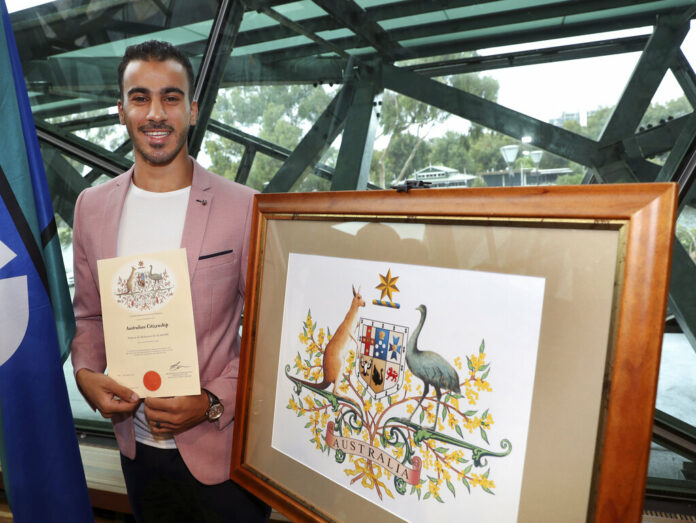
Hakeem al-Araiby, a former Bahraini international soccer player and refugee, displays his certificate after becoming an Australian citizen Tuesday, four weeks after escaping extradition to his homeland during a much-publicized detention in a Bangkok prison, in Melbourne. Photo: David Crosling / AAP Image via AP

SYDNEY — A former Bahraini soccer player and refugee has become an Australian citizen, after detention in a Thai prison and an extradition request from his homeland raised international concern.

Hakeem al-Araiby told reporters he’s “an Aussie now” and is happy to be safe.

The 25-year-old soccer player fled Bahrain citing political repression and had lived under refugee status in Australia for more than a year until he was detained in Bangkok in November while on holiday.

Bahrain wanted him returned to serve a prison sentence for a vandalism conviction he denies, but Thailand withdrew the extradition case last month after sustained pressure from the Australian government and soccer bodies.

He became an Australian citizen along with 200 other people at a ceremony in Melbourne on Tuesday.

Advertisement

Methamphetamine Output Booming in Southeast Asia: UN

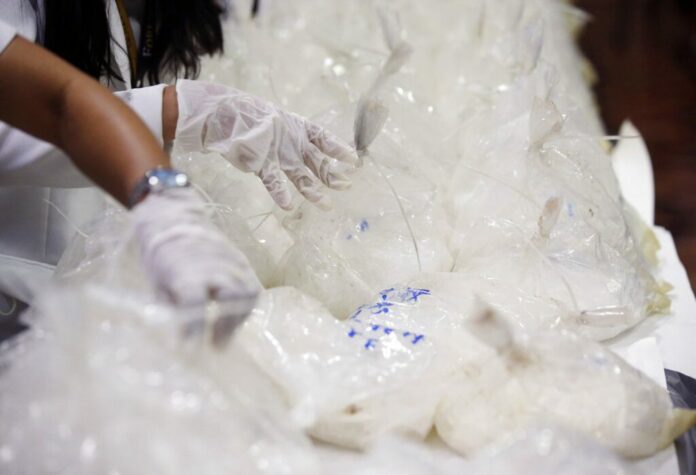
In this May 29, 2017, file photo, members of the National Bureau of Investigation arrange packs of seized methamphetamine at the National Bureau of Investigation in Manila, Philippines. Photo: Aaron Favila / Associated Press

BANGKOK — Production of methamphetamine is skyrocketing in Southeast Asia, with prices dropping and usage expanding, the U.N.’s anti-drug agency said Monday.

Even as seizures of the drug known as speed, ice and “ya ba” in its various forms reached a record high last year, street prices have dropped, indicating increased availability, said a report released by the United Nations Office on Drugs and Crime.

The agency said methamphetamine has become the main drug of concern in 12 out of 13 East and Southeast Asian countries, up from five a decade ago. The only exception was Vietnam, where heroin is considered the major problem.

In Thailand alone, 515 million methamphetamine tablets were seized in 2018, 17 times the total amount of the drug seized a decade ago in all 13 countries combined, the U.N. agency said. Much of the supply comes from neighboring Myanmar.

“Data on seizures, prices, use and treatment all point to continuing expansion of the methamphetamine market in East and Southeast Asia,” said Tun Nay Soe, the agency’s inter-regional program coordinator.

The report warns that organized crime groups in the region have stepped up their involvement in making and trafficking methamphetamine and other drugs in the Golden Triangle, the region where the borders of Myanmar, Laos and Thailand meet that has historically been a major source of opium and heroin.

It said the drug market in East and South-East Asia had shifted from such opiates to methamphetamine since the latter part of the 2000s.

“The shift to methamphetamine has affected even countries traditionally known to have a relatively large market for heroin, such as China and Malaysia,” it said. “In Malaysia, the number of methamphetamine users detected by law enforcement authorities surpassed that of heroin users for the first time in 2017.”

In another indicator of the methamphetamine epidemic, medical treatment related to its use dominated the number of drug-related admissions in several East and Southeast Asian countries, the report said.

The drug agency warned that other synthetic drugs were also gaining traction in Asian markets.

“Potent synthetic opioids (e.g. fentanyl), implicated in fatalities in other parts of the world, are being identified by some countries in the region,” it said. Fentanyl is one of a number of opioids responsible for growing deaths of drug users in the United States.

“Aside from methamphetamine which is getting most of the attention because of the surge in seizures and street price drops, synthetic opioids and other drugs have also been found across the region,” said Jeremy Douglas, UNODC regional representative for Southeast Asia and the Pacific.

Advertisement

Southern Separatists Blamed for 17 Bomb Attacks

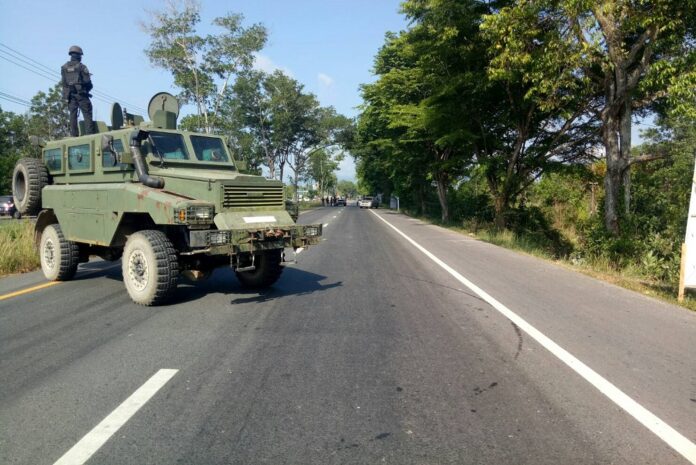
Armed soldiers guard a road in Narathiwat province on Monday.

BANGKOK — Deputy junta chairman Prawit Wongsuwan said Monday a suspect has been taken into custody in connection with yesterday’s bombing spree in the southern region.

Gen. Prawit did not identify the suspect, but said the 17 bombings – which struck Phatthalung and Satun provinces – were the work of separatists operating in the neighboring border region. No one was killed or injured in the attacks.

“I have received a preliminary report that one suspect has been apprehended,” Prawit told reporters. “The bomb attacks were committed by those seeking to cause unrest in the three southern border provinces.”

If Prawit’s claim is true, it marks an escalation by secessionist militants to bring their attacks northward toward Phatthalung and Satun, which had been mostly unaffected during the 15 years of violence.

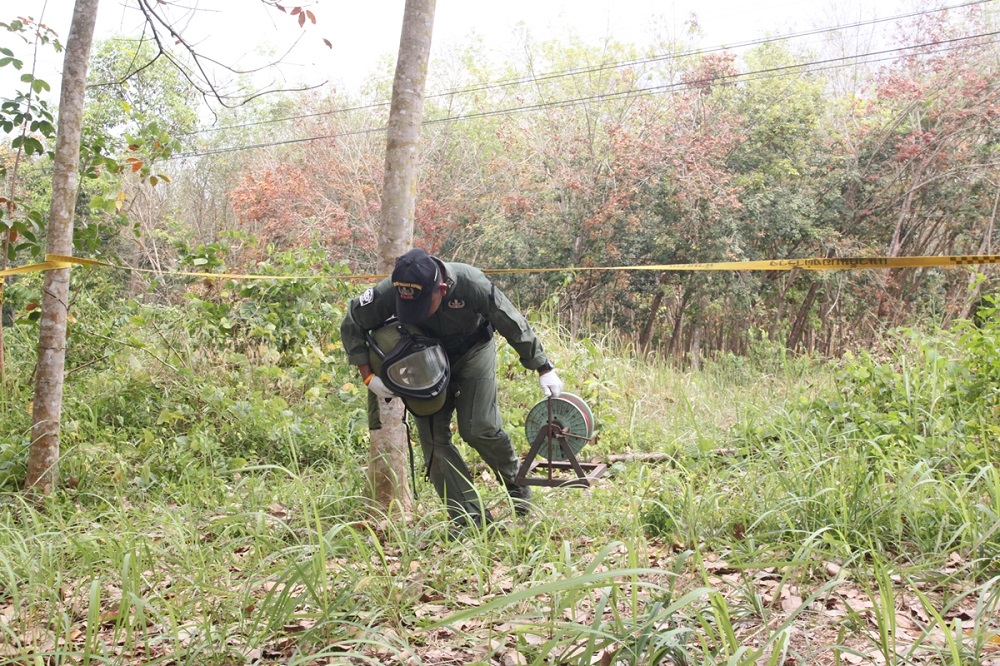
IMG 0416
An EOD officer defuses a bomb in Phatthalung province.

He also said the assailants appeared to target the two provinces because they are less defended than those in the Deep South.

Seven bombs were either found or detonated there Sunday. Though they caused widespread damage, no one was killed or injured.

Just this morning, a bomb went off in Narathiwat province and wounded a ranger who was on patrol.

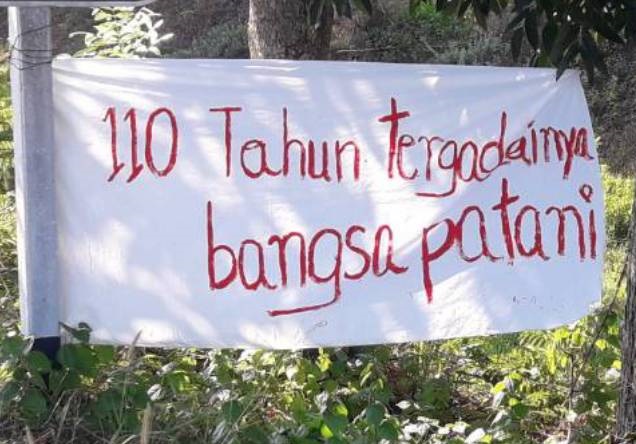
Police also reported that banners were hung in Yala and Narathiwat denouncing the Thai state over a 1909 treaty that partitioned the Patani sultanate between Siam and British Malaya. Sunday marked the 110th anniversary of the pact ending the Muslim kingdom’s independence.

1552291267439

Some roads were likewise defaced with graffiti reading “Patani 110.”

Speaking to reporters at Don Mueang Airport just after returning from meetings in the two provinces, Prawit insisted the attacks had nothing to do with any political factions.

“It’s not related to politics,” the general said.

It remains to be seen is whether it represents an ongoing escalation or one-off attack. In 2016, bombs ripped through seven provinces during Mother’s Day, killing four.

Speaking to reporters at Don Mueang Airport just after returning from meetings in the two provinces, Prawit insisted the attacks had nothing to do with any political factions.

“It’s not related to politics,” the general said.

Thailand is gearing up for an election on March 24.

Advertisement

Breathe in Thailand and Die Up to 4 Years Sooner: Research

BANGKOK — Those living in the most-polluted corners of the realm may live four years less than they may have elsewhere, according to a recent study.

Prolonged exposure to ultrafine particles called PM2.5 caused life expectancy of Thais to decrease by over two years on average compared to those living in areas that meet World Health Organization air quality standards, according to an analysis of conditions in 2016, which many worry has worsened since then.

On average, Bangkokians will live 2.4 years less, while people in Chiang Mai and Chiang Rai will respectively see 3.6 and 3.9 fewer summers, according to the Air Quality Life Index report published Wednesday by the University of Chicago. The index assesses the impact of particulate air pollution on life expectancy.

Read: Chiang Mai Tops World Pollution Charts

The report cited growth in the industrial sector and increased vehicle emissions for a 23-percent increase in Bangkok’s air pollution since 1998, when it took 1.7 years off people’s lives.

It also found 87 percent of the population live in areas where pollution exceeded WHO guidelines. Even under more-forgiving Thai government standards, three out of four people breathe “unhealthy” air.

The report came out as the northern and northeastern provinces are choking on seasonal toxic smoke largely caused by open burning and forest fire. It followed severe air pollution over the capital in January which saw officials scramble to douse public furore with a series of ineffective measures.

According to Twitter, there were at least 4.8 million tweets about PM2.5 in Thailand sent out between December and January. Public pressure has led to more measures from the government including a ban on open burning, school closures and checkpoints to fine polluting drivers.

Another study by AirVisual, an independent monitoring organization, ranked Thailand the 23rd worst-polluted country in 2018 with average concentrations of PM2.5, the smallest and most harmful particles, at 26.4 micrograms per cubic meter.

The WHO’s target is 10 micrograms per cubic meter.

While Bangkok was the world’s 24th most-polluted capital last year, Thailand’s foulest provinces were Samut Sakhon, Nakhon Ratchasima and Nong Khai.

Related stories:
Smog Grounds Flights in Northern Thailand
Smog Surges Over Thailand’s Two Major Cities
As Bangkok Clears, Provinces Choke on Seasonal Smoke
‘I Don’t Know What to Do’ About Smog: Bangkok Governor
Bangkok Schools Ordered Closed Due to Smog
Rail Construction Halted, Drivers Fined as Smog Persists
Bangkok Pollution Has Always Been Bad – So Have the Solutions: Experts

Advertisement

Parties Woo Thai Elderly With Expanded Safety Net

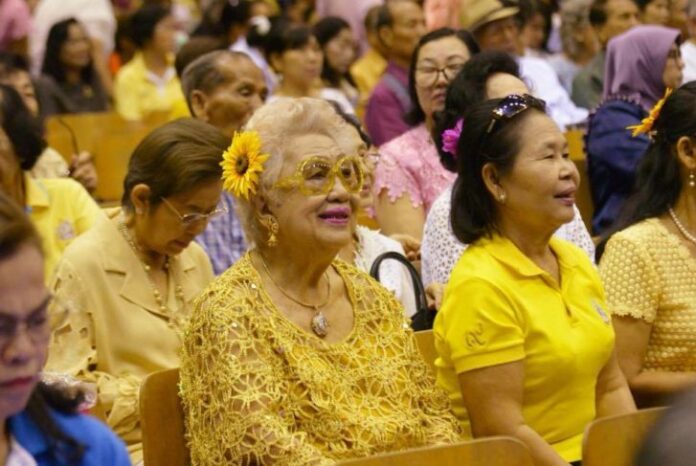
An audience listens to speeches marking the UN's International Day of Older Persons Oct. 2018 in Bangkok.

NONTHABURI — Representatives from four major parties presented dueling policies Monday to benefit the elderly who make up about one-fifth of the electorate.

Increasing welfare benefits and raising the mandatory retirement age were the top proposals from representatives of the Phalang Pracharat, Democrat, Pheu Thai and Future Forward parties at the forum held at the Public Health Ministry in Nonthaburi province.

“We will set aside funds for one million jobs for elderly people and push for reverse mortgages in order to turn properties into cash,” said Kobsak Pootrakool, Phalang Pracharat spokesman.

He also said the pro-junta party would push for raising retirement to 63 from 60 as well as encourage design standards to accommodate the elderly and those with disabilities.

About 10 million Thais are 60 or older, a demographic expected to swell in coming years.

Abhisit Vejjajiva, leader of the Democrat Party, was the only party leader and PM candidate to attend. He said it shows how seriously his party cares about preparing for the aging society.

Abhisit said the party would call for doubling the monthly stipend for seniors to 1,000 baht and, if the election brings it to power, giving away 3,500-baht skills training credits for one million people. His government would also discourage people from artificially prolonging the lives of terminally ill patients to reduce hospitals’ burden.

Pheu Thai spokeswoman Tidarat Yingcharoen said the party would develop a program to employ the elderly as local tour guides as has been done in Japan. It would also promote employment of seniors at community hospitals.

Future Forward Party representative Ekaphob Pianphisaet said the party would push for an expanded welfare in which the elderly are better cared for. This would include a 1,800 baht monthly support for elderly people and more accessible transportation.

While all four parties signaled support for improved accessibility, they were ambivalent at best about increasing the VAT by 3 percent to 10 percent to pay for senior benefits.

Abhsit said increasing the VAT would create a burden on rich and poor alike.

Future Forward Party’s representative meanwhile said that while there’s no need to increase the VAT at present, the issue “could be entertained at a future time”.

Pheu Thai’s Tidarat said increasing the VAT to fund elderly programs would only make senior citizens be regarded as a burden.

Kobsak meanwhile said Phalang Pracharat Party disagrees outright with such move. “This is the wrong approach,” he said.

Advertisement

#SmartChoice? Netizens Unconvinced by Prayuth’s Simple Meal

Image: Prayut Chan-o-cha / Facebook

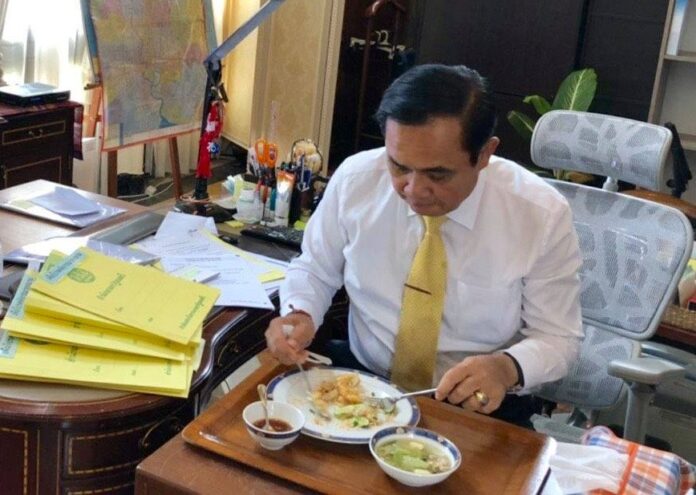
BANGKOK — When he’s not pulling the levers of power, junta chairman Prayuth Chan-ocha is a simple human who eats modest meals.

At least that’s the message the retired general – whose declared assets stand at about 128 million baht – telegraphed in a photo of the retired general eating what looks like fried rice and soup posted online Monday.  

“Delicious stuff doesn’t always have to be expensive. #SmartChoice” the junta leader wrote on his official Facebook page.

Instead of winning plaudits, the photo seemed to backfire as most comments mocked the image and dismissed it as an obvious setup. As of Monday afternoon, the post had been shared at least 6,600 times and received more than 7,800 comments.

“I’m about to take your photo. Please act like you’re eating and don’t look up at the camera,” user Sahaphap Nuansri wrote in a faux script. “Ready? Alright, 1, 2, 3, snap! Done! Mae Baan, take these plates away.”

“Doesn’t everyone eat meals like this?” Aekkasit Onklam asked.

“Other candidates keep showing off their visions. Uncle Tuu shows off his meal,” Wachinan Somjai said.

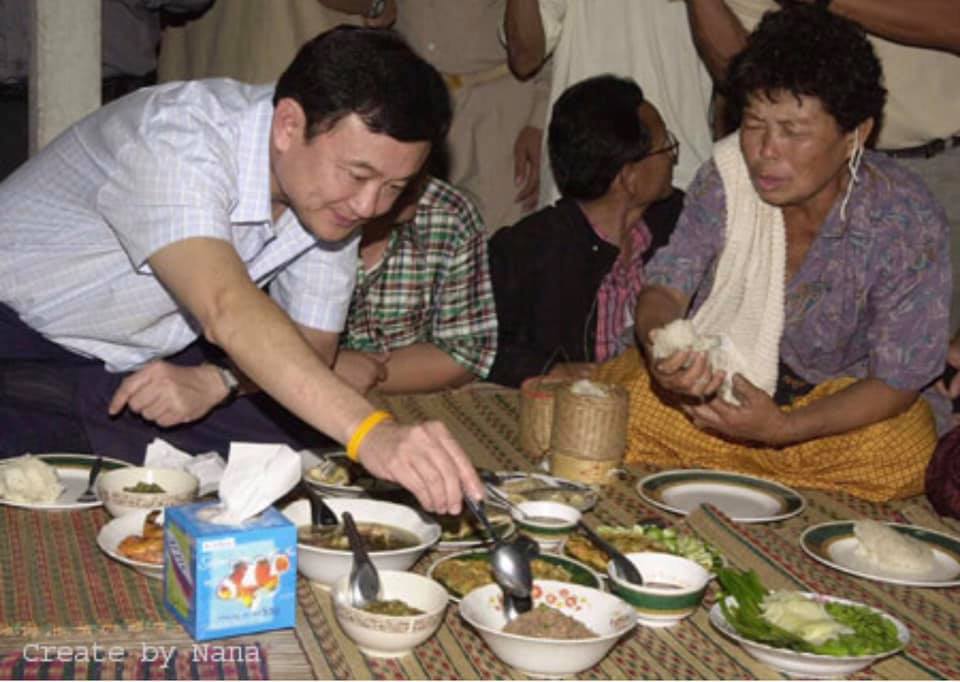
Not everyone reacted negatively. One user argued that former prime minister Thaksin Shinawatra also published photos of himself eating meals with rural villagers during his time in office.

“Let me ask you, is this photo also a PR move? If you say no, that means you’re biased,” Ying Praphanwong wrote with a photo of Thaksin.

53719236 2080789975308249 7157678567764000768 n
Then-PM Thaksin Shinawatra shares a meal with locals in Roi Et province in January 2006.

It didn’t take long for the controversial post to catch the internet hivemind’s attention.

Harry Potter exclaims that the magical food at Hogwarts must be expensive, only to be corrected by Ron that’s not necessarily true. A classmate warns him that “the headmaster’s seat” is very expensive, though.

“Good submarines don’t always have to be expensive,” reads the caption in a reference to the junta’s 36-billion-baht submarine deal with China.

Supermarket chain Tops advises customers to follow their #SmartChoice and choose “Thanathorn Oranges” from the north with the distinctive color adopted by the Future Forward Party.

“The audience knows you’re not smart,” reads a quote from a “mentor” on reality television show ‘The Face Thailand.’

This user challenged Prayuth to pose for a roadside meal like Future Forward Party leader Thanathorn Juangroongruangkit next.

The photo is the latest attempt to rehabilitate Prayuth’s image and rebrand the prickly military man as a relatable man of the people before the March 24 election. The junta leader is running for another term in office atop the Phalang Pracharat Party’s ticket.

53602103 2127852200838904 7034316623007711232 n
When you’re halfway into election season and he gives you this look.

Prayuth attempted similar meal moderation when his aides posted a video of him eating from a lunchbox in a van last month.

Late last week, Facebook pages allied to the junta released a striking set of photos of Prayuth mugging for the camera romantically. In one he rests his chin atop his clasped hands and gazes into the camera.

Phalang Pracharat spokesman Kobsak Pootrakool also told the media yesterday that his team will soon release exclusive photos of Prayuth in the theme of “Uncle Tuu the Otaku,” possibly taken when the regime chairman met members of the J-pop group AKB48 last year.

Advertisement

Hot News

LATEST NEWS

Bangkok
overcast clouds
36.1 ° C
36.6 °
35 °
61 %
3.6kmh
100 %
Sat
37 °
Sun
36 °
Mon
35 °
Tue
33 °
Wed
32 °