28.8 C
Bangkok
Saturday, June 27, 2026
Home Blog Page 1679

Asian Markets Rise on China-US Trade Prospect

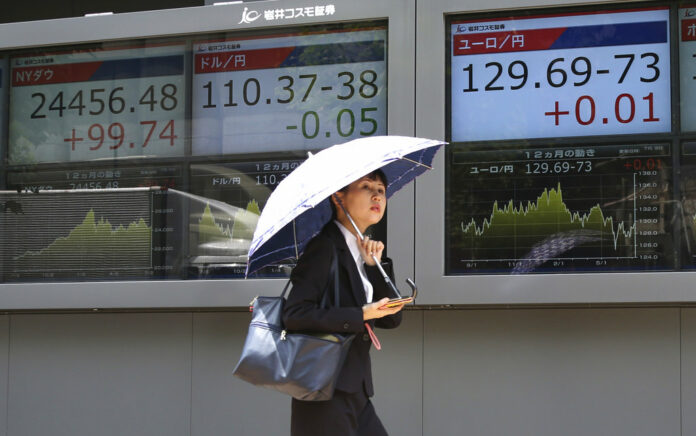
A woman walks by an electronic stock board of a securities firm in July in Tokyo, Japan. Photo: Koji Sasahara / Associated Press

SINGAPORE — Asian shares were mostly higher on Friday after a report suggested that the leaders of China and the U.S. could be endorsing a trade deal in weeks.

According to Bloomberg, U.S. officials are preparing a final trade deal ahead of a summit between President Donald Trump and Chinese leader Xi Jinping, which could take place as soon as mid-March. It cited unnamed sources close to the matter.

Thailand’s SET fell by 0.5 percent and traded at 1,645.68 Friday afternoon. Japan’s Nikkei 225 index picked up 1 percent to 21,602.69 and Hong Kong’s Hang Seng added 0.4 percent to 28,738.72. The Shanghai Composite index edged 0.4 percent higher to 2,953.02 and Australia’s S&P ASX/200 gained 0.4 percent to 6,192.70.

Shares rose in Singapore and Indonesia but fell in Malaysia. South Korean and Taiwanese markets were closed for a holiday.

Traders hope that a tariffs battle waged by the world’s two largest economies would soon be called off if a deal is reached.

Trump and Xi agreed to a 90-day ceasefire in December after raising import taxes on billions of dollars of each other’s goods. The U.S. was set to hit China with a fresh wave of tariffs once the agreement expires on Saturday.

While progress on issues like Washington’s unhappiness over Beijing’s technology policy has been slow, Trump said he will postpone the tariffs to give the countries more time to talk. He did not say for how long.

Buying in Asia was supported by an announcement by MSCI, a leading provider of indexes and analytics. MSCI said it will quadruple the weight of Chinese A shares in its global indexes by November. It will also add more Chinese stocks to its Emerging Markets Index, giving the country’s foreign inflows a much-needed boost.

A private survey also added to Chinese growth hopes. The Caixin manufacturing purchasing manager’s index, which measures growth in the sector, jumped to 49.9 in February, from 48.3 in the previous month. The index is on a 100-point scale, with 50 separating contraction from growth.

This comes after China’s official manufacturing PMI fell 0.3 points to 49.2 in February, a three-year low.


Wall Street

Stocks slid Thursday on news that the U.S. economy slowed at the end of last year, although the performance still beat analysts’ expectations. The country’s gross domestic product expanded at a 2.6 percent annual rate in the October-December period, down from 3.4 percent in the third quarter. The S&P 500 index lost 0.3 percent to 2,784.49 and the Dow Jones Industrial Average fell 0.3 percent to 25,916.00. The Nasdaq composite shed 0.3 percent to 7,532.53, while the Russell 2000 index of smaller company stocks also dropped 0.3 percent to 1,575.55.


Energy

U.S. crude added 44 cents to USD$57.66 per barrel in electronic trading on the New York Mercantile Exchange. It finished 28 cents higher at $57.22 a barrel overnight. Brent crude, used to price international oils, gained 60 cents to $66.91 a barrel. The contract gave up 27 cents to $66.31 in London.


Currencies

The dollar strengthened to 111.77 yen from 111.39 yen on Thursday. The euro climbed to $1.1374 from $1.1371.

Story: Annabelle Liang

Advertisement

Pakistan Ready to Hand Over Indian Pilot Amid More Shelling

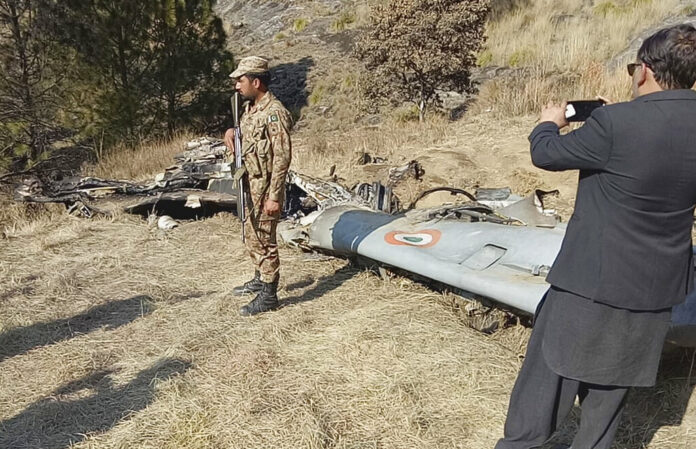
A Pakistani soldier stands guard near the wreckage of an Indian plane shot down by the Pakistan military on Wednesday, in Hurran, near the Line of Control in Pakistani Kashmir. Photo: Abdul Razzaq / Associated Press

ISLAMABAD — Pakistan prepared to hand over a captured Indian pilot on Friday while blistering cross-border attacks across the disputed Himalayan region of Kashmir continued for a fourth straight day, even as the two nuclear-armed neighbors seek to defuse their most serious confrontation in two decades.

Tens of thousands of Indian and Pakistani soldiers face off along the Kashmir boundary known as the Line of Control, in one of the world’s most volatile regions.

On the Indian side of Pakistan’s border crossing at Wagah, turbaned Indian policemen lined the road on Friday in expectations of the pilot’s handover. A group of cheering Indians waved their country’s national flag and held up a huge garland of flowers to welcome him back.

Tensions have been running high since Indian aircraft crossed into Pakistan on Tuesday carrying out what India called a pre-emptive strike against militants blamed for a Feb. 14 suicide bombing in Indian-controlled Kashmir that killed 40 Indian troops. Pakistan retaliated, shooting down two Indian aircraft Wednesday and capturing a pilot.

Since the escalation, world leaders have scrambled to head off an all-out war on the Asian subcontinent. President Donald trump in Hanoi on Thursday said he had been involved in seeking to de-escalate the conflict.

On Friday, Adel al-Jubeir, Saudi Arabia’s minister of state for foreign affairs, is expected in Islamabad with an urgent message from the kingdom’s powerful Crown Prince Mohammed bin Salman.

Pakistan Prime Minister Imran Khan told lawmakers on Thursday, “We are releasing the Indian pilot as a goodwill gesture tomorrow.”

But India made it clear that the latest escalation has changed its strategy and that going forward, it will strike, including inside Pakistan, if they get information of an attack in the planning. Indian Prime Minister Narendra Modi earlier Thursday warned “India’s enemies are conspiring to create instability in the country through terror attacks.”

Khan also said he had feared Wednesday night that India might launch a missile attack, but the situation was later defused. He did not elaborate.

“Pakistan wants peace, but it should not be treated as our weakness,” Khan said. “The region will prosper if there is peace and stability. It is good for both sides.”

Meanwhile, Pakistan’s air space remained closed to most air traffic, although some domestic flights were allowed on Thursday. The country’s civil aviation agency said authorities would announce Friday afternoon whether they are reopening or keeping the airspace closed.

Residents of the Pakistani border town of Chikhoti reported heavy shelling overnight and Friday morning. More than 200 people had fled to a military organized camp about 20 kilometers (16 miles) away from the border.

Police in the Indian-controlled Kashmir said one man was wounded and at least two civilian homes were damaged in the cross-border shelling.

Kashmir has been divided but claimed in its entirety by both India and Pakistan since almost immediately after the two countries’ creation in 1947. They have fought three wars, two directly over the disputed region.

Authorities in Pakistani-controlled Kashmir closed all schools and educational institutions in the region and urged parents to keep their children at home amid mounting tensions.

Pakistan’s Foreign Ministry spokesman Mohammad Faisal acknowledged his country received a “dossier” from India about the Feb. 14 suicide bombing. He refused to provide details about the information that New Delhi has shared.

Modi, in his first remarks since the pilot’s capture, gave a rallying speech ahead of elections in the coming months.

“Our defense forces are serving gallantly at the border,” he told tens of thousands gathered across the country Thursday to listen to him in a videoconference from New Delhi. “The country is facing challenging times and it will fight, live, work and win unitedly.”

This week’s violence marked the most serious escalation of the long-simmering conflict since 1999, when Pakistan’s military sent a ground force into Indian-controlled Kashmir at Kargil. That year also saw an Indian fighter jet shoot down a Pakistani naval aircraft, killing all 16 on board.

This latest wave of tensions between the two rivals first began after the militant group Jaish-e-Mohammad claimed responsibility for the suicide bombing on Indian paramilitary forces. India long has accused Pakistan of cultivating such militant groups to attack it. Pakistan has said it was not involved in that attack and was ready to help New Delhi in the investigation.

Also Friday, Pakistan’s top diplomat said he was skipping a meeting of foreign ministers from the world’s leading Islamic organization in the United Arab Emirates to protest the host’s decision to invite India, a non-member.

Foreign Minister Shah Mahmood Qureshi told Parliament he isn’t attending the meeting of the Organization of Islamic Cooperation in the UAE capital of Abu Dhabi because UAE’s Foreign Minister Abdullah bin Zayed Al Nahyan refused to withdraw the invitation to India’s External Affairs Minister Sushma Swaraj. Qureshi said India is neither a member of the 57-nation organization nor has observer status.

In her remarks at the gathering, Swaraj clearly criticized Pakistan, an OIC member.

“If you want to save that humanity, then we must tell the states who provide shelter and funding to the terrorist to dismantle the infrastructure of (those) terrorist camps and stop providing funding and shelter to the terror organizations based in that country,” she said.

Story: Cathy Gannon

Advertisement

Smog Grounds Flights in Northern Thailand

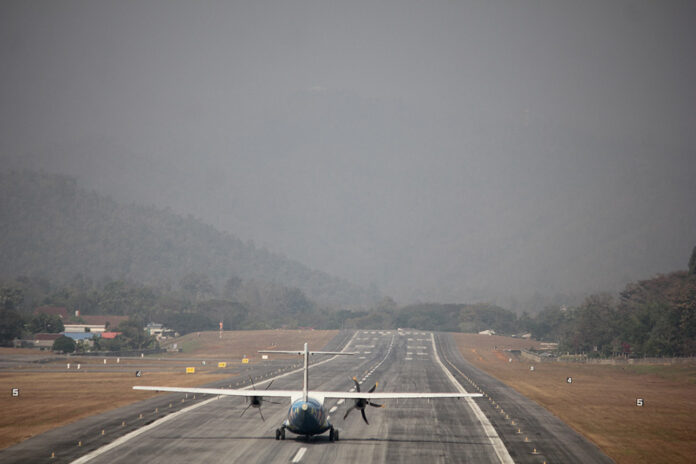
An ATR 72 on the runway Friday at the Mae Hong Son Airport.

MAE HONG SON — At least two flights were canceled Friday in the northwestern province of Mae Hong Son as smog continues to surge due to intense seasonal burning.

Bangkok Airways flights to and from Chiang Mai this morning were canceled. The airline said visibility in Mae Hong Son was blocked by heavy smoke from forest fires and smog.

The Pollution Control Department said the air quality in the urban area fell to a “very unhealthy” level Friday morning with the density of the dangerous ultrafine particles at 93 micrograms per cubic meter. Officials attributed the surge to people torching fields and forests before a two-month ban went into effect today.

Related stories:

As Bangkok Clears, Provinces Choke on Seasonal Smoke

Advertisement

Seth Green’s Thailand Buddy Film to Premiere at Bangkok Fest

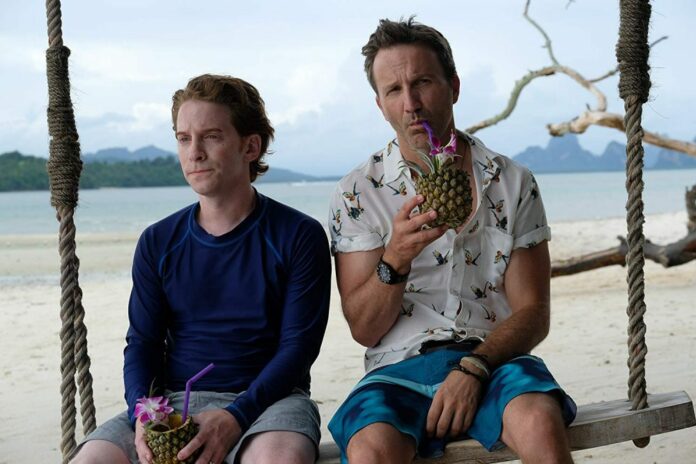
‘Changeland’ / Stoopid Buddy Stoodios

BANGKOK — An American man trying to outrun personal crisis brings his bro to Thailand in a film to premiere at a film festival in Bangkok this month.

Written, directed by and starring Seth “Robot Chicken” Green, “Changeland” will show for the first time at the seventh edition of the Thailand International Destination Film Festival, which celebrates movies shot in the kingdom.

The film follows American best friends Brandon (Green) and Dan (Breckin Meyer) as they take a bizarre tour of Thailand. Green’s directorial debut includes oddball appearances by former Disney star Brenda Song and her boyfriend, Macaulay Culkin of “Home Alone” fame and adolescent infamy.

Other films showing at the festival include “Gold” (2016), a Matthew McConaughey-starring crime drama loosely based on a 1993 scandal involving a pair of men who hit the mother lode in the jungles of Indonesia.

One of 2011’s biggest films, “The Hangover Part II,” which was shot at locations around Bangkok, will also be shown.

The festival runs March 27 to March 31 at Paragon Cineplex, a cinema located on the fifth floor of the Siam Paragon shopping mall.

The schedule is available online. Admission is free and can be reserved via a phone call or at a ticket booth in front of McDonalds on the fifth floor of Siam Paragon from March 26 through March 31.

In 2016 it pulled four movies as a result of censorship. They included “Twilight Over Burma,” a film based on the true story of an Austrian woman who married a Shan prince. The film, partly shot in northern Thailand, was announced as part of the festival before being rejected by the Film and Video Censorship Board.

The other three films barred from showing were “Pattaya,” “Happy Hour in Paradise,” and “Detective Chinatown.”

Advertisement

How to Possess Marijuana Legally in Thailand – Right Now

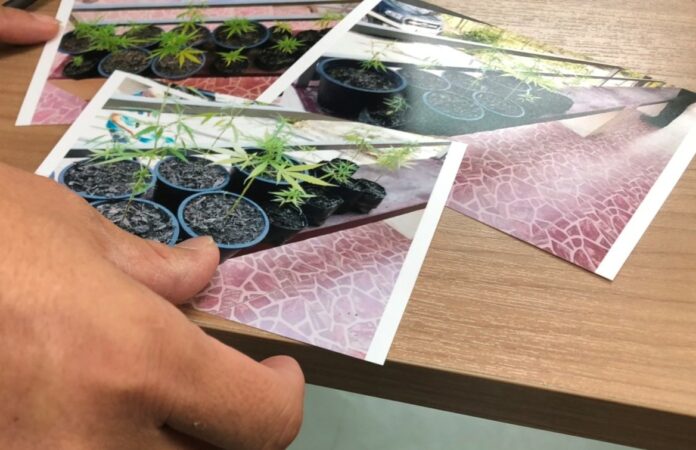
A medical marijuana patient shows photos of his marijuana plants to FDA officials Thursday in Bangkok.

BANGKOK — Though the distribution of medical marijuana has yet to begin, there’s now a way to legalize one’s stash – Thais and expats alike – provided they have a legitimate use for it.

Those who possessed marijuana for medical use prior to the law being enacted can register it under a new amnesty program rolled out Wednesday by the Food and Drug Administration. Four people showed up to do just that on the first day. For now the process is limited only to cannabis and not kratom, though the latter has also been made legal.

People who have been using cannabis for treatment of approved uses before the law was passed and want to go legal should first obtain a medical certificate verifying their eligible condition from a certified doctor, dentist or Thai traditional medicine practitioner.

After that, they can register with the FDA per the following steps. Though foreign nationals are eligible, they may need help if they don’t speak Thai.

Prepare the Documents

1. Identification documents (ID Card or passport).
2. Medical certificate(s) verifying relevant medical condition(s) being treated.
3. Download the application form. Send it to the printer. Fill in details including name, identification number (ID card or passport), details about the medical conditions being treated, the amount of marijuana in possession, and the name and license of the doctor, dentist or traditional medicine practitioner who certified your medical need (See No. 2).

Prepare the Goods

Patients must bring the cannabis they have been using along with their application. Those with amounts that can’t be moved or too large to transport must bring photos showing their stock, and department staff will schedule a date to send an inspector.

As the amnesty was designed to put the law into force before the full system can be rolled out, patients will be authorized to possess an amount deemed necessary for a 90-day supply. For quantities over that amount, users can either agree to surrender any excess (which requires completing another form) or justify its need on the original form.

Anyone unable to come in person can authorize a representative on the form to make the application on their behalf.

Hold Your Breath

Bring all the above to the second floor of building No. 6 at the Food and Drug Administration’s central offices in Bangkok. Those living outside the capital can take it to a provincial public health office (or Google translate and scroll down to the “Provincial Public Health Office” section to find a local office).

After approving the application, officials will countersign the application form which will then be kept by users as proof of their legal status. Rejected applicants will have their marijuana seized but will be free to leave without prosecution.

Tourists

The FDA and narcotics officials say that, as of now, medical marijuana allowed in Thailand must exist in a form approved by the Health Ministry, whether edible, flower or oil. Tourists traveling with medical cannabis might still get their stash confiscated while entering the country if it is in an unapproved form.

Officials advise visitors to carry a copy of their medical prescriptions to show to customs agents, then contact the FDA upon arrival to get official approval to avoid prosecution or get their seized cannabis returned.

They’ll need to complete a different form than that above declaring the amount of marijuana in their possession. After bringing that to the same FDA or public health office, they must also present their passport, proof they are traveling such as airline tickets, and a copy of their medical prescription and prescribing doctors’ license.

In one small bureaucratic wonder, none of these forms for tourists are available in English, and staff said they don’t know if that will change.

For more information, there are now two hotlines dedicated to medical cannabis. The one operated by the FDA includes an option for English speakers and can be reached at 1556, Ext. 3. Another has been set up by the Narcotics Control Board for other issues at 1386, Ext. 3. Both lines operate 8:30am to 4:30pm on regular government work days.

Expect a long wait as officials said the lines are meeting high demand.

Related stories:

Thailand Officially Unveils 1st Legal Pot Plantation (Photos)

Thai FDA Scrambles to Make Medical Weed a Reality

The Hidden Easter Eggs Inside Thailand’s New Cannabis Law

‘Stress’ Could be Valid For Prescribing Weed: Thai FDA

Weed Amnesty Proposed by Thai FDA

Advertisement

Gen. Prayuth Can Debate & Campaign, EC Rules

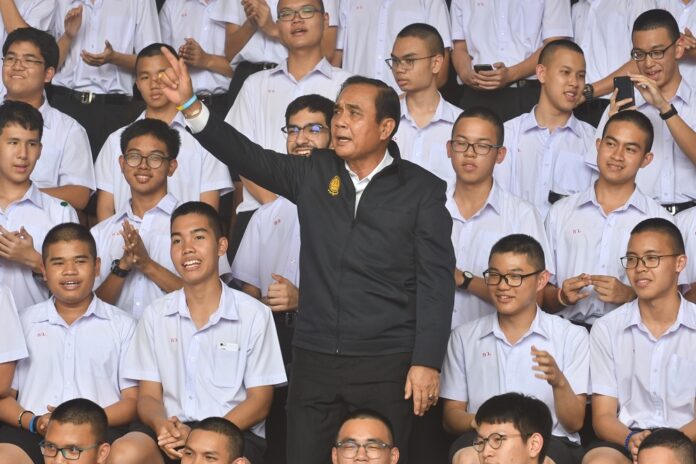
Junta chairman Prayuth Chan-ocha sings along with students at a school in Rayong province on Feb. 27, 2019.

BANGKOK — Junta chairman Prayuth Chan-ocha is free to debate his opponents on TV and walk the streets in canvassing trails just as other politicians, the Election Commission confirmed Friday.

The greenlight came after Phalang Pracharat Party, which has named Gen. Prayuth its candidate to be premier, asked the commission to clarify the issue, lest he violated the constitution. In response, the commission said Prayuth is entitled to the same rights as other candidates but urged him not to exploit his office. He has served as prime minister since the 2014 coup.

The general has come under pressure from politicians to engage in debates and be subjected to the same scrutiny as other party candidates. Major parties have already confronted each other through televised debates, which became topics of lively discussions on social media.

Gen. Prayuth has repeatedly refused the challenge, citing his concerns of breaking voting regulations. The retired general is also a garrulous and undisciplined speaker who is unaccustomed to being challenged publicly.

No response was available today from the junta leader as he is on sick leave, his aides said.

Democrat Party chairman Abhisit Vejjajiva welcomed the Election Commission’s decision, but warned Prayuth not to exploit his powers to canvass for votes.

“If he enters the race as an equal, no one has a problem with him,” Abhisit said while campaigning in Korat this morning. “He has to be mindful of himself.”

Asked whether Prayuth now lacks any excuse to avoid debate, Abhisit said it’s up to the junta chairman to decide.

“It’s his own decision whether to enter a debate,” the Democrat chairman said. “Whether he’s afraid to answer questions, you’ll have to ask him yourself. I don’t know, and I cannot answer on his behalf.”

Advertisement

The Art of the Walk? Summit Collapse and Trump’s Diplomacy

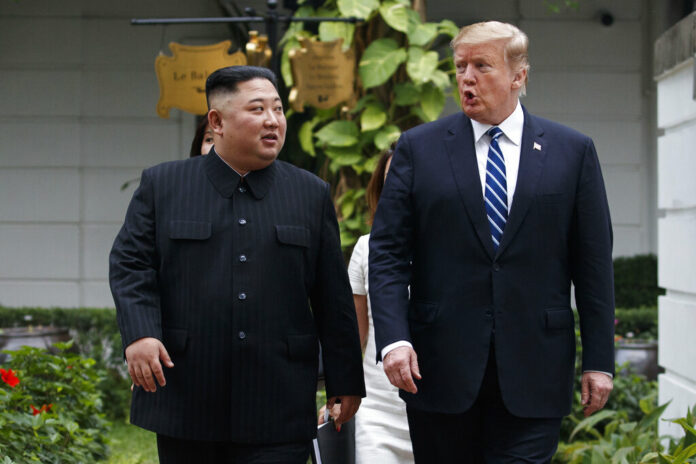
President Donald Trump and North Korean leader Kim Jong Un take a walk Thursday after their first meeting at the Sofitel Legend Metropole Hanoi hotel. Photo: Evan Vucci / Associated Press

HANOI — President Donald Trump framed the breakdown of his nuclear summit with North Korea’s Kim Jong Un as wisely knowing when “to walk.” But the stunning collapse revealed the limits of his unique brand of personal diplomacy and raised concerns about future efforts to disarm a global threat.

Eyeing the history books and a much-needed political victory, Trump bet big on the two-day Vietnam summit only to be forced to explain away its sudden failure.

The president and North Korea gave conflicting explanations of what went wrong, though the result actually was a relief to some critics and even some Trump supporters who feared he might give too much away in pursuit of a deal.

Trump, the businessman who was elected in part on his boasts of deal-making prowess, said a proposed agreement was “ready to be signed.” But he said he refused to accept what he described as North Korean insistence that all U.S. sanctions be lifted without the North committing to eliminate its nuclear arsenal.

“I’d much rather do it right than do it fast,” the president said. “We’re in position to do something very special.”

The North said it had demanded only partial relief from the punishing sanctions.

Trump had pushed for the summit, telling wary aides that his personal chemistry with North Korea’s young and reclusive leader outweighed any need for detailed, staff-level talks to iron out differences before either head of state set foot in Hanoi.

Secretary of State Mike Pompeo, who along with his special envoy for North Korea, Stephen Biegun, had been leading the preparatory effort, said staff work had achieved some results but that negotiators had intentionally left some of the most contentious issues unresolved.

“We were hoping we could take another big swing when the two leaders got together,” he told reporters as he flew from Vietnam to the Philippines after the summit collapsed. “We did. We made some progress. But we didn’t get as far as we would have hoped we would have gotten.”

Pompeo noted that “when you are dealing with a country that is of the nature of North Korea, it is often the case that only the most senior leaders have the capacity to make those important decisions.”

Echoing the refrain that “no deal is better than a bad deal” – often used during the Obama administration by critics of its Iran negotiations – there was relief in some quarters that the president had not impulsively agreed to concessions without much in return.

“Kudos to him for walking away from the table,” said Jonathan Schanzer of the Foundation for Defense of Democracies, a Washington think-tank that has been highly skeptical of Trump’s efforts with Kim Jong Un. “No deal is, in fact, better than a bad deal.”

And White House aides stressed that Trump stood strong. Some observers evoked the 1987 Reykjavík summit between Ronald Reagan and the Soviet Union’s Mikhail Gorbachev, a meeting that ended without a nuclear weapons deal but laid the groundwork for a future agreement.

Long-standing U.S. policy insists that American sanctions on North Korea will not be lifted until that country commits to, if not concludes, a complete, verifiable and irreversible end to its nuclear weapons program.

Trump, who did not consult with allies South Korea and Japan before breaking off the talks, declined to restate that goal Thursday, saying he wanted to retain flexibility with Kim.

But North Korea’s foreign minister, in a rare news conference, said that Trump wasted an opportunity that “may not come again” and that the North’s position wouldn’t change even if there was another round of dialogue.

The failure in Hanoi laid bare a risk in Trump’s negotiating style: Preferring one-on-one meetings with his foreign counterparts, his administration doesn’t always do the staff-level advance work intended to make a summit more of a victory lap than a negotiation.

“The developments over the past 48 hours highlight in stark fashion the inherent weaknesses of President Trump’s preference for summit diplomacy – international media spectacles that have failed to achieve substantial progress on the key issues, especially denuclearization,” said Paul Haenle, the director of the Carnegie-Tsinghua Center for Global Policy.

Unsurprisingly, former Obama administration officials agreed.

“At every step of the way, Trump has placed himself, rather than professionals, at the center of this process – and as a result, he’s been outmaneuvered every step of the way,” the National Security Action, a group of mainly Obama-era foreign policy practitioners, said in a statement.

Michael Fuchs, who worked on Asian issues as a State Department official under Obama, said there should be no more summits until the two sides are ready to announce a concrete agreement. “Let the real negotiators from both sides get to work,” he said. “Until then, no more reality TV summitry.”

One beneficiary of the Vietnam summit may have been the North Korean leader.

The first Trump-Kim meeting in Singapore gave the reclusive nation’s leader an entry to the international stage. The second appeared to grant him the legitimacy his family has long desired.

Kim, for the first time, affably parried with the international press without having to account for his government’s long history of oppression. He secured Trump’s support for the opening of a liaison office in Pyongyang, without offering any concessions of his own. Trump’s backing for that step toward normalization provided the sort of recognition the international community has long denied Kim’s government.

Experts worried that the darker side of Kim’s leadership, was being brushed aside. That includes massive human rights abuses, prison camps filled with dissidents, an absence of religious and speech freedoms and the executions of government and military officials.

Trump also appeared to accept the North Korean leader’s assertion that he had nothing to do with the 2017 death of Otto Warmbier, an American college student who was imprisoned for allegedly taking a propaganda poster while on a visit to the country.

The president said he took Kim “at his word” that he was unaware of the mistreatment Warmbier was subjected to in custody, a remark that drew widespread criticism, even from Trump’s former U.N. ambassador.

“Americans know the cruelty that was placed on Otto Warmbier by the North Korean regime,” former Ambassador Nikki Haley said.

Still, Robert Gallucci, who negotiated with North Korea as a senior State Department official during the Clinton administration, said the unorthodox way in which the two North Korea summits were organized, may not have been a mistake given the unusual nature of the two leaders.

“It does have its down sides, and we just experienced the down side,” Gallucci said. However, Hanoi wasn’t a total disaster as long as the two sides are willing to keep at it.

“I’m feeling good because nothing really bad happened, and we have a prospect of using the momentum of the meeting of heads of state to propel working-level discussions, with the understanding here that both sides have invested politically in this, and leaders have invested personally in this, and they want it to work,” Gallucci said.

Story: Johnathan Lemire, Matthew Lee

Advertisement

Ink Runs Wild: Tattoo Expo Returns to Bangkok

Images: Thailand Tattoo Expo 2019 / Facebook

BANGKOK — Yakuza, blackwork or sak yant? Whatever your style is, you got it.

It’s going to be three days of ink, designs and needles and at a Bangkok shopping mall where tattoo masters and enthusiasts will converge for the third annual Thailand Tattoo Expo.
The three-day convention will feature tattoo artists from several countries from Taiwan, Hong Kong and Sri Lanka to Lithuania and the United States.

Winners of the tattoo contest will go home with up to 300,000 baht.

The event runs 10am until 9pm, March 15-17 in the BCC Hall on the fifth floor of CentralPlaza Lardprao.

Anyone going to obtain elaborate inkwork should get there when it opens.

The shopping mall can be reached from MRT Phahon Yothin.

Advertisement

Sleeping Woman Avoids Snake Attack Like Ninja (Video)

You Can't Touch This plays in the background.

BANGKOK — A slumbering Bangkok woman narrowly missed being attacked by a snake that somehow made it into her bedroom, according to footage of the encounter.

The video, posted online by a man identifying himself as the woman’s son, shows the creature slither to the woman’s bed in the dark. The moment sure to make viewers squirm comes when the snake lunges at her foot just as she swings it out of the way, at 2.17.17 in the security timecode.

“The python slithered … and lunged at my mother’s foot! Luckily she was not injured at all because she was drawing her foot away at that moment, so the snake fell to the floor with a loud thud,” Nakorn Sudsopa wrote. “The sound woke my mom in surprise.”

นาทีงูฉกเท้าคุณแม่ ที่ 02 : 17 :17

โพสต์โดย นายช่าง อ้วนดำ เมื่อ วันพุธที่ 27 กุมภาพันธ์ 2019

Nakorn said the incident took place early Wednesday morning. Upon investigation, he said the snake appeared to enter the house via an open door or – flashback to one of 2016’s most viral moments – the toilet.

In true Thai tradition, many users responded to the video by asking Nakorn for his street address or any other related numerals, per popular belief that strange incidents carry hints to winning lotto wealth in the next draw. Indulging the request, Nakorn replied his home address is 121/460.

Citizens of Bangkok may yet rest in safety, as Nakorn revealed the python is still at large.

“The security guard told me the rescue workers took too long to retrieve the snake, so he let it go into the sewer,” he warned ominously. “Which home will be the next victim?”

Advertisement

Monks Injured in Bangkok Temple Fire

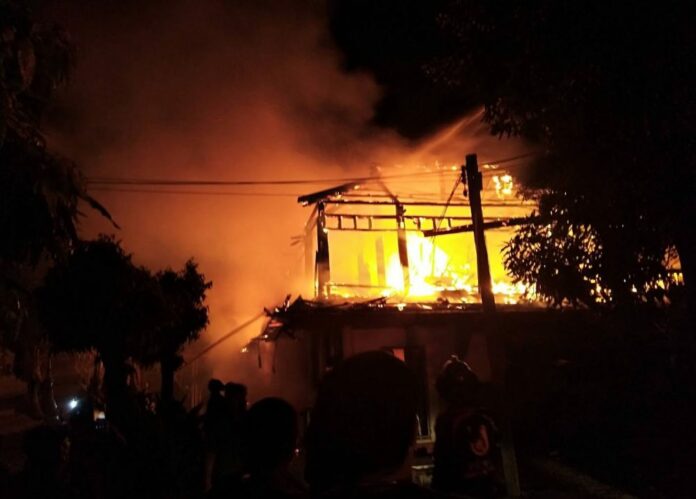
Photo: JS100 / Facebook

BANGKOK — A fire broke out late last night in a temple in the capital’s southwest, leaving several of its monks injured.

Firefighters managed to douse the flames at Wat Bang Khun Thian Nok in Soi Chom Thong 19 after the fire broke out just before midnight in the temple’s two-story monk’s quarters.

Although the blaze was extinguished within 20 minutes, much of the concrete and wood structure was destroyed. An 80-year-old monk was injured while others sustained burns.

As is often the case, faulty wiring is believed to be the cause.

Advertisement

Hot News

LATEST NEWS

Bangkok
overcast clouds
28.8 ° C
28.8 °
28.8 °
83 %
3.2kmh
100 %
Fri
29 °
Sat
37 °
Sun
36 °
Mon
36 °
Tue
33 °