30.5 C
Bangkok
Thursday, June 25, 2026
Home Blog Page 1699

Politico Wants Prayuth Disqualified From Election Race

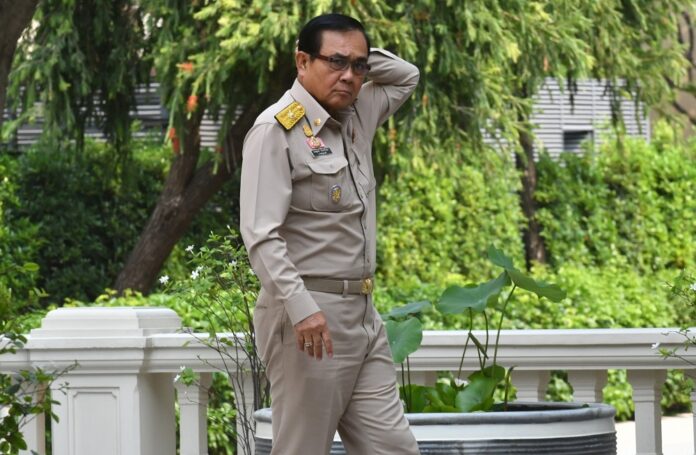
Junta chairman Prayuth Chan-ocha seen Monday at Government House.

BANGKOK — An opposition politician on Monday sought to bar junta chairman Prayuth Chan-ocha from running in the March 24 election.

In what appears to be a tit for tat legal maneuver, Thai Raksa Chart Party member Ruangkrai Leekijwattana filed a complaint to the Election Commission, arguing that Gen. Prayuth should be disqualified for breaching a constitutional clause.

Section 98 of the Thai constitution bans media agency owners from running for office. Ruangkrai’s petition said Prayuth is ineligible because as a prime minister he has a number of state media at his command.

Ruangkrai’s complaint was filed the same day the Election Commission was reportedly meeting to discuss whether his party should be disbanded for violating election laws.

The party is in hot water for nominating Princess Ubolratana Mahidol as its prime minister candidate Friday, only for His Majesty the King to block the move, saying that royal family members cannot seek office.

Advertisement

Police Seek Perpetrators of Fake Junta Order Removing Army Chief

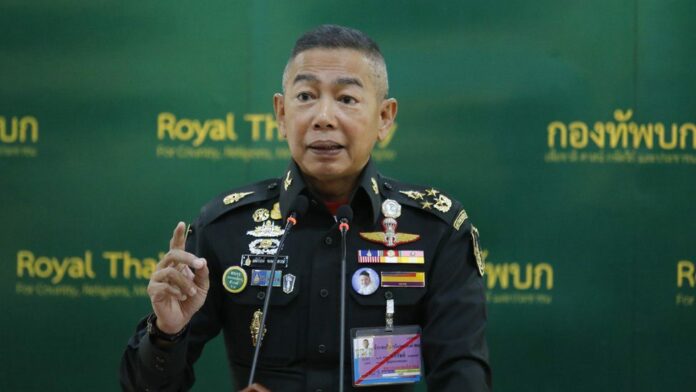
Apirat Kongsompong
Apirat Kongsompong

BANGKOK — Police were looking Monday morning for whoever was behind a forged Royal Gazette announcement that Army Chief Gen. Apirat Kongsompong and other armed forces leaders had been removed by the junta leader.

Apirat, who is also junta secretary, ordered its legal team to file a police complaint and bring the perpetrator to justice.

He also ordered that a “war room” be set up to monitor the situation and prevent people from panicking after rumors of a coup that spread Sunday night following the short-lived prime ministerial candidacy of former princess Ubolratana Mahidol, daughter of the late King Bhumibol.

The announcement of her nomination – which briefly turned Thai politics upside-down – ended 14 hours later when King Vajiralongkorn issued a royal command deeming it inappropriate and unconstitutional.

#Coup was topping Twitter hashtags in Thailand shortly before 9am today with more than 1,280,000 tweets.

Advertisement

Driver Miraculously Escapes Flipped, Flaming Car

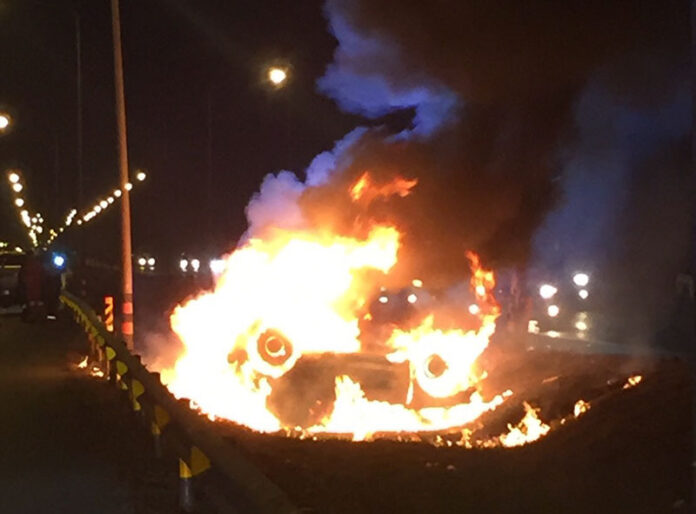
BANGKOK — A car burst into flames late Sunday night in the capital’s northwest after the driver fell asleep and crashed.

Police Lt. Col. Suthee Thansakul and firemen arrived at Soi Suwinthawong 34 in Minburi district to find a burning, flipped car. It took firefighters 20 minutes to extinguish the flames.

Driver Noppadol Bosuwan, 58, was miraculously unhurt, sustaining only a few scrapes on his body. He said he fell asleep and crashed into a utility pole. Sparks from the pole then ignited his car, which ran on gas.

Thailand’s notorious road safety record is plagued with cases of flaming car accidents.

S 38486053 S 38486056

Related stories:

Mahidol Prof Dies After Being Pulled From Flaming Wreck

Taxi Goes Up in Flames Outside CentralWorld

Teen Crashes Mustang Into Family, Crawls From Flaming Wreck

Short Blamed For Flaming Chinese NGV Bus at Ekkamai

Flaming Truck Circles Roundabout, Driver Unhurt

Advertisement

Cop Busted Breaking Into Car, Stealing – At Police HQ

Capt. Ekkachai Pengjan, left, stands Sunday next to an investigator by a car he was accused of breaking into at the police headquarters in Bangkok.

BANGKOK — A security police officer was caught red-handed breaking into another officer’s car and stealing properties of the Royal Thai Police headquarters in Bangkok, police said Sunday.

Capt. Ekkachai Pengjan of the Special Branch Police – tasked with intelligence gathering – was charged with theft and expelled Saturday after the car owner caught him in the act at the parking lot early that morning, at which point the car’s windows were already broken, a police spokesman said.

Col. Kritsana Pattanacharoen said Ekkachai initially confessed to stealing shoes, a spare tire and an amulet from the car he was breaking into. After his car was searched, Ekkachai also confessed to having stolen PCs, internet routers, a computer mainboard and tape cassettes from the office building.

“The Commissioner found it unacceptable and definitely won’t support a person who commited a crime inside the police headquarters with no respect for the laws and honor of the police,” Kritsana said.

He added that Gen. Chakthip Chaijinda had ordered investigators to seek maximum penalties for Ekkachai.

Correction: A previous version of this article mistakenly said Capt. Ekkachai was arrested Sunday. In fact, he was arrested Saturday.

Advertisement

Fatboy Slim, DJ Tiesto, Steve Aoki to Lead S2O Songkran Fest

BANGKOK — A UK dance music icon will headline at a giant Songkran music festival this year.

English DJ and producer Norman Quentin Cook, or Fatboy Slim, will perform on the first day of the three-day S2O Songkran Music Festival 2019 along with other lineups confirmed last week.

The 55-year-old musician was a pioneer of the big beat movement in the 1990s. Some of his best tracks are “The Rockafeller Skank,” “Praise You” and “Right Here, Right Now.”

Others who will perform at the festival are Dutch DJ-record producer Tiesto and American electronic house DJ Steve Aoki. Others to join the stage will be German house producer Robin Schulz, Brazilian duo Cat Dealers and Aussie DJ Throttle.

The annual S2O Songkran Music Festival runs from April 13 through April 15 at Live Park Rama 9, located on Rama IX Road.  Tickets for one day are 2,000 baht and available online.

Advertisement

Election Commission Meets to Discuss Disbanding Pro-Thaksin Party

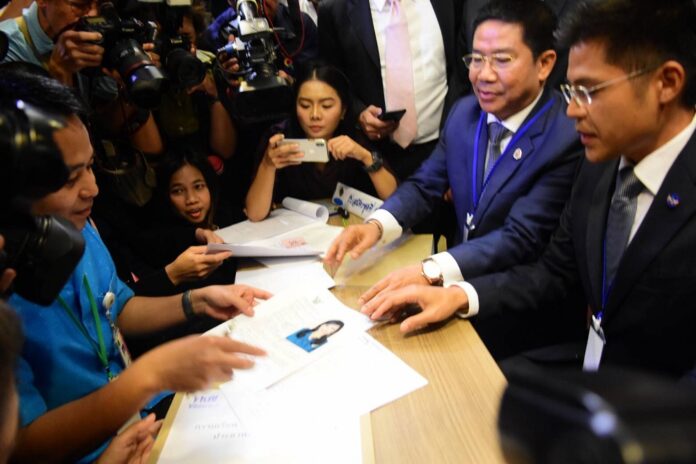
Thai Raksa Chart Party leaders nominate Princess Ubolratana as their prime minister candidate on Friday.

BANGKOK — The fate of a political party allied to former leader Thaksin Shinawatra hangs in the balance as officials were meeting Monday to decide whether the party should be disbanded.

In a legal backlash against the Thai Raksa Chart Party for nominating Princess Ubolratana to run in the upcoming election – an action blocked Friday night by His Majesty the King – the Election Commission is now investigating it for breaking a voting law which bans drawing the monarchy into politics, unnamed sources told the media.

If the party is found to be in violation, the commission will send the case to the Constitutional Court, which has the authority to disband guilty parties. Such disbandment would also impose a five-year political activity ban on the party’s executives.

Read: King Says Princess ‘Cannot’ Run for Office

It is unclear when the commissioners will reach their conclusion.

The party stunned the country by nominating the 67-year-old royalty as its prime minister candidate on Friday morning. Ubolratana later posted on Instagram that she’s running in the poll as a commoner, having relinquished her royal status in 1972 to marry an American man.

But His Majesty the King issued a royal decree later that day identifying Ubolratana as a royal family member. For its rationale, the decree stated that Ubolratana continued to live and work as a revered member of the Chakri dynasty after her resignation.

King Vajilralongkorn’s statement immediately sparked legal and political repercussions against Thai Raksa Chart, with many pro-establishment figures clamoring for its dissolution.

“If they used the surname Shinawatra [for campaigning] … they are free to do so,” former Senator Kaewsan Atibodhi wrote online Sunday. “But this is an exploitation of the monarchy’s influence. This is where they are wrong: for daring to immorally abuse the monarchy’s influence to seek their own power.”

Even transparency campaigner Srisuwan Janya, who has made himself a public enemy of the ruling junta for the past years, urged the Election Commission to disband Thai Raksa Chart for nominating the princess to the premiership.

One of Thai Raksa Chart executives also resigned from the party leadership on Monday. Speaking to reporters, Rungruang Pittiyasiri said he disagreed with his former party’s nomination of Princess Ubolratana.

Thai Raksa Chart executives on Saturday issued a statement accepting the king’s decision but would not comment any further. All party canvassing activities were cancelled in the wake of King Vajiralongkorn’s decree.

If disbanded, the pro-Thaksin faction would lose more than 200 MP candidates fielded by Thai Raksa Chart.

Advertisement

Asian Stocks Mixed Ahead of Next Round of US-China Talks

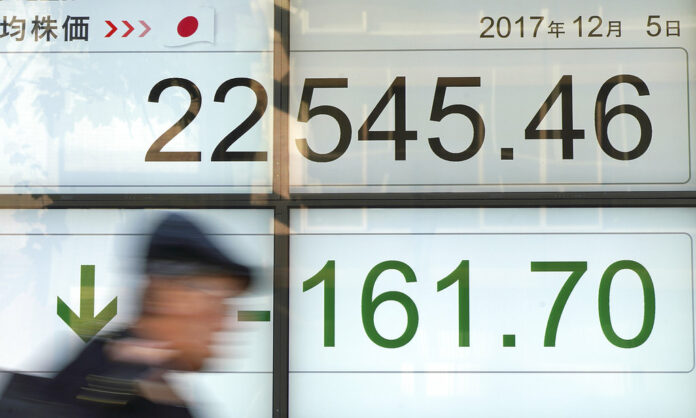
A man walks past an electronic stock board showing Japan's Nikkei 225 index at a securities firm in Tokyo on Dec. 5, 2017. Photo: Eugene Hoshiko / Associated Press

SINGAPORE — Asian stocks were mixed on Monday as traders watched for developments on a fresh round of trade talks with the United States this week in Beijing. Markets in China and Taiwan, reopening after a weeklong Lunar New Year break, edged higher on hopes that American and Chinese officials will make progress on a wide-ranging dispute that has weighed on the global economy.


Keeping Score

Thailand’s SET was down 0.8 percent, trading at 1,639.07 on Monday morning. The Shanghai Composite index picked up 0.4 percent to 2,628.50. The Kospi in South Korea declined 0.1 percent to 2,175.04 while Hong Kong’s Hang Seng rose 0.2 percent to 27,991.49. Australia’s S&P ASX 200 was down 0.5 percent at 6,040.00. Stocks rose in Taiwan but fell in Singapore and Indonesia. Japanese markets were closed for a holiday.


Wall Street

Gains by technology and consumer goods companies led most U.S. indexes higher on Friday. They more than balanced out losses by financial stocks and retailers after a mixed bag of quarterly earnings. The broad S&P 500 index climbed 0.1 percent to 2,707.88 and the Nasdaq composite rose 0.1 percent to 7,298.20. The Dow Jones Industrial Average lost 0.3 percent to 25,106.33. The Russell 2000 index of smaller company stocks advanced 0.1 percent to 1,506.39.


US-China Talks

Officials from the U.S. and China will gather in Beijing for trade talks on Thursday and Friday. U.S. Treasury Secretary Stephen Mnuchin and trade representative Robert Lighthizer will lead the American delegation at the talks, which are aimed at bringing both sides closer to resolving deep-seated issues such as unhappiness over Beijing’s technology policy. Lower-level negotiations are set to begin Monday, but a resolution isn’t expected before a truce on tariffs expires in early March. Any agreement before then, or a simple extension of the truce, will be viewed as a positive for markets. If not, the U.S. is expected to raise import taxes from 10 percent to 25 percent on USD$200 billion in Chinese goods.


Analyst’s Take

“For markets, after the worst December and best January in years, it appears that we are back at inflection point across various asset classes, waiting for direction yet again,” Jingyi Pan of IG said in a market commentary.


Energy

U.S. crude lost 56 cents to $52.16 per barrel in electronic trading on the New York Mercantile Exchange. It gained 8 cents to settle at $52.72 per barrel in New York. Brent crude, used to price international oils, shed 46 cents to $61.64 per barrel. It added 47 cents to close at $62.10 per barrel in London.


Currencies

The dollar rose to 109.89 yen from 109.73 yen late Friday. The euro was flat at $1.1324.

Story: Annabelle Liang

Advertisement

Thai Election for Dummies: How, When, Where to Cast Your Vote

The time has come. Thailand will vote next month in the first election since the junta seized the power five years ago.

Apart from having dozens of new parties competing in the long-awaited polls to decide the country’s future, notable changes have been made in the new electoral system under the current junta-written constitution.

For example, voters will have only one ballot to cast for their preferred candidate in a district, unlike previous polls where voters were given a second for the party-list slate of MPs.

Read: Thai Election for Dummies: Guide to the Parties

Here is a guide we hope is useful for eligible voters, many of whom will be casting ballots for the first time.

Who’s Eligible?

  • Those 18 and up on Election Day. Meaning they must have been born on or before March 24, 2001.
  • Those holding Thai nationality for at least five years.
  • No monks, novices, incarcerated felons, people with mental disorders or others whose right of suffrage has been revoked are eligible.

Before You Vote

  • Find out where your polling station is in advance. The Election Commission will mail information about voters’ polling stations not more than 20 days prior the election to their registered homes. Names and polling places can also be checked on the official site www.khonthai.com
  • Voters wishing to vote outside their registered home district have until midnight on Feb. 19 to register online for early voting at https://election.bora.dopa.go.th/ectoutvote. They will be able to vote at their new polling place 8am to 5pm on March 17.
  • Voters living or traveling abroad on Election Day also have until midnight on Feb. 19 to register for advanced voting at https://election.bora.dopa.go.th/ectabroad. Early voting date will take place March 4 to March 16 depending on where they are located. Information about how to vote and the schedule are available online.

For example, eligible voters in California can register at the Thai consulate in Los Angeles, then wait for a ballot to arrive at their home address. They must then follow the instructions included with the ballot before sending it back by mail to the indicated address for arrival by March 15.

Election Day

  • Be on time. Polling stations will open 8am to 5pm on March 24 – extended two hours from previous years.
  • Eligible voters must bring their national ID. Expired IDs will also be accepted. If voters don’t have an ID card, they can provide other official government-issued documents that shows their 13-digit Thai citizen number (e.g. driver’s license, public servant card or passport).

Rules

  • Alcohol sales will be banned nationwide from 6pm on March 16 until 6pm March 17 (early voting date), then again from 6pm on March 23 until 6pm on Election Day. Drinking alcohol will not be forbidden.
  • Taking photos of marked ballots will be forbidden.

Related stories:

Thai Election for Dummies: Find Your Polling Place, Candidates – Right Now

Thai Election for Dummies: Guide to the Parties

Viral Video Uses Pooches to Explain Dog-Eat-Dog Thai Elections

It’s Official! Thai Voters Will Go to Polls on March 24

Advertisement

Opinion: A Sad, Shocking Week That Tested Football’s Heart

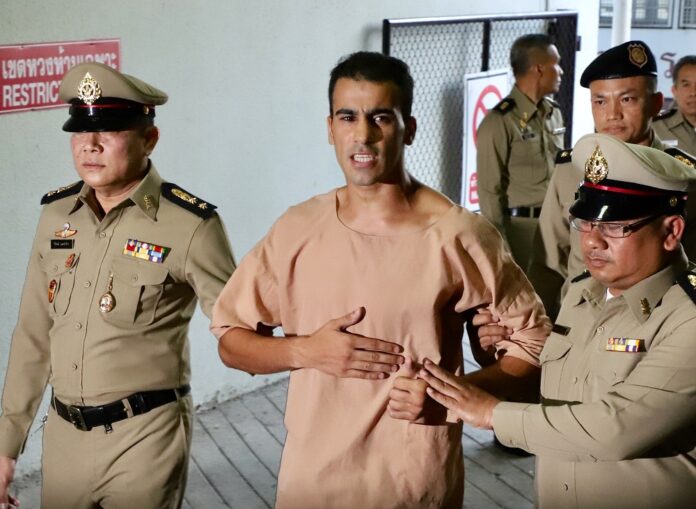
Hakeem Ali Mohamed Ali AlAraibi, shackled at his feet, arrives at a court in Bangkok on Feb. 4, 2018.

PARIS — It was a week of sad and shocking images for football.

From the murky depths of the cold sea that separates France and England came a chilling photograph, shot remotely, of the crumpled plane that crashed Jan. 21 as it was flying Emiliano Sala to a new career in the English Premier League, killing the Argentine forward and pilot David Ibbotson.

And on the other side of the world, in Thailand, TV cameras were on hand to film the pained, shuffling gait of imprisoned refugee footballer Hakeem al-Araibi in leg irons and bare feet, as he fought efforts in court to extradite him to Bahrain. The defender who was granted safe haven in Australia after fleeing a 10-year prison sentence in Bahrain in 2014 is terrified that he’ll be tortured if returned to the kingdom with a well-documented history of abuses.

Piling on the pain in football’s already tough week was a fire that torched the sleeping quarters of a football academy in Brazil on Friday, killing 10 people and injuring three.

In both the untimely death of 28-year-old Sala and al-Araibi’s battle for freedom, there have been emotional and impactful responses from football, heartening demonstrations of soul and decency from the world’s most popular sport, often so fixated by money. In mourning for Sala and campaigning for al-Araibi, there also have been signs that football and footballers are learning to leverage their power and reach for causes other than themselves, flashes of social conscience that should be nourished.

Had Sala not been a footballer, his body may never have been found. But fellow players, coaches and thousands of others poured donations into a campaign by his family to fund the search that located the wrecked light aircraft in the English Channel.

This weekend, Sala will be honored with a minute of applause at all matches in the top two leagues in France, where his play had caught the eye of Cardiff City, the Premier League club now mourning its new recruit. Nantes, which sold him, says it plans to retire his No. 9 jersey in memory of his 3½ seasons with the French club.

But as footballers and fans say goodbye to Sala, knowing that their generosity and support helped offer closure to his grieving family, they have everything still to do for al-Araibi.

Detained Nov. 27 at the start of what was meant to be a honeymoon in Thailand, the former Bahrain national team player is wanted back in the kingdom for an arson attack on a police station in 2012 for which he was sentenced in absentia.

Campaigners believe the case was bogus and have unearthed footage they say supports his claim that he was playing in a televised match at the time. They doubt Bahrain’s statements that he would be fairly treated if returned. That is partly because al-Araibi says he was tortured in custody before he fled Bahrain, telling The New York Times in 2016 that an officer “beat my legs really hard, saying: ‘You will not play football again. We will destroy your future.'”

Sounds familiar: Even a Bahrain government-ordered investigation reported deaths from torture in 2011 and said detainees were electrocuted, beaten on the soles of their feet, otherwise abused and reported being squeezed into tiny cells, sexually assaulted and other horrors.

Again, had 25-year-old al-Araibi not been a footballer, his plight likely wouldn’t have evoked much of a reaction beyond the human rights groups whose days are filled with such cases. There was no global reaction for previous renditions from Thailand of refugees and asylum-seekers to countries where campaigners said they risked ill-treatment. There was no equivalent of the #SaveHakeem campaign now catching on online when, for example, Thailand turned over a planeload of asylum-seekers to China in 2015, flown back with their heads covered in black hoods and flanked by masked Chinese security agents.

So kudos to the star players, the likes of Leicester City striker Jamie Vardy and Juventus defender Giorgio Chiellini who have spoken up this time, with tweets. That may not seem like much, but it is a start, better than nothing and makes one realize how the industry could, if everyone in it pulled their weight, do so much more to sway public opinion behind virtuous causes. The majority of other players who have so far stayed silent on al-Araibi need to ask themselves why. Are they really that shallow, muzzled or uncaring?

Also bravo to Pascoe Vale FC, the club al-Araibi plays for in Melbourne, for its classy announcement this week that it has signed him up for a new season. Most of all, hats off to Craig Foster, the retired Australia and Crystal Palace midfielder who is spearheading lobbying for al-Araibi’s release.

And what of FIFA? Well, although it remains hard to forget and forgive the many years when football’s governing body was synonymous for corruption, thievery and turning a blind eye, FIFA’s lobbying for al-Araibi deserves encouragement, because it suggests that the organization long so impervious to doing the decent thing is genuinely trying to change and that its human rights commitments since the 2015 ouster of Sepp Blatter as FIFA president aren’t simply window-dressing.

letter to the Thai prime minister from FIFA Secretary General Fatma Samoura laid out that al-Araibi should never, as a refugee, have been detained and urged his release. Federico Addiechi, a good-governance officer at FIFA who is in regular contact with human rights campaigners, also traveled this week from Switzerland to Thailand and back just for al-Araibi’s hearing and, FIFA says, for meetings related to the case.

That isn’t enough for critics who want Gianni Infantino, Blatter’s successor as FIFA president whose silence on al-Araibi grows deafening, to speak out and for FIFA to consider ways to sanction Thailand and Bahrain. But, to be fair, what FIFA has said and done so far is surely more than it would have done in the past, and about a mess caused not by FIFA, but by authorities in Thailand, Bahrain and Australia.

The ultimate gauge will be if al-Araibi is released.

If not, then all of football, from FIFA down to the players, will have to answer the same question: Did we do everything we could?

Story: John Leicester

Advertisement

Trump-Kim Summit to Focus on NKorea Nuke Complex, US Rewards

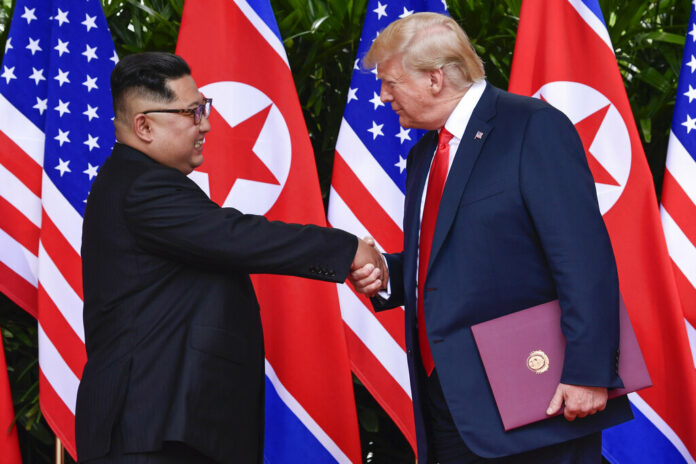
North Korea leader Kim Jong Un, left, and U.S. President Donald Trump shake hands at the conclusion of their meetings in June at the Capella resort on Sentosa Island in Singapore. Photo: Susan Walsh / Associated Press

SEOUL, South Korea — When President Donald Trump and North Korean leader Kim Jong Un first met in Singapore last year, there was pomp, there was circumstance, but there wasn’t much substance.

Before they meet again in Vietnam on Feb. 27-28, there’s growing pressure that they forge a deal that puts them closer to ending the North Korean nuclear weapons threat.

But what could that look like?

Kim may be willing to dismantle his main nuclear complex. The U.S. may be willing to cough up concessions, maybe remove some sanctions. The question, however, is whether what’s on offer will be enough for the other side.

Here’s a look at what each side could be looking for as Trump and Kim try to settle a problem that has bedeviled generations of policymakers.


Destroying a Nuke Complex

The North’s Yongbyon (sometimes spelled Nyongbyon) nuclear complex, located about 100 kilometers (60 miles) north of Pyongyang, has facilities that produce both plutonium and uranium, two key ingredients in nuclear weapons. North Korea’s state media have called the complex of a reported 390 buildings “the heart of our nuclear program.”

After a September meeting with Kim, South Korean President Moon Jae-in told reporters that Kim promised to dismantle the complex if the United States takes unspecified corresponding steps. Stephen Biegun, the U.S. special representative for North Korea, recently said that Kim also committed to the dismantlement and destruction of North Korea’s plutonium and uranium enrichment facilities when he met visiting Secretary of State Mike Pompeo last October.

Since fresh diplomatic efforts began last year, the North has suspended nuclear and missile tests and dismantled its nuclear testing site and parts of its long-range rocket launch facility. But destroying the Yonbgyon complex would be Kim’s biggest disarmament step yet and would signal his resolve to move forward in negotiations with Trump.

There is worry among some, however, that the complex’s destruction won’t completely dispel widespread skepticism about North Korea denuclearization commitments. It would still have an estimated arsenal of as many as 70 nuclear weapons and more than 1,000 ballistic missiles. North Korea is also believed to be running multiple undisclosed uranium-enrichment facilities.

“We could call (Yongbyon’s destruction) a half-deal or a small-deal,” said Nam Sung-wook, a professor at Korea University and a former president of the Institute for National Security Strategy, a think tank affiliated with South Korea’s main spy agency. “It’s really an incomplete denuclearization step” that matches past tactics meant to slow disarmament steps so it can win a series of concessions.


US Rewards

To get the North to commit to destroying the Yongbyon complex, some experts say Trump needs to make important concessions.

Those would likely need to include jointly declaring an end of the 1950-53 Korean War, opening a liaison office in Pyongyang, allowing North Korea to restart some economic projects with South Korea and possibly easing some sanctions on the North.

Kim may most want sanctions relief to revive his country’s dilapidated economy and bolster his family’s dynastic rule.

“For North Korea, abandoning the Yongbyon complex is a fairly big (negotiating) card … so the North will likely try to win some economic benefits,” said Chon Hyun-joon, president of the Institute of Northeast Asia Peace Cooperation Studies in South Korea.

At the Singapore summit, Kim and Trump agreed to establish new relations between their countries and build a lasting peace on the Korean Peninsula. But they didn’t elaborate on how to pursue those goals.

North Korea has since complained about the lack of action by the United States, saying it already took disarmament steps, and returned American detainees and the remains of American war dead. The U.S. for its part suspended some of its military drills with South Korea, a concession to North Korea, which calls the exercises dress rehearsal for invasion.

Kim and Moon agreed at the first of their three summits in 2018 to settle an end-of-war declaration. Moon said last month it could ease mutual hostility between Washington and Pyongyang, and accelerate North Korea’s denuclearization.

But some worry that a declaration ending the Korean War, which was stopped by an armistice and has yet to be replaced with a peace treaty, might provide North Korea with a stronger basis to call for the withdrawal of 28,500 U.S. troops in South Korea.

In his New Year’s address, Kim also said he was ready to resume operations at a jointly run factory park in the North Korean border town of Kaesong and restart South Korean tours to the North’s Diamond Mountain resort. Those are two of the now-dormant inter-Korean projects that supplied badly needed foreign currency for the impoverished North.


A Breakthrough

To make the Vietnam summit a blockbuster, Trump will likely need more than Yongbyon.

A bigger deal would see a detailed accounting of North Korea’s nuclear assets, and possibly shipping some North Korean nuclear bombs or long-range missiles out of the country for disabling.

That would be costly. North Korea would likely demand a drastic easing of sanctions and a resumption of exports of coal and other mineral resources.

A North Korean declaration of its nuclear program would provide invaluable information, if verified by U.S. intelligence, to Washington and others. It would offer looks at hidden nuclear fuel facilities and missile deployments, which is why Pyongyang has been reluctant to provide it.

According to South Korean and other assessments, Yongbyon alone is estimated to have 50 kilograms (110 pounds) of weaponized plutonium, enough for six to 10 bombs, and a highly enriched uranium inventory of 250 to 500 kilograms (550 to 1,100 pounds), sufficient for 25 to 30 nuclear devices.

Undisclosed uranium enrichment facilities would up the stockpile.

Because of the difficulty involved, Trump may want to focus on the North’s long-range missiles, which could, when perfected, pose a direct threat to the U.S. mainland. But such a partial deal would rattle many in South Korea and Japan, which are well within striking distance of North Korea’s short- and medium-range missiles.

If lower level officials can’t lay the ground for a bigger deal ahead of the summit, the Kim-Trump meeting could be cancelled, said Lim Eul Chul, a professor at South Korea’s Kyungnam University who has advised the Moon government on North Korea-related policies.

Story: Hyung-jin Kim

Advertisement

Hot News

LATEST NEWS

Bangkok
overcast clouds
30.5 ° C
30.5 °
30.5 °
78 %
6.6kmh
87 %
Thu
31 °
Fri
37 °
Sat
36 °
Sun
37 °
Mon
37 °