




























30 C
Bangkok
Tuesday, July 7, 2026
Home Blog Page 1723

Hong Kong Makes Record Seizure of Pangolin Scales, Ivory

A customs official displays one of 136 seized illegal pangolins at a 2017 news conference at the Customs Department headquarters in Bangkok. Photo: Sakchai Lalit / Associated Press

HONG KONG — Hong Kong customs officers have intercepted a record 8.3 tons of pangolin scales and hundreds of elephant tusks worth more than USD$8 million combined, underscoring the threat to endangered species from demand in Asia.

Acting on a tip from mainland Chinese authorities, local officials found the haul in mid-January in a refrigerated container labeled as frozen meat from Nigeria, officials said Friday.

They said the smugglers kept the temperature low to better disguise the smell of the illicit cargo. Police arrested two people in connection with the seizure.

It was the largest-ever seizure of pangolin scales in Hong Kong, representing the product of some 14,000 animals, and one of the largest of ivory in a decade, the officials said.

Scales of the anteater-like pangolin have for centuries been highly valued in traditional Chinese medicine. The scales, made of keratin akin to fingernails, are often roasted and ground to a powder before being added into a mix of ingredients to purportedly cure arthritis, promote breast feeding for mothers and boost male virility.

Scientists have designated all species of pangolins as being at risk of extinction. In the last two decades, the number of pangolins worldwide has dropped by about 90 percent.

Ivory tusks are a cherished decorative craft material in Asia, resulting in the devastation of wild elephant populations in Africa.

Under Hong Kong law, the importation and sales of endangered species and their products can be punished by up to 10 years in prison and a fine of $1.3 million.

China and Hong Kong have sought to crack down on the illegal trade, although the semiautonomous port and financial center remains a major transit point for endangered species products and other contraband.

Last year, following the outlawing of ivory sales in mainland China, Hong Kong’s legislature enacted a complete ban on the local ivory trade to take effect by 2021, while raising penalties for offenders.

Meanwhile, a court in Thailand this week dismissed charges against a Thai man believed to be a kingpin in the illicit trade, according to Freeland, an organization that works with police to combat trafficking.

Police arrested Boonchai Bach just over a year ago at Bangkok’s Suvarnabhumi airport for his alleged involvement in the smuggling of 11 kilograms (24.2 pounds) of rhino horns from Africa worth $700,000. A Chinese man and a Thai wildlife quarantine officer accused of assisting the smugglers were also arrested.

Citing a lack of evidence, the Samut Prakan Provincial Court found Boonchai Bach not guilty of multiple charges relating to wildlife trafficking, Freeland said.

Boonchai was suspected of running a large trafficking network on the Thai-Lao border that spread into Vietnam. According to Freeland, he and his family played a key role in a criminal syndicate that smuggled items including ivory, rhino horn, pangolins, tigers, lions and other rare and endangered species.

“Prosecution of a complex transnational organized crime case like this requires a multi-agency effort to bring all the pieces of the puzzle together,” said Steven Galster, founder of Freeland. “Instead, we saw a kingpin walk free after a narrowly focused case fell apart when the prosecution’s only major witness flipped in front of his boss.”

Story: Violet Law

Advertisement

Yastremska Beats Muguruza to Reach Thailand Open Semifinals

Ukraine's Dayana Yastremska plays Friday at the WTA Thailand Open in Hua Hin. Image: WTA / YouTube

HUA HIN, Thailand — Ukrainian teenager Dayana Yastremska advanced to the semifinals at the Thailand Open by beating two-time major champion Garbine Muguruza 7-6 (5), 6-1 Friday.

The 18-year-old Yastremska also beat Muguruza last year in Luxembourg.

“I forgot about what happened last year as this is a different match,” Yastremska said. “I watched highlights (of Muguruza’s matches) to see how she played. Although I’m confident, but it was last year. I had to concentrate.”

In the tiebreaker, Yastremska jumped out to a 6-1 lead but struggled to finally win the first set. After Muguruza netted a forehand on the deciding point, the Spaniard smashed her racket on the court and received a code violation from the chair umpire.

Yastremska will next play Magda Linette of Poland, who defeated Wang Yafan 6-2, 6-3.

Also, sixth-seeded Ajla Tomljanovic of Australia beat fourth-seeded Saisai Zheng of China 6-1, 6-3 to reach the semifinals. She will next face Tamara Zidansek of Slovenia, who defeated Victorija Golubic of Switzerland 4-6, 6-1, 6-2.

Advertisement

Belarusian Model: I Gave Info on Trump to Russian Tycoon

Image: Nastya Rybka / Instagram

MOSCOW — A Belarusian model who claims to have information on ties between Russia and Donald Trump’s election campaign told The Associated Press on Friday that she has turned that material over to Russian billionaire businessman Oleg Deripaska.

Anastasia Vashukevich fueled speculation around possible ties between Trump and the Kremlin last year when she posted a video from a police van, saying she had 16 hours of audio and video proving ties between Russian officials and the Trump campaign that influenced the 2016 U.S. elections.

Deripaska denied the allegations and even went to court to seek to remove the video Vashukevich posted in which he discusses U.S.-Russia ties with a senior Russian government official.

Vashukevich, who is also known as Nastya Rybka, returned to Russia last month almost a year after she was detained in Thailand on charges of soliciting sex, in what some believe was an attempt to silence her.

Vashukevich, 28, told the AP in an interview Friday that, contrary to earlier reports that she had destroyed the recordings, she had given them to Deripaska because it “relates to him” and that she “did not want any more trouble.”

Vashukevich rose to prominence in February last year when Russian opposition politician Alexei Navalny published an investigation detailing dealings between Deripaska and Sergei Prikhodko, then-Russian deputy prime minister who played a prominent role in shaping Russia’s foreign policy.

Navalny drew on Vashukevich’s video from summer 2016 when Deripaska was hosting Prikhodko on his yacht and was caught on tape saying that relations between Russia and the U.S. were bad because of then-Assistant Secretary of State Victoria Nuland.

Deripaska is close to Putin and also had a working relationship with Paul Manafort, Trump’s former campaign manager. Manafort was investigated by special counsel Robert Mueller as part of the probe into the 2016 election and was convicted last year of tax and bank fraud.

Deripaska’s representative at the time dismissed the reports as “scandalous and mendacious assumptions.” He promptly filed and won a lawsuit against Vashukevich for breach of privacy and secured a court ruling to delete the videos of him and Prikhodko.

Vashukevich and her teacher, self-styled sex guru Alexander Kirillov, were in Thailand shortly after Navalny’s investigation came out, conducting a sex training seminar when they were arrested for working without a permit. Vashukevich, Kirillov and several others ended up being charged with soliciting sex and spent 11 months in jail.

In January, Vashukevich and others were sentenced by the court in Pattaya to three-year prison terms before a new ruling gave them suspended 18-month prison terms and deported them to Russia.

In the early stages of their detention, the sex training group sent a note to the U.S. Embassy via an intermediary seeking help and political asylum. Vashukevich indicated she would turn over the recordings she claimed to have if the U.S. could help secure her release, but later withdrew the offer, suggesting that she and Deripaska had reached an agreement.

Vashukevich and Kirillov initially blamed Russia for their incarceration and said they were fearful for their lives. In April, however, Vashukevich changed her tune and said it was the U.S. government that was persecuting her, not Russia.

Vashukevich later told reporters outside a Thai courtroom that she had promised Deripaska not to speak about the U.S. election interference anymore.

Vashukevich and Kirillov were briefly detained upon their arrival in Moscow late last month on suspicion of soliciting sex in Russia but were promptly released.

When pressed Friday by the AP about her previous claims, Vashukevich said she had emailed “everything I had” to Deripaska and dodged a question of whether she kept a copy for herself.

“Oleg (Deripaska) has it all. If he wants to make any of it public, if he thinks that it’s a good idea, he can do it himself,” she said.

A spokeswoman for Deripaska had no immediate comment Friday on Vashukevich’s new allegations.

The Belarusian native who penned two books about seducing rich, powerful men explained to the AP how she changed her mind about who was to blame for her plight in Thailand.

She said he received multiple visits from Americans with FBI IDs who were seeking information about her claims of Russian interference in the 2016 U.S. election. She said they offered her safety in the U.S. or threatened her with a lengthy prison term if she refused to cooperate.

Around the time when she first publicly supported Russia, Vashukevich received a visit from Vladimir Pronin, Russia’s newly appointed consul in Pattaya, who she said helped to improve prison conditions for her and the other inmates. She credited Pronin for securing her release from the Thai prison and her deportation in January.

Russian publications The Bell and Proyekt last year pointed to another high-profile visitor who Vashukevich caught on tape spending time with Deripaska.

One video posted on her YouTube account showed a meeting between Deripaska and Adam Waldman, a U.S. lobbyist who has been working for Deripaska and who has had repeated meetings with WikiLeaks founder Julian Assange. The reported January 2017 meeting was several days before Waldman’s visit to Assange at the Ecuadorian Embassy in London.

The Democratic National Committee last year sued Trump’s campaign, Russia and WikiLeaks, saying they conspired to cheat Democrats in the 2016 election.

When asked Friday if the reports proving the Russian interference in the U.S. elections included recordings of Waldman, Prikhodko and Deripaska, the Belarusian woman said: “I didn’t tell you that.”

Vashukevich has kept a low profile since her release, a stark contrast to the racy photos that she used to post on Instagram.

On Friday, she would not respond to a question on whether she was currently collaborating with Russian authorities. Her remarks, however, indicated that she may have traded her silence for security.

“Things are so good right now, I don’t want this to change,” she said. “I don’t want to have to have to compare the Russian prison to the Thai prison. I don’t want any more trouble.”

In her old Instagram posts, Vashukevich used to take pride in manipulating rich, powerful men.

Asked Friday if she was now the one being manipulated, she swore in English and asked “What do you do?”

Story: Nataliya Vasilyeva

Advertisement

13,300 Flights Loaded With Tourists Inbound to Bangkok for CNY

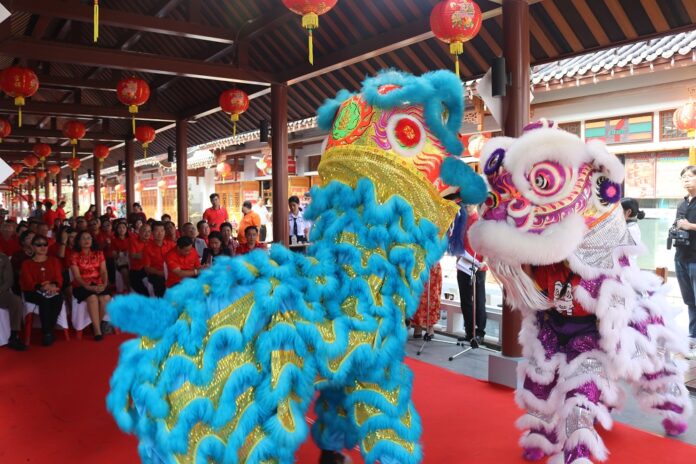
Lion dances are performed in Suphanburi province on Friday to welcome the Chinese New Year festival.

BANGKOK — Thailand is expected to receive a large influx of visitors for Chinese New Year, raising hope among officials that a rebound in mainland arrivals is underway.

Up to 325,000 Chinese travelers are projected to visit the kingdom to celebrate the Year of the Pig, according to a forecast published by Kasikorn Bank, while an aviation official said at least 13,330 flights will arrive at Bangkok’s two international airports.

Aeronautical Radio director Somnuk Rongthong said air traffic controllers have been put on full alert to monitor the airspace and clear up any delays during the holiday, which lasts Feb. 4 to 10.

Total flights arriving in Thailand will increase by 6.4 percent from the same period of time last year, Somnuk said.

The Airport Authority of Thailand said at least 10,000 Chinese tourists have been arriving daily via Suvarnabhumi Airport since late December. The agency expects an average of 200,000 arrivals per day from all nations during the Chinese New Year – known as the Golden Week in China.

Chinese arrivals took a major hit after a ferry sank in July 2018, killing more than 40 Chinese passengers. Numbers of Chinese visitors to Thailand did not recover until December, when arrivals rose by 2 percent over the year prior.

In a report published today, Kasikorn Bank’s research department said Thailand will welcome about 10.9 million Chinese tourists this year, though it added that the slowing Chinese economy and competition from other countries remain threats to the industry.

“It will be a challenge to maintain and sustain the growth rate,” the report said.

Advertisement

New Retiree Visa Rules Bewilder Thai Immigration: Source

A file photo of foreigners in Pattaya.

BANGKOK — Days after new rules changed how visas are processed for foreign retirees, immigration officials are already pushing back against them, according to sources inside the bureau.

Starting March 1, foreign retirees must either show a monthly income of at least 65,000 baht or hold a minimum of 800,000 baht in Thai banks. They must maintain that amount for three months after a visa or extension is granted, after which they can only take out half. The new rules also make unclear how long applicants must wait to learn whether their visas or extensions have been approved.

“We are discussing with the legal department what these new policies mean,” an immigration official involved in approving such applications said in an interview. “Right now we are all scrambling to find out what the procedures are.”

The source also said some operatives who oversee visa affairs will file memos to their commanders declaring that they are no longer sure how to process requests under the new regulations published Monday.

“We will ask them to reconsider,” said the official, who declined to give his name because he was not authorized to speak to the media.

Another official at the Immigration Bureau said the changes were ordered from the top after four embassies in Thailand – Britain, the United States, Denmark and Australia – stopped issuing affidavits certifying the monthly incomes of applicants from their respective countries.

“Therefore, the Immigration Bureau has to come up with its own methods of verifying the applicants’ financial status,” the source said on the same condition of anonymity.

Col. Nitipan Kanokvejyan, the officer who signed the new regulations, could not be reached for comment as of publication time.

Under the new rules, applicants for retirement visas must be 50 and up. They must either show evidence of monthly salaries of at least 65,000 baht transferred to a Thai bank account or balances of at least 800,000 baht in their Thai bank accounts.

The accounts have to bear the same names as the applicants. Spouses’ bank accounts are not eligible.

And the minimum amount of 800,000 baht must have been deposited two months before any visa application is filed, making that the mandatory balance for at least five months, plus application processing time.

The applicants (“aliens”) must continue to maintain at least 400,000 baht at all times, and the visa must be renewed yearly.

The change departed from previous rules which only required either an affidavits declaring a 65,000 baht salary or a one-time deposit of 800,000 baht at the time of application.

Reactions on Thaivisa, a webforum frequented by expats in Thailand, was overwhelmingly negative, with many commentators saying the regulations undercut claims from Thai officials that the deposit is to ensure they have sufficient resources to get by.

“Then why keep up the charade that this money is to cover living expenses if it can only be used six months out of the year,” user Connda wrote. “So…what’s next? What’s the next hammer to drop?”

“And I thought the 800,000 baht was for living expenses, not as an interest earner for the Thai banks!” user Madmitch vented.

Advertisement

‘Oust Me If You Dare, Jerks,’ Raging Prayuth Says (Video)

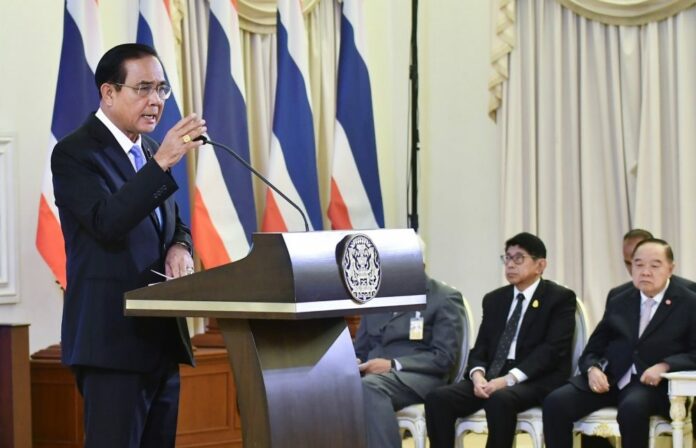
Junta chairman Prayuth Chan-ocha speaks Friday at the Government House in Bangkok.

Update: Prayuth apologized Friday afternoon for “the crude words” said this morning. “I must apologize, because sometimes I slip. I didn’t criticize everyone, but there are some bad people out there. I meant it for them. Sometimes I just get so angry.”

BANGKOK — Junta chairman Prayuth Chan-ocha tore into reporters in abrasive language Friday, reiterating that he would not step down ahead of March’s general election, saying “oust me if you dare, jerks.”

Gen. Prayuth had taken the dais following a briefing on junta accomplishments when he preempted any questions about whether he would resign with an angry rebuke. Making no effort to mask his anger and irritation, he said no democratic or communist leader had ever done so.

“Remember my words, in any country around this world, democratic or communist, no government leader has ever quit for an election. Barack Obama, the former US president … or Chinese President Xi Jinping, who has quit? Answer me!” he said.

He continued his unprovoked outburst by referring to the press as “meung,” a vulgar term of address.

“Don’t try so hard to chase people away. … This is what the law says. Oust me if you dare, jerks! Oust me if you can! I’m not challenging you, but I’m not quitting,” he went on, his temper flaring.

On Twitter, #OustMeIfYouDareJerks quickly leaped to become the No.1 top-trending hashtag as of Friday afternoon, with most comments expressing frustration with Prayuth’s history of coarse language that’s generally frowned upon in Thai discourse.

“His maturity is even lower than an elementary school student’s,” user @Yinglove_tigger wrote.

“Being stupid is bad enough. He’s both stupid and vulgar,” wrote @Otttpang.

Prayuth has come into criticism since he opted not to go into a caretaker role after elections were called, as the democratically elected leaders of the past have done. His decision was consistent with previous coup leaders who have refused to do so.

The retired general’s famously short fuse has led to repeated outbursts during speeches and press briefings since he seized power in 2014. His garrulous comments can veer off script into angry and personal rants. In recent years he has threatened to punch his critics in the mouth, yelled a fisherman asking him questions and “joked” about executing reporters. From time to time, he renews his vows to rein in his fury.

Here’s an unofficial translation of his comments today at the Government House:

“If you’re going to ask me again about the elections. You just can’t ask about anything else. I’d just say that the principles I have to consider on whether I’m going to resign from the premiership, have nothing to do with whether I’ll accept the nomination from a political party as a PM candidate.

“Remember my words, in any country around this world, democratic or communist, no government leader has ever quit for an election. Barack Obama, the former US president who also ran for a second term, or Chinese President Xi Jinping – who has quit? Answer me! Don’t write such nonsense thing again. This is about principle. Besides, the constitution, the rule of law, and traditions or ethics of elections worldwide, none of it says a PM candidate has to quit from an administrative position.

“Don’t try so hard to chase people away. You chase this one and they quit, and then you chase a prime minister away. This is what the law says. Oust me if you dare, jerks! Oust me if you can! I’m not challenging you, but I’m not quitting. The Democrats, Abhisit Vejjajiva lost the 2011 elections to Yingluck Shinawatra. Why did they lose? They were the government, why did they lose? It means that being the government shouldn’t give any significant advantages. It depends on whether they do a good job or not. If not, the people won’t vote for them.”

Related stories:

‘Tormented’ Prayuth Ready to Punch Critics In the Mouth

Prayuth Threatens to Silence Critics Amid Uptick in Detentions [Transcript]

Thai Junta Leader Unleashes Fury on Reporters [Transcript]

Advertisement

Request Made in Thai Court to Send Football Player to Bahrain

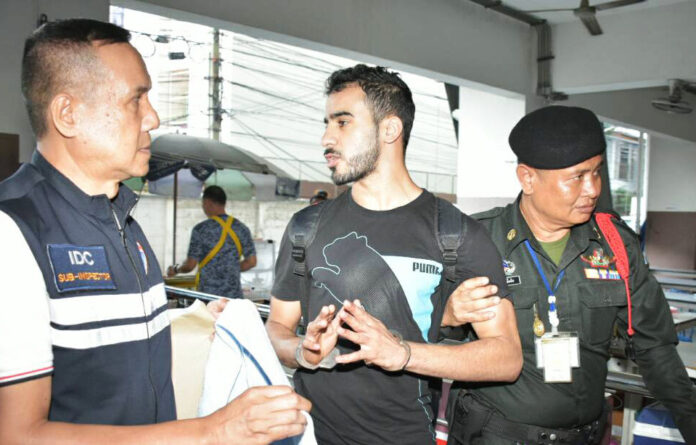
Hakeem Ali Mohamed Ali AlAraibi led in handcuffs at the Thai Criminal Court.
Hakeem Ali Mohamed Ali AlAraibi in December led in handcuffs at the Thai Criminal Court.

BANGKOK — Prosecutors have submitted a request in court for Thailand to extradite to Bahrain a detained football player who has refugee status in Australia.

The lawyer for Hakeem al-Araibi said she will file an appeal to the prosecutors’ request made in court in Bangkok on Friday.

Lawyer Nadthasiri Bergman said another court date is set for Monday when al-Araibi will be asked if he is willing to be extradited. Al-Araibi says he fled political repression there.

He had been living in Melbourne, Australia, and played for a semi-professional team. He was detained in Bangkok in November and a court ruled in December he could be held for 60 days.

Rights groups, soccer governing bodies and activists have pushed for Thailand to release al-Araibi so he can return to Australia.

Advertisement

Woman Enslaved by Japan’s Military Mourned Near Protest Site

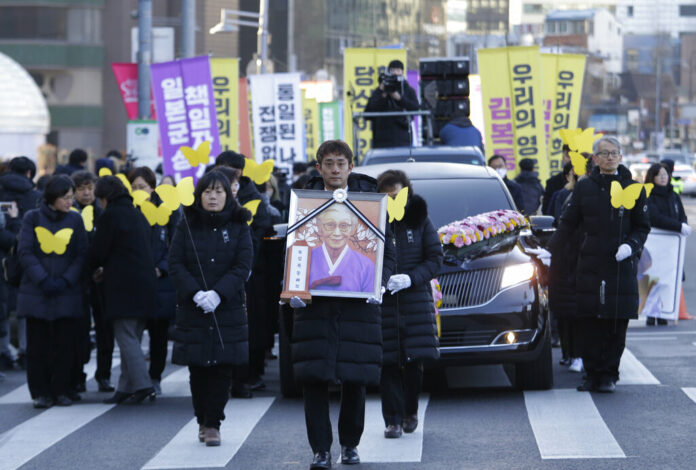
A mourner with a portrait of the deceased Kim Bok-dong, a former South Korean sex slave, marches toward the Japanese Embassy during her funeral ceremony Friday in Seoul, South Korea. Photo: Ahn Young-joon / Associated Press

SEOUL, South Korea — Hundreds of mourners gathered Friday near the Japanese Embassy in Seoul for the funeral of a South Korean woman forced as a girl into a brothel and sexually enslaved by the Japanese military in WWII.

The mourners, dressed mostly in black on a bitterly cold morning and holding paper cutouts of yellow butterflies, followed a hearse carrying Kim Bok-dong that stopped in front of a bronze statue of a girl representing the thousands of Asian women experts say the Japanese military forced into front-line brothels as it pursued colonial ambitions.

The scene near the embassy was the culmination of an hours-long march that wrapped up five days commemorating Kim, who had regularly led the rallies to demand that Japan more fully acknowledge the suffering of the so-called “comfort women,” the euphemism given to the women by the Japanese and embraced by some of the dwindling number of victims over the term “sex slave.”

Japanese leaders have repeatedly offered apologies or expressions of remorse, but many of the women and their supporters want reparations from Tokyo and a fuller apology. Of the 239 Korean women who have come forward as victims, only 23 are still alive.

Kim, who died at age 92 on Monday and had been suffering from cancer, had been a beloved leader of the protest movement, often sitting beside the bronze statue at weekly rallies that have been held since 1992 on a strip of sidewalk across from the embassy.

Her death has been met with grief around South Korea, with President Moon Jae-in crediting her relentless advocacy for giving South Koreans the “braveness to face the truth.”

As the limousine carrying Kim’s remains slowly rolled up to the statue Friday morning, mourners carried 94 vertical funeral banners that represented Kim’s age when counted in the traditional Korean manner and were marked with phrases thanking Kim and demanding Japanese reparations and remorse.

Many people cried during the march that started at City Hall and some shouted anti-Japan slogans such as “Japan formally apologize!” and “Japan provide formal compensation!”

Born in the South Korean town of Yangsan, Kim was dragged away from home at the age of 14 and forced to have sex with Japanese soldiers at military brothels in China, Hong Kong, Malaysia, Indonesia and Singapore from 1940 to 1945. She was one of the first victims to speak out in the early 1990s and break decades of silence over Japan’s wartime sexual slavery.

Kim traveled around the world testifying about her experience, including at the United Nations World Conference on Human Rights in 1993 and at a U.N. Human Rights Council panel in 2016.

Kim never married or had children.

A 1991-1993 Japanese government investigation concluded that many of the women were recruited against their will, leading to a landmark Japanese apology, although the investigation found no written proof in official documents.

Many South Koreans say past Japanese apologies didn’t go far enough. There’s also a sentiment that Tokyo’s past statements have been weakened by conservative Japanese leaders who have argued that the women weren’t coerced.

Japan insists that all wartime compensation issues were settled in a 1965 treaty that restored diplomatic ties between the countries and was accompanied by more than USD$800 million in economic aid and loans from Tokyo to Seoul, which was then under a military dictatorship. In recent years, South Korean courts, which are now fully independent, have ruled that the treaty cannot block the constitutional rights of individuals seeking reparations from Japan.

Kim’s death comes as relations between South Korea and Japan have sunk to their lowest point in years amid disputes over wartime history, which also includes Japan’s refusal to compensate forced Korean laborers during its colonial rule of the Korean Peninsula from 1910 through 1945.

Moon’s government in November announced plans to dissolve a foundation funded by Japan to provide payments to South Korean sexual slavery victims, which if carried out would effectively kill a controversial 2015 agreement between the countries to settle a decades-long impasse over the issue.

Many in South Korea believed that Seoul’s previous conservative government settled for far too less in a deal where Tokyo agreed to fund the foundation with 1 billion yen ($9 million). There’s also criticism that Japan still hasn’t acknowledged legal responsibility for atrocities during its colonial occupation of Korea.

Japan had said it didn’t consider the money it provided to the fund as formal compensation, repeating its stance that all wartime compensation issues were settled in the 1965 treaty.

Story: Kim Tong-hyung

Advertisement

Army Spends 2.2 Billion Baht For More Chinese APCs, Ammo

A screencap of a promotional footage of VN-1 armored personnel vehicles. Image: Norinco

BANGKOK — The Royal Thai Army’s buying spree shows no signs of letting up with the disclosure Friday it has committed to spending another 2.2 billion baht on more military hardware from China.

According to it purchase orders published on the army’s ordnance department, the force will acquire three armored personnel carriers, 12 mobile artillery units, 10 maintenance vehicles, 12 armored command vehicles and three armored medical vehicles.

These vehicles will join the existing fleet of 39 APCs Thailand bought from China in 2017.

Read: Defense Ministry Defends New Lot of Chinese Tanks

The purchase will also include more than 18,000 rounds of artillery shells, rifle grenades and other “high explosive projectiles.” There’s one line item for an unspecified “simulator” costing 151 million baht. In total, the deal will cost about 2.25 billion baht, the document reads.

The revelation came just weeks after the army announced it would buy 14 more battle tanks from the People’s Republic, in addition to the current stock of 39 Chinese-made tanks.

In a visit to Beijing last month, army chief Gen. Apirat Kongsompong said Thailand would work even more closely with the Chinese military throughout 2019.

Advertisement

Full Schedule for Royal Coronation Ceremony Unveiled

BANGKOK — A month’s worth of events involving sacred waters and auspicious occasions for the coronation ceremony were released by the palace.

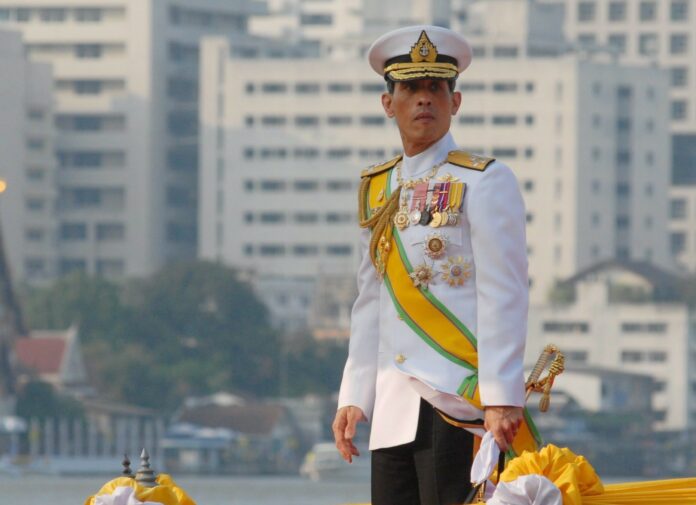
The palace on Thursday laid out the timeline for all royal ceremonies preceding and following King Vajiralongkorn’s official crowning on May 4. The schedule begins in April with events to take place across the country.

King Vajiralongkorn inherited the throne after his father King Bhumibol died in October 2016. The ceremony will officially mark the beginning of his reign.

April 6
Holy water drawing ritual: Hindu Brahmins will make offerings in Bangkok and 76 provinces to spirits at water sources that will be collected for later use.

April 8
Monks will ritually consecrate the water and light auspicious candles in honor of the king at provincial royal temples.

April 9
The auspicious candles will be extinguished and ritual Buddhist processions conducted around the temples.

April 18
The holy water collected nationwide will be sanctified at Wat Suthat in the capital.

April 19
The holy water will be moved to Wat Phra Kaew.

April 22-23
An engraving ceremony of the king’s name into a golden plate, a reading of the royal fortune, creation of the royal seal and designations of high-ranking royals will take place at Wat Phra Kaew.

May 2
The king will pay respect to previous kings and the capital’s spirits in the Royal Plaza and at the Memorial Bridge.

May 3
The king’s name, royal fortune and royal seal will be moved to the throne hall while the king pays respect to the Emerald Buddha and royal remains.

May 4
The official coronation ceremony will be held.

May 5
The inauguration of the king’s official name and signature, the re-establishment of the royal family members’ ranks and a royal parade will be held in the capital.

May 6
The king grants an audience to the public and foreign diplomats.

Later This Year
These events will be followed by the Royal Barge Procession, which will be scheduled some time between May and November.

Related stories:

Final Day of King’s Coronation Declared National Holiday

Sacred Water Sources Sought for Coronation Rituals

Coronation Dates Set for May: Palace

Advertisement

Hot News

LATEST NEWS

Bangkok
overcast clouds
30 ° C
30 °
25.5 °
83 %
3.9kmh
100 %
Mon
30 °
Tue
35 °
Wed
34 °
Thu
33 °
Fri
30 °