
































28.8 C
Bangkok
Wednesday, June 24, 2026
Home Blog Page 1733

And Now, Fine Cheese From Central Thailand. Really.

Heaven on Cheese’s cheeses. Photo: Joe Sloane / Courtesy

Camembert. Gruyeres. Brie. Names that have become more associated with the cheeses they produce than the cities themselves.

The same cannot be said of Nakhon Pathom.

When it comes to making cheese, central Thailand is neither on the map – nor anywhere near it. But that hasn’t stopped two farmers – a former Austrian cruise ship chef and a Thai veterinarian-turned-goat herder – from churning out artisanal, locally sourced fromage of their own.

From a vet using the power of science to make goat cheese on a Nakhon Pathom farm to a husband-and-wife curdling wheels from Nakhon Sawan cows, here are two pioneers in the cottage cheese industry.

Little Goat Farm and Cheesery: A Vet’s Journey from Virology to Dairy
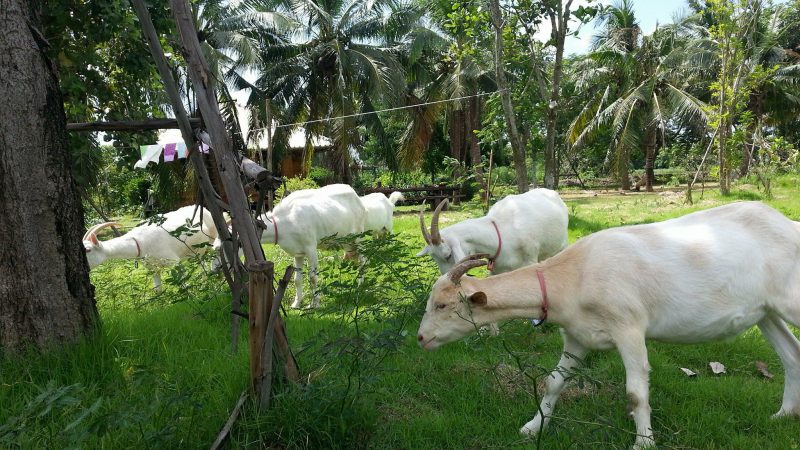
Photo: Little Goat Farm and Cheesery / Facebook

Veterinarian Rachanikorn “Kai” Srikong knew that her jargon-filled study on goat viruses wasn’t going to reach farmers or the general public like homemade jars of cheese spread.

Kai found during her veterinary school studies that a string of DNA particular to one breed of Thai goats made their milk suitable for cheese (Conveniently, she’d already been making cheese as a hobby by following YouTube videos). She originally hoped to share her findings with farmers to encourage them to ramp up production of goat-based goods in a country where they’re not widely raised and then mostly for their meat.

But she knew her “piece of paper” degree wouldn’t get farmers to start churning out cheese, so she decided to lead the way herself.

“I knew that it would be useless to publicize the study,” Kai said. “Agro people don’t want to hear about viruses in goats. They’ll stop listening if that’s the first card I turn over.”

Photo: Little Goat Farm and Cheesery / Facebook

Equipped with cheesemaking knowledge from the internet and her scientific know-how, the 42-year-old bought 30 goats and started making cheese at her farm in Nakhon Pathom, calling it the Little Goat Farm and Cheesery.

On a typical morning, Kai and a couple of farmhands milk the goats at 7am and then spend the rest of the day turning it into cheese. As for the goats, they spend their days chewing grasses, hay and banana stalks – but no food pellets.

It was a welcome difference from working in a science lab.

“Every time I make cheese, I’m happy. I created something edible, something not dangerous, unlike in the lab, where I’m surrounded by bacteria, diseases and viruses. As a scientist it makes me happy to see the cheese’s germs change form; happily growing,” she said.

Without a tongue “native to cheese,” the burgeoning cheesemaker got feedback from a French chef. The chef, who was unable to speak English, graded her cheese by ticking off taste descriptors on a table like “tangy” and “piquant.” She then translated the French terms online and adjusted her methods accordingly.

“What’s pla raa to us, is cheese to farang,” Kai quipped, referring to the pungent Isaan fermented fish.
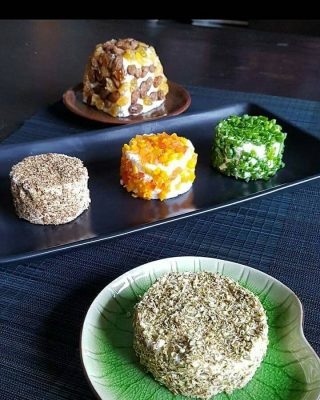
Photo: Little Goat Farm and Cheesery / Facebook

Due to the small scale of production, Kai says she can’t afford to make hard cheeses which can require years to age. Instead, she makes cheese spreads and soft cheeses which only need months or even days.

A 90-gram jar of soft white cheese spread costs 120 baht, and a 150-gram wheel of ripened cheese is 220 baht. Kai is also working on a brie, but the price isn’t stable yet. Although she’s mostly sold by delivery, she plans to start selling at farmers’ markets in Bangkok, like at Gateway Ekkamai.

Her goats’ cheese isn’t like anything found in a supermarket, she swears.

“This kind of soft cheese isn’t like stuff you find in a supermarket, because it’s hard to import from overseas because it’s so delicate and farm-made. It’s not industrial,” Kai said.

Heaven on Cheese

Photo: Reinhard Matheis

Anyone who’s tasted Heaven on Cheese’s double cream bries, reblochons and munsters may find it difficult to believe that they were not made in the French countryside but by a husband-and-wife operation in Nakhon Sawan.

For the past decade, Austrian Reinhard Matheis has worked from noon into the night and early morning most days crafting cheeses for his dedicated customers.

Matheis worked as a confectioner and then a baker in South Africa before taking his culinary talents onto the high seas aboard cruise ships. In 2005, the 49-year-old moved to the central province with his wife. Missing the taste of cheese, he started making his own from supermarket milk before upgrading to fresh, locally produced dairy in 2008. He got good feedback from friends.

News of Matheis’ products spread via word of mouth, online forums and restaurant suppliers. His restaurant customers include Viva Thonglor, Le Du, Siwilai City Club, Osito and high-end hotels like the M-Club Lounge at the Marriott Marquis Queen’s Park and the Sunday brunch at Le Meridien.

Matheis’ cheeses – he describes them as “artisan handmade cheese made with fresh, raw milk” are of another breed than those mass-produced by pasteurized milk.” He says they compare favorably to the imports, a lot of which are quite expensive despite being of “poor quality.”

Although he’s found that it more expensive to produce cheese in Thailand due to milk prices, he says local Thai milks create unique cheeses.

“[It] adds to the distinct flavor…and it has a better consistency. A bit softer, gooey,” he said.

Heaven on Cheese’s products can be ordered online or through meat distributor Sloane’s. A 230g wheel of Camembert costs 295 baht, while Rebruchon is 350 baht.

Related stories:

How to Snag Discounted Goodies at Bangkok’s Supermarkets (And Fight Food Waste)
Joe Sloane’s Philosophy of Happy Pig Slaughter

Advertisement

Trump Pleads on TV for Wall Money; Dems Say he ‘Stokes Fear’

WASHINGTON — In a somber televised plea, US President Donald Trump urged congressional Democrats to fund his long-promised border wall Tuesday night, blaming illegal immigration for the scourge of drugs and violence in the U.S. and framing the debate over the partial government shutdown in stark terms. “This is a choice between right and wrong,” he declared.Democrats in response accused Trump appealing to “fear, not facts” and manufacturing a border crisis for political gain.

Addressing the nation from the Oval Office for the first time, Trump argued for spending some $5.7 billion for a border wall on both security and humanitarian grounds as he sought to put pressure on newly empowered Democrats amid the extended shutdown.

Trump, who will visit the Mexican border in person on Thursday, invited the Democrats to return to the White House to meet with him on Wednesday, saying it was “immoral” for “politicians to do nothing.” Previous meetings have led to no agreement as Trump insists on the wall that was his signature promise in the 2016 presidential campaign.

Responding in their own televised remarks, Democratic House Speaker Nancy Pelosi and Senate Minority Leader Chuck Schumer accused Trump of misrepresenting the situation on the border as they urged him to reopen closed government departments and turn loose paychecks for hundreds of thousands of workers.

Negotiations on wall funding could proceed in the meantime, they said.

Schumer said Trump “just used the backdrop of the Oval Office to manufacture a crisis, stoke fear and divert attention from the turmoil in his administration.”

Overall, Trump largely restated his case for the wall without offering concessions or new ideas on how to resolve the standoff that has kept large swaths of the government closed for the past 18 days. Speaking in solemn tones from behind the Resolute Desk, he painted a dire picture of killings and drug deaths he argues come from unchecked illegal immigration.

Trump ticked off a string of statistics and claims to make his case that there is a crisis at the border, but a number of his statements were misleading, such as saying the new trade deal with Mexico would pay for the wall, or suggesting through gruesome examples that immigrants are more likely to commit crime.

Shifting between empathetic appeals and the dark immigration rhetoric that was a trademark of his presidential campaign, Trump asked: “How much more American blood must we shed before Congress does its job?”

Trump, who has long railed against illegal immigration at the border, has recently seized on humanitarian concerns to argue there is a broader crisis that can only be solved with a wall. But critics say the security risks are overblown and the administration is at least partly to blame for the humanitarian situation.

Trump used emotional language, referring to Americans who were killed by people in the country illegally, saying: “I’ve met with dozens of families whose loved ones were stolen by illegal immigration. I’ve held the hands of the weeping mothers and embraced the grief-stricken fathers. So sad. So terrible.”

The president often highlights such incidents, though studies over several years have found immigrants are less likely to commit crimes than people born in the United States.

Trump has been discussing the idea of declaring a national emergency to allow him to move forward with the wall without getting congressional approval for the billions he’s requested. But he did not mention that Tuesday night.

With his use of a formal White House speech instead of his favored Twitter blasts, Trump embraced the ceremonial trappings of his office as he tries to exit a political quagmire of his own making. For weeks he has dug in on a signature campaign promise to his base voters, the pledge to build an impregnable “beautiful” wall along the U.S.-Mexico border.

The partial government shutdown reached its 18th day, making the closure the second-longest in history. Hundreds of thousands of federal workers are going without pay, and government disruptions are hitting home with everyday Americans.

Story: Catherine Lucey, Jill Colvin and Lisa Mascaro

Advertisement

EU Lifts Long-Standing Warning Against Thai Fishing Industry

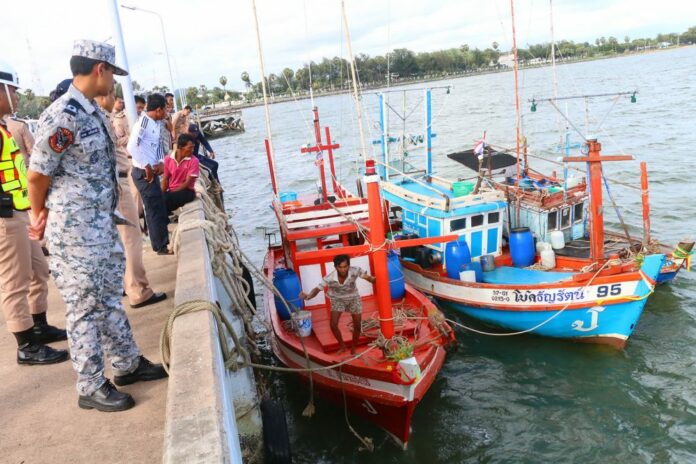
Navy officials in Chonburi province seize fishing boats that fail to comply with fishery regulations in May 2016.

BANGKOK — The European Union announced Tuesday that it has lifted its warning over Thai fishing products, citing improvements in labor practices.

Nearly four years after it issued a “Yellow Card” and warned it might boycott Thailand’s fishery, the European Commission said sufficient steps have been taken to combat overfishing, the use of slave labor and unsafe fishing boats.

“I am excited that today we have a new committed partner in this fight,” EU’s commissioner of environment and maritime affairs, Karmenu Vella, said in a statement.

The commission will continue to work with Thailand to fight against illegal, unreported and unregulated fishing, or IUU, the statement added.

Speaking in Brussels, deputy prime minister Chatchai Sarikulya said Thailand was gratified by the European Union’s decision.

“Thailand designated IUU issues as the top national agenda,” Gen. Chatchai, who oversees a committee tackling fishery violations, told reporters. “I believe Thailand has now laid down the foundations to completely prevent IUU.”

The statement was issued Tuesday afternoon and there was no immediate reaction from Thai officials.

The Yellow Card was issued in April 2015 after years of documented violations in the Thai industry. The ruling junta responded by forcing fishing boats to be equipped with GPS and logbooks, raiding suspected human trafficking rings and requiring higher standards be met across the board.

Advertisement

Yingluck Appointed Head of South China Port

Former prime minister Yingluck Shinawatra poses for a photo on Jan. 2, 2016

BANGKOK — Former prime minister Yingluck Shinawatra was named the chairwoman of a major seaport in China’s Guangdong province.

Yingluck, whose government was overthrown in a 2014 coup, fled Thailand in 2016 shortly before a guilty verdict was delivered following a lengthy corruption trial. The ex-premier will now head the Shantou International Container Terminal, according to a report posted online by Chinese state media People’s Daily.

The brief article said Yingluck was also appointed the firm’s legal representative. The port is located in Shantou, a major port city on the eastern seaboard of China.

The news came several days after Yingluck and her brother, former premier Thaksin Shinawatra, were spotted in Shantou. Both former leaders are descended from Chinese immigrants with roots in southern China.

Since she left the country, Yingluck has lived in exile in multiple countries where she keeps residences, like her brother Thaksin. He was deposed in a 2006 putsch and, like Yingluck, fled Thailand to avoid a corruption conviction two years later.

The siblings continue to wield immense influence among their Redshirt supporters despite years of self-imposed exile.

On Tuesday, deputy junta leader Prawit Wongsuwan said Thaksin is welcome to return anytime and fight his case under the justice system. Thaksin shot back by tweeting that he doesn’t trust a justice system controlled by Prawit.

Advertisement

Will New Pro-Democracy Rallies Draw More Than Usual Suspects?

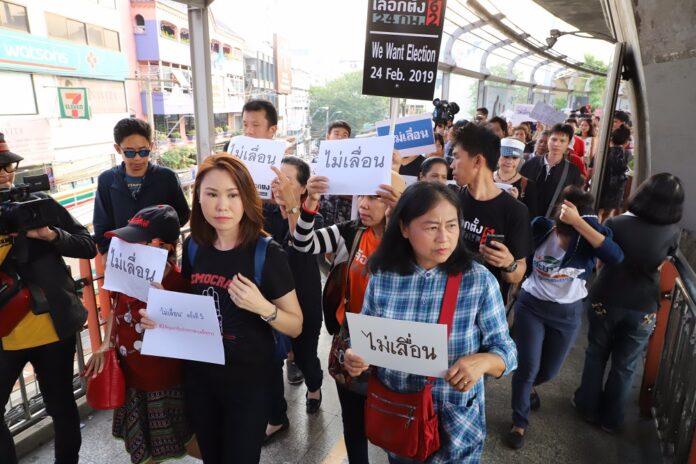
Protesters rally Sunday against the possible delay of the election slated for February.

BANGKOK — Demonstrators said Tuesday they hope more people attend rallies to pressure the military regime into holding elections as promised next month.

Arnon Nampa, a 34-year-old leader of the Democracy Restoration Group, said hours before a protest planned for 5pm this afternoon that he hopes at least 1,000 people show up.

“We disagree with postponing elections,” he said, adding that a bigger rally is needed. “We have to try.”

Read: Govt Quietly Halts Election Preparations Nationwide

Arnon estimated that only 200 people showed up Sunday to protest at the Victory Monument. The group will meet at 5pm today on the skywalk over Ratchaprasong Intersection and stick around until 8pm, he said.

The move came after the government acknowledged Tuesday that officials have been ordered to halt election preparations nationwide.

Describing the development as “not a big deal,” Gen. Anupong Paochinda, who serves as interior minister, confirmed the veracity of an internal document leaked onto social media.

Last week, it was announced that the coronation of King Vajiralongkorn would take place in the first week of week of May, around the end of the window of time that a poll must be held, according to the law.

That announcement has prompted some to call for putting off or canceling elections entirely.

The last major spasm of street protests was this past May for the fourth anniversary of the coup. Organizers faulted low turnout for their easy containment and dispersal by security forces.

This afternoon is a test for the pro-democracy camp’s viability. Though the military government’s popularity appears to be in decline, frustration with its rule may not translate into larger protests.

Arnon, who is also a human rights lawyer, said he believes an attempt to defer elections is more about the junta wanting to stay as long as possible in power, however.

While the ban on political gatherings has been lifted, the junta and its self-styled National Council for Peace and Order, which staged the 2014 coup, still hold the power to detain people without charge for seven days for “attitude adjustment.”

Anurak Jeantawanich, a Redshirt known to activists as “Ford Red Path,” said he was questioned by plainclothes police Tuesday about how he funded his political activities. Anurak wrote online Tuesday that the money came from selling political T-shirts.

Nuttaa Mahattana, another leader of the group, said today that she expects about 300 demonstrators to show up at the intersection, but added that she is bad at estimating.

Nuttaa called on people earlier today via Facebook to gather and demonstrate wherever it’s convenient, not just at Ratchaprasong Intersection or in Bangkok.

“People who want elections nationwide should spread out and show their power …,” she wrote.

Advertisement

Bangkok to Halt Roundups, Take New Approach to Stray Animals

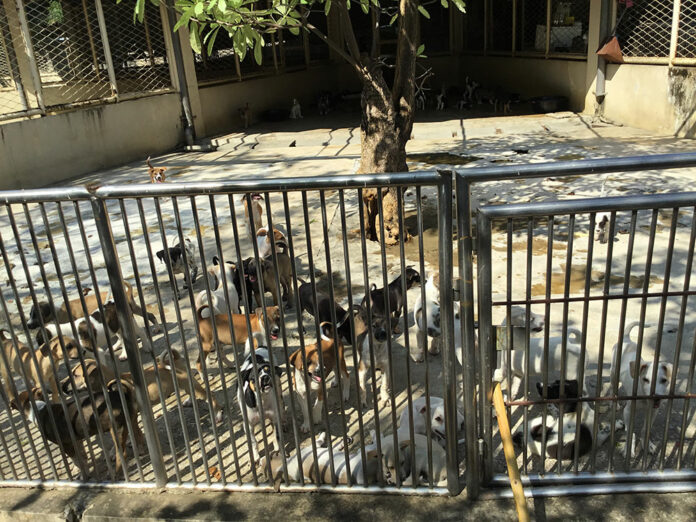
Sick animals packed into cages at a government animal shelter in December at Bangkok's Prawet district. Photo: Watchdog Thailand / Courtesy

BANGKOK — Bangkok’s governor on Tuesday promised new policies to address stray animals in the capital, signaling an end to transporting them to shelters where thousands have died.

Acknowledging that its public animal shelters lack the space to accommodate all strays, Gov. Aswin Kwanmuang said local administors have been asked to work with private animal organizations to regularly vaccinate and sterilize the animals instead of shipping them off to the city’s sole shelter in Prawet district.

Speaking after a meeting today with groups including Watchdog Thailand, The Voice Foundation, Soi Dog and The Hope Thailand; Aswin said animals that are snipped and vaccinated would be tagged and set free. He expects the administration will be able to process 600 dogs and cats per week.

Read: Cats & Dogs Die by Hundreds in Disease-Infested Bangkok Shelter

The Prawet shelter is able to hold up to 1,000 animals, while another one in Uthai Thani province can accommodate 8,000, Aswin said. That’s just a fraction of the dog population, which Aswin conservatively estimated to be 150,000.

John Dalley of the Soi Dog Foundation welcomed the announcement, as the policy is aligned with what his organization has long advocated for controlling the street animal population.

“It’s a very positive move,” he said. “It’s the only that will work.”

A network of animal welfare groups assailed the city in November after it resumed the roundup of strays across the capital, citing complaints. City Hall later backtracked after being threatened with legal action.

Pictures and videos taken inside the Prawet shelter last month showed sick cats and dogs packed in small cages. Watchdog said hundreds were killed within weeks by various diseases contracted in the shelter.

Public animal shelters are often called out by animal rights groups over mismanagement, poor treatment and a lack of proper equipment, resulting in large numbers of animals dying once sent there. A Khaosod reporter in May found a mass grave at a shelter in Nakhon Phanom province after animal activists alleged thousands had died there after being rounded up due to a rabies scare.

Going forward, City Hall will only catch those that are too dangerous to be let loose in communities, Aswin said. He added that they will undergo some kind of expert training before being set free.

According to Aswin, new protocols for handling strays will be drafted, and private-sector shelters will be allowed to open. He said the new policies should make an impact on the population of stray dogs and cats within two years.

Advertisement

Collector Offers 10,000 Baht For Faceless Rama X Coins

Misprinted coins displayed by a collector offering a 10,000 baht bounty for more. Image: Boonyarit Sriviset / YouTube

BANGKOK — An antique collector said Tuesday he’s willing to pay up to 10,000 baht for each misprinted 1-baht coin minted under the current monarch.

In a video posted online, Boonyarit Sriviset offered a bounty for coins that – due to a minting error – have one side left blank. Some lack either the face of King Vajiralongkorn on one side or the royal insignia on the other.

Each coin may fetch about 8,000 – 10,000 baht. In a phone interview, Boonyarit said the price depends on condition.

“I have to see it myself. I can’t describe to you what their condition should look like,” the collector said.

Misprinted and limited edition coins are highly sought after by collectors, and their appeals have sparked national sensations. In 2014, a shop went viral after it offered to buy rare, 10 baht coins for 100,000 baht each.

And those thinking they could cheat Boonyarit by filing off one side of the coin, take note: The collector said there are ways to detect fakery. For instance, genuine faceless coins would weigh exactly at 3.0 grams and 3.1 grams, while altered coins would weigh less.

Boonyarit said those interested in selling should send photos of the coins via Line to @Bank0840721303.

Related stories:

Misprinted 1 Baht Coins 40,000% More Valuable

Advertisement

Khon Kaen Railway Land Considered For … Theme Park?

Original photo: Si Ri Wat Yupin / Facebook

KHON KAEN — Land by Isaan’s rail hub could be developed into condos, offices – or even a theme park, according to railway officials.

A plot of 108 rai (17 hectares) near the Khon Kaen Railway Station, currently used for golfing and residences, will be leased out by the state railway, which is brainstorming possible ideas to entice developers to enter a long-term lease.

At a Monday session spitballing ideas for the land, a railway finance officer said he envisioned an amusement park that travelers would flock to.

“The park could be a tourist destination for the province, and have rides like roller coasters and water parks,” Worawut Mala said. “We would apply the model of a movie theme park, like Movie World or Universal Studios.”

The area slated for development has been divided into five zones: 16.2 rai for residential and commercial use, 26.5 rai for a possible hotel and convention center, and another 8 rai for office and residential use.

The largest section, a 58.6-rai area currently used as a golf course and employee housing, could be made into a theme park, of the state railway said Monday.

Pouring cold water on Worawut’s dream was project property manager Jitlekha Detcharoen – she says it’s too small.

“Maybe the land doesn’t have that potential yet. Theme parks overseas are huge and all on one piece of land. So this land could be about half a park,” she said.

Still, there’s hope, if the right investors pulled through.

“The investors probably saw that there’s no full-fledged theme park in Isaan yet, with rollercoasters and carousels. So they think one would draw a lot of people,” she said. The train station receives around 20,000 to 38,000 travelers daily.

Whatever the outcome, Jitlekha said that there’s little chance of it becoming a mall.

“This land isn’t adjacent to the main road, which malls need,” she said, laughing. “And Central Khon Kaen is right by.”

She said the most realistic and profitable plan would be chosen.

“When it comes time to take bids, an investor might say they could make 100 million with a theme park, but then another investor can defeat them by saying they could make 200 million with a hotel,” she said. “It’s up to the investors what this will be; what will earn the most profits.”

The cash-strapped and debt-saddled state enterprise has been seeking to leverage its extensive land holdings through development deals for years. Those efforts have run into opposition to the development of green areas such as a large plot in Bangkok’s Makkasan area.

The land in Khon Kaen is already partially developed.

“It’s not an empty area. It’s where some employees’ homes are, so investors will need a course of action for relocation,” she said.

Jitlekha said that more fully fledged proposals would start pouring in by the middle of the year, with one selected around mid-2020 at the earliest.

Prasertsuek Saipawan, who’s also involved in the railway’s development projects, said the land will be leased 30 to 50 years to a project he expects will cost 5 billion baht to 8 billion baht to build.

Advertisement

Saudi Officials ‘Satisfied’ by Handling of Rahaf: Big Joke

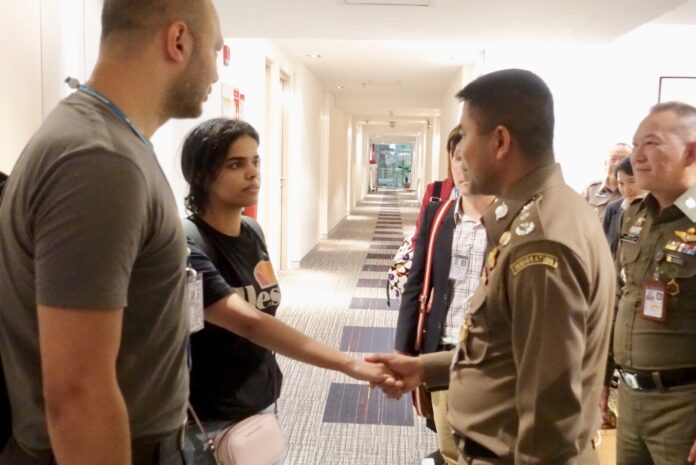
Rahaf Alqunun shakes hand with immigration chief Surachate Hakparn, at right, Monday at Bangkok's Suvarnabhumi Airport. Photo: Immigration Bureau
Rahaf Alqunun shakes hand with immigration chief Surachate Hakparn, at right, Jan. 7 at Bangkok's Suvarnabhumi Airport. Photo: Immigration Bureau

BANGKOK — After meeting Tuesday with officials from the Saudi Embassy, the head of Thai immigration said they told him they are satisfied with how the case of a young Saudi woman who claims to be fleeing her abusive family has been handled.

Lt. Gen. Surachate Hakparn explained the Saudi reaction to reporters after a meeting with its diplomats. The embassy issued a statement Tuesday denying accusations that it had requested the extradition of Rahaf Mohammed Alqunun or seized her passport, as the 18-year-old woman had charged several times. The statement said the case is a “family affair but yet, it is under the care and attention of the Embassy.”

“The position of two countries on this matter is the same — that the priority is to provide her safety. We are both concerned for Miss Rahaf’s safety and well-being,” said Surachate. “The Saudi charge d’affaires said he is satisfied and expressed confidence on the work of Thai immigration, of the Thai government, and of the Foreign Ministry yesterday.”

Read: Saudi Woman Leaves Bangkok Airport Under UN Care

Alqunun grabbed global attention when she sent out pleas for help via social media, saying she feared for her life if she were put on a plane back to Kuwait, where she had slipped away from her family, or her homeland.

Instead, she was given back her passport and allowed to enter Thailand temporarily under the protection of the U.N. refugee agency, which was expected to take about five to seven days to study her case and her claim for asylum. The office of the U.N. High Commissioner for Refugees said in a Tuesday statement that it would look into Alqunun’s case “to assess her need for international protection.” She has said she wants to go to Australia to seek refuge there.

Surachate said Alqunun’s father and brother were due to arrive soon in Bangkok, but that it was her decision whether to meet with them. On Twitter, she has expressed fear of such a meeting. The father had previously been expected Monday night.

Meanwhile, Human Rights Watch called on the Australian government to allow Alqunun’s entry into that country.

Alqunun said she had a visa to continue her journey to Australia, but media reports say the Australian government has now canceled it. Australian officials have not responded to multiple requests for comment.

While Surachate claimed Alqunun never had a visa to enter Australia, Human Rights Watch’s Australian director, Elaine Pearson, said she had seen electronic confirmation of the visa, shown by Alqunun to HRW’s Asia deputy director, Phil Robertson.

But, Pearson said, Alqunun could no longer access her visa page on Australia’s immigration website on Tuesday, sparking concern that the document had been canceled. An Australian visa is usually processed electronically and not stamped in one’s passport, but confirmed by a document that the visitor can print out.

Though refugee status would mean a different form of visa would be needed, Pearson said Australia’s apparent cancellation of Alqunun’s tourist visa was a worrying sign.

“It’s extremely concerning if it is the case that the visa has been canceled,” she told The Associated Press, adding that Australia should allow Alqunun entry in any case.

Since Australia has expressed concern in the past about women’s rights in Saudi Arabia, it should “come forward and offer protection for this young woman,” Pearson said.

For runaway Saudi women, fleeing can be a matter of life and death, and they are almost always trying to escape male relatives.

In 2017, Dina Ali Lasloom triggered a firestorm online when she was stopped en route to Australia, where she planned to seek asylum. She was forced to return to Saudi Arabia and was not publicly heard from again, according to activists tracking her whereabouts.

Despite efforts by the Saudi government to curtail the scope of male guardianship laws, women who try to flee their families in Saudi Arabia have few good options inside the kingdom. They often are pressured to reconcile with their families, sent to shelters where their movement is restricted, or face arrest for disobeying their legal guardian.

Advertisement

Opinion: Unequal Thailand a Daily Struggle

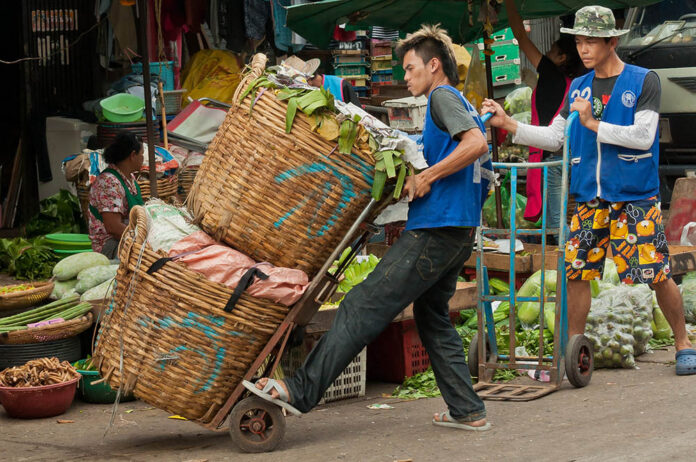
A worker at Bangkok's Khlong Toei Market. Photo: Mark Fisher

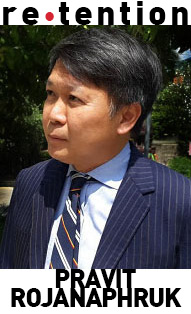
Re•tention: Pravit RojanaphrukThat Thailand is one of the most unequal societies on earth should be a concerns for all Thais, from those at the top all the way to the lowest echelons.

Last month, the National and Social Development Board vehemently denied that Thailand has the world’s largest income gap as reported by Credit Suisse Bank.

Days before Christmas, Al Jazeera claimed Thailand “has the greatest wealth gap in the world” with 1 percent of the population controlling more than two-thirds of the nation’s wealth.

This is not new news. Back in mid-2016, Credit Suisse claimed that Thailand was the third most unequal country in the world, with 1 percent owning 58 percent of the kingdom’s wealth, behind only Russia and India.

After the 2018 report came out, economist Varakorn Sarmkoses argued that only 35 countries of 133 ranked have complete data for making such computations and thus the results may be inaccurate.

Let us not be too pedantic about whether Thailand is truly the most unequal society on earth. Personally I think it’s not, although the inequality is rather severe.

There are different ways to measure inequality. Here are some aspects that reminds us of the situation:

Let us start with the deserted Bangkok during the just-concluded New Year’s holidays. Bangkok’s streets were near empty as the majority of people working in the capital escaped to visit their home provinces. It means Bangkok is what sociologists call a primate city, a singularly large urban center where most functions – and jobs – are concentrated. Bangkok, which is at least 10 times larger than the next biggest city, Chiang Mai, is concrete testimony to the country’s unequal opportunities. If you were born in the province and had the benefit of a good enough education, you will mostly likely come to Bangkok to seek jobs commensurate with your abilities or try your luck in a nation with a more developed economy.

Don’t think the middle class in Bangkok are not struggling, however.

A friend told me she has to hire tutors for her 4-year-old boy because, by mid-2019, he will have to compete for a kindergarten seat at a well-known state university’s demonstration school. She said on average, there are 4,000 applicants and the school only admits 200. What’s more, 100 out of the 200 places are reserved for either big donors or children of alumni.

The school, she said, is the only way for her son to get a quality education without paying the exorbitant tuition of other schools like international schools or top private schools.

She said money will have to be saved for her boy’s piano and other private tutorials.

While the middle class in Bangkok tries hard to ensure that the next generation will at least be able to maintain the same lifestyle of a middle class.

What about the poor?

It’s tough when you are at the bottom and don’t read or speak English (or increasingly, Chinese). Many pretentious restaurants in Bangkok and other cities don’t have menus in Thai, and if you can’t read English, you simply feel out of place. This may not be a big issue as dinners at such establishments easily cost a week’s worth of minimum wages.

This is why when new political party Future Forward wanted to be as friendly to the poor as possible, it reluctantly decided to reduce annual party membership fees from 200 baht to 100 baht. A hundred baht may be loose change for the middle class, but definitely not for the poor. Thus the adjustment.

Societies that are too unequal cannot expect to be at peace or happy. The inequalities confronting us on a daily basis are a daily struggle for many, who consider winning the lottery their best hope for a truly better future. This is a reminder that we have failed to bring many on board.

Advertisement

Hot News

LATEST NEWS

Bangkok
few clouds
28.8 ° C
28.8 °
28.8 °
71 %
4.1kmh
13 %
Tue
29 °
Wed
38 °
Thu
39 °
Fri
37 °
Sat
37 °