23.9 C
Bangkok
Monday, July 6, 2026
Home Blog Page 1773

Strasbourg Shooting Suspect Identified

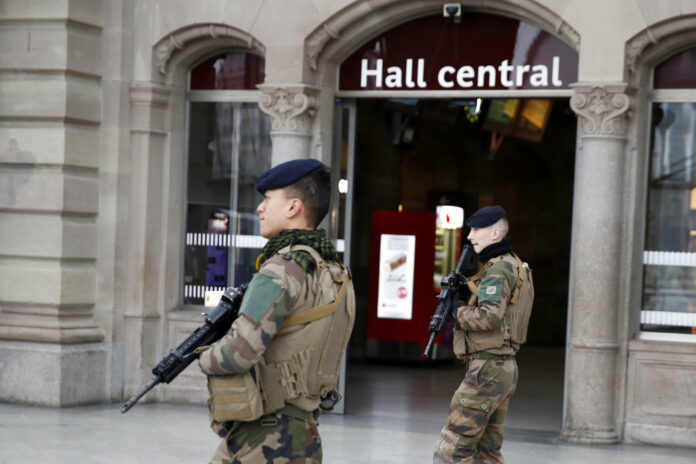
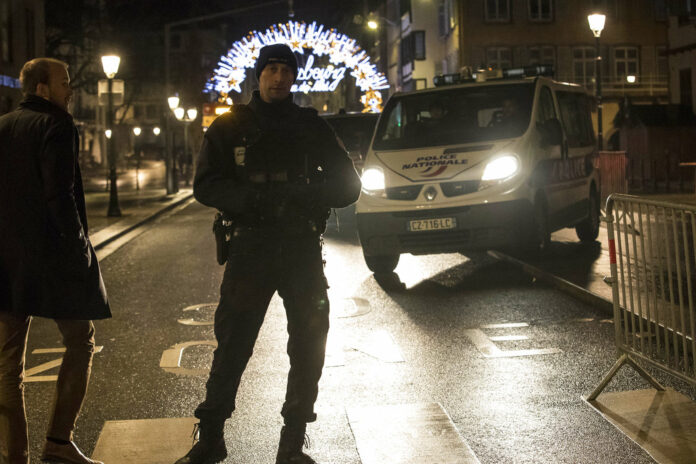
French soldiers patrol Wednesday in the railway station of the city of Strasbourg following a shooting, eastern France. Photo: Christophe Ena / Associated Press

STRASBOURG, France — Two police officials have identified the suspected Strasbourg gunman as 29-year-old Cherif Chekatt.

One police source said Chekatt’s criminal record mentions 25 judicial cases, including several serious cases of robbery.

The official said his apartment was searched by police on Tuesday morning – hours before the shooting – in an investigation for attempted murder. He was not at home at the time.

The two officials spoke anonymously because they were not allowed to speak publicly on an ongoing investigation.

The suspect was still on the run on Wednesday after he fired gunshots near the famous Christmas market of Strasbourg, killing three and wounding at least 13.

Advertisement

Fire Cards and Paratroopers: A Look Back at Thailand’s ‘Dirtiest Election’

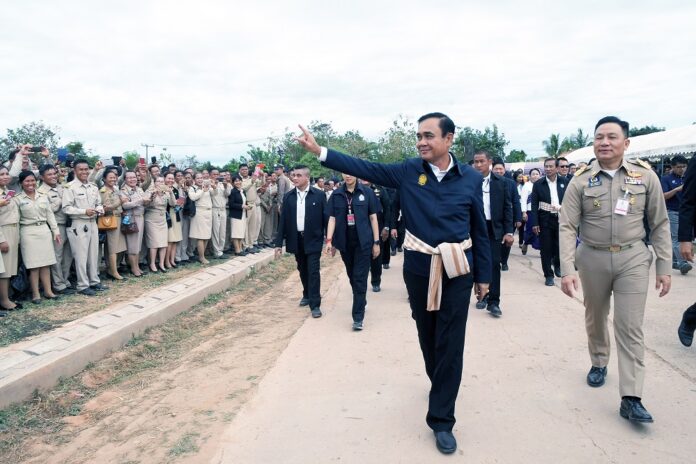
Junta chairman Prayuth Chan-ocha greets residents of Bueng Kan province with an "I love you" hand sign on Dec. 12, 2018.

BANGKOK — As Thailand edges closer to a long-elusive election – now scheduled for Feb. 24 – the junta faces a rising chorus of criticism for allegedly rigging the poll.

A pro-junta party voraciously poaching MPs. Government tours showering taxpayer money on potential voters. A gerrymandered electoral district map that baffles observers. A mystifying need to remove party logos from ballots. Uneven rules disadvantaging the opposition.

And that’s just in recent weeks.

All these signs prompted a prominent academic to warn the regime could be dragging Thailand into a future resembling its inglorious past.

Thirayuth Boonmee, who as a student activist helped spark an uprising that overthrew military rule four decades ago, raised concern Monday that junta chairman Prayuth Chan-ocha risks manipulating the upcoming poll to the point it loses all credibility.

“I’d like to plead with Gen. Prayuth … to prevent all sides from using legal manipulation or any other means to the point that there are accusations of a dirty election,” Thirayuth said on the occasion of an annual news conference where he offers his analysis on current affairs.

“Just like what the military dictators did in 1957,” he added in comments to an audience well aware that what followed was much worse.

That Monday remark has since seized the imaginations of politicians and editorial writers. Naewna, a reliably pro-establishment outlet, urged the government to heed Thirayuth’s “well-intended” words in a Tuesday column.

Weighing in online, the leader of what has been the most powerful political party went so far as to suggest the election junta-organized poll might turn out even worse.

“Will the 2019 election be written on a new page of Thai history as the most unfair?,” said Phumtham Vechayachai of the Pheu Thai Party, after discussing the 1957 poll in his post.

So what made it so notorious? Let’s take a look back at the plots, ruses and naked ploys by which another military government attempted to steal the vote in what went down as Thailand’s dirtiest election.

“In terms of trickery, there are similarities,” historian Thamrongsak Petchlertanan said in an interview. “There was cheating even before the election in order to perpetuate the junta regime in power.”

Old Soldiers, Same Tricks

When Thais went to the polls in 1957, they had been living under the military rule of Field Marshal Plaek Pibulsongkram for 10 years – a decade punctuated by political purges, internal coups and bloody rebellions.

There was no putting off the election – under the constitution, it was mandated because the parliament had completed its four-year term. A previous election a few years earlier had been boycotted by the opposition, including the Democrat Party, to protest a follow-up coup by Plaek to further consolidate his power.

But the Democrats and their allies changed tactics when the field marshal announced the 1957 election. They would contest it. The public was awash with excitement at the news. It would be the first time Plaek and his clique faced adversaries on the ballot.

“The question for the junta was: How do you organize an election and win it as a governing party, too?” Thamrongsak said, a question that rings with relevance then as now.

The answer was launching a pro-junta party called the Serimanangkasila – a reference to the Manangkasila Mansion on Lanluang Road, which served as a residence for the prime minister’s guests from overseas.

Founded two years prior to the election, the party was led by the triumvirate of power at the time: Plaek, Field Marshal Phin Choonhavan and army chief Sarit Thanarat.

The similarities to today pile up.

On the way to Election Day, the party poached MPs from other factions, either by buying them out or outright intimidation. Contemporary accounts allege that thugs hired by then-police chief Phao Sriyanond intimidated rural villagers to only vote for Serimanangkasila, and some Democrat candidates had human feces thrown at their homes.

Some ministers serving under Plaek also formed small parties allied with the Serimanangkasila to help stack up votes, Thamrongsak the historian said.

Vote Early, Vote Often

When polls opened Feb. 26, 1957, the shitshow that followed was one for the books. Fraud emerged in so many forms that observers assigned nicknames to each variety.

First there were the paratroopers: groups of soldiers “dropped in” to vote at various polling booths throughout the capital.

Others were less subtle. Security forces were spotted queuing up and voting at the same booths almost immediately after they already cast their ballots, earning them the nickname wian tian for a Buddhist ritual observed by marching around a temple thrice on religious days.

And when polls closed, there was the discovery of fire cards: mysterious ballots that appeared out of nowhere in the ballot boxes. Of course, they all were marked Serimanangkasila.

According to media reports at the time, one polling station where the pro-junta party trailed behind the Democrats had a blackout just as officials were counting votes. After power was restored, Serimanangkasila soon took the lead; activists observing the count accused officials of adding hundreds of bogus ballots.

Chaos soon erupted. Newspapers denounced the results. Students at two elite universities, Chulalongkorn and Thammasat, put aside their rivalry to march side by side in the streets of Bangkok to protest the outcome – marking the first time students engaged in political activism on a large scale.

The government responded by declaring a State of Emergency, enraging the students even further. By the night of March 2, protesters broke through police barriers and threatened to storm Plaek’s seat of power at the Government House. Tensions were only defused when Field Marshal Sarit met with the students in person and proposed to mediate a solution.

“I’ll see you all again when the nation needs me,” Sarit told the cheering students after they agreed to disperse.

He made good on his promise six months later when, citing discontent and corruption, Sarit seized power from Plaek. He went on to suppress dissent on a scale dwarfing that of the tyrant he deposed. Some of the students who applauded his intervention over election fraud were jailed on suspicion of being communists.

Dirtiest Myth?

Despite the many reported attempts to steal the election, Thamrongsak disagrees with historians who characterize the 1957 poll as the “dirtiest,” since it was never established if similar mischief occurred outside the capital.

He urged people today to exercise judgment when reading those accounts because much of the sensational coverage was fanned by Sarnseri, a tabloid newspaper owned by Sarit.

In fact, Thamrongsak even suspects that the field marshal, regarded by many progressive activists at the time as a reliable ally, might have encouraged the dirty tricks to discredit Plaek and play them to his advantage.

“Many media agencies chose to side with Sarit because they wanted to destroy Field Marshal Plaek,” the historian said. “They ended up as a tool in Sarit’s hands to destroy democracy.”

For its part, the current junta insists voting in February will be fair and free. On Tuesday, the regime lifted its nearly five-year-old ban on political gatherings, ostensibly to pave way for the poll.

But some remain unconvinced. On Wednesday, pro-democracy activists and politicians rallied at the Election Commission to demand it functions independently.

“The government must not dominate or interfere with the Election Commission,” Pheu Thai spokeswoman Laddawan Wongsriwong told reporters.

Related stories:

Battlefield Bangkok: The Time the Navy Defied the Army – And Lost

Why Was the 1932 Revolution Plaque So Important?

Advertisement

Study Finds Female-Led Films Outperform Male Ones

This image released by Warner Bros. Entertainment shows Gal Gadot in a scene from
This image released by Warner Bros. Entertainment shows Gal Gadot in a scene from "Wonder Woman." Image: Associated Press

NEW YORK — A new study that analyzed four years’ worth of films found that female-led movies have consistently outperformed those in which men get top billing.

The study analyzed the 350 top-grossing films worldwide released between January 2014 and December 2017. Researchers found that in films with small, medium and large budgets, all averaged better global grosses when a woman was listed as the lead star.

Conducted by the talent agency Creative Artists Agency and the tech company shift7, the study found that films that passed the Bechdel test do better, too. The Bechdel test, an invention of the cartoonist Alison Bechdel, rates whether a movie features two female characters having a conversation about something other than a man.

Researchers found every USD$1 billion film at the box office – including films like “Star Wars: The Force Awakens,” ”Jurassic World” and “Beauty and the Beast” – passed the Bechdel test. Among films that cost more than $100 million to make, the ones that passed the Bechdel test grossed on average $618 million worldwide, while those that didn’t averaged $413 million.

“Women comprise half the box office, yet there has been an assumption in the industry that female-led films led were generally less successful,” CAA agent Christy Haubegger, who participated in the research, said in a statement. “We found that the data does not support that assumption.”

For budget data and determining lead actor, researchers depended on data from the Nielsen’s box-office data collection company Gracenote. Gracenote’s Studio System defines a “female lead” as a woman who is listed first in official press materials.

Of the 350 films studied, 105 qualified as female-led and 245 registered as male-led. The greatest gap was in larger budgeted films. In movies with a budget greater than $100 million, there were 75 male-led films and 19 female-led films.

The study was conceived through a group that formed through the gender equality initiative Time’s Up, including Amy Pascal, former chairman of Sony Pictures. Earlier research by academics has chronicled similar rates of inequality in top-grossing Hollywood releases, and the financial benefits of inclusion.

“This analysis affirms data showing that diversity has a positive impact on a company’s bottom line,” said Lisa Borders, Time’s Up president and chief executive. “As studios consider their fiduciary responsibilities to their investors, these findings offer a clear approach to delivering the best results.”

Story: Jake Coyle

Advertisement

5 Detained as France Hunts Xmas Market Shooting Suspect

Emergency services patrol Tuesday at the center of the city of Strasbourg following a shooting, eastern France. Photo: Jean-Francois Badias / Associated Press

STRASBOURG, France — French authorities detained five people as they hunted Wednesday for a suspected extremist who sprayed gunfire at one of Europe’s most famous Christmas markets in the eastern city of Strasbourg, killing three and wounding at least 13 and putting the whole country on edge anew.

The government raised the security alert level and sent police reinforcements to Strasbourg, where some 350 security forces are searching for the assailant. Police officials said he was wounded in a gunfight with soldiers after the Tuesday night attack but escaped, and a top official said he might have escaped to neighboring Germany.

The attacker is a 29-year-old with a police record in France and Germany who had been flagged for extremism, police said. Police detained five people in overnight searches around the city, Laurent Nunez, secretary of state for the Interior Ministry, said on France-Inter radio.

An investigation was opened, but the motive of the attack is unclear. Nunez said eight of the injured are in serious condition, and the city mayor said some had head wounds.

Witnesses described shots and screams after the gunman opened fire at the Christmas market Tuesday evening in a city that’s home to the European Parliament and considers itself a capital of Europe – and promotes itself as the “capital of Christmas.” For several hours swaths of the city were under lockdown.

The attack is a new blow to France, after a wave of Islamic extremist killings in 2015 and 2016, and amid a month of protests against President Emmanuel Macron that have blocked roads around the country, led to rioting in the capital and put heavy strain on police.

While authorities urged people in the area to stay inside after Tuesday’s attack, Strasbourg Mayor Roland Ries told BFM television Wednesday that “life must go on” so that the city doesn’t cede to a “terrorist who is trying to disrupt our way of life.”

The assailant got inside a security zone around the venue and opened fire from there, Mayor Roland Ries said on BFM television.

One possible reason for the attack: police tried and failed to arrest him earlier Tuesday for an attempted murder, Nunez said. The suspect had been identified as radicalized during past stays in prison, Nunez added. Authorities did not identify him publicly.

Police were out in force in Strasbourg on Wednesday morning, and the Christmas market was closed. Strasbourg, a city about 500 kilometers (310 miles) east of Paris on France’s border with Germany, promotes itself as the “Capital of Christmas” and the market set up around the local cathedral is a holiday tradition. The market was the target of an al-Qaida-linked plot at the turn of the millennium.

Many of Europe’s deadliest terror attacks in recent years have taken place in France. In response to Tuesday’s shooting, the government decided to take the country’s attack risk up a level on the official threat index and to send security reinforcements to Strasbourg, Interior Minister Christophe Castaner said in Strasbourg.

Some 350 officers and two helicopters were searching for the assailant after Tuesday’s drama, which involved shooting in multiple neighborhoods of Strasbourg, authorities said. The assailant confronted law enforcement officers twice, exchanging fire, while he “sowed terror,” Castaner said.

The shooter was shot and wounded by soldiers guarding the Christmas market, according to Stephane Morisse of police union FGP Police.

“I heard two or three shots at around 7:55 p.m., then I heard screams. I got close to the window. I saw people running. After that I closed the shutters. Then I heard more shots, closer this time,” said Yoann Bazard, 27, who lives in central Strasbourg.

“I thought maybe it’s firecrackers,” he said, speaking by phone. “And then, as it got close, it was really shocking. There were a lot of screams. … There were police or soldiers shouting ‘Get inside!’ and ‘Put your hands on your head.'”

Another witness, Peter Fritz, told the BBC one of the three people killed was a Thai tourist who was shot in the head and didn’t respond to lengthy attempts to revive him.

Advertisement

UK PM Theresa May to Face No-Confidence Vote in Her Leadership

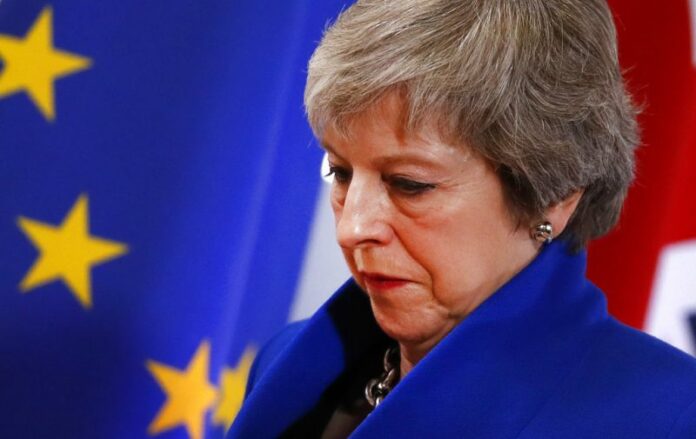
British Prime Minister Theresa May walks past the EU flag at the conclusion of an EU summit in Brussels, Sunday, Nov. 25, 2018. Photo: Alastair Grant / Associated Press

LONDON — A British Conservative Party official says Prime Minister Theresa May will face a no-confidence vote from party lawmakers.

Graham Brady says the threshold of 48 letters from lawmakers needed to trigger a leadership vote has been reached. Brady chairs the party committee that oversees leadership contests.

Many lawmakers have been growing angry with May over her handling of Brexit.

If she loses the vote of party legislators, taking place on Wednesday evening, May must step down. If she wins, she can’t be challenged again for a year.

Advertisement

Jailed Myanmar Journalists Join Khashoggi, ‘Guardians’ as Time Person of 2018

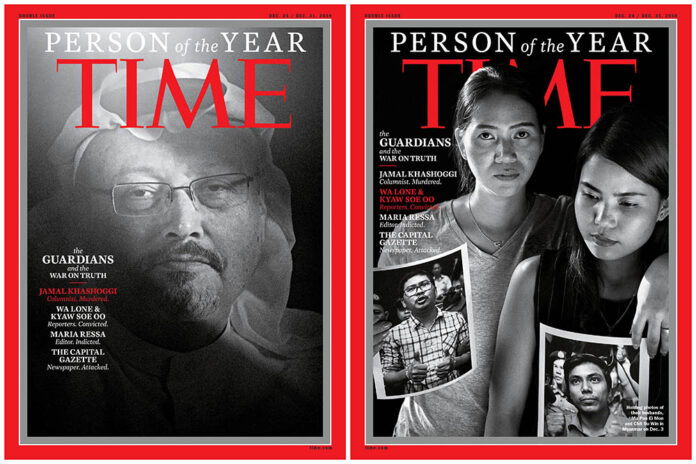
Saudi journalist Jamal Khashoggi, at left, and Reuters journalists Wa Lone, 32, and Kyaw Soe Oo, 28, were named TIME's Person of the Year for 2018 in two of four separate covers. Image: Time Magazine / Courtesy

NEW YORK — Time magazine on Tuesday recognized journalists, including slain Saudi columnist Jamal Khashoggi and two Reuters reporters jailed in Myanmar as its 2018 Person of the Year in what it said was an effort to emphasize the importance of reporters’ work in an increasingly hostile world.

The designation wasn’t intended as a specific message to the magazine’s runner-up choice, President Donald Trump, who has denounced “fake news” and called some reporters enemies of the people, said Ben Goldberger, executive editor.

Time cited four figures it called “the guardians.” Besides Khashoggi, they are the staff of the Capital Gazette in Annapolis, Maryland, where five people were shot to death in June; Philippine journalist Maria Ressa; and Reuters reporters Wa Lone and Kyaw Soe Oo, who have been jailed in Myanmar for a year.

It’s the first time since the magazine began the end-of-year tradition in 1927 that Time has featured a journalist or recognized someone posthumously.

Time said that 2018 has been marked by manipulation and abuse of information, along with efforts by governments to foment mistrust of the facts.

Goldberger said the magazine hopes the choice reminds people outside of journalism about the importance of the work.

Joel Simon, executive director of the Committee to Protect Journalists, said he sees this message already starting to get through — sadly, in part because of the attention paid to Khashoggi’s killing. Khashoggi is one of at least 52 journalists murdered so far this year, the committee said.

“In some ways, I feel we’re at a turning point,” Simon said.

Khashoggi was killed two months ago when The Washington Post columnist, who had lived in the U.S., visited Saudi Arabia’s consulate in Turkey for paperwork so he could get married. He had been critical of the Saudi regime.

The Washington Post applauded Time for its message of support for journalists.

“We hope this recognition will prompt our nation’s leaders to stand up for America’s values and hold accountable those who attempt to silence journalists who cover our communities or in Jamal’s case, an oppressive authoritarian government,” said Fred Ryan, the Post’s publisher and CEO.

Reesa co-founded the online site the Rappler, which has aggressively covered the government of Philippines President Rodrigo Duterte. She was recently charged with tax fraud, with many in the Philippines seeing that as a reaction to the Rappler’s reporting.

Wa Lone and Kyaw Soe Oo were imprisoned after investigating a massacre of Rohingya Muslims.

Four journalists and a sales assistant were killed by a gunman at the Capital Gazette newspaper last spring.

Time is producing four different covers featuring “the guardians.”

Last year Time recognized people who came forward to report on sexual misconduct. Trump, this year’s runner-up, was Person of the Year in 2016.

The third-place finisher this year was special counsel Robert Mueller, who Time indicated could move up in next year’s rankings depending on the findings of his investigation into the Trump campaign’s contacts with Russia.

Story: David Bauder

Advertisement

Elderly Benz Driver Charged For Fatal Expressway Wreck

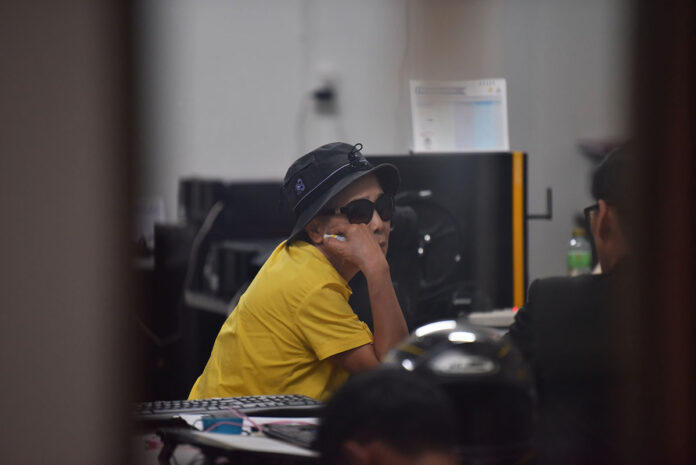
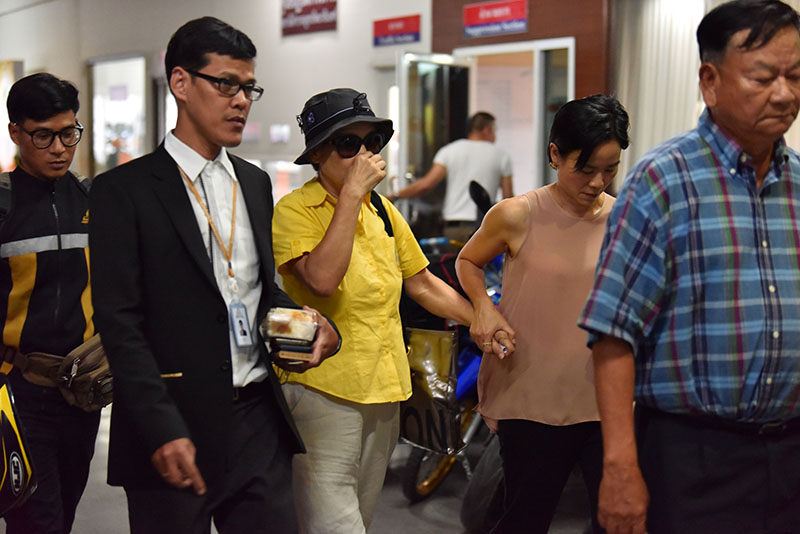
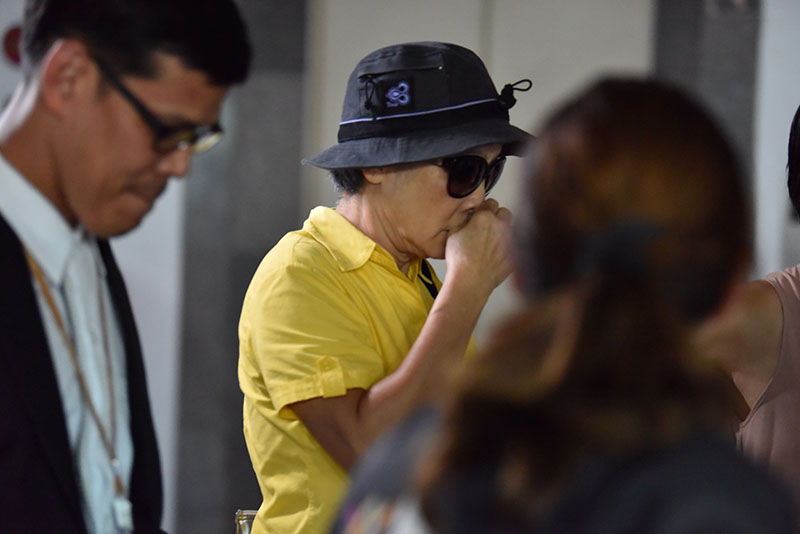
Surang Supornsuk talks to police Tuesday night at the Rattanathibet Police Station in Nonthaburi city.

NONTHABURI — An elderly woman who crashed into a disabled truck and sent two men plummeting their deaths has been charged with fatal reckless driving.

Surang Supornsuk, 72, was also charged Tuesday night with destroying government property after she plowed her Mercedes-Benz into a furniture delivery truck on the Si Rat Expressway near Wat Bua Kwan on Tuesday in northern metro Bangkok. Woothichai Suracha and Caris Waraklan, 32 and 22 respectively, died after falling from the elevated roadway.

“She seems confused about what happened. She said she doesn’t know how she hit the car,” police Col. Kittisak Tiangkamol said. “I suppose she may have fainted or was reaching for something in the car, because she didn’t brake at all.”

Read: Deliverymen Fall to Death After Speeding Benz Plows Into Truck

Surang did not make any public comment after reporting to the Rattanathibet Police Station. She paid an undisclosed amount of monetary compensation to victims’ families.

“She seemed very sorry and said she would pay for everything, including the funeral and not abandon my family,” said Thida Suracha, Woothichai’s widow. “She understands that we lost our main breadwinner and said that she should help me find a job as well.”

Kittisak said Surang did not seem to suffer from any impairment. On Tuesday, Woothichai and Caris, who made deliveries for SB Furniture, had stopped their truck on the left shoulder of the highway after it broke down and exited the vehicle.

Tongpan Kotila-ong, a manager at SB Furniture, said that both Caris and Woothichai had worked there nine years.

“Both of them were nice, hardworking and responsible. When they made mistakes, they improved themselves,” Tongpan said. “As soon as I heard the news, I was shocked,”

Tongpan said that he would help find jobs at SB Furniture for the families if they needed income.

The Expressway Authority of Thailand issued a statement Tuesday warning people to stay inside their vehicle and call the 1543 hotline for help if their car breaks down on the highway. Alternatively, it advised stranded motorists to use call boxes located every 500 meters to 1 kilometer before returning to one’s vehicle to wait.

S 25255945 S 25255946

Related stories:

Deliverymen Fall to Death After Speeding Benz Plows Into Truck

Advertisement

Jason Momoa Swims but ‘Aquaman’ Sinks

Superheroes who travel by sea horse never get any respect.

Since Paul Norris and Mort Weisinger first dreamed him up in 1941, Aquaman’s fate has largely been as the Rodney Dangerfield of DC Comics – a regular punchline for his not-so-potent powers. Sure, he can talk underwater and brandishes a big fork for weapon. But like Luca Brasi, he sleeps with the fishes.

Yet Aquaman’s day has finally arrived. And if there was one inspired stroke behind the first solo movie for the Atlantis hero, it was in casting Jason Momoa in the Justice League role, one he begun in 2016’s “Batman v Superman.” It’s almost a dare: Try telling this guy your Aquaman jokes.

In James Wan’s waterlogged, fitfully entertaining “Aquaman,” a heavy metal guitar riff blares at our first close-up of the long-haired, much-tattooed, shirtless Momoa. “Permission to come aboard?” he says with a sly, over-the-shoulder grin.

It’s a welcome arrival. As Momoa showed on his recent “Saturday Night Live” hosting gig, his charisma is as formidable as his brawn. So why is “Aquaman” so soggy with Atlantis mythology and drowning in special effects when all it really needs to do is let Momoa’s Aquaman rock?

There are pleasures in Wan’s extravagant underwater pageant. It’s surely the only movie around where you can enjoy a floating Willem Dafoe (as Vulko, royal counselor to Atlantis ruler Orm, played by Patrick Wilson), see a gladiatorial showdown sounded by an octopus on drums and, in one of the many scenes where water is weaponized, witness death by Chianti, in a tussle that tumbles into a Sicilian wine store.

“Aquaman” weighs in somewhere between the lugubrious “Justice League” and the less leaden “Wonder Woman” on the uneven scales of recent DC films. To both the movie’s benefit and detriment, the seas here are choppier than in the predictably (and sometimes boringly) smooth sailing of a Marvel movie. But the bright spots (Momoa, that octopus) can be difficult to really relish amid the oceans of exposition and a typically pulverizing, overelaborate screenplay.

A war is brewing underwater, but David Leslie Johnson-McGoldrick and Will Beall’s script takes a while to get us there. They have origin stories to map out, beginning with Atlanna, the banished Atlantis princess (Nicole Kidman, a screen goddess without the need to play an aquatic one), washing up on the rocky Maine shores of a lighthouse keeper (Temuera Morrison). They fall in love and have a child named Arthur (our Aquaman to be) before Atlanna is forced to return to the sea.

As an adult, Arthur – trained by Vulko as a kid – moonlights as a hero in between happy-hour trips to the bar. But he’s reluctantly drawn into a struggle for the throne of the seven seas with his younger brother Orm, who’s plotting a battle with “surface dwellers.” He regards Arthur as a “half-breed” not fit for the underwater kingdom he grew up outside of. The red-haired Xebel princess Mera (Amber Heard), herself a formidable fighter, joins with Arthur on a globe-trotting mission to save Atlantis and prevent war by finding a sacred trident (oh, there is so very much trident action), with occasional, half-hearted gestures of romantic banter along the way.

After centuries of invisibility and peace, Orm and his conspirators have had enough of the landlubbers above. (Why they weren’t earlier pushed over the edge by jet skis or, for that matter, “Baywatch,” is unclear.) In one tidal wave of vengeance, he washes the ocean’s garbage and warships onto beaches around the world.

But “Aquaman” is too timid to take this thread seriously (or even to substantially include sea animals for Aquaman to, you know, talk to). Instead we have a tiresome tale of royal power struggle that could almost as easily happen on Krypton or in ancient Greece, albeit without the benefit of a floating Dafoe.

Wan, the director of the “Saw” franchise and “Furious 7,” deserves both criticism for soaking the film so thoroughly in kitschy CGI and praise for the glowing synthetic beauty of Atlantis. The movie zips along too quickly before we get much more than a float-over view of Atlantis. (Many mysteries, such as how plumbing functions on the seafloor, go unanswered.) But in almost “Tron”-like contours of luminous neon, Atlantis is a cinema world well built, at least on the outside. But the movie’s only truly visually stunning sequence is a deep-sea chase lit by a lone flare while hordes of frightful creatures close in.

But both Wan and Momoa have a surprisingly firm grasp of who Aquaman is, and they ultimately – more than two hours later – steer their film toward sincerity and away from bombast. It’s surely some measure of accomplishment that “Aquaman,” for all its messy grandiosity, culminates in its hero therapeutically saying “Let’s talk,” and it’s uttered not to a manatee but to a brother.

“Aquaman,” a Warner Bros. release, is rated PG-13 for sequences of sci-fi violence and action, and for some language. Running time: 143 minutes. Two stars out of four.

Story: Jake Coyle

Advertisement

China Detains Canadian Diplomat Hours Before Huawei CFO Gets Bail

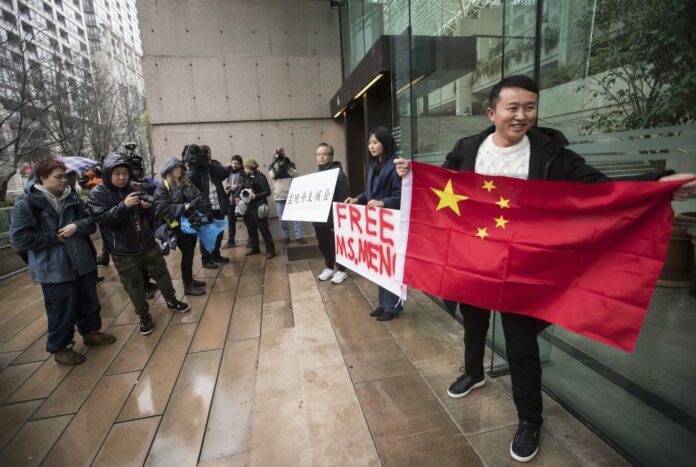
Supporters hold signs and a Chinese flag outside the British Columbia Supreme Court in Vancouver during the third day of a bail hearing for Meng Wanzhou, the chief financial officer of Huawei Technologies, on Dec. 11, 2018. (Darryl Dyck/The Canadian Press via AP)

VANCOUVER — A Canadian court granted bail Tuesday to a top Chinese executive arrested at the United States’ request in a case that has set off a diplomatic furor among the three countries and complicated high-stakes U.S.-China trade talks.

Hours before the bail hearing in Vancouver, China detained a former Canadian diplomat in Beijing in apparent retaliation for the Dec. 1 arrest of Meng Wanzhou, chief financial officer of Chinese telecommunications giant Huawei and daughter of the company’s founder.

After three days of hearings, a British Columbia justice granted bail of $10 million Canadian (US$7.5 million) to Meng, but required her to wear an ankle bracelet, surrender her passports, stay in Vancouver and its suburbs and confine herself to one of her two Vancouver homes from 11 p.m. to 6 a.m.

The decision was met with applause in the packed courtroom, where members of Vancouver’s Chinese community had turned out to show support for Meng. She left the courthouse late Tuesday surrounded by a security detail and was driven away in a black SUV without responding to questions from reporters.

Amid rising tension between China and Canada, Canadian Public Safety Minister Ralph Goodale confirmed earlier that a former Canadian diplomat had been detained in Beijing. The detention came after China warned Canada of consequences for Meng’s arrest.

“We’re deeply concerned,” Goodale said. “A Canadian is obviously in difficulty in China. … We are sparing no effort to do everything we possibly can to look after his safety.”

Michael Kovrig, who previously worked as a diplomat in China and elsewhere, was taken into custody by the Beijing Bureau of Chinese State Security on Monday night during one of his regular visits to Beijing, said the International Crisis Group, for which Kovrig works as North East Asia adviser.

Rob Malley, head of the Brussels-based non-governmental group, said Canadian consular officers had not been given access to Kovrig. He thinks Kovrig was in Beijing on personal matters and was definitely not there for any reason that would undermine Chinese national security.

Canada had been bracing for retaliation for Meng’ arrest. The Canadian province of British Columbia canceled a trade mission to China amid fears China could detain Canadians to put pressure on Ottawa over Meng’s detention.

“In China there is no coincidence,” Guy Saint-Jacques, a former Canadian ambassador to China, said of Kovrig’s detention. “Unfortunately Canada is caught in the middle of this dispute between the U.S and China. Because China cannot kick the U.S. they turn to the next target.”

Earlier in the day, China vowed to “spare no effort” to protect against “any bullying that infringes the legitimate rights and interests of Chinese citizens.”

Chinese Foreign Minister Wang Yi didn’t mention Meng by name. But ministry spokesman Lu Kang said Wang was referring to cases of all Chinese abroad, including Meng’s.

Washington accuses Huawei of using a Hong Kong shell company to sell equipment to Iran in violation of U.S. sanctions. It says Meng and Huawei misled banks about the company’s business dealings in Iran.

On Tuesday, U.S. State Department spokesman Robert Palladino told reporters in Washington “the charges against Meng pertain to alleged lies to United States financial institutions” about Huawei’s business dealings in Iran.

“It is clear from the filings that were unsealed in Canada, Meng and others are alleged to have put financial institutions at risk of criminal and civil liability in the United States by deceiving those institutions as to the nature and extent of Huawei’s business in Iran,” Palladino said.

Meng has denied the U.S. allegations through her lawyer in court, promising to fight them if she is extradited to face charges in the United States.

“We have every confidence that the Canadian and U.S. legal systems will reach a just conclusion in the following proceedings,” Huawei said in a statement.

“As we have stressed all along, Huawei complies with all applicable laws and regulations in the countries and regions where we operate, including export control and sanction laws of the UN, US, and EU. We look forward to a timely resolution to this matter.”

Huawei, the biggest global supplier of network gear for phone and internet companies, is the target of U.S. security concerns. Washington has pressured other countries to limit use of its technology, warning they could be opening themselves up to surveillance and theft of information.

The U.S. and China have tried to keep Meng’s case separate from their wider trade dispute and suggested Tuesday that talks to resolve their differences may resume.

But President Donald Trump undercut efforts to distinguish between trade talks and the Huawei case. In an interview with Reuters, he said Tuesday that he would consider intervening in the Justice Department’s case against Meng if it would be in the interest of U.S. national security or help forge a trade deal with Beijing.

Roland Paris, a former foreign policy adviser to Canadian Prime Minister Justin Trudeau, called Trump’s comments troubling.

“Canada is acting in good faith, according to the law, in response to a U.S. extradition request,” Paris tweeted.

The Chinese government said its economy czar had discussed plans with U.S. Treasury Secretary Steven Mnuchin and Trade Rep. Robert Lighthizer for talks aimed at settling the two countries’ differences. Lighthizer’s office confirmed he had spoken by phone with Chinese Vice Premier Liu He.

The news that trade negotiations may resume lifted stock markets around the world.

The United States has slapped tariffs on $250 billion in Chinese imports in response to complaints Beijing steals American technology and forces U.S. companies to turn over trade secrets.

Tariffs on $200 billion of those imports were scheduled to rise from 10 percent to 25 percent on Jan. 1. But Trump agreed to postpone those by 90 days while the two sides negotiate.

___

Associated Press writer Jim Morris reported this story in Vancouver, AP writer Rob Gillies reported from Toronto and AP writer Paul Wiseman reported from Washington. AP writers Matthew Lee in Washington and Joe McDonald in Beijing contributed to this report.

Advertisement

Malaysian Ex-PM Slapped With New Charge Over 1MDB Scandal

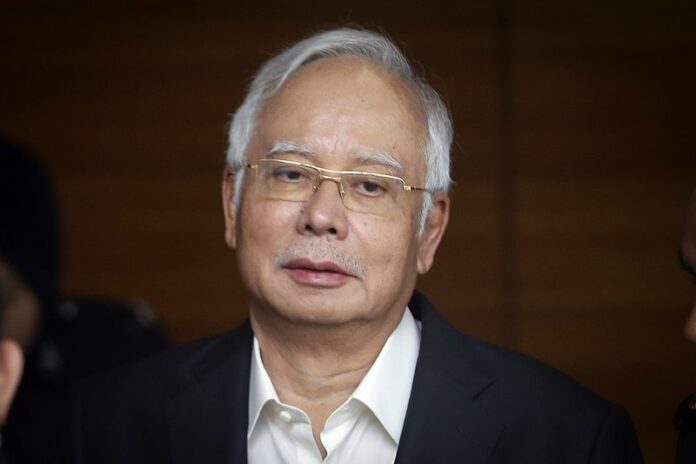
Former Malaysian Prime Minister Najib Razak in May arrives at Malaysian Anti-Corruption Commission (MACC) Office in July in Putrajaya, Malaysia. Photo: Vincent Thian / Associated Press

KUALA LUMPUR — Former Malaysian Prime Minister Najib Razak was charged Wednesday with tampering with the final audit report into a defunct state investment fund, adding to a long list of corruption allegations against him since his ouster in May elections.

Najib was charged along with Arul Kanda Kandasamy, the former head of the 1MDB fund, which is being investigated in the U.S. and other countries for alleged cross-border embezzlement and money laundering.

Najib pleaded not guilty to abusing power to order the modification of the report in February 2016 before it was presented to the Public Accounts Committee, in order to protect himself from disciplinary and legal action. Kandasamy, who was detained overnight by anti-graft officials, pleaded not guilty to abetting Najib.

The charges came after the auditor-general revealed last month that some details had been removed from the 1MDB report. Kandasamy led 1MDB from 2015 until he was terminated in June. The two men were released on bail, and face up to 20 years in prison if found guilty.

Najib set up 1MDB when he took power in 2009 to promote economic development, but the fund amassed billions in debts. U.S. investigators say Najib’s associates stole and laundered USD$4.5 billion from the fund, including some that landed in Najib’s bank account.

Public anger over the scandal led to the defeat of Najib’s long-ruling coalition in May 9 elections and ushered in the first change of power since Malaysia gained independence from Britain in 1957.

The new government reopened the investigations stifled under Najib’s rule. Najib, his wife and several top-ranking former government officials have been charged with multiple counts of corruption, criminal breach of trust and money laundering.

Najib, 65, has accused the new government of political vengeance.

Advertisement

Hot News

LATEST NEWS

Bangkok
light rain
23.9 ° C
26.6 °
23.9 °
56 %
2.8kmh
100 %
Sun
29 °
Mon
31 °
Tue
36 °
Wed
31 °
Thu
33 °