


































28.8 C
Bangkok
Monday, July 6, 2026
Home Blog Page 1777

Japan to OK Divisive Bill Allowing More Foreign Workers

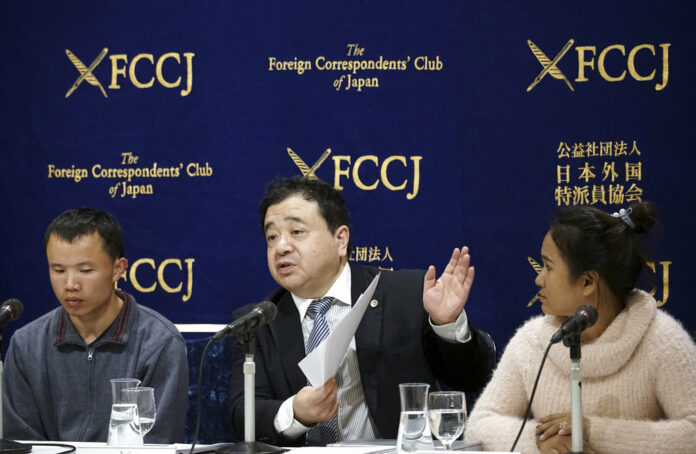
Lawyer Shoichi Ibusuki, center, speaks in November during a press conference in Tokyo, on the problems in Japan's technical intern program, with Eng Pisey, right, Cambodian technical trainee and Huang Shihu, left, Chinese technical trainee in Tokyo. Photo: Eugene Hoshiko / Associated Press

TOKYO — Japan is preparing to officially open the door to foreign workers to do unskilled jobs and possibly eventually become citizens.

Lawmakers were to vote early Saturday on government-proposed legislation allowing hundreds of thousands of foreign laborers to live and work in a country that has long resisted accepting outsiders. The bill is expected to pass because of the ruling party’s majority in parliament.

It’s seen as an unavoidable step as the country’s population of about 126 million rapidly ages and shrinks.

Many short-handed industries, especially in the services sector, already rely heavily on foreign “trainees” and language students. The country also selectively grants visas to white-collar professionals, often from the west.

Bringing in foreign laborers is a last resort after Prime Minister Shinzo Abe’s deeply conservative government tried to meet labor shortages by encouraging more employment of women and older workers and using more robots and other automation.

“Japan has come to a point where we had to face the reality that there is serious depopulation and serious aging,” said Toshihiro Menju, an expert on foreign labor and population issues at the Japan Center for International Exchange.

“Shortages of workers are so serious … that (allowing) immigrants is the only option the government can take,” he said.

Abe’s latest plan calls for relaxing Japan’s visa requirements in sectors facing severe labor shortages such as construction, nursing, farming, transport and tourism – new categories of jobs to be added to the current list of highly skilled professionals.

The number of foreign workers in Japan has more than doubled since 2000 to nearly 1.3 million last year, out of a working-age population of 67 million. Workers from developing Asian countries used to stay mostly behind the scenes, but not anymore. Almost all convenience stores are partly staffed by Asian workers and so are many restaurant chains.

The fastest growing group of foreign workers is Vietnamese, many of whom are employed in construction and nursing. Construction workers are particularly in demand as Japan rushes to finish building venues and other infrastructure for the 2020 Tokyo Olympics.

In many cases the workers are subjected to poor working conditions and other abuses.

“I had no time for a holiday. … Even if I worked so hard I still had no money,” said Eng Pisey, 33, from Cambodia, who came to Japan on a training program in 2016 and worked at a garment factory in Tochigi, north of Tokyo. She said she had to borrow USD$4,000 to pay a broker to arrange her job, and ended up quitting after becoming ill from overwork.

Under the legislation, two categories of workers will be accepted beginning in April: less-skilled workers and former interns with basic Japanese competency are allowed to stay in the country for only up to five years as visitors and cannot bring in family members. That is meant to encourage them to leave when their visas expire, preventing them from settling in Japan.

The second category, those with higher skills, Japanese language and cultural understanding, would be allowed to bring their families and apply for citizenship after living in Japan for 10 years if they commit no crimes.

“Creating new visa statuses to accommodate foreign human resources is our urgent task as we face serious labor shortages, especially at small and medium-size companies,” Chief Cabinet Secretary Yoshihide Suga said Friday.

Many Japanese understand the need to solve labor shortages. Industry groups have urged the government to expand the work visa program so they can legally hire more foreign workers.

But Abe’s traditional political base and opposition groups oppose the change – for different reasons.

Abe has denied that Japan is opening the door to immigrants. His right-wing supporters view Japan as a homogenous society and want to keep out outsiders, especially those from other Asian countries. They cite concerns over risks of more crime.

Human rights activists and lawyers have criticized the legislation, saying it has insufficient protections and support for foreign workers and lacks a vision for how Japan might create a more inclusive society that accepts diversity.

Since 1993, Japan’s Technical Intern Training Program has provided on-the-job training in the name of international cooperation, mostly to workers from other Asian countries. The trainees often have worked under poor conditions. In 2017 some 7,000 of the 270,000 technical interns fled, citing underpay and mistreatment, according to government statistics.

Shoichi Ibusuki, a lawyer specializing in labor cases who aids victimized foreign students and interns, says the program is a guise for using cheap labor. He says it should be scrapped and replaced.

Ibusuki supports giving unskilled workers official status, but says the legislation fails to provide enough protections for workers. In particular, he is unhappy with the lack of restrictions on recruiting brokers who are cited as a cause of abuse. “The program seems to treat foreign workers like goods, not humans,” he said.

Huang Shihu, a Chinese intern, said he came to Japan to study the language while working, but suffered a severe hand injury after being employed for about six months at a tin factory in Kobe. He said his employer claimed it could not pay him compensation because it was bankrupt.

“With this hand injury I can’t work. I don’t know what to do,” Huang told reporters, showing his still bandaged fingers. “I really feel wronged by the company.”

Menju said the lack of oversight in the existing trainee program allowed mistreatment to persist, with foreign workers seen as cheap labor willing to tolerate harsh conditions. He hopes the new program will allow a fresh start.

The legislation is not so great, he says, but may mark a turning point. “This is the first time people started to discuss the issue of foreign workers,” Menju said. “Before that it was a taboo.”

Story: Mari Yamaguchi
Advertisement

Opinion: Honest Learning From Strangers in the Next Table

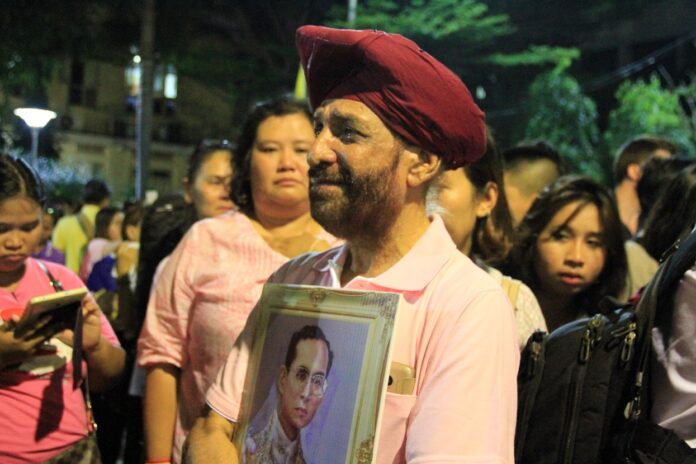
A man weeps outside Siriraj Hospital on the evening of Thursday, Oct. 13, 2016, in Bangkok, where HM King Bhumibol had earlier died.

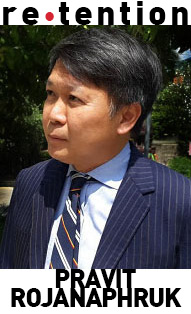
Re•tention: Pravit Rojanaphruk

One of the occasional perks of sitting alone at a cafe or bar next to a table of conversing people is you get to hear things you otherwise wouldn’t.

At a cafe in Bangkok, I recently sat next to a table of four people talking about “Thainess” and the alleged problem of the hotel industry.

On “Thainess,” three of the four opinionated people were trying to describe the essence of Thai identity. The three; a Thai-Indian man, a Thai-Chinese woman in her late twenties who grew up in Hong Kong, and a Frenchman of similar age to the rest, were deep into the debate when the lady concluded that “Thainess” is about three things: lying, smiling and avoiding conflict.

The rest seemed to concur and the debate effectively ended.

I personally do not believe in looking to find the essence of culture or the much-abused notion of “Thainess.” The former basically posits that all diversity in society can be reduced to a few alleged dominant traits – correctly or not.

As for the notion of “Thainess,” not only does it reject diversity in norms and behavior, but it is often used to promote a specific kind of behaviour according to the wishes of those in power.

The most obvious is the dominant hegemony tying “Thainess” to loyalty to the monarchy, which leaves Thais who question it – or even the draconian lese majeste law – as “un-Thai.”

Back to the conversation I overheard, the same lady complained about the seniority system in the Thai luxury hotel industry and how once you speak openly about work-related conflicts with other colleagues, they cannot put the matter behind. She said that as a result, she could no longer expect to advance her career at the organization in the future because she didn’t avoid open conflict.

Being just an eavesdropper, I lacked the context to fully verify such situations, but it left me with food for thought and reminded me how some Thais would avoid confrontation until it ruins an organization or the economy, as problems are swept under the rug until the last minute. Think of the 1997 financial crisis, for example.

Last topic worth mentioning is the Thai-Indian man complaining about how other Thai commuters would avoid him like the plague on the BTS Skytrain, as they assume all Indians have a strong body odour.

“But like other Thais, I shower properly and don’t smell,” he told his friends in English. The man then added that the seats next to him are often the last to be taken. At one time, he said he was standing next to a smelly Caucasian and that the Thais around him assumed the odor came from him and started distancing themselves.

These conversations are at times politically incorrect but frank and fluid. They enables us to rethink some of the assumptions we have and lead us to topics we may not have thought about. It is the reason why I often enjoy sitting alone next to a table full of opinionated people.

I had been eavesdropping for about half an hour and by then, the group seemed aware that I had been sitting alone for far too long.

I smiled, got up and discreetly left my table feeling thankful.

Advertisement

Officials: 6 Dead, Dozens Hurt in Club Stampede in Italy

Image: Rising Bd / YouTube

ROME — Six people have died and dozens have been injured in a stampede at a nightclub at a coastal town in central Italy.

Italian fire officials and the ANSA news agency said concertgoers at a nightclub in the town of Corinaldo, on the Adriatic Sea, panicked and ran for the exits after someone sprayed a noxious substance.

A teenage survivor told ANSA that when he tried to flee, he discovered that at least one of the emergency exits was locked.

Advertisement

Cambodia’s Hun Sen Says No to Foreign Military Bases

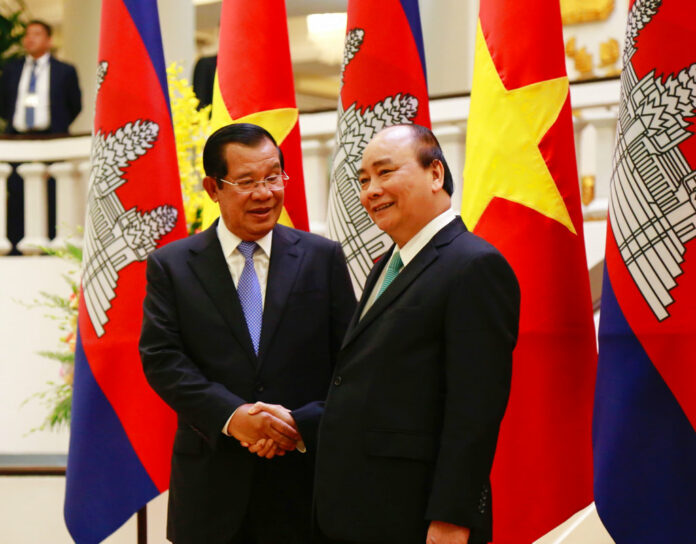
Cambodian Prime Minister Hun Sen, left, shakes hands Friday with his Vietnamese counterpart Nguyen Xuan Phuc before heading for talks behind closed doors in Hanoi, Vietnam. Photo: Tran Van Minh / Associated Press

HANOI — Cambodian Prime Minister Hun Sen said Friday that his government will not allow any foreign military bases in its territory and called media reports that China is seeking a naval base there “fake news.”

Hun Sen, who is on a three-day visit to Vietnam, insisted at a news briefing with his Vietnamese counterpart, Nguyen Xuan Phuc, that the Cambodian Constitution does not permit foreign military bases.

“I want to emphasize to you that the Constitution of the Kingdom of Cambodia does not allow any country to set up military bases in Cambodia,” Hun Sun said through a translator.

Asia Times reported last month that China has lobbied Cambodia since 2017 for a base in the southwestern province of Koh Kong in the Gulf of Thailand.

Hun Sen dismissed the report.

“There has been distorting information over the past month that there are preparations to build military establishments in Cambodia,” he said. “I want to say and I have just told Prime Minister Nguyen Xuan Phuc and the Vietnamese delegation that this is fake news and there’s no such thing happening in Cambodia.”

Asia Times said the alleged naval base is part of a USD$3.8 billion tourism development named Dara Sakor Beachside Resort led by a Chinese company. It said the project reportedly includes a deep-water port, an international airport and manufacturing facilities.

It is located in the Gulf of Thailand but has direct access to the South China Sea, most of which is claimed by China. China in recent years has built seven artificial islands in the disputed Spratly Island chain and placed military equipment on some of them, raising alarm among other countries in the region and in the United States.

Advertisement

Thailand Begins Extradition of Bahraini Football Player

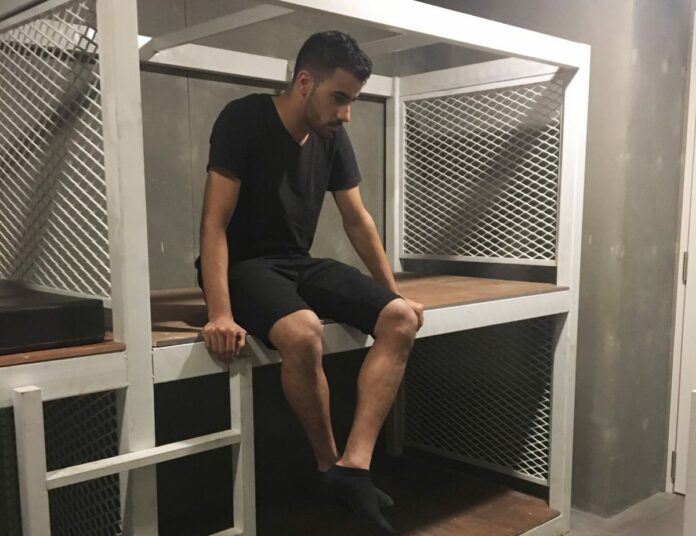
Hakeem Ali Mohamed Ali Al-Araibi in lockup at Suvarnabhumi Airport in November. Photo: Human Rights Watch / Courtesy

Update: Bahraini Football Player Moved to Jail Before Extradition Hearing (Video)

BANGKOK — Thai authorities have approved an arrest warrant for a detained Bahraini footballer with Australian refugee status, kickstarting extradition back to the home country he fled after alleged torture.

According to a human rights watchdog, the Bangkok Criminal Court on Friday approved an arrest warrant for Hakeem Ali Mohamed Ali AlAraibi, a Bahraini footballer who was taken into custody at Suvarnabhumi Airport last week and prevented from flying to Australia, where he has political refugee status.

“There’s imminent concerns that Thai authorities aren’t listening and will send him to be tortured while violating international law,” Sunai Phasuk of Human Rights Watch said. “If we can contact Big Joke, we will know for sure when the extradition process is initiating,” he said, referring to Surachet Hakpan, commander of the Immigration Bureau Police.

Sunai said that Human Rights Watch believes that the court approved the warrant based on Bahrain’s extradition request. Immigration Police could not be immediately reached for comment.

FIFA itself issued a request for AlAraibi to be returned, an unprecedented move by the ruling football body, said Sunai. The request was prompted by Human Rights Watch’s warnings, he said.

Read: FIFA Supports Bahraini Football Player Detained at Suvarnabhumi

“One positive thing about all this is that he now has a lawyer. He was allowed legal counsel for the first time today, but it should have been earlier,” Sunai said. On Thursday, AlAraibi was reportedly prevented from meeting with his attorney at the Suan Phlu Immigration Detention Center.

According to the Bahrain Institute for Rights and Democracy, AlAraibi said Thursday, “This might be my last message. I still don’t know whether I will be deported to Bahrain tomorrow. I appeal to the United Nations, individual states, FIFA, footballers, and all people, as my fate is now in danger and my future will soon be over.”

AlAraibi said that if he is deported to Bahrain, anything said by or about him should no longer be considered credible.

“I know what will happen to me and I know I will be tortured to confess things that I have never done. Please continue your fight to save me,” he said.

Other refugee networks have also called for AlAraibi to be returned to Australia.

“It is outrageous that the Thai government is even considering the extradition request from the Bahrain government,” Evan Jones, spokesman of the Asia Pacific Refugee Rights Network said. “To return Mr Al-Araibi to Bahrain would be disastrous and would most certainly breach their obligations under customary international law.”

According to the London-based institute, AlAraibi was tortured by Bahrain authorities in 2012 allegedly for his brother’s political activities and public criticism of the Bahraini royal family’s alleged involvement in sports scandals.

AlAraibi, who now plays on Melbourne’s Pascoe Vale Football Club, fled Bahrain to Australia in 2014 after he was sentenced to a decade in prison for allegedly vandalizing a police station, which he denies.

He was granted refugee status in November 2017, which allows him to live in Australia. He was first detained at Suvarnabhumi Airport on Nov. 27 and later moved to the downtown detention center this past Saturday. On Tuesday, a Thai court approved holding him for 12 days in Bangkok.

Related stories:

FIFA Supports Bahraini Football Player Detained at Suvarnabhumi

BKK Departure of Bahraini Refugee Footballer Blocked

Advertisement

Thailand World’s Most Unequal Nation? Govt Says Not

Shoppers and tourists at IconSiam shopping mall on Nov. 9.

BANGKOK — A government spokesman on Friday hit back at a Swiss bank report claiming Thailand has the world’s most unequal distribution of wealth.

Puttipong Punnakan said the claim, which was based on a report released by global investment firm Credit Suisse, is misleading because it only examined 40 countries – most of them wealthy members of the OECD – and relied on outdated data.

“In reality, the situation of inequality in Thailand has been gradually improving,” Puttipong said.

The issue was first raised by Banyong Pongpanich, a former advisor to the prime minister from 2014 to 2016, who posted the Credit Suisse report on his Facebook and noted that the wealthiest 1 percent possess more than two-thirds of the nation’s wealth, or 66.9 percent.

“Thailand has become the most unequal country in the world,” Banyong wrote, a remark that was seized by many media agencies in their headlines.

The Credit Suisse report sampled Thailand and 39 other nations like the US, UK, Austria and France. Two years ago, it ranked Thailand the third most unequal nation behind Russia and India.

The government took exception to two dated citations in the report, a socioeconomic survey from 2006 and household debt report from 2008.

Puttipong said that data is outdated and Thailand has come a long way since then.

“The ratio of income difference between the richest and the poorest fell from 29.92 times in 2006 to 19.29 times in 2017,” the spokesman said.

He also said putting Thailand in the sampled group is also [not fair] because all other nations, except for China, India, Colombia, Romania, South Africa and Taiwan, are developed countries in the Organisation for Economic Co-operation and Development.

A separate report by the World Bank, updated in September, said Thailand has been making gains in eradicating poverty, though it added that inequality remains an important issue.

“As of 2014, over 80 percent of the country’s 7.1 million poor live in rural areas. Moreover, an additional 6.7 million were living within 20 percent above the national poverty line and remain vulnerable to falling back into poverty,” the World Bank said.

Advertisement

New Study Explains Creation of Deadly California ‘Firenado’

REDDING, California — A rare fire tornado that raged during this summer’s deadly Carr Fire in Northern California was created by a combination of scorching weather, erratic winds and an ice-topped cloud that towered miles into the atmosphere, according to a study announced Wednesday.

The churning funnel of smoke and flame killed a firefighter as it exploded in what already was a vast and devastating wildfire in July on the edge of Redding, about 250 miles (400 kilometers) north of San Francisco.

The wildfire claimed eight lives and destroyed more than 1,000 homes before it was contained on Aug. 30.

The study in the Geophysical Research Letters journal used satellite and radar data to suggest how a monstrous “firenado” the size of three football fields developed on July 26.

It said the firenado was formed in much the same way as a regular tornado, which differs from the “fire whirls” that are formed only by heat from a wildfire.

The only other documented case of such a “firenado” was during the 2003 Canberra fires in Australia, according to the study.

A key factor was the development of a cloud generated by the fire itself that was ice-topped and grew quickly, doubling in length in just 15 minutes. It reached as high as 39,000 feet (11.9 kilometers), according to the study, which was published on Nov. 21.

The development of that pyrocumulonimbus cloud “helped stretch the underlying column of air, concentrating the rotation near the surface” and causing tornado-strength winds that reached 143 mph, according to the study.

“This paints a clear picture of the sequence of events leading to the vortex development and intensification,” said Neil Lareau of the University of Nevada, Reno, who co-authored the paper.

Other factors included record high temperatures, low humidity and a “near-surface cyclonic wind shear zone,” according to the study. A wind shear occurs when the wind speed or direction suddenly changes, so that the wind actually is blowing in two opposite directions.

The wind shear near the ground set up the spin that developed the fire tornado plume, Lareau said.

“These observations may help forecasters and scientists identify – and potentially warn – for future destructive fire-generated vortices,” according to the study.

Lareau is an assistant professor in the Physics Department of the College of Science. The article was co-authored by Nicholas Nausler of the Storm Prediction Center in Norman, Oklahoma and John Abatzoglou from the Department of Geography at the University of Idaho in Moscow, Idaho.

Advertisement

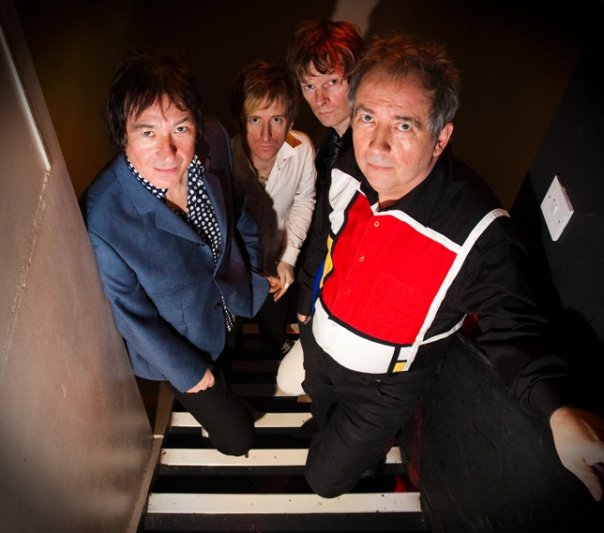
Pete Shelley, Punk Troubadour of Buzzcocks, Dies at 63

Image: Buzzcocks / Facebook

LONDON — Pete Shelley, the singer-songwriter and co-founder of the punk band the Buzzcocks, has died at age 63.

On Thursday, the band confirmed “with great sadness” his death and called him “one of the U.K.’s most influential and prolific songwriters.” The Buzzcocks announced in a tweet on its website. It did not elaborate on the details of Shelley’s death but said that more information would be released later.

The Buzzcocks were part of the punk revolution which began in England in the mid-1970s and also featured such groups as the Sex Pistols and the Clash. Like their contemporaries, the Buzzcocks scorned what they considered the pretensions and bloated style of mainstream groups and turned out brief, stripped down songs, performed at manic speed.

Their singles included “Ever Fallen in Love (With Someone You Shouldn’t’ve),” the explicit “Orgasm Addict” and “What Do I Get?” Their energy and intensity were worthy of punk, but they also had a melodic streak, with the song “Everybody’s Happy Nowadays” sounding at times like a punk version of the Beach Boys.

On Thursday, Mike Mills of R.E.M. tweeted: “Damn. Pete Shelley gone. The Buzzcocks were and are a favorite of mine, and I was fortunate to be able to hang with Pete a few times and tell him so.”

Shelley, whose real name was Peter Campbell McNeish, was born in the English town of Leigh in 1955. He founded Buzzcocks with Howard Devoto after they met at what is now the University of Bolton. The band debuted in 1976 in Manchester, opening for the Sex Pistols. Devoto left in 1977 and Shelley took over as lead singer.

The Buzzcocks broke up in the early 1980s, but reunited in the late ’80s and continued to perform and record over the past three decades.

Tributes poured in from around the music world.

Guns N’ Roses bassist Duff McKagan tweeted: “As a lifelong @Buzzcocks fan…I so appreciate the musical influence Pete. Condolences to your family….”

Peter Hook, the bassist and co-founder of Joy Division and New Order, tweeted: “Pete Shelley – a true gent! He helped us so much at the start of our career out of a sheer love for all things punk. Without Pete & the Buzzcocks I would probably still be working at the Docks. RIP mate.”


Advertisement

FIFA Supports Bahraini Football Player Detained at Suvarnabhumi

In this Thursday, Nov. 29, 2018, image from video, Hakeem Ali Mohamed Ali AlAraib speaks at Suvarnabhumi Airport, Thailand. Photo: SBS via AP

Update: Bahraini Football Player Moved to Jail Before Extradition Hearing (Video)

ZURICH — FIFA says it wants a soccer player who has refugee status in Australia to return to the country “at the earliest possible moment” rather than be extradited from Thailand to Bahrain.

Former Bahrain international Hakeem AlAraibi was detained at Bangkok airport last week. An Interpol warrant for his arrest was issued in apparent violation of rules protecting refugees.

Read: BKK Departure of Bahraini Refugee Footballer Blocked

World soccer’s ruling body FIFA says it now expects his case “to be solved in accordance with well-established international standards,” and has asked Australian soccer officials to urgently “take the matter up with their government.”

Australian authorities said last week that embassy officials in Bangkok were working on the case.

Rights activists say AlAraibi was tortured after being arrested in 2012. He fled to Australia which gave him political asylum.

Advertisement

Prawit Plays Down Republican Threat

A photo published by the Organization for a Thai Federation purports to show a group of people unfurl a republican flag in Udon Thani province. Image: Organization for a Thai Federation / YouTube

BANGKOK — Deputy junta chairman Prawit Wongsuwan said Friday a Thai republican group believed operating from Laos should not be taken seriously.

Gen. Prawit’s assessment of the underground network came after a meeting with the Laotian defense minister earlier today. Prawit said Gen. Chansamone Chanyalath confirmed the republicans are based in his country.

Prawit said Chansamone told him the cell consists of only a small number of people.

“Their movement is not worrying because they cannot do anything,” Prawit, who also serves as Thailand’s defense minister, said at a news conference. “They can only be a nuisance. They don’t have any force.”

Prawit added that Chansamone assured him Laotian authorities are looking into possible action against the group, which calls itself the Organization for a Thai Federation.

Calling for a republic is widely considered a crime in Thailand, where the constitution dictates that the country is ruled by a monarchy.

In September, at least four people were arrested for possessing black T-shirts emblazoned with the group’s symbol. On Wednesday police questioned two men who wore the T-shirts in public before releasing them without charge.

The pro-republic organization continues to publish videos advocating its cause on YouTube. In one recent video, the group called on supporters to don black shirts this past Wednesday, a public holiday dedicated to King Rama IX, as a show of strength.

The group also posted photos purportedly showing its supporters wearing black on that day in shopping malls like MBK, Mega Bangna and The Mall Bangkapi.

One photo shows a group of people, including a monk, unfurl a republican flag at a a shopping mall in the northeastern province of Udon Thani.

Advertisement

Hot News

LATEST NEWS

Bangkok
overcast clouds
28.8 ° C
28.8 °
28.8 °
81 %
3.6kmh
100 %
Mon
32 °
Tue
35 °
Wed
33 °
Thu
33 °
Fri
29 °