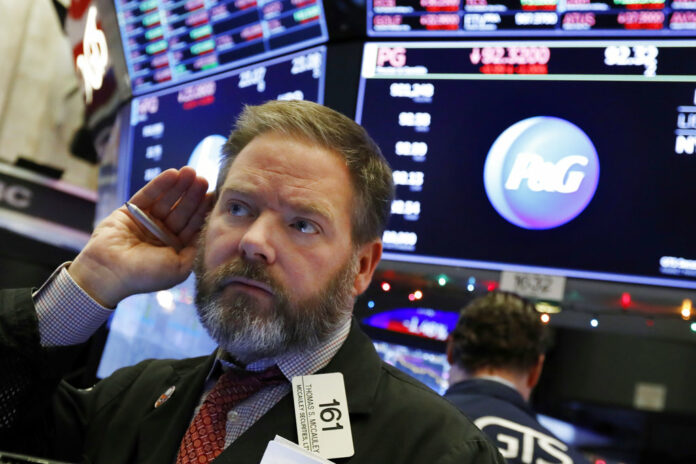
Trader Thomas McCauley works Thursday on the floor of the New York Stock Exchange. Photo: Richard Drew / Associated Press
TOKYO — Asian shares were mostly higher Friday after gains on Wall Street but investors continued to watch for news about U.S.-China trade friction.The Stock Exchange of Thailand was up slightly in late-morning trading.
KEEPING SCORE: Japan’s benchmark Nikkei 225 added 0.1 percent to 21,524.02, and Australia’s S&P/ASX 200 gained 0.5 percent to 5,685.50 in early trading. South Korea’s Kospi rose 0.1 percent to 2,070.83. Hong Kong’s Hang Seng inched up less than 0.1 percent to 26,164.46, while the Shanghai Composite was also up less than 0.1 percent at 2,606.52. Shares were also higher in Indonesia and Taiwan.
ANALYST’S TAKE: “Clouded with much uncertainty, markets will likely remain jittery and may struggle to hold on to the gains,” says Jayden Loh, a Trader at IG in Singapore.
WALL STREET: The S&P 500 index fell 4.11 points, or 0.2 percent, to 2,695.95. The benchmark index had been down as much as 2.9 percent. The Dow dropped 79.40 points, or 0.3 percent, to 24,947.67. The average briefly slumped as much as 784 points. The technology-heavy Nasdaq composite reversed an early loss to finish with a gain, adding 29.83 points, or 0.4 percent, to 7,188.26. The Russell 2000 index of small-company stocks gave up 3.34 points, or 0.2 percent, to 1,477.41. U.S. stock and bond trading were closed Wednesday because of a national day of mourning for President George H.W. Bush.
FED WATCH: Last week, stocks jumped after Fed Chairman Jerome Powell indicated the central bank might consider a pause in rate hikes next year while it gauges the impact of its credit tightening program. The Fed has raised rates three times this year and is expected to boost rates for a fourth time at its Dec. 18-19 meeting of policymakers. At the same time, there has been growing evidence that global economic growth is slowing.
TRADE WATCH: The gap between what the U.S. sells and what it buys from foreign countries hit $55.5 billion in October, according to the U.S. Commerce Department. The politically sensitive deficit with China rose 7.1 percent to a record $43.1 billion. The dramatic arrest of Meng Wanzhou, Huawei’s chief financial officer, has driven home why it will be so hard for the Trump administration to resolve its deepening conflict with China. Skepticism is growing about the trade truce Presidents Donald Trump and Xi Jinping reached last weekend in Buenos Aires, Argentina.
ENERGY: U.S. benchmark crude fell 24 cents to $51.25 a barrel. It dropped 2.6 percent to $51.49 a barrel in New York. Brent crude, used to price international oils, dipped 39 cents to $59.67.
CURRENCIES: The dollar weakened to 112.75 yen from 112.80 yen late Thursday. The euro rose to $1.1376 from $1.1345.
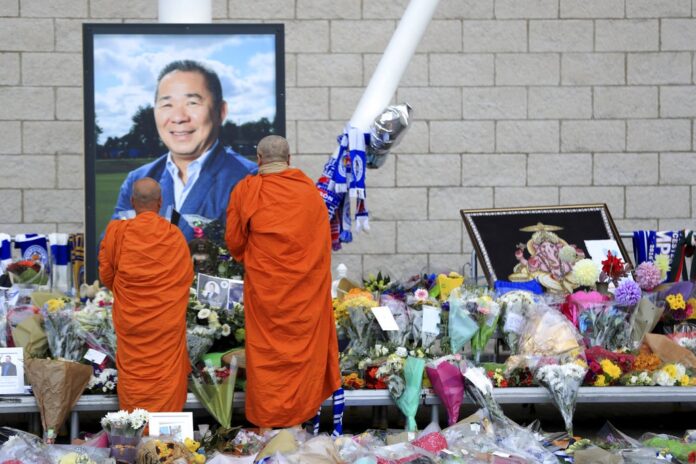
Buddhist Monks pay their respects Nov. 31 at Leicester City Football Club in Leicester, England. Photo: Mike Egerton / Associated Press
LONDON — Investigators say the helicopter involved in a crash that killed the owner of English soccer team Leicester and four other people lost control because of a mechanical fault.
The Air Accidents Investigation Branch says the mechanism linking the pilot’s pedals with the tail rotor blades became disconnected, resulting in the helicopter making an uncontrollable right turn before it spun and crashed.
Vichai Srivaddhanaprabha, the Thai retail entrepreneur who owned Leicester, was among those killed when his aircraft crashed and burst in flames outside the King Power Stadium following a Premier League game on Oct. 27.
The AAIB provided its update on Thursday after a detailed examination of the helicopter’s control system. It will continue to investigate.
Footage of the incident appears to show that sections of the tail rotor may have fallen off in mid-air.
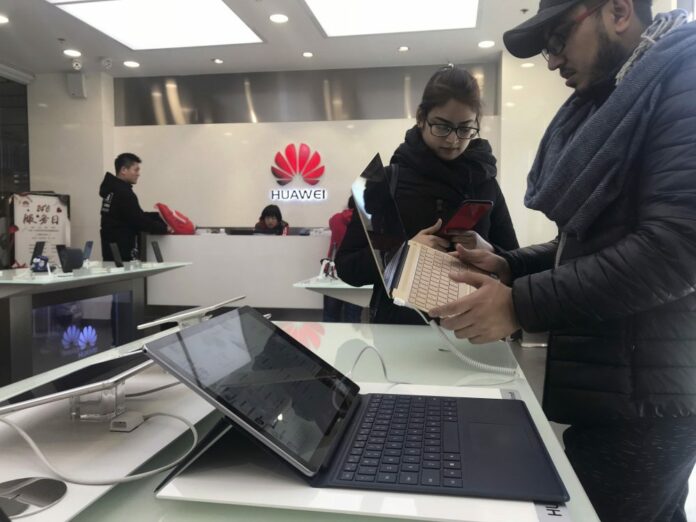
Foreigners look at a Huawei computer at a Huawei store in Beijing, China, Thursday, Dec. 6, 2018. (AP Photo/Ng Han Guan)
WASHINGTON — The dramatic arrest of a Chinese telecommunications executive has driven home why it will be so hard for the Trump administration to resolve its deepening conflict with China.
In the short run, the arrest of Huawei’s chief financial officer heightened skepticism about the trade truce that Presidents Donald Trump and Xi Jinping reached last weekend in Buenos Aires, Argentina. On Thursday, U.S. stock markets tumbled on fears that the 90-day cease-fire won’t last, before regaining most of their losses by the close of trading.
But the case of an executive for a Chinese company that’s been a subject of U.S. national security concerns carries echoes well beyond tariffs or market access. Washington and Beijing are locked in a clash over which of the world’s two largest economies will command economic and political dominance for decades to come.
“It’s a much broader issue than just a trade dispute,” said Amanda DeBusk, chair of the international trade practice at Dechert LLP. “It pulls in: Who is going to be the world leader essentially.”
The Huawei executive, Meng Wanzhou, was detained by Canadian authorities in Vancouver as she was changing flights Saturday — the same day that Trump and Xi met at the Group of 20 summit in Argentina and produced a cease-fire in their trade war. The Globe and Mail newspaper, citing law enforcement sources, reported that Meng is suspected of trying to evade U.S. sanctions on Iran. She faces extradition to the United States, and a bail hearing was set for Friday.
The British bank HSBC is cooperating with U.S. authorities in its investigation, people familiar with the matter said Thursday.
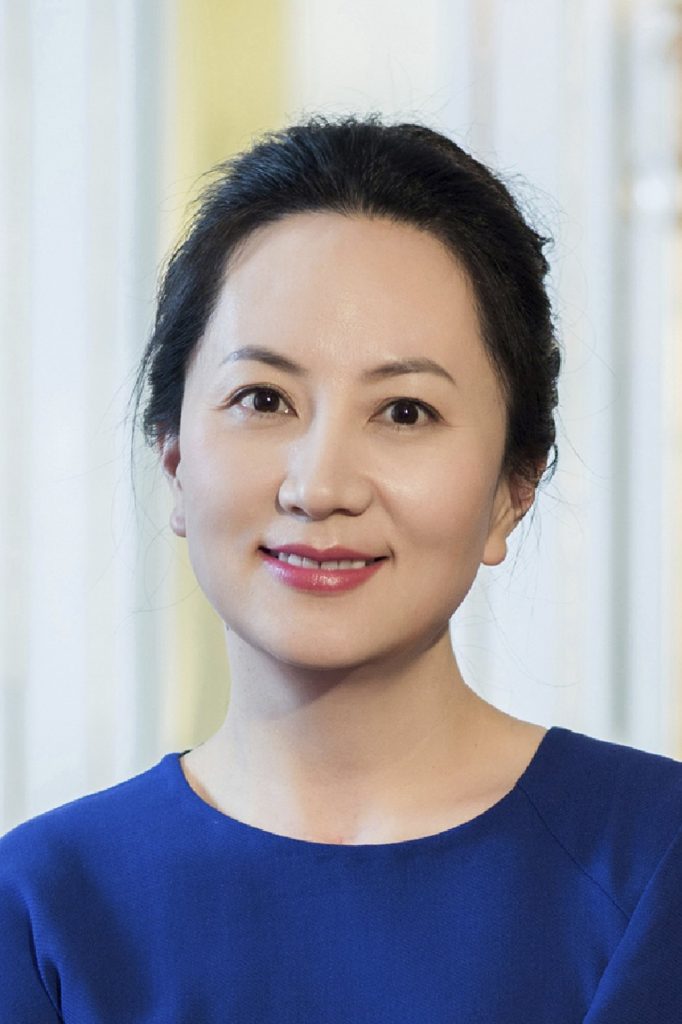
Meng Wanzhou (Huawei via AP)
Huawei, the world’s biggest supplier of network gear used by phone and internet companies, has long been seen as a front for spying by the Chinese military or security services, whose cyber-spies are widely acknowledged as highly skilled. A U.S. National Security Agency cybersecurity adviser, Rob Joyce, last month accused Beijing of violating a 2015 agreement with the U.S. to halt electronic theft of intellectual property.
Other nations are increasingly being forced to choose between Chinese and U.S. suppliers for next-generation “5G” wireless technology. Washington has been pushing other countries not to buy the equipment from Huawei, arguing that the company may be working stealthily for Beijing’s spymasters.
Beijing protested Meng’s arrest but signaled that it doesn’t want to disrupt progress toward settling its trade dispute with the Trump administration. Chinese Commerce Ministry spokesman Gao Feng said China is confident it can reach a deal during the 90 days that Trump agreed to suspend a scheduled increase in U.S. import taxes on $200 billion worth of Chinese products.
U.S. national security adviser John Bolton told NPR that he knew of the pending arrest in advance. He noted that there has been much concern about the suspicion that Chinese firms like Huawei use stolen U.S. intellectual property.
In the view of the United States and many outside analysts, China has embarked on an aggressive drive to overtake America’s dominance in technology and global economic leadership. According to analysts, China has deployed predatory tactics, from forcing American and other foreign companies to hand over trade secrets in exchange for access to the Chinese market to engaging in cyber-theft.
Washington also regards Beijing’s ambitious long-term development plan, “Made in China 2025,” as a scheme to dominate such fields as robotics and electric vehicles by unfairly subsidizing Chinese companies and discriminating against foreign competitors.
In addition to Trump’s tariffs, the administration is tightening regulations on high-tech exports to China. It’s also making it harder for Chinese firms to invest in U.S. companies or to buy American technology in such cutting-edge areas as robotics, artificial intelligence and virtual reality.
Earlier this year, the United States nearly drove Huawei’s biggest Chinese rival, ZTE Corp., out of business for selling equipment to North Korea and Iran in violation of U.S. sanctions. But Trump issued a reprieve, possibly in part because U.S. tech companies are major suppliers of the Chinese giant and would also have been scorched. ZTE got off with paying a $1 billion fine, changing its board and management and agreeing to let American regulators monitor its operations.
The U.S. and Chinese tech industries depend on each other so much for components that “it is very hard to decouple the two without punishing U.S. companies, without shooting ourselves in the foot,” said Adam Segal, cyberspace analyst at the Council on Foreign Relations.
Dean Garfield, president of the U.S. Information Technology Industry Council trade group, said innovation by U.S. companies often depends utterly on product development and testing by Chinese partners, not to mention component suppliers.
British Telecom said this week that it would stop using Huawei equipment in its 5G network, the BBC reported, and U.S. lawmakers have lobbied Canada’s prime minister to freeze out the Chinese supplier. New Zealand and Australia already have. Other, less wealthy nations are concerned less about spying and more about low prices, which play to Huawei’s advantage.
Both Huawei and ZTE have not only been barred from use by U.S. government agencies and contractors; they have also been mostly locked out of the American market. A 2012 report by the House Intelligence Committee report urged U.S. businesses to avoid their products and called for blocking all mergers or acquisitions involving them.
And nearly a year ago, AT&T pulled out of a deal to sell Huawei smartphones.
“There is ample evidence to suggest that no major Chinese company is independent of the Chinese government and Communist Party — and Huawei, which China’s government and military tout as a ‘national champion’ is no exception,” Sens. Mark Warner, D-Va., and Marco Rubio, R-Fla., wrote in October to Canadian Prime Minister Justin Trudeau. They urged him to keep Huawei off Canada’s next-generation network.
Priscilla Moriuchi, a former East Asia specialist at National Security Agency now with the cybersecurity firm Recorded Future, said both ZTE and Huawei are wedded to China’s military and political leadership.
“The threat from these companies lies in their access to critical internet backbone infrastructure,” she said.
“No matter what happens in the short term, (the arrest of Huawei’s CFO) is a symptom of a long-term technology clash,” said Derek Scissors, a China specialist at the conservative American Enterprise Institute. “We’re not going to deal that away in 90 days.”
Scissors said he doubts that China will change its tech policies. Beijing must develop innovative technologies to keep its economy growing as its labor force ages and it confronts a huge stockpile of debt. Yet its political and economic system — which promotes inefficient state-owned companies at the expense of nimbler private ones — discourages innovation.
“I don’t see a way out of this,” Scissors said.
Likewise, Rod Hunter, an international economic official in President George W. Bush’s White House and a partner at law firm Baker McKenzie, said, “I’m skeptical that the Chinese are going to want to say ‘uncle.’ ” U.S. and Chinese officials are “trying to tackle a problem that is going to take years, maybe a decade, to resolve.”
___
Bajak reported from Boston. AP staff writers Rob Gillies in Toronto and Joe McDonald in Beijing contributed to this report.
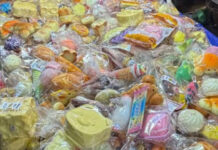
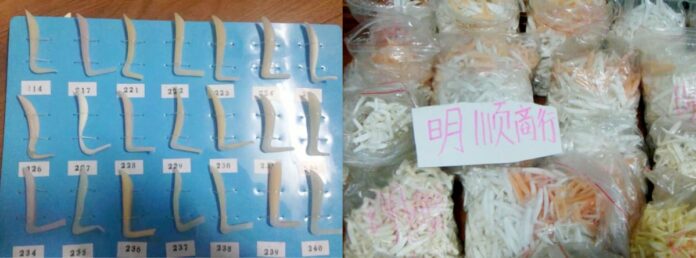
BANGKOK — Netizens have been touching their nozzles in a mix of awed confusion after a post of silicone implants went viral – especially since every faux-nose costs under 100 baht.
It started with an online post consisting of nothing but bundles of silicone noses that appeared Thursday night and has since been liked and shared tens of thousands of times. What really caught attention was these olfactory augmentations are being sold not at nosebleed prices but for less than many Bangkok meals.
“I was looking for stuff to sell but found this. They sell them by the kilo – silicone noses and chins from America, Korea and China,” Ratchadaporn Sathipjan, who posted the images, wrote. “Each one is less than 100 baht. No wonder plastic surgeons are rich as hell!”
Ratchadaporn, who imports clothing and other items from China for resale, said she found the images and prices on a Chinese wholesale website. She won’t tell nosy netizens which one, however.
“I already did a nose job, so I decided to post it for fun since it was interesting to me,” Ratchadaporn said by phone.
A lot of discussion ensued, but mostly of the positive variety – no one was looking down their septums at these noses. Especially those who’ve gone under the rhinoplasty knife.
“Dammit, one of those is in my nose! 5555,” commented user Muekeyboard Pookaamodduaymueplao.
“I guess some fresh doc grad is gonna set up a clinic with a 4,900 baht or 7,900 baht promotion now,” wrote Pacharawalee Changkeb.
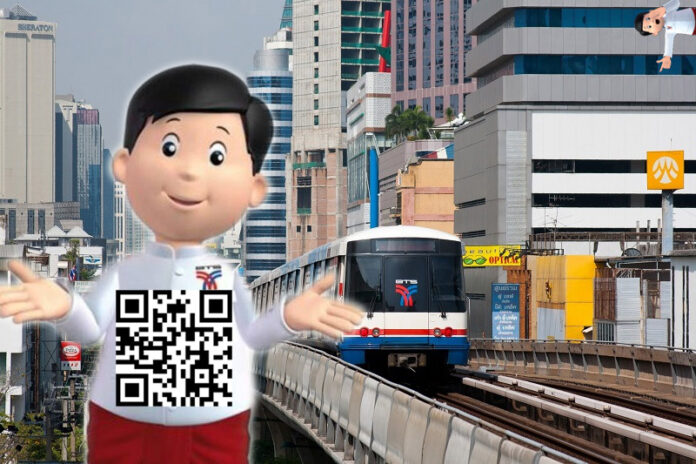
Bangkok's BTS Skystrain in 2010. Original image: Ilya Plekhanov / Wikimedia Commons
BANGKOK — Commuters can now use their cleverphones to pay for fares by QR code at six BTS Skytrain stations, the operator announced Thursday.
The system is being piloted at BTS Siam, Ari, Chong Nonsi, Samrong, Paknam and Kheha, with the aim of expanding it to all stations by next month, according to BTS chief Surapong Laoha-Unya.
Paying for tickets with cash is inconvenient for both commuters and the company, Anat Arbhabhirama, a company executive, said. He added that the change will save the operator time lost handling cash transactions.
Similar to the present ticket vending machines found at some stations, there are now two automatic machines that take coins and QR codes – but not cash – at the six stations, two of which are on the new extension to Samut Prakan that opened today.
Passengers can scan the displayed QR code with their smartphones using Line or their commercial banking app to pay for single ride tickets.
Until now, only a few BTS stations have machines that can accept both coins and banknotes. Often, commuters without enough coins for a ticket have to line up to get change from an attendant then requeue to pay the machine.
BANGKOK — Ask for the right room inside a style-heavy boutique hotel in Ari to discover a hidden bar whose special cocktails retrace the globetrotting journey of one “Mr. Josh.”
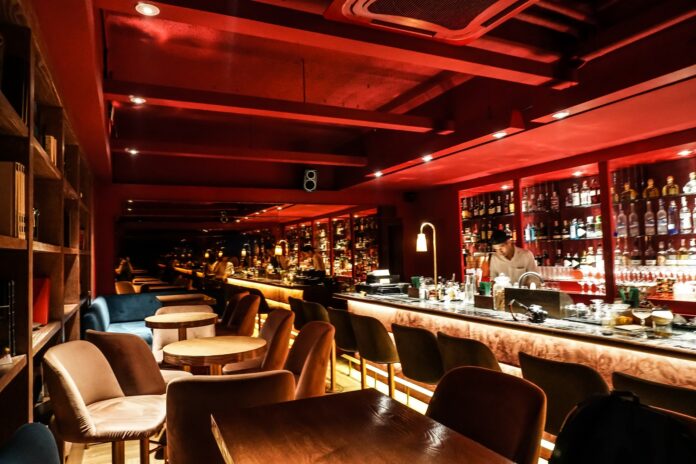
Enter an already-hip neighborhood to find the devoutly hip Josh Hotel, which borrows liberally from the visual style of director Wes Anderson. Step inside and tell staff you’re checking into room No. 72. Key card in hand, pass through a vampy red door to find not a single bed nor well-furnished suite, but a bar called The Key.
The speakeasy, which opened in late August, lays out its concept to serve cocktails invented by fictitious hotel and bar owner Mr. Josh, a world traveler who’s settled in Bangkok. What he looks like is up to guests’ imagination. One hint is a cartoon depiction on a sign out front that’s reminiscent of young reporter Tintin.
The bar, painted in vibrant red (like the reception area and elevator in “The Grand Budapest Hotel”), offers a long list of alcoholic beverages such as negroni, long islands and sazerac. But what barflies must really try is one or more of nine signature cocktails.
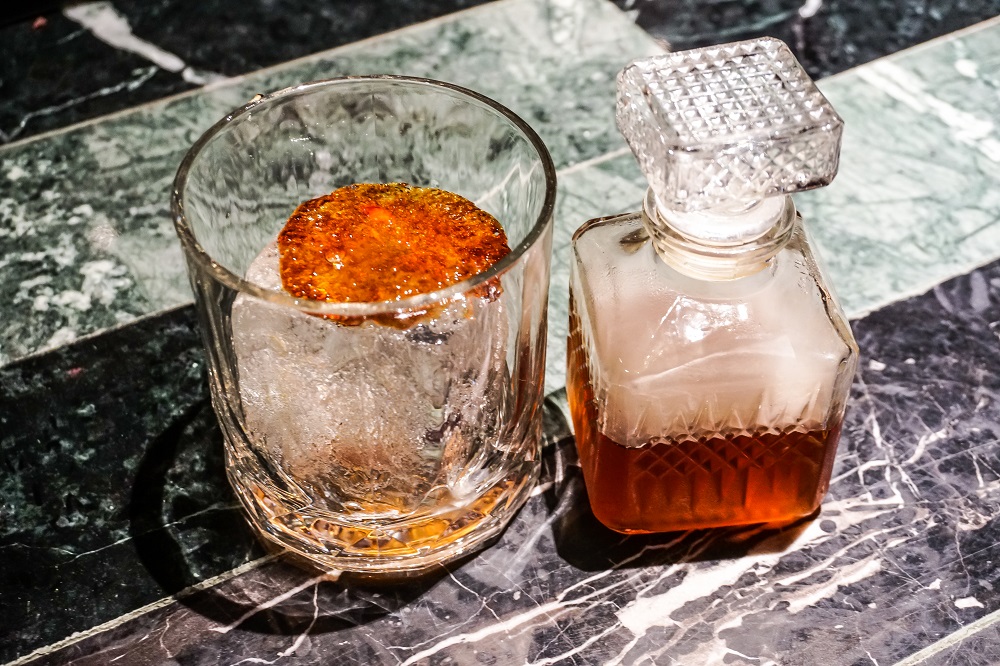
A rough day can be pushed away with a sip on the spirit-forward Mr. Josh’s Journey (380 baht). After the bartender takes a torch to it, the blended malt whiskey is served with the fragrance of smoked rosemary and a wafer of caramelized brown sugar. Nibble on the latter from time to time for a break from the heavy, bitter booze.
‘Mr. Josh’s Journey’
Mr. Josh must’ve visited America sometime between 1950 to 1959 because one of his drinks is called Marilyn 1950s (380 baht). It’s vodka, lime juice, honey syrup and grapefruit bitters. Cinnamon poured on top is a good compliment. Compared to the “Journey,” Marilyn is much easier to drink – and sexier, too.
If none of above suit your fancy, pick your favorite destination:
A Drop of Tokyo (350 baht) mixes vodka with sake joined by wasabi syrup. The Communists (320 baht) blends whiskey with coffee and star anise, a well-known Asian herbal spice, and is served with dried coconut. Josh’s trip to France becomes Sweet as Josephine (380 baht) as he puts truffle oil, raspberry syrup and lime juice in cognac.
Off the menu but available to order, Roasted Coconut (380 baht) is carefully crafted by mixologist Danuwat Into, who won second place at a recent contestchallenging them to use local ingredients. The very drink that brought him home the award, it’s a rum-based concoction with smoked coconut water and a pinch of aromatic floral tonic, garnished with a single piece of burnt dried coconut.
Music fans should come on Fridays and Saturdays for full-on jazz music. The space-limited, refurbished meeting room can accommodate up to 24.
The Key Room No. 72, is open 6pm to 2am every day inside Josh Hotel on Soi Ari 4 (North), a few minutes’ walk from BTS Ari.
Josh Hotel opened late last year with designs and decorations inspired by the visual style of American director Wes Anderson. The hotel attracts many visitors who check in for a getaway in Ari and, of course, snaps for their Instagram.
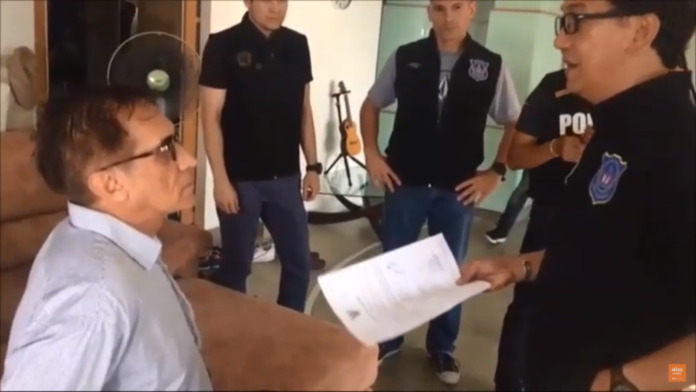
Police question David Kulik about a suspected cannabis export operation as they take him into custody Monday. Image: Matichon
BANGKOK — The police sent a strong reminder Thursday that weed in any form remains illegal by announcing the arrest of four men, including a Brit and Canadian, suspected of exporting cannabis oil on an industrial scale.
The Narcotics Control Board said the suspects; Englishman Joseph Toole, 67; Canadian David Kulik, 64; Suriyan Suwanchairob, 34; Suppakij Kaewma, 54; were detained Monday and charged with multiple counts relating to the production, possession and sale of Class 5 narcotics from their Samut Prakan factory for over a year.
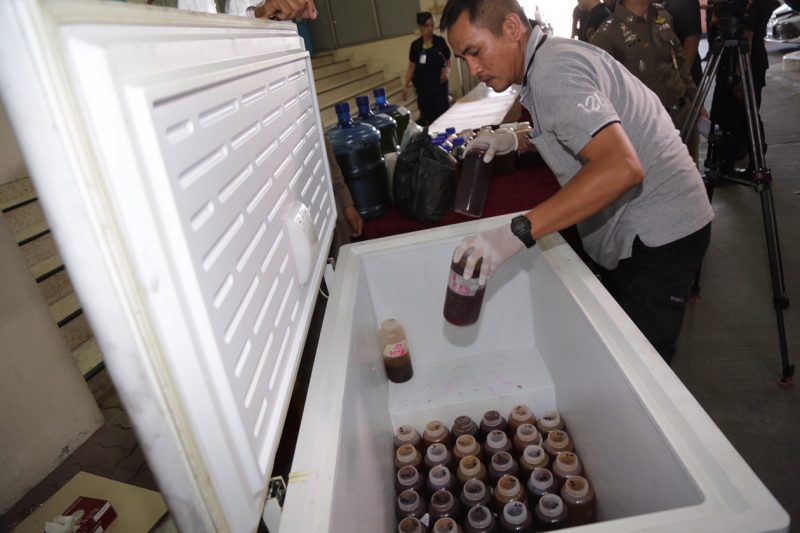
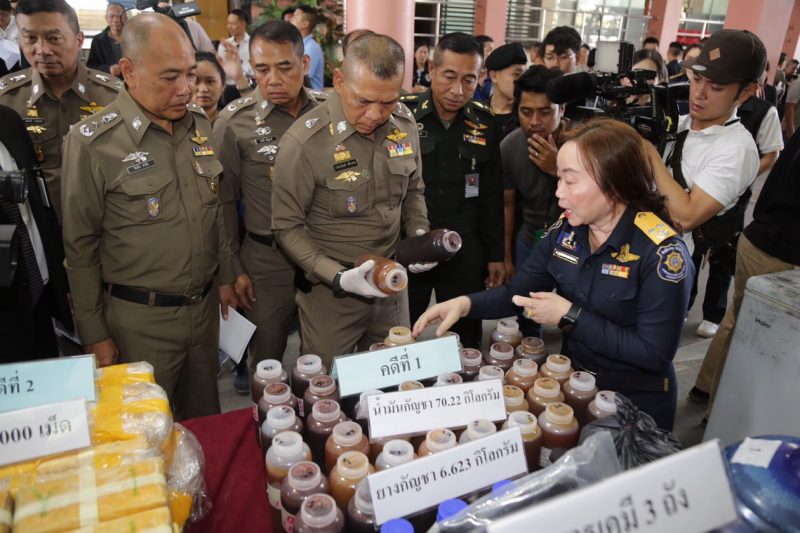
Following raids earlier this week, the authorities said they seized 70 kilograms of cannabis oil, 6.6 kilograms of the drug in resin form and related tools.
According to police, Toole and Kulik were arrested in Chonburi province, while Suriyan and Suppakij were found in Sakon Nakhon and Bangkok respectively.
They were accused of producing and exporting cannabis oil, which remains illegal under current drug laws, to several countries including Belgium. They allegedly obtained the raw materials from drug rings in Thailand and Laos.
Deputy police commissioner Chalermkiat Sriworakan said the department was tipped off about the group back in March and found their contraband hidden in shredded coconut shells shipping out of the Laemchabang Port. Some of the shipments made it to Antwerp, Belgium, he said.
Gen. Chalermkiat said the initial investigation points to Kulik being one of the investors, while Toole, a former doctor, was in charge of production.
He added that the group is believed to be headed by a Japanese investor. It’s estimated to have exported at least five metric tonnes of cannabis oil to Belgium, which might not be their sole destination. He said investigators are still unsure where else the group sent their products to, and whether more people were involved.
A bill legalizing medical cannabis and kratom is currently under review by the National Legislative Assembly.
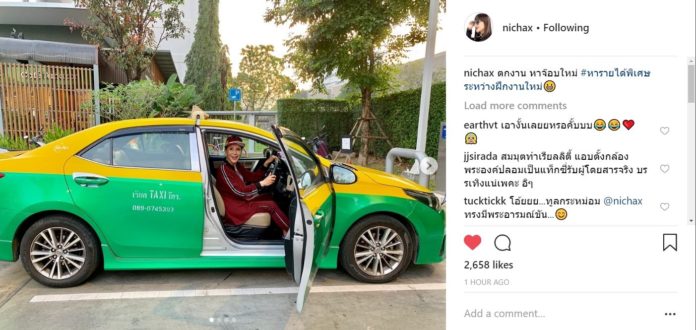
Princess Ubolratana in a taxi. Photo: Nichax / Instagram
BANGKOK — Princess Ubolratana posted a photo of herself behind the wheel of a taxi Thursday to the viral approval of many netizens.
“Out of work. Finding a new job. #SideHustlingWhileJobTraining,” read the caption, posted to her private (but widely followed) Instagram account.
The Land Transport Department could not be reached for comment as to what the 67-year-old princess, the eldest child of Queen Sirikit and the late King Bhumibol, was doing in the driver’s seat of a yellow-and-green taxi.
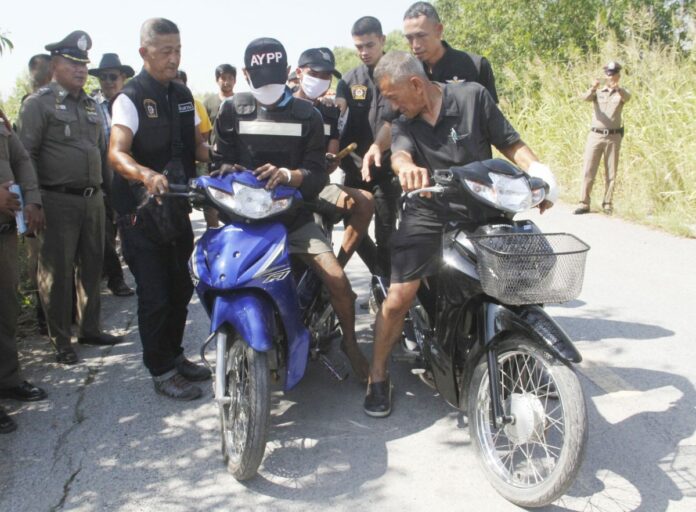
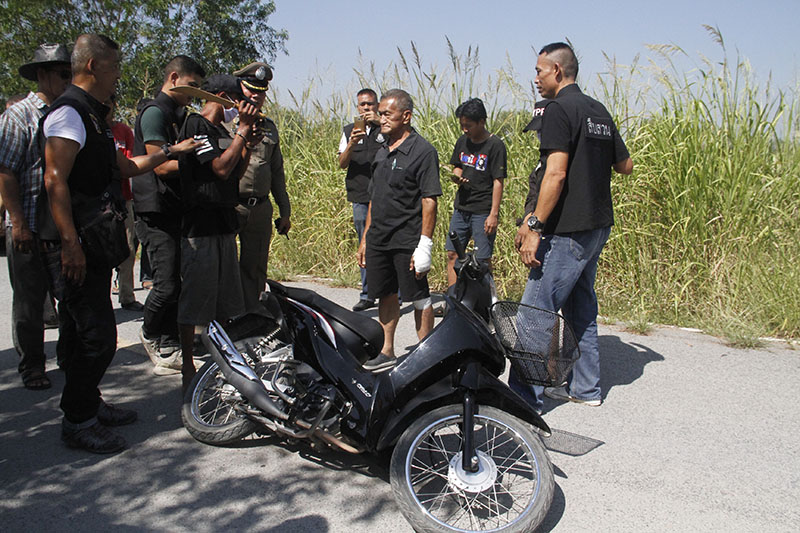
Police lead Suporn Supapradit and Saran Taosanya through a “crime reenactment” with Boonpop Yingsawad.
AYUTTHAYA — Two twenty-something men confessed to targeting elderly motorcyclists and mugging them at machete point on Father’s Day.
Police said Suporn Supapradit, 23, and Saran Taosanya, 21 confessed Wednesday to stealing two elderly men’s motorbikes, which they then traded for yaa baa pills.
“We targeted old people because they don’t fight back. I didn’t mean to hurt them, just threaten them,” Suporn said. “I just got out of jail and couldn’t find work, so I got my friend from prison to get together to do this.”
On Nov. 28, Suporn and Saran were on a motorcycle together when they forced 65-year-old Jame Peuchsing to pull over. After stealing Jame’s bike, they spotted Boonphop Yingsawad, 76, passing on another motorcycle. The pair raced after him and kicked his scooter to the ground before robbing him of his cash – 20 baht.
“I was coming back from the market when the two guys rode next to me and kicked my bike down,” Boonphop said, who sustained injury to a leg and arm.
Police found the two men through security camera footage along Liab Khlong Rom Sai Road in Bangkok’s Bang Sai district.
Suporn and Saran also allegedly confessed to mugging two other elderly people in north of Bangkok in Pathum Thani province.
Suporn said they would sell the stolen motorbikes and trade them for yaa baa. New motorbikes can fetch 60 pills, while older models net 20 to 30 pills, they said.
In March, an elderly Bangkok garbage picker diedafter being kicked unconscious by a 21-year-old man.
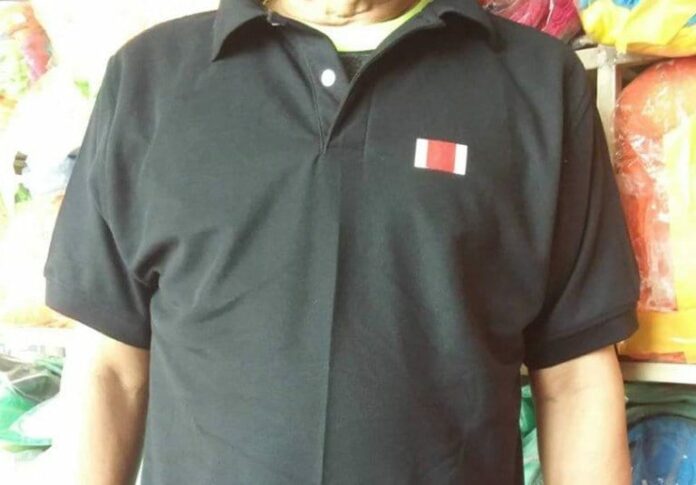
A photo of the black T-shirt with the red and white emblem associated with the Thai republican group. Image: Thai Lawyer for Human Rights.
BANGKOK — Police briefly detained a man and a woman wearing T-shirts associated with a republican group in public yesterday, according to a civil rights group.
Thai Lawyers for Human Rights said the pair were approached by police officers on Wednesday – a public holiday dedicated to King Rama IX – in Bangkok’s Lat Phrao district and taken to a local police station. They were reportedly released later in the day. An officer at the Lat Phrao Police Station declined to comment.
“I cannot answer any questions about this,” deputy station chief Satapana Junnawat said Thursday.
In an online post, the lawyers group said the two people, who would only identify themselves as Terdsak and Prapan, were approached by officers while they were eating at a McDonald’s and brought to the station for interrogation.
They were reportedly wearing black T-shirts with the emblem of the Organization for a Thai Federation, an underground network that seeks to secede parts of Thailand from the kingdom to establish a republic.
Thai Lawyers for Human Rights said the pair were later released at about 7pm without being charged. Terdsak and Prapan told the group that police warned them not to participate in any activity organized by the republicans.
In September, police arrested at least four people in connection with the pro-republic group. The organization responded to the crackdown by accusing the police of attempting to intimidate its supporters.
Correction: An earlier version of this article misidentified Prapan as a man. In fact, she is a woman. We regret the error.