

























33.8 C
Bangkok
Saturday, June 27, 2026
Home Blog Page 1819

Khashoggi Warns in Last Column of Free Rein to Silence Media

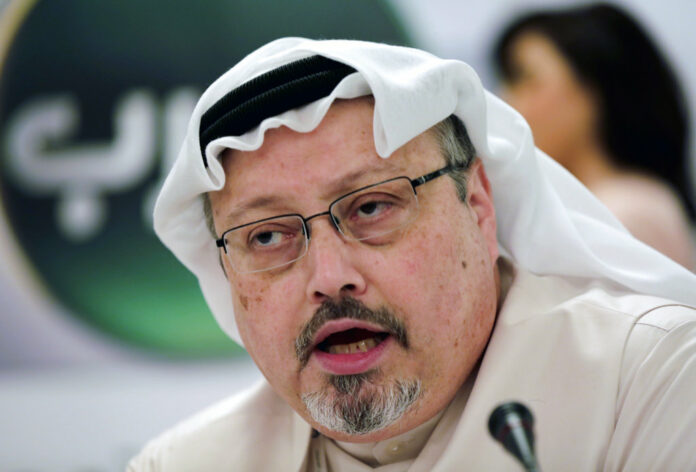
Saudi journalist Jamal Khashoggi speaks during a press conference in 2015 in Manama, Bahrain. Photo: Hasan Jamali / Associated Press

WASHINGTON — The Washington Post has published a new column by missing Saudi writer Jamal Khashoggi in which he warns that governments in the Middle East “have been given free rein to continue silencing the media at an increasing rate.”

The Post published the column Wednesday, more than two weeks after Khashoggi was last seen entering the Saudi Consulate in Istanbul and only hours after a gruesome account in Turkey’s Yeni Safak newspaper alleged that Saudi officials cut off Khashoggi’s fingers and then decapitated him inside the consulate while his fiancee waited outside. The Saudi government, including Crown Prince Mohammed bin Salman, has denied any involvement.

In a note affixed to the top of the column, Post Global Opinions editor Karen Attiah said she received the essay from Khashoggi’s translator and assistant a day after he was reported missing. Khashoggi first began writing for the Post’s opinion section in September 2017, and his columns criticized the prince and the direction of the Saudi kingdom.

In the op-ed, titled “Jamal Khashoggi: What the Arab world needs most is free expression,” Khashoggi recounted the imprisonment of a prominent writer who spoke against the Saudi establishment, and cited an incident in which the Egyptian government seized control of a newspaper.

“These actions no longer carry the consequence of a backlash from the international community. Instead, these actions may trigger condemnation quickly followed by silence,” he wrote.

“As a result, Arab governments have been given free rein to continue silencing the media at an increasing rate,” Khashoggi wrote.

President Donald Trump, who initially came out hard on the Saudis over the disappearance but since has backed off, said Wednesday that the U.S. wanted Turkey to turn over any audio or video recording it had of Khashoggi’s alleged killing “if it exists.” He has recently suggested that the global community had jumped to conclusions that Saudi Arabia was behind Khashoggi’s disappearance.

In the column, Khashoggi, a Saudi citizen who went into self-imposed exile in the U.S. over the rise of the crown prince, also discussed the practice of Middle Eastern governments blocking internet access to control tightly the information their citizens can see.

“The Arab world is facing its own version of an Iron Curtain, imposed not by external actors but through domestic forces vying for power,” Khashoggi wrote.

He praised the Post for translating many of his columns from English into Arabic and said it’s important for Middle Easterners to be able to read about democracy in the West. He also said it’s critical that Arab voices have a platform on which to be heard.

“We suffer from poverty, mismanagement and poor education,” Khashoggi wrote. “Through the creation of an independent international forum, isolated from the influence of nationalist governments spreading hate through propaganda, ordinary people in the Arab world would be able to address the structural problems their societies face.”

The Post initially held off on publishing the column amid hope for Khashoggi’s return, Attiah said. But, she wrote, “Now I have to accept: That is not going to happen.”

She ended her note: “This column perfectly captures his commitment and passion for freedom in the Arab world. A freedom he apparently gave his life for. I will be forever grateful he chose The Post as his final journalistic home one year ago and gave us the chance to work together.”

Story: Ashley Thomas
Advertisement

New Army Chief Open to Staging Another Coup

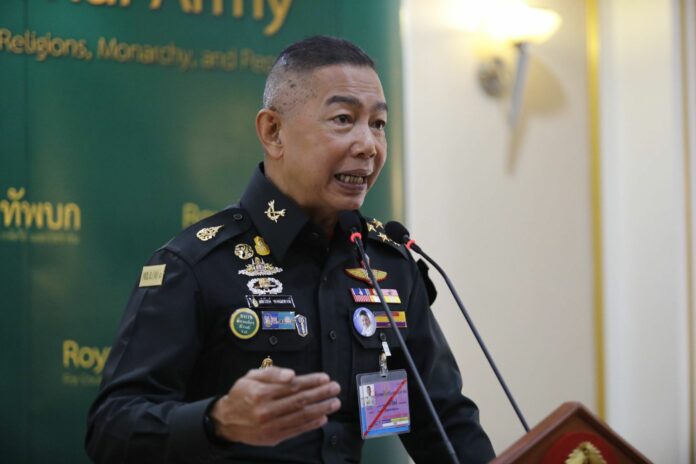
Army chief Gen. Apirat Kongsompong speaks to reporters Wednesday in Bangkok.

BANGKOK — The refusal by Thailand’s new army chief to disavow another military coup drew a heated response Thursday.

Former Pheu Thai Party MP Watana Muangsook said the army chief, who spoke to reporters for the first time Wednesday since assuming command earlier this month, is already placing himself above the law and damaging the investment climate.

“It shows that the army leader is autocratic and acts above the law because such remarks during the interview were a threat to use force to overthrow [the government] or change the constitution, which is a crime of treason under Article 113 of the Penal Code,” Wattana said in comments published online.

Read: New Army Chief Calls Royal Petitioners ‘Insane’

Gen. Apirat Kongsompong on Wednesday refused to commit to not staging another military coup when asked by a reporter if how he would handle another political crisis such as that which precipitated the 2014 coup that brought the current ruling junta to power.

“I am confident that if politics does not cause a riot, there won’t be any. Thailand has had more than 10 coups, but it’s no longer like in the past, because the recent ones occurred due to politics,” Apiwat said.

The new army chief, himself the son of the general who led the 1991 coup, assumed the all-powerful position on Oct. 1. He also defended current junta leader-cum-prime minister, saying he believes that Gen. Prayuth Chan-ocha did not intend to stage a coup over four years ago.

“I truly believe Gen. Prayuth never wanted to as well, but he had to sacrifice himself. What would have happened if Gen. Prayuth did not decide to stage the coup?” said the army chief, adding that he hopes there will be no future political violence.

Others on Facebook expressed anger at Apirat’s non-committal stance.

“An ungrateful guy! I’m a taxpayer!” Facebook user Kanonkkorn Onlamri wrote.

“I can’t believe that he would dare speak this way. They don’t respect the people who pay their salaries through taxes,” Facebook user Poom Pattara wrote.

Some defended Apirat and the most recent coup, however.

“The coup occurred after political demonstrations!! We must ask why protesters committed arson or shot innocent people …” @Notergg tweeted.

“I agree with the soldier,” @Skcallcenter tweeted last night.

One Twitter user put forth their idea for a solution: arming the electorate.

“Amend the law to enable people to more easily own guns, and there will be fewer coups,” wrote @Mowtntan on tweeted.

Advertisement

Trump Starts Leaving Postal Union in Latest Anti-China Move

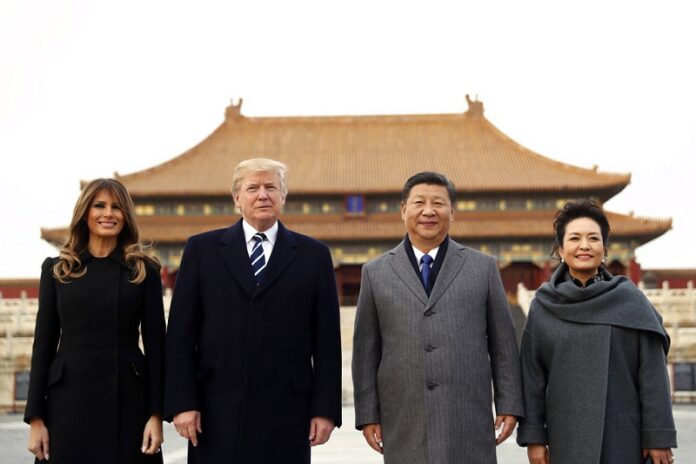
U.S. President Donald Trump, second left, first lady Melania Trump, left, Chinese President Xi Jinping and his wife Peng Liyuan stand together as they tour the Forbidden City in 2017 in Beijing, China. Photo: Andrew Harnik / Associated Press

WASHINGTON — The United States announced Wednesday that it is preparing to pull out of an international postal treaty that allows China to ship packages to America at discounted rates. The move would escalate a trade dispute with China.

President Donald Trump argues that the 144-year-old Universal Post Union benefits China and other countries at the expense of U.S. businesses – making it cheaper to ship packages from Beijing to New York than from San Francisco to the U.S. East coast, which particularly benefits Chinese manufacturers. The officials say the treaty is used by shippers of the narcotic fentanyl to the U.S. from China.

The U.S. is willing to renegotiate the treaty over the next year but will leave the union if no agreement can be reached, the officials said.

Bishar Hussein, director of the Universal Postal Union, said he regrets the U.S. decision and will seek a meeting with American officials.

The move was welcomed by the U.S National Association of Manufacturers, which called the exiting postal pact “outdated” in the age of e-commerce and at a time of Chinese manufacturing dominance.

“Manufacturers and manufacturing workers in the United States will greatly benefit from a modernized and far more fair arrangement with China,” Jay Timmons, president of the manufacturers association, said in a statement.

The U.S. and China are already locked in a trade war. The United States has imposed tariffs on about USD$250 billion in Chinese goods, and Beijing has responded by targeting about $110 billion in U.S. products.

The world’s two biggest economies are clashing over U.S. allegations that China is using predatory practices to challenge American technological dominance. These include hacking into U.S. companies’ computers to steal trade secrets and forcing American firms to hand over technology to China in exchange for access to the Chinese market.

Trump has made a point of cutting America’s international ties. His first week in office he pulled the United States out of a trade pact with 11 Pacific Rim countries. He also has left UNESCO and the United Nations Human Rights Council and pulled U.S. funding for the UN agency for Palestinian refugees.

Story: Zeke Miller, Paul Wiseman

Advertisement

Vietnam Frees Popular Blogger on Condition She Leave for US

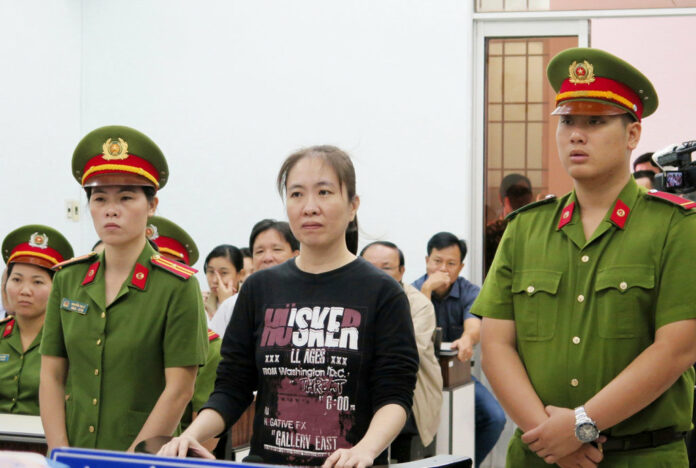
Nguyen Ngoc Nhu Quynh, center, a prominent Vietnamese blogger, stands trial in 2017 in the south-central province of Khanh Hoa, Vietnam. Photo: Tien Minh / Associated Press

HANOI — Vietnam has freed a well-known blogger after two years in prison on the condition that she leave for the United States.

Nguyen Ngoc Nhu Quynh, known as “Mother Mushroom,” was arrested in October 2016 and sentenced to 10 years in prison on charges of defaming the Communist government. The conviction of the popular blogger, who wrote about human rights and industrial pollution, drew criticism from some Western governments and international human rights groups.

Friends of the 39-year-old blogger said she was on her way to the U.S. with her mother and two young children.

“After numerous efforts, the family of Nguyen Ngoc Nhu Quynh was reunited in a free country,” her friend Nguyen Tin wrote on his Facebook page. “Congratulations to her small family.”

Quynh’s lawyer, Ha Huy Son, said her release was good news but did not lift the obstacles faced by people who fight for democracy in Vietnam.

Nicholas Bequelin, Amnesty International’s Regional Director for East and South East Asia, said in a statement, “While Mother Mushroom is no longer imprisoned, the condition for her release was exile and there are over one hundred people languishing in jail because they peacefully spoke their mind – in public, on blogs or on Facebook.”

In June, Vietnam’s Communist authorities released prominent human rights lawyer Nguyen Van Dai and exiled him and another dissident to Germany.

Quynh’s release came as U.S. Secretary of Defense Jim Mattis visited Vietnam.

Meawhile, a court in southern Binh Duong province sentenced an activist to seven years in prison on Wednesday after finding him guilty of producing 3,300 leaflets calling on workers to protest against a proposed law on special economic zones.

Nguyen Dinh Thanh, 27, was convicted of conducting propaganda against the state in the one-day trial.

Protests took place across the country in June against the proposed law, which critics say would favor Chinese investors. The government has since delayed passage of the law by the National Assembly.

Vietnam has stepped up a crackdown on dissent over the past two years with dozens of activists and bloggers put on trial for national security law-related offenses.

Despite sweeping economic reforms since the mid-1980s that opened Vietnam to foreign investment and trade and made it one of the fastest-growing economies in Asia, Communist authorities tolerate no challenge to their one-party rule.

There are more than 100 “prisoners of conscience” in Vietnamese prisons, according to Amnesty International.

Advertisement

Thai Law: Foreigners Need Business Visas to Attend Meetings

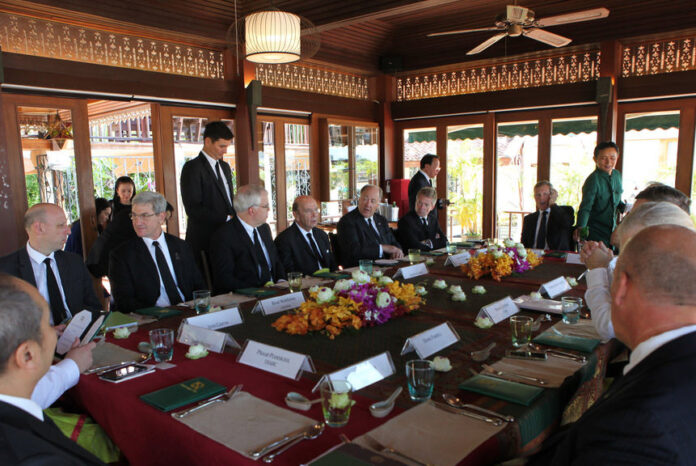
US Commerce Secretary Wilbur Ross, seated fifth from left, chairs a 2017 meeting in Bangkok. Photo: U.S. Embassy Bangkok

A recent revamp of the work permit law has made life easier for foreign investors visiting the country to do business. Since it was enacted earlier this year, the Executive Decree on Administration and Management of Employment of Foreigners means they are no longer required to obtain a work permit to attend business meetings in Thailand.

A legal peril few were likely aware of, it was in fact the case for decades that attending a meeting for even one day was deemed “work” under the law and therefore illegal without a permit.

wirot.3Most foreign visitors simply ignored the law and risked arrest by entering the country on a tourist visa to participate in meetings. Arrests were rare, and people took the remote risk for granted.

Yet, in the back of their minds, there was fear and worry.

Now, attending a business meeting without fear of arrest means only obtaining a business visa – at least until immigration law fully catches up. The link between the work permit and immigration laws is that foreigners must enter Thailand on a Non-Immigrant B Business Visa to obtain a work permit.

With all the hype of foreign direct investment glory, the irony was that attending the kinds of meetings that lead to local investment could be prosecuted as a crime. No one who has pondered this could imagine why a work permit was necessary. The illegality even extended to high-ranking executives of multinational companies coming to visit their Bangkok subsidiaries for meetings with local counterparts to supervise operations. Government after successive government, efforts to turn the City of Angels into a hub of regional headquarters was apparently at odds with the outdated law.

2013: A Watershed Moment

Complaints from the foreign business community prompted the Labor Ministry’s Department of Employment, or DOE, to seek a ruling from the Council of State, the government’s legal arm. In 2013, the council ruled in favor of foreign investors, saying that attending business meetings did not fall within the law’s definition of “work.”  To adopt the ruling as policy, the department issued internal written guidelines excluding business meeting attendance from the work definition and permit requirement.

Practically, no arrests have been made by labor enforcement officers for violation of the work permit law on the grounds of attending a business meeting without a work permit since the date of the guideline.

2015: Permanent Change

Because the guideline is a mere internal policy with no force of law, the DOE ultimately put a regulation in place regarding activities not classified as work two years later. “Attending meetings or consultation,” and “Attending meetings to discuss business” were no longer considered “work” – and as a result, a work permit was not necessary.

Under the new work permit law, meetings are no longer considered work, so the DOE no longer cares what type of visa foreigners obtain. They can have tourist visas, or any visa, or no visa at all if the country of residence is on the waiver list.

2018: Immigration Law Amended

But visas are governed by a separate law, the Immigration Act of 1979. Work permit and immigration laws are intertwined, and a violation of the former can be enforced by immigration police conducting raids on places of business.

In an attempt to align the immigration and work permit laws, the former was amended in March to cover the latest key amendments in the work permit law.

Unlike the new work permit law, no rulings or guidelines or regulations have been issued excluding business meetings from the definition of work under the new immigration law.

In principle, this is the same set of laws, and the new immigration law is meant to incorporate the new work permit law that allows business meetings without the need for a work permit or a Non-Immigrant B Business Visa.

One should validly assume the definition of “work” in the work permit law and the immigration law is the same, with “Attending meetings to discuss business” excluded from the definition, even though there are no express words authenticating that assumption. Just as with the work permit law, no work permit or a business visa should be required under the immigration law.

Should be legal isn’t the same thing as legal, when it comes to the letter of the law.

The lack of specific wording prompts immigration police in the field to continue to interpret the immigration law in that traditional way: Attending business meetings remains work or business, and therefore the business visa is always required.

Immigration still sees tourist visas for the purpose of tourism and unusable to attend business meetings – which are for work and business, and must therefore come under the umbrella of a business visa.

Their view is that any foreign executive attending a business meeting on a tourist visa is in violation of immigration law (which in turn incorporates some key provisions of the work permit law by way of reference), and risks being arrested if, for instance, authorities are tipped off by a rival company.

Issue New Immigration Guideline

Obviously, foreign investors are caught between the inconsistencies of two government bodies interpreting two overlapping laws differently. While foreign executives are relieved that they do not have to apply for a work permit to attend a business meeting, their unnecessary burden remains taking the precautionary measure of applying for a business visa before arriving in the kingdom. It’s the only way to be assured immigration police won’t take them into custody.

To circumvent the two connected laws running in opposite directions, there are two options.

The first is easier: The Immigration Division of the National Police Bureau might consider issuing a clear, practical, internal guideline to underline its policy to its law enforcement officers to adopt the regulations and guidelines of the DOE that a tourist visa or the normal visa exemption is sufficient. The existing broad language of the new immigration law already provides a solid foundation for this approach.

The second option is more complicated, but achievable: Make an immigration regulation or announcement that packs the punch of law along the same lines as the DOE regulation to expressly exclude business meetings from “work.”  The proposed regulations should steer clear of any doubt by specifically permitting meeting attendance on a regular tourist visa or visa waiver.

Either move will alleviate the worries of top executives in multinational companies who visit Thailand to join meetings that their freedom will not be at stake for the technical reason of traveling on the wrong visa.  The effort would square the two laws and strengthen Thailand’s reputation as a leading, investor-friendly nation in the region.

Wirot Poonsuwan is a practicing attorney and can be reached at [email protected].

Advertisement

Mahidol Prof Dies After Being Pulled From Flaming Wreck

BANGKOK — A Mahidol University lecturer died Wednesday night after he was dramatically pulled from a burning vehicle near Central Pinklao.

Rattakarn Komolrat, a 40-year-old business instructor, was taken to the Chao Phraya Hospital where he succumbed to injuries and loss of blood sustained in a car accident that took place on Borommaratchachonnani Road.

Rattakarn’s Nissan had crashed into the back of a pickup truck at about 10:45am. It soon became engulfed in flames. Dramatic images from the scene showed his rescue by a police officer.

Capt. Saranpong Onsing said he used a hammer to break a window and pull Rattakarn from the car before he was burned to death.

Investigating officer Lt. Col. Natthanan Muang-ngam said the driver of the pickup truck was being questioned.

Rattakarn taught Business Administration at the Mahidol University International College.

106584

Advertisement

MTV’s ‘Real World’ Coming to Thailand Next Year

NEW YORK — MTV’s long-running reality show “The Real World” is going digital and international.

The network announced Wednesday that its production studio will work with Facebook Watch to create new editions of the series next year for audiences in the United States, Mexico and Thailand. The series, which depicts the adventures of young strangers placed in a house together, will stream on Facebook Watch.

The social media platform will also try to connect fans to participants in the show with Facebook Live, watch parties and other innovations. MTV president Chris McCarthy said it’s an opportunity to create a new genre of television.

“The Real World” aired 32 separate seasons on MTV between 1992 and 2017. It’s the first time it will have international editions with non-U.S. cast members.

Advertisement

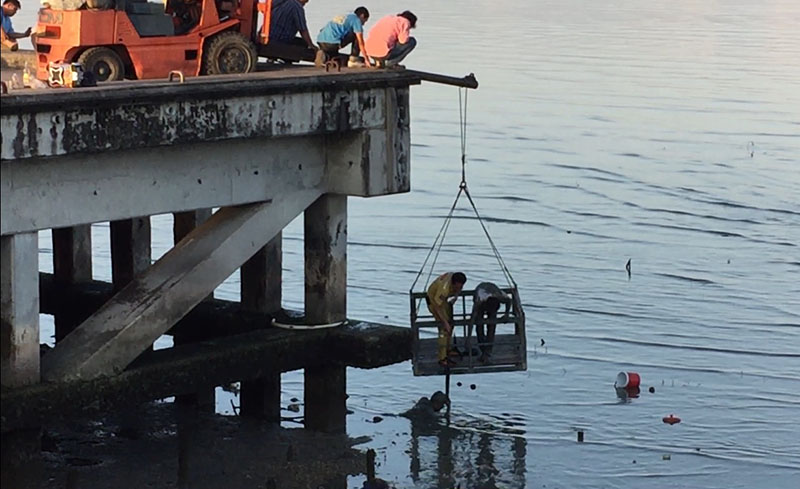
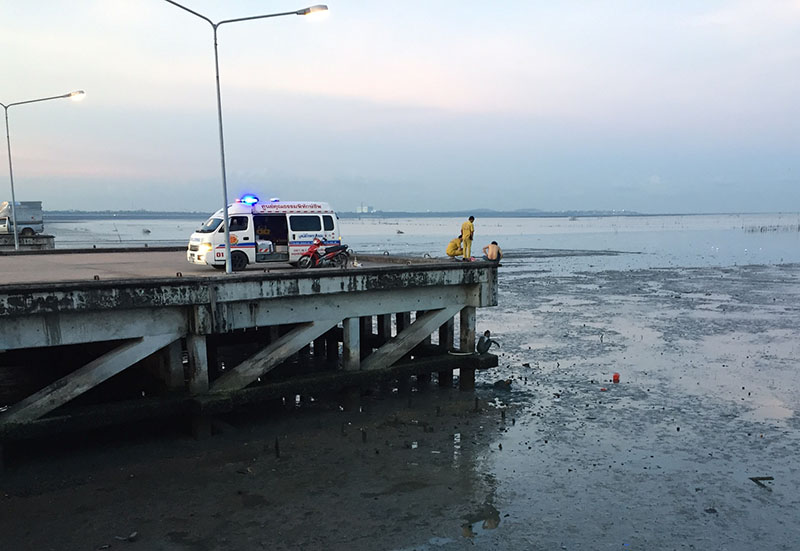
Forklift Frees Drunk Chonburi Man From Really Sticky Mud

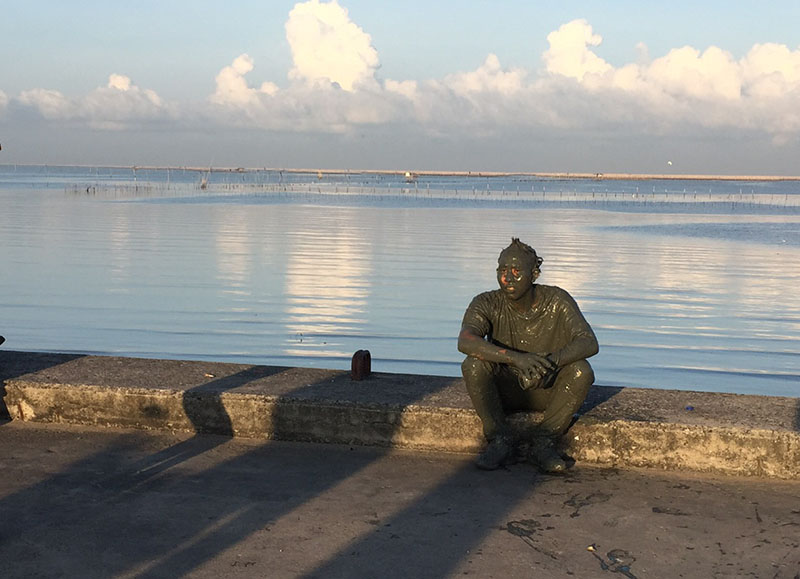
CHONBURI — A man who capped off an all-night bender with a drunken morning pier jog Wednesday found himself trapped in mud and unable to get up.

Rescue workers had to bring a forklift to raise Songpong Singseeta from the muddy quagmire he fell five meters into near the Plee Seaside Market parking lot. He was uninjured, physically.

Songpong, 32, had been drinking with two buddies on the pier all night before he decided, still drunk, to go for the fateful morning run.

S 27238403 S 27238415 S 27238410

Advertisement

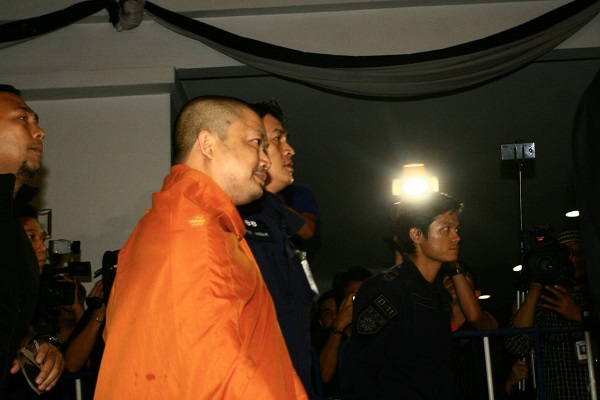
Disgraced Monk Sentenced for Raping 13-Year-Old He Impregnated

Wirapol Sukphol arrives at the Department of Special Investigation in 2017 in a monk robe after leaving the United States.

BANGKOK — A court on Wednesday sentenced a former Buddhist monk known for his jet-set lifestyle to 16 years in prison for raping a 13-year-old girl who he also impregnated.

Wirapol Sukphol became infamous when he appeared in a 2013 YouTube video in his monk’s robe aboard a private jet wearing aviator sunglasses with a Louis Vuitton carry-on by his side.

He was defrocked amid accusations that he had sexual relations with women – a major violation of the precepts guiding monks’ behavior – and had impregnated one. Because of the furor, he fled to the United States, where he was arrested in 2016 and extradited last year.

On Wednesday, the Ratchada Criminal Court in Bangkok handed Wirapol two eight-year prison terms, one for violating a minor under 15 and another for rape.

Wirapol is already serving a lengthy prison sentence. In August, the same court sentenced him to 114 years in connection with funds he fraudulently raised from followers. He was found guilty of fraud, money laundering and violation of the computer crime act for spending money he had solicited for Buddhist statuary and temple improvements instead on cars and luxury goods.

Legal technicalities capped the 114-year sentence at 20 years, meaning he will now serve a 36-year prison sentence.

Wednesday’s court ruling said prosecutors charged that Wirapol abducted a 13-year-old girl and sexually assaulted her from January 2000 to the middle of 2001, during which time she also became pregnant.

The victim, now 32, said she was satisfied with Wednesday’s sentencing. She said she would present the ruling to the Sisaket Juvenile and Family Court, where she has filed a lawsuit against Wirapol requesting 40 million baht (USD$1.2 million) in child support in a case the court had put on hold pending Wednesday’s ruling. She said Wirapol had initially provided her 10,000 baht per month to take care of their child but he gradually stopped the payments.

According to the Department of Special Investigation, Wirapol at one point had accumulated assets estimated at 1 billion baht ($30.1 million). During a shopping spree from 2009 to 2011, he bought 22 Mercedes Benz cars worth 95 million baht ($2.9 million), the department said.

An earlier civil court ruling ordered the confiscation of 43.5 million baht ($1.3 million) from Wirapol.

Story: Kaweewit Kaewjinda

Related stories:

‘Jet-Setting Monk’ Convicted, Gets 114 Years 

Former Jet-Setting Monk Stripped of Robe Upon Arrival in Thailand

DSI Says Disgraced ‘Jet-Setting Monk’ to be Extradited

Advertisement

Man Survives Kanchanaburi Ravine Plunge

A medevac helicopter in a May 2018 file photo in Bangkok.

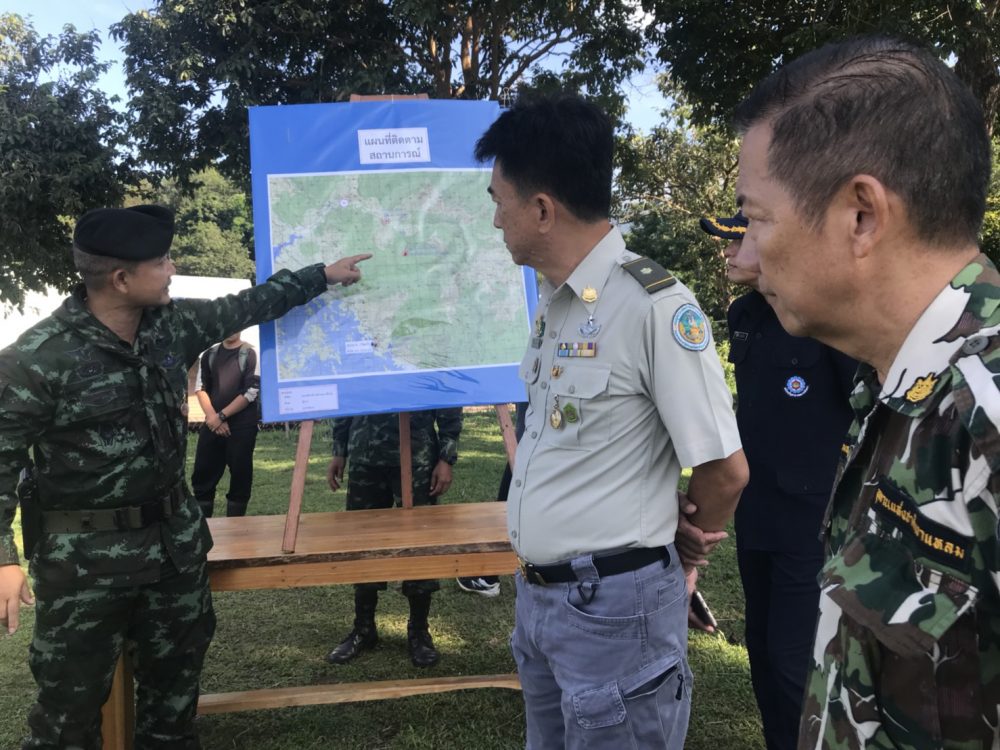
KANCHANABURI — A man trapped for two nights at the bottom of a ravine was rescued Wednesday morning after a challenging rescue operation.

The 46-year-old man, identified only as Niphon or by his nickname Tai, was airlifted at about noon by helicopter in a rescue mission involving more than 60 rescue workers and soldiers.

Niphon reportedly suffered a broken right leg and unspecified head injury.

It took time for the rescue team to retrieve him due to challenging terrain and weather – rain and heavy fog limited visibility.

Niphon had been traveling with a group of five Monday night when he fell from a hill near the Roi Wa Waterfall in the Khao Laem National Park.

S 41984035 spf6iCp e1539765852256


25660174 1515355718577946 6744695973371210702 n
Photo: Khao Laem National Park / Facebook


Advertisement

Hot News

LATEST NEWS

Bangkok
overcast clouds
33.8 ° C
35 °
32.2 °
63 %
3.6kmh
100 %
Sat
37 °
Sun
36 °
Mon
35 °
Tue
34 °
Wed
33 °