SONGKHLA — 17 August 2026, A 34-year-old woman staying alone at a hotel in Hat Yai was left frightened after a male guest repeatedly knocked on her door and allegedly used a key to open it at around 04:00.
The woman stayed at the hotel on the night of 16-17 August. She said a man, whose condition she could not determine, walked along the corridor knocking on several doors before coming to hers.
He allegedly used a key to unlock her door and managed to open it, but an interior security chain prevented him from entering fully. The man reportedly reached through the opening and attempted to remove the chain.
The woman immediately called hotel staff for help. The man was reportedly staying in a neighboring room and had allegedly behaved similarly two or three times.
She said the hotel staff only came to check the situation and took no further action, prompting her to file a complaint at Kho Hong Police Station in Hat Yai district, seeking legal action for alleged trespassing.
She said she was particularly concerned about what could have happened if the man had managed to enter the room.
Pol Col Apichart Wannako, chief of Kho Hong Police Station, ordered investigators to urgently collect evidence, including CCTV footage, to pursue legal action.
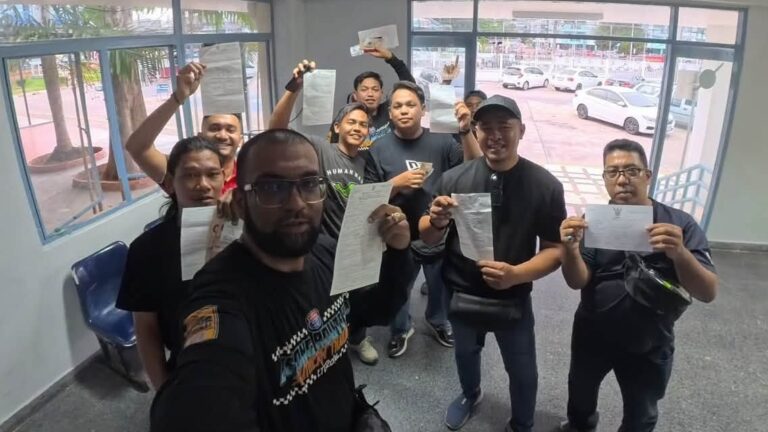
A social media post by a Malaysian tourist threatening to boycott Hat Yai has sparked debate after a group of Malaysian motorcyclists were fined by Thai police for traffic violations.
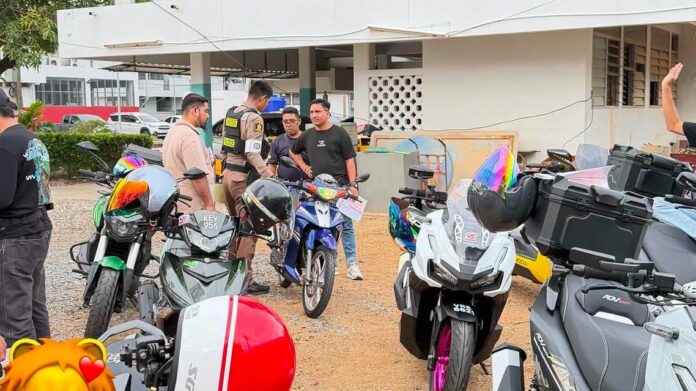
The Facebook user, who goes by the name “Tok Singa,” posted a video claiming that his group of 17 Malaysian motorcyclists received 15 tickets totaling about 15,000 baht during a traffic inspection by Hat Yai Police.
The post alleged that only one police officer handled the inspection, which took nearly three hours. It also claimed the group was threatened with detention if they delayed paying the fines, while some riders said their motorcycles still had factory-standard exhaust pipes and that police did not accept digital driving licences.
The video went viral and included a call for Malaysians to boycott Hat Yai, a popular destination for Malaysian tourists.
Hat Yai Police, however, disputed several of the claims.
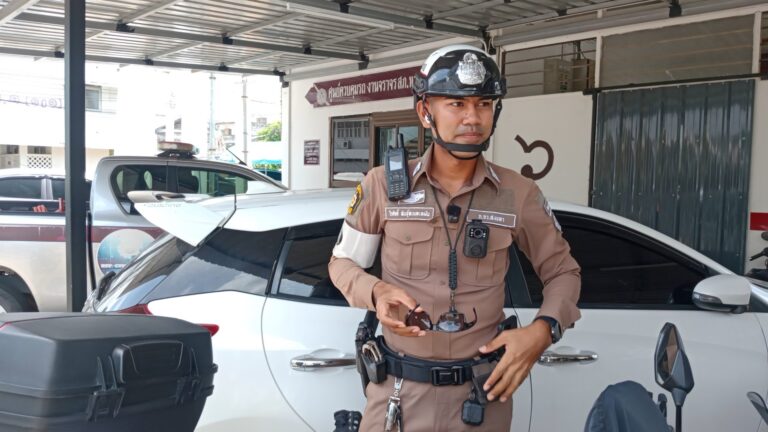
Police Sgt. Maj. Veerasak Phansaeman, the officer involved in the incident, said he was directing traffic outside Hat Yai Police Station when he noticed a group of about 17 motorcycles from Malaysia.
Police Sgt. Maj. Veerasak Phansaeman
Some motorcycles had modified flashing rear lights, while others appeared to have excessively loud exhaust systems, he said. Officers followed the group and stopped them at Dam Bridge intersection before bringing the motorcycles to the police station for a detailed inspection of documents, compulsory insurance, driving licences and vehicle equipment.
After inspecting all 17 motorcycles, police found violations involving nine vehicles and issued nine tickets, with total fines of 12,000 baht — not 15 tickets totaling 15,000 baht as claimed in the social media post.
Individual fines ranged from 1,000 to 3,000 baht, depending on the violation.
Veerasak said police used a sound-level meter in accordance with legal requirements when checking motorcycle exhaust noise. Officers first checked the manufacturer’s noise-level plate, allowing an additional 5 decibels where applicable. If no plate was available, the limit was determined by the vehicle’s registration date.
Motorcycles registered before 2024 are subject to a maximum limit of 95 decibels, while those registered from 1 January 2024, are limited to 90 decibels, he said.
Veerasak said officers explained the regulations to the Malaysian tourists and denied that police had mistreated or singled them out because they were foreigners.
“The video distorted some of the facts,” he said, adding that officers had followed legal procedures and treated foreign tourists and Thai motorists equally.
He urged visitors driving into Thailand to familiarize themselves with local traffic laws and comply with them.
“Even though we are concerned about the impact on the tourism image, officers must uphold the law,” Veerasak said.
He added that he did not expect the incident to have a significant impact on Hat Yai’s tourism industry, saying most visitors comply with Thai laws.
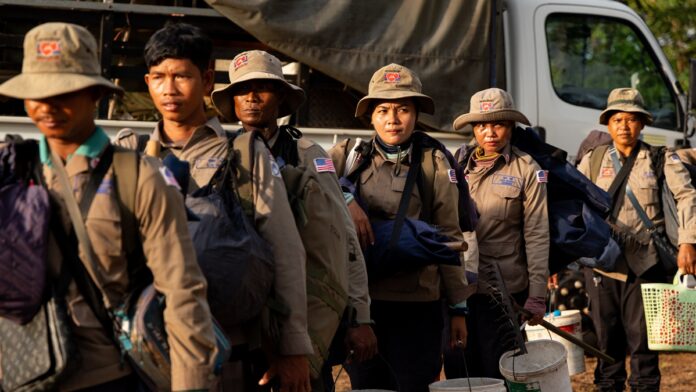
Deminers prepare to enter a landmine field in Siem Reap, Cambodia on Thursday, July 2, 2026. (AP Photo/Anton L. Delgado)
SIEM REAP, Cambodia (AP) — En Poy was minding cattle in a former Khmer Rouge stronghold in Cambodia when he set off his first land mine.
The blast from the rusty relic he picked up cost him an arm and an eye. It also inspired his career with the nonprofit Cambodian Self Help Demining, which clears land mines and unexploded ordnance across the country, deadly remnants of wars from the last century.
Groups like Poy’s that rely on foreign aid are struggling as donors shift funding for humanitarian demining toward active conflicts in Ukraine, Gaza and Sudan, and to more recent wars, like in Syria and Afghanistan. Today’s conflicts are also driving higher defense spending, leaving less money for aid.
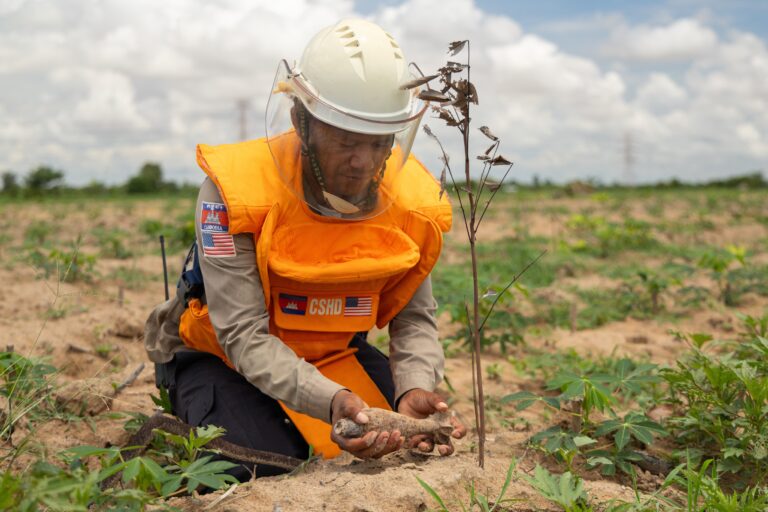
Sun Theary, a member of an explosive ordnance disposal team, picks-up a 60mm mortar round in Siem Reap, Cambodia on Thursday, July 2, 2026. (AP Photo/Anton L. Delgado)
Cambodia’s predicament shows that dangers remain even when fighting ends. Demining groups say that without international support, Southeast Asia’s unfinished work clearing land mines and unexploded bombs will continue to endanger communities, maiming and killing people and slowing development for years to come.
Poy was wounded in a second land mine explosion that pierced his face and body with shrapnel and killed three of his colleagues. He now educates fellow Cambodians in high-risk areas on how to avoid such dangers. But he’s not sure how long that will last.
“If one day donors stop funding my organization, I would definitely be sad because we haven’t finished our job,” he said. “There are still a lot of landmines left over.”
The Vietnam War’s deadly legacy
The Vietnam War bled into neighboring Cambodia and Laos, triggering strife that lasted long after the Americans fled the fall of Saigon, including the Khmer Rouge’s reign of terror, which killed about 1.7 million Cambodians.
Since the wars ended, land mines and unexploded ordnance have killed approximately 90,000 people and wounded almost twice as many across the three countries.
Leftover weapons lie beneath fields and forests, blocking construction of roads and schools. They are deadly discoveries, mistaken for toys by children who account for more than 40% of the civilian casualties recorded globally since 1999 by the Landmine and Cluster Munition Monitor, formed by nonprofit groups to track such issues.
Demining is slow and painstaking work.
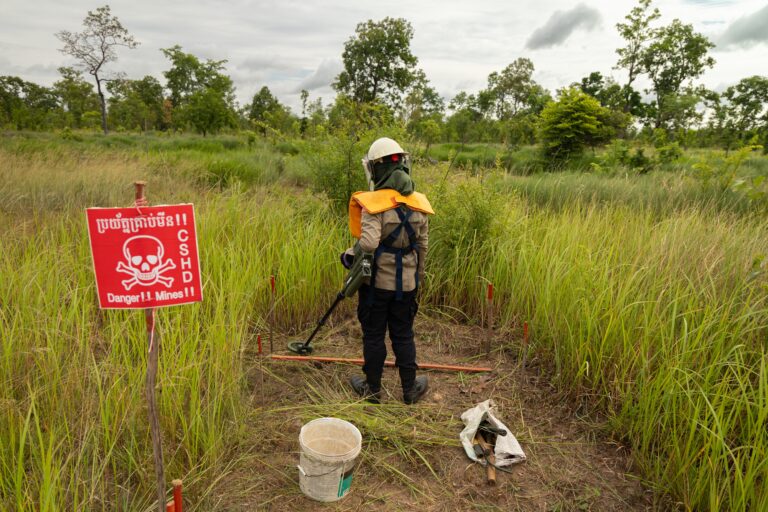
Teams first survey and map contaminated areas. Then step-by-step they clear vegetation, using metal detectors and specialized equipment to locate explosives and destroy them. Progress is measured in meters (feet) a day and work often stops in wet weather.
“These things don’t really become less dangerous with time. They become more dangerous as they deteriorate,” said Charles Ray, a Vietnam War veteran who became the first post-war U.S. consul general in Ho Chi Minh City and later ambassador to Cambodia.
By funding demining, the U.S. proved it cared, Ray said. “We’re not just this behemoth that comes in with our military machine and breaks things, we can also help nations rebuild,” he said.
Modern conflicts pull funds from Southeast Asia
Funding for humanitarian demining amounted to $4.3 billion from 2020 to 2024, according to the land mine monitor.
National contributions from affected countries made up about a fifth and foreign aid provided the rest, with most of the funds from the U.S., Germany, the European Union, Norway, and Switzerland, the land mine monitor says.
Recent conflicts are creating unprecedented demand for demining as contaminated areas expand, said Maria Vardis of the U.N. Mine Action Service.
Ukraine received a third of all humanitarian demining funding in 2024, more than any other country, the land mine monitor found. Other active conflict zones, like Yemen and Gaza, received increased funding, while demining efforts in Syria, Sudan and Afghanistan have also ramped up, while some Asian nations are getting less funding.
Piles of defused landmines and other remnants of war are seen in the Cambodia Landmine Museum in Siem Reap, Cambodia on Sunday, June 28, 2026. (AP Photo/Anton L. Delgado)
“Funding does fluctuate year to year, but in the big picture, even in the face of cuts by many governments, the big crises continue to be funded, but smaller and older mine action projects are struggling,” Vardis said.
Pause in U.S. aid rattled trust built over decades
Under Trump, U.S. demining aid to Southeast Asia has yo-yoed. That has “set a really dangerous precedent for what can be done,” said Danae Hendrickson of the U.S.-based advocacy group Legacies of War.
Last year, the U.S. approved $56.5 million for war-legacy programs in Vietnam, according to congressional documents, compared to $197 million allocated in 2024. In July, Secretary of State Marco Rubio announced $130 million in demining assistance for Southeast Asia, without giving details.
Last year’s freeze briefly halted war-legacy projects in Vietnam and weakened Hanoi’s confidence in U.S. commitments, said Nguyen Khac Giang, a visiting fellow at Singapore’s ISEAS–Yusof Ishak Institute.
“The lasting damage is to the hard-earned trust between the two former enemies,” he said.
In an email to The Associated Press, a U.S. State Department spokesperson said American assistance is “not charity” and that humanitarian demining aid will continue to serve U.S. interests around the world.
Cambodian demining group faces closure
Between 1992 and 2025, about 1.2 million mines and 3.2 million other explosive remnants of war were found in Cambodia, according to the Cambodian Mine Action and Victim Assistance Authority.
The country still had 1,749 square kilometers (about 675 square miles) of uncleared land as of last year.
Thousands or even millions more weapons may still be out there, said Bill Morse, president of the Landmine Relief Fund, which supports Cambodian Self Help Demining.
A deminer uses a metal detector to clear a landmine field in Siem Reap, Cambodia, Thursday, July 2, 2026. (AP Photo/Anton L. Delgado)
Barely an hour from the famed Angkor Wat temple complex in Siem Reap, deminers with South Korean, Swiss and American flags on their uniforms and helmets, recently inched through a minefield, clearing the land one painstaking step at a time.
They found a Soviet-designed anti-personnel land mine. Another unit nearby was dispatched to destroy a mortar round and a rocket-propelled grenade at a cassava farm just off a highway leading to a new Chinese-funded airport.
The group may have to stop their work by September due to sharp cutbacks in donations. “We have simply run out of donors,” Morse said.
“If people want to pull their money away, that’s a decision that they have to make,” he said. “But when they do, people will die here.”
At least 500 people have been hospitalised with severe diarrhoea in Yangon since 9 August, with 149 testing positive for cholera in rapid tests, according to a regional official.
Yangon regional Social Affairs Minister Bo Htay told the regional parliament on Monday that nine cases had so far been confirmed as Vibrio cholerae infections by Myanmar’s National Health Laboratory.
The outbreak marks a growing public health concern in Myanmar’s largest city, where years of civil war have placed severe strain on the country’s healthcare system and other essential infrastructure.
More than 100 patients were admitted on a single day last Thursday, but the number of new hospital admissions has since declined, Bo Htay said.
Health authorities are conducting epidemiological surveillance and outbreak-control measures in affected areas, according to officials.
Cholera is a potentially deadly bacterial infection that causes severe diarrhoea and vomiting, usually after consuming contaminated food or water. Without prompt treatment and rehydration, severe cases can become fatal within hours.
The World Health Organization considers cholera a major global public health threat and has linked its spread to inadequate access to safe water, sanitation and healthcare.
Myanmar’s health system has faced mounting pressure since the military seized power in 2021, with the prolonged conflict further disrupting public services and access to medical care.
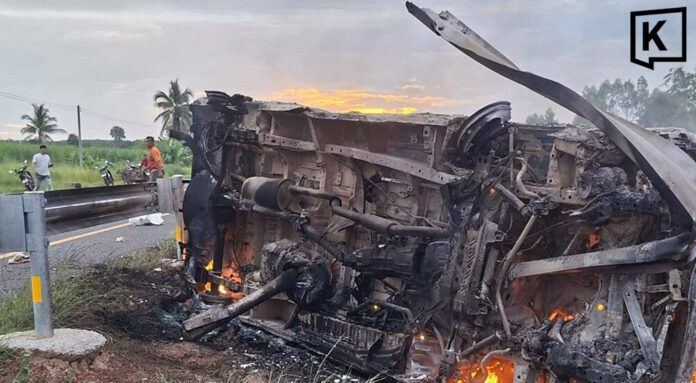
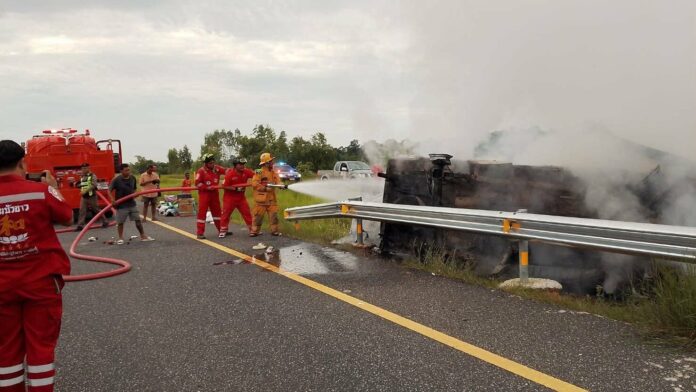
ROI ET — 18 August 2026, Two Lao nationals were killed and 12 others injured after a passenger van veered off the road, overturned and burst into flames in Roi Et province early Tuesday morning. A survivor said the driver had been speeding and appeared to be falling asleep at the wheel.
The accident occurred at around 05:20 on the four-lane Kalasin-Mukdahan Road near Ban Khok Lam in Nong Yai subdistrict, Phon Thong district, Roi Et, close to the border with Kuchinarai district in Kalasin province.
Police and emergency responders were alerted through the 191 emergency centre and rushed to the scene, where the van was engulfed in flames. Firefighters, rescue teams and medical personnel were dispatched to control the blaze and assist the passengers.
Initial information showed that the Bangkok-registered passenger van was carrying 14 people, including the driver, all travelling Lao nationals. They had left Bangkok at around 21:00 on 17 August, heading to Mukdahan to renew their permits before returning to Laos.
The van reportedly lost control and ran off the road in the early morning before overturning and catching fire. The vehicle was completely destroyed.
Two people died and 12 were injured. The victims were taken to several hospitals, with five transported to Kuchinarai Crown Prince Hospital, six by Buakhao rescue workers and one by Sam Kha rescue workers. Authorities had not yet identified the gender of the two deceased passengers.
A wounded Lao passenger told reporters that the group was travelling to Mukdahan to renew their permits and return home.
During the journey, two young male and female passengers sitting nearby asked the survivor to warn the driver because they felt the van was travelling too fast, at around 140 kph.
The survivor said he told the driver to slow down. The driver initially reduced his speed but later began driving fast again.
He also noticed the driver appeared extremely tired, repeatedly nodding off while driving. The survivor said the driver was holding the steering wheel with only one hand, while the other hand was not on the wheel.
Although the van had stopped briefly to rest earlier, the driver did not appear to have had enough sleep, he said.
The survivor was about to warn the driver about the speed again when the van suddenly veered off the road.
Police from Phon Thong Police Station are conducting a detailed inspection of the scene to determine the exact cause of the crash. Authorities are also working to verify the identities and details of the injured and deceased.
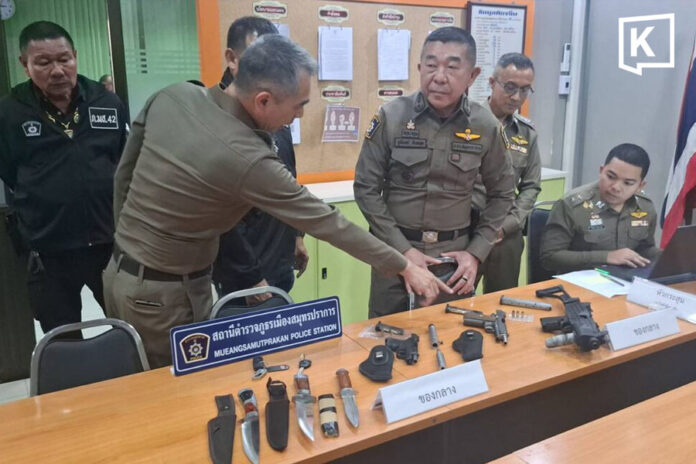
SAMUT PRAKAN — 17 August 2026, Police have arrested two suspected gunmen, including a 16-year-old, after two youths were seriously injured in a motorcycle shooting on Srinakarin Road early Sunday. The suspects said the modified, unlicensed firearms used in the attack had been purchased online.
The shooting occurred at about 02:00 in Muang district, Samut Prakan. The two victims were struck in the abdomen and other parts of their bodies, police said.
Police said CCTV footage helped officers identify the alleged gunmen within hours. The suspects were 16 and 19 years old. They were arrested at homes in Bang Bo district.
A search of the premises reportedly uncovered several modified, unlicensed firearms, including magazine-fed guns, pen guns and a long automatic firearm with a folding stock. The two were taken to Muang Samut Prakan Police Station for questioning.
Provincial police commander Pol Maj Gen Phumin Singhasut later praised officers for making the arrests quickly.
The two suspects have initially been charged with attempted murder and firearms-related offences. Police said about seven other suspects, aged 16 to 19, remain at large.
Investigators said the two suspects claimed the firearms had been purchased online. Police are expanding the investigation to trace the alleged sellers.
ZAMBONGA CITY, The Philippines — 18 August 2026, Two students were killed in a shooting at a high school in the southern Philippines, authorities said, with the situation now under control.
The shooting took place at a school overseen by Ateneo de Zamboanga University in Zamboanga City in the southern Philippines.
Zamboanga City Mayor Kimerer Adan Olaso told radio station DZMM that both victims were students and that one of them was the suspected shooter. The gunman reportedly used a high-powered firearm.
University president Ernald Andal confirmed that the shooting had ended and that there were no additional deaths or injuries reported.
“We can confirm that there are two fatalities and there is no longer an active shooter,” Andal said.
The university is coordinating with authorities and will release further information once more details have been confirmed.
“We do not want this kind of thing to happen. Our highest priority is the safety of all our students,” Andal said.
The shooting marks the second school shooting in the Philippines in nearly two months.
The latest incident follows an attack at a public high school in Tacloban in June, when at least three students were killed and around 20 others injured after two students opened fire inside the school.
KAMPHAENG PHET — 18 August 2026, A Thai mother has been left devastated after learning that her 34-year-old daughter, who had worked as a traditional massage therapist in South Korea for seven years, died under unexplained circumstances.
The family, from Kamphaeng Phet province, said they do not have enough money to bring her body home for a funeral.
Several Facebook pages shared an appeal seeking relatives of a Thai woman who had died suddenly in South Korea. She was later identified as Ms. Piyawan, known as Pla, 34, from Kamphaeng Phet. Her surname has been withheld.
The case came to public attention after many Facebook pages posted a photo and urged the woman’s relatives to urgently contact the Royal Thai Embassy in Seoul.
A local community leader in Trai Trueng subdistrict recognized the woman as a resident of the area and immediately contacted reporters.
Reporters later visited the family home in Trai Trueng subdistrict, Mueang district, Kamphaeng Phet, where they met Pla’s 69-year-old mother, Lam Yai, who was grieving heavily.
Lam Yai said her daughter had traveled to South Korea seven years ago to work as a traditional massage therapist. She regularly called home to check on the family and occasionally sent money to support them.
Their last conversation was on 8 August, when Pla told her mother that she was experiencing unusually heavy menstrual bleeding. Her mother advised her to buy painkillers. She said her daughter had no known underlying medical conditions.
The family was shocked by the news and said they would leave South Korean authorities to investigate the exact cause of death.
Tearfully, Lam Yai said she had contacted her daughter’s colleagues in South Korea and learned that transporting the body back to Thailand could cost around 200,000 baht, while bringing only her ashes home would cost about 100,000 baht.
The family earns a living through general labor and is struggling financially, leaving them unable to cover the costs. Lam Yai appealed to members of the public for help so her daughter could be brought home for a religious funeral.
Winai Detsri, chief executive of Trai Trueng Subdistrict Administrative Organization, visited the family to offer support and is coordinating with relevant agencies to explore ways to provide assistance.
The major obstacle is the high cost of transporting the body internationally, which is beyond the family’s financial means.
People wishing to help cover the cost of bringing Pla home can donate through the Bank for Agriculture and Agricultural Cooperatives (BAAC):
Account No.: 016982971787 Account name: Nang Lam Yai Samridee
The family said the account will be closed once sufficient funds have been raised to cover the necessary expenses.
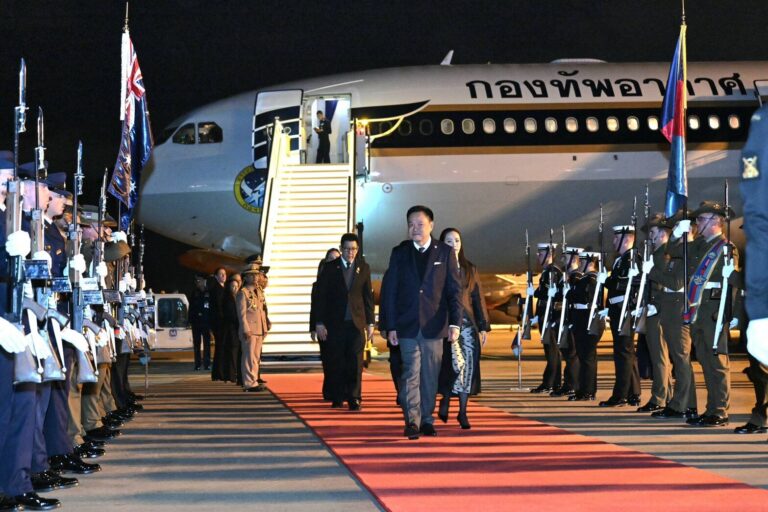
BANGKOK — 17 August 2026, Prime Minister Anutin Charnvirakul arrived in Sydney on Sunday night for an official visit to Australia aimed at advancing the Thailand-Australia Strategic Partnership.
Government spokesperson Rachada Dhnadirek said Anutin arrived at 22:00 Sydney time, three hours ahead of Thailand. He is visiting Australia from 17-20 August at the invitation of Australian Prime Minister Anthony Albanese.
The trip is intended to turn the two countries’ strategic partnership into concrete cooperation across a range of areas, she said.
Anutin was welcomed by New South Wales Attorney-General Michael John Daley, representing the state governor; Laura Thomson, acting deputy head of protocol at the Department of the Prime Minister and Cabinet; and Karina Cameron, deputy chief of protocol for New South Wales.
An official welcome ceremony is scheduled for Wednesday, 19 August, at Parliament House in Canberra.
On Monday, Anutin is due to pay a courtesy call on the Governor of New South Wales at Government House in Sydney, before delivering a speech at the Lowy Institute on Thailand’s vision for relations with Australia and cooperation in the Indo-Pacific.
He will then meet members of the Thai community and visit Thai Town before meeting executives of Canva Pty Ltd. and touring its office. The discussion is expected to cover digital technology, innovation and opportunities for cooperation in the digital economy.
In the afternoon, Anutin will attend a networking reception at Crown Sydney to promote trade and investment links between Thai and Australian businesses. He is then scheduled to have dinner with Thai business representatives before flying to Canberra, where he is expected to arrive at Fairbairn Airport at 21:30.
“The visit to Australia is an important opportunity to build on Thailand-Australia relations in every dimension,” Rachada said. “The government places importance on turning the strategic partnership into practical cooperation in the economy, security, clean energy, technology and innovation, while creating new benefits and opportunities for businesses and people in both countries.”
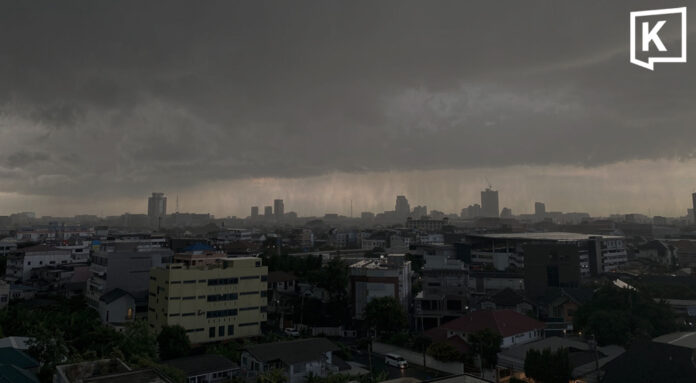
BANGKOK — 18 August 2026, The Meteorological Department warned of heavy to very heavy rain in parts of Thailand on Tuesday, with thunderstorms forecast to cover up to 60% of some regions, including Bangkok and surrounding provinces.
The department’s 24-hour forecast, from 06:00 on 18 August to 06:00 on 19 August, said a monsoon trough is moving southward across upper Laos toward a low-pressure cell over northern Vietnam. Meanwhile, the southwest monsoon covering the Andaman Sea, Thailand and the Gulf of Thailand is strengthening.
Residents in affected areas were advised to beware of heavy to very heavy rainfall and accumulated rain, which could trigger flash floods, forest runoff and overflowing waterways, particularly in foothill areas, near waterways and in low-lying areas.
Winds and waves in the Andaman Sea and Gulf of Thailand are moderate. Waves in the upper Andaman Sea and upper Gulf are around 2 meters high, rising above 2 meters during thunderstorms.
Boaters were advised to exercise caution and avoid areas experiencing thunderstorms.
Regional forecasts
North: Thunderstorms are forecast over 40% of the area, with isolated heavy rain in Mae Hong Son, Chiang Mai, Chiang Rai, Phayao, Nan, Lampang, Phrae and Tak. Temperatures will range from 22-28°C, with highs of 32-36°C. Southwest winds will reach 10-20 kph.
Northeast: Thunderstorms will cover 60% of the region, with heavy rain in Nong Khai, Udon Thani, Sakon Nakhon, Kalasin, Mukdahan, Roi Et, Yasothon, Amnat Charoen, Surin, Si Sa Ket and Ubon Ratchathani. Very heavy rain is expected in Bueng Kan and Nakhon Phanom. Temperatures will range from 24-26°C, with highs of 33-36°C. Southwest winds will reach 10-20 kph.
Central: Thunderstorms will cover 40% of the area, mainly in Kanchanaburi and Saraburi. Temperatures will range from 24-27°C, with highs of 35-37°C. Southwest winds will reach 10-25 kph.
East: Thunderstorms will cover 60% of the region, with heavy rain in Nakhon Nayok and Chanthaburi and isolated very heavy rain in Trat. Temperatures will range from 22-26°C, with highs of 31-35°C. Southwest winds will reach 20-35 kph. Waves will be around 2 meters high and above 2 meters during thunderstorms.
South, east coast: Thunderstorms will cover 30% of the area, mainly in Prachuap Khiri Khan, Chumphon, Nakhon Si Thammarat, Yala and Narathiwat. Temperatures will range from 23-26°C, with highs of 33-36°C. Southwest winds will reach 15-35 kph. Waves will be 1-2 meters high offshore, around 2 meters, and above 2 meters during thunderstorms.
South, west coast: Thunderstorms will cover 40% of the area, mainly in Ranong, Phang Nga, Trang and Satun. Temperatures will range from 23-26°C, with highs of 31-34°C.
From Ranong northward, southwest winds will reach 20-35 kph, with waves around 2 meters and above 2 meters during thunderstorms. From Phang Nga southward, winds will reach 15-35 kph, with waves of 1-2 meters and above 2 meters during thunderstorms.
Bangkok and surrounding areas: Thunderstorms are forecast over 60% of the area. Temperatures will range from 25-28°C, with highs of 35-37°C. Southwest winds will reach 10-25 kph.