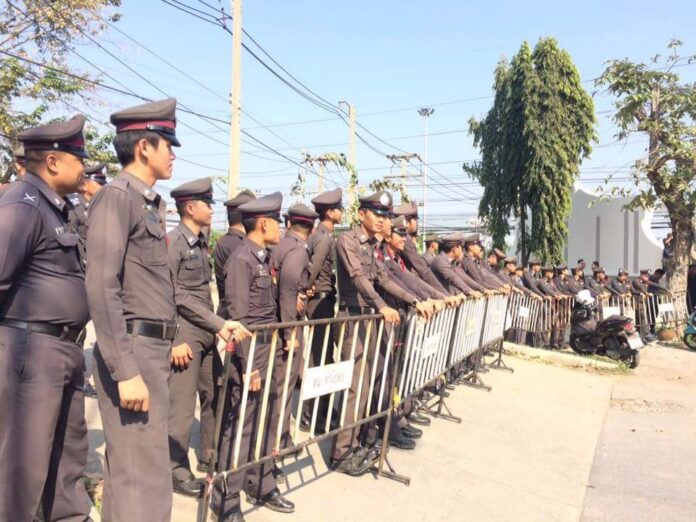
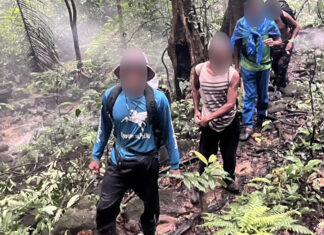
Police prevent activists from marching to Khon Kaen on Saturday in Rangsit.
BANGKOK — Police on Saturday spent several hours blocking a group of grassroots activists and academics from marching from the northern edge of Bangkok to Khon Kaen province to demand for equal rights.
Citing the ban on political gatherings of five or more people, authorities blocked about 70 to 80 activists from starting a 450-kilometer march from Bangkok’s Rangsit area to Khon Kaen organized by the People Go network to demand equal rights. After reaching a compromise with the authorities, about a dozen were allowed through late Sunday afternoon.
Assembling at Thammasat University’s Rangsit campus in Pathum Thani province just north of Bangkok, the group were been blocked by a barricade of dozens of officers acting on the orders of the ruling junta, said Anusorn Unno, a member of the group.
Anusorn said the group originally planned to march out of the university toward Khon Kaen in a month-long walk to raise awareness about rural and political rights.
Speaking by phone shortly before 4pm, Anusorn said the group had yet to come up with an alternative plan deemed acceptable by the military regime.
“They allowed us to carry out activities inside the university but not leave the campus,” said the sociologist.
Anusorn’s group seeks to highlights issues such as rights to universal healthcare, food security – including alternative agriculture – guarantee that no legislatures undermines human rights, community rights, appropriate management of local natural resources and a call for a more participatory constitution.
The initial blockade led to criticism on social media.
“Even their right to walk has been curbed. Is this a country that is heading toward elections?” wrote Twitter user @Aoewiki, a self-proclaimed northeasterner with 10,000 followers.
The junta banned political gatherings upon seizing power in 2014, saying it was necessary to restore order and stability. Such restrictions have not been lifted despite a promise that elections will be held in nine months.
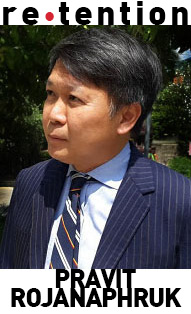
Human rights lawyer Sirikarn Charoensiri warned the National Council for Peace and Order, or NCPO, to think carefully, claiming it was embarrassing itself and undermining its own image.
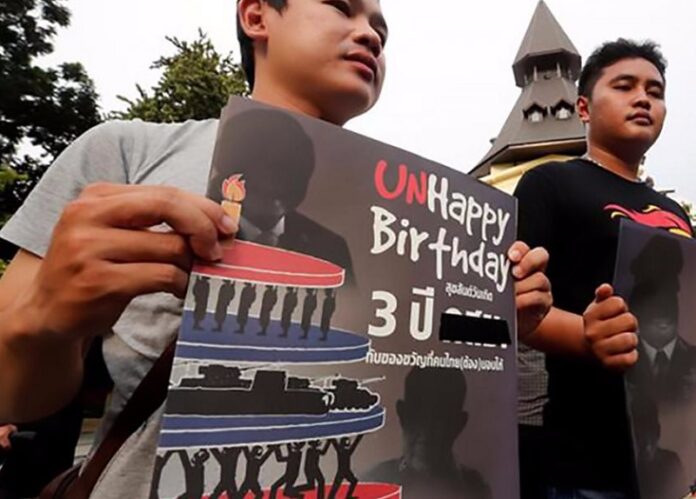
Activists protest last May to mark the third anniversary of the military coup in Bangkok.
BANGKOK — An American watchdog criticized the continued repression of freedoms exercised by the Thai military junta in its latest report on Thailand released Friday.
New York-based Human Rights Watch said in its 2018 report for Thailand that sweeping, unchecked and unaccountable military powers continued to be in place despite the promise of free and fair elections at the end of the year.
“Section 44 of the 2014 interim constitution allows Prime Minister Gen. Prayuth Chan-ocha, in his current position as NCPO chairman, to wield absolute power without oversight or accountability,” the report said. “The 2017 constitution, promulgated in March, endorses the continuance of this power, thereby guaranteeing that both the NCPO and officials operating under its orders cannot be held accountable for their rights violations.”
Freedom of Speech Under Threat
The report chronicled intimidation and punishment meted on media outlets that publish content critical of the junta and the monarchy.
“Media outlets that refused to fully comply, including Voice TV, Spring News Radio, Peace TV, and TV24, were temporarily forced off the air in March, April, August, and November respectively,” the report said. “These stations were later allowed to resume broadcasting when they agreed to practice self-censorship, either by excluding outspoken commentators or avoiding political issues altogether.”
The watchdog said that in Nov. 27 last year a peaceful protest in Songkhla province was violently dispersed.
Elsewhere, it said sedition laws and the Computer Crimes Act had been used against prominent politicians and journalists “to criminalize criticism and peaceful opposition to military rule”.
On the Computer Crimes Act, Human Rights Watch said the law “provides the government with broad powers to restrict free speech and enforce censorship”.
“The law uses vague and overbroad grounds for the government to prosecute any information online that it deems to be “false” or “distorted,” including allegations against government officials regarding human rights abuses.”
On the lese majeste law, the rights watch said that those charged are systematically denied bail and held in prison for years while awaiting trial.
Secret Detentions
Other issues highlighted included secret detention in the Deep South, where suspected separatists are detained for up to seven days without charges.
“The government also regularly uses military detention, in which abuses during the interrogation occur with impunity, in its counterinsurgency operations against suspected separatist insurgents in the southern border provinces of Pattani, Yala, and Narathiwat,” the report read.
“The NCPO in 2017 rejected calls by human rights groups to disclose information about persons held in secret military detention, and summarily dismissed all allegations that soldiers tortured detainees,” referring to the military junta, formally the National Council for Peace and Order.
Attitude Adjustment
Human Rights Watch noted that in 2017, the NCPO continued to summon members of the opposition Pheu Thai Party and the United Front for Democracy Against Dictatorship, or UDD – as well as anyone opposing military rule – for talks and detentions without charge which it called “attitude adjustment”.
“Failure to report to the junta’s summons is considered a criminal offense,” the report read.
Asylum Seekers, Refugees and Migrant Workers
The report said that migrant workers from Myanmar, Cambodia, Laos and Vietnam continued to be vulnerable to “physical abuses, indefinite detention, and extortion by Thai authorities; severe labor rights abuses and exploitation by employers; and violence and human trafficking by criminals who sometimes collaborate with corrupt officials.”
What’s more, the report stated that migrant workers remained fearful of reporting abuses to Thai authorities due to lack of effective protection.
On the Rohingya refugees, the report said in September, the Internal Security Operations Command, or ISOC, announced a policy to push back Rohingya refugees seeking to enter the kingdom by boat.
“The government also refused to allow the UN Refugee Agency, UNHCR, to conduct refugee status determinations for Rohingya asylum seekers, and planned to put those who landed in indefinite lockups,” the report said, adding that over 60 ethnic Uighurs from China have been held in indefinite detention since March 2014.
Concerns for the Future
On Thailand’s future prospects, the report said that even if there were to be elections this November, an unelected senate would lay foundations for “prolonged military control.”
RATON, New Mexico — Andra Cobb was frantic when she called for help, telling an emergency operator that a helicopter she was riding in with her father, longtime partner and others had crashed in a remote part of New Mexico and that she was watching her “family burn.”
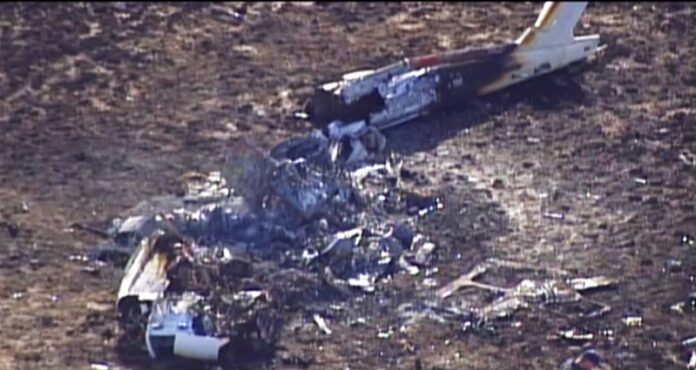
Police released 911 recordings Friday from the crash near the Colorado-New Mexico line that killed five people, including Zimbabwean opposition leader Roy Bennett, and his wife, Heather. Cobb, 39, was the sole survivor, escaping with broken bones before the helicopter burst into flames.
Her father, Paul Cobb, the co-pilot, and her longtime partner, Charles Burnett III, a Texas-based investor who owned the ranch where the group of friends was headed, also were killed in the crash Wednesday, along with pilot Jamie Coleman Dodd.
“I’m watching my family burn in a fire,” Andra Cobb screamed on the call. “I don’t know what to do. There’s a big fire. I’m covered in gasoline.”
Dodd also called 911 before he later died. He told authorities immediately after the crash that there were three victims and three survivors – him, Andra Cobb and Roy Bennett, who was suffering from a head wound as authorities tried to determine their location.
Officials launched a search but said the response was slow because of the rugged terrain and lack of access. Andra Cobb remained on the call for about an hour as she waited for authorities to arrive.
Bennett’s death was met with an outpouring of grief in Zimbabwe. A white man who spoke fluent Shona and drew the wrath of former President Robert Mugabe, Bennett had won a devoted following of black Zimbabweans for passionately advocating political change.
Bennett, treasurer-general of the Morgan Tsvangirai’s Movement for Democratic Change opposition party, previously survived a traumatic year in jail and death threats over his work.
He and his wife had traveled to New Mexico to spend their holiday with their friend Burnett, according to loved ones. The wealthy businessman was described as a fun-loving person who enjoyed entertaining, at times extravagantly.
Burnett’s friends Dodd and Cobb were experienced aviators who would not have taken unnecessary risks in the helicopter, according to the investor’s personal lawyer, Martyn Hill. Hill and Cobb’s wife, Martha, said the co-pilot had survived being shot down while flying a helicopter in the Vietnam War.
The cause of the crash remains under investigation. Despite frigid temperatures, there was no indication of bad weather that night.
Authorities eventually found the wreckage engulfed in flames, which had sparked a grass fire.
Colfax County Sheriff Rick Sinclair told The Associated Press that he helped search the rugged terrain and that when crews found the wreckage, residents from nearby ranches were working to extinguish the blaze.
Two victims were found in the helicopter, and a third was found several feet away, he said.
Bennett and Dodd were alive but in critical condition when authorities arrived. One of them was so injured that he rolled some 150 feet (46 meters) to get away from the flames, Sinclair said. The other appeared to have walked an equal distance before collapsing.
“The will to survive from the guy that rolled is incredible because he was smashed up,” Sinclair said.
State police say one of the men died at the scene a short time later and the other died en route to the hospital.
Dodd said on his call that he had a broken pelvis and was trying to move away from the blaze. Andra Cobb also told a 911 operator that Dodd was “rolling away from the fire the best he can.”
She said the helicopter had been in the air for just three to five minutes after taking off from the airport in the small community of Raton. In the call, she can be heard weeping and telling Bennett to breathe.
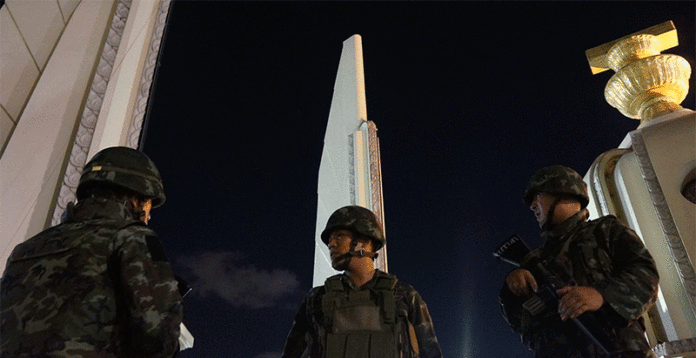
Soldiers stand guard at Bangkok's Democracy Monument on May 22, 2014, hours after the army staged the 12th successful coup d'etat in modern Thai history.
Is Thai-style “democracy” like fusion food or something that has mutated to the point of no longer deserving to be called democracy? At what point is Thai democracy no longer democracy?
Contributing to this conundrum, junta leader Gen. Prayuth Chan-ocha uttered the following last week: “Our nation cannot afford further conflict. We certainly must have democracy but it is Thai-style democracy. We must not break rules ….”
The remarks were made by Prayuth, as prime minister, in a speech marking National Children’s Day.
The key word according to Prayuth seems to be “conflict” – that Thai-style democracy should be free of conflicts.
There are two ways to avoid conflicts in politics and society.
The first is to ensure that all Thais think alike. This is not only unnatural but impossible.
Second, pretend no conflict exists either through denial or suppression of differing opinions that challenge the dominant discourse.
In reality, both options cannot genuinely bring about a conflict-free society, not to mention democracy. There is not conflict-free society because differing political perspectives are a natural part of any pluralistic society in the tens of millions.
Like cuttlefish – which despite the name are not fish but molluscs – a conflict-free, Thai-style democracy would be a misnomer. It would rather be a dictatorial government that detests and suppresses differing opinions to mask conflict – or at least paint camouflage over it.
Thai-style democracy is therefore an oxymoron put to use as a euphemism for Thai-style dictatorship.
Instead of yearning for a conflict-free political system, Thais should double their efforts to learn to coexist with political conflicts and resolve conflicts in a peaceful manner. That requires no killing those who think differently, no suppression of the others through censorship and fear and no more military coup.
There can be no democracy if people evade conflicts, as conflict resolution is an integral part of a free and democratic society. Conflicts is part of a free society.
Prayuth is not the first to use the term Thai-style democracy, and the notion has been around for quite some time. Other characteristics of Thai-style democracy includes:
Belief that military intervention is a legitimate political mechanism to correct the excesses and abuses of elected politicians. The 12 “successful” coups in 85 years since the end of absolute monarchy and introduction of a parliamentary system averages to one every seven years. Note that the coup prior to that of 2014 occurred in 2006, thus the statistics bears out.
A Thai-style democracy lacks the perseverance, the “long game” necessary to allow political conflicts to resolve themselves naturally, without inviting military interventions. A politician or political movement you don’t like? Give it time; the pendulum will swing the other way.
A large portion of the Thai press are guilty of enabling this attitude by being coup apologists. They always tell their the readers that thought they may dislike military coups, they are a necessary evil to break political impasse and resolve conflict.
Nearly four years after the 2014 coup, only a fool would think – or liar claim – there’s no more political conflict in Thailand. The present semblance of normalcy and accord was achieved through censorship, suppression and banning political gatherings.
What’s more, the notion of a Thai-style democracy depends on disenfranchising the poor and disadvantaged, because it assumes they are incapable of making sound electoral decisions and therefore unworthy of their votes. Some people genuinely believe only those with university degrees deserve to vote.
Thai-style democracy also means a belief that certain fundamental freedoms will be not recognized. The draconian lese majeste law, which effectively forbids any meaningful discussion of the monarchy, is a case in point.
There’s another side to the coin that is Thai-style democracy, though. There are those who oppose military coups but think elections are another way of awarding the spoils and power to one side or the other.
They are electoral supremacists who think that once a government is elected, the opposition and anyone unhappy with the outcome must accept whatever the elected government does without resistance and await their chance in the next general election. They do their part, intentionally or not, in ensuring some continue to support the notion of Thai-style democracy.
BANGKOK — Two years after a court-ordered deadline for all BTS Skytrain stations to be made accessible to wheelchairs, we wanted a clear picture of what work has been done.
We went out and traveled both the Sukhumvit and Silom lines to determine which were usable by commuters with disabilities.
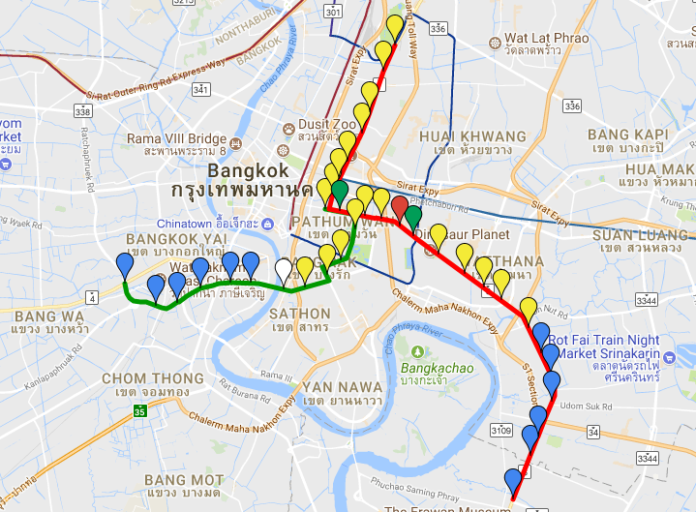
Here’s a map we made from what we learned for today’s news feature.
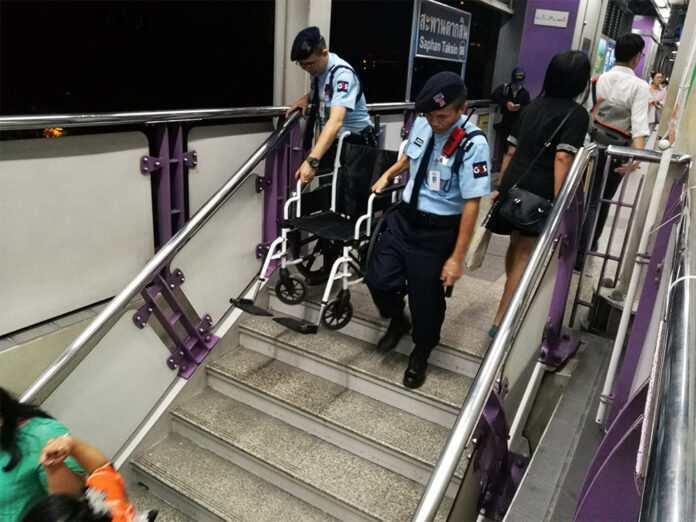
Private security carry a commuter's wheelchair down the stairs Tuesday at BTS Saphan Taksin. Three years after the highest court gave the city 12 months to make all stations wheelchair-accessible, the work remains incomplete.
Top: Private security carry a commuter’s wheelchair down the stairs Tuesday at BTS Saphan Taksin. Three years after the highest court gave the city 12 months to make all stations wheelchair-accessible, the work remains incomplete.
BANGKOK — The BTS Skytrain remains inaccessible to commuters with disabilities three years after the courts ordered City Hall to install elevators, and a class-action suit remains in administrative limbo one year after it was filed.
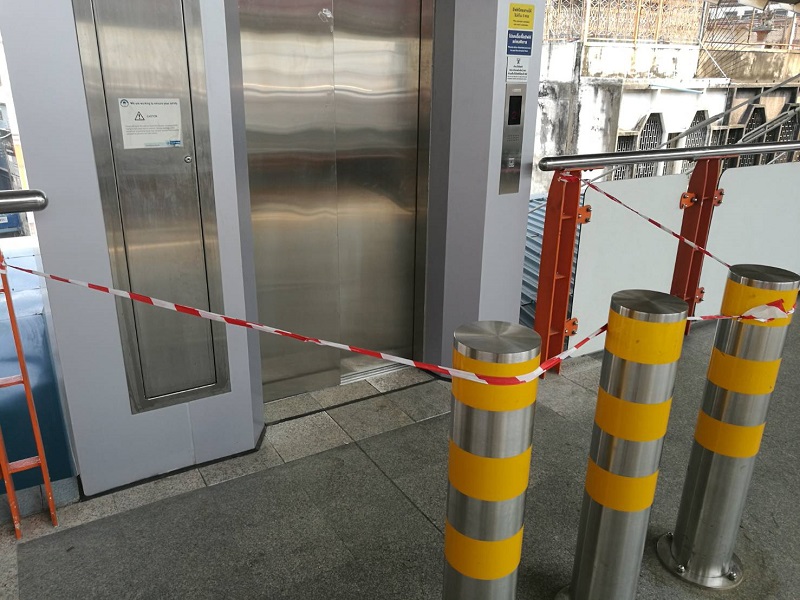
As of Saturday, the anniversary of both the landmark 2015 court ruling and historic 2017 lawsuit, some stations still lack functioning lifts. Most with elevators connecting to ground level are only available on one side of the street.
“Along BTS lines, new malls pop up on a daily basis,” said Manit Intharapim, the wheelchair user who for years has fought for access to the popular rail service. “It takes them a year to build such malls. How difficult is it then to install elevators?”
Manit, members of advocacy group Transportation for All and other disabled commuters traveled en masse one year ago today to the Civil Court to file a class-action lawsuit against the Bangkok Metropolitan Administration, or BMA, one of Thailand’s first such suits.
Lawyers for City Hall challenged it on administrative grounds. The case has yet to be taken up in any venue.
The BMA’s top traffic and transportation official, Thanoochai Hoonniwat, said the BMA would continue working toward fully equipping all stations with lifts.
“This is not about winning or losing. It’s our duty to enable access and comfort,” Thanoochai said, adding that at least 100 million baht is being sought in this year’s budget to install more lifts to satisfy the Supreme Administrative Court’s 2015 order.
Siding with the plaintiffs after a long legal battle, the 2015 decision gave City Hall one year to make all stations accessible. That deadline came and went without a single elevator installed. BMA officials, who have come and gone over the years, have cited difficulties in completing the work and promised new completion dates they were unable to meet.
In March, Bangkok’s junta-appointed governor, Aswin Kwanmuang, said he’d push for the work to be completed by the end of 2017.
Thanoochai, who recently took the helm of the Department of Traffic and Transportation, said he could not pin down any time frame for when it would be done.
“It would be a lie [to do so]. And this is not an excuse,” he said, citing external factors such as complicated underground electrical lines at spots such as BTS Sala Daeng, which requires major work by the utilities and has hindered progress.
Our look in 2016 at BTS accessibility
Half Measures
Of the original Skytrain stations that opened in 1999 – Mo Chit to On Nut on the Sukhumvit Line and National Stadium to Saphan Taksin on the Silom Line – elevators were later added to five: Siam, Asoke, Mo Chit, On Nut and Chong Nonsi.
In August, the activists identified 18 BTS stations as not being fully accessible. (see box for our latest updates on the status of these stations.)
The elevator at BTS Saphan Khwai was cordoned off Tuesday.
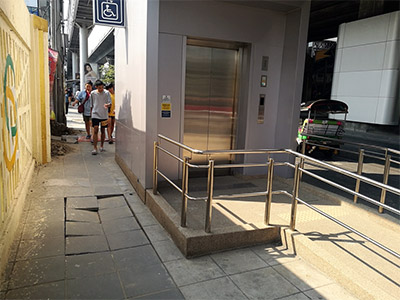
Most stations now have functioning elevators from the street to the ticket-selling concourse, where separate elevators go up to both sides of the platform. But most only have one that goes down one side of the street.
BTS Nana has no lift to the street. BTS Chong Nonsi, a station with two elevators from the street is still problematic, according to Sonthipong Mongkonsawat, the activist group’s pro bono lawyer.
“Once you take a lift down to ground level on Chong Nongsi station, you are dead … because you will find yourself on a traffic island,” he said. “If a disabled person takes the lift, he would probably be run down by a car.”
Manit of Transportation for All is particularly outraged by the lack of access to both sides of the street. He acknowledges that the court order didn’t spell out that ground lifts must installed on both sides of the traffic, but believes it should be clear to the BMA as necessary to be considered accessible.
Sidewalk access to the elevator at BTS National Stadium is limited.
“They told us we should take a taxi to go to the other side,” said Manit, 51, who has used a wheelchair since he was in a car accident at 24.
Manit refused to identify which BMA official told him to take a cab.
“Try tying yourself to a wheelchair and flagging a cab to go to the other side of the street and see how complicated life gets. It’s been very hard. I want to see sincerity on the part of the BMA.”
Return to the Courts
Thanoochai meanwhile said the BMA will eventually install lifts on both sides of the streets, adding that there the BMA does not disagree it should be done. He said City Hall would make its best effort to ensure that all stations lifts on both sides of the street where they are situated.
Still, a slew of unkept promises over the years is what led activists on Jan. 20, 2017, two years after the original decision, to seek another bold remedy from the courts: millions of baht in punitive compensation.
The lawsuit, filed after new legislation allowed class actions, has stalled since the city challenged which court can hear it.
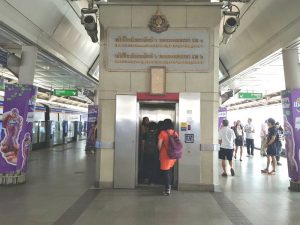
Commuters use the elevator Wednesday at BTS Siam.
“It’s like our side is trapped in a pothole and immobilized,” Manit said. “We will probably have to continue using social measures.”
Sonthipong, the lawyer helping with the class action, said he expects some clarity on their lawsuit in the next month or two, now that a judicial committee has been set up to decide which court has jurisdiction over the case.
The suit seeks 1,000 baht for each plaintiff to join the class for every day that has passed since the court-ordered completion deadline of Jan. 21, 2016. It seeks 4,000 baht for every day that has passed since the suit was filed one year ago, plus 7.5 percent annual interest.
Sonthipong said some of the excuses cited over the years by the BMA for years of delay are reasonable, such as issues coordinating with the utilities in charge of underground infrastructure.
He also agreed that some stations were not structurally built to accommodate the addition of elevators.
Then there’s opposition by shopkeepers in some areas who see an elevator shaft in front of their shophouse as a business-killer. Sonthipong argues that the BMA has the legal authority to relocate and compensate such shop owners to make way for construction, however.
Additionally, as long as there exist access to the elevated stations from only one side of the road, the BTS system does not meet international standards and cannot be considered genuinely accessible, Sonthipong said, adding that his clients are not ruling out further legal action against City Hall.
A man walks his dog across the snow-covered beach while a cargo ship sits in the steaming fog of Lake Ontario in Toronto. According to a report released on Thursday, Jan. 18, 2018, U.S. and British scientists calculate that 2017 wasn’t the hottest year on record, but close and unusually warm for no El Nino cooking the books. Photo: Frank Gunn / The Canadian Press
WASHINGTON — Earth last year wasn’t quite as hot as 2016’s record-shattering mark, but it ranked second or third, depending on who was counting.
Either way, scientists say it showed a clear signal of man-made global warming because it was the hottest year they’ve seen without an El Nino boosting temperatures naturally.
The National Oceanic and Atmospheric Administration and the United Kingdom’s meteorological office on Thursday announced that 2017 was the third hottest year on record. At the same time, NASA and researchers from a nonprofit in Berkeley, California, called it the second.
The agencies slightly differ because of how much they count an overheating Arctic, where there are gaps in the data.
The global average temperature in 2017 was 58.51 degrees (14.7 degrees Celsius), which is 1.51 degrees (0.84 Celsius) above the 20th century average and just behind 2016 and 2015, NOAA said. Other agencies’ figures were close but not quite the same.
Earlier, European forecasters called 2017 the second hottest year, while the Japanese Meteorological Agency called it the third hottest. Two other scientific groups that use satellite, not ground, measurements split on 2017 being second or third hottest. With four teams calling it the second hottest year and four teams calling it third, the United Nations’ World Meteorological Organization termed 2017 a tie for second with 2015.
“This is human-caused climate change in action,” said Nobel Prize winning chemist Mario Molina of the University of California San Diego, who wasn’t part of any of the measuring teams. “Climate is not weather, (which) can go up and down from year to year. What counts is the longer-term change, which is clearly upwards.”
Which year is first, second or third doesn’t really matter much, said Princeton University climate scientist Gabriel Vecchi. What really matters is the clear warming trend, he said.
NOAA’s five hottest years have been from 2010 on.
During an El Nino year — when a warming of the central Pacific changes weather worldwide — the globe’s annual temperature can spike, naturally, by a tenth or two of a degree, scientists said. There was a strong El Nino during 2015 and 2016.
But 2017 finished with a La Nina, the cousin of El Nino that lowers temperatures. Had there been no man-made warming, 2017 would have been average or slightly cooler than normal, said National Center for Atmospheric Research climate scientist Ben Sanderson.
On the other hand, NASA calculated if the temperature contributions of El Nino and El Nina were removed from the global data through the years, 2017 would go down as the hottest year on record, NASA chief climate scientist Gavin Schmidt said.
Carbon pollution is like putting the Earth on an escalator of rising temperatures, with natural variation such as El Nino or the cooling effect of volcanoes like hopping up or down a step or two on that escalator, scientists said. Not every year will be warmer than the last because of natural variations, but the trend over years will be rising temperatures, they said.
The observed warming has been predicted within a few tenths of a degree in computer simulations going back to the 1970s and 1980s, several scientists said.
It has been 33 years since the last month that the globe was cooler than normal, according to NOAA.
Northern Illinois University climate scientist Victor Gensini has never lived through a month or year that wasn’t hotter than normal.
“I look at pictures of the great winters of the late ’70s from my parents and wonder if I’ll ever experience anything like that in my lifetime,” said Gensini, who’s 31.
CANBERRA, Australia — A flying drone has dropped a flotation device to two teens caught in a riptide in heavy seas off the Australian coast in what officials describe as a world-first rescue.
Monty Greenslade and Gabe Vidler got into trouble on Thursday at Lennox Head, 750 kilometers north of Sydney. They were about a kilometer from lifeguards, who were about to start training with one of the new drones equipped with a camera, rescue gear and six rotors.
After a friend raised the alert, lifeguard Jai Sheridan said he piloted the drone to the swimmers and dropped a rescue pod minutes faster than lifeguards could have reached the pair by conventional means.
“I was able to launch it, fly it to the location, and drop the pod all in about one to two minutes. On a normal day, that would have taken our lifeguards a few minutes longer to reach the members of the public,” Sheridan said in a statement.
Greenslade, 16, said Friday the pair were lucky that the drone had been nearby.
“We realized pretty quickly that it was a rescue drone, once we heard it,” Greenslade told Nine Network television. “It was pretty noisy, so it was kind of hard to miss it, to be honest.”
“With the heavy waves, we were sort of going under and coming up for breath and … the drone dropped the package and we both grabbed on pretty quickly. It’s kind of obvious what you’re supposed to do with it,” he added.
Vidler, 17, told Nine: “It was pretty heavy out there and we were a little bit concerned.”
“It just dropped the life raft and so we just held on to that and just swam into shore,” Vidler said.
It was the first drone rescue since the New South Wales state government last month invested 430,000 Australian dollars (11 million baht) in drone technology for rescue and shark spotting work in the state’s north.
“This is a world-first rescue,” state Deputy Premier John Barilaro said. “Never before has a drone, fitted with a flotation device been used to rescue swimmers like this.”
Yellow Line construction begins Friday night and will put the crunch on the ever-lousy Lat Phrao Road when the first phase of the 30-kilometer stretch – linking MRT Lat Phrao to the east and south by way of BTS Samrong – begins construction at 10pm.
Portions of Lat Phrao Road will be closed for the duration of the first phase of construction, which starts tonight and continues for about eight months. That includes several hundred meters of the outermost lanes going both ways.
Several hundred meters of the outermost, westbound lane will be closed between sois Lat Phrao 136 and 134. The same goes for the eastbound side of the road from Soi Lat Phrao 45/1 to Soi Lat Phrao 45.
Transit spokeswoman Naruemon Poomhoi broke down some traffic pro tips for wary end-of-week commuters:
“There’s extra traffic expected, so please try driving along some shortcutssuch as going into Soi Lat Phrao 130, which will connect through Soi Ramkhamhaeng 81, or going into Soi Lat Phrao 80 which will go through to Soi Pracharat Bamphen 26.”
The entire, 52-billion-baht extension, including 25 new stations, is expected to take three years and three months to complete, though most major rail projects have seen years of delay.
By the time it reaches BTS Samrong, that station will no longer be the terminus of the Sukhumvit Line. Eight additional stations planned along the Sukhumvit Green Line – which will push 13 kilometers toward the Gulf of Thailand – will be operating by December, Surapong Laoha-Unya of the Bangkok Mass Transit System said last month.
An average of more than 660,000 people ride the BTS each day, a ridership expected to grow by 3 percent to 5 percent annually. BTS profits for 2017 were at 10.4 billion, according to Surapong. He said the BTS plans to purchase 46 more trains to accommodate the additional lines.