25 C
Bangkok
Friday, June 19, 2026
Home Blog Page 2125

Top US Aid Recipients Ignore White House Threat on UN Vote

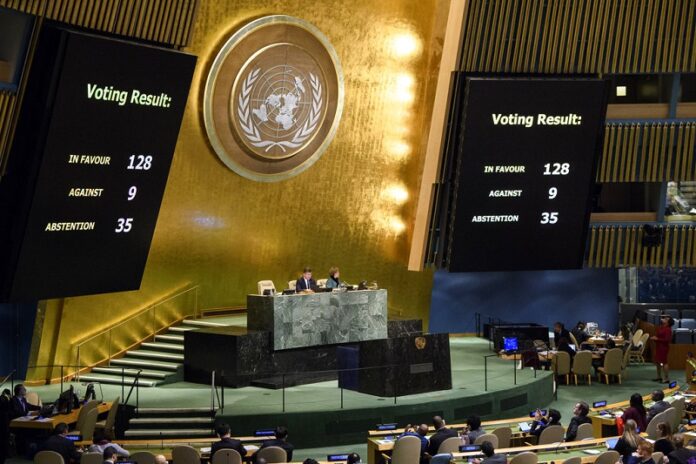
The results of a vote are posted in the General Assembly, Thursday, Dec. 21, 2017, at United Nations headquarters. Photo: Manuel Elias / Associated Press

JERUSALEM — Ahead of a dramatic vote at the United Nations on Thursday, the United States made an unprecedented threat to fellow members of the international community: those who vote against President Donald Trump’s decision to recognize Jerusalem as Israel’s capital risk diplomatic retaliation and losing American financial aid.

But when the dust settled, the biggest recipients of American aid – most of them Muslim or Arab countries – rejected the threat, leaving the White House facing a tricky dilemma as it plots a course forward for the Middle East. Key Arab allies, led by Saudi Arabia, all banded together against the U.S.

Yet for Trump and Israeli Prime Minister Benjamin Netanyahu, there were some bright spots in the lopsided vote. Some influential countries, mostly African and Latin American countries courted by Israel in recent years, stepped back from past support for the Palestinians by abstaining or skipping the vote altogether. Still, two of Netanyahu’s biggest targets, China and India, came down solidly in favor of the Palestinians.

These mixed trends could allow each side to claim a victory of sorts.

Here is a closer look at how key countries and regions voted in Thursday’s General Assembly resolution:


Aid Recipients

With the exception of Israel, the top recipients of international aid are Muslim, Arab or African countries. Afghanistan, Egypt, Jordan and Pakistan all voted to back the resolution proposed by the Palestinians, as did African countries Nigeria, Ethiopia, Tanzania, and South Africa. In addition to Israel, the only member of the top 10 aid recipients not to support the Palestinians was Kenya, a close Israeli ally that skipped the vote, according to Foreignassistance.gov.


Arab Allies

The Arab world voted across the board with the Palestinians, an expected move given the importance of Jerusalem and the Palestinian cause to the Arab public. Nonetheless, the vote could embarrass the White House, which has sought to cultivate ties with Saudi Arabia, Egypt and other moderate Sunni countries to counter rising Iranian influence. It also could complicate attempts by the U.S. to rally support for an expected region-wide peace plan it says is in the works.


Claiming Victory

The Palestinians praised the lopsided majority in their favor, saying it shows “once again that the just Palestinian cause enjoys the support of (the) international community.” Yet the Palestinians have long enjoyed widespread support in the United Nations, which is dominated by developing countries sympathetic to their cause.

In a possible cause for concern, the level of support was slightly less than a 2012 landmark vote in the General Assembly to recognize Palestine as a nonmember state. In that vote, 138 nations supported the Palestinians, compared to 125 on Thursday.


Israeli Outreach

Netanyahu has made significant outreach efforts in recent years to countries in Africa, Asia and Latin America in a bid to soften support for the Palestinians at the U.N. Those efforts showed some signs of success. After the vote, Netanyahu said he appreciated the growing number of countries that “refused to participate in this theater of the absurd.”

Mexico and Argentina, countries that Netanyahu visited earlier this year, both shifted from past support for the Palestinians to abstentions on Thursday. Two Latin American countries, Guatemala and Honduras, even voted against Thursday’s measure.

While Kenya skipped the General Assembly vote, Uganda and South Sudan – African countries courted by Netanyahu – also dropped their past support for the Palestinians and abstained.

But a possible concern for Israel could be the apparent support by two countries with poor human rights record – Myanmar, which skipped the vote, and the Philippines, which abstained. Both countries voted with the Palestinians in 2012.

The Indian and Chinese votes also exposed the limits of Netanyahu’s outreach.


Whither Europe

As the U.S. prepares a new Mideast peace push, Thursday’s vote at the General Assembly exposed deep divisions with Europe. The three most important countries in Europe – Britain, France and Germany – all voted against the U.S. on Thursday. That could signal trouble if the U.S. seeks European support for its peace plan down the road.

Other European countries with close ties to Israel, including Poland, Hungary and the Czech Republic – all with nationalist governments – abstained in the vote.

These divisions within Europe could complicate attempts by the European Union to formulate a joint position on the Israeli-Palestinian conflict moving forward.

Story: Josef Federman

Advertisement

Thailand Joins UN Vote Against US Recognition of Jerusalem

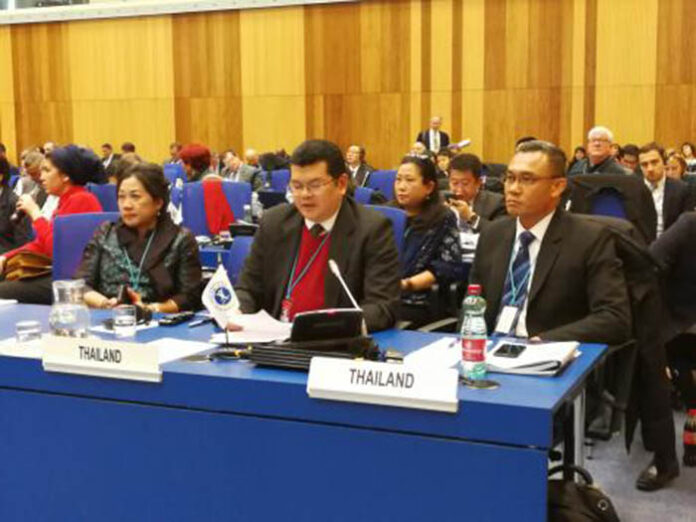
Thailand's ambassador to the United Nations Sek Wannamethee, at center, with the Thai delegation in Geneva in a file photo released Tuesday. Photo: ThaiEmbassy.org

UNITED NATIONS — The Thai delegation to the United Nations voted to support the General Assembly’s overwhelming vote Thursday to denounce President Donald Trump’s recognition of Jerusalem as Israel’s capital, ignoring Trump’s threats to cut off aid to any country that went against him.

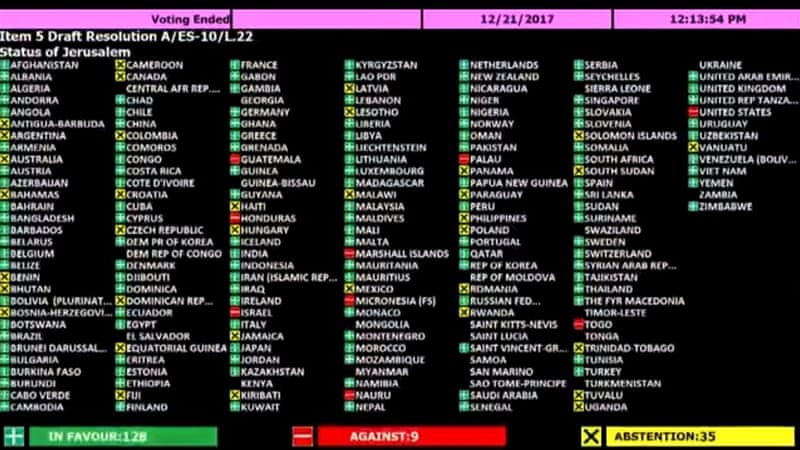
The nonbinding resolution declaring U.S. action on Jerusalem “null and void” was approved 128-9 – a victory for the Palestinians, but not as big as they predicted. Amid Washington’s threats, 35 of the 193 U.N. member nations abstained and 21 were absent.

The resolution reaffirmed what has been the United Nations’ stand on the divided holy city since 1967: that Jerusalem’s final status must be decided in direct negotiations between Israel and the Palestinians.

Thai Foreign Affairs Ministry spokeswoman Busadee Santipitaks said Thailand voted in accordance with the stance of the United Nations, which “we have always done.”

As for Trump’s threat, she said Thailand would be unaffected.

“Thailand has not received any aid from the United States for many years now because we are ranked as a developed country,” she said. “Most of our interactions involve regional cooperation.”

The Trump administration made it clear the vote would have no effect on its plan to move the American Embassy from Tel Aviv to Jerusalem. And Israeli Prime Minister Benjamin Netanyahu said afterward that he completely rejects the “preposterous” resolution.

Image: United Nations

Palestinian Ambassador Riyad Mansour called the vote a victory not only for the Palestinians but for the United Nations and international law, saying U.S. Ambassador Nikki Haley “failed miserably” in persuading only seven countries aside from the U.S. and Israel to vote against the resolution.

“And they used unprecedented tactics, unheard of in the diplomatic work at the U.N., including blackmail and extortion,” he said.

The United States and Israel had waged an intensive lobbying campaign against the measure, with Haley sending letters to over 180 countries warning that Washington would be taking names of those who voted against the U.S. Trump went further, threatening a funding cutoff: “Let them vote against us. We’ll save a lot. We don’t care.”

But in the end, major U.S. aid recipients including Afghanistan, Egypt, Jordan, Pakistan, Nigeria, Ethiopia, Tanzania and South Africa supported the resolution. Egypt received roughly $1.4 billion in U.S. aid this year, and Jordan about $1.3 billion.

The nine countries voting “no” were the U.S., Israel, Guatemala, Honduras, Micronesia, Nauru, Palau, the Marshall Islands and Togo. Among the abstentions were Australia, Argentina, Canada, Colombia, Croatia, Czech Republic and Mexico.

The absent countries included Kenya, which was the fifth-largest recipient of U.S. aid last year, Georgia and Ukraine, all of which have close U.S. ties.

After the vote, Haley tweeted a photo naming the 65 nations that voted no, abstained or were absent, and said: “We appreciate these countries for not falling to the irresponsible ways of the UN.”

She later sent invitations to the 65 ambassadors inviting them to a reception on Jan. 3 to thank them for their friendship with the United States.

The U.S. is scheduled to dispense USD$25.8 billion in foreign aid for 2018. Whether Trump follows through with his threat against those who voted “yes” remains to be seen.

But within hours, the Trump administration appeared to be backing away from its funding threats. In Washington, State Department spokeswoman Heather Nauert said cuts to countries that opposed the U.S. are not a foregone conclusion.

“The president’s foreign policy team has been empowered to explore various options going forward with other nations,” Nauert said. “However, no decisions have been made.”

During the debate, Arab, Islamic and non-aligned nations urged a “yes” vote on the resolution, which was sponsored by Yemen and Turkey.

Yemeni Ambassador Khaled Hussein Mohamed Alyemany warned that Trump’s recognition of Jerusalem undermines any chance for peace in the Mideast and “serves to fan the fires of violence and extremism.”

He called Trump’s action “a blatant violation of the rights of the Palestinian people and the Arab nations, and all Muslims and Christians of the world,” and “a dangerous violation and breach of international law.”

On Wednesday, Trump complained that Americans are tired of being taken advantage of by countries that take billions of dollars and then vote against the U.S. Haley echoed his words in her speech to the packed assembly chamber, threatening not only member states with funding cuts, but the United Nations itself.

Haley said the vote will make no difference in U.S. plans to move the American Embassy, but it “will make a difference on how Americans look at the U.N., and on how we look at countries who disrespect us in the U.N.”

“And this vote will be remembered,” she warned.

Trump’s pressure tactics had raised the stakes at Thursday’s emergency meeting and triggered accusations from the Muslim world of U.S. bullying and blackmail.

“It is unethical to think that the votes and dignity of member states are for sale,” said Turkish Foreign Minister Mevlut Cavusoglu. “We will not be intimidated! You can be strong but this does not make you right!”

The Palestinians and their supporters sought the General Assembly vote after the U.S. on Monday vetoed a resolution supported by the 14 other U.N. Security Council members that would have required Trump to rescind his declaration on Jerusalem.

The resolution adopted by the assembly has language similar to the defeated measure.

It “affirms that any decisions and actions which purport to have altered the character, status or demographic composition of the holy city of Jerusalem have no legal effect, are null and void and must be rescinded.”

Story: AP’s Edith M. Lederer, Khaosod English

Related stories:

Thai Junta Leader Pledges Assistance to Palestine

Advertisement

SHINee Fans Hold Memorial For K-Pop Star in Bangkok (Video)

Post-it notes written by fans for K-Pop singer Jonghyun at a memorial Thursday night at Wat Suthiwararam in Bangkok.

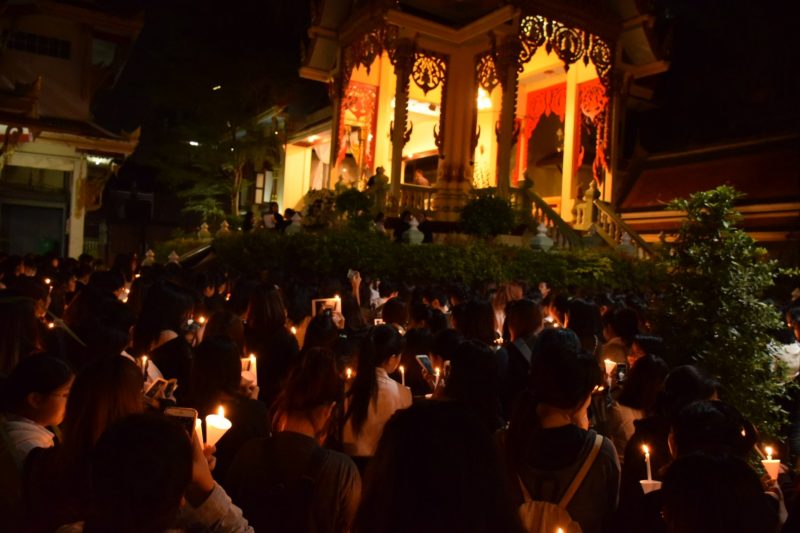
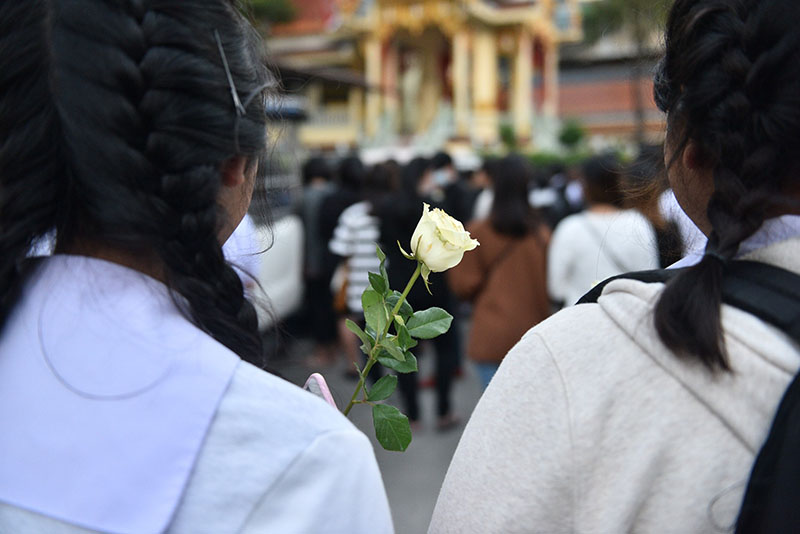
BANGKOK — More than 1,000 devoted fans of a K-pop idol who committed suicide earlier this week held Buddhist mourning rites for him Thursday night at a Bangkok temple.

Elegy chants for Kim Jonghyun, lead singer of K-pop boy band SHINee, resounded at Wat Suthiwararam in the Yan Nawa district as fans gathered starting at 6pm to say goodbye in the crisp evening air.

Fans wrote their farewells on Post-it notes, lit candles and held a moment of silence. Some brought memorabilia on which the temple performed Buddhist and some Christian rites – Jonghyun was Christian – before cremating and interring the ashes.

Read: Thai Fans Despair Over Death of K-Pop Idol

The Bangkok ceremony was held the same day Jonghyun’s funeral took place in South Korea. His former bandmates and artists from his S.M. Entertainment label were the pallbearers for the Seoul funeral.

“We have to be strong, do not let him see that we are weak. Jonghyun will be worried,” @Dsfameee tweeted Thursday night in English.

A fan told a Khaosod reporter they organized the ceremony through donations shortly after news broke of his death.

Kim Jonghyun committed suicide Monday evening by inhaling the toxic fumes of coal briquettes he burned in his Seoul apartment. His suicide notes revealed a struggle with depression.

Since Tuesday, #RIPKimJonghyun has remained one of the top trending Twitter hashtags.

DRlGme VQAAJUoQ e1513918877690
Fans of Kim Jonghyun at a fan-organized ceremony at Wat Suthiwararam on Thursday night in Bangkok. Photo: JiminJ021 / Twitter

ไว้อาลัย คิมจงฮยอน 171222 0019 ไว้อาลัย คิมจงฮยอน 171222 0025

Advertisement

Wiretapping Proposal Withdrawn Under Fierce Criticism

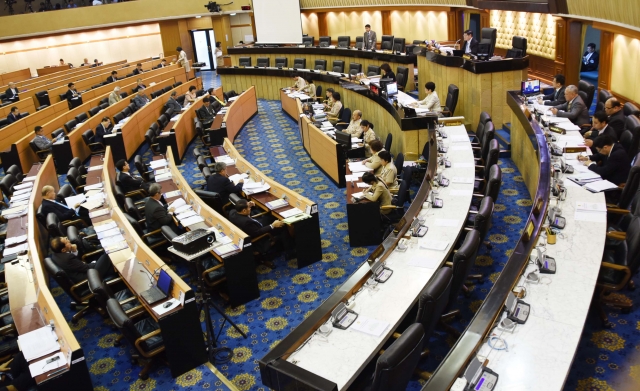
The National Legislative Assembly meets this past December in Bangkok. Photo: Prachachat

BANGKOK — Proposed wiretapping legislation was withdrawn from parliament Friday after meeting fierce criticism.

Police Gen. Chatchawan Suksomjit, who leads a committee in the legislature, conceded just before 11am that the public and legislators held deep concerns about potential abuses of power under the proposed law. He said it would be best to withdraw the proposed Article 37/1 of proposed anti-corruption legislation that would have allowed the National Anti-Corruption Commission to wiretap and spy on corruption suspects’ digital communications.

Read: Lawmakers Warn of Power Abuse if Parliament Passes Spying Law

“There are concerns about the repercussions, and there may be concerns that those using the power may use it inappropriately,” Chatchawan told the junta-appointed NLA.

“[We] don’t want such sentiments to get out of control. It may take more time to create understanding. Actually what we asked was so little. But we discussed it and concluded that the time is not right, that we should withdraw it first.”

Since Thursday, most lawmakers took turns attacking the proposed power, saying it could easily be abused by gathering intelligence for blackmail purposes.

Before the decision by the national legislature’s vetting committee withdrew the proposal, lawmaker Tuang Inthachai took to the floor to warn that passage would deepen existing distrust in society.

“For the past 10 years, people in Thai society do not trust one another,” he said. “[This proposal] will add more fuel to that distrust and will lead to another crisis.”

Debate on the proposed law began Thursday and had been held over to Friday morning.


Advertisement

Rohingya Survivors: Myanmar’s Army Slaughtered Men, Children

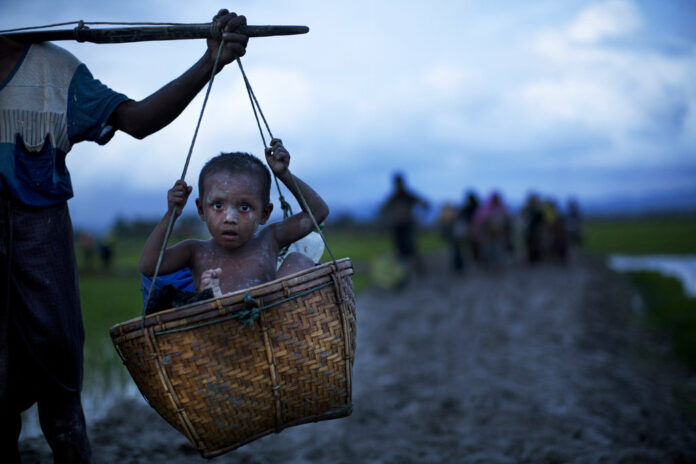
A Rohingya child from Myanmar is carried in a basket past rice fields after crossing over to the Bangladesh side of the border last year near Cox's Bazar's Teknaf area. Photo: Bernat Armangue / Associated Press

UKHIA, Bangladesh — For six hours he hid in an upstairs room, listening to the crackle of gunfire and the screams of people being slaughtered outside his Myanmar home.

With every footstep that drew near, every cry that pierced the air, 52-year-old Bodru Duza braced for the soldiers to find him, to kill him like all the others who had fled to his compound that morning seeking a safe place to shelter. They were being blindfolded and bound, marched away in small groups, then butchered and shot as they begged for their lives.

What had started out as a quiet Sunday in northwestern Myanmar had spiraled into an incomprehensible hell – one of the bloodiest massacres reported in the Southeast Asian nation since government forces launched a vicious campaign to drive out the country’s Rohingya minority in late August.

By the time it was over, there was so much blood on the ground, it had pooled into long rivulets across the uneven earth, among bits of human flesh and the fragments of shattered skulls.

When Duza finally dared to emerge from his hiding place, he wondered how anyone could have survived.

The compound he grew up in was now consumed by an ethereal silence. His wife, daughter, and five young sons were nowhere to be seen. And as he crept toward a backdoor to escape, he stumbled upon the corpse of an unknown boy sprawled on the floor.

“Oh Allah!” he thought. “What have they done to us? What have they done to my family?”

The Associated Press reported this story with a grant from the Pulitzer Center on Crisis Reporting.

Duza’s family belonged to the ethnic Rohingya Muslim community, which has long been persecuted and denied basic rights in predominantly Buddhist Myanmar. They lived in the village of Maung Nu, where at least 82 Rohingya are believed to have been murdered on Aug. 27.

The massacre was part of a streak of violence that started before dawn two days earlier, when Rohingya insurgents staged an unprecedented wave of 30 attacks on security posts across Rakhine state. At least 14 people were killed.

The assaults triggered one of the greatest catastrophes the Rohingya have ever known: an army counter-offensive that has left hundreds of villages burned and driven 650,000 refugees into Bangladesh. The aid group Doctors Without Borders estimates 6,700 Rohingya civilians were killed in the first month of reprisals alone, and human rights groups have documented three large-scale massacres.

The Associated Press has reconstructed the massacre at Maung Nu as told by 37 survivors now scattered across refugee camps in Bangladesh. Their testimony and exclusive video footage from the massacre site obtained by AP offer evidence, also documented by the United Nations and others, that Myanmar armed forces have systematically killed civilians.

Myanmar’s military did not respond to repeated requests for comment on this story, and the government – which prohibits journalists from independent travel to northern Rakhine State – did not reply to an AP request for a visit. The army has insisted in the past that not a single innocent has been slain.

For as long as anyone could remember, there was only one place in Maung Nu that was truly considered safe. It was a large two-story residence shared by two of the village’s most prominent businessmen – Duza and his brother Zahid Hossain.

Built on a hillside more than half a century ago, the vast home was known for its three-foot-thick walls of hardened mud, which many believed to be bullet-proof and virtually impossible to burn. That mattered in Rakhine state, where the Rohingya population lived in fear of both the military and the area’s ethnic Rakhine Buddhists. Although the Rohingya have lived in Myanmar for decades, they are still seen as foreign invaders from Bangladesh who are intent on stealing land.

Despite the tensions, Hossain worked extensively with local army commanders, trading cows and rice and jointly operating a brick-making factory. Both brothers were charismatic, educated and popular. Duza, an affable man who was well-known throughout the area, had previously served as village administrator for 12 years. Many people assumed that neither he nor his compound would be harmed.

After insurgents launched their first attacks a year ago, the government had imposed strict new measures aimed at curbing militant activity. Islamic schools were closed, a curfew was put in place, and authorities ordered the removal of fences and even shrubbery so security forces could see inside private compounds.

But Maung Nu, a village of about 2,000 people also known as Monu Para, remained peaceful. Duza and his brother counted their blessings. They were among the village’s wealthiest men. They owned scores of cows and buffalo, and vast acres of rice.

Soon, it would all be gone.

A few hours after midnight on Aug. 25, fierce volleys of gunfire woke the residents of Maung Nu. Rohingya militants had launched a surprise assault on a Border Guard Police post in Hpaung Taw Pyin, less than a kilometer (a mile) to the north.

The fighting lasted until dawn. According to the government, two officers and at least six of the assailants died.

That morning a commander from the army’s Light Infantry Battalion 564, based just south of Maung Nu, called the local district administrator, Mohamed Arof, furious.

“Why didn’t you tell us about these attacks?” the commander demanded.

“I didn’t know anything about it,” replied Arof, a Rohingya. “I only heard the shooting, like you.”

The same day, police snatched Arof’s 15-year-old son from a rice paddy and took him to their camp, where he was hanged with a rope along with three other teenagers, according to Arof and several witnesses. It’s unclear why the teens were killed, but word of their deaths spread quickly.

Fearing more reprisals from security forces, most of Hpaung Taw Pyin’s residents fled. Hundreds of them walked to the homes of friends and relatives in Maung Nu, in the hope they would be safe there.

And for a day, they were.

On Aug. 27, bursts of gunfire echoed across Maung Nu again. This time only the army was shooting.

Several military trucks parked on the village’s main road around 9 a.m. and began disgorging troops who fanned out on foot, firing into the air. Peering out a window of her home, 35-year-old Jamila Begum spotted several armed soldiers crossing her yard carrying coils of nylon rope.

Hundreds of people were already on the move, seeking the closest refuge – the hillside compound of Duza and Hossain, which included half a dozen other homes belonging to their relatives and a large rectangular pond. Jamila’s family joined them.

Other residents were being rounded up by force and ordered to head to the compound. Some cowered inside their homes, wondering what to do. One of them, 18-year-old Mohammadul Hassan, put a woman’s veil over his face when troops burst through the front door of his home, guns drawn.

Hassan immediately recognized one of the soldiers – a skinny army staff sergeant named Baju who was well-known in the village. A member of the 564th Battalion, Baju had lived in the area for 15 years and spoke the Rohingya dialect, according to numerous villagers. Duza said Baju was also a frequent visitor to his home.

When the soldiers discovered Hassan hiding among several female relatives, they became enraged. He was dragged outside along with two of his brothers, shoved to the ground and kicked until blood poured from his left eye.

As troops ripped clothes off the women and seized their valuables, the three brothers were stripped and tied up. The soldiers marched them to Duza’s compound naked, at gunpoint, the sunbaked dirt road burning their bare feet.

Duza had never seen people so scared.

As the number of Rohingya hiding on his property rose into the hundreds, his wife, a warm woman with an easy smile named Habiba, turned to him and asked, “What’s happening? What’s going on?”

The answer came when dozens of helmeted soldiers in olive green uniforms arrived around 11 a.m., accompanied by several border guard police.

Their entrance set off a new panic. A few men in Duza’s house locked the main wooden doors and climbed the stairs to a balcony, where most of the males already had gathered.

Before joining them, Duza pulled Habiba aside.

“Please take care of our daughter and our sons.”

So many people were crammed into their house by then, though, that Habiba soon lost track of all but one child.

Outside, a soldier’s voice rose above the others. It was Baju, and he was calling on everyone to come out, assuring them they would not be harmed. As the minutes passed and nobody emerged, the calls turned menacing, and the sergeant threatened to burn the compound to the ground.

Several bursts of gunfire rang out and a young boy was struck in the forehead. The women recoiled in horror as he lay motionless before them, the back of his skull blown apart.

Seconds later, soldiers broke down the doors and began dragging people out, separating the men from the women.

Mothers and elderly women were ordered onto their knees. Some tried to push back when troops ripped off their headscarves and tore at their clothes. The soldiers first demanded their cell phones, then grabbed at exposed breasts as they snatched gold earrings, necklaces and wads of cash.

About 20 or 25 of the women – mostly attractive and young – were taken away. They were never seen again. The rest eventually were driven, along with their children, into a pair of houses on the property.

The soldiers bound the men’s hands behind their backs and ordered them into the dirt courtyard in front of the house, where they were forced face down onto the stifling ground. Most were blindfolded with masking tape or veils taken from the women. A handful who tried to resist were thrown off the balcony head-first.

Troops started to walk across the sea of people, grinding boots into their heads and beating them with rifle butts. Some of the soldiers cursed their prisoners, calling them dirty “kalar,” a derogatory word for Muslims that is frequently used in Myanmar.

Duza’s brother, Hossain, begged for the violence to stop.

“Why are you doing this?” he cried. “Why are you tying us up?”

There was no answer.

Around noon, a senior officer called a commander on his phone. The officer said they had rounded up 87 men.

“What should we do with them?”

The call ended shortly afterward, and the officer barked an order to his troops.

“Let us begin.”

Duza watched through a slit in a closed window as a soldier plunged a long knife into his brother’s neck in front of their house. When two of Hossain’s sons got up and tried to run, soldiers opened fire.

Duza stepped back in shock. He scrambled to an upstairs room and crawled into the only place he could think of to hide: a foot-high space under a large wooden container normally used to store rice. He covered his legs with rice sacks and curled into a ball, trying to disappear.

Outside, screams like he’d never heard before reverberated across the courtyard.

Several soldiers hammered four-inch nails into the temples of three men on the ground with the butts of their rifles. Four other men were decapitated, including a prominent gray-bearded mullah.

Then a pair of soldiers – one was Baju – descended on Jamila’s husband. With two-foot-long machetes, they hacked into his neck from both sides. He crumpled in the dirt, gagging on blood.

Gasping for breath, Jamila stumbled toward the door. She wanted to rush to his side, to help him, to be with him – to die.

But the women in the house pulled her back.

“You can’t go,” one said, as Jamila collapsed, weeping. “If you go out there, they’ll kill all of us.”

While women rocked back and forth, several children began praying. In the courtyard, they could hear people begging for their lives.

“Please Allah!” Please help us!”

“We’re dying!”

When Jamila rose to look out the window again, she saw her 16-year-old son dragged away by the collar of his shirt and tied to a tree, screaming, “I didn’t do anything!”

The gunshots rang out. Jamila could not bear to look.

As the afternoon wore on, the carnage became more methodical.

Men and teenage boys were taken away in small groups and killed by firing squads near a forested area on the edge of the property. In some cases, a soldier blew a whistle beforehand, signaling for them to begin.

Other troops wrapped corpses in orange and green tarps and transported them downhill in three-wheeled push-carts to a pair of army trucks parked on the road. Several witnesses reported seeing soldiers digging pits and dumping bodies into them.

When Mohammad Nasir was marched to the killing ground with six others, he saw more than a dozen cadavers crumpled there under the trees. As those beside him braced for death and called out Islamic creeds – “There is no god but Allah! Mohamed is his prophet!” – Nasir wriggled loose and ran.

He made it to the far side of a small ravine before the first burst of gunfire rang out. Half an hour later, when he had run out of breath, he realized he had been shot in the elbow.

Mohammadul Hassan was taken to a pond just east of the main house. Soldiers ordered him to kneel with his two brothers, then shot them all from behind and rolled them over to make sure they were dead. When Hassan unexpectedly opened his eyes, an officer sitting on the bank walked casually forward and fired a single rifle shot into his chest. Hassan later regained consciousness, stumbled away, and survived.

That afternoon, soldiers began searching the compound for men. At one point, Baju grabbed Duza’s 9-year-old son Mohamed Ahasun, and demanded to know where his father was.

The boy said Duza had left four days earlier for another village. Baju slapped him, but let him go.

In the tiny, darkened crawl space upstairs, Duza’s mind had gone numb. He kept telling himself: “It has to stop … This has to end somehow.” Praying for survival, he waited for the soldiers to discover him, to drag him out by the feet.

But they never did. And when the guns finally fell silent, he crept slowly downstairs, and slipped away.

For the next two weeks, he traveled alone, joining the hordes of Rohingya bound for Bangladesh. They crossed streams and forests and mountains, and finally the Naf River, which separates the two countries.

When Duza got out of a boat and stepped onto Bangladeshi soil, he looked back toward Myanmar and saw half a dozen columns of smoke curling skyward from burning Rohingya homes. His family, he thought, was surely dead.

There is no way to independently confirm the death toll in Maung Nu. But one handwritten tally seen by The AP details the names, ages and professions of 82 people, most of them men and boys from Maung Nu and Hpaung Taw Pyin, who family members say were killed.

They are farmers and students, carpenters, businessmen and teachers. The youngest is seven years old; the oldest, 95.

According to Arof, the village administrator, at least 200 more remain missing and are feared dead.

Most of the survivors struggle to understand why so many of their neighbors were slaughtered. Arof said the army falsely believed they were supporting the insurgency, but something much deeper had driven the killing. The massacres reported since August have stood out for their high casualty toll, their ferocity, and the methodical way in which they were carried out.

“You have to understand … they hate us,” Arof said. “This didn’t only happen in our village, it happened everywhere.”

In the end, Duza was one of the luckiest survivors.

After weeks spent imagining another life without a family, he found a newly-arrived refugee with a Myanmar phone and asked to use it.

He dialed his wife Habiba’s number. A young girl answered.

He could barely believe it. It was his 14-year-old daughter, Taslima.

As tears welled in his eyes, Duza asked about the rest of his family. “Are they with you? Are they alive?”

“Yes papa! Yes!” Taslima replied. “We’re here! Everybody is fine.”

Duza’s family had been elsewhere in the compound when he fled. It would take them six more weeks to make the journey to Bangladesh.

When the family reunited in a refugee camp, Duza broke down as he hugged his wife and squeezed the children he never thought he’d see again. They had lost so much – their friends and relatives, their home, their savings, their future – but they had somehow found each other.

“It felt like living in another world,” Duza said. “It felt like a new life.”

Story: Todd Pitman

Advertisement

Pheu Thai Denies Making Thaksin-Yingluck Calendar

Image: Arunwatee Kong Li Chattay / Facebook

BANGKOK — Pheu Thai Party’s chairman said Friday his party was not behind calendars featuring former prime ministers Thaksin Shinawatra and Yingluck Shinawatra, who are currently living in exile.
A photo of one of two calendar designs posted Thursday by a Pheu Thai supporter show Thaksin, still the party’s de facto leader despite his ouster a decade ago, holding his infant granddaughter. The other shows Yingluck, its most recent leader and Thaksin’s sister, performing a waii.

“I thank you for all the support you have always given me,” reads the caption accompanying Yingluck’s photo, which includes what appears to be her signature.

But Pheu Thai exec Phongthep Thepkanjana said the party had nothing to do with it.

“They were definitely not made by Pheu Thai,” he said. “I also saw them on social media. I don’t know where they’re from. But I can tell you, they are not related to Pheu Thai.”
Asked which group was responsible for the calendars, Pongthep said, “I really don’t know.”

The person who posted the photo, Arunwatee Kong Li Chattay, said the calendars were given to her by a friend so she did not know who made them.
Calendars were previously a point of conflict between Pheu Thai supporters and the ruling junta which toppled Yingluck’s government in 2014.

When similar calendars depicting Thaksin and Yingluck surfaced in January 2016, the regime banned their distribution. Junta chairman Prayuth Chan-ocha slammed the calendars on the grounds that Thaksin was a corrupt fugitive from justice.

“Do you want to worship him so much? There are many good people out there,” Gen. Prayuth said at the time. “If he thinks he’s not wrong, then come back. I will make so many calendars for him, too.”

Related stories:

MFA Says ‘No Evidence’ Yingluck Has Obtained British Passport

Court Finds Yingluck Guilty, Hands Down 5-Year Sentence

Advertisement

Lawmakers Warn of Abuse of Power if Wiretapping Law Passes

The National Legislative Assembly meets this past December in Bangkok. Photo: Prachachat

BANGKOK — The president of the anti-corruption commission on Thursday played down concerns about proposed wiretapping legislation that could infringe on internet privacy by saying 80 other countries had passed similar laws.

The junta-appointed National Legislative Assembly, or NLA, began debating the amendment to Article 37/1 of the organic law on anti-corruption Thursday before calling a recess at 5pm. It will likely vote tomorrow after resuming the debate at 9am.

Commission leader police Gen. Watcharapol Prasarnrajkit told the NLA that the National Anti-Corruption Commission, or NACC, needs “tools” to apprehend politicians thought to be engaged in corruption.

Some lawmakers and pro-democracy activists expressed concerns about potential abuse of power and said the law would contribute to a climate of fear.

“Don’t use the word wiretapping. It’s repulsive. It’s just [spying on] Line [social media application],” Watcharapol told the parliament. “The NACC has no intention to violate people’s rights. Eighty countries have such law. Singapore and Malaysia have it even Cambodia has some [similar] measures.”

Under the proposed amendment, the NACC is required to ask for permission from the Criminal Court, Watcharapol added.

The proposal would allow wire-tapping and internet spying for up to a period of 90 days per each request made to the court.

“Don’t worry [about possible abuses],” Watcharaphon said, adding that the whole NACC has to vote and decide before seeking court permission and that no one wants to go to prison for abusing their power.

But critics said the proposal, which will enable the NACC to intercept telephone lines and eavesdrop on all types of communications – including the internet and social media – of suspected corrupt officials and politicians could be abused.

Pro-democracy activists Thursday expressed concerns about the move, saying such important decision should have been deferred until there is an elected parliament.

“There should have been more thorough deliberation and public consultation,” said Yingcheep Atchanont, program manager at iLaw, a non-profit group specializing in legal reform and human rights.

Yingcheep said he’s not against the move per se but the decision should be passed by an elected parliament, not a junta-appointed parliament.

“It should be considered by a legitimate parliament that represents the people,” he said.

Rangsiman Rome, founder of Democracy Restoration Group, said he’s concerned about not just the lack of legitimacy of the NLA but the possible abuse of the power by the NACC.

While the issue of legitimacy wasn’t raised in parliament, Thursday saw a few junta-appointed NLA members voicing opposition.

Opponents are found even among some members of the NLA as well as members of its special committee vetting the proposed amendment.

NLA member Montian Boontan warned that such power given to the NACC will create a climate of fear in society.

“The result will be the creation of a climate of fear. It’s not just Line [application], but mail, telephone, everything. It’s a sensitive human rights issue. It will create fear among people… Please withdraw the motion because damage beyond our ability to conceive,” he said.

“It risks unnecessary violation of privacy,” said Jade Dhonavanik, a minority voice of the NLA special committee vetting the proposed amendment, on Thursday afternoon, adding that it would lead to a climate of fear. “Political office holders are in contact with many people.”

Another opponent, NLA member Somchai Sawaengkarn, warned that future NACC may not be trustworthy and that power could be abused. He said, such power to spy is dangerous and could be used for blackmail.

He warned that such power, if granted, will be criticized by the international community for human rights violations.

Wallop Tangkananuwat, another NLA member said the proposed power is dangerous.

“Although we were not elected. We have the conscience to not pass laws that would unnecessarily allow a law that violates human rights,” said Wallop, urging for a recess shortly before 5pm and to withdraw the motion.

Advertisement

Vitas Thanks Thai Fans for Cover of ‘Weird Russian Song’

Image: PlanetVitas / YouTube

BANGKOK — Vitas, a singer known for a strange noughties-era Russian song thanked Thai fans for paying tribute to his wonderful weirdness.

On Wednesday night, the official Vitas page posted a video of Thai Air Force officers performing a cover of the singer’s song “Soul” accompanied by words of gratitude.

“We would like to recognize fans in Thailand today. The internet is filling up with new Vitas memes and parodies everyday, with many coming from the Thailand,” read the post.

The video features Thai air force officers trilling passionately to the hit from Vitas’ 2001 “Philosophy of Miracle” album.

While Vitas memes have been circulating the Internet since at least since 2010, a viral compilation of his songs was posted Dec. 16 by Satharna Thailand Facebook page, gaining almost 2 million views, more than 40,000 likes and more than 21,000 shares.

Vitas, born Vitaliy Vladasovich Grachov, is a Latvian singer best known for his 2001 hit, “The 7th Element” which has become a viral Internet meme. In the video, a bald Vitas wears a bedazzling bodysuit and makes strange noises with his tongue as part of the song.

The five-octave singer, widely known in Russia and China, has also released hits such as “Opera No. 2,” “Shores of Russia” and “I Divide My Love Into Parts.” Vitas has also collaborated with several Chinese singers in performances and even had a role in the 2009 Chinese action film “Mulan.”

Advertisement

Thais, Passports and Struggles at Immigration

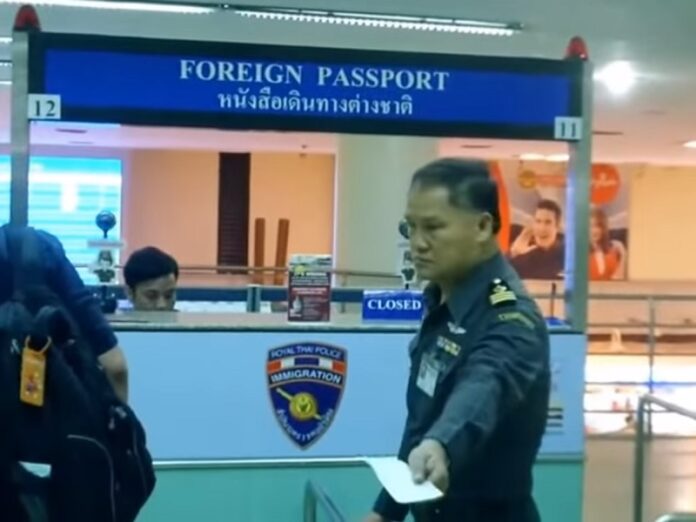
Image: lifeinthailand / YouTube

Tuptim Malakul LaneImagine the scene. An overweight and intimidating-looking LAX officer painfully scrutinizes the papers handed over by the tiny Asian lady. Glancing up, he matches the face to the passport. Looking down, he checks his screen’s blacklist.

The young lady, jet-lagged after 20 hours in transit from Thailand, signs deeply and in halting English explains her simple goal: to visit the in-laws.

Desperately, she looks for her husband to substantiate this incredible claim – but he’s nowhere to be found, already fast-tracked through the “welcome home” line and off to the luggage carousel.

It falls to her to convince Officer Travis (assumed name) that her arrival in the United States is legitimate and on the up-and-up.

At Heathrow, Charles de Gaulle or even Schiphol Airport, this scene repeats itself time and again for Thai ladies married to foreigners. Perhaps she’s used to it; perhaps this is how she sees the world and accepts it.

The reputation of Thai women preceded her arrival a generation earlier, and yet she has to suffer the indignation regardless.  Given today’s extremism and illegal immigrants, the necessity to protect the country’s resources and safety for its people is understandable.

But come on. The lady just married. Probably holding the first passport she’s ever owned, she has to defend her status under the examination of the jaded officer.

On the flip side, when visiting Thailand on holiday from the United Kingdom, I had a baby in one arm, a six-year-old pushing the stroller, and an eight-year-old pretending to be the man of the house.

With the real man of the house struggling with luggage at the tail end, I handed my collection of five passports to the Thai immigration officer. He looked at me up and down.

In his hand were my Thai passport, my husband and baby’s two EU passports and my older and middle children’s two American passports. He raised his eyes, giving a moralistic attitude.

“Where is the American husband?” his authoritative voice boomed, indicating at my multitude UN pack behind me, acquired through marriage.

That provocative remark sent such indignation. This feminist, self-righteous and jetlagged lady was about to give this immigration officer Col. Thawee (assumed name) a mouthful.

For I possessed all three nationalities legally, I was about to launch into a vitriolic speech when I saw a sly grin and a wink.

“Be smart, collect them all – husbands and passports; in life you must have choices.  Get an Australian one next time,” he said.

The atypical immigration cop laughed and turned what could have been frustrating and awkward into something that stuck in my memory for all those years: that I was right all along and that possessing the citizenship of your husband ensures a smooth ride in life.

A woman in love with a man from another country, taking on his name, bearing his children should by all accounts adopt his citizenship.

When all that is perfect, it all goes right and good. Invariably life has its moments, and things do go wrong, the adopted citizenship could help in repatriating, housing, free education.

A chance to start over and continue on the children’s growth of his or her other bi-racial component that make up their identity.

With Meghan Markle paving the way, adopting UK citizenship upon marriage will hopefully ease the law for the less titled.

I urge all Thai ladies, married to farangs to arm themselves with knowledge, learn the rules of the country and be smart. In life, you must have choices.

Advertisement

80-Meter Bridge Collapses After Barge Strike (Video)

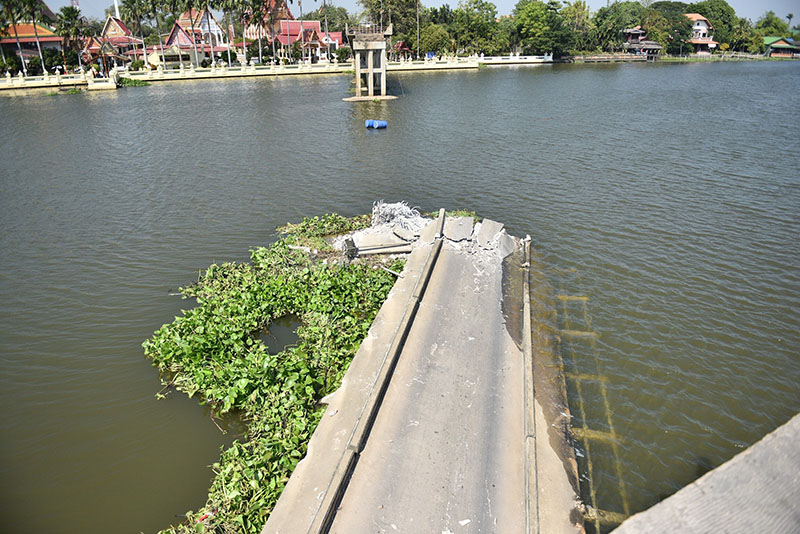
NAKHON PATHOM — A barge pilot was hit with a minor fine Thursday morning after his vessel smashed into a bridge and caused it to collapse.

The bridge in front of Wat Thaiyawat across the Thai Chin River in Nakhon Pathom province was destroyed after Sumet Tappandee, 35, lost control of the soybean-carrying barge and rammed it into one of the bridge’s pillars.

The operator said he was sailing from Ko Sichang to deliver a shipment to an oil factory when the engine shut off and the rudder stopped working, causing the boat to smash into the bridge.

เรือชนสะพานนครปฐม 171221 0003
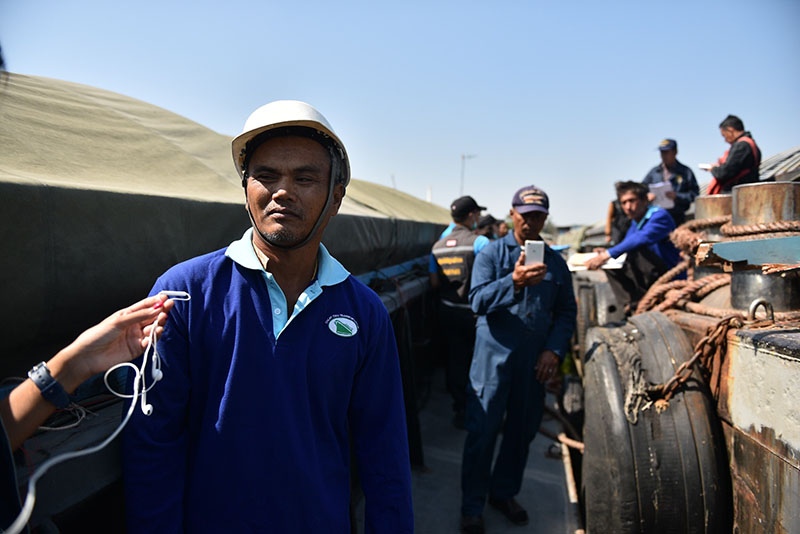
Sathit Kasemwong talks to reporters Thursday afternoon.

“Luckily I wasn’t at the front of the boat but at the back today,” crewmember Sathit Kasemwong, 43, said Thursday afternoon. “Usually there’s someone stationed at the front and back.”

There were no reports of injuries or deaths.

In the afternoon, Sumet was taken to Nakhon Chai Si Police Station and fined 2,000 baht for possessing an expired boat license since 2012. Police said he will be fined for property damage.

Thai Vegetable Oil Public Company Limited – for which Sumet works – said it would provide free transportation from 6am to 9pm from Friday onward for students and commuters who usually used the bridge.

เรือชนสะพานนครปฐม 171221 0025
The collapsed bridge Thursday afternoon.

เรือชนสะพานนครปฐม 171221 0010 เรือชนสะพานนครปฐม 171221 0032 เรือชนสะพานนครปฐม 171221 0039 เรือชนสะพานนครปฐม 171221 0041

Correction: An earlier version of this story said it was a tugboat that struck the bridge, when it fact it was a barge.

Advertisement

Hot News

LATEST NEWS

Bangkok
light rain
25 ° C
27.2 °
25 °
92 %
8.2kmh
100 %
Fri
25 °
Sat
32 °
Sun
35 °
Mon
36 °
Tue
37 °