



























32.8 C
Bangkok
Monday, June 29, 2026
Home Blog Page 2190

Philippines Troops Find Dead, soon to Declare End of Siege

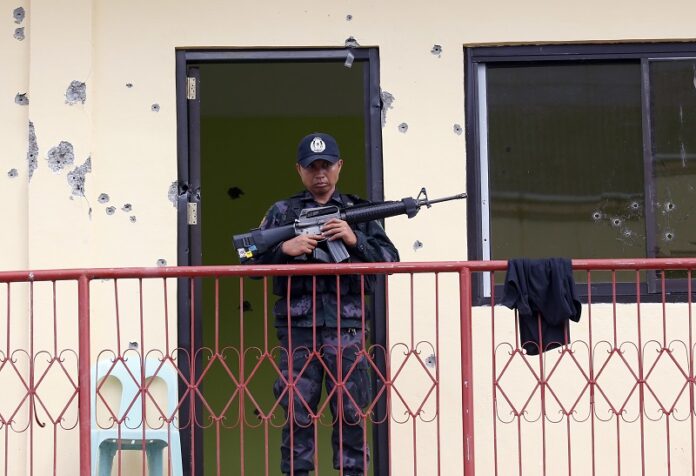
A police officer watches from the balcony of bullet-riddled business establishment as government troops battle with Muslim militants who continue to hold their ground in some areas of Marawi city in May in southern Philippines. Photo: Bullit Marquez / Associated Press

CLARK, Philippines — Philippine troops have captured a building where pro-Islamic State group militants made their final stand in southern Marawi city and found about 40 bodies of suspected gunmen inside, two security officials told The Associated Press on Monday.

The officials said the seizure of the building and the defeat of the militants would allow the military to declare later on Monday the end of the Marawi siege, which hundreds of black flag-waving gunmen launched exactly five months ago.

The two officials spoke to The AP on condition of anonymity because they were not authorized to make public the latest developments in Marawi, where government forces have begun a gradual withdrawal as the fighting considerably eased in recent days.

It’s possible that a few militants may still be hiding. It was not immediately clear how the dozens of suspected militants found in the two-story building near Lake Lanao died but it’s possible some committed suicide after they were cornered by troops, one of the officials said.

The siege sparked fears the Islamic State group may gain a foothold in Southeast Asia by influencing and providing funds to local militants as it suffers battle defeats in Syria and Iraq. The defeat of the IS-linked uprising and the killings of its leaders by Filipino troops, however, have provided a relief to the region, where terrorism remains a key security concern.

Southeast Asian defense ministers opened their annual meeting at the Clark freeport north of Manila on Monday, with counter-terrorism strategies high on the agenda. As the meetings opened, the head of the Brunei delegation expressed condolences for the loss of lives in Marawi but congratulated the Philippines for being able to liberate the city.

Army Col. Romeo Brawner has said troops were aiming to end the crisis before midnight Sunday. The remaining gunmen, who include some Indonesian and Malaysian fighters, have the option of surrendering, or they can either be captured or killed, Brawner said.

“Our government forces will try to do everything to finish the firefight today,” Brawner said in a news conference on Sunday in Marawi.

“It’s either they all get killed, because they’re determined to die inside, or we capture them or they surrender,” he said.

The fighting has left at least 1,131 people dead, including 919 militants and 165 soldiers and policemen. While the fighting raged at noon on Sunday, troops continued to us loudspeakers to ask the gunmen to surrender, Brawner said.

Military chief of staff Gen. Eduardo Ano said Sunday some of the remaining militants were “suicidal.”

Hundreds of militants, many waving Islamic State group-style black flags, launched the siege on May 23 in Marawi, a bastion of Islamic faith in the south of the largely Roman Catholic Philippines, by seizing the lakeside city’s central business district and outlying communities. They ransacked banks and shops, including gun stores, looted houses and smashed statues in a Roman Catholic cathedral, according to the military.

At least 1,780 of the hostages seized by the militants, including a Roman Catholic priest, were rescued, and a final group of 20 captives were freed overnight, Brawner said. That left the gunmen with none of the hostages they had used as human shields to slow the military advance for months.

The disastrous uprising, which has displaced hundreds of thousands of Marawi residents, erupted as the Philippines was hosting annual summit meetings of the Association of Southeast Asian Nations this year, along with the 10-nation bloc’s Asian and Western counterparts, including the United States and Australia. The two governments have deployed surveillance aircraft and drones to help Filipino troops rout the Marawi militants.

Last Monday, troops killed the final two surviving leaders of the siege, including Isnilon Hapilon, who is listed among the FBI’s most-wanted terror suspects in the world, and Omarkhayam Maute. Following their deaths, President Rodrigo Duterte traveled near the main scene of battle and declared Marawi had been essentially liberated from terrorist influence, although skirmishes with a few dozen gunmen continued.

DNA tests done in the United States requested by the Philippine military have confirmed the death of Hapilon, according to the U.S. Embassy in Manila. Washington has offered a bounty of up to USD $5 million for Hapilon, who had been blamed for kidnappings for ransom of American nationals and other terrorist attacks.

Among the foreign militants believed to be with the remaining gunmen in Marawi were Malaysian militant Amin Baco and an Indonesian known only as Qayyim. Both have plotted attacks and provided combat training to local militants for years but have eluded capture in the south.
Advertisement

Toll Rises in Malaysian Landslide; 11 Foreign Workers Dead

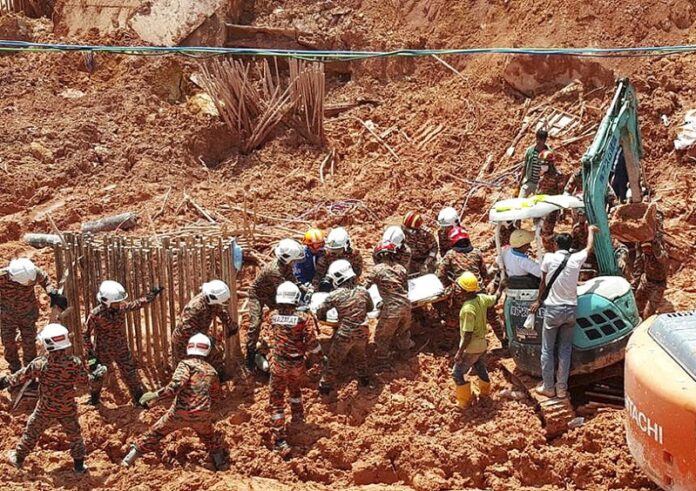
Malaysian rescuers carry the body of a victim after he was pulled out from the debris of a landslide Sunday in Penang, Malaysia. Photo: Gary Chuah / Associated Press

KUALA LUMPUR — Rescue workers have located two more bodies buried by a landslide in a construction site in northern Malaysia, bringing the death toll to 11.

Fire and rescue official Mohamad Rizuan Ramli said the body of a Bangladeshi was retrieved early Monday but rescuers were still trying to bring out the body of a Malaysian trapped deep under the rubble.

A hillside crashed down early Saturday at the site where two 49-story condominiums are being built in northern Penang state, a popular tourist destination.

Three of the 14 workers buried by the landslide survived. The other victims were from China, Pakistan, Indonesia, Myanmar and Bangladesh.

The condominium project is now under scrutiny after authorities said it didn’t obtain government approval as it was too close to a granite quarry.

Advertisement

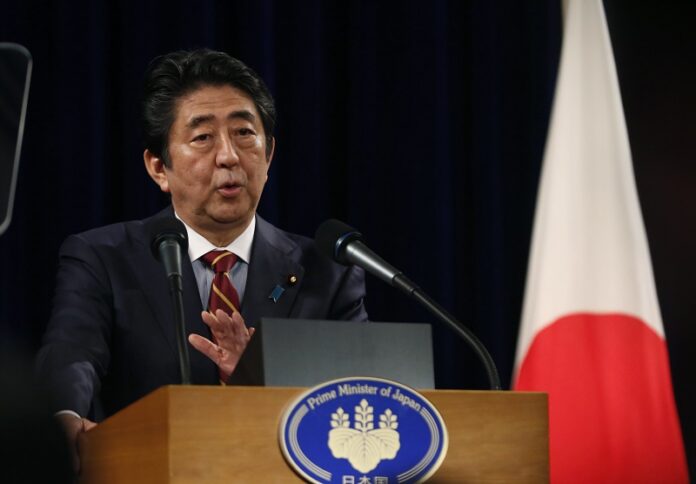
Japanese Prime Minister Abe Wins Big in National Elections

Japanese Prime Minister Shinzo Abe speaks during a press conference in 2017 in Hanoi, Vietnam. Photo: Associated Press

TOKYO — Japan’s leader has scored a major victory in national elections that returned his ruling coalition to power in decisive fashion.

Japanese media said Monday that Prime Minister Shinzo Abe’s Liberal Democratic Party and a small coalition partner had together secured at least 312 seats in the 465-seat lower house of parliament, passing the 310-barrier for a two-thirds majority. Four seats remained undecided.

The victory boosts Abe’s chances of winning another three-year term next September as leader of the Liberal Democratic Party. That could extend his premiership to 2021, giving him more time to try to win a reluctant public over to his longtime goal of revising Japan’s pacifist constitution.

In the immediate term, the win likely means a continuation of the policies Abe has pursued since he took office in December 2012 – a hard line on North Korea, close ties with Washington, including defense, as well as a super-loose monetary policy and push for nuclear energy. Stocks rose in Tokyo on Monday morning.

Abe’s ruling coalition already has a two-thirds majority in the less powerful upper house. Having a so-called supermajority in both houses gives them virtually a free hand to push even divisive policies and legislation.

Abe said the results indicate that voters support his policies and want to see his political leadership continue.

“I think the results reflected the voters’ preference for a solid political foundation and their expectations for us to push polices forward and achieve results,” Abe told NHK.

With the win, Abe has bounced back from the summer, when his support ratings plunged to 30 percent after accusations of government favoritism to people connected to him. For the first time since he took office nearly five years ago, he appeared vulnerable as both party leader and prime minister.

The ruling coalition’s victory, though, reflects as much the lack of viable alternatives as support for Abe, a fact that he seemed to acknowledge in post-election comments. Turnout was just 54 percent, as typhoon rains lashed much of the country.

“I will humbly face the victory and continue to work humbly and sincerely,” he told NHK, noting lingering public distrust over the scandals.

Abe dissolved the lower house less than a month ago, forcing the snap election. Analysts saw it as an attempt to solidify his political standing at a time when the opposition was in disarray and his support ratings had improved somewhat.

His plan was briefly upstaged by the launch of a new opposition party by populist Tokyo Gov. Yuriko Koike. But initial excitement faded, and the Party of Hope took only 49 seats.

Another new party, the Constitutional Democratic Party of Japan, won 54 seats and looks to be the biggest opposition grouping. It is liberal-leaning, while both the Party of Hope and Abe’s Liberal Democratic Party are more conservative.

Koike called the results “very severe” in a televised interview from Paris, where she is attending a conference of mayors. She said some of her remarks might have been taken negatively by voters, and that she would take the blame.

Abe’s party and its nationalist supporters have advocated constitutional revisions for years. They view the 1947 constitution as the legacy of Japan’s defeat in World War II and an imposition of the victor’s world order and values. The charter renounces the use of force in international conflicts and limits Japan’s troops to self-defense, although Japan has a well-equipped modern military that works closely with the U.S.

Any change to Japan’s constitution, which has never been amended, requires approval first by two-thirds of parliament, and then in a public referendum. Polls indicate that the Japanese public remains opposed to amendment.

Story: Ken Moritsugu

Advertisement

India Says Myanmar Must Take Back Rohingya Muslims

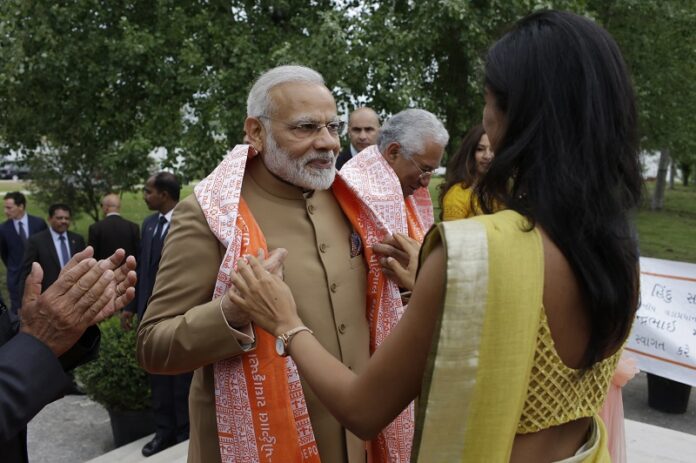
India's Prime Minister Narendra Modi and Portuguese Prime Minister Antonio Costa, right, ar given ceremonial shawls in June during a visit to the Radha Krishna Temple in Lisbon, Portugal. Photo: Armando Franca / Associated Press

DHAKA, Bangladesh — India’s foreign minister told Bangladesh’s government that Myanmar must take back Rohingya Muslims to resolve one of Asia’s largest refugee crises in decades, the government said.

Indian Foreign Minister Sushma Swaraj conveyed her message Sunday during a meeting with Bangladeshi Prime Minister Sheikh Hasina, who ordered border guards and her administration to allow the Rohingya to cross the border and shelter in makeshift camps in the coastal district of Cox’s Bazar.

Nearly 600,000 Rohingya Muslims have fled Myanmar’s Rakhine state since Aug. 25 to escape persecution that the United Nations has called ethnic cleansing.

The United News of Bangladesh agency reported that Swaraj said, “Myanmar must take back their nationals … this is a big burden for Bangladesh. How long will Bangladesh bear it? There should be a permanent solution to this crisis.”

She met earlier with her Bangladeshi counterpart A.H.Mahmood Ali and said India was worried about the violence. Human rights groups have interviewed refugees who said Myanmar security forces killed indiscriminately, committed rapes and burned villages to force Rohingya to leave.

“We’ve urged the situation be handled with restraint, keeping in mind the welfare of the population,” Swaraj said in a statement.

Swaraj also said India supported the implementation of recommendations suggesting recognition of the Rohingya ethnic group within Myanmar, where they are denied citizenship and are effectively stateless.

In the statement, she also said creating economic opportunity in the troubled Rakhine state could help resolve the situation.

“In our view, the only long-term solution to the situation in Rakhine State is rapid socio-economic and infrastructure development that would have a positive impact on all the communities living in the state,” she was quoted as saying in the statement.

Bangladeshi Foreign Minister urged India to play a greater role by “exerting sustained pressure” on Myanmar to find a peaceful solution to the Rohingya crisis.

India’s shift toward resolving the Rohinga crisis would mean a lot to China’s policy to support Myanmar.

An official with China’s ruling Communist Party said Saturday the country supports Myanmar in “safeguarding peace and stability” and won’t join other nations in condemning the government’s actions. Beijing condemns “violence and terror acts” and backs measures to restore order, said the vice minister of the party’s International Department, Guo Yezhou, apparently referring to attacks by Rohingya rebels on Myanmar security forces.

Story: Julhas Alam

Advertisement

Buddhists Protest to Urge Myanmar Not to Repatriate Rohingya

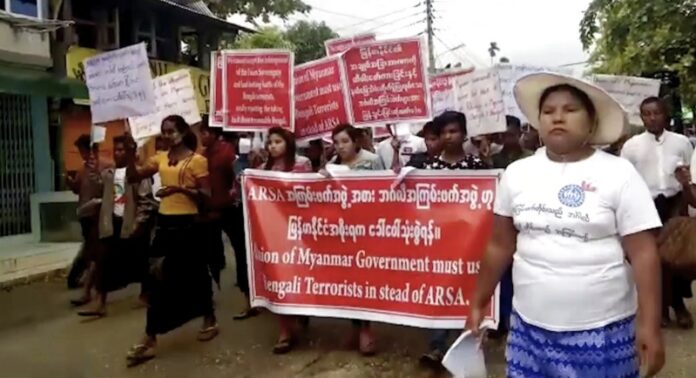
Protesters march Sunday in Sittwe, Myanmar. Image: Associated Press

SITTWE, Myanmar — Hundreds of hard-line Buddhists protested Sunday to urge Myanmar’s government not to repatriate the nearly 600,000 minority Rohingya Muslims who have fled to Bangladesh since late August to escape violence in Myanmar’s Rakhine state.

The protest took place in Sittwe, the state capital, where many Rohingya lived before an outbreak of inter-communal violence in 2012 forced them to flee their homes.

Aung Htay, a protest organizer, said any citizens would be welcome in the state. “But if these people don’t have the right to be citizens … the government’s plan for a conflict-free zone will never be implemented,” he said.

Myanmar doesn’t recognize Rohingya as an ethnic group, instead insisting they are Bengali migrants from Bangladesh living illegally in the country. Rohingya are excluded from the official 135 ethnic groups in the country and denied citizenship.

More than 580,000 Rohingya from northern Rakhine have fled to Bangladesh since Aug. 25, when Myanmar security forces began a scorched-earth campaign against Rohingya villages. Myanmar’s government has said it was responding to attacks by Muslim insurgents, but the United Nations and others have said the response was disproportionate.

Myanmar de facto leader Aung San Suu Kyi’s government said earlier this month that it was willing to take back Rohingya refugees who fled to southeastern Bangladesh. The government has agreed to form a joint working group to start the repatriation process.

On Sunday, protesters, including some Buddhist monks, demanded that the government not take back the refugees.

“The organizers of the protest applied to get permission for a thousand people to participate in the protest, but only a few hundred showed up,” said Soe Tint Swe, a local official.

Meanwhile, thousands of people gathered Sunday in Myanmar’s capital, Naypyidaw, to show support for Suu Kyi and the government’s handling of the Rohingya crisis.

Colorful crowds of people, some wearing T-shirts with Suu Kyi’s photo and some holding photo frames of Suu Kyi and her National League for Democracy party flag, took part in the rally.

The global image of Suu Kyi, a Nobel Peace laureate, has been damaged by the violence in Rakhine, which has sparked Asia’s largest refugee crisis in decades.

Advertisement

Virtual Thailand: Enter the Crematorium of King Rama IX

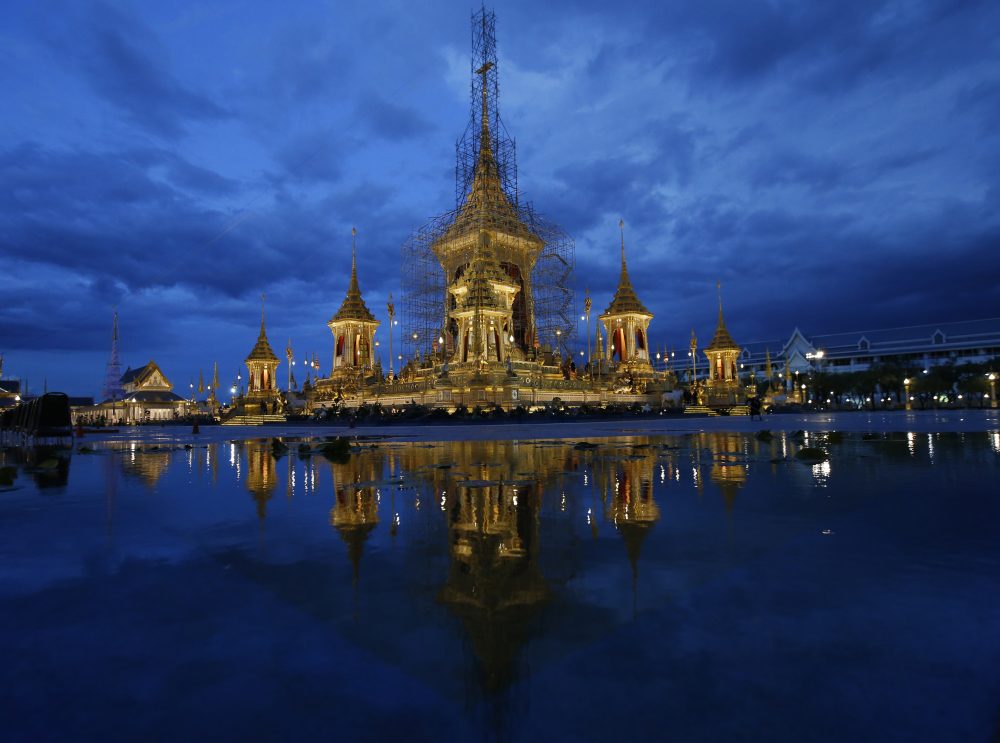
Thailand has been mourning for a year. For the past eight months of the mourning, a sprawling funerary complex has been under construction in Bangkok’s Sanam Luang, a royal field reserved solely for such cremations.

On Thursday, that mourning will culminate with the cremation of King Bhumibol Adulyadej, who reigned 70 years until his death last October at 88.

Workers and artisans have put innumerable hours into erecting a structure modeled after Mount Meru, a sacred place at the center of Hindu and Buddhist cosmology.

Three billion baht (USD$90 million) has been allocated for the funeral.

Take a virtual reality tour of the funerary pyre recorded on a recent visit.

The video is available embedded above and below from YouTube. On the desktop, use your pointing device to look around. On a smartphone, move your phone around to change the viewing direction. Users of Samsung Gear VR, Google Cardboard or virtual reality headsets should check their documentation on how to view using their devices.

Advertisement

3 Media Agencies Sanctioned For Streaming Practice Parade

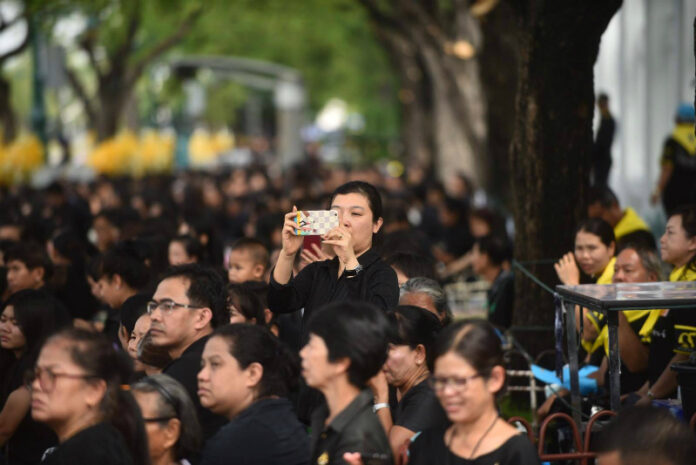
A mourner takes photos during parade rehearsal Sunday in front of the Grand Palace in Bangkok.

BANGKOK — Three media outlets had their credentials to cover the royal cremation ceremony temporarily revoked after they livestreamed a Saturday parade rehearsal.

For violating one of many strict limits imposed on how the royal funeral is covered, Nation TV, TNews and Thai TV 6 immediately lost their access to the second day of full-dress rehearsals today. The chief of the government’s public relations department, Lt. Gen. Sansern Kaewkamnerd, said the news agencies violated prohibitions on both real-time live-streaming and broadcasting footage before the rehearsals had ended.

Their passes will be returned Tuesday in time for them to cover Thursday’s cremation ceremony.

Nation TV issued a statement saying it had no intention to violate the regulations. It said the footage which appeared on their Facebook Live, which it simultaneously broadcast on television at 11am, was filmed at 8:30am.

Nation did acknowledge it violated the rules by broadcasting footage before the rehearsal ended due to a misunderstanding.

TNews and Thai TV 6 did not issue a response. The ban was seen as a forceful warning for other media outlets to toe the line on strict regulations come Thursday.

Though mourners are allowed to livestream video through personal Facebook accounts, media agencies are not. They have been told they can only run the signal provided by the government’s TV Pool for real-time broadcast.

Twelve stands have been erected around the Sanam Luang area for the media to film. Only those with legitimate media passes and certain types of professional cameras will be allowed on the stands. They have to choose between taking still images or filming video and register their intent in advance, according to the guidelines Sansern gave earlier this month in a press briefing.

Photographers in the stands will not be allowed to feed material real-time back to their newsrooms during the ceremony and will only be allowed depart when the procession ends. They will not be permitted to walk freely around the ceremony area to capture the atmosphere.

Those who attend must also follow detailed regulations on attire. Female Thai reporters were advised not to have colored hair. Men with long hair were told to get haircuts. Sansern also advised them to prepare transparent raincoats in case of bad weather.

A media guide for covering the royal cremation said when any royals pass, all photographers must pay respect. They are not allowed to take photos of seated royals straight on. It is also forbidden to take photos of royal family members when they are going up or down stairs or eating.

Reporters without proper cameras will only be allowed inside the off-site press center.

Related stories:

Drones Grounded Over Most of Bangkok for Royal Cremation

Govt Deplores Foreign Media Coverage, BBC Coverage Blocked

Advertisement

US: Purported Head of ISIS in Southeast Asia is Dead

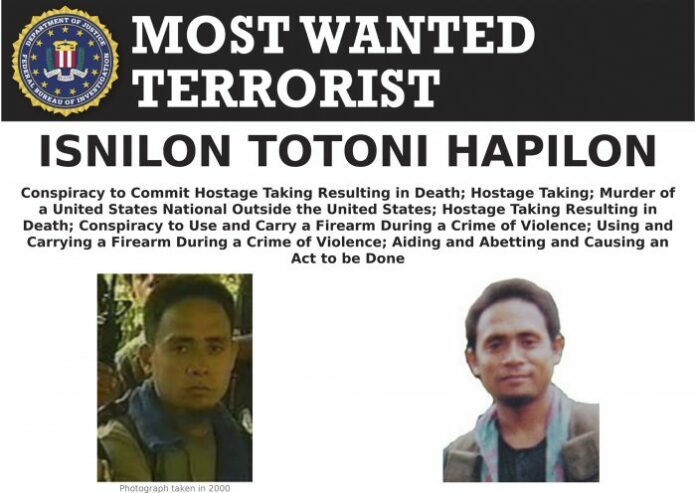
Undated file image provided by the US FBI shows a wanted poster for Isnilon Hapilon, who was purportedly designated leader of the Islamic State group's Southeast Asia branch in 2016 but has long ties to local extremist movements. Image: FBI

MANILA — DNA tests have confirmed the death of one of the FBI’s most-wanted terror suspects, who the Philippine military reported was killed in a final battle to quell an Islamic State group-linked siege in southern Marawi city, U.S. and Philippine officials said Saturday.

U.S. Embassy spokeswoman Molly Koscina told The Associated Press that DNA tests done in Virginia at the request of the Philippine military confirmed the death of Isnilon Hapilon. Washington has backed efforts by the Philippines, a treaty ally, to combat terrorism for years.

“This is yet another example of how the U.S. is supporting our friend, partner and ally in the fight against terror,” Koscina said.

Hapilon and Omarkhayam Maute, another leader of the Marawi siege, were killed in a gunbattle Monday in a push by thousands of troops to retake the last pocket of the Islamic city held by the militants, Defense Secretary Delfin Lorenzana said.

The Philippine military believes that Mahmud bin Ahmad, a top Malaysian militant and close associate of Hapilon, had also been killed in the Marawi clashes, although his body has yet to be recovered by troops.

DNA tests were also being done on the remains of other suspects who have been recovered by troops, Lorenzana said without elaborating.

The confirmation of the deaths of Hapilon and Maute would pave the way for the payment of huge U.S. and Philippine bounties offered for the two. A rescued 16-year-old hostage provided the crucial information that allowed troops to locate Hapilon and Maute in one building in Marawi, Lorenzana said.

The U.S. State Department has offered a reward of up to USD$5 million (166 million baht) for Hapilon, who Washington blames for ransom kidnappings of several Americans, one of whom was beheaded in 2001 in southern Basilan province. Hapilon had been indicted in the District of Columbia for his alleged involvement in terrorist acts against U.S. nationals and other foreigners.

A soft-spoken Islamic preacher born to a family of militants on southern Basilan island, Hapilon had been linked to several major attacks in the southern Philippines, including kidnappings, bombings and attacks on urban centers.

Hapilon and Maute were among the leaders in a nearly five-month insurrection in the lakeside city that has left at least 1,127 people dead, including 915 militants and 165 soldiers and police.

The siege has sparked fears that the Islamic State group may gain a foothold in Southeast Asia by influencing and providing funds to local militants as it suffers battle defeats in Syria and Iraq.

The United States and Australia have deployed surveillance aircraft to help Filipinos battling the Marawi attackers.

Story: Jim Gomez

Advertisement

King’s Legacy Still Felt Strongly as Thailand Says Goodbye

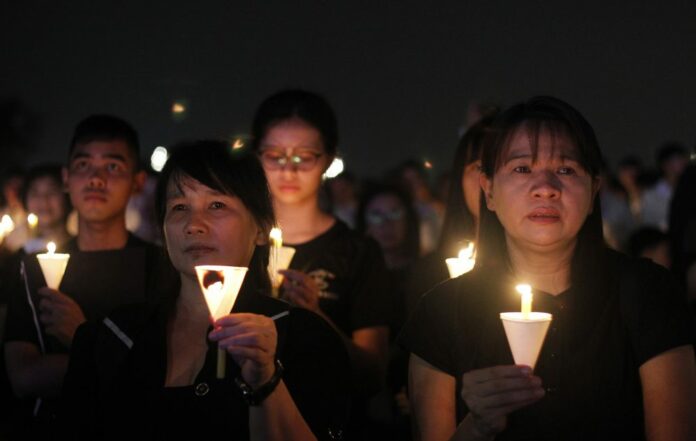
In this Oct. 13, 2017, photo, mourners attend a candlelight vigil marking one year since the death of King Bhumibol Adulyadej in Bangkok, Thailand. Following a reign of seven decades, Bhumibol's death at age 88 has sparked a national outpouring of grief and a year of mourning that will culminate with his cremation on Oct. 26. (AP Photo/Sakchai Lalit)

HUAY HOM, Thailand — Half a century has passed and the king is dead, but the villagers of Huay Hom still haven’t forgotten the day Bhumibol Adulyadej descended by helicopter into their remote, impoverished mountain valley in northern Thailand and changed their lives forever.

The king, they recall, brought electricity and a road that replaced the trail they trudged over for eight hours to reach the nearest roadhead. Coffee growing was greatly expanded and soon supplanted opium harvests, reaching such high quality that Starbucks is now a steady customer. The village even reaped profits from the royal-assisted raising of sheep and wool weaving, a rarity in tropical Thailand.

So to thank the king on behalf of Huay Hom’s 72 now well-to-do families, Kamchai Sawankitsomboon traveled more than 750 kilometers to Bangkok’s Grand Palace. There, after standing in line for 13 hours, he prostrated himself before Bhumibol’s coffin — one of nearly 13 million people to do so during a year of mourning that will all but come to a close with the late king’s cremation this coming week.

The religious-like fervor surrounding this outpouring of grief stems from many things: nostalgia for the past, a very personal connection that millions of Thais felt they had forged with their monarch, and gratefulness, as in Kamchai’s case, for the decades Bhumibol put in working on behalf of the country’s have-nots.

Regarded as a stabilizing figure amid political turbulence and headlong modernization, the king’s passing on Oct. 13, 2016 also evoked anxiety about what comes next as the country confronts the close of an era.

AP17292260727098 e1508650249920
Warm light illuminates the royal crematorium and funeral complex for the late King Bhumibol Adulyadej on Tuesday as preparations continue in Bangkok. Photo: Sakchai Lalit / Associated Press

With his son King Maha Vajiralongkorn, a yet untested monarch, on the throne and an entrenched military regime promoting a meandering “roadmap to guided democracy,” several Thai academics at a recent international conference said “the Bhumibol consensus” has been replaced by “politics of uncertainty.”

“Thai people will never be the same again as Thailand will never be the same again,” said Thitinan Pongsudhirak, a political scientist at Bangkok’s Chulalongkorn University.

Thais born when Bhumibol’s reign began 70 years ago who are still alive today have known 30 prime ministers and a succession of coups, constitutions and economic upheavals. But until last year they had had only one king who many credit with steering the country through these crises and presiding over evolution from a poor rural society to a modern $400 billion economy.

Many were imprinted with his image at an early age. His persona became a part of their lives.

Oraboon Imchai Bulut, a young businesswoman, vividly remembers seeing the king’s portrait on the cover of her first school notebook. While she never met Bhumibol, a friend told her how her grandfather’s eyesight was saved by an operation sponsored by the king.

Waiting overnight to view the coffin, Oraboon brought along a photograph of her deceased father in what she said was “a last chance to say goodbye.”

“People in their 40s, 50s and 60s still feel very much related, involved and attached to his reign. The millennials perhaps less because His Majesty did less of the public engagements (after his illness),” Thitinan said. “By and large the vast majority of Thais today would more or less collectively feel the same: we are grateful for the reign.”

Criticism of the late monarch has surfaced in recent years. Some Thai and foreign analysts and activists say the king impeded the progress of the country’s still fledgling democracy by wielding too much power and often siding with the military and other conservative forces.

Bhumibol’s near deification, critics say, has in part been driven by royalist propaganda and buttressed by strict laws outlawing insults to the monarchy. Others have noted that a society relying too heavily on one individual rests on fragile foundations.

But such commentary has been largely subdued within Thailand as the nation prepares for the final farewell to Bhumibol, who died at the age of 88 after a prolonged illness.

He will be cremated Oct. 26 within a soaring, purpose-built USD$30 million (1 billion baht) pavilion. Three billion baht (USD$90 million) is being spent on the funeral. Officials expect a quarter million people clad in black to attend an elaborate, centuries-old ceremony that is probably the last of its kind in Asia.

Bhumibol himself may prove to be the last monarch of his kind, someone embedded in the national psyche through his overreaching sway and historical circumstances.

“It was an extraordinary time and he was just an exceptional individual suited for it,” Thitinan said. “The country needed a lot of development so he spearheaded development projects. The country needed to keep away from communism so he was a rallying point, a unifying symbol against communism,” he continued, referring to the Cold War when Thailand’s neighbors fell to communist regimes and the country tackled a domestic, Chinese-backed insurgency.

It was during this era that many of the now more than 4,000 royal development projects were seeded.

In Huay Hom village, cradled in a 1,000-meter, mist-streaked valley, a third generation of Christian inhabitants of the Karen ethnic minority relate how the Buddhist king built upon earlier help from American missionaries.

“Never a day goes by while in the village without one of the old timers reminding me of that day,” writes Richard Mann, who accompanied Bhumibol and his family on that first visit.

In an unpublished memoir, the American former head of a project to replace opium with profitable cash crops describes how the local church choir sang hymns to the royals in four-part harmony and how the elders were blunt in their requests for a road, a better school, medical clinic and electricity.

“All those needs,” he wrote, “have been met.”

Jiripan Davivongs, deputy secretary general of the Chaipattana Foundation which oversees a number of the royal development initiatives, said the projects will continue through government funding and other support.

But Bhumibol’s most lasting legacy, he believes, was his concept of the self-sufficiency economy, which stressed smaller-scaled, sustainable production that could better withstand global shockwaves.

That notion gained traction when Thailand was hit by forces largely out of its control during the 1997 Asian economic crisis, although some regarded it more as an idealized throwback to an older epoch rather than a viable economic system for an already highly capitalistic, globalized nation.

How many of Bhumibol’s words and deeds endure remains to be seen.

An editorial in the English-language Bangkok Post last week said that already in the past 12 months, state and other actors had failed in their pledges to follow in the king’s footsteps.

It cited matters Bhumibol had opposed: excessive military spending, scandals in sustainable agricultural projects, eviction of landless people and the disappearance of conservation activists. “Merely paying lip service to his words and wishes is not enough,” it said.

Thitinan said that with a greatly transformed Thailand, the time had come to recalibrate the old political order to include more institutions and players, not just the military, bureaucratic and royalist power brokers.

“Now we have to find a system not based on one individual,” he said. “It cannot be the same as before.”

Associated Press writer Denis D. Gray has reported on Thailand since 1975. His coverage of the king included a rare interview.

Advertisement

Unable to Confront Present or Examine Past Means What Future for Thailand?

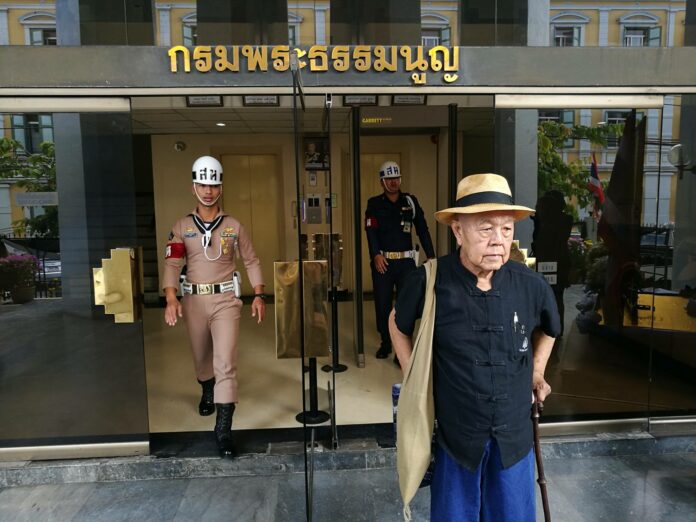
Sulak Sivaraksa, accused of lese majeste over comments about a 16th century elephant battle, meets Oct. 9 with military prosecutors.

It was painful watching famed social critic struggle Sulak Sivaraksa walk haltingly with his cane. More painful was seeing the 84-year-old man, wracked by advancing years, do so to visit the military prosecutors deciding whether he defamed the monarchy by casting doubt on popular accounts of a 400-year-old event.

By publicly suggesting several years ago that an elephant duel between King Naraesuan and his Burmese rival may not have taken place as written into the national psyche, Sulak tried to excavate and improve our understanding of the past.

retention.columnFor this he faces 15 years in prison under the anachronistic and draconian lese majeste law, which is specifically written only to protect the current reigning monarch, queen, heir apparent and regent – not a king who ruled and died four centuries ago.

What will become of Thai history, the study of history, and ordinary people’s understanding of the past if we cannot questions historical events that have to do with a past king or queen? Should we stop calling it history altogether and refer to it as illuminated texts only for rote memorization and recitation without question? There can be no study of history if some questions about the past cannot be asked. We will truly not know ourselves if we cannot gaze back critically.

This is the excess of the lese majeste law under its ever widening interpretation. Call it LM Plus and don’t confuse it with the cigarette brand. Is it not enough that speaking critically of the reigning monarch is illegal, which already makes it difficult to describe the present state of Thai society in any meaningful way?

Listen to royalist songs or read widespread texts praising the late King Bhumibol Adulyadej, and one cannot fail to notice the common ticks of describing love for “our king” as held by “all Thais.”

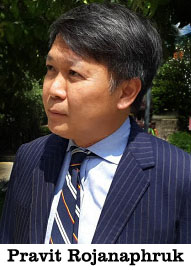
Pravit.mug .column.final

There is no space to even acknowledge Thais who think differently about the institution or allow themselves to express themselves. You either have to flee the kingdom and never return or face a jail term here for expressing something otherwise.

It is as if these people have no voice, and all Thais must pretend to think alike.

We’re ill-equipped to improve society when we cannot talk about the present critically. And now some people think we shouldn’t be able to talk about the past as well.

It’s a sad state for Thailand. This is a country where many people do not want to look straight in the mirror. They want comfortable stories that are tear-jerking or push safe emotional buttons to reinforce a preferred image. Anything that disrupts that prevalent narrative must be censored, silenced or made illegal.

What’s the hope for Thailand, for its history, its future, given the situation?

While waiting for the legal papers to be processed, Sulak joked to a senior army officer who entered the room to receive him that he might be celebrating his 100th birthday in jail if he’s locked up this time. It may sound sad to hear such a joke, tragic even, but I couldn’t help feel even sadder for Thai people who are content with having their right to talk about their society and its past undermined.

Advertisement

Hot News

LATEST NEWS

Bangkok
overcast clouds
32.8 ° C
32.8 °
32.7 °
91 %
6.4kmh
100 %
Mon
31 °
Tue
33 °
Wed
31 °
Thu
32 °
Fri
31 °