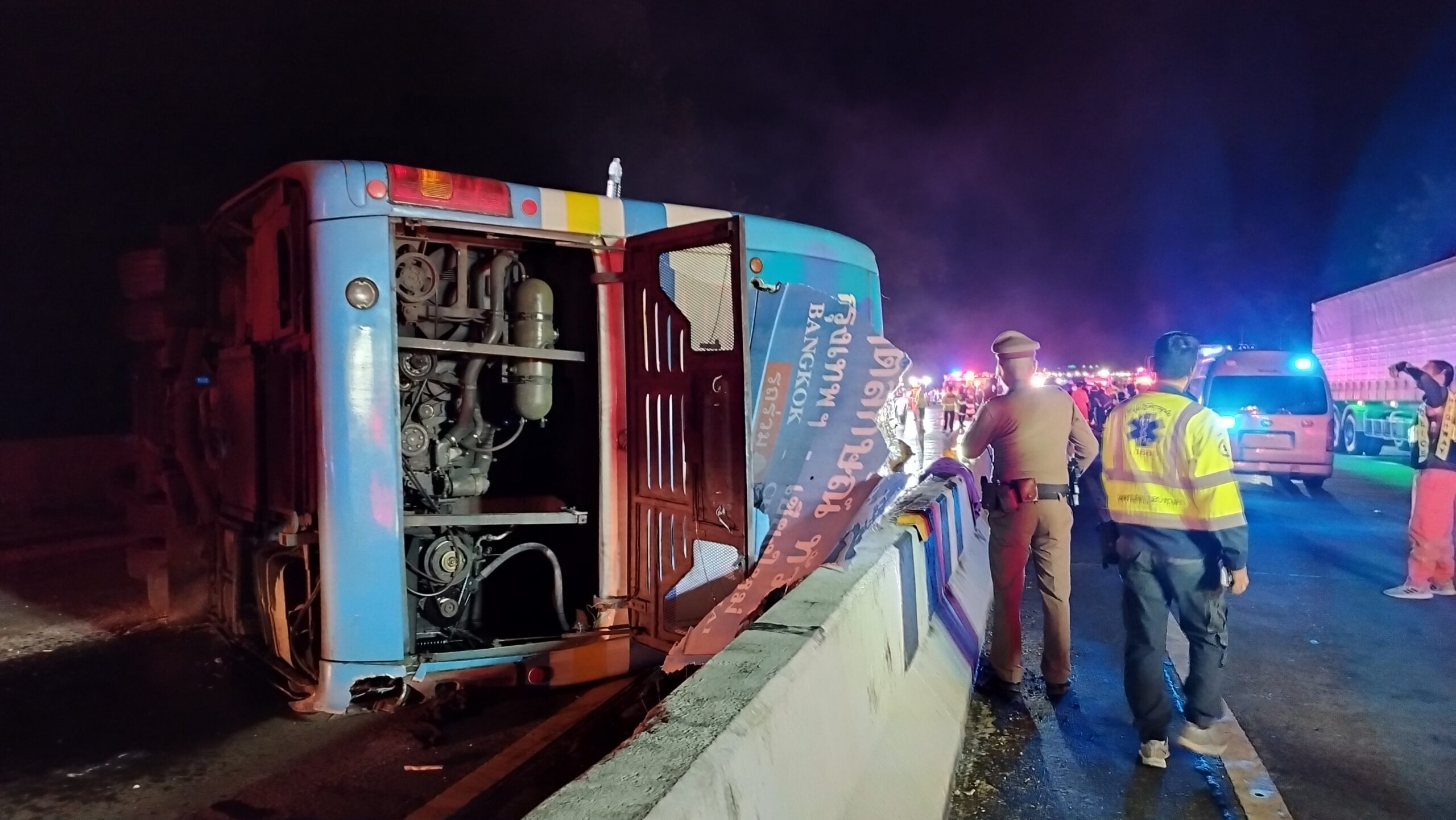
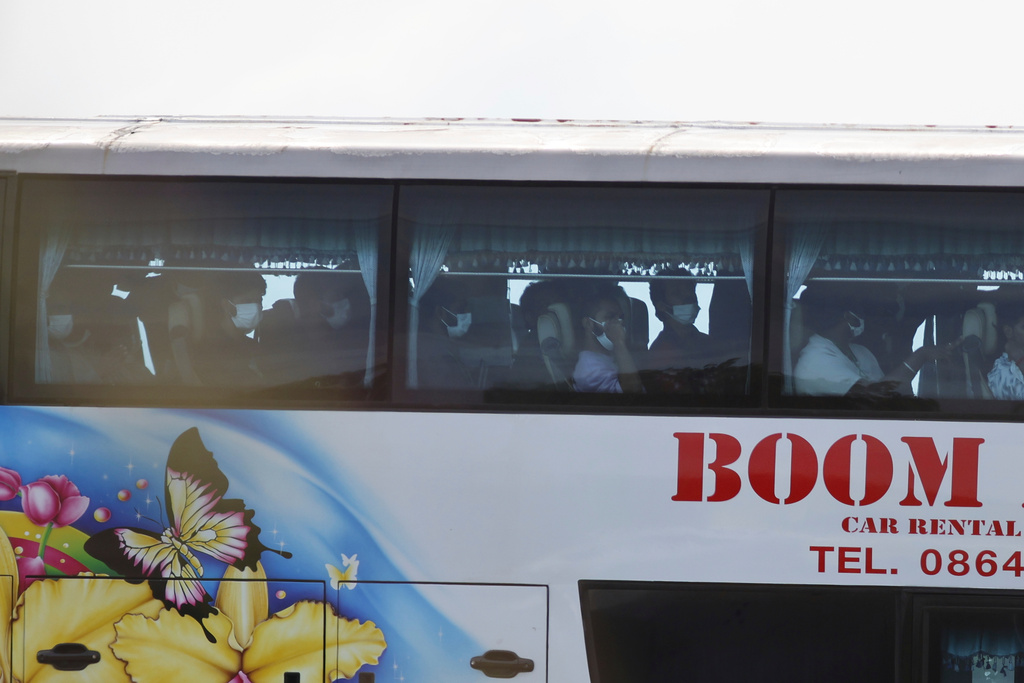
Rescue workers surround an overturned tour bus on the Lampang–Chiang Mai highway after it skidded off the Khun Tan mountain pass on Nov. 8, 2025.
LAMPANG — A tour bus carrying 38 foreign tourists overturned while descending the Khun Tan mountain pass in northern Thailand on Saturday night, injuring more than a dozen people, including two critically, police said.
The Sri Thawong Tour bus, traveling from Chiang Mai to Bangkok, lost control after hitting an oil slick around 8:45 p.m. on the Lampang–Chiang Mai highway in Wiang Tan subdistrict, Hang Chat district.
Emergency crews assist injured passengers after a tour bus carrying 38 foreign tourists overturned on the Khun Tan descent in Lampang province, northern Thailand, on Nov. 8, 2025.
The vehicle flipped onto its side, blocking all southbound lanes and causing a major traffic jam.
All passengers were foreign nationals, mostly from Arab countries. Two were in critical condition and 12 others sustained injuries, authorities said.
A bus hostess told police the driver struggled to regain control after skidding on the slick surface. “The bus swerved and overturned across the road,” she said.
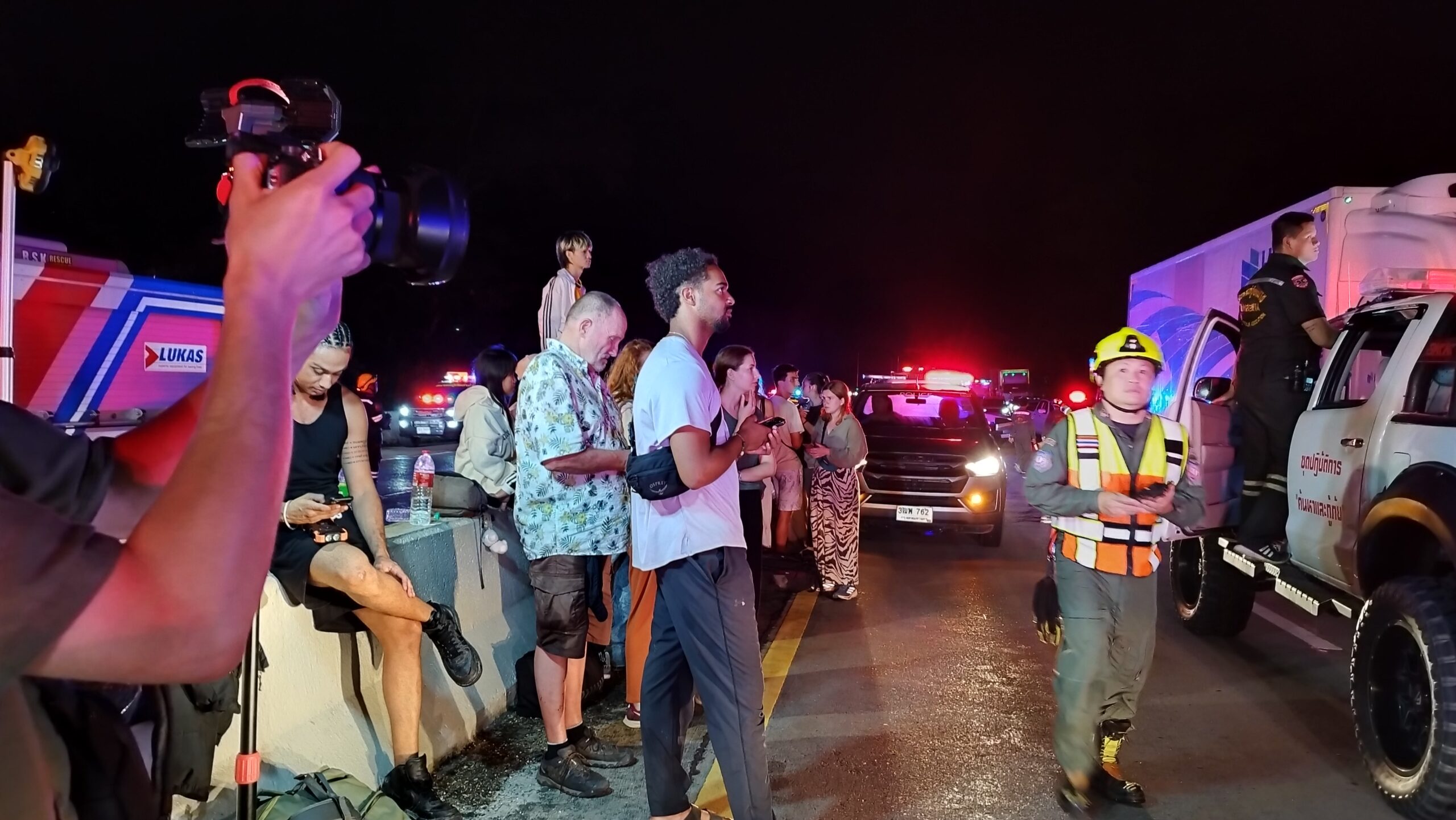
Foreign tourists wait by the roadside for a replacement bus after their tour vehicle overturned on the Lampang–Chiang Mai highway in northern Thailand on Nov. 8, 2025.
Rescue efforts were hampered when an emergency vehicle responding to the crash collided with a pickup truck, injuring several more people and causing delays in both directions.
Police, rescue units, and utility workers cleared the road and cut power after a toppled pole blocked the lane. Stranded passengers were escorted to a highway service center while waiting for a replacement bus.
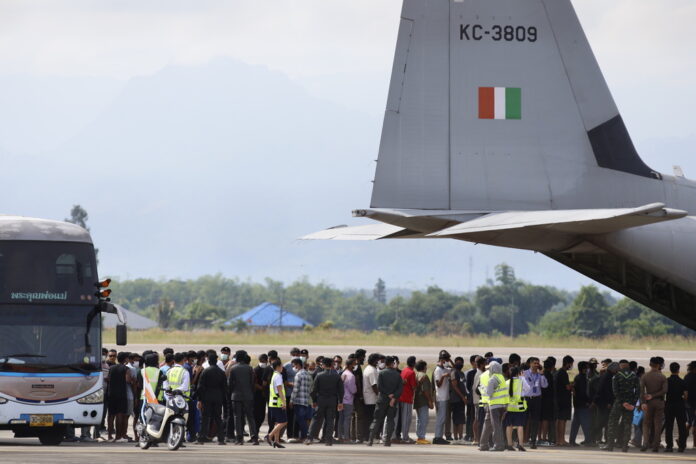
India nationals, believed to have worked at scam center in Myanmar, board a plane at Thailand's Mae Sot International Airport in Tak, before being sent back to India Thursday, Nov. 6, 2025. (AP Photo/Sarot Meksophawannakul)
By HUIZHONG WU
BANGKOK (AP) — It often starts with a text message asking if you are available on weekends, looking for a part-time job or you get a simple “hello” from an unknown number. Halfway across the world, a laborer is usually pulling in 12-16 hour days, sending non-stop messages, hoping someone will take the bait.
The ultimate goal is always to take your money — victims have lost tens of billions to scams and hundreds of thousands of people are in forced labor to keep the schemes going. These workers are often housed in massive complexes scattered across southeast Asia, where the industry has flourished.
Here is why rooting out the scamming industry is such a complex issue:
The crackdown in Myanmar
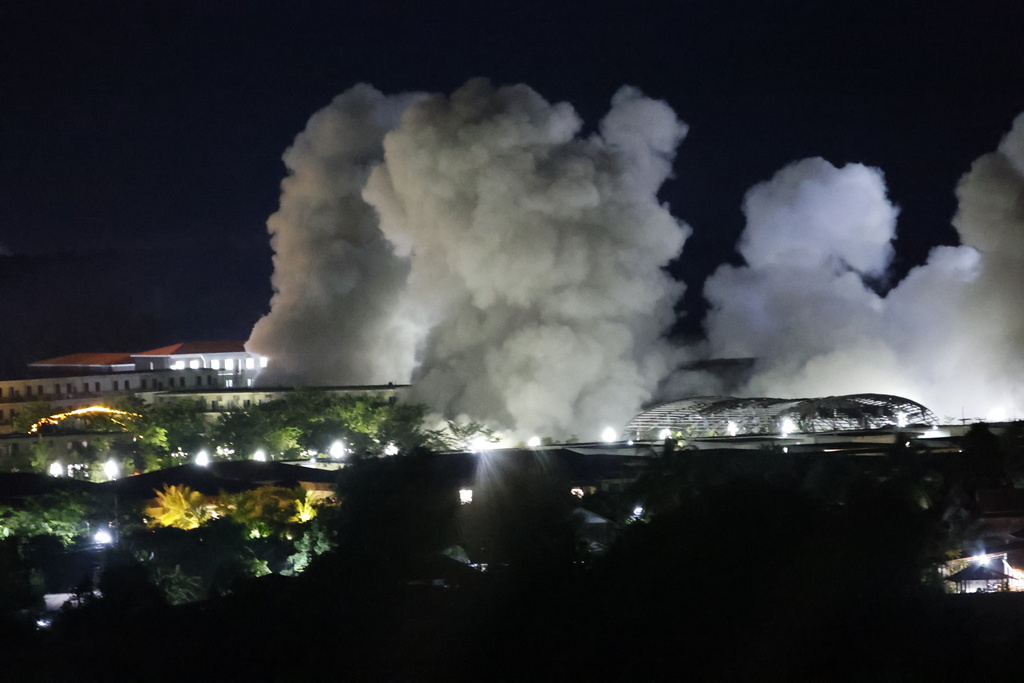
The Myanmar military last month went into one of the most well-known scam compounds — the massive KK Park, along the border with Thailand — and announced its shutdown, though civil society groups later said parts of the compound are still operating.
Thailand is now working with India and other foreign governments to repatriate their citizens. On Thursday, one of the largest groups of workers was flown home aboard Indian air force transport planes and more are to return next week.
However, KK Park was just one of dozens such centers along the Thai-Myanmar border and hundreds across Southeast Asia.
White smoke billows after an explosion at KK Park online scam center in Myawaddy township, Karen State, Myanmar, Saturday, Oct. 25, 2025. (AP Photo/Sarot Meksophawannakul)
Emerging from casinos and illegal gambling
Scam compounds are often located in rural areas, sprawling complexes with sleeping quarters, shops and entertainment venues for the staff.
They are constructed on a model where developers may build out a single property and then lease out the space inside to various companies.
They often operate with the protection of local elites. Smaller operations also exist — housed in one floor of legitimate office buildings, or even a rented house in an urban area.
The centers originated from casinos — both online and physical casinos that mushroomed across Southeast Asia. The United Nations Office on Drugs and Crime counted more than 340 licensed and non-licensed casinos in 2021 alone.
The casinos and attached junket tours attracted high-rollers from China, where gambling is outlawed and are operated by Chinese criminal groups.
During the pandemic, visiting such locations became difficult amid strict travel restrictions. Lacking customers, some online casinos shifted their work model to a criminal operation: defrauding targets from all over the world through digital schemes.
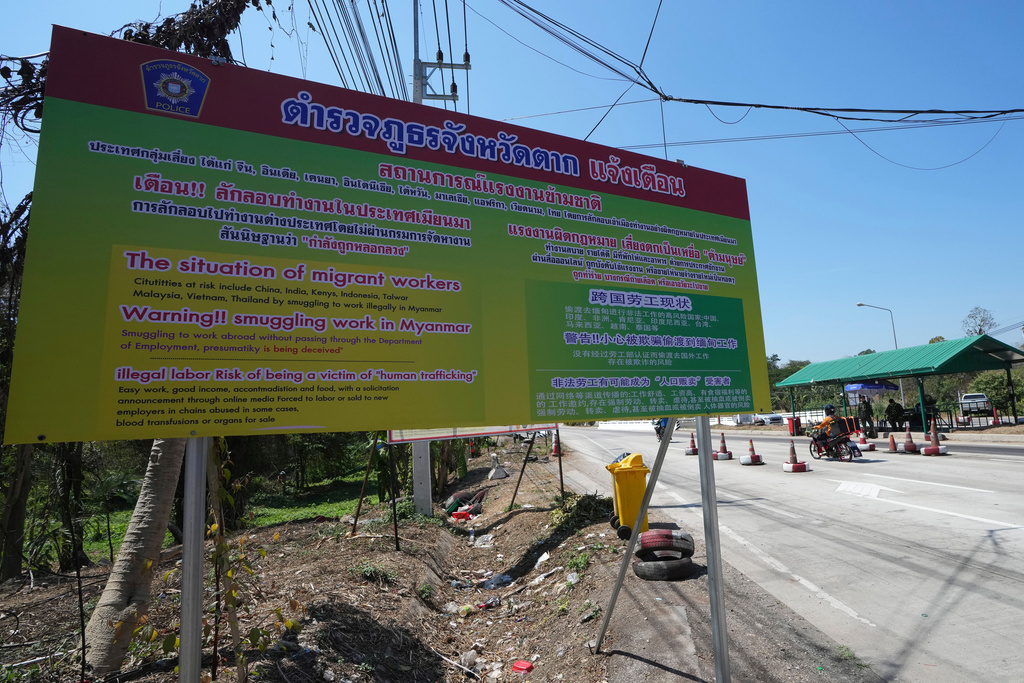
FILE – A sign near military checkpoint warns in Thai, English and Chinese of the danger of being trafficked and forced to work in locked scam compounds across the Myanmar border, in Mae Sot, Thailand, Feb. 26, 2025. (AP Photo/Sakchai Lalit, File)
Relying on both trafficked and willing labor
It’s estimated that at least 120,000 people across Myanmar may be held in situations where they are forced to work on online scams, with another 100,000 people in Cambodia, according to a 2023 Office of the United Nations High Commissioner for Human Right report.
The numbers are estimates at best, but scam centers rely on a mix of trafficked and willing laborers, lured by false promises of relatively high salaries and an easy office job.
Early on, workers came from China and Chinese speaking countries, but now the U.N. drugs and crime office says laborers are drawn from 56 countries, from Indonesia to Liberia.
The reality is a stark contrast from their expectations — their passports are often confiscated to keep them from leaving the complex. Only very senior managers and trusted lieutenants are able to have freedom of movement, workers have said. Workers who don’t perform are beaten or face other physical punishments.
A global scourge
Scammers don’t discriminate — they target people across the world, aided by translation tools that are powered by artificial intelligence.
In the Philippines, authorities raided a complex in March 2024 where workers had been targeting Chinese nationals in an investment scheme. Working off a script, the scammers pretended they were a high-ranking employee at the state-owned China National Petroleum Corporation and got their targets to invest in crude oil futures, according to a copy of a script seen by The Associate Press.
Also recently, U.S. prosecutors unveiled an indictment against Chen Zhi, Chinese-Cambodian businessman on charges of defrauding people in a massive criminal network. The prosecutors charge that his organization scammed 250 Americans out of millions of dollars, with one losing $400,000 alone in cryptocurrency.
In 2024, Americans lost at least $10 billion to Southeast Asia-based scams, according to the U.S. Treasury Department.
A bus, believed to be carrying India nationals who have worked at scam center in Myanmar, crosses the 2nd Thai-Myanmar Friendship Bridge in Mae Sot in Thailand’s Tak province before being flown back to India, Thursday, Nov. 6, 2025. (AP Photo/Sarot Meksophawannakul)
The victims
Scams vary in how they’re carried out, ranging from investments in cryptocurrency, to online task scams where people are asked to top-up to get their next task — with real money sometimes paid out in the earlier stages of a scam.
Many scammers build a sense of urgency when asking for an investment, saying the target will miss out if it’s not done by a certain time.
A United Nations report in April said scammers have bilked victims out of billions of dollars through false romantic ploys, bogus investment pitches and illegal gambling schemes reported operating as far afield as Africa and Latin America.
“If we only rescue the victims, and don’t arrest anybody, especially the Chinese mafia and those transnational syndicates, then there will be no point,” said Jay Kritiya, the coordinator of the Civil Society Network for Victim Assistance in Human Trafficking.
“They can get more victims … they can scam anytime,” said Kritiya, who has rescued forced laborers from scam compounds.
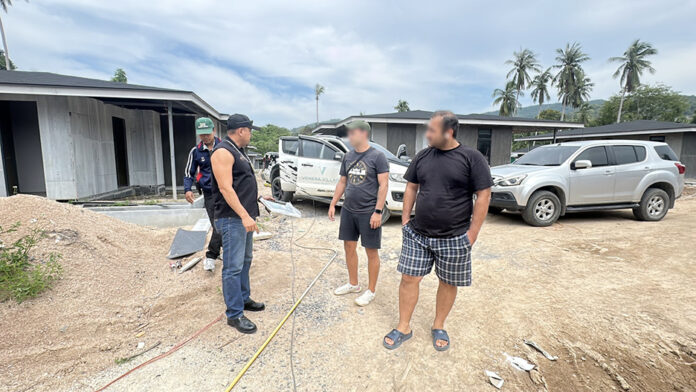
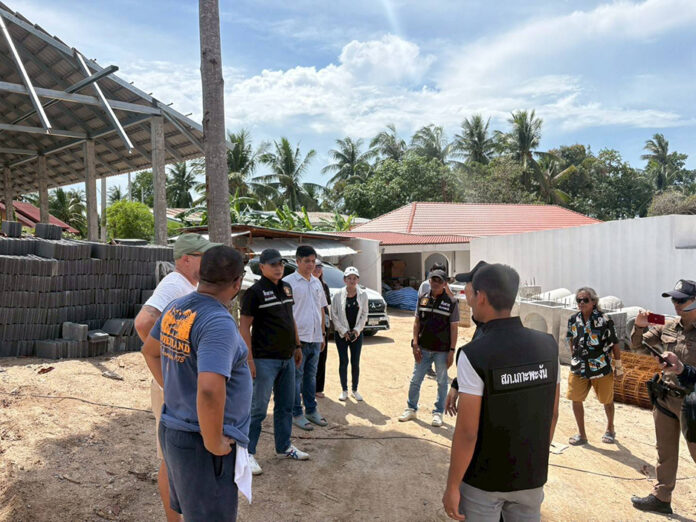
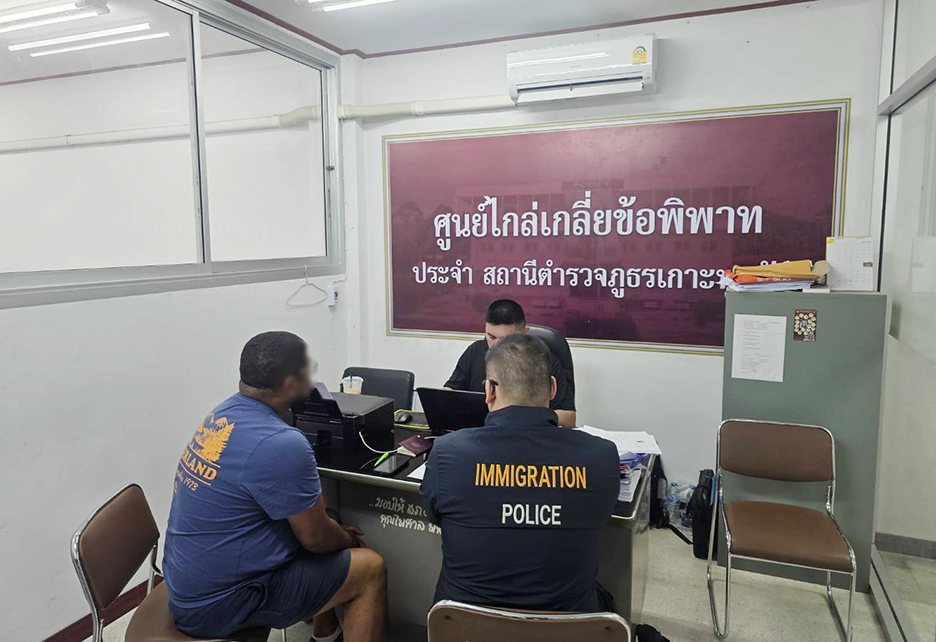
Thai authorities question a 29-year-old Ukrainian man and a 26-year-old Azerbaijani national at a construction site in Si Thanu village, Koh Phangan, Surat Thani province on November 8, 2025.
KOH PHANGAN — Tourist Police on the resort island of Koh Phangan have arrested two foreign nationals—one Ukrainian and one Azerbaijani—accused of illegally operating as electrical system contractors without proper permits, according to a police statement released on Saturday.
The arrests are the latest in a series of crackdowns targeting foreigners working illegally in occupations reserved for Thai citizens in the popular tourist destination.
The operation, carried out on November 8, was conducted by Tourist Police Station 5, in collaboration with Koh Phangan local police and district officials, following an order from Tourist Police Commissioner Pol. Lt. Gen. Saksira Puek-am.
Caught in the Act
The two suspects were identified as Mr. Viacheslav (29), a Ukrainian national, and Mr. Ramis (26), an Azerbaijani national (last names withheld). They were detained at a construction site in Si Thanu village, Moo 8, Koh Phangan Sub-district.
Authorities had been monitoring their activities and intercepted them after they were observed driving a white Ford Ranger pickup truck to purchase various electrical supplies, including flexible conduit pipes, and then transporting the equipment to the construction site.
Denial and Threats
Upon being confronted by the officers, the two men initially denied the charges and became aggressive, allegedly shouting that they were merely tourists and threatening to sue all the arresting officers.
However, police did not believe their claims after a search of their vehicle revealed damning evidence, including:
Cash receipts for building materials and electrical installation equipment.
A diagram of the housing project.
Detailed construction blueprints for the homes.
Evidence of yellow conduit pipes installation at a construction site on Koh Phangan after Ukrainian and Azerbaijani suspects transported materials to the location, November 8, 2025.
A Thai foreman at a nearby site, identified only as Mr. A, also provided a critical statement, confirming that Mr. Viacheslav and Mr. Ramis were the direct contractors for the electrical installation work, having been hired by the project owner, and that they came to the site daily.
Faced with the overwhelming evidence, which also included a significant cache of materials like 14 rolls of yellow conduit pipes, 40 junction boxes, 100 lengths of rigid piping, wiring, and power tools seized from their storage area, the suspects eventually confessed.
They admitted to illegally contracting for electrical and interior decoration work in the area without the required work permits, acknowledging they had completed several such jobs previously.
The suspects were charged with “jointly operating a business (electrical contracting) without permission” and “working as a foreigner without a work permit.” They have been transferred to the Koh Phangan Police Station for further legal proceedings.
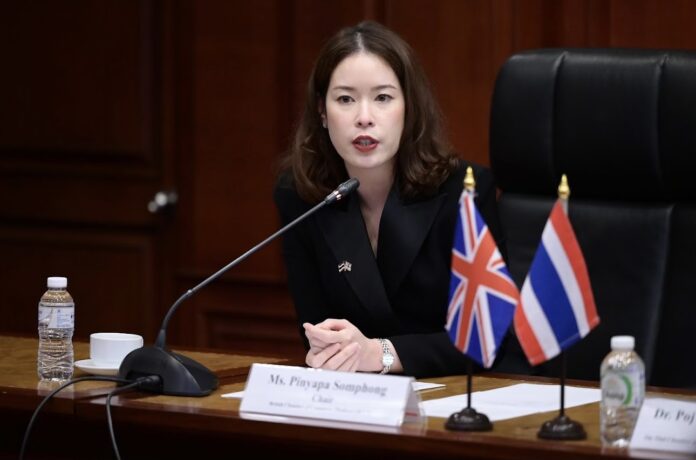
Pinyapa Somphong from BCCT attends a meeting with the Thai Chamber of Commerce – Board of Trade of Thailand (TCC-BOT) to explore pathways for deeper trade, investment, and partnership between the UK and Thailand on October 31, 2025.
BANGKOK— The British Chamber of Commerce Thailand (BCCT) is urging the Thai government to accelerate negotiations on a free trade agreement (FTA) with the United Kingdom, warning that delays could put British and Thai exporters at a disadvantage once the Thailand–EU FTA takes effect in 2026.
BCCT President Pinyapa Somphong said the chamber wants the upcoming UK deal to provide tariff and regulatory benefits comparable to those offered to the European Union, ensuring fair competition for both sides.
“The value of trade between Thailand and the UK has grown substantially. We hope the new Thai government will move quickly to resume and advance these negotiations,” Pinyapa said to Prachachat Business.
Talks began under the Joint Economic and Trade Committee (JETCO) framework, leading to the signing of an Enhanced Trade Partnership (ETP) in 2024, but discussions have since slowed following global tariff shifts sparked by U.S. policy changes earlier this year.
The UK is already pursuing multiple trade pacts, including an FTA with Indonesia expected in early 2026 and ongoing talks with India. Meanwhile, Thailand’s pending deal with the EU could tilt trade toward European markets if UK tariffs remain higher.
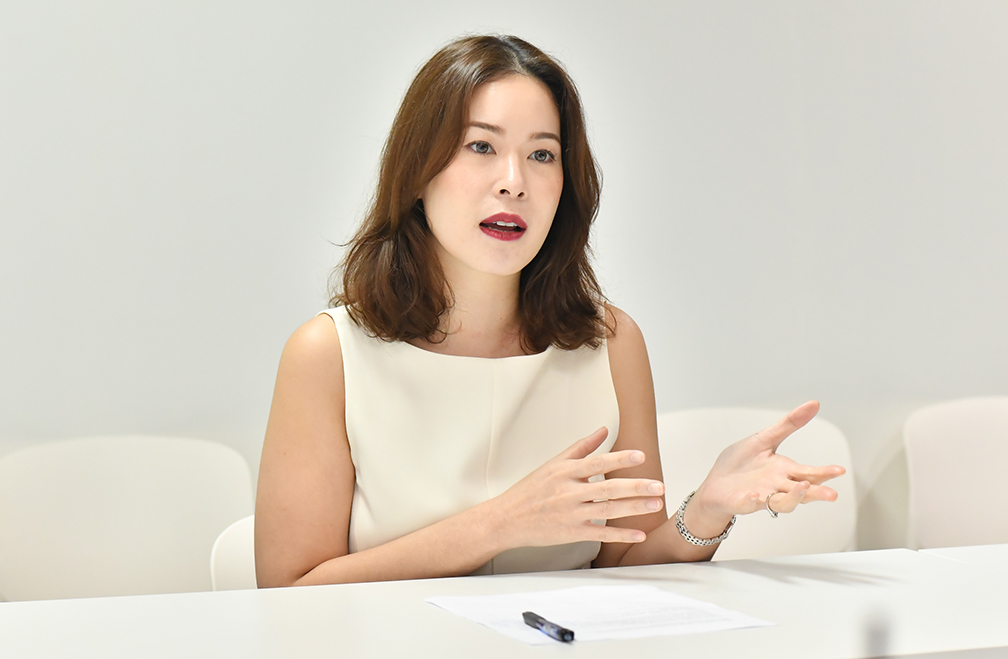
BCCT President Phinyapa Sompong gives an interview to Prachachat Business on Nov. 6, 2025.
Investment Climate and Business Priorities
Founded in 1946, the BCCT is Thailand’s oldest foreign chamber of commerce, with more than 560 member companies across sectors such as education, energy, retail, and finance. The chamber supports both inbound and outbound investment and hosts regular events to promote trade and policy dialogue.
Pinyapa said both economies are facing headwinds in 2025 as Thailand focuses on stimulating consumption and tourism, while the UK prioritizes domestic business recovery. She expects investor confidence to improve in 2026 as policies become clearer under the new Thai administration.
Call for Regulatory Reform
The BCCT also called on Thailand to reform outdated and overlapping regulations that continue to deter foreign investors, citing the Foreign Business Act’s Annex 3 as a key obstacle.
“If redundant laws are reduced, it will be easier for foreign investors to do business and trade in Thailand,” Pinyapa said, noting that Vietnam has moved faster in streamlining investment procedures.
The chamber urged the Thai government to simplify approvals and reduce bureaucratic overlap between the Board of Investment and other agencies to make investment decisions faster and more cost-efficient.
“Cutting red tape will attract more foreign capital and benefit Thai consumers through greater competition, innovation, and quality,” Pinyapa said.
Police officers inspect a villa project under construction during a raid on Koh Phangan on November 7, 2025, as part of an investigation into alleged illegal business operations by foreign nationals.
KOH PHANGNAN— Police on Koh Phangan raided four locations linked to a French-run villa business amid allegations of using Thai “nominees” to illegally operate real estate and unlicensed hotels.
The joint operation on November 7 involved officers from the Surat Thani Provincial Police, Koh Phangan Police Station, Immigration Bureau, Tourist Police, and the Koh Phangan District Office.
Police executed search warrants at four sites:
Location 1: A company office in Moo 1, Koh Phangan subdistrict, where accounting records for four companies directed by two French nationals were kept. Officers seized documents and questioned three Thai employees.
Location 2: An 18-villa project where units were rented to foreign tourists for 5,000 baht ($155) per night. Two Thai receptionists and two foreign guests were questioned.
Location 3: Another 18-villa project offering daily rentals between 5,000 and 15,000 baht ($155-465). One foreign guest was questioned.
Location 4: The project, with 29 villas under construction, where police interviewed two French project owners.
A foreign guest is questioned by authorities at Koh Phangan Police Station on November 7, 2025, after being found staying at one of the villa projects where units were being rented without proper hotel licenses.
The Business Model
Investigators said the French nationals leased land from Thai owners on 30-year contracts, subdivided the plots, and built villas later sold through subleasing rights valued between 3 million and 7 million baht ($92,610 – 216,090 each.)
Some buyers used the properties themselves, while others hired the French operators to manage and rent them out for a 20% fee. Police intelligence indicated the operation generated at least 200 million baht annually from rentals and management income.
Investigation Ongoing
Authorities seized business records for further review and are questioning those involved to determine if the companies violated hotel licensing laws or used illegal nominee structures.
Police said the raid is part of a broader crackdown on foreigners running unauthorized businesses in major tourist destinations across Surat Thani province.
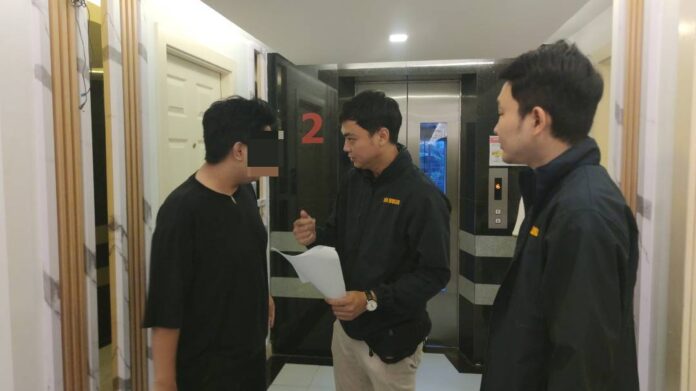
Police apprehend 26-year-old Malaysian national at a hotel in Don Mueang district, Bangkok, under warrant for fraud by impersonating a police officer in a 3.3 million baht scam, on November 7, 2025.
BANGKOK — Thai police on Thursday arrested a 26-year-old Malaysian man accused of posing as a government officer to collect cash from an elderly victim in a phone scam that defrauded him of 3.3 million baht ($101,850).
Officers from Don Mueang and Thung Khru police stations apprehended the suspect, identified as Tan, at a hotel on Soi Soranakorn 3 in Don Mueang district under a Criminal Court warrant issued Nov. 7 for fraud and impersonation.
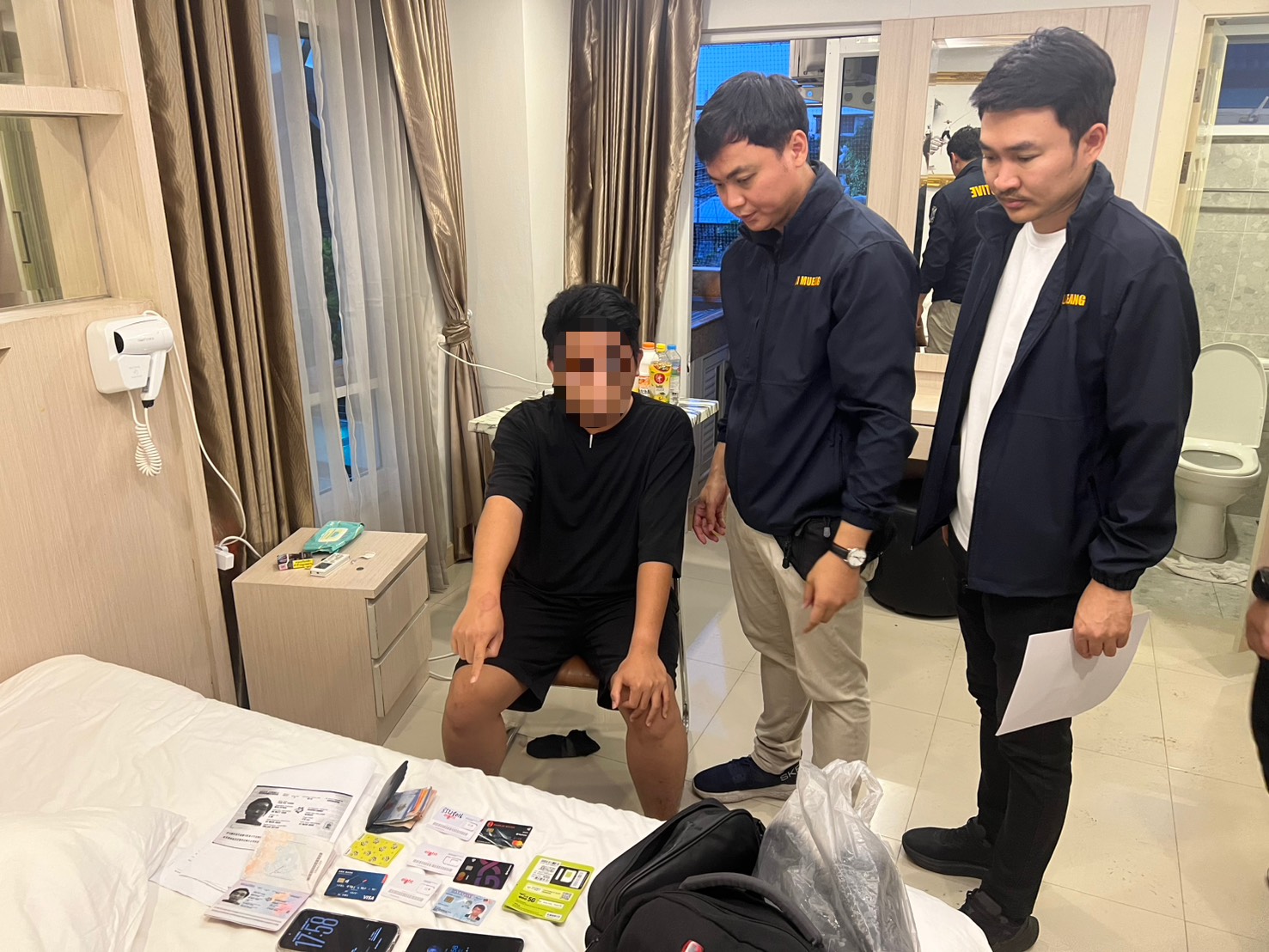
Police seized several items from the suspect, including clothing believed to have been worn during the crime, a black backpack, two mobile phones, a blank SIM card sleeve from AIS, four unused Singaporean SIM cards, one blank SIM card, and three foreign debit cards.
The Scam
According to investigators, the arrest followed a complaint filed Nov. 5 by a 70-year-old man who said he received a call from someone claiming to be a police officer. The caller alleged that the victim’s bank account was linked to mule accounts and money laundering.
The scammer told the victim to add a LINE account under the name “Por Pom,” who claimed to be an officer from Mueang Khon Kaen Police Station. The fraudster sent messages, fake documents, and initiated a video call to discuss the man’s assets, instructing him to prepare them for “inspection.”
The arrested suspect with seized evidence used to defraud an elderly victim, photographed at a hotel in Don Mueang district, Bangkok, on November 7, 2025.
Convinced the call was genuine, the victim withdrew cash, sold personal possessions, and gathered 3.3 million baht ($101,850). The scammer maintained video contact throughout, monitoring the victim’s actions.
The Handoff
The victim was directed to deliver the money to a gas station on Pracha Uthit Road in Thung Khru district, near the local police station. The Malaysian suspect, described as a well-dressed man wearing glasses, a medical mask, and a shirt bearing the Comptroller General’s Department insignia, arrived to collect the cash. He claimed to be a government officer conducting an inspection and assured the victim that the money would be returned after verification — before quickly disappearing.
Suspect’s Statement
Through an interpreter, Tan told police he previously worked at a casino in Cambodia but lost his job when the business stopped hiring foreign workers. He said he found a “delivery job” in Thailand via Facebook, claiming he was only instructed to collect and deliver items for 1,000 Malaysian ringgit (about 7,000 baht or $220). Tan also claimed the SIM cards found in his possession were for resale to tourists.
Police said the investigation is ongoing as they work to identify and arrest other members of the scam network.
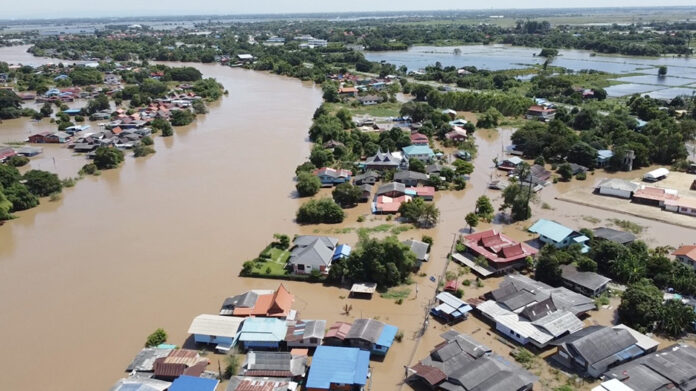
An aerial view shows hundreds of homes in Bang Chanee Subdistrict, Bang Ban District, Phra Nakhon Si Ayutthaya Province, submerged for two to three months and now facing the impact of Tropical Storm Kalmaegi.
BANGKOK — Tropical Depression Kalmaegi, which left hundreds dead across the Philippines and Vietnam earlier this week, moved into Thailand on Friday morning, bringing heavy rain and flooding to several regions as authorities scrambled to deploy water pumps across Bangkok.
The storm, downgraded from a deadly typhoon after striking the Philippines and central Vietnam, entered Thailand through Sirindhorn district in Ubon Ratchathani province before moving westward across Si Sa Ket, where its center was located Friday morning.
Meteorologists said Kalmaegi is expected to weaken further into a low-pressure system in the coming days.
Thailand’s Disaster Prevention and Mitigation Department and the Royal Irrigation Department (RID) were placed on high alert, as the Meteorological Department warned of intense rainfall from November 7–8 across the Northeast, Central, and Northern regions.
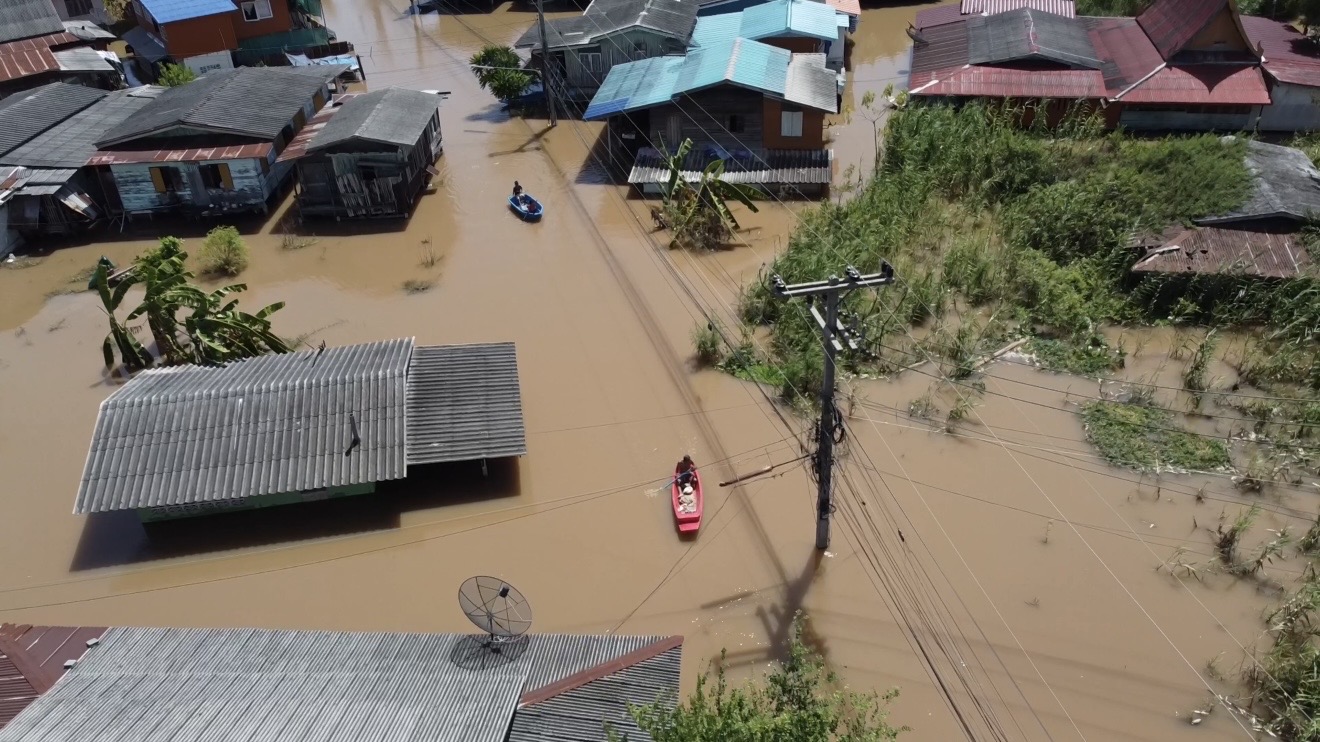
Rice plants ready for harvest lie submerged in floodwaters in Surin Province, northeastern Thailand, after heavy rain from Tropical Storm Kalmaegi hit the area on Nov. 7, 2025.
Heavy Rainfall and Risk Zones
Meteorological Department Director-General Dr. Sukanyanee Yawincharn said areas at highest risk of rainfall exceeding 90 millimeters include lower northeastern provinces such as Ubon Ratchathani, Buriram, Surin, Si Sa Ket, Maha Sarakham, Roi Et, Yasothon, Amnat Charoen, and Nakhon Ratchasima. Other parts of the country — including the North, Central, East, South, and the Bangkok metropolitan area — could experience 35–90 millimeters of rainfall, she added.
Emergency operation centers nationwide have prepared flood-relief machinery including water pumps, rescue boats, and 24-hour response teams.
Bangkok on Pump Power
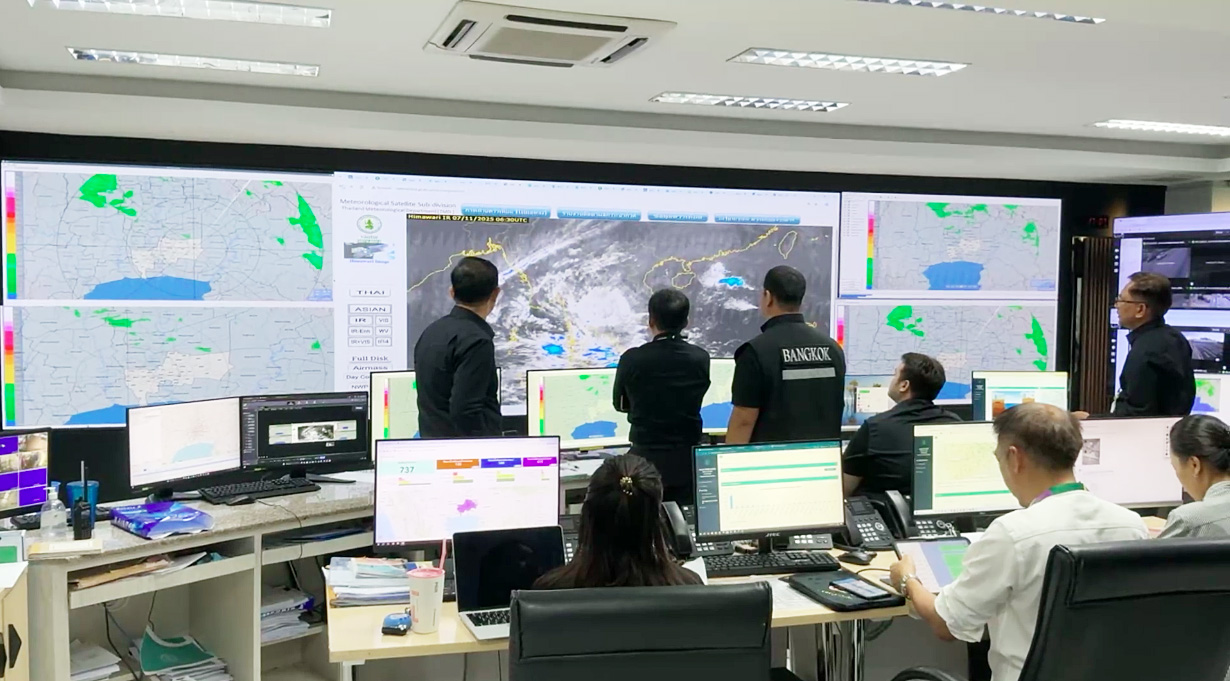
Bangkok Permanent Secretary Narong Ruangsri said the capital faces the dual challenge of torrential rains and rising river and sea levels. The RID has increased water discharge from the Chao Phraya Basin, while the Royal Thai Navy’s Hydrographic Department has warned of high tides from November 5–14.
Officials at the Bangkok Flood Control Center monitor rainfall, northern runoff, high tides, and the impact of Tropical Storm Kalmaegi on Nov. 7, 2025.
“We must admit that Bangkok is surviving because of its water pumps,” said RID Water Management Director Thanes Somboon. “This year’s water volume is not as severe as in 2011, but the pumps are working hard because the city is being hit by three sources of water at once — rainwater, runoff from the north, and tidal surges.”
Thanes added that northern runoff will not cause major flooding in Bangkok, but localized flooding from rainfall could submerge areas for three to five hours. The RID has raised the discharge rate at the Chao Phraya Dam from 2,700 to 2,800 cubic meters per second. As of early November, Thailand’s major reservoirs collectively held 63.9 billion cubic meters of water — about 90% of their total capacity.
Central Plains Tensions Rise
In Ayutthaya province, residents in eight flood-prone districts — including Sena, Bang Ban, and Phak Hai — staged a road blockade Friday to demand faster drainage after more than 30,000 households were inundated and 11 people died in recent floods.
An aerial view shows hundreds of homes in Bang Chanee Subdistrict, Bang Ban District, Phra Nakhon Si Ayutthaya Province, submerged for two to three months and now facing the impact of Tropical Storm Kalmaegi.
The protest prompted the Minister attached to the Prime Minister’s Office to intervene. Authorities eventually agreed to open water gates by 80%, easing tensions temporarily. However, residents vowed to keep pressing for a sustainable flood management plan, saying they suffer yearly inundations from dam discharges diverted away from industrial zones.
Storm’s Path Through the Region
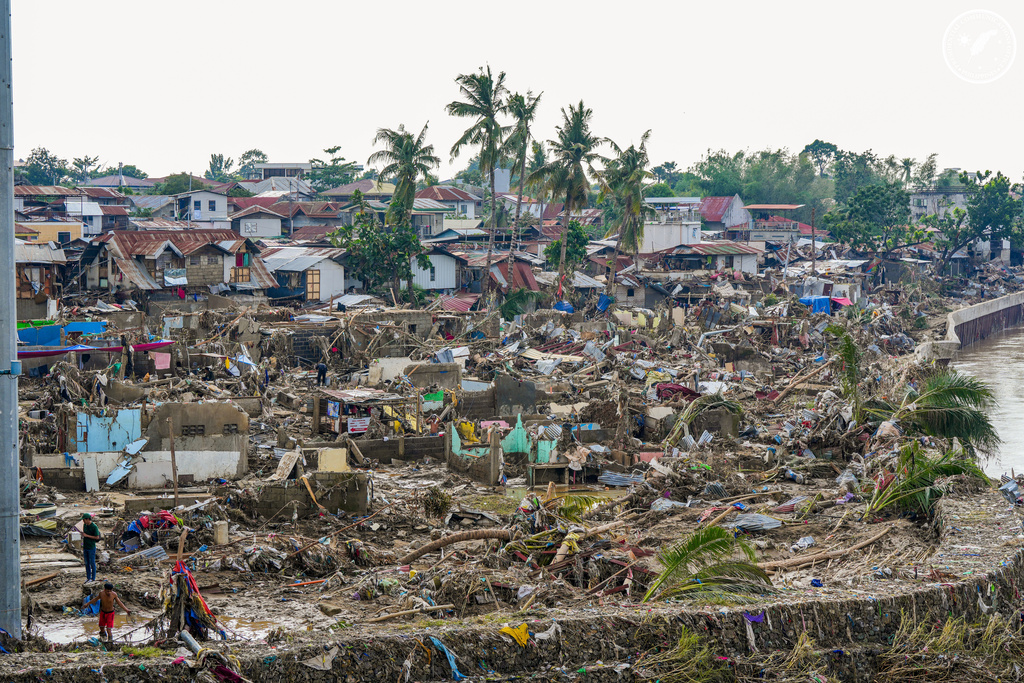
Earlier, the Associated Press reported that Typhoon Kalmaegi had killed at least five people and caused widespread damage in Vietnam after leaving nearly 190 dead and 135 missing in the Philippines. The storm’s remnants swept into Laos before reaching Thailand on Friday.
Scientists warn that climate change is intensifying storms and rainfall across Southeast Asia, making tropical cyclones more destructive and frequent.
In this photo provided by the Malacanang Presidential Communications Office, damaged homes beside Mananga Bridge in Talisay, Cebu Province, central Philippines on Friday Nov. 7, 2025 after Typhoon Kalmaegi devastated the province and claimed lives. (Malacanang Presidential Communications Office via AP)
From left, Alexandre Sanchez, Managing Director of Airbus Helicopters; Bert Porteman, Airbus Chief Representative for Thailand; and Zakir Hamid, head of Asia-Pacific for Airbus Defence and Space, pose for photos during a press event in Bangkok on Nov. 7, 2025. (Photo: Pravit Rojanaphruk)
BANGKOK — Airbus will renew its cooperative agreement with Thai Aviation Industries (TAI), a state enterprise under the Royal Thai Air Force, on November 10 as part of plans to expand its long-term presence in Thailand, company executives said Friday.
At a press conference in Bangkok, Airbus officials said they aim to sell more aircraft and helicopters to support Thailand’s defense, security, and disaster-response capabilities.
Airbus’s relationship with TAI began in 2017 with “after-sales support” for government helicopter fleets. TAI is also the main service provider for the Thai armed forces and police. Bert Porteman, Airbus Chief Representative for Thailand, said Airbus is a strategic market for its firm while the company is a trusted partner and is here in Thailand for long-term cooperation.
Porteman pointed out that the aviation giant first supplied a commercial aircraft to Thailand—an A300-B4 passenger aeroplane—back in 1977 and at present, there are 140 Airbus commercial aeroplanes in Thailand, 70 Airbus civil, paramilitary and military helicopters used by the Thai government, and over 15 Airbus military transport aircraft are currently in service with various national agencies and armed services, supporting not just military missions from troop and cargo transport but also for search and rescue (SAR), emergency medical services (EMS), with one order made in September.
With four decades of partnership with Thailand, Airbus executives highlighted some new aircraft, helicopters and drones they will try to display at next week’s Defence & Security exhibition at IMPACT Muang Thong Thani, and hope to eventually sell some to Thailand.
Airbus’ sales pitch to expand its footprint in Thailand and supporting Thailand’s longer-term needs includes selling a package of “mixed-fleet strategy” by combining its A400M, A330 MRTT and C295 aircraft in order to provide Thailand with a “full spectrum solution for missions ranging from defence to disaster response.”
Zakir Hamid, head of Asia-Pacific for Airbus Defence and Space, said at the Airbus office in Bangkok that the firm offers a “future-ready defence system” to Thailand. Its A330 MRTT, for example, can help enhance mobility and operation reach of the Thai armed forces as well as its capability for humanitarian missions.
The aircraft consumes 8 per cent less fuel than its rivals and emits lower noise, said Hamid.
C295 aeroplane (Photo: Airbus)
According to Airbus, the aircraft is a “true multi-role aeroplane,” used for refuelling, transport of up to 300 passengers, freight transport, as well as VIP transport. It can carry a load of up to 45 tonnes.
Meanwhile, its C295 aeroplane is described as a reliable and versatile workhorse with “exceptional versatility,” said Hamid, that can be used for firefighting as well as search and rescue and is easy and economical to maintain. It is used in 38 countries.
Besides helicopters, Airbus also offers a high-performance unmanned aerial vehicle, or drone, called SIRTAP which can be used for maritime survey, tactical defence and border protection. It can be airborne for up to 20 hours and has a range of 2,000 kilometres.
Alexandre Sanchez, Managing Director of Airbus Helicopters, not only introduced new multi-purpose helicopters like H160, with the French Navy currently has six for search and rescue, but a new unmanned aerial vehicle called Flexrotor which has a unique fixed wing and compact footprint. Sanchez said this aerial vehicle can be used for real-time intelligence gathering in disaster zone and remote areas and can be used in GPS-denied environment for defence and security.
Flexrotor is attracting interests in the Asia and Pacific region, said Sanchez.
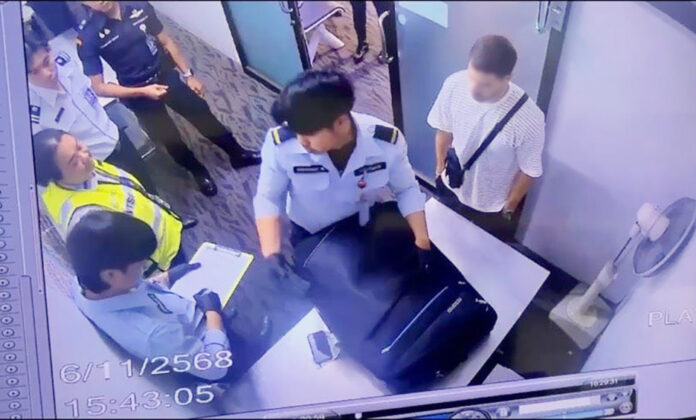
Airport security officers inspect an Israeli tourist’s luggage in the X-ray screening room at Phuket International Airport on Nov. 6, 2025.
PHUKET — Police at Phuket International Airport are investigating an Israeli tourist who was caught with ammunition in his luggage during an X-ray screening at the domestic terminal before 4 p.m. on November 6.
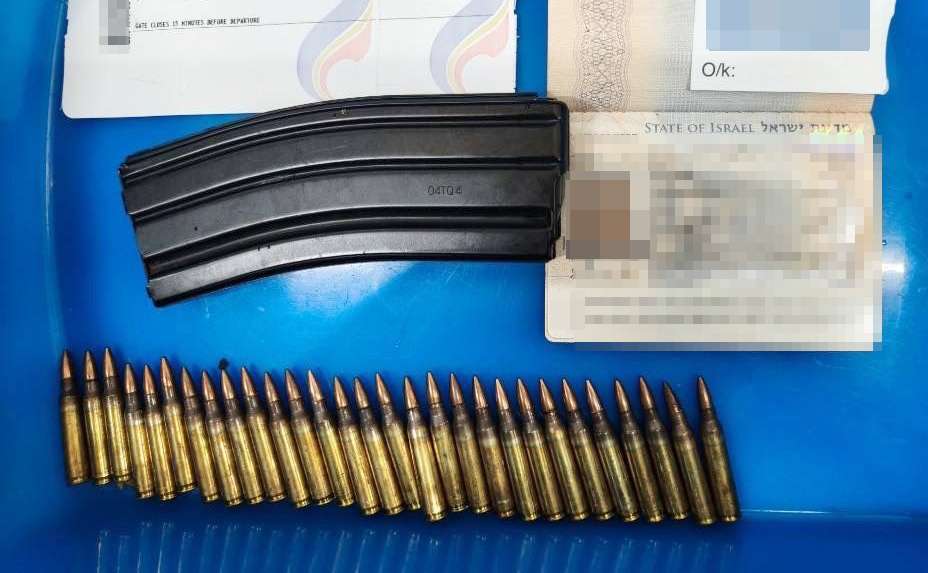
The 26-year-old Israeli man, whose name was not released, was preparing to board a flight to Koh Samui in Surat Thani province when security staff discovered 29 rounds of 5.56mm ammunition loaded in a magazine inside his black travel bag.
Authorities informed the tourist of his rights and charged him with illegal possession of ammunition that cannot be legally licensed in Thailand. Under Section 72 of the Firearms Act, the offense carries a penalty of one to 10 years in prison and a fine ranging from 2,000 to 20,000 baht ($62–$620).
Officials display 29 rounds of 5.56mm ammunition loaded in a magazine found inside the Israeli traveler’s luggage.
Israeli Embassy Discusses Tourist Concerns
Two days earlier, on November 4, Israeli Ambassador to Thailand Dr. Alona Fisher-Kamm and Embassy Consul Eli Sneh met with Surat Thani Governor Theerut Supawiboonphol to address concerns among Israeli visitors following reports of police investigations and monitoring of tourists.
“I confirm that the majority of Israeli tourists are good tourists who love traveling to Thailand,” Fisher-Kamm said. “Only a small minority behave inappropriately or break the law, and we fully support Thai authorities taking legal action as they would with any other nationality.”
Dr. Alona Fisher-Kamm, the new Ambassador of Israel to Thailand, meets with Surat Thani Governor Teerut Supawiboonphol at the Provincial Hall, on November 4, 2025.
Governor Theerut said there was no discrimination against Israeli nationals, stressing that officials were focused on enforcing laws while promoting tourism responsibly. He proposed creating a direct communication channel between Surat Thani authorities and the Israeli Embassy to improve coordination and understanding.
Collaboration between Israeli officials and Thai police has also resulted in arrests of suspects wanted in Israel who had fled to Thailand. Authorities recently detained an Israeli fugitive for armed robbery, threats, breaking and entering, and theft on Koh Samui after a request for cooperation from the Israeli Embassy’s Police and Internal Security Attaché Office.
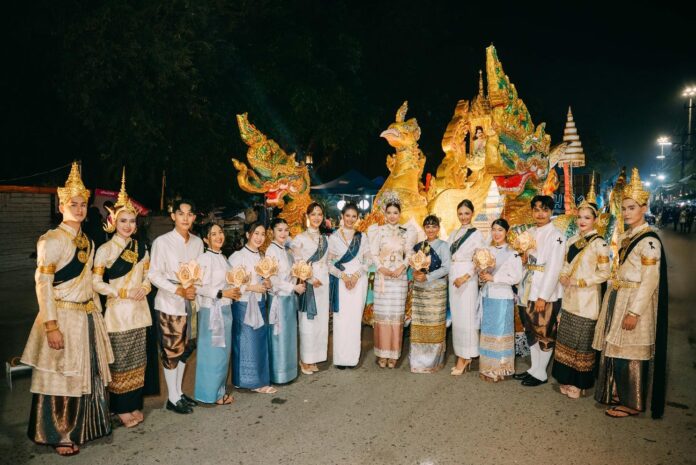
On the 6th of November 2025 Hylife Group took part in the Chiang Mai Yee Peng Festival 2025, joining the grand Krathong parade under the theme “The River of Divine Grace Flowing Across the Thai Sky, Forever in the Hearts of the People.” The parade was held in remembrance of the boundless grace and benevolence of Her Majesty Queen Sirikit The Queen Mother.
This year’s magnificent float parade was led by Mrs. Pola Mazumdar Nair, Non-Executive Director of Hylife Group, who also represented the organisation in receiving a certificate of honor from Mr. Tanakorn Sarabun, Secretary to the Mayor of Chiang Mai Municipality, in recognition of the company’s contribution to preserving the beauty of Thai culture.
Hylife Group’s parade portrayed “The River of Love and Virtue” symbolising the flowing force that nurtures the Thai land in peace and harmony. The float was adorned with mythical creatures from Thai literature, including the Golden Swan, Naga, Singha, and Garuda, each representing blessings, virtue, and auspiciousness. Together, they depicted the heavenly procession of Her Majesty amid the light of faith and reverence from the Thai people. Adding a touch of charm and delight to the parade was Omelet Siriyakron Teeratongdee, Miss Grand Lampang 2026, who joined to spread smiles and enhance the festive spirit along the route.
Hylife Group’s float was proudly awarded the First Runner-Up Prize in the Royal Trophy Grand Krathong Parade Contest at the Chiang Mai Yee Peng Festival 2025. The award was presented by Mr. Assanee Buranupakorn, Mayor of Chiang Mai Municipality, marking another proud moment for the company and reflecting its dedication to preserving and celebrating Thai cultural heritage.
This participation in the Yee Peng Festival highlights Hylife Group’s dedication to upholding Thai cultural heritage and honoring the grace of Her Majesty The Queen Mother. It also reflects the company’s vision to preserve and extend the value of cultural heritage in harmony with modern living ensuring that the beauty of Thai culture continues to flourish sustainably within Thailand and beyond.