BANGKOK — 30 July 2026, Thailand’s Department of Labour Protection and Welfare has opened public consultation on a draft regulation that would extend maternity leave for female employees of state enterprises from 98 to 120 days.
State enterprises are government-owned or government-controlled businesses that provide commercial or public services, such as the State Railway of Thailand, Thai Post, the Government Savings Bank and electricity authorities. Their employees are not civil servants, and their employment conditions are regulated separately from those in ordinary private companies.
The draft would amend the minimum employment standards set by the State Enterprise Labour Relations Committee, which establishes baseline conditions across state enterprises. It would allow eligible employees to take up to 120 days of maternity leave and receive wages at their normal rate throughout the leave, capped at 120 days.
The proposal is intended to bring state-enterprise maternity leave in line with the 120-day entitlement already available to private-sector employees under the Labour Protection Act (No. 9), which took effect in December 2025.
However, the proposed pay provision would go further than the private-sector statutory minimum. Private-sector employees are entitled to up to 120 days’ maternity leave, but employers are required to pay full wages for only the first 60 days. Under the amended Labour Protection Act, private-sector employees may also take up to 15 additional days of leave at 50% pay to care for a newborn with qualifying medical conditions. The law also grants private-sector employees up to 15 days of fully paid leave to assist a spouse after childbirth.
The state-enterprise consultation concerns maternity leave only. It does not alter the separate leave rules for civil servants, nor does it automatically change benefits offered under individual state enterprises’ employment agreements, which may already exceed the minimum standard.
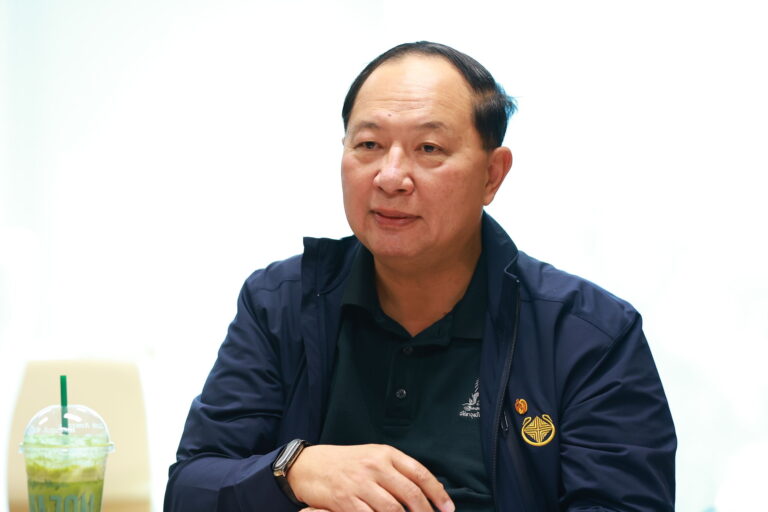
Labour Protection and Welfare Department director-general Capt. Saroj Khomkhai said the measure is intended to improve workers’ quality of life, support families and strengthen national labour protections.
Employers, state-enterprise employees, relevant organisations and members of the public may submit comments through the government’s Law Portal until 24 August 2026.
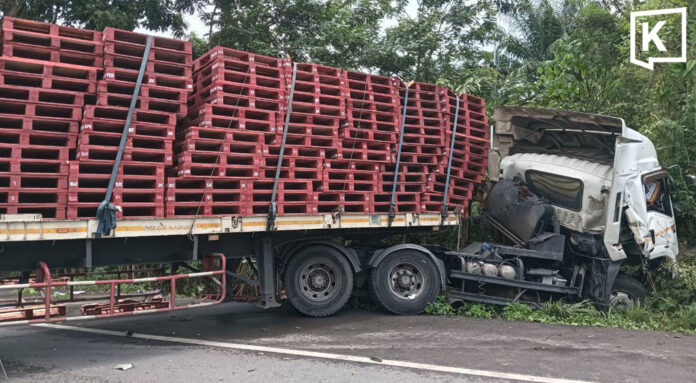
CHUMPHON — 30 July 2026, A man described as having impaired mental faculties allegedly stole an unattended pallet truck and drove it more than 40 kilometres before crashing into two other trailer trucks on Thursday.
The incident occurred at around 13:50 on Asian Highway 41, heading towards Bangkok, near kilometre marker 92/600 in Suan Taeng subdistrict, Lamae district.
Police and rescue workers rushed to the scene after receiving reports of a multi-vehicle collision involving three trailer trucks and several injured people.
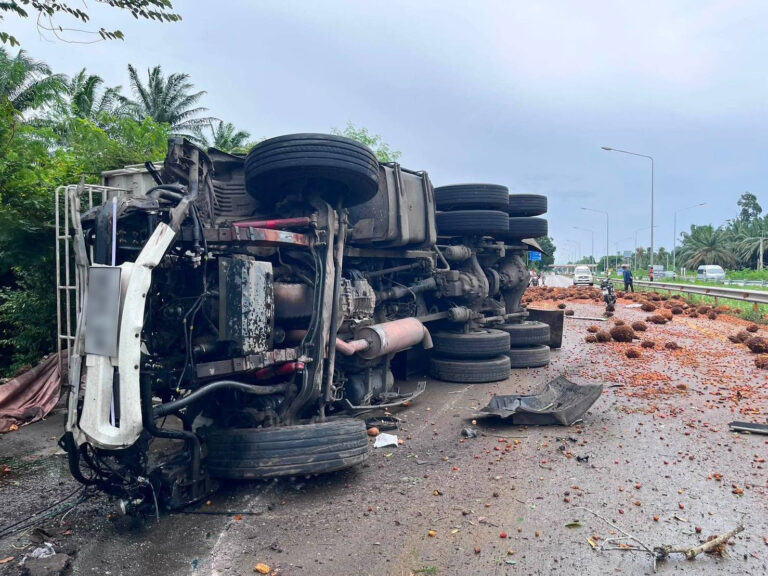
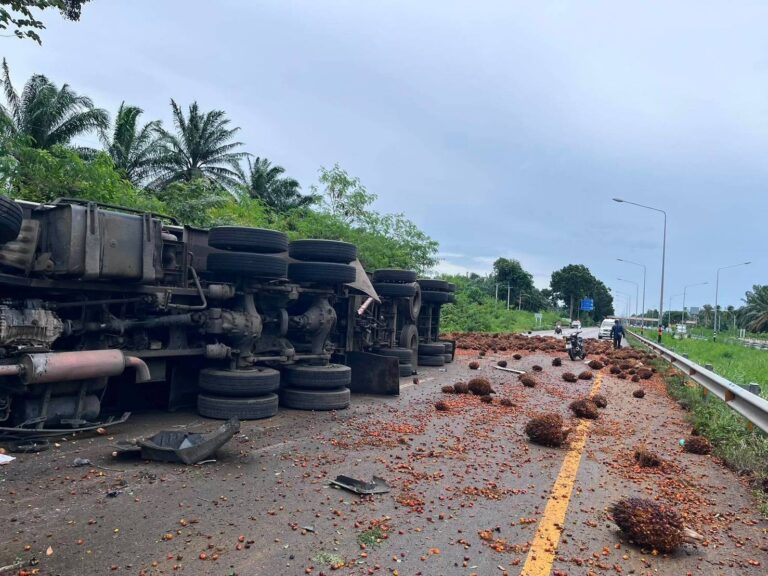
The scene was chaotic, with vehicle wreckage and debris scattered across the road.
The first vehicle, a white Hino oil palm trailer truck registered in Surat Thani, suffered a massive impact that tore the cab away from the truck. The cab was thrown into a roadside ditch, while the truck and trailer overturned across the road.
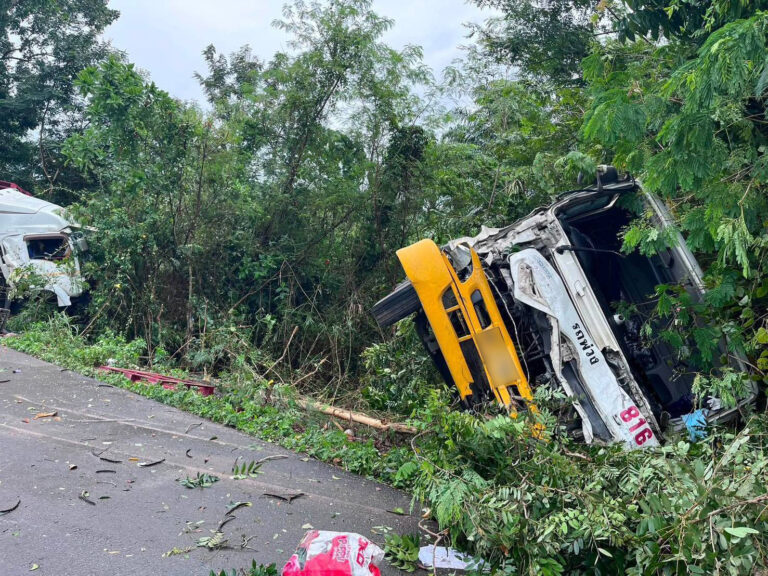
The second vehicle, a white Hino empty car carrier registered in Bangkok, overturned with its cab in a ditch. Its trailer was also detached and partially submerged in a roadside ditch.
The third vehicle, a white Isuzu pallet truck registered in Nakhon Sawan, which police identified as the vehicle that caused the crash, came to a stop blocking the road, with its cab plunged into a roadside ditch.
Good Samaritans and rescue workers rushed all three drivers to Lamae Hospital with injuries to their ribs and bodies caused by the impact.
The injured drivers were identified as Kiattisak Yangmee, 32, who was driving the oil palm truck; Boonchuay Isarapap, 55, who was driving the car carrier; and Nattanon Daengkanit, 27, who was driving the pallet truck.
Police said their initial investigation revealed that the pallet truck had originally been parked on the side of Asian Highway 41 in Tha Chana district, Surat Thani, while its actual driver stopped to have a meal.
The driver reportedly left the vehicle with the key still in the ignition.
Nattanon, who was described as having impaired mental faculties, allegedly spotted the unattended truck, climbed inside, started the engine and drove away at high speed towards the north along Asian Highway 41.
After travelling more than 40 kilometres, the truck entered Lamae district in Chumphon, where it reportedly lost control and collided with the two other trailer trucks travelling along the highway.
The impact caused extensive damage, with the truck cabs torn apart and debris scattered across the road.
Police documented the scene, conducted an investigation and had all three wrecked vehicles towed to Lamae Police Station.
A preliminary urine test at Lamae Hospital found no traces of drugs in Nattanon’s system. Police have sent a request for further blood testing to determine his blood alcohol level.
Police will wait for his injuries to improve before questioning him and determining the appropriate charges over the alleged vehicle theft and crash.
Diplomacy is no longer confined to diplomats and politicians. Increasingly, and for better or worse, people-to-people relations shape ties between two nations. It is not just face-to-face contact, but the use of social media that shapes the trajectory relations between two nations.
Two examples are apparent in Thailand: relations with Cambodia, and China.
The toxic tensions between Thailand and Cambodia are at least a year old, if not longer. They have left both governments needing to ensure that they are not seen as too soft on the other country following two brief undeclared wars last year. This, unfortunately, means that any normalisation of relations between Thailand and Cambodia is partly dictated by angry netizens in both countries.
As it stands, many social media users in both countries have been hurling hate speech—and even dehumanising speech—at one another on a daily basis.
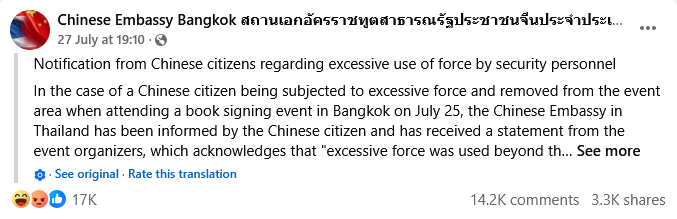
Another “diplomatic stage” this week saw the Chinese Embassy in Bangkok come under heavy criticism by nationalist Thai social media users for issuing a statement that, rightly or wrongly, Thai netizens interpreted as both unfair and arrogant.
This came after a physical altercation between a Chinese woman and a female security guard at a Bangkok fan meet sparked an online uproar in both Thailand and China. The Chinese Embassy in Thailand called on the Thai authorities to investigate, but failed to acknowledge that the Chinese woman had first assaulted a Thai security guard, following her lengthy refusal to accept that she had jumped the queue. This was quickly followed by Thai Foreign Minister Sihasak Phuangketkeow ordering a probe, further fuelling rage among Thais who perceive the Chinese Embassy as behaving as if it can tell the Thai government whatever it likes while the Thai government complies subserviently.
The Chinese Embassy’s statement never acknowledged that the Chinese woman in the orange shirt had jumped the queue and then kicked a Thai security guard. Nor did it include any apology or expression of regret over the woman’s behaviour.
Instead, the embassy reached a swift conclusion on this case, in stark contrast to its stalling over issues such as the toxic pollution in the Kok River, the “fake Thai children” controversy, and the many “grey Chinese” cases that have become almost daily news. Furthermore, the Chinese ambassador previously urged Thais to stop using the term “grey Chinese”.
Many Thais are already concerned that China may be attempting to turn Thailand into a de facto tributary state in which Beijing can directly interfere in matters it cares about. Recent examples include alleged attempts to pressure Thai media into censoring masks depicting President Xi Jinping worn by Thai protesters over the Kok River contamination, as well as efforts to pressure Thai organisers of a Taiwan film festival to remove the name of Taiwan’s Ministry of Culture from promotional materials, without going through Thailand’s Ministry of Foreign Affairs.
These concerns have been reinforced by what many perceive as the Thai government’s unusually deferential approach to China. The Thai prime minister, Anutin Charnvirakul, once even volunteered to drive China’s foreign minister Wang Yi to lunch, despite diplomatic protocol, which would normally place Thailand’s own foreign minister—an official of equivalent rank—in that role. Notably, no similar gesture appears to have been made for the foreign ministers of other countries.
Most recently, Thai Foreign Minister Sihasak Phuangketkeow promptly ordered an investigation into the incident involving the Chinese woman in the orange shirt following the Chinese Embassy’s request. Yet when it came to the far more serious issue of toxic pollution in the Kok River, which affects hundreds of thousands of people in Thailand, Prime Minister Anutin did not even raise the matter with President Xi Jinping during his official visit to China earlier this month.
Consequently, angry attacks were unleashed on the Facebook page of the Chinese Embassy in Bangkok. As of Thursday morning—two days after the statement was issued—the post had attracted over 14,000 comments, mostly critical, if not outright anti-China.
Ugly stereotypes surfaced on both sides. Some Chinese X users portrayed Thais as wild monkeys, a nation of mongrels and beggars, extending that view to the Thai government, which they accused of being overly subservient to Beijing.
That raises a legitimate question: has the Anutin government become too eager to kowtow to China’s leaders? Or has Anutin forgotten that he no longer works as a construction contractor, as he did before entering politics, but as Thailand’s head of government, with a duty to uphold the country’s dignity and national honour?
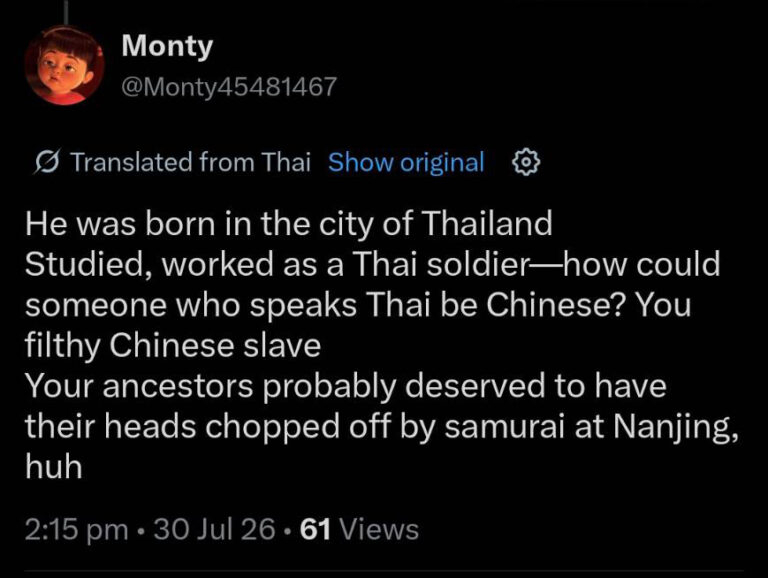
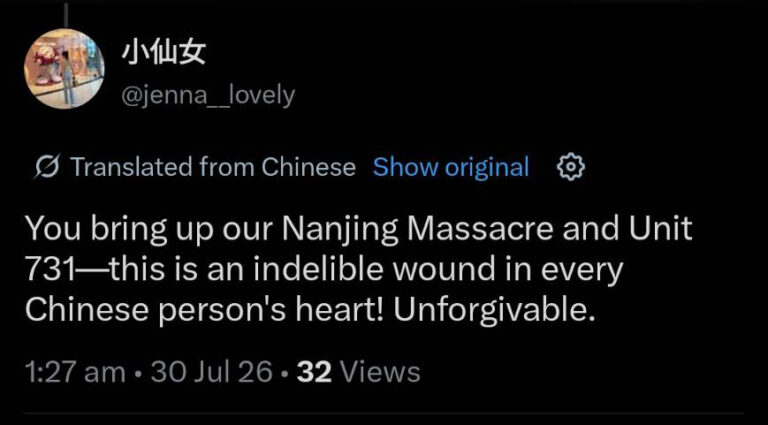
Meanwhile, a few Chinese netizens were outraged that some Thai netizens brought up the Nanjing Massacre and Unit 731, the Japanese Imperial Army unit notorious for conducting cruel and inhumane medical experiments on Chinese captives.
As translated by X: “He was born in the city of Thailand Studied, worked as a Thai soldier-how could someone who speaks Thai be Chinese? You filthy Chinese slave Your ancestors probably deserved to have their heads chopped off by samurai at Nanjing, huh”
“This is an indelible wound in every Chinese person’s heart! Unforgivable,” Chinese X account user @jenna_lovely tweeted to me on Wednesday.
“..this is an indelible wound in every Chinese person’s heart! Unforgivable,” Chinese X account user @jenna_lovely tweeted to me on Wednesday.
Any hate speech employed by Thai or Chinese netizens must be denounced and condemned. We must also take stock and recognise that Sino-Thai relations have entered uncharted and fragile territory that calls for restraint and common sense on both sides before the situation becomes too difficult to salvage.
Thailand risks losing recoverable petroleum resources and economic value from ageing petroleum fields if policy decisions on expiring concessions are delayed, according to Dr. Kurujit Nakornthap, Executive Director, Petroleum and Energy Institute of Thailand (PEIT) and former permanent secretary of the Energy Ministry.
Kurujit said many mature petroleum fields still contain commercially recoverable resources, but maintaining production requires continuous investment for drilling and field development. Without timely policy decisions, operators may delay investment, causing production to decline and disruption before concessions formally expire.
“An ageing field does not necessarily mean that its petroleum resources have been exhausted,” he said. “The remaining resources require more investment and technical expertise especially at the late stage of production. Without clarity over future operating rights, companies cannot commit to an investment.”
He said the government should evaluate each petroleum field individually rather than relying on a single policy for all expiring concessions. Depending on the remaining reserves, production potential and economic conditions, options could include extending existing concessions under revised conditions, opening competitive bidding, adjusting investment terms or proceeding with decommissioning where production is no longer viable.
For mature fields that still have strong production potential, allowing the existing operator to continue under transparent and measurable conditions may reduce disruption because existing operators already possess field knowledge, production data and operational infrastructure. However, he stressed that any extension should be subject to new investment commitments and clear public-interest conditions rather than being granted automatically.
Competitive bidding remains an important policy option only when it can deliver better technology, stronger investment or greater returns to the state. Nevertheless, changing operators requires sufficient preparation to ensure production continuity and avoid unnecessary disruption.
Kurujit said the most important issue is not whether Thailand ultimately extends concessions or launches new bidding rounds, but whether decisions are made early enough to maintain investment momentum.
“Petroleum projects require years of planning,” he said. “If policy decisions come too late, investment slows, drilling is postponed and production may decline before replacement arrangements are ready.”
He also called for greater flexibility under Thailand’s Petroleum Act so that the government can adopt different approaches for different fields while maintaining transparent decision-making and improving coordination of environmental and permitting processes.
Maintaining domestic gas production is increasingly important for Thailand’s long-term energy security. If production falls more rapidly than expected, the country will rely more heavily on imported LNG, increasing exposure to global price volatility, transportation costs and geopolitical risks.
“The priority is not to predetermine whether concessions should be extended or rebid,” Kurujit said. “The priority is to make timely, evidence-based decisions that preserve production, maximise the remaining value of petroleum resources and strengthen Thailand’s long-term energy security.”
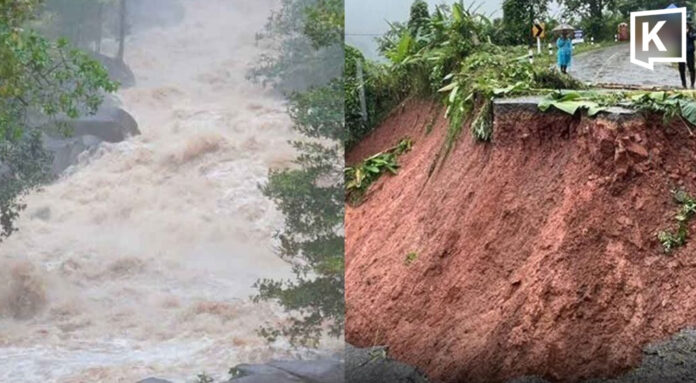
30 July 2026 — Thailand’s Department of Mineral Resources has warned residents in 15 provinces to remain vigilant for landslides and flash floods over the next one to three days amid continuing heavy rainfall.
The department’s Geological Disaster Operations Centre urged its disaster monitoring and warning network volunteers and residents to monitor the situation from 30 July to 1 August.
The 15 provinces are Tak, Mae Hong Son, Chiang Mai, Lamphun, Chiang Rai, Nan, Phayao, Phrae, Uttaradit, Phetchabun, Kanchanaburi, Chanthaburi, Trat, Ranong and Phang Nga.
The warning is particularly focused on mountainous and high-risk areas in the North, Central, East and South.
In the North, areas at risk include several districts in Tak, Mae Hong Son, Chiang Mai, Lamphun, Chiang Rai, Nan, Phayao, Phrae, Uttaradit and Phetchabun.
In the Central region, the warning covers parts of Kanchanaburi, including Sangkhla Buri, Thong Pha Phum, Sai Yok and Si Sawat districts.
In the East, areas in Chanthaburi and Trat are being monitored, while in the South, authorities are watching areas in Ranong and Phang Nga.
The department said a monsoon trough is extending across the North and Northeast, while a relatively strong southwest monsoon is affecting the country, bringing persistent heavy rainfall.
Rainfall measured over a 24-hour period has exceeded 150mm in some areas. Several locations have also experienced accumulated heavy rainfall over multiple days, with flash floods already reported in some areas.
The conditions could trigger landslides, particularly in mountainous areas and locations with saturated soil.
The department urged its disaster monitoring volunteers to remain prepared, closely monitor rainfall levels and issue warnings to residents if landslides or flash floods occur.
Volunteers have also been instructed to notify relevant agencies and follow established disaster monitoring and response plans.
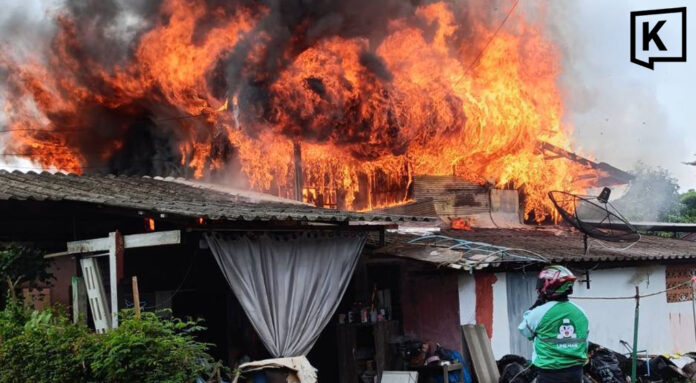
CHIANG MAI — 30 July 2026, A wooden house in a community in Saraphi district, was completely destroyed by fire on Thursday, with an electrical short circuit suspected as the cause. The occupants escaped unharmed.
At around 11:30, police at Saraphi Police Station were alerted to a fire at a house in Yang Noeng subdistrict, Saraphi district.
Police and firefighters from Yang Noeng Subdistrict Municipality and Ku Suea Subdistrict Municipality rushed to the scene.
Firefighters found flames rapidly spreading across the roof of the house, with thick flames clearly visible. Local residents were alarmed and rushed to evacuate while taking whatever belongings they could carry.
Firefighters took about one hour to bring the blaze under control and prevent it from spreading to nearby homes.
The house, owned by 69-year-old Boonma Chitban, was completely gutted by the fire. The extent of property damage was still being assessed, with preliminary losses estimated at around 800,000 baht.
Police said there were no injuries. The house was reportedly not insured.
Witnesses believed the fire may have been caused by an electrical short circuit. The homeowner reportedly did not dispute the suspected cause.
A family member said he had been working at a house across the road while his father was working in the garden behind the home. His mother was inside when she noticed smoke coming from the house and raised the alarm.
Fortunately, both his parents managed to escape in time.
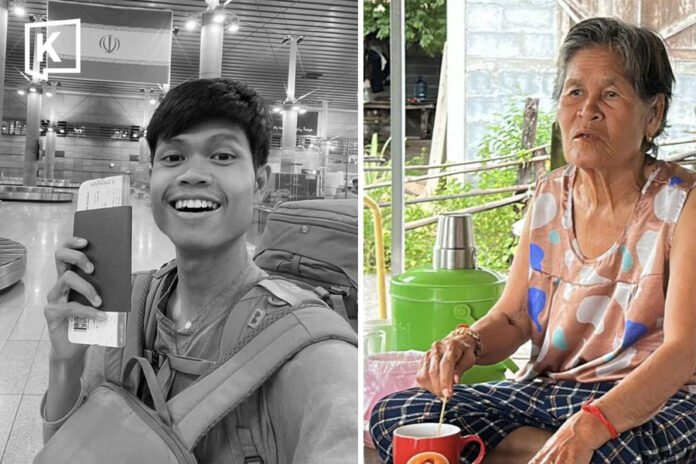
KALASIN — The grandmother of Thai travel YouTuber Hlun Solo has tearfully accepted that her grandson died in Georgia after the family received official confirmation from Thailand’s Ministry of Foreign Affairs, while rejecting speculation that he took his own life.
Relatives of Hlun, whose real name was Bowornthat Pengsuk, had spent days awaiting confirmation after he disappeared while travelling in Georgia. Late on Wednesday night, the Foreign Ministry informed the family that a body found at a hotel in the country was that of the 26-year-old traveller.
The confirmation plunged the family into grief at their home in Kalasin province, where relatives gathered to comfort one another. Hlun’s grandmother, Som Pengsuk, described him as hardworking, cheerful and deeply devoted to his family.
“He was a good person, diligent and grateful,”
“Whenever I wanted something, he would always try to get it for me. Whenever he travelled abroad, he would bring me gifts and food from the countries he visited.”
Before leaving for Georgia, Hlun asked what she wanted as a gift, Som said. She told him she wanted a karaoke set so they could sing together at the end of the year.
“He promised me he would get it,” she said through tears.
“I thought we would be singing together later this year, but now that will never happen.”
Som also rejected online speculation that her grandson may have died by suicide.
“He never drank alcohol or smoked. I simply cannot believe that he would commit suicide,” she said.
Family members have raised questions about the circumstances of Hlun’s death, including the timeline of events and why relatives were not contacted sooner, despite the hotel having his passport details.
Georgian authorities are conducting an autopsy to establish the cause of death. The family has not yet decided whether Hlun’s body will be returned to Thailand for funeral rites or cremated in Georgia, saying they are awaiting further coordination with authorities.
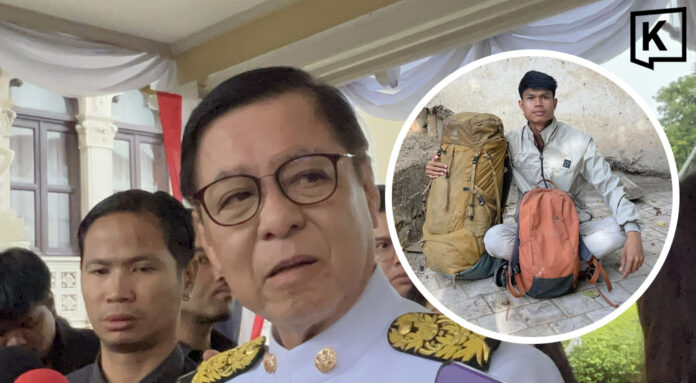
BANGKOK — 30 July 2026, Deputy Prime Minister and Foreign Minister Sihasak Phuangketkeow has expressed condolences to the family of Thai travel YouTuber Boworntat Pengsuk, known as “Hlun Solo,” while Thai embassy officials have travelled to Georgia to investigate the circumstances surrounding his death.
Speaking at Government House at around 08:25 on Thursday, Sihasak said the Foreign Ministry and the Thai Embassy in Ankara, Türkiye, which is responsible for consular affairs in Georgia, had sent officials to Tbilisi to investigate the case.
He said Thai authorities would wait for Georgian officials to complete their investigation and for the Thai embassy team to report its findings before drawing any conclusions about the cause of death.
“I would like to express my condolences to the family of the deceased. This is an incident that no one expected, as Hlun had travelled to many countries,” Sihasak said.
Asked about bringing Hlun’s body back to Thailand, Sihasak said the process would begin once the investigation had been completed, with the arrangements also depending on the wishes of the family.
Regarding reports that Hlun had been out of contact for more than two weeks, Sihasak said Georgian authorities and the Thai embassy had acted as soon as they became aware that he had been missing and had lost contact.
The body was subsequently found inside a hotel, he said.
Sihasak said Hlun had been travelling in Georgia and continued filming content during his trip. Once authorities were informed that he had lost contact, coordination efforts began.
Asked whether Thai authorities would participate in the investigation or leave it entirely to Georgia, Sihasak said Thai officials were already involved in monitoring the case but that Georgian authorities would first need to complete their investigation and report the findings.
He stressed that no conclusion could yet be reached regarding the cause of death.
“There have been claims that he was attacked or that he took his own life. We have to wait for the investigation results first,” Sihasak said.
Responding to reports by local Georgian media that the death was a suicide, the minister said he did not want to draw any conclusions at this stage.
“We should wait for the investigation by the authorities, who are working to establish what happened. Once the results are known, we will inform his relatives and family first,” he said.
Asked whether Thailand needed to issue new travel warnings or raise safety alerts following the deaths of several foreign tourists in Georgia, Sihasak said the Foreign Ministry regularly provides information and warnings about areas considered unsafe or affected by conflict.
He advised people planning to travel to areas where there may be safety concerns to contact the Foreign Ministry for the latest information and to coordinate with the relevant Thai embassy if necessary.
Thailand does not have embassies in every country, he said, but Georgia falls under the responsibility of the Thai Embassy in Ankara, whose officials travelled to Georgia immediately after being informed of the incident.
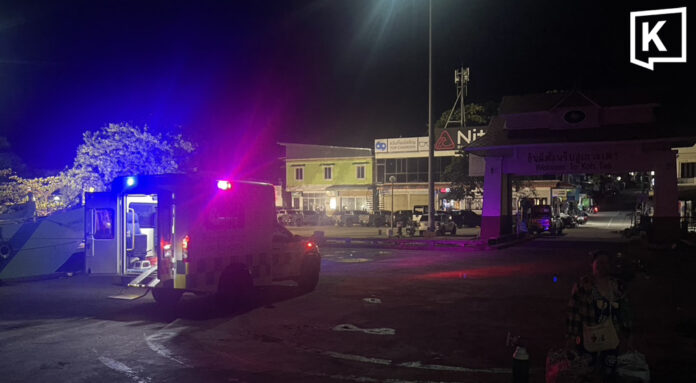
SURAT THANI — 30 July 2026, authorities dispatched a patrol boat late Wednesday night to urgently transfer a critically ill pregnant woman from Koh Tao Hospital to Koh Samui Hospital amid rough seas.
Lt. Cmdr. Natthaphon Sinphunphon, deputy director of the Internal Security Operations Command (ISOC) in Surat Thani, received a request from the Naresuan Gulf Emergency Medical Centre on Koh Samui for a boat to transport a 38-week pregnant woman suffering from high blood pressure and abdominal pain.
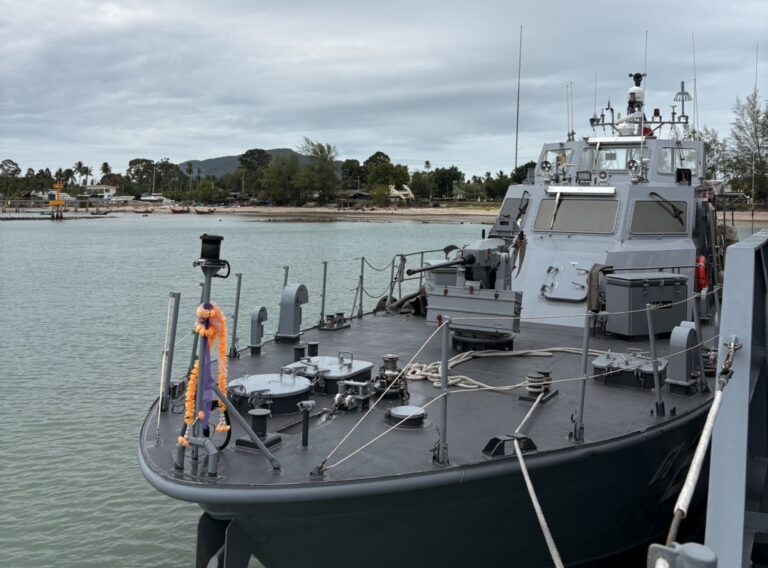
Due to strong winds and waves at sea, authorities requested a patrol boat to safely transfer the patient for further treatment on Koh Samui.
Natthaphon reported the situation to Vice Adm Thepparit Lapphlue, commander of the Royal Thai Navy’s Second Area and director of the Thai Maritime Enforcement Command Centre Region 2, who approved the deployment of Patrol Boat Tor 268 along with officers from the Surat Thani branch.
The patient was identified as War War Cho, 32, a Myanmar national. She was reportedly in critical condition with severe preeclampsia.
The patrol boat transported her from Koh Tao to Koh Samui, where she was safely handed over to doctors at Koh Samui Hospital for further treatment.
KALASIN — 29 July 2026, The grandmother of Thai travel YouTuber Hlun Solo says she still believes he is alive, despite reports on social media that he has died in Georgia.
The family has not received official confirmation from the Thai consulate or any other authorities, and says it cannot verify reports of Hlun’s death.
Speaking at the family home in Kalasin at 21:50, Som Plengsuk said her grandson, whose real name is Borwat Pengsuk, should return home if he hears the appeal.
“I still believe my grandson is alive,” she said. “I want everyone and the relevant agencies to help bring him home safely. His family is waiting to welcome him.”
She also rejected speculation that, if he had died, it could have been suicide.
“I do not believe that at all,” she said.
“He was cheerful, friendly and loved by people. He had no enemies or conflicts with anyone.”
Som said Hlun had been earning money to repair and build a home for her, adding that this made the suggestion especially difficult to believe. She appealed for divine protection and for him to return home safely.
Pornsawan Muangnikorn, Hlun’s aunt, said the family had not seen any evidence confirming that the person reportedly found dead was Hlun.
“There has been no photograph, no information about the condition of the body, no passport — nothing that can confirm it was him,” she said.
Hlun’s sister, Borlak Plengsuk, said the family had been contacted by pages and individuals following the case, some of whom told them he had died. However, she said no relevant authority had contacted the family or provided a definitive confirmation.
“At this point, we cannot confirm that my younger brother has died,”
she said. “We do not know what happened, how it happened or under what circumstances. No agency has officially confirmed anything to us.”