

























36.1 C
Bangkok
Saturday, June 27, 2026
Home Blog Page 2464

As Trump Era Begins, Border Wall Divides Republicans

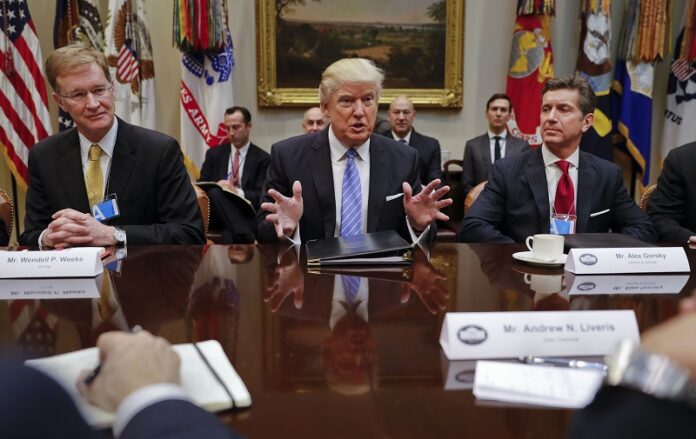
President Donald Trump speaks while hosting a breakfast with business leaders in the Roosevelt Room of the White House in January in Washington. Photo: Pablo Martinez Monsivais / Associated Press

PHILADELPHIA — Congressional Republicans leave their annual policy retreat divided over paying for President Donald Trump’s border wall, one of several thorny issues looming to trip them up as the GOP adjusts to full control of Washington.

Lawmakers welcomed a speech from Trump endorsing their goals on repealing and replacing former President Barack Obama’s health care law and overhauling the loophole-ridden tax code. But the president’s comments on paying for the wall, and subsequent clarification and walk-backs from the White House, sowed widespread confusion Thursday.

After the White House press secretary announced a 20 percent border tax on imports from Mexico, House Republicans felt certain the administration was describing a central plank of their own tax plan  so-called border adjustment that taxes imports instead of exports. They argued it would more than pay for the wall and would end up with Mexico footing the bill in the end, as promised. But Senate Republicans, who are not sold on the House GOP tax plan, began to raise questions.

Then the White House began to walk the idea back, saying it was simply part of a menu of options.

“Many unanswered questions about proposed ‘border adjustment’ tax,” the No. 2 Senate Republican, John Cornyn of Texas, said over Twitter. GOP Sen. Lindsey Graham of South Carolina said that “any policy proposal which drives up costs of Corona, tequila or margaritas is a big-time bad idea.”

The confusion underscored the tricky currents ahead as the GOP aims to repeal and begin to replace “Obamacare” by March and complete action on taxes by summer’s end  all while paying for the border wall and other spending proposals, writing an infrastructure bill and taking must-do action to raise the government’s borrowing limit.

“It’s obvious we have an awful lot of work to be done,” said Sen. Susan Collins, R-Maine. “There’s not necessarily consensus on it, but there is a sense of excitement about it.”

Amid their two-day retreat in Philadelphia, Republicans sought to fall in line behind their new president even if it meant abandoning long-held GOP principles.

House Speaker Paul Ryan of Wisconsin and Senate Majority Leader Mitch McConnell of Kentucky announced that Congress would take steps to pay the USD $12 billion to USD $15 billion for the border wall without committing that the money would not be added to the deficit. It was a marked turnaround from the GOP’s traditional opposition to deficit spending.

Lawmakers praised Trump for his use of executive orders for the wall and other issues, something they criticized bitterly when it was coming from Obama.

And even as Trump continued to stoke controversy, Republicans increasingly said they could live with his erratic approach, and some were even coming around to the view that it was helpful.

“I think he’s completely winning the expectations game. I think he’s a genius at lowering expectations and over-performing,” said Rep. Peter Roskam, R-Ill. “It’s really remarkable.”

During his presentation Trump said he was with the GOP on its aggressive agenda on health care and taxes, welcome words to Republicans. Many were pleased that in his 20-minute remarks Trump stayed mostly on the script shown on his teleprompter and did not veer into the false allegations about massive voter fraud and inaugural crowd size that have raised controversy.

“I think a lot of people in the room feel calm when we see teleprompters in front of him,” said GOP Rep. Dan Donovan of New York. “You have to love the man, though. He speaks his mind.”

Yet it was clear that Trump would have his detractors. Sen. John McCain of Arizona told reporters that he was not sold on paying for the border wall, and the former prisoner of war passionately denounced Trump’s new suggestions that torture works and that enhanced interrogation techniques and black CIA sites should be renewed.

“When he brings up this issue of torture again, I have to speak up. I have to speak up. I have to. I have no choice on that,” McCain said, adding that torture “does not work” and is clearly illegal.

Story: Erica Werner

Advertisement

Comrades in Arts Show Power of Brush and Spray at Bridge

Photo: Mister Ogay / Facebook

BANGKOK — Four Thais, three Koreans, two Japanese and two Taiwanese artists are coming to occupy a Charoen Krung gallery with their works for a month.

Mitr, which means “comrades,” presents 11 established and up-and-coming street, graffiti and mixed media artists from four Southeast Asian countries early next month at a riverside art space.

Veteran graphic artist Thaweesak Srithongdee aka Lolay will lead the crew including psychedelic street artist Hideyuki Katsumata from Japan, Korean black-and-white graffiti artist GR1 and Taiwan’s Mr. Ogay, whose works mostly involve funny but possibly traumatizing cartoons of naked old men.

The exhibition runs Feb. 3 through the end of the month at Bridge Art Space. Admission is free. The opening reception starts at 7pm with appearances by all artists and a party starting about 9pm.

Cafe-shophouse-art space Bridge is located on Soi Charoen Krung 51. Get there by walking from BTS Saphan Taksin’s exit No. 4.

Photo: Bridge Art Space / Facebook

Advertisement

Anti-Corruption Chief Complains Dive in Corruption Index ‘Unfair’

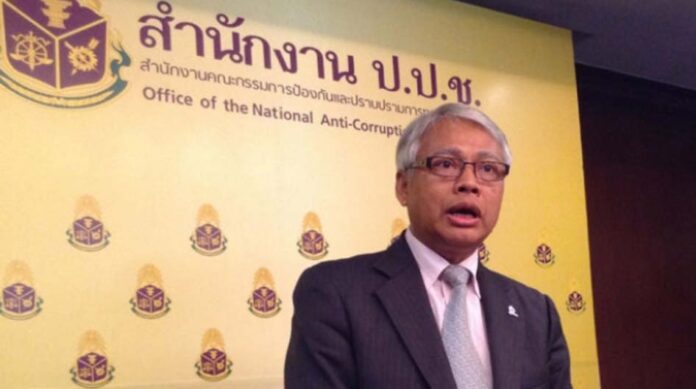
Sansern Poljiak, secretary-general of the National Anti-Corruption Commission speaks Friday in Bangkok. Photo: Prachachat

BANGKOK — The government’s top corruption fighter Friday rejected Thailand’s fall to 101st place in a world ranking of corruption by a German anti-corruption nonprofit.

The head of the National Anti-Corruption Commission said Thailand’s sharp drop to 101 from 76 in Transparency International’s annual ranking of perceived levels of corruption was “unfair” because it factored in the nation’s departure from democracy.

“I want to ask them their reason for including this information about ‘Varieties of Democracy’ for the 2016 ranking. Is it fair to Thailand or not?” said Sansern Poljiak, commission secretary-general. “If they didn’t factor in this information, we wouldn’t have fallen so far.”

For its analysis, the Berlin-based NGO factored in data from political science research at the University of Gothenburg and Kellogg Institute at the University of Notre Dame. The Varieties of Democracy project measured different aspects of democracies for a more complete picture of corruption, according to a University of Gothenburg paper.

The additional measures were included in a year the organization said it was concerned about the “connection between corruption and inequality” and rise of populism. Transparency International brought in Varieties of Democracy as a data source in addition to their other sources such as World Economic Forum and World Justice Project.

Sansern said that data’s inclusion was “unanticipated.”

Released Wednesday, the report found corruption on the rise throughout the world, particularly in Southeast Asia, where Cambodia and Thailand are named among declines in the Asia-Pacific region. The report calls out Thailand for “(g)overnment repression, lack of independent oversight, and the deterioration of rights.”

Thailand fell 25 places to rank 101 out of 176, tying the nation with Gabon, Niger, Peru, the Philippines, Timor-Leste, Trinidad and Tobago.

Transparency International is a Berlin-based nonprofit founded in 1993 to combat corruption worldwide through research and reports such as the Corruption Perceptions Index.

Advertisement

Thailand Seeks Freedom of Official Jailed in Japan for Theft

Hotel paintings allegedly stolen by Suphat Saguandeekul were said to depict Kyoto scenery, like this woodblock painting of the Japanese city by artist Hiroshige.

BANGKOK — The Thai consulate in Japan was trying Friday to negotiate a settlement with the hotel where a Thai bureaucrat allegedly stole three paintings, as prosecutors decide whether to try him on charges of theft.

Suphat Saguandeekul was behind bars after a Japanese court on Thursday ordered him held for 10 days in Kyoto, a foreign affairs ministry spokesman said. The consulate in Osaka hoped striking a deal would convince prosecutors to drop criminal charges against the 60-year-old official.

“The Consul-General is trying to discuss with the hotel and negotiate about compensation,” ministry spokesman Sek Wannamethee said by telephone. “If we can reach an agreement, the prosecutor may drop the case.”

Sek said Suphat was not indicted yet. Instead, the court ordered him jailed for the next 10 days while the case is ongoing, Sek said, adding that Suphat has access to legal assistance provided by the consular officials.

Suphat, a deputy director of Department of Intellectual Property, was in Kyoto for a meeting with Japanese counterparts about patent rights, officials said. For some reason, he later stole three paintings from the hallway of the hotel where he was staying, a crime reportedly captured on camera, according to Japanese media reports.

His arrest proved an embarrassing episode for the bureaucracy and sparked a flurry of ridicule online, including a false report one of the paintings stolen depicted an AV actress.

Sek disputed that news.

“The consulate confirmed to me the paintings show scenery of Kyoto, and not what was shared on social media,” the spokesman said.

Related stories:

Thai Commerce Official Arrested in Japan for Stealing Hotel Paintings

Memes Go Dank in Response to Hotel Painting Caper

Advertisement

Tonic for the Soul: Gin Festival to Soak Bangkok All Week

Gin Jubilee Festival in 2016 in Hong Kong. Photo: East Imperial / Facebook

BANGKOK — Martini traditionalists and quinine addicts in Bangkok will rejoice at a gin-fueled, five-day festival starting next week.

For the first time in the capital, the East Imperial Gin Jubilee is coming from Singapore to pour good spirits at more than a dozen bars around town.

Monday through Friday, expect all kinds 0f gin-spired activities from workshops on its proper mixing with tonic to sipping a unique, strong gin at swinging jazz events and food pairing nights.

The Gin Lane Street Party closes the fest on Feb. 4. It will take place from 6pm until late at Quaint Bangkok on Soi Sukhumvit 61. The free-entry closing party will offer a variety of gin and tonic drinks priced at 200 baht, with live music and graffiti art.

East Imperial is a tonic brand owned by New Zealand-based winemaker Glengarry Wines.

The full schedule is available onlineThe festival runs Monday through Friday.


Advertisement

Thailand’s Media Protests Law to ‘License’ All Journalists

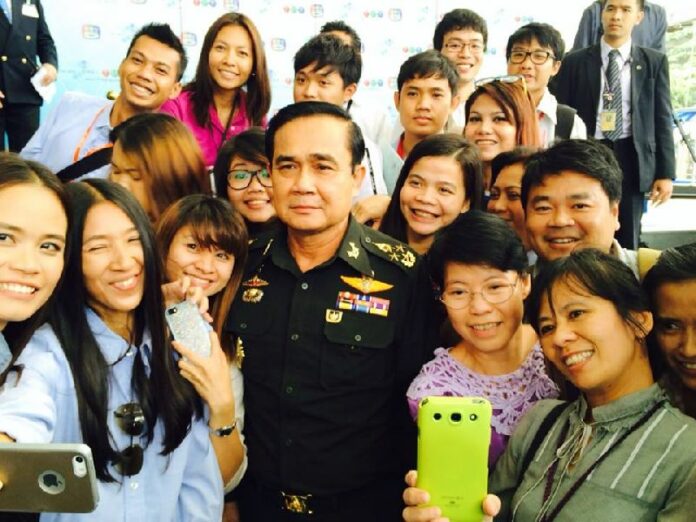
Members of the government press corps pose for a selfie with Gen. Prayuth Chan-ocha on Sept. 5, 2014, at the Royal Thai Army Radio and Television, aka Channel 5, in Bangkok. Photo: Matichon

BANGKOK — A government bid to regulate the media by requiring every journalist nationwide to be licensed is closer to becoming reality as press associations sound the alarm it is a vehicle for censorship.

At least 20 media associations will gather Sunday to protest a law billed as meant to protect press freedoms and promote ethical standards but open the door for government intervention and rolling back decades hard-won press freedoms.

Despite strong objections from journalists and their associations, a new draft of the bill will be brought up Monday by the National Reform Steering Assembly, a junta-appointed body that devises legislation to forward to the junta’s interim legislature for consideration.

The law would require all media in the country to register and submit to a national media council. No matter their platform – television, periodical or digital – all outlets would be overseen by the same council, which according to those who’ve seen the latest draft, would be comprised of industry representatives, citizens, unspecified experts from various fields and the permanent secretaries of four government ministries.

“No democratic countries license journalists,” Wanchai Wongmeechai, president of the Thai Journalists Association, said Thursday.

Among the council’s powers would be drafting a course all reporters and media professionals would have to attend in order to earn a license. The council would have the power to fine journalists 30,000 baht and blacklist them from working by revoking their licenses.

Born of the junta’s long-held desire to “reform the press,” it’s been a slow burn for the idea first raised in mid-2015 to reach fruition. It was drafted by the reform steering assembly’s media reform committee, which is headed by a retired Air Force general.

Retired Air Chief Marshal Kanit Suwannet said the council is needed because self-regulation has been ineffective.

“Their self-regulation was not based on a law. So it lacked binding force,” he said Thursday. “Someone did something wrong, and they just resigned from the association and returned to the industry.”

The latest draft to be taken up Monday has yet been revealed to the public. If the legislative process goes as planned, the draft will be submitted to the junta’s interim cabinet early next month. After it is approved, it will be passed to the junta-appointed legislature for final approval.

After many fruitless petitions against the bill, the Thai Journalist Association has invited the media and public to show their opposition to the law’s threat to their rights and freedoms at 11am on Sunday at its office on Samsen Road.

Though the draft can still be amended along the way to becoming law, its central ambition of forming a regulatory body to govern all media in the nation is unlikely to change.

Wanchai of the journalist association said there are already many laws that can enforce press ethics such as defamation, child protections and national security bills.

“These days we already have many junta orders about the media,” he said. “Some of the press today censor themselves and refrain from criticism.”

ACM Kanit said the media needs to be taught a lesson.

“So they learn about the limits to exercising rights and freedom and can be mindful of infringing on others’ rights,” he said. “They should write the way a person who loves the nation would.”

Work by unlicensed reporters would be illegal. Kanit said they will have to discuss further whether foreign journalists would be held to the same regulations.

Kanit disputed the licensing system has anything to do with limiting media rights and freedoms.

“It is the same as your driving license …you need to know the rules and not be mentally ill in order to drive,” he said, citing other professions for which licenses are required, such as physicians, pilots, lawyers or engineers.

But Wanchai said that comparison was not logical.

“Those professions involve [the safety of] people’s lives,” he said. “But you don’t need to graduate from mass communication to do a reporting job. It is about finding the truth, which uses many skills in combination.”

Attempts to regulate media have been rejected in other nations as incompatible with democratic institutions.

The Southeast Asian Press Alliance has been working with the Thai Journalist Association to campaign against the bill, which they argue will hand control of the media to the government and make journalists legally vulnerable.

Alliance Executive Director Edgardo Legaspi said the law will push Thailand back to the 1970s, when a coup leader granted himself the power to shut down newspapers.

The most significant concern for Wanchai is the four of 13 members of the media council would be permanent secretaries from various government ministries.

“They have the power to revoke these licenses,” Wanchai said. “What if a permanent secretary was investigated by the media and then turned to abuse their power?”


Related stories:

Prayuth Named ‘Press Freedom Predator’ – Again

Voice TV Deepens Self-Censorship by Cutting Political Coverage

Voice TV Pressured to Pull Pundits For Rattling Junta

Thailand Won’t Get Next Issue of ‘The Economist’

Citing Ethical Lapses, Ultraconservative Newspaper Quits Media Council

Junta Grants Authorities Legal Immunity to Regulate Media

Foreign Correspondents Being Denied Media Visas

Tough Media Visa Rules Meant to Discourage ‘Inaccurate Reporting’

Junta Orders Media to Discuss Charter ‘Respectfully’

Junta’s Threat Against Media Causes Uneasiness & Paranoia: Journalists Association

Media Reform Committee Weighs Article 44 for Crackdown on Online Media

Advertisement

Review: In ‘The Founder,’ Cutthroat Big Business, Supersized

Michael Keaton, center, in a scene from, "The Founder." (Photo: The Weinstein Company/ AP)

Ketchup, mustard, two pickles. In John Lee Hancock’s “The Founder,” about Ray Kroc and the making of McDonald’s, the ingredients for success are ruthlessly simple.

When Kroc (Michael Keaton), a struggling traveling salesmen selling milkshake mixers, first beelines to San Bernardino, California, in 1954 to get a look at Dick (Nick Offerman) and Mac (John Carroll Lynch) McDonald’s burger joint, he stands agog at the counter. Moments after he orders, Kroc is handed his burger and fries in a bag, but he might as well have been flame-grilled by lightning. “But I just ordered,” he stutters.

Kroc quickly recognizes the revolutionary power of the McDonalds’ restaurant and becomes its franchise-driver and the pre-eminent proselytizer of an empire built on burgers. The arches, an invention of Dick’s just like its other innovations, will spread “from sea to shining sea,” Kroc vows. As a gathering place for families, it will be “the new American church, open seven days a week,” he says.

“It requires a certain kind of mind to see the beauty in a hamburger bun,” wrote David Halberstam of the minds behind McDonalds in “The Fifties.” Of course, the genius behind McDonald’s lied largely with Dick McDonald, who engineered the “speedee service system” of its assembly line-like kitchen, designed its layout and focused its tiny menu.

But the ironically titled “The Founder” is not about him. It’s about Kroc, a hard-drinking, slightly shifty Illinois salesman who took the idea of the McDonalds and spread it around the world through sheer (and sometimes unscrupulous) force of will and savvy standardization. In the opening scenes, Kroc, struggling to eke out a living on the road, faithfully listens to Norman Vincent Peale’s “The Power of Positive Thinking.” ”Persistence, determination alone are all powerful,” Kroc absorbs.

“The Founder” is a quintessentially post-war American story about a self-made man largely made by others. Kroc, who died in 1984, fashioned himself as the “big picture” visionary to the McDonald brothers’ enterprise. Though McDonald’s had by 1954 already sold 21 franchises, Kroc’s zeal for expansion was compulsive and it turned him into a billionaire.

The McDonald brothers quickly realize, as Dick says, that they’ve let a wolf in the hen house. They begin fighting over issues that in their world are of massive importance, like milkshakes. Defending his high standards, Dick warns of “crass commercialism” infecting the franchise, and somewhere, Ronald McDonald chokes on a Big Mac.

But Kroc outmaneuvers them and eventually takes control of the company, leaving the run-over McDonalds to stare blankly at the yellow-and-red Frankenstein they’ve created. “I’m national,” a swelling Kroc declares. “You’re local.”

Yet if there’s any tragedy in “The Founder,” it’s not in the fate of the McDonald brothers but in Kroc’s success. The film is penned by Robert D. Siegel, whose “The Wrestler” and “Big Fan” also reflected the dark underbellies of American dreams. But “The Founder,” like its subject, is a little mechanical and a little too timid to really take a bite out of McDonald’s. It’s less a full meal than a drive-thru order.

Hancock’s film stays laser-focused on Kroc, and with the naturally appealing Keaton playing him, our sympathies initially slide toward him. But unease steadily creeps in, especially as Kroc, while espousing the virtues of family, callously jettisons his quietly steadfast wife (Laura Dern) for another man’s (Linda Cardellini). The bad taste of day-old McNuggets begins to form in our mouths as our hero turns villain, and a successful one at that.

Keaton chomps on the role, a Willy Loman who strikes it rich. Like Bryan Cranston on “Breaking Bad,” we can see the wheels turning behind his eyes in his step-by-step drive for power, albeit selling a slightly healthier product than Walter White peddled.

The frightful thing about “The Founder,” though, is that for all Kroc’s back-stabbing and double-crossing, he’s right. Remorseless brutality, just like fresh buns, turns out to be a necessary ingredient in business. Would you like fries with that?

“The Founder,” a Weinstein Co. release, is rated PG-13 by the Motion Picture Association of America for “brief strong language.” Running time: 115 minutes. Three stars out of four.

Story: Jake Coyle

Advertisement

Top Royalty Retroactively Freed From Inheritance Tax

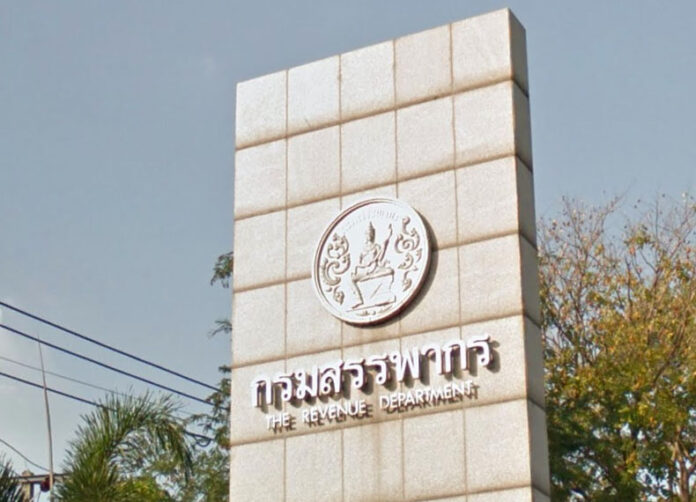
Exterior of the Revenue Department in Bangkok. Photo: Google

BANGKOK — A new regulation published in the Royal Gazette on Wednesday exempts top members of the royal family from paying inheritance tax.

The law makes the exception for princes and princesses and above, bearing titles of His and Her Royal Highness and upward, from paying tax if receiving an inheritance of more than 100 million baht. It was written to be retroactive to February 2016, the first day the 2015 Inheritance Tax Act went into effect.

The 2015 Inheritance Tax Act set a 5 percent tax for direct descendant beneficiaries and 10 percent for others. It exempted money bequeathed for donation to religious, educational or social benefit.

Under the act, those who receive an inheritance are obligated to submit tax forms to the Revenue Department within 150 days. The 2015 law was the first specific law in seven decades after a 1933 law was scrapped in 1944. Since then it has been a line item in income tax returns.

The junta restored the inheritance tax after seizing power as a means of reducing economic inequality in the country.

Advertisement

Run a Minimarathon, Win a Trip to China

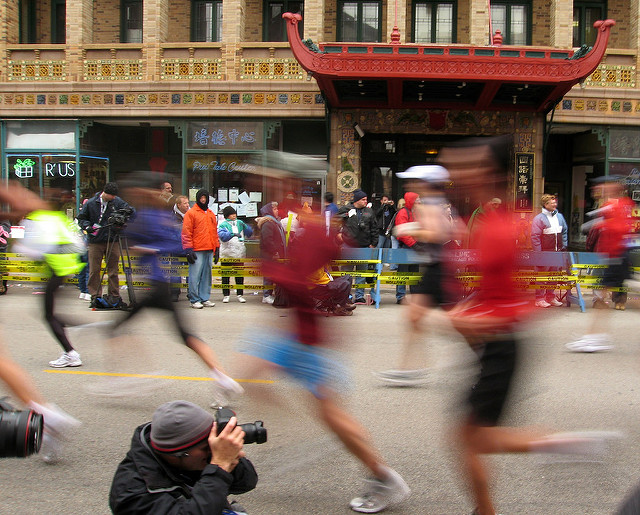
Chicago Marathon in Chinatown in Oct. 22, 2006. Photo: Michael Mooney/ Flickr.

BANGKOK — To start the Year of Rooster in good health, join a minimarathon to Yaowarat Road and get a chance to fly to China.

After celebrating Chinese New Year with food and shopping, it’s time to say“Gong Xi Fa Chai” to one’s health by being on track in a race to Bangkok’s Chinatown.

Not only will the winner of the first prize for the minimarathon earn a red envelope filled with a 25,000 baht-worth plane ticket to China, but all participants will also get a chance to win 6 similar tickets and other prizes from a lucky draw.

Proceeds will go to World Visions Foundation of Thailand to support needy children and families.

The races are 5K and 11K and will start at 5:30am on Feb. 12 from National Stadium, near MBK Center, to Yaowarat Road.

Registration fee is 470 baht and 520 baht if runners wish to receive t-shirts and bibs via postal service. Those interested can register online until Jan. 31.

Advertisement

Scientists Take First Steps to Growing Human Organs in Pigs

Pigs seen at a farm in 2011 in Rockville, Virginia.

NEW YORK — Scientists have grown human cells inside pig embryos, a very early step toward the goal of growing livers and other human organs in animals to transplant into people.

The cells made up just a tiny part of each embryo, and the embryos were grown for only a few weeks, researchers reported Thursday.

Such human-animal research has raised ethical concerns. The U.S. government suspended taxpayer funding of experiments in 2015. The new work, done in California and Spain, was paid for by private foundations.

Any growing of human organs in pigs is “far away,” said Juan Carlos Izpisua Belmonte of the Salk Institute in La Jolla, California, an author of the paper in the journal Cell.

He said the new research is “just a very early step toward the goal.”

Even before that is achieved, he said, putting human cells in animals could pay off for studies of how genetic diseases develop and for screening potential drugs.

Animals with cells from different species are called chimeras (ky-MEER’-ehz). Such mixing has been done before with mice and rats. Larger animals like pigs would be needed to make human-sized organs. That could help ease the shortage of human donors for transplants.

The Salk team is working on making humanized pancreases, hearts and livers in pigs. The animals would grow those organs in place of their own, and they’d be euthanized before the organ is removed.

Most of the organ cells would be human. By injecting pig embryos with stem cells from the person who will get the transplant, the problem of rejection should be minimized, said another Salk researcher, Jun Wu.

Daniel Garry of the University of Minnesota, who is working on chimeras but didn’t participate in the new work, called the Cell paper “an exciting initial step for this entire field.”

Here’s what the new paper reports:

Scientists used human stem cells, which are capable of producing a wide variety of specialized cells. They injected pig embryos made in the lab with three to 10 of those cells apiece, and implanted the embryos into sows. At three to four weeks of development, 186 embryos were removed and examined.

Less than 1 in every 100,000 embryonic cells was human, which still comes to about a million human cells, Wu said. That contribution is lower than expected, he said, “but we were very happy to see we actually can see the human cells after four weeks of development.”

The cells generated the precursors of muscle, heart, pancreas, liver and spinal cord tissue in the embryos. The researchers said they plan to test ways to focus human cells on making specific tissues while avoiding any contribution to the brain, sperm or eggs.

That addresses ethical concerns that the approach could accidentally lead to pigs that gain some human qualities in their brains, or make human egg or sperm.

There was no sign of that in the new research. The government, meanwhile, has signaled that it may lift the federal funding ban soon but impose extra oversight of any proposed work.

A pig might not always have to be brought to term, Belmonte and Wu said. Even a pig fetus might provide human pancreatic cells to treat diabetes, or kidney cells to repair injuries to that organ, they said.

The University of Minnesota’s Garry said the research offers some direction about what kind of human stem cells will work best. And it shows a need for boosting the number of human cells that appear in the embryo, he said.

Hiromitsu Nakauchi of Stanford University said his own unpublished experiments with pig and sheep embryos also found a sparse contribution from injected human cells. That’s a challenge for making organs, but it might be surmounted by focusing cells on doing that job, he said.

Ethics experts were also impressed by the results. “It really does give a green light to explore more,” said Insoo Hyun of Case Western Reserve University in Cleveland.

Hyun said he understood why some people might object on moral grounds to making animals with human organs.

“It seems kind of creepy,” he said. But “this is a strategy to help save human lives” and so it is justified if properly done, he said.

Story: Malcom Ritter

Advertisement

Hot News

LATEST NEWS

Bangkok
overcast clouds
36.1 ° C
36.6 °
35 °
61 %
3.6kmh
100 %
Sat
37 °
Sun
36 °
Mon
35 °
Tue
33 °
Wed
32 °