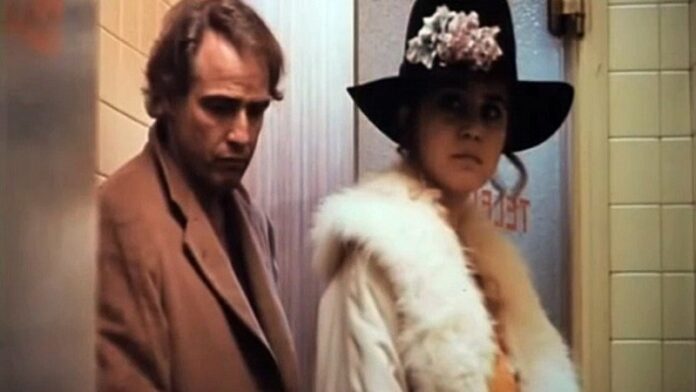
LOS ANGELES — “Last Tango in Paris” is making headlines again 44 years after the controversial film came out. A recently unearthed video interview with Italian director Bernardo Bertolucci from 2013 has renewed interest, and outrage, over what happened to actress Maria Schneider on set during the infamous butter rape scene.
Bertolucci said that neither he nor Marlon Brando told Schneider of their plans to use the stick of butter during the simulated rape scene — a concept they came up with the morning of the shoot — because he wanted her to react “as a girl not as an actress.” He wanted her, he said, to feel “the rage and the humiliation.”
Schneider, who died in 2011 at age 58 after a lengthy illness, spoke a number of times about the scene between her, then aged 19, and Marlon Brando, then 48, even saying in a 2007 Daily Mail interview that she “felt a little raped” by her co-star and director.
“They only told me about it before we had to film the scene, and I was so angry,” Schneider said. “I should have called my agent or had my lawyer come to the set because you can’t force someone to do something that isn’t in the script. But at the time, I didn’t know that.”
But despite Schneider’s past comments, the video interview with Bertolucci struck a chord this weekend as it circulated on social media that the director was admitting that the scene was non-consensual.
Actress Jessica Chastain wrote on Twitter that she felt “sick” over the revelation that “the director planned her attack.”
Filmmaker Ava DuVernay called it “inexcusable.”
“As a director, I can barely fathom this. As a woman, I am horrified, disgusted and enraged by it,” DuVernay wrote.
Chris Evans also expressed his rage and said it was “beyond disgusting,” while Anna Kendrick weighed in that she “used to get eye-rolls” when she brought the incident up to people previously and that she was “glad at least it will be taken seriously now.”
Some, like actress Jenna Fischer, took a more extreme stance, writing that “all copies of this film should be destroyed immediately.”
Schneider, a relative unknown when she was cast in the film, said that the “whole circus” of suddenly being famous made her turn to drugs and she even attempted suicide a few times. She stayed friends with Brando until his death in 2004, but she said that “for a while we couldn’t talk about the movie.”
Bertolucci, however, did not maintain a relationship with Schneider. He said he knew she hated him for life in that interview two years after her death. And while he doesn’t regret the scene, he said he does feel guilty about it.
Hong Kong Exchanges and Clearing Ltd. Chairman Chow Chung-kong, fifth from left, and Hong Kong Chief Executive Leung Chun-ying, fourth from right, smile after banging a gong during a ceremony to launch the Shenzhen-Hong Kong Stock Connect on Monday in Hong Kong. Photo: Vincent Yu / Associated Press
HONG KONG — Trading began Monday on a new cross-border stock link between Hong Kong and the neighboring Chinese city of Shenzhen, widening access to China’s markets for global investors.
The long-awaited Shenzhen-Hong Kong Stock Connectlink allows international investors to buy and sell 880 high-growth small and mid-cap stocks traded on the exchange in the southern boom town of Shenzhen via the Hong Kong exchange.
Its debut follows the launch of a similar link between Hong Kong and China’s main exchange in Shanghai two years ago.
Hong Kong’s top leader and the exchange’s chairman marked the occasion by banging a gong in a ceremony connected by live video link to their counterparts in Shenzhen, where officials rang a bell to kick off trading.
Market response was muted in early trading, with the Shenzhen All-Share index down 0.4 percent while the Hang Seng slipped 0.3 percent, in line with other Asia market declines.
“If Shanghai Connect was our baby step on the first step, Shenzhen connect is our second step. Now we can walk and we can begin to run. So this indeed is a historical moment,” said Charles Li, chief executive of market operator Hong Kong Exchanges and Clearing.
With a market value of USD$3.3 trillion, Shenzhen’s exchange rivals Shanghai’s in size and is the world’s eighth biggest. While Shanghai is home to many huge state-owned enterprises, Shenzhen’s bourse is dominated by small, fast-growing private companies in up-and-coming sectors such as technology and health-care. It often is referred to as China’s Nasdaq.
“We believe Shenzhen is the largest untapped market in the world and, not surprisingly, investor knowledge is fairly limited,” HSBC’s Steven Sun and Bruce Pang said in a recent report.
Foreign ownership of Shenzhen-listed companies is minimal, at less than 1.2 percent. In Hong Kong, a former British colony controlled by China that has a financial system open to international investors, it’s 46 percent.
Hong Kong has long been used as an offshore outpost by Beijing, since China’s markets are still mostly fenced off from global capital flows. Before the links were launched, foreign access was limited to a quota program for selected fund managers.
Of the 880 stocks listed in Shenzhen that can be traded via the Hong Kong exchange about 200 on the tech-heavy ChiNext board will be open to institutional professional investors at first.
Mainland investors, meanwhile, get access to 417 Hong Kong small cap stocks. That might appeal to mainland investors looking to diversify away from assets denominated in the yuan, which has weakened to its lowest level in eight years. Hong Kong stocks are priced in the city’s own currency, which is pegged to the U.S. dollar.
Shenzhen’s status as a financial center has risen as China’s communist leaders have sought to shift away from reliance on export-oriented manufacturing toward growth based on self-sustaining, more environmentally friendly domestic demand.
“Shenzhen represents the ‘new economy,’ that’s very clear,” said Nicole Yuen, head of China equities at Credit Suisse. She noted that about two-thirds of Shenzhen-listed firms are private enterprises while the remaining third are state-owned. On the Shanghai board, it’s the reverse, she said.
The market’s not for the fainthearted: China’s markets are volatile partly because individual, or “retail,” investors dominate trading. In developed markets, institutional investors lead.
“With a retail-driven market, of course it’s riskier because you think alike with other retail people. It can swing more quickly,” leading to a “herd instinct,” said Yuen. So, “why would people go to a risky market? Because the reward is better.”
The Shenzhen All-Share index has risen 8.3 percent over the past six months but is down about 10 percent for the year. That compares with increases of 6.3 percent and 5 percent respectively for the Nasdaq Composite.
Expanding cross-border trading could help restore confidence in China’s markets after a spectacular meltdown last year that was worsened by regulators’ attempts to intervene. In June, the global stock benchmark provider MSCI opted not to add mainland Chinese stocks to its widely followed Emerging Markets Index. It said the markets need to be more accessible and closer to international standards.
“Shenzhen Connect may not simply open a floodgate of untouched opportunities as some might expect,” said Michael Karbouris, Nasdaq’s head of Asia-Pacific business development.
“The market is fairly expensive and already dominated by retail investors that like to speculate, and the combination of low cap stocks and volatility means the investment story is not straightforward. Investors will need to exercise caution.”
A crowd gathers in celebration at the Oceti Sakowin camp after it was announced that the U.S. Army Corps of Engineers won't grant easement for the Dakota Access oil pipeline Sunday in Cannon Ball, North Dakota. Photo: David Goldman / Associated Press
CANNON BALL, North Dakota — The U.S. Army Corps of Engineers said Sunday that it won’t grant an easement for the Dakota Access oil pipeline in southern North Dakota, handing a victory to the Standing Rock Sioux tribe and its supporters, who argued the project would threaten the tribe’s water source and cultural sites.
North Dakota’s leaders criticized the decision, with Gov. Jack Dalrymple calling it a “serious mistake” that “prolongs the dangerous situation” of having several hundred protesters who are camped out on federal land during cold, wintry weather. U.S. Rep. Kevin Cramer said it’s a “very chilling signal” for the future of infrastructure in the United States.
The four-state, USD$3.8 billion project is largely complete except for the now-blocked segment underneath Lake Oahe, a Missouri River reservoir. Assistant Secretary for Civil Works Jo-Ellen Darcy said in a news release that her decision was based on the need to “explore alternate routes” for the pipeline’s crossing. Her full decision doesn’t rule out that it could cross under the reservoir or north of Bismarck.
“Although we have had continuing discussion and exchanges of new information with the Standing Rock Sioux and Dakota Access, it’s clear that there’s more work to do,” Darcy said. “The best way to complete that work responsibly and expeditiously is to explore alternate routes for the pipeline crossing.”
The company constructing the pipeline, Dallas-based Energy Transfer Partners, had said it was unwilling to reroute the project. It had no immediate comment Sunday.
The decision came a day before the government’s deadline for the several hundred people at the Oceti Sakowin, or Seven Council Fires, encampment to leave the federal land. But demonstrators say they’re prepared to stay, and authorities say they won’t forcibly remove them.
As the news spread Sunday, cheers and cheers and chants of “mni wichoni” — “water is life” in Lakota Sioux — broke out among the protesters. Some in the crowd banged drums. Miles Allard, a member of the Standing Rock Sioux, said he was pleased but remained cautious, saying, “We don’t know what Trump is going to do.”
“The whole world is watching,” Allard added. “I’m telling all our people to stand up and not to leave until this is over.”
Attorney General Loretta Lynch said Sunday that the Department of Justice will “continue to monitor the situation” and stands “ready to provide resources to help all those who can play a constructive role in easing tensions.”
“The safety of everyone in the area – law enforcement officers, residents and protesters alike – continues to be our foremost concern,” she added.
Carla Youngbear of the Meskwaki Potawatomi tribe made her third trip from central Kansas to be at the protest site.
“I have grandchildren, and I’m going to have great grandchildren,” she said. “They need water. Water is why I’m here.”
Standing Rock Sioux tribal chairman Dave Archambault didn’t immediately respond to messages left seeking comment.
Morton County Sheriff Kyle Kirchmeier, whose department has done much of the policing for the protests, said that “local law enforcement does not have an opinion” on the easement and that his department will continue to “enforce the law.”
U.S. Secretary for the Interior Sally Jewell said in a statement that the Corps’ “thoughtful approach … ensures that there will be an in-depth evaluation of alternative routes for the pipeline and a closer look at potential impacts.”
Earlier Sunday, an organizer with Veterans Stand for Standing Rock said tribal elders had asked the military veterans not to have confrontations with law enforcement officials, adding the group is there to help out those who’ve dug in against the project.
About 250 veterans gathered about a mile from the main camp for a meeting with organizer Wes Clark Jr., the son of former Democratic presidential candidate Gen. Wesley Clark. The group had said about 2,000 veterans were coming, but it wasn’t clear how many actually arrived.
“We have been asked by the elders not to do direct action,” Wes Clark Jr. said. He added that the National Guard and law enforcement have armored vehicles and are armed, warning: “If we come forward, they will attack us.”
Instead, he told the veterans, “If you see someone who needs help, help them out.”
Authorities moved a blockade from the north end of the Backwater Bridge with the conditions that protesters stay south of it and come there only if there is a prearranged meeting. Authorities also asked protesters not to remove barriers on the bridge, which they have said was damaged in the late October conflict that led to several people being hurt, including a serious arm injury.
“That heavy presence is gone now and I really hope in this de-escalation they’ll see that, and in good faith . the leadership in those camps will start squashing the violent factions,” Cass County Sheriff Paul Laney said in a statement, reiterating that any violation will “will result in their arrest.”
Veterans Stand for Standing Rock’s GoFundMe.com page had raised more than $1 million of its $1.2 million goal by Sunday — money due to go toward food, transportation and supplies. Cars waiting to get into the camp Sunday afternoon were backed up for more than a half-mile.
“People are fighting for something, and I thought they could use my help,” said Navy veteran and Harvard graduate student Art Grayson. The 29-year-old from Cambridge, Massachusetts, flew the first leg of the journey, then rode from Bismarck in the back of a pickup truck. He has finals this week, but told professors, “I’ll see you when I get back.”
Steven Perry, a 66-year-old Vietnam veteran who’s a member of the Little Traverse Bay band of Odawa Indians in Michigan, spoke of one of the protesters’ main concerns: that the pipeline could pollute drinking water. “This is not just a native issue,” he said, “This is an issue for everyone.”
Art Woodson and two other veterans drove 17 hours straight from Flint, Michigan, a city whose lead-tainted water crisis parallels with the tribe’s fight over water, he said.
“We know in Flint that water is in dire need,” the 49-year-old disabled Gulf War Army veteran said. “In North Dakota, they’re trying to force pipes on people. We’re trying to get pipes in Flint for safe water.”
Some veterans will take part in a prayer ceremony Monday, during which they’ll apologize for historical detrimental conduct by the military toward Native Americans and ask for forgiveness, Clark said. He also called the veterans’ presence “about right and wrong and peace and love.”
Italian Premier Matteo Renzi speaks early Monday during a press conference at the premier's office Chigi Palace, in Rome, Italy. Photo: Gregorio Borgia / Associated Press
ROME — Italian voters dealt Premier Matteo Renzi a stinging defeat on his reforms referendum, triggering his resignation announcement and galvanizing the populist, opposition 5-Star Movement’s determination to gain national power soon.
“I lost, and the post that gets eliminated is mine,” Renzi said early Monday about an hour after the polls closed. “The government’s experience is over, and in the afternoon I’ll go to the Quirinal Hill to hand in my resignation” to President Sergio Mattarella.
Besides the “anti-establishment” 5-Stars, the outcome energized another “anti” party, the anti-immigrant Northern League, an ally of French far-right leader Marine Le Pen, a candidate in France’s presidential race.
In voting No, Italians also delivered a rebuke to Italy’s industrialists, banks and other establishment institutions, which had staunchly backed the referendum. The anti-reform victory, which could spook investors, comes just as the government had made some inroads in cutting the staggering rate of youth employment and while Italy’s banks have urgent need for recapitalization.
During the campaign, the risk of political instability in Italy, Europe’s fourth-largest economy, triggered market reaction, with bank stocks sinking and borrowing costs on sovereign debt rising.
But some analysts predicted the political crisis sparked by Renzi’s exit would be short-lived, as politicians focus on lining up support for a new electoral law they view as boosting their parties’ chances for whenever elections are called.
Wolfango Piccoli, a London-based analyst and co-president at Teneo Intelligence, said the main risk of Renzi’s “devastating defeat” will lie in the medium term.
That could see “a prolonged muddle-through period, the emergence of an ineffective patched-up coalition government in the post-election phase and continuously poor economic performance,” Piccoli said in an emailed comment.
The 5-Star Movement, led by anti-euro comic Beppe Grillo, spearheaded the No camp on the constitutional reforms, a package aimed at updating Italy’s post-war Constitution that Renzi had depicted as vital to modernizing Italy and reviving its economy.
Characteristically confident — detractors say arrogant — Renzi, 41, and Italy’s youngest premier, had bet his political future — or at least his current premiership — on a Yes vote win, and campaigned hard for a victory in recent weeks to confound opinion polls indicating that it would likely go down to defeat.
With votes counted from nearly all the polling stations in Sunday’s referendum, the No’s were leading Yes votes by a 6-to-4 margin, Interior Ministry data indicated. The turnout of 67 percent was especially high for a referendum, and more in line for a vote for Parliament.
Renzi had been hoping to beat off the rising populist forces that have gained traction across Europe, as well as with the U.S. presidential victory last month by billionaire political outsider Donald Trump.
Earlier on Sunday, in Austria’s presidential runoff, left-leaning candidate Alexander Van der Bellen prevailed over a right-wing populist.
Leaders of the populist 5-Star Movement, which is led by Grillo, joined the chorus among opposition forces for early elections. The 5-Stars are the chief rivals of Renzi’s Democrats and are anxious to achieve national power for the first time.
“Today the caste in power lost,” said a 5-Star leader, Luigi Di Maio. It was a sharp retort to Renzi’s characterizing the reforms as an opportunity to shrink the “caste” of elite, perk-enjoying politicians by reducing the numbers and powers of Senators.
“Arrogance lost, from which we’ll learn many things in forming our team for government and our platform,” Di Maio said. “Starting tomorrow we’ll be working on a government of the 5-Stars, we’ll involve the energies and the free persons who want to participate.”
The 5-Stars’ constituency is largely internet based, and bills itself as anti-establishment.
“The man alone at the command doesn’t exist anymore, but the citizens who govern the institutions” do, Di Maio told a news conference minutes after Renzi conceded.
In Bologna, traditionally a left-leaning city, about 100 people rallied after the defeat to burn several Yes-vote flags and carried a banner saying “Renzi go home.”
Mattarella, as head of state, would have to decide whether to accept Renzi’s resignation.
Renzi is widely expected to be asked to stay on at least until a budget bill can be passed later this month. Then he or some other figure, perhaps from his Democrats, Parliament’s largest party, could be asked to lead a government focused electoral reform.
The current electoral law would grant the biggest vote-getting a generous bonus of seats in Parliament.
Renzi’s Democrats and the center-right opposition of former Premier Silvio Berlusconi want the law changed to avoid risking that the bonus would go to the 5-Stars should they lead the vote-getting.
Elections are due in spring 2018, but Renzi’s resignation could prompt their being moved up a year.
Another opposition leader, Matteo Salvini, of the anti-immigrant Northern League, hailed the referendum as a “victory of the people against the strong powers of three-quarters of the world.” He urged elections straightaway.
Many had read the referendum as an outlet for growing anti-establishment, populist sentiment in Europe.
When Renzi late last year promised to resign if the referendum was defeated, it was months before Britain’s David Cameron had made his ill-fated bet that a referendum would cement the U.K.’s membership in the European Union. Cameron was forced to resign when Britons instead voted to leave the EU fold.
In Italy, the referendum was required because the reforms were approved by less than two-thirds of Parliament. The reforms included steam-lining the Senate and giving the central government more powers at the cost of the regions.
“We didn’t exit from Europe, but we didn’t ‘exit,’ from the Constitution either,” said former Premier Massimo D’Alema.
A former Communist, D’Alema opposed fellow Democrat Renzi on the referendum issue, aggravating tensions within their bickering party.
Photo: Alex Face / Bangkok CityCity Gallery / Courtesy
BANGKOK — Glimpse the iconic three-eyed creature in the animal costume and know it must be the work of Alex Face. The prolific street artist is back with work that won’t be found dripping from a concrete wall but in a gallery.
Alex’s work has found its way onto walls from Bangkok and Tokyo to London and Berlin. To celebrate the end of 2016, his signature character and other works will welcome audiences to “Alive,” his sixth exhibition.
More than 30 new impressionist works will be shown including paintings, drawings and a large scale sculpture. Don’t be fooled by the new collection’s seeming tranquil, it reflects the artist’s view that Thai society may not be as serene as it appears.
Alex Face is the alias of Patcharapon Tangrue, a 35-year-old artist well-known for his street art in Bangkok, most iconically the three-eyed character inspired by his newborn daughter. He has been invited to several international street art festivals.
The exhibition starts Dec. 21 and runs through Feb. 19 at Bangkok CityCity Gallery, which can be reached via MRT Lumphini exit No. 2.
BANGKOK —Chinatown is no longer a working center of Thai-Chinese businesses. Over the years, it has evolved into a tourist attraction in its own right. For the uninitiated, there’s more to do than to eat noodles and gaze at the neon-saturated nightscape.
Let’s take a stroll down the arterial road of Yaowarat, named for “young king” Rama V who ordered it built, to find the stuff for which it’s famous.
Gold Smiths
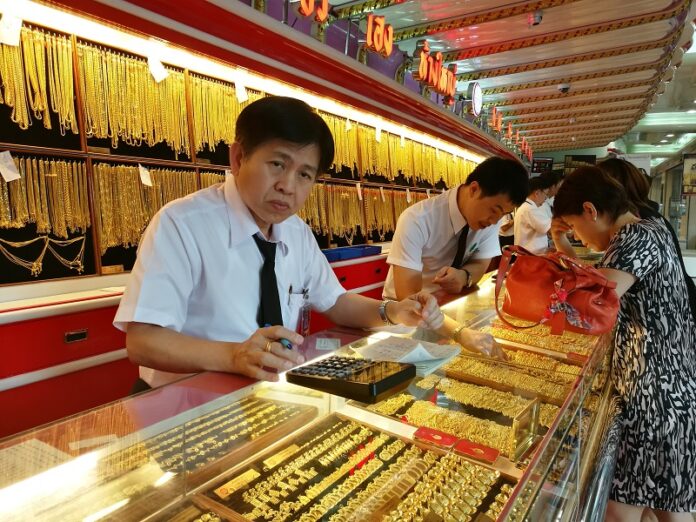
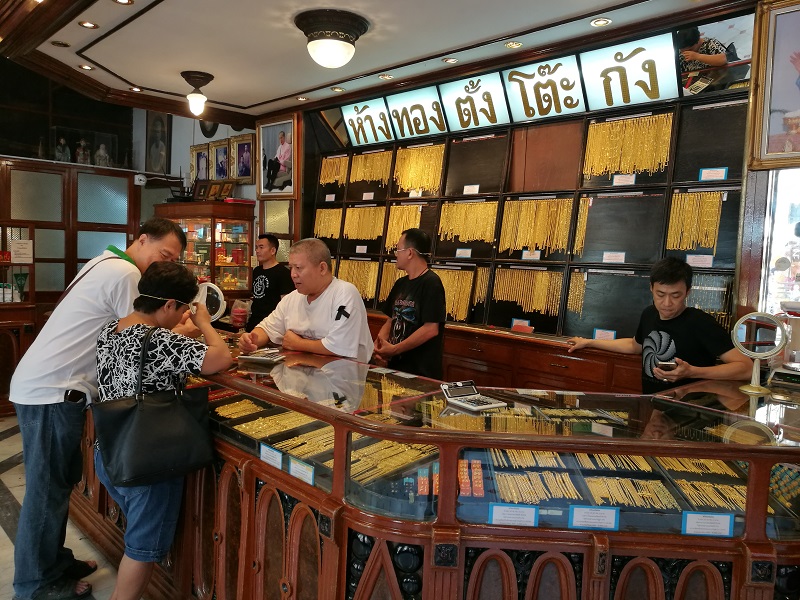
There are at least two dozen gold shops large and small along and around Yaowarat Road. One big chain has three or fours shops in one area. A clerk told me it’s like having many convenience stores in the same densely populated areas to increase the chance customers will walk into one of them.
Walking in to check one out is a must for anyone visiting the neighborhood. Bangkok’s Chinatown would look totally different without the big signs in Thai and Chinese advertizing their goods, regarded by Thais as a safe haven in times of economic calamity and long-term savings for those who can’t be bothered to invest in stocks or derivatives.
In Thailand, the preferred purity of gold jewelry is 96.5 percent, or 23.16 karats. This means it’s softer but purer and richer in hue than the color of 18 karat yellow gold, which is 75 percent pure and commonly used to make jewelry in the West. Prices are adjusted several times on a daily basis, with prices publicly posted out front, in line with the fluctuation of gold prices on the world market. All shops close on Sundays.
Inside Tang Toh Kang goldshop.
Traditionally, ordinary Thais, including the working class, saved whatever they could and turned it into gold necklaces, rings or bangles to keep as hard assets or give to loved ones. It can be pawned or sold in times of economic hardship, as the metal can be easily liquidated into cash.
A few Western tourists can be spotted inside the Yaowarat goldsmiths, and even those not into gold will find it worth checking out just to marvel at the sheer abundance and the characteristic use of the color red, being an auspicious color for the Chinese.
The front of the famous Tang Toh Kang goldshop on Mangkorn Rd.
For the most traditional of all goldsmiths, considering decor and ambience, head to Mangkon Road, which intersects Yaowarat toward Chinatown’s western edge. Turn southwest and walk one minute into this small alley to find Tang Toh Kang Goldsmiths, founded in 1875, with its dark wood panels and beautiful traditional Thai and Chinese signboards.
As a sign of changing times, a clerk at the shop told me they now do sell gold bars of 99.9 percent purity in order to save the trouble of having to mix or extract other metals that make gold alloys harder. However, most other goldsmiths still only stick to the 23-karat gold standard.
Market and Small Alleys
Back when Ayutthaya was the capital, the city had its own Chinatown as well, known as Nai Kai Market, according to “A History of The Thai-Chinese” a seminal English-language text by Jeffery Sng and Pimpraphai Bisalputra.
“At the market itself, Chinese shop houses lined the main street and sold all varieties of items, including porcelain, silk, herbs, medicine, tea, fresh and preserved fruits, Chinese sweets, spices, brass wares, iron implements and woks. There was also a large fresh market. Nai Kai Market was busy all day, especially during the junk trading season around Chinese New Year,” the two authors note.
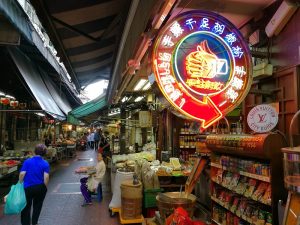
Nai Kai Market may be long gone but it’s not difficult to imagine being there by getting lost in Chinatown’s small alleys and chancing upon old shops and stalls selling the same sorts of goods – with the addition of electricity, cameras and electronics.
A shop full of dried meat & dried fruits.
I found much of the goods described in the book still being peddled, 300 years later. While the many nooks and alleys provide surprising discoveries, my recommendation is a stroll in the afternoon into the narrow and relatively dark alley next to Soi Yaowarat 6 opposite the Old Market, or Talad Gaow. A 15-minute walk through the alley will most certainly overwhelm your visual and olfactory senses. The smell of spices, herbs, fish and more will transport you to another realm.
At the other end of the alley is Charoen Krung Road, and just across is the famous Dragon Temple, or Wat Mangkon Kamalawat.
Dragon Temple and its Tips for a Prosperous New Year
Built in 1871 to spread Mahayana Buddhism and granted its Thai name by King Chulalongkorn, it is arguably the most famous Chinese temple in Thailand.
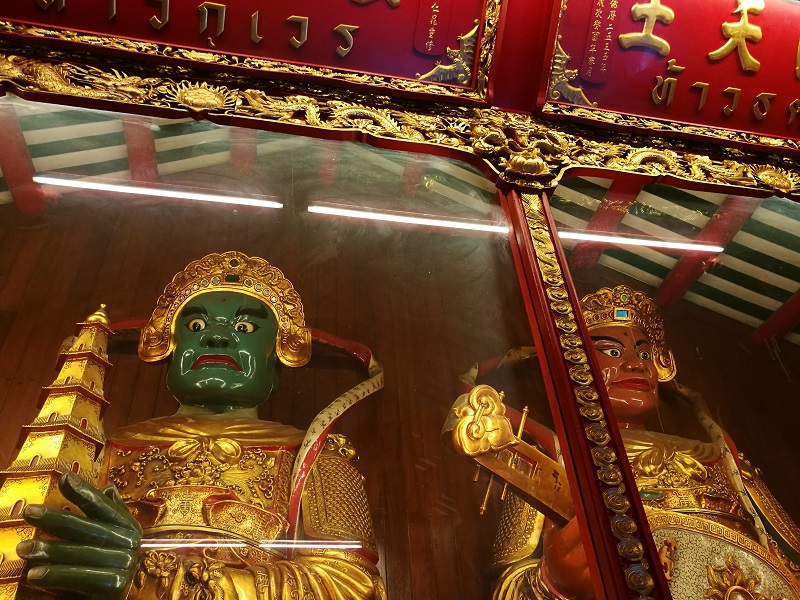
Signs in Thai and Chinese speak of the intercultural marriage. Stop by just before dusk when the statues of deities and Buddha look splendid due to the light and gold reflections. Dramatic are the four gigantic Guardian of the World statues in Chinese warrior costumes looking furiously down at visitors from the inner gate.
Statues of two guardians at Wat Mangkon Kamalawat.
The majority of Thai-Chinese cannot read Chinese. In fact most of their ancestors who migrated to Siam and what became Thailand over the centuries were mostly poor and illiterate. Attempts have been made to pass on some of the Chinese cultural knowhow, such as adapting the rendering of southern Chinese opera into Thai language and more.
As Sng and Pimpraphai noted, “the ancestors of the Chinese in Thailand mostly come from the ranks of merchants, peasants, adventurers and coolies with very few members of the literati class among them. The absence of a literati tradition in the local Chinese community is reflected in the dearth of Chinese clan records.”
At the temple, red posters with instructions in Thai remind Thai-Chinese and Thai worshippers and visitors on how to conduct themselves on Chinese New Year’s Day in order to avoid bad omens.
A small alley opposite Yaowarat’s old market.
Here are some of the more interesting don’ts:
“Do not clean the house. It will remove your good fortune from home.”
“Do not wash or cut your hair. It will remove your prosperity.”
“Do not use expletives or engage in a quarrel. Saying bad things will bring misfortune for the rest of the year.”
“Do not break objects. It’s a bad omen signalling that the family will be broken or someone [in the family] will die.”
“Do not use sharp objects. It will cut away your good fortune.”
“Do not wear white or black. Black and white clothing is bad omen, that’s why Chinese people wear red, because red is a lucky color.”
On Chinese New Years past, I’ve seen mainland Chinese tourists in Bangkok wearing black. Apparently some are less superstitious than the Thai-Chinese.
Not all instructions can be said to be plainly superstitious, however.
I found at least one which offers a rather sound advice on how to handle one’s financial situation.
“Do not lend money to others. This will lead others to always borrow money from you. If you owe money to someone you will be in debt for the rest of the year.”
That’s practical.
A Note on Food and Drinks
Bangkok’s Chinatown is known for its – you guessed it – Chinese restaurants and also way-above-average street food.
Popular offerings include grilled Thai-Chinese seafood, street stalls, Lek & Rut as well as T&K on Phadungdao Road, which intersects the upper eastern part of Yaowarat Road. Upscale southern Chinese restaurants can be found on both sides of Yaowarat, and many are of decent quality. But expect rather gaudy decor – that’s part of the experience.
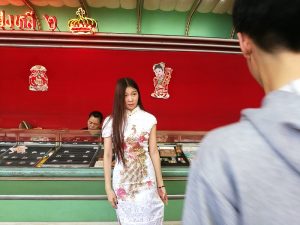
A young woman trying on Chinese dress for male friend to take a photo.
Walking around, one should never fail to look up and note the hodgepodge of architectural styles of shophouses and buildings on both sides of Yaowarat ranging from old Sino-Portuguese and art deco with a Thai-Chinese twist, to modern and postmodern designs.
By night, neon signs light up the neighborhood and give it a mesmerizing ambience. Sit and have a mug of beer or enjoy some tea. Take in the street life and the lights that make Bangkok’s Chinatown a fascinating place to stroll through. Shanghai Mansion and Chinatown Hotel, both on the upper eastern part of Yaowarat and just a stone’s throw from the Chalerm Buri intersection, are two places where you can sit al fresco next to the footpath and slurp it all in.
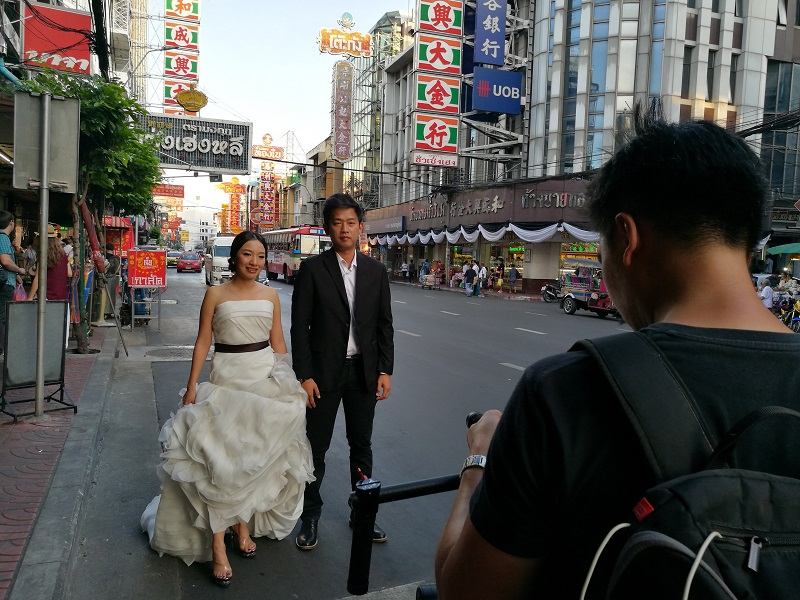
A young couple taking wedding photo on Yaowarat Rd.
BANGKOK— A Thai-Indian street photographer will show off what he got from capturing photos at a Hua Lamphong terminal platform at 10am for over six months at an exhibition this month.
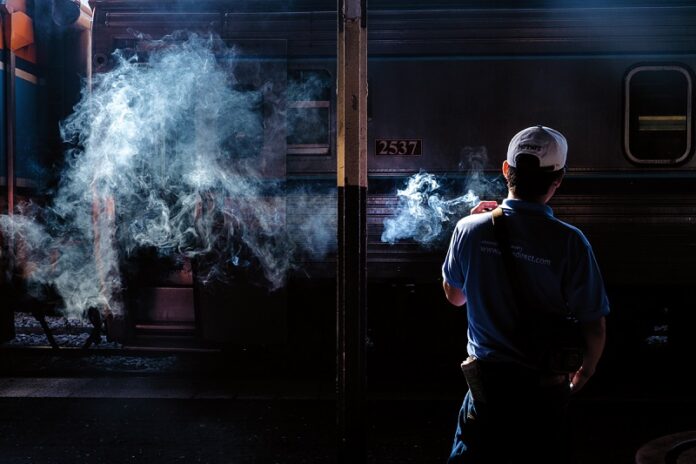
Bangkok-based Rammy Narula will show a collection of color photos he took as part of the project which had him visiting the city’s main railway station and shooting a single platform’s moments for half a year.
“[At Platform 10], I found the light I loved. The same train comes every day in the morning and stays for 20 minutes,” Rammy said. “The project concentrated on a very tight area to keep consistency for the final results in terms of color, light and mood.”
Rammy will also launch his photo book of the same name published under New York’s photobook publisher Peanut Press.
Rammy’s solo exhibition Platform 10 will open Dec. 14 and run until February at Hotel Sofitel Bangkok Sukhumvit’s S Gallery. The opening reception will go from 5:30pm to 10pm on Dec. 14.
Rammy’s former works include a 2013 project called Hua Lamphong Train Station comprised of black-and-white photos of the station’s commuters.
A PZL M28 Skytruck in 2009 at the Góraszka Air Picnic, similar to the one that crashed Saturday in Batam, Indonesia. Photo: Konflikty.pl / Associated Press
JAKARTA, Indonesia — Indonesian rescuers on Sunday recovered body parts in the sea where a police plane with 13 people aboard is believed to have crashed after takeoff.
The light aircraft lost contact Saturday on the way to the island of Batam off the southeast coast of Sumatra island near Singapore. All those aboard, including five crew and eight police passengers, are feared dead, officials said.
The M28 Skytruck plane is believed to have plunged into 24-meter (79-feet) deep waters, said National Search and Rescue Agency chief Henry Bambang Soelistyo.
He told a news conference that body remains probably of the victims were found in the area where villagers earlier retrieved a seat and a bag containing a cellphone and police documents.
TV footage showed police uniforms and other clothing also were retrieved from the sea.
Search teams involving Indonesia’s navy, customs office and maritime police as well as aircraft from Singapore were scouring a 518-square-kilometer (200-square-mile) sea area for the wreckage of the aircraft, Soelistyo said, adding that divers also were deployed.
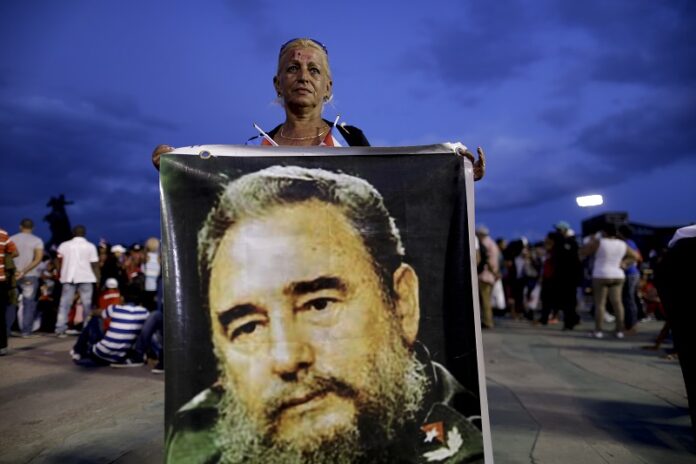
A woman holds a picture of Fidel Castro Saturday before a rally honoring Cuba's late leader at Antonio Maceo plaza in Santiago, Cuba. Photo: Natacha Pisarenko / Associated Press
SANTIAGO, Cuba — President Raul Castro announced that Cuba will prohibit the naming of streets and monuments after his brother Fidel, and bar the construction of statues of the former leader and revolutionary icon in keeping with his desire to avoid a cult of personality.
The announcement late Saturday came after a week of national mourning for Fidel Castro that reached near-religious peaks of adulation and a half-day before his ashes are interred in Santiago’s Santa Ifigenia cemetery, ending the official mourning period.
“The leader of the revolution rejected any manifestation of a cult of personality and was consistent in that through the last hours of his life, insisting that, once dead, his name and likeness would never be used on institutions, streets, parks or other public sites, and that busts, statutes or other forms of tribute would never be erected,” Raul Castro told a massive crowd gathered in the eastern city of Santiago.
He said that Cuba’s National Assembly would vote in its next session on the law fulfilling the wishes of his brother, who died last week at 90. The legislature generally holds a meeting in December and under Cuba’s single-party system, parliament unanimously or near-unanimously approves every government proposal.
Fidel Castro, who stepped down in 2006 after falling ill, kept his name off public sites during his near half-century in power because he said he wanted to avoid the development of a personality cult. In contrast, the images of his fellow revolutionary fighters Camilo Cienfuegos and Ernesto “Che” Guevara became common across Cuba in the decades since their deaths.
Mourning for Castro has been fervent and intense across the country since his death, particularly in rural eastern Cuba, where huge crowds have been shouting Castro’s name and lining the roads to salute the funeral procession carrying his ashes.
“All of us would like to put Fidel’s name on everything but in the end, Fidel is all of Cuba,” said Juan Antonio Gonzalez, a 70-year-old retired economist. “It was a decision of Fidel’s, not Raul’s, and I think he has to be respected.”
Raul Castro, 85, spoke at the end of a second massive rally in honor of Fidel as Cuba neared the end of a nine-day period of public mourning. Castro’s ashes arrived Saturday afternoon in Santiago, ending a four-day journey across Cuba that began after a massive rally in Havana’s Plaza of the Revolution.
Thousands of people welcomed the leader’s remains to shouts of “Fidel! I am Fidel!” Hundreds of thousands more gathered in Santiago’s Revolution Plaza Saturday night, cheering speeches by the heads of state-run groups of small farmers, women, revolutionary veterans and neighborhood watch committee members.
The event was attended by Bolivian President Evo Morales, Nicaraguan leader Daniel Ortega and Nicolas Maduro of Venezuela, along with former Brazilian presidents Dilma Rousseff and Lula da Silva.
Castro’s ashes will be interred Sunday morning in Santiago’s Santa Ifigenia cemetery, ending the official mourning period.
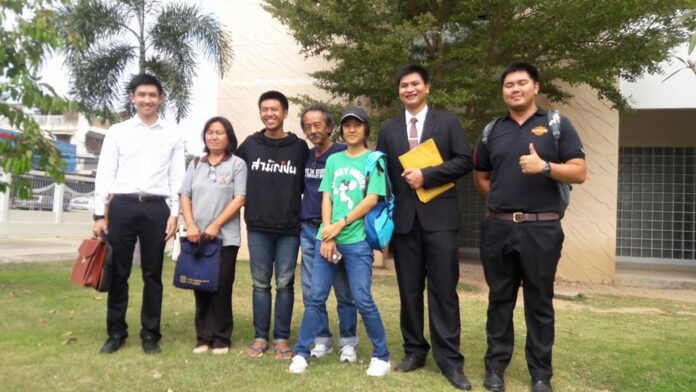
Activist Jatupat ‘Pai’ Boonpattararaksa, third from left, in a photo with family, friends and lawyer after being freed on bail. Photo: Wiboon Boonpattararaksa/ Facebook
KHON KAEN —After being arrested on a charge of defaming the monarchy for sharing a BBC Thai biography of King Rama X, a northeastern activist was freed on bail Sunday.
A Khon Kaen court granted bail for Jatupat “Pai” Boonpattararaksa, a member of community rights group Dao Din, on a 400,000 baht bond, according to message posted online by pro-democracy activist group New Democracy Movement.
Jatupat has been accused of four political crimes to date. The latest allegation was from a Facebook post he shared quoting a biography of King Rama X produced by BBC Thai on Friday morning. For this, Jatupat was charged with lese majeste under Article 112 of the Penal Code and arrested Saturday.
Jatupat’s lawyer attributed for the bail that his client has never fled from previous arrests and that he is due to sit for his final exams Thursday to complete his law degree at Khon Kaen University.