31.1 C
Bangkok
Tuesday, June 23, 2026
Home Blog Page 2606

No Payout to Boat Victims’ Families Because Officials May Have Pocketed Premiums

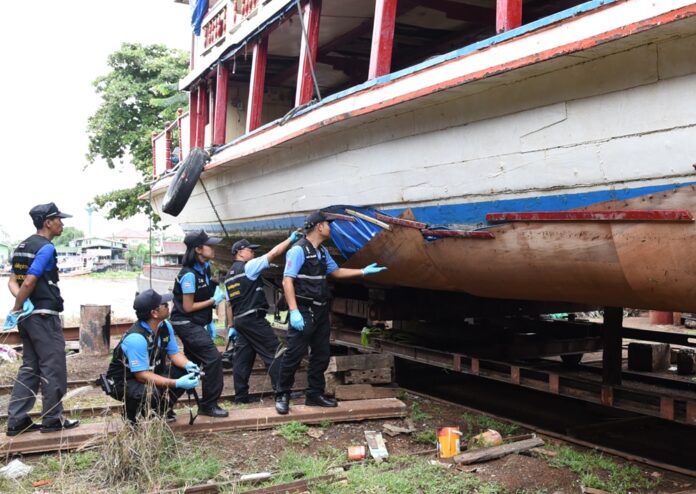
Police investigators on Wednesday inspect the boat salvaged from Chao Phraya River in Ayutthaya province.

AYUTTHAYA — Officials might have stolen the premiums for a missing insurance policy meant to compensate the families of those who died in a recent boat accident, the Marine Department said Friday.

The department’s director said only embezzlement or a clerical error could explain what happened to the policy paid for by the owner of the boat which capsized and caused 28 Muslim pilgrims to die Sunday. The investigation was announced Thursday along with a review of such policies nationwide.

Ferry Captain Charged As More Bodies Pulled From Chao Phraya

“It might have been careless mistake, or whatever reasons,” Sorasak Saensombat, director of the Marine Department, said by telephone Friday. “We’re investigating how it happened. Was it like what the boat owner said? Or was it a careless mistake? We’re looking for facts to confirm it.”

After his boat capsized, owner Sunthorn Pansueathong learned the insurance policy he paid for when he renewed its license didn’t exist. Insurance for vessels can be paid for and arranged through the department.

Speaking at Ayutthaya City Police Station on Thursday, Sunthorn denied the boat was uninsured. He said he paid officials for mandatory premiums for Thai Pattana Insurance Co. in June when he renewed the license in Nonthaburi province.

On Monday the Nonthaburi office denied that he renewed the insurance, he said.

“Can anyone explain to me what happened? Where’s the money I paid? And how could the license be issued in the first place?” he said.

Sunthorn owned the boat rented Sunday by a group of Muslims in Nonthaburi for travel to an annual religious ceremony at a mosque in Ayutthaya on Sunday. The boat, captained by Wirat Chaisirikul, hit a berm at high speed before sinking. Twenty-eight people died, including children. Police said the boat was overloaded twice over capacity.

Per regulations, licenses can only be issued for vessels with valid insurance.

Hathaikan Penkun, head of Nonthaburi’s Marine Department office, was transferred to an inactive post Thursday while her office is investigated for possible embezzlement.

The inquiry will take about two weeks, Sorasak said. In the meantime, he said, marine officials will inspect all passenger boats nationwide to see whether there are other cases of missing insurance.

“By mid-October, we expect to have the answers,” Sorasak said.

He also ordered implementation of a new computer system to prevent officials from fraudulently issuing permits.

Due to the lack of insurance, Sunthorn told reporters Thursday he’s selling his assets and borrowing money from his family members to compensate the victims’ families.

He’s charged with several offenses, including operating an overloaded vessel that caused death and injury. He faces life in prison.

Sunthorn was granted bail on Thursday, police said.

Related stories:

‘Sit Down!’ Video Captures Sinking of Chao Phraya Ferry (Video)

Death Toll in River Ferry Accident Rises to 18, Search Goes On

13 Dead, 39 Injured When Boat Goes Down in Chao Phraya

Advertisement

Chinese Moms Love Their Gay Kids in ‘Mama Rainbow’

BANGKOK — A gay-positive Chinese documentary which challenges conservative notions of family and prevailed against censorship at home will show in Bangkok next month.

Directed by Fan Popo, “Mama Rainbow” looks at six mothers from different backgrounds and locales who talk openly about how their children came out to them.

While displays of family affection are rare and having gay children is considered shameful by many parents in mainland China, the film made a mark for its positive portrayal of Chinese moms who learn to speak up for their gay children.

The 80-minute documentary premiered in Hong Kong before showing at LGBT film fests in cities including Boston, Mumbai and Vancouver.

The Beijing-based director and his film made headlines last year for suing Chinese Censors after his film was pulled from domestic streaming sites. Popo won the legal battle in December, though state censors denied responsibility.

Mama Rainbow” will show in Chinese with English subtitles starting at 8pm on Oct. 9 at Jam. Activist-filmmaker Popo will be present at the event to discuss his film afterward in English.

Admission is free. The art-bar space is on Soi Charoen Rat 1, a five-minute walk from BTS Surasak’s exit No. 2.

Advertisement

Fishermen Who Fled Slavery in US Sue Boat Owner

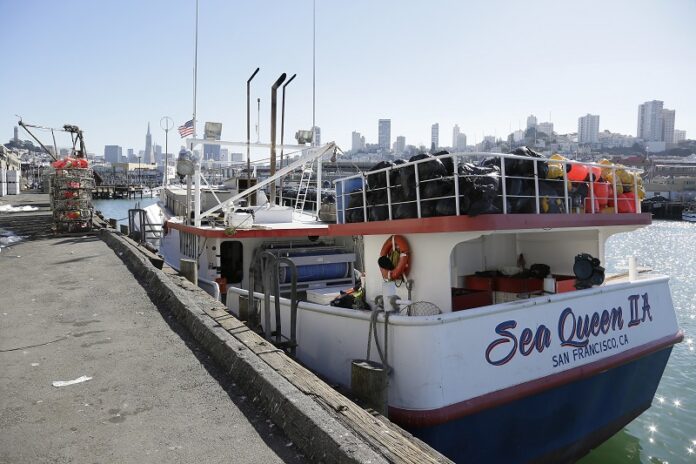
The Sea Queen II docked at Fisherman's Wharf in San Francisco, California. Photo: Eric Risberg / Associated Press

SAN FRANCISCO — Two Indonesian fishermen who escaped slavery aboard a Honolulu-based tuna and swordfish vessel when it docked at San Francisco’s Fisherman’s Wharf are suing the boat’s owner for tricking them into accepting dangerous jobs they say they weren’t allowed to leave.

Attorneys for Abdul Fatah and Sorihin, who uses one name, say in a lawsuit filed in federal court Thursday that they were recruited in Indonesia seven years ago to work in Hawaii’s commercial fishing fleet without realizing they would never be allowed onshore. They have since been issued visas for victims of human trafficking and are living in the San Francisco area.

The lawsuit alleges that San Jose, California, resident Thoai Nguyen, owner and captain of the Sea Queen II, forced Sorihin and Fatah to work up to 20-hour shifts, denied them medical treatment and demanded thousands of dollars if they wanted to leave before their contracts expired. Nguyen did not return calls seeking comment.

The lawsuit seeks payment for debts the men incurred, fees they paid and compensation promised without specifying a dollar amount, and asks for unspecified damages for “mental anguish and pain.”

“I want to be compensated because of the suffering I felt on the boat and all the suffering I have endured after I got off the boat,” Sorihin said Thursday through a translator at his lawyer’s San Francisco office. “And I hope no one will suffer what I have suffered.”

The lawsuit comes two weeks after an Associated Press investigation found around 140 fishing boats based in Honolulu, including Sea Queen II, were crewed by hundreds of men from impoverished Southeast Asia and Pacific Island nations. The seafood is sold at markets and upscale restaurants across the U.S. A legal loophole allows them to work without visas as long as they don’t set foot on shore. The system is facilitated by the U.S. Coast Guard, as well as Customs and Border Protection who require boat owners to hold workers’ passports.

AP found some men are paid as little as 70 cents an hour. Others had to use buckets instead of toilets, suffered running sores from bed bugs or sometimes lacked sufficient food.

In response, the Hawaii Longline Association representing fishing boat owners has created a universal crew contract that will be required on any boat wanting to sell fish in the state’s seafood auction starting Oct. 1. The group says it deplores human trafficking, and that the contract will protect workers.

The contracts let owners continue to set their own minimum salaries, allow workers to spend the entire year at sea (15 trips, 10 to 40 days each), and reiterate that they must remain on board with passports held by owners.

Cornell University law professor Stephen Yale-Loehr said the new contract “reinforces the current deplorable situation by emphasizing that the crew members have no real rights.”

“Congress should repeal the loophole that exempts U.S. fishing captains from having to provide basic labor protections to their crew,” he said.

Here’s what Sorihin and Fatah say happened to them.

They signed contracts promising USD$350 a month plus bonuses. They borrowed about USD$300 to pay an agent in Jakarta. They flew from Jakarta to Singapore, then Sydney, on to Fiji and Pago Pago, American Samoa, an exhausting, 12,500-mile trip.

Because docking is inconvenient and potentially costly, the fishermen had to swim from one boat to another before sailing to Honolulu to begin fishing.

Then it got worse.

One day as Sorihin wrestled a shark onto the Sea Queen, a fishing line got wrapped around his finger, nearly breaking it off. He said his captain set it straight with a chopstick, rubbing ginger and honey on it.

Another time a winch cable snapped, cracking Sorihin in his shoulder; swollen and sore, he was allowed a two-hour rest. A swordfish sliced his face as he pulled it aboard, according to the lawsuit.

They say the captain was verbally abusive and gave them only torn and worn-out gear. There was new protective gear on the boat but the captain said they would have to pay for it. Both men asked to see a doctor at various times but were told there was no health insurance.

“I knew if I stayed on that boat I was going to die,” said Sorihin in an interview.

They worked from 6 a.m. to 6 p.m. without a food break. Then, after a meal and a few hours’ rest, they’d fish some more. After a few trips, three relatives of the captain’s joined them as crew.

“The captain’s nephew kicked me with his feet to wake me up. I never felt safe working on that boat,” Fatah said in an interview.

Although there was a toilet on board, they had to go to the bathroom in plastic buckets and baggies on deck. And the money, a few hundred dollars a month, just wasn’t worth it.

After a few 20-day trips out of Hawaii, they began docking in San Francisco about once a month. They would gaze from Fisherman’s Wharf dock over to Scoma’s, a classic San Francisco seafood restaurant where diners enjoyed the freshest catch.

Then they’d head out to sea again. One day Fatah got washed onto a railing by a huge wave. He shivered, cried and cramped up. “I thought, ‘This is probably the end,'” he said.

They asked to go home, but were told they would have to reimburse the captain the USD$6,000 he spent to bring them there.

Finally, they decided to run. It was before dawn, six years ago, when the skipper was gone and drunken crewmembers slept. Sorihin and Fatah sneaked into a private room and grabbed their passports. They dashed through San Francisco’s historic waterfront and eventually boarded a southbound train toward San Jose, where they sought help from an Indonesian man they knew of.

“I didn’t think I’d have another chance to survive at sea,” said Fatah. “I was really afraid.”

The man took them in and found them help, through the Catholic Church, a shelter, social workers and eventually immigration attorneys.

Today they both work two jobs. They clerk at a liquor store, and Sorihin also drives a car for hire. Fatah takes inventory at a department store. Neither goes anywhere near Fisherman’s Wharf.

Earlier this year, before filing their lawsuit, they looked at photos of the Sea Queen II and their former captain.

“That’s him,” said Sorihin, shaking his head when asked if he would take a short walk to see the boat. “I’m afraid of this man.”

Story: Martha Mendoza

Advertisement

Niece of Army Torture Victim Indicted for Defaming Officer

A group of army conscripts march in a drill parade May 23 at the 11th Army Circle headquarters in Bangkok. Image: Matichon
BANGKOK — A woman whose uncle was beaten to death by drill sergeants on a southern army base five years ago was indicted Thursday for writing about his torture.

Naritsarawan Kaewnopparat is charged with defamation and violating the Computer Crime Act – two laws long described by activists as tools to suppress free speech – filed against her by the army officer who reportedly oversaw the deadly abuse.

Niece of Army Torture Victim Arrested For Internet Messages

A court official informed Naritsarawan about her indictment Thursday morning, Prachatai news agency reported.

She will stand trial at a court in Narathiwat province, where Maj. Phuri Perksophon filed charges against her in December.

Naritsarawan’s uncle was Pvt. Wichian Puaksorn, a draftee who was tortured and beaten to death by a group of soldiers in June 2011 at an army base in Narathiwat, reportedly for trying to desert.

Last year Naritsarawan posted photos and stories about the brutality that killed her uncle in a bid to seek on his behalf. No one was ever held legally accountable for Wichian’s death.

Phuri, a lieutenant at the time of Wichian’s death, was identified as the commanding officer present when the beating took place. He took offense to Naritsarawan’s messages and filed the defamation charges.

Related stories:

New Recruit Beaten to Death As Draft Season Begins

Advertisement

Selfie Series: History Seen Through Lens of Vanity at BACC

Photo: Chumpol Kamwanna / Courtesy

BANGKOK — Movies, music, theatre plays and talks. While a variety of events will mark the 40th anniversary of the Thammasat University massacre, one artist has a unique approach.

Taking a note from those who commemorate important dates from coups to uprisings by uploading selfies, Chumpol Kamwanna created 10 oil paintings to show off at Selfie Series.

“What I see on [important occasions] is no longer different from other ordinary days,” Chumpol said. “Commemorating an event now means just taking a picture with a monument.”

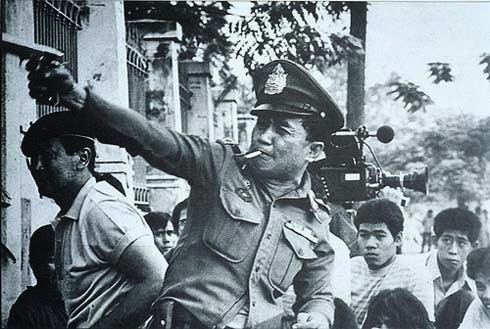
One of his works depicts a naked man taking a selfie of himself that recalls an infamous photo of a cigarette-smoking police officer aiming a pistol into the campus.

A photo taken by Thairath photographer Wirot Mutitanon

The opening reception for Selfie Series starts at 6pm on Oct. 6. The exhibition runs through the end of the month at People’s Gallery on the second floor of the Bangkok Art and Culture Centre.

The Bangkok Art and Culture Centre can be reached on foot by skywalk from BTS National Stadium.

Advertisement

Will Thailand Choke on the Tailpipe of Bangkok’s Eco-Hubris?

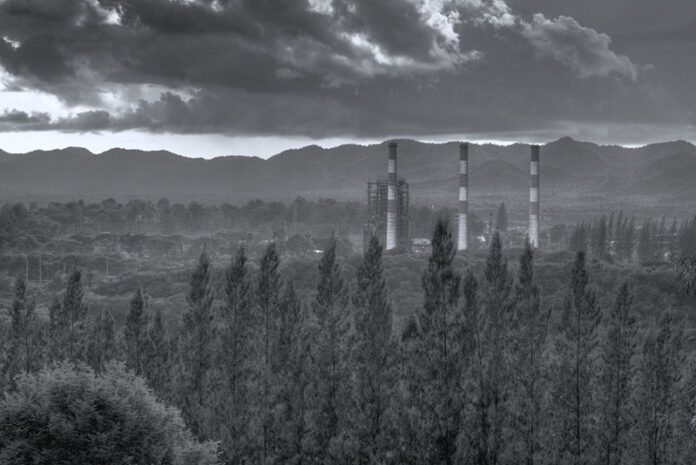
The Mae Moh coal burning power plant in the northern province of Lampang. Photo: Watanyou Intachai / Flickr

Green – not army but eco – is en vogue. Electric vehicles have been buzzing in the headlines, with Deputy PM Somkid Jatusripitak saying the country will become a hub for electric vehicles, or EV, and the Energy Ministry pushing plans to reduce taxes on EVs to spur adoption.

But while the Bangkok elite talks about how green it will be with a shiny new Tesla or BMW i3 EV, are they actually saving the planet? Thailand’s mid-20th century energy mix – namely fossil fuels such as coal – could mean the green brigade’s misguided idealism will make things worse.

A Bloomberg report on Tuesday concluded the benefits of EVs depend on where they are used — the energy sources in play.

“In places that use low-carbon energy sources like renewables and nuclear, electric vehicles dramatically reduce emissions,” it read. “There’s less of a difference in regions where most of the power comes from coal, like China.”

The electricity needed to charge a zero-emission vehicle still needs to be produced somewhere, and that somewhere usually means burning fossil fuels. Countries with a heavy reliance on nuclear energy such as France (over 90%) came out with huge improvement. Germany, a country with a reputation for excess daytime energy because of solar production, only saw CO2 output reduced by roughly a third.

China, which does have a well-known problem of coal-fired smog, put out more CO2 per kilometer than Germany, but EV use reduced it by 40 percent. Japan is a paradox. Though EV use brought down output, electric cars there are getting dirtier as more gas-fired energy plants replace nuclear, post-Fukushima.

But what of Thailand?

Back in January, Gen. Prayuth Chan-ocha used Article 44 of the interim constitution, aka the absolute power clause, to fast-track construction of two new coal plants: the 2,200MWh Theptha plant in Songkhla and an 800MWh power plant in Krabi. He also exempted them from environmental and health impact reviews.

Well, to be fair, Dear Leader exempted every power plant already planned through to 2036 under his long-term power roadmap, as well as biogas and waste-to-gas plants (not all bad, one may argue). It so happens that 2036 is the same year the same energy master plan sees 1.2 million EVs on Thai roads.

The idea of commissioning dirty coal-fired power plants to charge clean EVs must be worthy of some award.

Last month the Energy Ministry announced how EVs would save the country transport-energy related costs. However, those were immediate costs rather than those born of long-term environmental impacts. And although there don’t seem to be any published studies on EV carbon emissions under the country’s power mix, we can make some extrapolations.

In the UK, according Bloomberg, an EV “emits” just over 80g/km of CO2 from the power plants. The UK energy mix still has a substantial basis in carbon fuels, mostly natural gas.

In Q1 this year, the UK energy mix was 25.1 percent renewables, 18.7 percent nuclear and over half from various fossil fuels. In Thailand, domestically produced clean energy accounts for 8 percent with another 7 percent of imported hydro energy. To oversimplify, England’s energy is 43.8 percent clean vs. 15 percent for Thailand.

Using rough back-of-envelope calculations (wrongly treating all fossil fuels as the same), Bloomberg’s hypothetical EV would emit 142g/km if the non-carbon energy was removed from UK figures. In Thailand, with 15 percent renewables, the equivalent CO2 emissions would be 120.7g/km.

That is not bad, but it far from zero-emission, as the green brigade would like to have you believe. The real problem for anyone thinking of buying an EV is that a diesel Mazda 2 boasts just 89g/km of carbon emissions.

Yes, let that sink in. In Thailand, a 780,000 baht Mazda is arguably cleaner than a 5 million baht Tesla EV because of the country’s carbon fuel-heavy energy mix.

Both figures are best-case scenarios, before air-conditioning, traffic and bad driving take their toll.

But, but, but – one might argue, EVs remove the pollution from overcrowded Bangkok and put it at the energy plant where it can be dealt with properly. Yes, the residents of Rayong’s Map-ta-phut district who are dying from respiratory illnesses from the gas-fired power plants would undoubtedly agree with that argument, if they could still speak out at all, what with all the coughing.

We all need to do our part to save the world. But we need to save the world by actually saving the world instead of further damaging it with make believe. That path starts with informed debate and dialogue, not dismissing naysayers as troublemakers and overruling environmental protection laws with diktats in the name of efficiency.

For Thailand, it starts with cleaning up our energy and focusing on the big picture that is best for our children, not the bottom line of state enterprises.

Advertisement

Bangkok Copes as Roads Run Wet And Prepares For More (Photos)

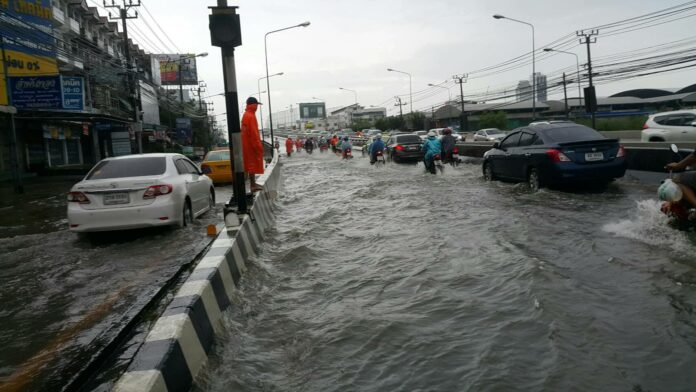
Srinakarin Road on Friday morning. Photo: FM. 91 Trafficpro / Facebook

BANGKOK — Relentless outpouring from the sky turned to traffic tears Friday morning with consequences?

Flooding was reported in various locations and roads throughout the capital including Asoke, Bearing, Sri Nakarin and Saphan Kwai.

Monsoon strength will remain concentrated in east and central Thailand, with heavy rain in Bangkok expected Saturday before diminishing slightly as a weakening northern pressure front pushes monsoon forces toward the north.

https://twitter.com/TZ_Ploii/status/779112979203620865


https://twitter.com/manopsi/status/779153788384845824

Advertisement

Rat Couturier Amongst Winners of Ig Nobel Prize

Thomas Thwaites, left, accepts the Ig Nobel prize in biology from Nobel laureate Eric Maskin (economics, 2007) Thursday during ceremonies at Harvard University in Cambridge, Massachusetts. Photo: Michael Dwyer / Associated Press

BOSTON — A Swede who wrote a trilogy about collecting bugs, an Egyptian doctor who put pants on rats to study their sex lives and a British researcher who lived like an animal have been named winners of the Ig Nobels, the annual spoof prizes for quirky scientific achievement.

The winners were honored  or maybe dishonored  Thursday in a zany ceremony at Harvard University.

The 26th annual event featured a paper airplane air raid and a tic-tac-toe contest with a brain surgeon, a rocket scientist and four real Nobel laureates.

Winners receive $10 trillion cash prizes  in virtually worthless Zimbabwean money.

This year’s Ig Nobels, sponsored by the science humor magazine Annals of Improbable Research , included research by Fredrik Sjoberg, who published three volumes about collecting hoverflies on the sparsely populated Swedish island where he lives.

It sounds downright dull, but Sjoberg’s books are a hit in his homeland, and the first volume’s English translation, “The Fly Trap,” has earned rave reviews.

“I had written books for 15 years (read by no one) when I finally understood it’s a good thing to write about something you really know, no matter what that might be,” Sjoberg said in an email, describing the award as the pinnacle of his career.

“The Ig Nobel Prize beats everything,” he said. “At last I hope to become a rock star. Leather pants, dark sunglasses, groupies. All that.”

Ahmed Shafik decided rats needed pants.

He dressed his rodents in polyester, cotton, wool and polyester-cotton blend pants to determine the different textiles’ effects on sex drive. The professor at Cairo University in Egypt, who died in 2007, found that rats that wore polyester or polyester blend pants displayed less sexual activity, perhaps because of the electrostatic charges created by polyester. He suggested that the results could be applied to humans.

The study did not explain how he measured a rat’s waist and inseam.

Charles Foster, a fellow at the University of Oxford in the United Kingdom, won for literally living like an animal. He spent months mimicking a badger, an otter, a fox, a deer and a bird in an attempt to see the world through their eyes, then wrote a book, “Being a Beast,” about his experiences.

He lived as a badger in a hole in a Welsh hillside; rummaged like a fox through trash cans in London’s East End looking for scraps of chicken tikka masala and pepperoni pizza; and was tracked by bloodhounds through the Scottish countryside to learn what it’s like to be a deer.

It wasn’t much fun.

“I was hunted down quite quickly,” he said.

Andreas Sprenger was part of a team at the University of Luebeck in Germany that found that if you have an itch on one arm, you can relieve it by looking in a mirror and scratching the opposite arm. Sound silly? But imagine, Sprenger said via email, if you have a skin condition with an intolerable itch, you can scratch the other arm to relieve it without rubbing the affected arm raw.

Gordon Logan, a professor of psychology at Vanderbilt University, and colleagues from Canada and Europe won for their research on lying. Their study of more than 1,000 people who are ages 6 to 77  “From junior to senior Pinocchio: A cross-sectional lifespan investigation of deception”  found that young adults are the best liars.

How do the scientists know their subjects weren’t lying to them?

“We don’t,” Logan said.

Story: Mark Pratt

Advertisement

Record-Breaking Hack Stole 500 Million Yahoo Accounts

People walk in front of a Yahoo sign in 2014 at the company's headquarters in Sunnyvale, Calif. Photo: Marcio Jose Sanchez / Associated Press

SAN FRANCISCO — Computer hackers swiped personal information from at least 500 million Yahoo accounts in what is believed to be the biggest digital break-in at an email provider.

The massive security breakdown disclosed Thursday poses new headaches for beleaguered Yahoo CEO Marissa Mayer as she scrambles to close a $4.8 billion sale to Verizon .

The breach dates back to late 2014, raising questions about the checks and balances within Yahoo — a fallen internet star that has been laying off staff and trimming expenses to counter a steep drop in revenue during the past eight years.

At the time of the break-in, Yahoo’s security team was led by Alex Stamos, a respected industry executive who left last year to take a similar job at Facebook.

ONCE MORE UNTO THE BREACH

Yahoo didn’t explain what took so long to uncover a heist that it blamed on a “state-sponsored actor” — parlance for a hacker working on behalf of a foreign government.

The Sunnyvale, California, company declined to explain how it reached its conclusions about the attack for security reasons, but said it is working with the FBI and other law enforcement. Yahoo began investigating a possible breach in July, around the time the tech site Motherboard reported that a hacker who uses the name “Peace” was trying to sell account information belonging to 200 million Yahoo users.

Yahoo didn’t find evidence of that reported hack, but additional digging later uncovered a far larger, allegedly state-sponsored attack.

“We take these types of breaches very seriously and will determine how this occurred and who is responsible,” the FBI said in a Thursday statement.

MOST ACCOUNTS EVER STOLEN

The Yahoo theft represents the most accounts ever stolen from a single email provider, according to computer security analyst Avivah Litan with the technology research firm Gartner Inc.

“It’s a shocking number,” Litan said. “This is a pretty big deal that is probably going to cost them tens of millions of dollars. Regulators and lawyers are going to have a field day with this one.”

Yahoo says it has more than 1 billion monthly users, although it hasn’t disclosed how many of those people have email accounts. In July, 161 million people worldwide used Yahoo email on personal computers, a 30 percent decline from the same time in 2014, according to the latest data from the research firm comScore.

The data stolen from Yahoo includes users’ names, email addresses, telephone numbers, birth dates, scrambled passwords, and the security questions — and answers — used to verify an accountholder’s identity. The company said the attacker didn’t get any information about its users’ bank accounts or credit and debit cards.

Security experts say the Yahoo theft could hurt the affected users if their personal information is mined to break into other online services or used for identity theft. All affected users will be notified about the theft and advised how to protect themselves, according to the company.

Yahoo also is recommending that all users change their passwords if they haven’t done so since 2014. If the same password is used to access other sites, it should be changed too, along with any security questions similar to those used on Yahoo.

THE VERIZON IMPACT

News of the security lapse could cause some people to have second thoughts about relying on Yahoo’s services, raising a prickly issue for the company as it tries to sell its digital operations to Verizon.

That deal, announced two months ago, isn’t supposed to close until early next year. That leaves Verizon with wiggle room to renegotiate the purchase price or even back out if it believes the security breach will harm Yahoo’s business. That could happen if users shun Yahoo or file lawsuits because they’re incensed by the theft of their personal information.

Verizon said it still doesn’t know enough about the Yahoo break-in to assess the potential consequences. “We will evaluate as the investigation continues through the lens of overall Verizon interests, including consumers, customers, shareholders and related communities,” the company said in a statement.

DELAY OF SALE?

At the very least, Verizon is going to need more time to assess what it will be getting into if it proceeds with its plans to take over Yahoo, said Scott Vernick, an attorney specializing in data security for the law firm Fox Rothschild.

“This is going to slow things down. There is going to be a lot of blood, sweat and tears shed on this,” Vernick said. “A buyer needs to understand the cybersecurity strengths and weaknesses of its target these days.”

Investors evidently aren’t nervous about the Verizon deal unraveling yet. Yahoo’s stock added a penny Thursday to close at $44.15. But the Verizon sale represents a sliver of Yahoo’s total market value, which primarily consists of a stake in Chinese e-commerce leader Alibaba Group currently worth $42 billion.

Story: Michael Liedtke

Advertisement

In Interview, Syria’s Assad Blames US for Collapse of Truce

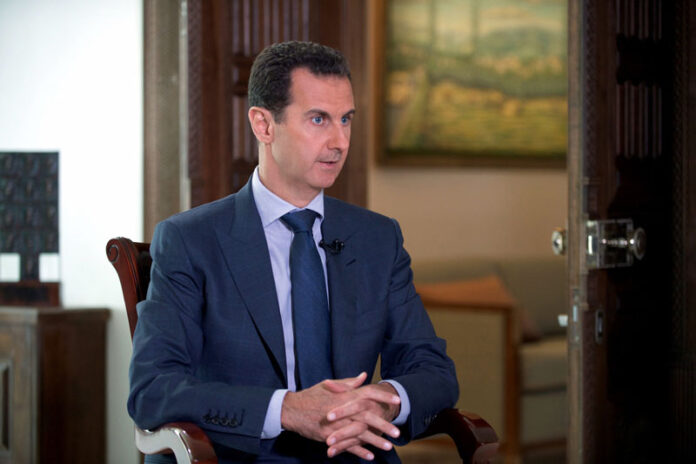
Syrian President Bashar Assad speaks to The Associated Press at the presidential palace in Damascus, Syria, in a Wednesday, Sept. 21, 2016, photo released by the Syrian Presidency. Photo: Syrian Presidency / Associated Press

DAMASCUS, Syria — President Bashar Assad rejected U.S. accusations that Syrian or Russian planes struck an aid convoy in Aleppo or that his troops were preventing food from entering the city’s rebel-held eastern neighborhoods, blaming the U.S. for the collapse of a cease-fire many had hoped would bring relief to the war-ravaged country.

In an interview with The Associated Press in Damascus, Assad also said deadly airstrikes by the U.S.-led coalition on Syrian troops last week were intentional, dismissing American officials’ statements that they were an accident. Assad said the U.S. lacked “the will” to join forces with Russia in fighting extremists.

In Washington, the State Department countered that Assad’s assertions on the attack were “ridiculous.”

Assad, who inherited power from his father and is now in his 16th year in office, cut a confident figure during the interview — a sign of how his rule, which once seemed threatened by the rebellion, has been solidified by his forces’ military advances and by the air campaign of his ally Russia, which turned the tables on the battlefield last year.

He said his enemies alone were to blame for nearly six years of devastation across Syria, and while acknowledging some mistakes, he repeatedly denied any excesses by his troops. He said the war was only likely to “drag on” because of continued external support for his opponents

“When you have many external factors that you don’t control, it’s going to drag on and no one in this world can tell you when” the war will end, he said, insisting Syrians who fled the country could return within a few months if the U.S., Saudi Arabia, Turkey and Qatar stopped backing insurgents.

He spoke Wednesday in Damascus’ Muhajireen palace, a white-stone building where he often receives guests, nestled among trees on the foothills of Qasioun Mountain. The Syrian capital, seat of Assad’s power, has stayed relatively untouched throughout the conflict, spared the devastation inflicted on other, opposition-held areas of the country. In recent months,Assad’s forces have taken rebel strongholds in suburbs of the capital, bolstering security and reducing the threat of mortar shells.

The attack on the aid convoy outside Aleppo took place Monday night, hitting a warehouse as aid workers unloaded cargo and triggering huge explosions. Footage filmed by rescuers showed torn flesh being picked from the wreckage. Witnesses described a sustained, two-hour barrage that included barrel bombs — crude, unguided explosives that the Syrian government drops from helicopters.

A senior U.S. administration official said the U.S. believes with a very high degree of confidence that a Russian-piloted aircraft carried out the strike. The official wasn’t authorized to speak publicly on the matter and asked for anonymity.

Assad dismissed the claims, saying whatever American officials say “has no credibility” and is “just lies.”

Like Syria, Russia has denied carrying out the convoy bombing.

Syria and the United States have been at loggerheads since the Sept. 17 airstrikes by the U.S.-led coalition that hit Syrian troops in the eastern province of Deir el-Zour. U.S. officials said the attack — its first direct hit on Syrian forces since the civil war began — was accidental and that the warplanes thought they were targeting Islamic State group positions. Russia said the strikes killed more than 60 Syrian troops, and afterward, IS militants briefly overran government positions in the area until they were beaten back.

Assad said he did not believe the American account and said that attack targeted a “huge” area constituting many hills.

“It wasn’t an accident by one airplane… It was four airplanes that kept attacking the position of the Syrian troops for nearly one hour, or a little bit more than one hour,” Assad said in the interview. “You don’t commit a mistake for more than one hour.”

“How could they (IS) know that the Americans are going to attack that position in order to gather their militants to attack right away and to capture it one hour after the strike?” Assad asked. “So it was definitely intentional, not unintentional as they claimed.”

A spokesman for the U.S. State Department dismissed Assad’s claims as “ridiculous,” adding that they underline that Assadhas lost his legitimacy to govern.

“It’s difficult to see how these ridiculous claims deserve a response, except to say they prove yet again the degree to whichAssad has lost his legitimacy to govern and how vital it remains for the international community to achieve a political solution that gives the Syrian people a voice in their future,” spokesman John Kirby said Thursday.

The strikes contributed to the collapse of the cease-fire, which had already been marred by numerous violations on both sides of the conflict. They also cast serious doubt on chances for implementing an unprecedented U.S.-Russian agreement to jointly target militants in the country.

Assad said the United States lacked the will to work with Russia against extremists in Syria. “I don’t believe the United States will be ready to join Russia in fighting terrorists in Syria,” he said.

Despite extensive evidence to the contrary, Assad repeatedly denied that his forces were besieging opposition-held eastern Aleppo, which has become a symbol both of resistance and also the high price civilians are paying in the war.

He flatly denied claims of malnutrition and a chronic lack of medical supplies.

“If there’s really a siege around the city of Aleppo, people would have been dead by now,” Assad said, asking how rebels were able to smuggle in arms but apparently not food or medicine.

The ancient city, now partly destroyed, has been carved out into rebel and government-controlled areas since 2012. Rebel reinforcements broke a hole in the blockade in August. But in heavy bombardment over the following weeks, more than 700 civilians were killed. Earlier this month, Syrian troops backed by Russian airstrikes retook the roads and the siege resumed.

Since then, the U.N. has accused Assad’s government of obstructing aid access to the city, despite an agreement to allow aid in during the weeklong cease-fire. During the brief cease-fire, trucks carrying aid sat idle by the nearby Turkish border, awaiting permits and safety guarantees.

Throughout the conflict, Assad’s forces have been accused of bombing hospitals and civilians and choking opposition cities. Millions have fled Syria, some of them drowning at sea in the Mediterranean.

The war has been defined by gruesome photos and video posted in the aftermath of bloody attacks or documenting the plight of children in particular. Hundreds of thousands of people have been killed, and once thriving cities have been ravaged, with entire blocks reduced to rubble. The images have galvanized public opinion worldwide — but Assad, while acknowledging that the war had been ‘savage,’ said eyewitness accounts should not be automatically believed.

“Those witnesses only appear when there’s an accusation against the Syrian army or the Russian (army), but when the terrorists commit a crime or massacre or anything, you don’t see any witnesses… So, what a coincidence,” he said.

Assad scoffed at the idea that Syria’s “White Helmets” — civil defense volunteers in opposition held areas seen by many as symbols of bravery and defiance — might be considered for a Nobel Peace Prize after a nomination earlier this year.

“What did they achieve in Syria?” he said. “I would only give a prize to whoever works for the peace in Syria.”

The group shared this year’s Right Livelihood Award, sometimes known as the “Alternative Nobel,” with activists from Egypt and Russia and a Turkish newspaper, the prize foundation announced Thursday.

Asked about his methods, including the use of indiscriminate weapons, Assad said “when you have terrorists, you don’t throw at them balloons, or you don’t use rubber sticks for example. You have to use armaments.”

Story: Ian Phillips, Zeina Karam

Advertisement

Hot News

LATEST NEWS

Bangkok
overcast clouds
31.1 ° C
35 °
31.1 °
74 %
4.8kmh
97 %
Tue
34 °
Wed
37 °
Thu
36 °
Fri
36 °
Sat
37 °