29.4 C
Bangkok
Saturday, July 4, 2026
Home Blog Page 2730

Vietnam Frees Dissident Priest Ahead of Obama Visit

BANGKOK — Vietnam granted early release from prison to a Catholic priest who is one of its most prominent dissidents, a move widely seen as a goodwill gesture before President Barack Obama arrives on an official visit late Sunday night.

The Catholic Archdiocese of the central city of Hue reported on its webpage that it welcomed the return Friday of the Rev. Nguyen Van Ly from prison. Photos on its website showed a frail Ly, 70, being helped off a minibus, kneeling to pay his respects to his senior colleagues, then being led to a room prepared for him at the diocese. He has suffered several health crises while imprisoned.

Ly has served several long terms in prison or under house arrest for promoting political and religious freedoms in the communist nation. He had been serving an eight-year prison term since March 2007 after being convicted of spreading propaganda against the state. He was first jailed in 1977, two years after the Communist takeover of all Vietnam.

\
Catholic priest Nguyen Van Ly sits in a courtroom in Hue, Vietnam, in a March 30, 2007, image taken from a CCTV.  Photo: Tran Van Minh / Associated Press


Vietnam's persecution of dissidents has been a roadblock to warmer relations with the United States, from which it is seeking the lifting of an arms embargo. Washington and Hanoi share a strategic interest in challenging Chinese territorial claims in the South China Sea, some of which are in areas long claimed by Vietnam.

The government's relations have always been strained with the Catholic church, associated with French colonial rule and the former anti-communist South Vietnam, as well as an influential power base independent of the ruling Communist Party's control.

The U.S. State Department said it welcomed Ly's release.

"We consistently have called for the release of Father Ly and all other prisoners of conscience in Vietnam," said Gabrielle Price, the department's spokeswoman for East Asia and Pacific affairs. "We remain deeply concerned for all prisoners of conscience in Vietnam. We call on the government to release unconditionally all prisoners of conscience and allow all Vietnamese to express their political views peacefully without fear of retribution."

More than a dozen human rights groups last month sent an appeal to Obama urging him to press Hanoi to release political prisoners.

The appeal, whose signees included Human Rights Watch as well as groups focusing on Vietnam, urged him "to make clear, both in private and in public, that (the) U.S.-Vietnamese relationship will not fundamentally advance absent meaningful human rights improvements, including the release of imprisoned activists, and end to harassment of civil society groups, and respect for international law."

Story: Grant Peck, additional reporting Matthew Pennington / Associated Press

Advertisement

Volleyball Sees Olympic Hope Glimmer, Netizens Still Simmer

Photo: @boswicked19 / Twitter

BANGKOK — What a difference winning makes. Three days after crying foul over a loss to Japan, netizens were generous in victory this morning, praising a defeated South Korea for its spirit.

The women’s volleyball Olympic qualifier Saturday morning sparked some hope for Thailand’s prospects after it turned things around to win 3 sets to South Korea’s 2. Instead of calling for a boycott of bulgogi, the internet offered positive reactions after players from both teams were visibly friendly after the match.

The South Korean women had a reason to smile: Despite today’s loss, they’ve already done well enough to win a place in Rio de Janeiro in August.

Thailand’s holds a slim chance if it can beat Peru on Sunday, and if Japan loses its final matches with Italy and Netherlands.

“I hopes Thailand is coming to Olympic game with us,” South Korea’s team captain Kim Yeon-koung said in an interview after Saturday’s match in Tokyo.

That video clip has been retweeted enthusiastically in Thailand, and #womensvolleyballolympic2016, in Thai, became the top trending hashtag with 1.3 million tweets.

Photos and videos of the two teams’ friendly exchange were posted online.

“We have to thank South Korea and Kim Yeon-koung for playing with Thailand’s team with spirit,” wrote the admin of Facebook page Best Shot Volleyball.

For some, it was just a way to further pile upon Japan, whose win Wednesday led to questions of fairness and drew a furious response from Thai netizens.

“Thailand and South Korea just explained to Japan what the word ‘friend’ means. Isn’t it cool?” wrote Facebook user Im Sai-Ngam.


\


\


\


Advertisement

Lives Changed by Coup, Supporters and Opponents Now Share Uncertainty

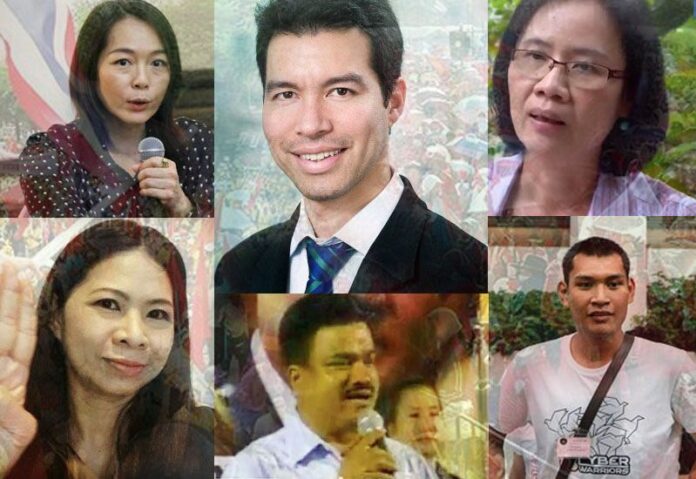
Clockwise from top left, Chiang Mai translator and pro-democracy activist Pakavadi Veerapasapong, Dhurakij Pundit University law lecturer Jade Donavanik, Chulalongkorn University professor Puangthong Pawakapan, online dissident Noppakow Kongsuwan, community organizer Suriyan Tonghnu-eid and Redshirt Suda Rangkupan.

BANGKOK — It was late afternoon in Bangkok, and Suriyan Tonghnu-eid was on a stage calling for the government’s ouster.

Little did he know, as he gathered outside Government House with about 1,000 demonstrators on the stage of a group called Network of Students and People for Reform of Thailand, the government had already been deposed by the military. It was May 22, 2014.

“The news about the coup was brought to me. It was just for those with arms to intervene,” said Suriyan, now 48. “We dissolved the demonstration that evening because people realized that Yingluck [Shinawatra]’s administration was no longer in power. The coup wasn’t our goal, but we could protest no more.”

\Suriyan Tonghnu-eid speaks at a protest against the government of former Prime Minister Yingluck Shinawatra in 2014. Photo: Campaign for Popular Democracy / Facebook


A 10-minute drive away, on Thammasat University’s historic Bodhi Tree Lawn, was Chulalongkorn academic Puangthong Pawakapan along with 50 pro-democracy scholars from various universities. They were protesting the imposition of martial law two days earlier by then-army chief Gen. Prayuth Chan-ocha.

“A reporter told us a coup had been staged,” Puangthong said in a recent interview.

Many lives were changed by the coup d’etat which took place two years ago Sunday, and others during the ensuing 24 months. In interviews with people who both embraced and opposed the coup, a consistent theme emerged: anxiety over Thailand’s future.

Far away from home, Dhurakij Pundit University law lecturer Jade Donavanik was in California on a business trip. Due to the time difference, it was before dawn in California when the 4pm coup took place in Bangkok.

“When I woke up there were 40 to 50 missed calls, I realized what had happened,” Jade recalled.

To former Chulalongkorn University linguist Suda Rangkupan, a prominent Redshirt, the coup was truly life changing. She soon fled Thailand after the putsch and has since campaigned from abroad for the establishment of a Thai Republic, which means the 50-year-old academic may never be able to return to the kingdom again.

“If the goal is achieved, I shall return,” Suda wrote in reply from exile. “Otherwise I will have to remain outside [Thailand] for the rest of my life in order to campaign for the establishment of Thailand as a republic, until it materializes.”

Suda said the junta has requested governments extradite anti-junta activists and claims it has even sent soldiers hunting for them.

“Military or security officers have been dispatched to various countries. News has spread the hunt is on for those not lying low. Our families back home are being pressured. The ‘witch hunt’ in Thailand also means people inside are afraid of contacting us.”


Lessons Learned

With the passage of two years time, the four and others spoke about what they’ve learned in that time, and what remains their primary concerns for the future of Thailand under military rule.

To those opposed to the coup and junta, formally known as the National Council for Peace and Order, such as Puangthong, the junta has proven to be an even worse nightmare than expected.
\Chulalongkorn University professor Puangthong Pawakapan in an undated image from Matichon TV.


“We grossly underestimated the rightwing groups. I didn’t expect them to drag Thailand back [in time] this far,” said Puangthong, who left Thailand for a research fellowship in Singapore from July 2014 to January 2015 after being called in by the junta July 3 to be warned about her political stance and views on the controversial lese majeste law.

“I felt I didn’t want to be in Thailand anymore,” said Puangthong, who has since returned to resume teaching at Chulalongkorn but still feels deeply concerned for the direction the kingdom is moving.

“Reconciliation is not possible, as the junta wants to mold society its way. The path will eventually lead to bloodshed like in the Oct. 14, 1973 uprising.”

Suriyan, who protested against the previous government, his initial acceptance of the coup soured long ago. Suriyan said he hoped earnest national reforms would take place under the auspices of the NCPO.

Now he has no such hope, as the people are excluded from all processes branded “reforms” by the junta.

“What we saw over the past two years was the use of special laws over normal laws, and the transgression of bureaucratic power over people’s power,” he said.

On a personal level, Suriyan is secretary of the Campaign for Popular Democracy and for several years has advocated for community rights issues in the north.

Now he doesn’t believe he can continue.

“It’s difficult to carry out any activism,” he said, as the junta has quashed local activism, and he’s been threatened by those who regard him as an enemy in the northern communities of Chiang Mai which are Redshirt strongholds.

“I can’t lead my life as before. It’s not safe. It’s a double whammy, from the military and those on the other side of the political spectrum who dislike me. The [Campaign for Popular Democracy] also can’t engage in activism like in the past.”

\For Jade, life under the junta got busier. He was appointed by the NCPO to help write the first draft of a proposed constitution. When that draft was rejected by another junta-appointed body last year, he was named adviser to the new head drafter, Meechai Ruchuphan.

Now, he feels that past two years were a wasted opportunity.

“It there was to be an election and [political] problems could not be solved, there could be another [putsch]. If the junta stays on it would be grave too,” Jade said.

Jade said junta leaders have always suffered from denial that they are politicians, despite that fact that’s what they became the moment they seized power and had to deliver results.


Coup a ‘Strategic Success’

While some of its supporters express criticism, a member of the so-called Facebook 8 charged with sedition last month accords the military regime some credit.

\“I consider this coup to be a ‘success’ in terms of military strategy. The military used force without deaths and injuries and caused real fear among the general public,” said Noppakow Kongsuwan, who was plucked from his home by soldiers for running a Facebook page lampooning Prayuth.

Now free on bail, Noppakow still manages the Facebook presence of Redshirt leader Jatuporn Prompan.

“Another success was coining the term ‘attitude adjustment’ for violating the rights and liberty of the people, by making them feel there’s nothing scary … and that no rights have been violated, while it fact that wasn’t the case,” Noppakow said.

Chiang Mai translator and pro-democracy thinker Pakavadi Veerapasapong believes the coup’s best lesson is that no genuine democratization can take place without reform of the military to ensure civilian supremacy.

\“A democratic system with only national-level elections cannot ensure a strong governing system, and decentralization is needed,” she said.

Pakavadi is concerned that this time the military is directly running most ministries in a totalitarian fashion, like Burma of the past, without any tangible policies.

She is more alarmed however by belief the junta is undermining the social welfare the people have benefited from and joined hands with big capitalism to plunder resources from rural areas through various mega-projects. She fears uprising as a possible future for Thailand.

As for how she’s been personally touched, Pakavadi said even symbolic protest or symposiums have been criminalized.

“Personally, the change is that there has been unprecedented curb on freedom of expression. … I don’t know when I or my friends will be dragged into a military camp and charged with severe offenses,” she said.

As for Redshirt Suda, the coup wasn’t just a regime change, but an attempt to install a permanent dictatorship.

\“People have to decide themselves if they will allow a single group of people to decide on their behalf under a dictatorship, or we’re to rise up and declare the rights to govern ourselves in accordance with a democratic system,” she said. “We’ve come to the point where both sides, namely the elites and the people, will have to decide whether they want to change ‘the system’ or not.”

Looking ahead, Suda said she’s most concerned about violence and the economy.

“People who are not politically awakened fall victim to this violence without knowing the cause,” she said. “They turn to superstitions or resort to violence. It’s the responsibilities of academics to analyze the real problems, but most do not have faith in people’s power compared to their fear of dictators.”

Advertisement

2 Years On, Has the Junta Kept These 8 Promises?

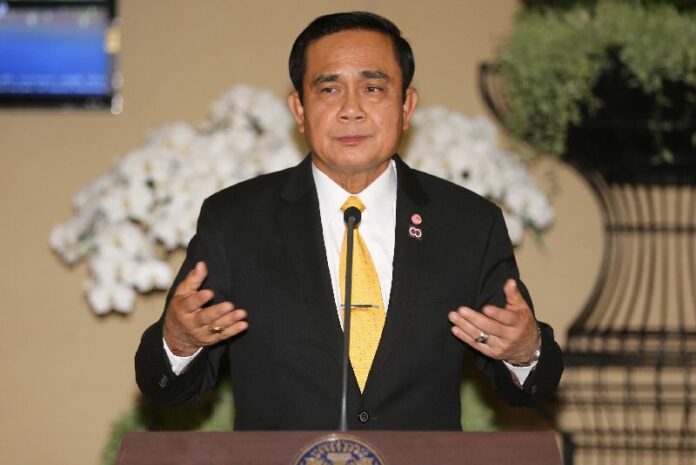
Junta chairman Prayuth Chan-ocha speaks to reporters May 21 in Bangkok

BANGKOK — It was the kind of media event that would have once been unthinkable, but in a time of everything-everywhere expectations, the rapt coverage of an unfolding suicide Thursday seemed to raise ratings more than editorial alarms.

That is what army officials rushed to tell reporters and diplomats hours after then-army chief Prayuth Chan-ocha surprised the nation by declaring martial law at 4am on May 20, 2014. Later that day, when a reporter asked the general whether martial law presaged a coup, his answer was more ominous: “It’s a question I cannot answer.”

Two days later, with troops deployed in key parts of Bangkok and political leaders locked up in an army facility for “peace discussion,” Prayuth announced the coup, the 12th in Thailand’s history since democracy was installed in 1932.

And thus began what he calls “national reforms” to move the country forward.

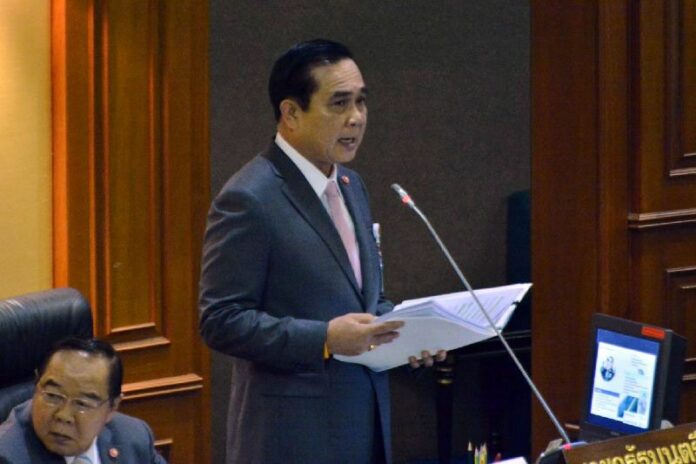
He made many promises. In fact, when Prayuth unveiled his policy objectives to his rubber stamp parliament shortly after it named him prime minister, his speech took nearly two hours.

Two years later, how have those promises held up? Has the junta come close to fulfilling the missions for which it justified taking power, goals it said could achieve unconstrained by voter accountability?

We talked to various stakeholders and sat down with junta spokesman Col. Winthai Suvaree to evaluate progress on those major platforms.


Political Division

\
Redshirt and Yellowshirt activists feed each other noodles at an army-organized ‘reconciliation fair’ in Nakhon Ratchasima province June 8, 2015.


The junta has maintained the coup was necessary to save Thailand from unending political upheaval pitting Redshirts against Yellowshirts in cyclical street unrest, the most recent of which saw the Yellowshirts undermining a Redshirt-backed government.

The regime took immediate measures it said would foster “reconciliation” from banning political activities and protests to organizing bipartisan football matches and making Redshirts and Yellowshirts swear oaths of friendship.

Winthai acknowledges the political factions are still entrenched in their color-coded camps, although they have gone quiet due to restrictions imposed by the regime.

“Even though they may not express anything symbolically, they are still there,” Winthai said. “Their ideas are still there.”

One thing that has brought the two sides together, Winthai said, is common cause against the junta.

“There’s not much hostility between the two groups now, but there’s a feeling of suspicion and anxiety toward the state coming from them,” he said. “But we are not worried. We can create understanding with them.”


Corruption

\
Schoolchildren march in a state-sponsored demonstration against corruption Dec. 9, 2015, in Korat.


Accusing the civilian government of endemic corruption, junta chairman Prayuth promised to eradicate graft from the nation. He installed a special anti-corruption taskforce and occasionally invoked his absolute power to remove suspect officials.

Kanokkan Anukansai of Transparency Thailand, an anti-graft group, said the junta has made a lot of progress. Examples, she said, include new morality lessons taught in school and open-government initiatives such as transparency reports on projects.  

“In term of motives, the reason they do it for is another issue,” she said. “But as a person who experiences the results, I see the effort.”

Kanokkan feels corruption is less widespread with the junta in charge. “For their dedication, I give them a score of 7.5 out of 10,” Kanokkan said.

However, the 2015 corruption perception index compiled by her organization had Thailand at the same ranking as 2014. The kingdom is the 76th in transparency of 168 nations.

The junta itself has been dogged by accusations of corruption; namely, a billion-baht royal monument fraught with financial irregularities and a five-billion baht irrigation project that was reportedly awarded to a private firm without public oversight.


Lese Majeste

\
Well-wishers elebrate HM the King's birthday on Dec. 5, 2014, in front of Siriraj Hospital in Bangkok.


Defending the monarchy from slander was named by Prayuth as his regime’s No. 1 goal.

"We will use legal measures, social-psychological measures, telecommunications and information technology to deal with those who are not mindful of their words, are arrogant at heart, or harbor ill intentions to undermine the important institution of the nation," he told his interim parliament in 2014.

Prosecution of royal defamation, known as lese majeste, has since reached an unprecedented level. The past two years have seen record arrests, convictions and sentences for lese majeste, sometimes on absurd grounds. A man was charged for mocking a royal pet dog, and a woman for replying “okay” to allegedly offensive remarks sent via ostensibly private Facebook chat.

From the coup through to April 30, at least 66 have been charged, according toInternet Law Reform Dialogue, which tracks cases and advocates legal reform. And under the junta, suspects are being tried in secret by military tribunals where they cannot appeal their sentences.

On this point, Winthai played down the government’s success. In line with official insistence such offenses are criminal and not political, he said the spike in such cases stems from an increase in law and order.

“This is about enforcement of the law, naturally, we enforce it in a more strict manner,” he said.

Southern Insurgency

\
Security officers inspect the scene of a car bomb in front of a Islamic Bank of Thailand branch August 2012 in Yala province.


A few months after taking power, Prayuth famously vowed to bring peace to the Deep South – ending 15 years of violence rooted in 700 years of ethnic-religious conflict – by the end of 2015.

Speaking five months after that deadline came and went, a professor deeply familiar with the situation noted the obvious.

“They could not fulfill their promise,” said Srisomphop Jitpiromsri, who’s also director of the Deep South Watch news agency. “It’s still the same. There have been ups and downs.”

Srisomphop said it’s a pity, because the junta came up with comprehensive policies, such as higher funding for security forces, re-organizing agencies to be more efficient, and even continuing peace dialogues with insurgent groups begun by the ousted government.

“The structures are rather good, actually, they are better than the previous government,” Srisomphop. What went wrong, he said, was the junta’s decision to exert a top-down approach by excluding local communities and social groups.

“They only focus on efficiency, they think like soldiers,” he said. “They cut out any process of scrutiny or control from civil society and locals. Therefore, all of these plans did not reflect the people’s needs … they do it for the people, but it wasn’t done by the people.”

The professor gave the junta a “failing” grade. “They do a lot of work, but they still fail in the exam,” he said.


Human Trafficking

\
Rescue workers carry a dead body from a humant trafficking gulag May 1, 2015, in Songkhla province.


One of the uglier skeletons in the nation’s closet, the trafficking of humans, was long ignored by previous governments. It was thrust to national attention a year after the coup when actual skeletons were exhumed from horrifying border slavery death camps.

Under the junta’s oversight, Thailand saw an unprecedented prosecution of more than 80 people investigators linked to the series of Rohingya slave camps in the Deep South. The suspects included businessmen, local politicians, police officers and a high-ranking army official.

Pressed by a threatened E.U. ban on seafood exports, the junta also moved to crackdown on a package of illegal fishing practices of which slavery on the high seas is a part. Then four months later, the case was closed, despite the lead investigator’s insistence it was unfinished.

While acknowledging some progress made, migrant worker rights activist Andy Hall said the effort still lacks coordination between different agencies and necessary personnel.

“One of the [frequent] problems is a lack of interpreters, and sometimes, the interpreters are the [slave] brokers. There’s nothing to qualify which interpreters are good guys, and which are bad guys,” Hall said.

There remains inadequate protection for victims and whistleblowers, he added.

“When there are victims, they are arrested and sent to detention centers,” Hall said. “But workers want to work. So they don’t want to identify themselves as victims. They are afraid.”

The investigator who was gung ho to go after the military and government figures he said were behind the trafficking? Maj. Gen Paween Pongsirin soon fled to Australia, citing threats on his life.


Sino-Thai Railway

\
Gen. Prayuth Chan-ocha signs an MOU for a joint Thai-Chinese rail project on Dec. 22, 2014, aboard a high-speed train in China.
 

In 2014, the junta scrapped a signature policy of the previous government: A high-speed rail line to plug Thailand into wider markets. Soon thereafter, the junta announced the same thing under a new name, saying it’s chief partner and financier would be China.

But two years on, the project is in limbo, as it seems the two governments have been unable to reach agreement, possibly due to Bangkok balking at Beijing’s terms.

Most recently, Transport Minister Arkhom Termpittayapaisith told the media May 14 that construction would begin on the first portion of the railway – Bangkok to Korat – by September.

However, he also admitted negotiations are ongoing, and nothing is final.


Organized Crime

\
Soldiers and police arrest a suspected drug dealer March 12 in Nonthaburi province.
 

The junta’s pledge to wipe out organized crime has been renewed and escalated several times. This past November, it found a new target: so-called “influential figures.” In late March, Prayuth controversially granted police powers to soldiers, ostensibly to go after the capos.

“We are doing our best,” Winthai said. “From what I have been briefed on, the government and the junta are already making some progress. Partly, it was due to enthusiasm from local communities, too. They no longer tolerated that kind of thing.”

However, what counts as “influential figures” remains vague. In one definition, the junta listed 16 businesses as such, from illegal logging and loan sharking to selling illegal firearms and overcharging tourists.

Political activists, environmental activists – and most recently Uber and Grabmotorcycle taxi services – have also somehow found themselves labeled “influential figures,” leading critics of the junta to accuse the regime of using the term as a blanket excuse for sweeping arrests.


Public Transportation

\
Soldiers and police announce a fresh crackdown on bad taxis Feb. 9 in Pattaya.


In another much-heralded issue, the junta pledged to regulate public transportation such as taxis, motorcycle taxis and vans.

By 2016, many of their efforts appear to have flopped: A parking area for Victory Monument vans is now abandoned, dodgy cabbies are as abundant as ever, and the soldiers which for a time directed traffic flow near some major Skytrain stations are gone.

But perhaps the most lasting effect is with the ranks of motorcycle taxis. Since the coup, all motosai were made to register with the government, display their licenses and post fares at their stands. The regime also vowed to crackdown on the neighborhood criminal elements which extort taxi operators for bribes and kickbacks.

Chalerm Changtongmadan, chairman of Motorcycle Taxi Association, said the junta has done a good job eradicating the racketeers. “Right now, there is no mafia anymore,” he said.

Most of 80,000 motorcycle taxis are now properly registered, according to Chalerm.

Chalerm said his main concern is the competition with other motorcycle services like Uber and GrabBike, which the junta is trying to stamp out. Last week, both companies announced they would comply with the ban.


Teeranai Charuvastra can be reached at[email protected] and @Teeranai_C.


\

Advertisement

2 Years On, Has the Junta Kept These 8 Promises?

In one of his first acts after being named prime minister, Gen. Prayuth Chan-ocha outlined the goals of his regime in a speech lasting over two hours Sept. 12, 2014, in Bangkok.

BANGKOK — The latest coup in Thailand began with a stern statement that it wasn’t a coup.

That is what army officials rushed to tell reporters and diplomats hours after then-army chief Prayuth Chan-ocha surprised the nation by declaring martial law at 4am on May 20, 2014. Later that day, when a reporter asked the general whether martial law presaged a coup, his answer was more ominous: “It’s a question I cannot answer.”

Two days later, with troops deployed in key parts of Bangkok and political leaders locked up in an army facility for “peace discussion,” Prayuth announced the coup, the 12th in Thailand’s history since democracy was installed in 1932.

And thus began what he calls “national reforms” to move the country forward.

He made many promises. In fact, when Prayuth unveiled his policy objectives to his rubber stamp parliament shortly after it named him prime minister, his speech took nearly two hours.

Two years later, how have those promises held up? Has the junta come close to fulfilling the missions for which it justified taking power, goals it said could achieve unconstrained by voter accountability?

We talked to various stakeholders and sat down with junta spokesman Col. Winthai Suvaree to evaluate progress on those major platforms.


Political Division

\
Redshirt and Yellowshirt activists feed each other noodles at an army-organized ‘reconciliation fair’ in Nakhon Ratchasima province June 8, 2015.


The junta has maintained the coup was necessary to save Thailand from unending political upheaval pitting Redshirts against Yellowshirts in cyclical street unrest, the most recent of which saw the Yellowshirts undermining a Redshirt-backed government.

The regime took immediate measures it said would foster “reconciliation” from banning political activities and protests to organizing bipartisan football matches and making Redshirts and Yellowshirts swear oaths of friendship.

Winthai acknowledges the political factions are still entrenched in their color-coded camps, although they have gone quiet due to restrictions imposed by the regime.

“Even though they may not express anything symbolically, they are still there,” Winthai said. “Their ideas are still there.”

One thing that has brought the two sides together, Winthai said, is common cause against the junta.

“There’s not much hostility between the two groups now, but there’s a feeling of suspicion and anxiety toward the state coming from them,” he said. “But we are not worried. We can create understanding with them.”


Corruption

\
Schoolchildren march in a state-sponsored demonstration against corruption Dec. 9, 2015, in Korat.


Accusing the civilian government of endemic corruption, junta chairman Prayuth promised to eradicate graft from the nation. He installed a special anti-corruption taskforce and occasionally invoked his absolute power to remove suspect officials.

Kanokkan Anukansai of Transparency Thailand, an anti-graft group, said the junta has made a lot of progress. Examples, she said, include new morality lessons taught in school and open-government initiatives such as transparency reports on projects.  

“In term of motives, the reason they do it for is another issue,” she said. “But as a person who experiences the results, I see the effort.”

Kanokkan feels corruption is less widespread with the junta in charge. “For their dedication, I give them a score of 7.5 out of 10,” Kanokkan said.

However, the 2015 corruption perception index compiled by her organization had Thailand at the same ranking as 2014. The kingdom is the 76th in transparency of 168 nations.

The junta itself has been dogged by accusations of corruption; namely, a billion-baht royal monument fraught with financial irregularities and a five-billion baht irrigation project that was reportedly awarded to a private firm without public oversight.


Lese Majeste

\
Well-wishers elebrate HM the King's birthday on Dec. 5, 2014, in front of Siriraj Hospital in Bangkok.


Defending the monarchy from slander was named by Prayuth as his regime’s No. 1 goal.

"We will use legal measures, social-psychological measures, telecommunications and information technology to deal with those who are not mindful of their words, are arrogant at heart, or harbor ill intentions to undermine the important institution of the nation," he told his interim parliament in 2014.

Prosecution of royal defamation, known as lese majeste, has since reached an unprecedented level. The past two years have seen record arrests, convictions and sentences for lese majeste, sometimes on absurd grounds. A man was charged for mocking a royal pet dog, and a woman for replying “okay” to allegedly offensive remarks sent via ostensibly private Facebook chat.

From the coup through to April 30, at least 66 have been charged, according to Internet Law Reform Dialogue, which tracks cases and advocates legal reform. And under the junta, suspects are being tried in secret by military tribunals where they cannot appeal their sentences.

On this point, Winthai played down the government’s success. In line with official insistence such offenses are criminal and not political, he said the spike in such cases stems from an increase in law and order.

“This is about enforcement of the law, naturally, we enforce it in a more strict manner,” he said.

Southern Insurgency

\
Security officers inspect the scene of a car bomb in front of a Islamic Bank of Thailand branch August 2012 in Yala province.


A few months after taking power, Prayuth famously vowed to bring peace to the Deep South – ending 15 years of violence rooted in 700 years of ethnic-religious conflict – by the end of 2015.

Speaking five months after that deadline came and went, a professor deeply familiar with the situation noted the obvious.

“They could not fulfill their promise,” said Srisomphop Jitpiromsri, who’s also director of the Deep South Watch news agency. “It’s still the same. There have been ups and downs.”

Srisomphop said it’s a pity, because the junta came up with comprehensive policies, such as higher funding for security forces, re-organizing agencies to be more efficient, and even continuing peace dialogues with insurgent groups begun by the ousted government.

“The structures are rather good, actually, they are better than the previous government,” Srisomphop. What went wrong, he said, was the junta’s decision to exert a top-down approach by excluding local communities and social groups.

“They only focus on efficiency, they think like soldiers,” he said. “They cut out any process of scrutiny or control from civil society and locals. Therefore, all of these plans did not reflect the people’s needs … they do it for the people, but it wasn’t done by the people.”

The professor gave the junta a “failing” grade. “They do a lot of work, but they still fail in the exam,” he said.


Human Trafficking

\
Rescue workers carry a dead body from a humant trafficking gulag May 1, 2015, in Songkhla province.


One of the uglier skeletons in the nation’s closet, the trafficking of humans, was long ignored by previous governments. It was thrust to national attention a year after the coup when actual skeletons were exhumed from horrifying border slavery death camps.

Under the junta’s oversight, Thailand saw an unprecedented prosecution of more than 80 people investigators linked to the series of Rohingya slave camps in the Deep South. The suspects included businessmen, local politicians, police officers and a high-ranking army official.

Pressed by a threatened E.U. ban on seafood exports, the junta also moved to crackdown on a package of illegal fishing practices of which slavery on the high seas is a part. Then four months later, the case was closed, despite the lead investigator’s insistence it was unfinished.

While acknowledging some progress made, migrant worker rights activist Andy Hall said the effort still lacks coordination between different agencies and necessary personnel.

“One of the [frequent] problems is a lack of interpreters, and sometimes, the interpreters are the [slave] brokers. There’s nothing to qualify which interpreters are good guys, and which are bad guys,” Hall said.

There remains inadequate protection for victims and whistleblowers, he added.

“When there are victims, they are arrested and sent to detention centers,” Hall said. “But workers want to work. So they don’t want to identify themselves as victims. They are afraid.”

The investigator who was gung ho to go after the military and government figures he said were behind the trafficking? Maj. Gen Paween Pongsirin soon fled to Australia, citing threats on his life.


Sino-Thai Railway

\
Gen. Prayuth Chan-ocha signs an MOU for a joint Thai-Chinese rail project on Dec. 22, 2014, aboard a high-speed train in China.
 

In 2014, the junta scrapped a signature policy of the previous government: A high-speed rail line to plug Thailand into wider markets. Soon thereafter, the junta announced the same thing under a new name, saying it’s chief partner and financier would be China.

But two years on, the project is in limbo, as it seems the two governments have been unable to reach agreement, possibly due to Bangkok balking at Beijing’s terms.

Most recently, Transport Minister Arkhom Termpittayapaisith told the media May 14 that construction would begin on the first portion of the railway – Bangkok to Korat – by September.

However, he also admitted negotiations are ongoing, and nothing is final.


Organized Crime

\
Soldiers and police arrest a suspected drug dealer March 12 in Nonthaburi province.
 

The junta’s pledge to wipe out organized crime has been renewed and escalated several times. This past November, it found a new target: so-called “influential figures.” In late March, Prayuth controversially granted police powers to soldiers, ostensibly to go after the capos.

“We are doing our best,” Winthai said. “From what I have been briefed on, the government and the junta are already making some progress. Partly, it was due to enthusiasm from local communities, too. They no longer tolerated that kind of thing.”

However, what counts as “influential figures” remains vague. In one definition, the junta listed 16 businesses as such, from illegal logging and loan sharking to selling illegal firearms and overcharging tourists.

Political activists, environmental activists – and most recently Uber and Grab motorcycle taxi services – have also somehow found themselves labeled “influential figures,” leading critics of the junta to accuse the regime of using the term as a blanket excuse for sweeping arrests.


Public Transportation

\
Soldiers and police announce a fresh crackdown on bad taxis Feb. 9 in Pattaya.


In another much-heralded issue, the junta pledged to regulate public transportation such as taxis, motorcycle taxis and vans.

By 2016, many of their efforts appear to have flopped: A parking area for Victory Monument vans is now abandoned, dodgy cabbies are as abundant as ever, and the soldiers which for a time directed traffic flow near some major Skytrain stations are gone.

But perhaps the most lasting effect is with the ranks of motorcycle taxis. Since the coup, all motosai were made to register with the government, display their licenses and post fares at their stands. The regime also vowed to crackdown on the neighborhood criminal elements which extort taxi operators for bribes and kickbacks.

Chalerm Changtongmadan, chairman of Motorcycle Taxi Association, said the junta has done a good job eradicating the racketeers. “Right now, there is no mafia anymore,” he said.

Most of 80,000 motorcycle taxis are now properly registered, according to Chalerm.

Chalerm said his main concern is the competition with other motorcycle services like Uber and GrabBike, which the junta is trying to stamp out. Last week, both companies announced they would comply with the ban.


Teeranai Charuvastra can be reached at [email protected] and @Teeranai_C.

Follow Khaosod English on Facebook and Twitter for news, politics and more from Thailand. To reach Khaosod English about this article or another matter, please contact us by e-mail at [email protected].


Follow @KhaosodEnglish

\

Advertisement

Has the Junta Kept The Promises Made 2 Years Ago? We Checked.

BANGKOK — The latest coup in Thailand began with a stern statement that it wasn’t a coup.

That is what army officials rushed to tell reporters and diplomats hours after then-army chief Prayuth Chan-ocha surprised the nation by declaring martial law at 4am on May 20, 2014. Later that day, when a reporter asked the general whether martial law presaged a coup, his answer was more ominous: “It’s a question I cannot answer.”

Two days later, with troops deployed in key parts of Bangkok and political leaders locked up in an army facility for “peace discussion,” Prayuth announced the coup, the 12th in Thailand’s history since democracy was installed in 1932.

And thus began what he calls “national reforms” to move the country forward.

He made many promises. In fact, when Prayuth unveiled his policy objectives to his rubber stamp parliament shortly after it named him prime minister, his speech took nearly two hours.

Two years later, how have those promises held up? Has the junta come close to fulfilling the missions for which it justified taking power, goals it said could achieve unconstrained by voter accountability?

We talked to various stakeholders and sat down with junta spokesman Col. Winthai Suvaree to evaluate progress on those major platforms.


Political Division

\
Redshirt and Yellowshirt activists feed each other noodles at an army-organized ‘reconciliation fair’ in Nakhon Ratchasima province June 8, 2015.


The junta has maintained the coup was necessary to save Thailand from unending political upheaval pitting Redshirts against Yellowshirts in cyclical street unrest, the most recent of which saw the Yellowshirts undermining a Redshirt-backed government.

The regime took immediate measures it said would foster “reconciliation” from banning political activities and protests to organizing bipartisan football matches and making Redshirts and Yellowshirts swear oaths of friendship.

Winthai acknowledges the political factions are still entrenched in their color-coded camps, although they have gone quiet due to restrictions imposed by the regime.

“Even though they may not express anything symbolically, they are still there,” Winthai said. “Their ideas are still there.”

One thing that has brought the two sides together, Winthai said, is common cause against the junta.

“There’s not much hostility between the two groups now, but there’s a feeling of suspicion and anxiety toward the state coming from them,” he said. “But we are not worried. We can create understanding with them.”


Corruption

\
Schoolchildren march in a state-sponsored demonstration against corruption Dec. 9, 2015, in Korat.


Accusing the civilian government of endemic corruption, junta chairman Prayuth promised to eradicate graft from the nation. He installed a special anti-corruption taskforce and occasionally invoked his absolute power to remove suspect officials.

Kanokkan Anukansai of Transparency Thailand, an anti-graft group, said the junta has made a lot of progress. Examples, she said, include new morality lessons taught in school and open-government initiatives such as transparency reports on projects.  

“In term of motives, the reason they do it for is another issue,” she said. “But as a person who experiences the results, I see the effort.”

Kanokkan feels corruption is less widespread with the junta in charge. “For their dedication, I give them a score of 7.5 out of 10,” Kanokkan said.

However, the 2015 corruption perception index compiled by her organization had Thailand at the same ranking as 2014. The kingdom is the 76th in transparency of 168 nations.

The junta itself has been dogged by accusations of corruption; namely, a billion-baht royal monument fraught with financial irregularities and a five-billion baht irrigation project that was reportedly awarded to a private firm without public oversight.


Lese Majeste

\
Well-wishers elebrate HM the King's birthday on Dec. 5, 2014, in front of Siriraj Hospital in Bangkok.


Defending the monarchy from slander was named by Prayuth as his regime’s No. 1 goal.

"We will use legal measures, social-psychological measures, telecommunications and information technology to deal with those who are not mindful of their words, are arrogant at heart, or harbor ill intentions to undermine the important institution of the nation," he told his interim parliament in 2014.

Prosecution of royal defamation, known as lese majeste, has since reached an unprecedented level. The past two years have seen record arrests, convictions and sentences for lese majeste, sometimes on absurd grounds. A man was charged for mocking a royal pet dog, and a woman for replying “okay” to allegedly offensive remarks sent via ostensibly private Facebook chat.

From the coup through to April 30, at least 66 have been charged, according to Internet Law Reform Dialogue, which tracks cases and advocates legal reform. And under the junta, suspects are being tried in secret by military tribunals where they cannot appeal their sentences.

On this point, Winthai played down the government’s success. In line with official insistence such offenses are criminal and not political, he said the spike in such cases stems from an increase in law and order.

“This is about enforcement of the law, naturally, we enforce it in a more strict manner,” he said.

Southern Insurgency

\
Security officers inspect the scene of a car bomb in front of a Islamic Bank of Thailand branch August 2012 in Yala province.


A few months after taking power, Prayuth famously vowed to bring peace to the Deep South – ending 15 years of violence rooted in 700 years of ethnic-religious conflict – by the end of 2015.

Speaking five months after it didn’t, a professor deeply familiar with the situation, noted the obvious.

“They could not fulfil their promise,” said Srisomphop Jitpiromsri, who’s also director of the Deep South Watch news agency. “It’s still the same. There have been ups and downs.”

Srisomphop said it’s a pity, because the junta came up with comprehensive policies, such as higher funding for security forces, re-organizing agencies to be more efficient, and even continuing peace dialogues with insurgent groups begun by the ousted government.

“The structures are rather good, actually, they are better than the previous government,” Srisomphop. What went wrong, he said, was the junta’s decision to exert a top-down approach by excluding local communities and social groups.

“They only focus on efficiency, they think like soldiers,” he said. “They cut out any process of scrutiny or control from civil society and locals. Therefore, all of these plans did not reflect the people’s needs … they do it for the people, but it wasn’t done by the people.”

The professor gave the junta a “failing” grade. “They do a lot of work, but they still fail in the exam,” he said.


Human Trafficking

\
Rescue workers carry a dead body from a humant trafficking gulag May 1, 2015, in Songkhla province.


One of the uglier skeletons in the nation’s closet, the trafficking of humans, was long ignored by previous governments. It was thrust to national attention a year after the coup when actual skeletons were exhumed from horrifying border slavery death camps.

Under the junta’s oversight, Thailand saw an unprecedented prosecution of more than 80 people investigators linked to the series of Rohingya slave camps in the Deep South. The suspects included businessmen, local politicians, police officers and a high-ranking army official.

Pressed by a threatened E.U. ban on seafood exports, the junta also moved to crackdown on a package of illegal fishing practices of which slavery on the high seas is a part. Then four months later, the case was closed, despite the lead investigator’s insistence it was unfinished.

While acknowledging some progress made, migrant worker rights activist Andy Hall said the effort still lacks coordination between different agencies and necessary personnel.

“One of the [frequent] problems is a lack of interpreters, and sometimes, the interpreters are the [slave] brokers. There’s nothing to qualify which interpreters are good guys, and which are bad guys,” Hall said.

There remains inadequate protection for victims and whistleblowers, he added.

“When there are victims, they are arrested and sent to detention centers,” Hall said. “But workers want to work. So they don’t want to identify themselves as victims. They are afraid.”

The investigator who was gung ho to go after the military and government figures he said were behind the trafficking? Maj. Gen Paween Pongsirin soon fled to Australia, citing threats on his life.


Sino-Thai Railway

\
Gen. Prayuth Chan-ocha signs an MOU for a joint Thai-Chinese rail project on Dec. 22, 2014, aboard a high-speed train in China.
 

In 2014, the junta scrapped a signature policy of the previous government: A high-speed rail line to plug Thailand into wider markets. Soon thereafter, the junta announced the same thing under a new name, saying it’s chief partner and financier would be China.

But two years on, the project is in limbo, as it seems the two governments have been unable to reach agreement, possibly due to Bangkok balking at Beijing’s terms.

Most recently, Transport Minister Arkhom Termpittayapaisith told the media May 14 that construction would begin on the first portion of the railway – Bangkok to Korat – by September.

However, he also admitted negotiations are ongoing, and nothing is final.


Organized Crime

\
Soldiers and police arrest a suspected drug dealer March 12 in Nonthaburi province.
 

The junta’s pledge to wipe out organized crime has been renewed and escalated several times. This past November, it found a new target: so-called “influential figures.” In late March, Prayuth controversially granted police powers to soldiers, ostensibly to go after the capos.

“We are doing our best,” Winthai said. “From what I have been briefed on, the government and the junta are already making some progress. Partly, it was due to enthusiasm from local communities, too. They no longer tolerated that kind of thing.”

However, what counts as “influential figures” remains vague. In one definition, the junta listed 16 businesses as such, from illegal logging and loan sharking to selling illegal firearms and overcharging tourists.

Political activists, environmental activists – and most recently Uber and Grab motorcycle taxi services – have also somehow found themselves labeled “influential figures,” leading critics of the junta to accuse the regime of using the term as a blanket excuse for sweeping arrests.


Public Transportation

\
Soldiers and police announce a fresh crackdown on bad taxis Feb. 9 in Pattaya.


In another much-heralded issue, the junta pledged to regulate public transportation such as taxis, motorcycle taxis and vans.

By 2016, many of their efforts appear to have flopped: A parking area for Victory Monument vans is now abandoned, dodgy cabbies are as abundant as ever, and the soldiers which for a time directed traffic flow near some major Skytrain stations are gone.

But perhaps the most lasting effect is with the ranks of motorcycle taxis. Since the coup, all motosai were made to register with the government, display their licenses and post fares at their stands. The regime also vowed to crackdown on the neighborhood criminal elements which extort taxi operators for bribes and kickbacks.

Chalerm Changtongmadan, chairman of Motorcycle Taxi Association, said the junta has done a good job eradicating the racketeers. “Right now, there is no mafia anymore,” he said.

Most of 80,000 motorcycle taxis are now properly registered, according to Chalerm.

Chalerm said his main concern is the competition with other motorcycle services like Uber and GrabBike, which the junta is trying to stamp out. Last week, both companies announced they would comply with the ban.


Teeranai Charuvastra can be reached at [email protected] and @Teeranai_C.

Follow Khaosod English on Facebook and Twitter for news, politics and more from Thailand. To reach Khaosod English about this article or another matter, please contact us by e-mail at [email protected].


Follow @KhaosodEnglish

\

Advertisement

King Treated Again for Too Much Fluid in Brain

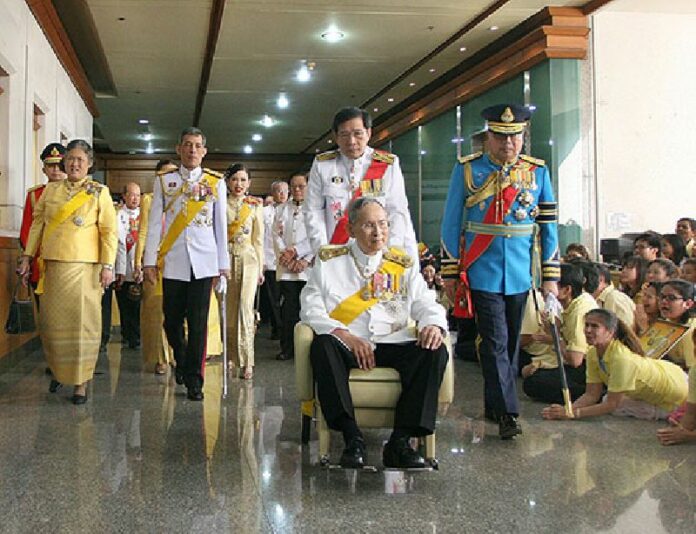
King Bhumibol at Bangkok's Siriraj Hospital in an undated file photo.

BANGKOK — King Bhumibol Adulyadej was treated for excessive water in his brain, the palace announced late Friday night.

The longest reigning monarch underwent treatment Friday at Siriraj Hospital, where he has resided on and off in recent years, for hydrocephalus, the same condition reported in August, according to a statement issued at 11.20pm last night.

“The result was satisfactory to the team of physicians,” read the statement. “And we will closely monitor his condition further.”

Updates about the health of the king, who has spent most of his time at the riverside hospital since 2009, usually comes during Thailand’s royal news hour traditionally broadcast nationwide at 8pm.

The statement said the 88-year-old king unusual muscle spasms were detected in his face Friday, leading doctors to conduct a computer X-ray of his brain.

After an abnormal accumulation of cerebrospinal fluid was found, a tube placed in his abdomen earlier this month was adjusted, a process that began at 6.30pm and took a little over an hour.

This is the second statement about King’s health issued by the royal household bureau in recent days. On May 14, a bulletin said he was suffering from arthritis in the knee and excessive phlegm.

Held up as a father figure, the king and his health are closely watched as his condition is a matter of considerable anxiety.


Related stories:

Princess Urges Thais to Pray for King’s Health

Thai King Treated for 'Water on the Brain,' Palace Announces


Advertisement

Watchdogs ‘Too Late’ to Stop Media Spellbound by Slow-Motion Suicide

In this screenshot from a Thairath live broadcast, reporters swarm into the motel where murder suspect Wanchai Danaitamonut fatally shot himself just minutes earlier on Thursday in Bangkok.

BANGKOK — It was the kind of media event that would have once been unthinkable, but in a time of everything-everywhere expectations, the rapt coverage of an unfolding suicide Thursday seemed to raise ratings more than editorial alarms.

Today, prominent media watchdog agencies admit they moved too late to take action against news agencies which broadcast live footage of a cornered murder suspect committing suicide in Bangkok.


While Nation Watches Live, 5-Hour Standoff Ends as Murder Suspect Shoots Himself


The live broadcasts, which went on for nearly six hours and ended only after university lecturer Wanchai Danaitamonut fatally shot himself, again raised uproar about media ethics in Thailand, where the bar for standards rests low, and concerns about privacy are readily discarded to satisfy public appetite for novelty and horror.

The confrontation between Wanchai, who was wanted for the murders of his fellow professors on Wednesday, began at around 2pm and was subsequently broadcast live on television by news channels as well as online by traditionally print organizations such as Thairath, the largest newspaper in Thailand.  

Thairath streamed the incident over Facebook Live, a medium being rapidly adopted by non-broadcast news outlets. Print media has been in decline in Thailand as much as anywhere, and internet streaming has provided a welcome audience boost to newspapers struggling to transition to an online future.

The first condemnation came just before 6pm from the Thai Journalist Association, which urged members of the media to “exercise caution” in their coverage out of consideration for the “feelings of the public” in a statement. 

Just after 6pm, telecommunications regulators ordered state news agencies under their jurisdiction to pull the plug on live coverage. 

“This case is not only about ethics, but it’s considered a violation of laws related to television operations,” Supinya Klangnarong of the National Telecommunication and Broadcasting Commission wrote on Twitter.

About 40 minutes later, at 6:44pm, Wanchai ended the standoff by shooting himself in the head. By that time, many media agencies had stopped their live broadcasts of the incident. The actual suicide took place off screen of those who continued to cover it, such as Nation TV, Thairath and Khaosod, though a loud gunshot was still heard in the background. 

Thai Journalist Association director Wanchai Wongmeechai said his organization took too long to issue a warning because they were in a meeting while the drama unfolded outside. Ironically, the meeting was about how to improve media ethics, Wanchai said. 

“After the meeting ended, and I came out, someone phoned me about it, and I turned on radio, so I found out what happened, and I made phone calls to the media ethics committee,” Wanchai said by telephone. “At that point, I thought we needed to hurry, because there was already criticism on social media. If we didn’t act, the society would look at the media even more negatively.”

He said the statement was not sent directly to any particular media agency, but he hoped it would “send a signal” to the editors in charge. According to Wanchai, many agencies toned down their coverage after the warning was issued.

However, he said the main responsibility of policing the media lies with the National Broadcasting and Telecommunications Commission, not his organization. 

“If the NBTC had acted more quickly, it would have been better,” Wanchai said. 

Supinya, the media commissioner, said on Twitter the NBTC took action when it was too late. The delay was due to to the fact that the commission normally only takes legal action based on what the media already published, and Thursday’s event was an extraordinary, unprecedented exception.

“First time for NBTC to intervene live broadcast on TV (tho still late) which the Panel had to hold meeting by phone before sending letters,” she wrote.

Wanchai said the journalist association will strive to “find a lesson” from yesterday’s incident and campaign more aggressively on issues of ethics. 

“We will campaign for media to be responsible, not to violate ethics, and improve credibility for the media,” Wanchai said. “If we still have problem in ethics, it would be a problem when we fight for media freedom.” 

Related stories:

Celebrity Dies, Paparazzi Frenzies, Public Rages Against Media Machine

Thai Press Groups Respond to Junta’s Execution Threats with Mild Rebukes

Mainstream Media Trades in Worst LGBT Stereotypes, Review Finds

Advertisement

Morley Safer, News Legend, 84

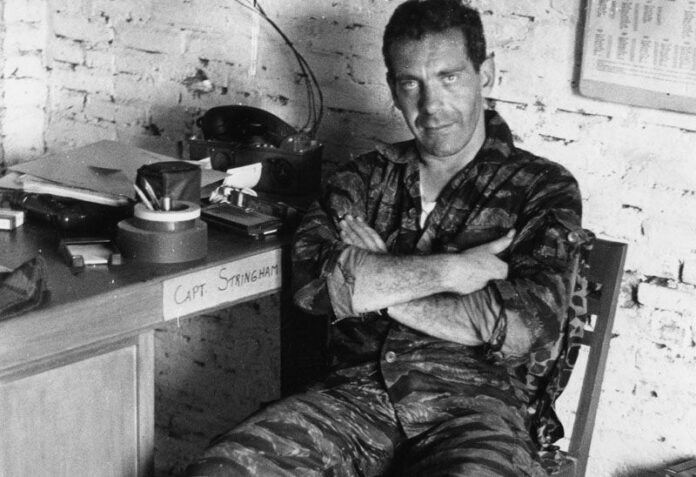
This 1965 image released by CBS shows newsman Morley Safer soaking his feet while on assignment in South Vietnam. Safer, the veteran “60 Minutes” correspondent who exposed a military atrocity in Vietnam that played an early role in changing Americans’ view of the war, died Thursday. Photo: Alex Brauer/ CBS News / AP

NEW YORK — Viewers didn't need to see Morley Safer's reporting to feel its effects.

They could have almost heard the yowling from the Oval Office and the Pentagon after Safer's 1965 expose of a U.S. military atrocity in Vietnam that played an early role in changing Americans' view of the war.

They may have felt a flush of gratitude on learning that Safer's 1983 investigation of justice gone awry resulted in the release of a Texas man wrongfully sentenced to life in prison.

Perhaps they headed to their wine shop with a heightened sense of purpose after word spread of Safer's story that quoted medical experts who said red wine can be good for you.

Safer's far-flung journalism got reactions and results during a 61-year career that found him equally at home reporting on social wrongs, the Orient Express, abstract art and the horrors of war.

That career came to an end this week, with a "60 Minutes" tribute on Sunday and, then, with Safer's death, at 84, on Thursday.

He is survived by his wife, the former Jane Fearer, and his daughter Sarah Safer.

\
The "60 Minutes" team, from left, Morley Safer, Steve Kroft and Mike Wallace pose at the Metropolitan Museum of Art in New York celebrating their 25th anniversary. Photo: Mark Lennihan  / Associated Press

Safer, who had been in declining health, watched Sunday's program from his Manhattan home, CBS said, and shortly thereafter tweeted what would be his last dispatch: "It's been a wonderful run, and I want to thank the millions of people who have been loyal to our 60 Minutes broadcast. Thank you!"

NBC News Special Correspondent Tom Brokaw visited with Safer last Friday, two days after his retirement was announced.

They spoke about the towering journalists of Safer's era, men like The Washington Post's Ben Bradlee and "60 Minutes" creator-executive producer Don Hewitt.

Safer said quietly, "All the great ones are gone," Brokaw recalled in an email.

"No Morley, you're still with us," Brokaw replied before kissing Safer on the forehead.

During his 46 years on "60 Minutes," Safer did 919 stories, from his first in 1970 about U.S. Sky Marshals to his last this March, a profile of Danish architect Bjarke Ingels.

Along the way, he exhibited style, toughness and, when it suited, a bit of mischievous wit, such as with his 1993 essay, "Yes, But Is It Art?", which examined the relative merits of representational and abstract art, and outraged the contemporary art world.

He famously said, "There is no such thing as the common man; if there were, there would be no need for journalists."

Safer was no common man. He cut a dashing figure as a bon vivant who for a time drove a Bentley bought with poker winnings. He seemed to bridge the gap between the glory ink-stained-wretch days of foreign correspondents (Ernest Hemingway was an early inspiration) and the blooming electronic age of TV news.

"Morley Safer helped create the CBS News we know today," said CBS News President David Rhodes.

CBS chairman and CEO Leslie Moonves said Safer broadly impacted the news industry: "Morley was one of the most important journalists in any medium, ever."

"Morley was a fixture, one of our pillars, and an inspiration in many ways," said Jeff Fager, "60 Minutes" executive producer. "He was a master storyteller, a gentleman and a wonderful friend. We will miss him very much."

Safer was outspoken in his allegiance to words more than pictures — heresy for most TV professionals, though comfortably in synch with Hewitt's mandate at "60 Minutes."

"What you're aiming at are people's ears rather than their eyes," said the man who claimed to "not really like being on television," yet made his peace with this "intimidating" medium: "The money's very good," he noted with a sly smile.

It was in 1970 that Safer joined "60 Minutes," then just two years old and far from the national institution it would become. He claimed the co-host chair alongside a talk-show-host-turned-newsman named Mike Wallace.

During the next four decades, Safer's rich tobacco-and-whiskey-cured voice delivered stories that ranged from art, music and popular culture, to "gotcha" investigations, to one of his favorite pieces, which, in 1983, resulted in the release from prison of Lenell Geter, the engineer wrongly convicted of a holdup at a fast food restaurant and serving a life sentence.

A memorable 1984 profile of Jackie Gleason took place in a bar around a pool table, where "the Great One" showed Safer and his viewers how it's done — but not before Safer nearly ran the table.

And in 2011, he scored a sit-down with Ruth Madoff, who offered her first public description of the day she learned from her husband, Bernard, that he was running the biggest Ponzi scheme in history. More than 18.5 million viewers tuned in.

Safer won a Robert F. Kennedy Journalism Award for his 2001 story on a school in Arizona specifically geared to serve homeless children.

Other honors include three George Foster Peabody awards, 12 Emmys and two George Polk Memorial Awards.

Safer, who was born in Toronto in 1931, insisted he was "stateless" and, as a reporter chasing stories around the globe, claimed, "I have no vested interests." He eventually became an American citizen, holding dual citizenship.

He began his career at several news organizations in Canada and England before being hired by Reuters wire service in its London bureau. Then, in 1955, he was offered a correspondent's job in the Canadian Broadcasting Company's London bureau, where he worked nine years before CBS News hired him for its London bureau.

In 1965 he opened CBS' Saigon bureau.

That August, "The CBS Evening News with Walter Cronkite" aired a report by Safer that rocked viewers, who, at that point, remained mostly supportive of the U.S. war effort in Vietnam. Safer had been invited to join a group of Marines on what a lieutenant described as a search-and-destroy mission in the tiny villages that made up Cam Ne.

But what he encountered there, and captured on film, was the spectacle of American soldiers employing their Zippo lighters to burn the thatched-roof, mud-plastered huts to the ground, despite having met with no resistance from village residents.

Safer's expose ignited a firestorm.

President Lyndon Johnson gave CBS President Frank Stanton a tongue-lashing. "Your boys shat on the American flag yesterday," he reportedly roared, and intimated that Safer had "Communist ties" and had staged the entire story. Safer feared for his safety in the company of angry U.S. soldiers and said the Pentagon treated him with contempt for the rest of his life.

"The Cam Ne story was broadcast over and over again in the United States and overseas. It was seized upon by Hanoi as a propaganda tool and by scoundrels of the left and right, in the Pentagon and on campuses," Safer wrote in his 1990 memoir, "Flashbacks: On Returning to Vietnam."

Safer rotated in and out of Vietnam three times, then, in 1967, began three years as London bureau chief.

In 1970, he was brought to New York to succeed original co-host Harry Reasoner (who was moving to ABC News) on an innovative newsmagazine that, in its third season, was still struggling in the ratings, and would rely on Safer and Wallace as its only co-anchors for the next five years.

In 1971, Safer won an Emmy for his "60 Minutes" investigation of the Gulf of Tonkin incident that began America's war in Vietnam.

He quickly became a fixture at "60 Minutes" — and part of that show's rough-and-tumble behind-the-scenes culture as the stature and ratings of the show took off.

Jeff Fager, then a producer for Safer, has kept on display a framed remnant of the curtain that was the landing place for a cup of coffee Safer once threw at him.

But Safer had an especially combative, if ultimately respectful, relationship with fellow "60 Minutes" pioneer Wallace.

Sunday's tribute to Safer's career — which notably contained no new interview footage with him — featured outtakes from an interview that Safer conducted with Wallace upon the latter's retirement. During the sequence, the two of them were quarrelling even as they praised each other.

By 2006, Safer had reduced his output, accepting half-time status. But he remained after the departures of Wallace — who retired in 2006 at age 88, and died in 2012 — as well as Don Hewitt, who stepped down in 2004 at 81, and died in 2009, and Andy Rooney, who, at 92, ended 33 years as the resident essayist in October 2011, and died a month later.

"Mind if I smoke?" Safer asked an Associated Press reporter a few years ago as he closed his office door at "60 Minutes" while flouting health laws, inasmuch as his cigarette by then was halfway done. It felt appropriately old school, given Safer's link to the days when legends — as well as smoke — filled those hallways.

"60 Minutes" carries on, but now the legends are gone.

Story: Frazier Moore; additional reporting David Bauder, Mark Kennedy / Associated Press

Advertisement

Egyptian Jet Crash Blamed on Terrorism

An EgyptAir Airbus A320 takes off August 21 from Vienna International Airport in Austria. Photo: Thomas Ranner / Associated Press

CAIRO — An EgyptAir jetliner en route from Paris to Cairo with 66 people aboard veered wildly in flight and crashed in the Mediterranean Sea early Thursday, authorities said. Egyptian and Russian officials said it may have been brought down by terrorists.

There were no signs of survivors.

EgyptAir Flight 804, an Airbus A320 with 56 passengers and 10 crew members, went down about halfway between the Greek island of Crete and Egypt's coastline, or around 282 kilometers offshore, after takeoff from Charles de Gaulle Airport, authorities said.

Greek Defense Minister Panos Kammenos said the plane spun all the way around and suddenly lost altitude just before vanishing from radar screens around 2:45am Cairo time.

He said it made a 90-degree left turn, then a full 360-degree turn to the right, plummeting from 11,582 meters to 4,572 meters. It disappeared at about 3,048 meters, he said. There were no reports of stormy weather at the time.

Egyptian and Greek authorities in ships and planes searched the suspected crash area throughout the day for traces of the airliner or its victims, with more help on the way from the United States, Britain and France.

But as night fell, they had yet to find any confirmed debris, at one point dismissing a reported sighting of life vests and other floating material.

Civil Aviation Minister Sherif Fathi cautioned that the disaster was still under investigation but said the possibility it was a terror attack "is higher than the possibility of having a technical failure."

Alexander Bortnikov, chief of Russia's top domestic security agency, went further, saying: "In all likelihood it was a terror attack."

There was no immediate claim from militants that they had downed the plane.

If it was terrorism, it would be the second deadly attack involving Egypt's aviation industry in seven months.

Last October, a Russian passenger plane that took off from an Egyptian Red Sea resort crashed in the Sinai, killing all 224 people aboard. Russia said it was brought down by a bomb, and a local branch of the Islamic State claimed responsibility.

Thursday's disaster also raises questions about security at De Gaulle Airport, at a time when Western Europe has been on high alert over the deadly Islamic extremist attacks in Paris and at the Brussels airport and subway over the past six months.

French Foreign Minister Jean-Marc Ayrault said that airport security had been tightened considerably before the disaster, in part because of the coming European soccer championship, which France is hosting.

The Egyptian military said it did not receive a distress call from the doomed plane, and Egypt's state-run daily Al-Ahram quoted an unidentified airport official as saying the pilot did not send one. That could mean that whatever sent the aircraft plummeting into the sea was sudden.

Its erratic course suggested a number of possible explanations, including a catastrophic mechanical or structural failure, a bombing, or a struggle over the controls with a hijacker in the cockpit.

Egyptian security officials said they were running background checks on the passengers to see if any had links to extremists.

In the U.S., the FBI offered its assistance in the investigation. FBI Director James Comey said the bureau has no evidence yet that the plane was brought down intentionally.

California Rep. Adam Schiff, the ranking Democrat on the House Intelligence Committee, said there is much that is unknown.

"We are looking through our intelligence collections to figure out if we have any images. Do we have any signals intelligence that reveals a discussion of a plot like this?" Schiff said.

"We're working with the French to try to figure out is there any information we have that could shed light on any of the passengers, but there's nothing yet to confirm the cause of the plane crash."

He said the plane seemed to have broken apart in flight, but why is unclear.

Retired U.S. Air Force Maj. Gen. Robert Latiff, an aerospace expert at the University of Notre Dame, said that while it is too early to tell for certain, an accidental structural failure of the highly reliable A320 is "vanishingly improbable."

He also cast doubt on the possibility of a struggle in the cockpit, saying the crew would have triggered an alarm.

Instead, he said, "sabotage is possible, and if there were lax controls at airports and loose hiring and security policies, increasingly likely."

Similarly, John Goglia, a former U.S. National Transportation Safety Board member, said early indications point more to a bomb, since it appears that no mayday call was issued during the abrupt turns. He said the aircraft's black-box voice and data recorders should hold the answers.

Those on board, according to EgyptAir and various governments, included 15 French passengers, 30 Egyptians, two Iraqis, one Briton, one Kuwaiti, one Saudi, one Sudanese, one Chadian, one Portuguese, one Belgian, one Algerian and two Canadians. Two babies were aboard, officials said.

Among the passengers, according to employers and officials, were the Egypt-raised manager of a Procter & Gamble plant in Amiens, France; a Saudi woman who works at the Saudi Embassy in Cairo; the sister-in-law of an Egyptian diplomatic official in Paris; and a student at France's prestigious Saint-Cyr military academy who was heading home to Chad to mourn his mother.

Whatever caused the crash, the disaster is likely to deepen Egypt's woes as the country struggles to revive its ailing economy, particularly its lucrative tourism industry. It has been battered by the bloodshed and political turmoil that have engulfed Egypt since the 2011 overthrow of President Hosni Mubarak.

French President Francois Hollande held an emergency meeting at the Elysee Palace. He also spoke with Egyptian President Abdel-Fattah el-Sissi by telephone and agreed to "closely cooperate to establish as soon as possible the circumstances" surrounding the disaster, according to a statement.

In addition to joining the search-and-rescue operation, France sent a team of accident investigators.

In Cairo, el-Sissi convened an emergency meeting of the National Security Council, the country's highest security body. It includes the defense, foreign and interior ministers and the chiefs of the intelligence agencies.

In Paris, the city prosecutor's office opened an investigation. "No hypothesis is favored or ruled out at this stage," it said in a statement.

Families of passengers gathered at the Cairo airport, desperate for any news. Authorities brought doctors to the scene after several distressed family members collapsed.

"They don't have any information," lamented Mohamed Ramez, whose in-laws were on the plane. "But obviously there is little hope."

At De Gaulle Airport, a man and woman sat at an information desk near the EgyptAir counter, the woman sobbing into a handkerchief, before they were led away by police.

The Airbus A320 is a widely used twin-engine plane that operates on short- and medium-haul routes. Nearly 4,000 A320s are in use around the world.

The last deadly crash involving one of the planes was in March 2015, when one of the pilots of a Germanwings flight deliberately slammed it into the French Alps, killing all 150 people aboard.
Airbus said the aircraft in Thursday's disaster was delivered to EgyptAir in 2003 and had logged 48,000 flight hours. The pilot had more than 6,000 hours of flying time, authorities said.

In March, an EgyptAir plane was hijacked and diverted to Cyprus. A man described by authorities as mentally unstable was taken into custody.

Story: Maggie Michael, Elena Becatoros, Raphael Satter / Associated Press

Advertisement

Hot News

LATEST NEWS

Bangkok
overcast clouds
29.4 ° C
29.4 °
25.5 °
77 %
4.8kmh
100 %
Fri
29 °
Sat
31 °
Sun
34 °
Mon
29 °
Tue
30 °