30 C
Bangkok
Friday, June 26, 2026
Home Blog Page 2808

Love Triangle Blamed for Valentine’s Day Mall Murder

CentralPlaza Rattanathibet located on Rattanathibet Road in Nonthaburi city. Photo: CentralPlaza Rattanathibet / Facebook

NONTHABURI — A young girl was injured when a man shot a mall sales assistant to death yesterday in western metro Bangkok before turning the gun on himself.

Suchart Puapradit, 50, reportedly chased Pijakkana Somsakul, 44, who worked at CentralPlaza Rattanathibet on Sunday morning, to the mall’s second floor where he shot her three times with a .38 revolver.

A 9-year-old girl was hit in the neck by a stray bullet. She was immediately sent to a hospital where she is in stable condition and expected to survive, according to Maj. Gen. Susak Prakkamakul of Nonthaburi police.

Apinya Duangprom, 24, who works at a coffee shop in the mall, told police she saw a woman run up an escalator to the second floor with a man in pursuit. The man shot her three times then shot himself.

Suchart’s mother Sunadda Puapradit told police that her son dated Pijakkana, who was married with two children, for several months. The 69-year-old mother said she had urged her son to break it off with Pijakkana many times, but he said he was deeply in love with the woman.

Susak said police assume Suchart was distressed by some personal issue with Pijakkana which led to the murder.

Advertisement

Sudden Supreme Court Vacancy Tests 2016 US Candidates

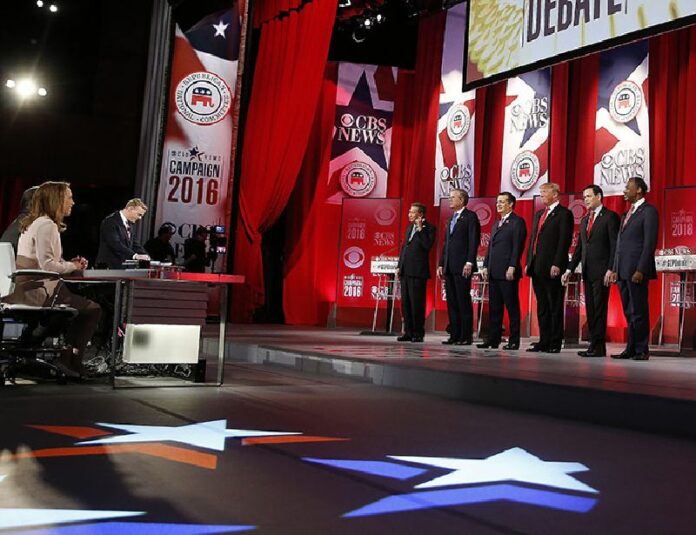
Republican presidential candidates, from left, Ohio Gov. John Kasich, former Florida Gov. Jeb Bush, Sen. Ted Cruz, R-Texas, businessman Donald Trump, Sen. Marco Rubio, R-Fla., retired neurosurgeon Ben Carson take a moment of silence for US Supreme Court associate justice Antonin Scalia on Saturday at a Republican presidential debate in the state of South Carolina. Photo: John Bazemore / Associated Press

WASHINGTON — The stakes in the U.S. presidential election just got higher.

The unexpected death of Supreme Court Justice Antonin Scalia — and the immediate declaration from Republicans that the next president should nominate his replacement — adds even more weight to the decision voters will make in November's general election.

The court now is divided between four liberal and four typically conservative justices, putting the ideological tilt up for grabs. Scalia, a hero to conservatives during his nearly 30 years on the Supreme Court, was found dead Saturday at a resort ranch in West Texas.

For months, the candidates have espoused theoretical, sometimes vague, policy proposals. Now, the prospect of President Barack Obama's successor nominating a Supreme Court justice immediately after taking office offers a more tangible way for voters to evaluate the contenders.

Candidates in both parties moved quickly to reframe the election as a referendum on the high court's future.

"Two branches of government hang in the balance, not just the presidency, but the Supreme Court," Texas Sen. Ted Cruz said in the latest Republican presidential debate, held in South Carolina just hours after word filtered out Saturday aboutScalia's death in Texas. "If we get this wrong, if we nominate the wrong candidate, the Second Amendment, life, marriage, religious liberty, every one of those hangs in the balance." The Second Amendment of the U.S. Constitution guarantees the right to bear arms.

Democratic candidate Hillary Clinton painted a similarly stark scenario.

"If any of us needed a reminder of just how important it is to take back the United States Senate and hold onto the White House, just look at the Supreme Court," Clinton said.

Clinton has said she would have "a bunch of litmus tests" for potential nominees, including a belief that the Citizens United ruling clearing the way for super political action committees and unlimited campaign contributions should be overturned. She also said the court's makeup is crucial to preserving abortion rights and the legality of gay marriage nationwide.

Vermont Sen. Bernie Sanders, who is challenging Clinton for the Democratic nomination, has raised opposition to Citizens United as a requirement for any Supreme Court nominees.

Obama pledged to nominate a replacement in "due time," even after Senate Majority Leader Mitch McConnell said that responsibility should fall to the winner of the 2016 election.

Obama could try to ram a nominee through the Senate this year, taking a high court vacancy off the next president's immediate to-do list. Even if that were to happen, a confirmation vote probably would be months away, leaving the Supreme Court in the center of the campaign during the nomination process.

With three other justices over the age of 75, the next president could have other vacancies during his or her tenure, even if Obama fills Scalia's seat.

It's unclear how the new focus on the Supreme Court might affect voters' decisions in an election that has seen surprising and unconventional candidates such as billionaire businessman Donald Trump and Sanders challenge their parties' establishments.

Previous political thunderbolts that were supposed to push voters toward more traditional candidates, such as last fall's terrorist attacks in Paris and California, passed without any negative impact on Trump and Sanders. In fact, Sanders has strengthened since then, with the economic-focused Vermont senator handily defeating Clinton in the New Hampshire primary and finishing a close second in the Iowa caucuses.

Trying to counter Sanders' momentum, Clinton has urged voters to consider which candidate is most electable in November. With the balance of the Supreme Court now potentially on the line, Clinton and her allies are certain to increase their warnings about the risk of sending a self-declared democratic socialist to face a Republican in the fall.

"For any Democrat thinking about casting a protest vote for Sen. Sanders, this should serve as a wake-up call for what's exactly at stake," said Jim Manley, a former aide to top Democratic senators.

Among Republicans, Florida Sen. Marco Rubio, former Florida Gov. Jeb Bush and Ohio Gov. John Kasich are casting themselves as candidates who could appeal to swing voters in the general election and put Republicans in position to guide the next court nominations. But that could open them up to questions from Republican primary voters about the ideological purity of their judicial choices.

Cruz is using the potential vacancy to build on his long-standing argument that Republicans should select a nominee with the most conservative credentials. An uncompromising conservative since arriving in the Senate, Cruz vowed to put "principled constitutionalists" on the Supreme Court. He contends Trump could not be trusted to do the same.

"Donald Trump is president, he will appoint liberals," said Cruz, noting the billionaire's past support for Democratic politicians.

During Saturday's debate, Kasich bemoaned that Washington and presidential candidates had "run so fast into politics" following Scalia's death.

But if anything, the speed at which politics did take over portends a furious fight to come over which candidate gets to put his or her imprint on the court.

Additional reporting Ken Thomas

Story: Julie Pace / Associated Press


Advertisement

50 Latvian Couples Get Hitched in Midair, Literally

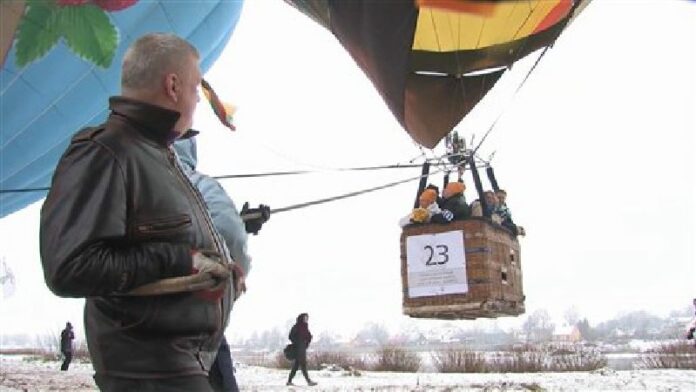
This image taken from Associated Press television shows a hot air balloon with couples about to be wed in Jekabpils, Latvia Sunday Feb. 14, 2016.

JEKABPILS, Latvia — Latvian couples have tied the knot in the air on Valentine's Day hoping to set a world record in the number of simultaneous weddings in hot air balloons.

Fifty couples in 30 balloons rose into the sky Sunday during the Love Cup festival near the southeastern city of Jekabpils, watched by thousands of spectators but the balloons were hitched to cars because it was snowing at the time, impeding them from rising higher than some 15 meters.

It wasn't immediately clear if the ceremony would qualify for an entry in the Guinness Book of World Records as the largest airborne wedding in hot air balloons.

The event was watched by independent observers, including a Guinness representative who couldn't be reached for comment.

\

This image taken from Associated Press television shows a couple preparing to be wed in a hot air balloon in Jekabpils, Latvia Sunday Feb. 14, 2016. 


Story: Associated Press


Advertisement

Europe on the Sidelines

By Ana Palacio
Project Syndicate

MUNICH – The liberal international order that has helped stabilize the world since the end of the Cold War is under strain. A revanchist Russia, chaos in the Middle East, and simmering tensions in the South China Sea are all symptoms of a system that is beginning to fray.

The drivers of instability are many. They include a shift in economic power from the West to the East, the weakening of formal institutions, and widespread disaffection in Western democracies. But, above all, two key developments that have been eroding the liberal international order: the United States’ withdrawal from global leadership and Europe’s prolonged crisis.

Recently, there have been signs that the United States is beginning to reassert itself. After six years of “leading from behind” and drawing meaningless red lines, U.S. President Barack Obama has started to seek out innovative, flexible arrangements – diplomatic and military – to respond to global threats.

In 2015, the Obama administration was instrumental in bringing about the Paris climate agreement and a deal to rein in Iran’s nuclear program. And, last week, U.S. Defense Secretary Ashton Carter unveiled a proposed military budget for 2017 that signaled plans for a muscular global stance. The request included funding for naval operations in Asia, a restocking of the military arsenal depleted in the fight against the Islamic State, and a commitment to technological innovation.

The proposal’s centerpiece, however, was the quadrupling of U.S. spending in Europe to “support our NATO allies in the face of Russia’s aggression.” Many in Europe might regard Carter’s announcement as cause for relief. After years of handwringing over Obama’s strategic “pivot” to Asia, even as Russia was stirring up trouble in Ukraine, Europe is once again a strategic focus for the United States. But the deeper message is far less encouraging. The United States is acting because its European partners have not.

This divergence is troubling. American engagement is necessary to provide momentum, but it is Europe’s weight that has served as the critical mass required to move the world’s liberal order in a positive direction. From the perspective of the European Union, the latest U.S. security bailout raises the possibility that after more than two decades of growing prominence, Europe will lose its agenda-setting power.

In 2011, after NATO’s operation in Libya, which fully revealed the limits of Europe’s military capacity, then-U.S. Defense Secretary Robert Gates visited Brussels. His message was stark: “If current trends in the decline of European defense capabilities are not halted and reversed, future U.S. political leaders – those for whom the Cold War was not the formative experience that it was for me – may not consider the return on America’s investment in NATO worth the cost.”

In the years since, Russia has annexed Crimea and destabilized eastern Ukraine. Instability in the Middle East has sparked a large-scale migration crisis. Terrorism has reemerged as an important threat. And yet, for all the talk of streamlining and strengthening Europe’s defense capabilities, little of significance has been accomplished.

America’s change in calculus is not the result of Europe getting its act together; it reflects the recognition that the threat posed by Russia cannot be left unchecked. This point was driven home by a recent report by the Rand Corporation showing how vulnerable NATO’s Baltic partners – Estonia, Latvia, and Lithuania – would be to a Russian assault. As persistently low energy prices put the Kremlin under increasing pressure, there is a growing risk that Russian President Vladimir Putin could fan the flames of nationalism by lashing out once again.

On its surface, America’s decision to confront Russia recalls previous occasions when Europe proved unable to respond to challenges in its neighborhood – most memorably in Bosnia in the 1990s. But the current situation is more dangerous still; it is reminiscent of the Cold War, when Europe was an object and not an actor in geopolitics. The continent risks once again becoming the chessboard on which the US and the Kremlin play for advantage.

In 2001, the U.S. accounted for one-fifth of the world’s economic output. Today, it accounts for less than one sixth of the global total. No matter how committed and innovative American leadership remains, the U.S. by itself can no longer guarantee the liberal international order. It needs allies in the effort, and the EU, still the world’s largest economy despite years of stagnation, would make a perfect candidate – if only it would pull itself together.

During the 20th century, Europe was America’s partner of first resort. Now, when it is needed once again, the EU is slipping toward the sidelines. Unless its leaders change course, the painful unraveling of the liberal world order will continue.

Ana Palacio, a former Spanish foreign minister and former Senior Vice President of the World Bank, is a member of the Spanish Council of State, a visiting lecturer at Georgetown University, and a member of the World Economic Forum's Global Agenda Council on the United States.

Copyright 2015, Project Syndicate


To reach us about this article or another matter, please contact us by e-mail at: [email protected].

Follow Khaosod English on and Twitter for news, politics and more from Thailand.

Follow @KhaosodEnglish

\

Advertisement

Prayuth in California Doesn't Signal Sunnier U.S. Stance

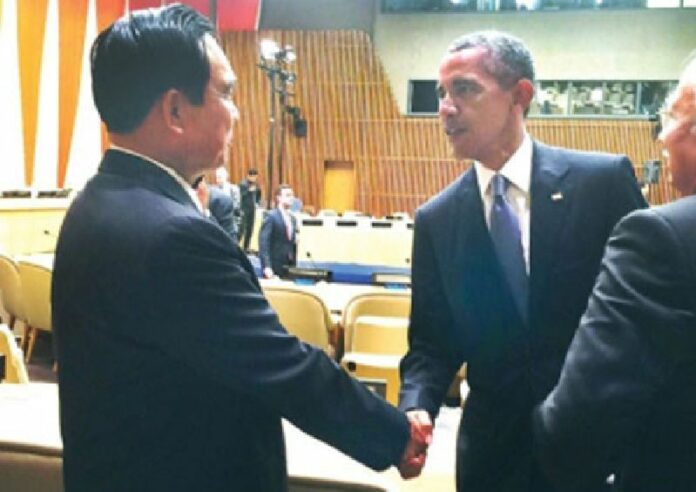
A widely dissected and debated photograph of junta chairman Prayuth Chan-ocha and US President Barack Obama shaking hands Sept. 29 at the United Nations General Assembly in New York.

By Pravit Rojanaphruk
Senior Staff Writer

BANGKOK — When the leader of Thailand’s junta arrives in California tomorrow for the first ASEAN summit held on U.S. soil, its critics agree that it signals no softening in Washington’s approach to the regime, but warn that pro-democracy forces must rely on themselves rather than Western support.

International relations experts generally agree that Thais who want power returned to the people cannot expect it to happen under pressure from Western governments. Instead most hope American officials take the opportunity Monday and Tuesday to remind Gen. Prayuth Chan-ocha to keep his promises this time when it comes to holding a free and fair vote on the draft charter and general elections next year.

The question comes as Prayuth’s second visit to the United States next week will not be on United Nations’ business as in September but at the invitation of the Americans, who have played it cool and cordial with their longtime ally since the coup.

“I don’t think it constitutes a policy shift on part of the U.S., as all ASEAN leaders have been invited and the U.S. president is trying to engage with ASEAN as a bloc instead of on a state-by-state basis as China does,” said Pongkwan Sawasdipakdi, a lecturer of International Relations at Thammasat University. “I don’t think they will pay special attention to Thailand [during the summit].”

Indeed as Cold War maneuvering unfolds in the disputed South China Sea, Southeast Asia has become critical to the U.S. strategy of confronting China, and six of 10 ASEAN states – Thailand included – have yet to join a key part of that: the Trans-Pacific Partnership trade agreement.

A Chulalongkorn University academic said the United States was merely providing a venue and by no means should be seen as shifting its policy toward Thailand’s junta.

“The National Council for Peace and Order will likely make use of the visit to their benefit, however,” said Puangthong Pawakapan, associate professor of international relations, using the junta’s formal name.

Another international relations expert expressed a similar view, saying that lumping Thailand in with the rest of ASEAN member states is a strategic approach.

“Southeast Asia is important to American strategic interests in Asia and the Pacific region and part of the ‘Asian Pivot’ to contain China,” said Thammasat University’s Virot Ali. ”Thailand is a partner in the region.”

Virot said while Washington will not sever ties with Thailand, the junta leader is unlikely to get a personal invitation to visit the United States either.

“There will probably be no special invitation. ASEAN members already know that they too need the United States, so this is not a softening of the stance of the U.S. [toward Thailand’s military regime],” Virot said.

All three academics said they want to see the United States, possibly President Obama, pressure Prayuth on the sidelines of the ASEAN summit, which takes place Monday and Tuesday in Rancho Mirage, Calif., to ensure the promised referendum on the junta-sponsored draft charter will be conducted in a free and fair manner and pave the way for an elected government to take over by the end of 2017 or early 2018.

“The United States may not say it straight, but President Obama could express concerns about the transition to democracy, and it may be done vaguely during a closed door meeting. But they will definitely have to take a stance on the matter,” Pongkwan said.

On Friday, the New York-based Committee to Protect Journalists called on Obama to use the summit as an opportunity to press Southeast Asian leaders to improve “press freedom as a precondition for developing stronger ties.”

Pongkwan however believes there’s not much the United States can do, adding that perhaps backdoor diplomacy with the conservative Thai elite may be more effective.

“I’m rather without hope when it comes to whether the United States will do more than just talk. We can’t just expect the U.S. [and E.U. as well as U.K.] to save us beyond making [Prayuth] look like a buffoon,” she said.

Locally, U.S. diplomats have reportedly played down the possibility of Obama singling out any specific ASEAN players for admonishment. Pongkwan remains hopeful that Obama, who’s in the twilight of his presidency, will take the opportunity to send a clear message.

“America is playing a two-legged strategy, and things are rather unclear,” the Thammasat lecturer said. “But Obama could do something for his legacy as he’s finishing his term.”


Thais Should Rely More on Themselves

Many of those interviewed said the Western powers of the United States, United Kingdom and European Union are only willing to go so far to oppose Thailand’s military junta as they have to consider their own economic and geopolitical interests. They advocate pro-democracy Thais do more than just sit and wait for change.

“While we must admit that these countries’ roles toward Thailand are important, what’s more important is the role of Thai people themselves,” said Rangsiman Rome, a leader of the New Democracy Movement. “If people in the country continue accepting the junta, it will make Prayuth appear legitimate.”

Similarly, Puangthong said the West doesn’t want to squeeze Thailand so hard it tilts further toward Beijing.

“I don’t want Thais to pin too much hope on Western nations. They have their own interests to defend, and they fear Thailand falling into China’s orbit,” she said.

Pongkwan too warned that any state will defend its own national interests first and foremost.

“They will probably recalibrate their policies [toward Thailand] if the junta stays beyond [its current promise to cede power at the end of 2017.].”

A longtime American scholar based in Khon Kaen said the challenge for the United States is to find a way to engage democratic forces in Thailand instead of giving in to just “treating Thailand as just one more authoritarian state in Southeast Asia.” After all, David Streckfuss said, Thai democracy may be flawed but it is also vibrant.

Streckfuss predicts the junta will not keep to its timetable.

“The military will continue to cite any reason to stay on in power [beyond 2017]. [The West] simply can’t get bored and back out,” he said, adding that the junta’s strategy seems to be to exhaust its opponents, both domestic and abroad.

In case the junta stays on long than its currently promising, Thammasat’s Virot believes the West could either step up its pressure or simply abandon Thailand as another despotic state as it did with Myanmar in the 1990s and build closer economic and political ties with Thailand’s neighbors.


Related stories:

Prayuth Warns Obama Not to Trust Reports of Rights Abuses

Obama: 'Militarization' of South China Sea Must Stop

Obama Offered Handshake to Prayuth, Govt Says

.


Pravit Rojanaphruk can be reached at [email protected] and @PravitR.

Follow Khaosod English on Facebook and Twitter for news, politics and more from Thailand. To reach Khaosod English about this article or another matter, please contact us by e-mail at [email protected].


Follow @KhaosodEnglish

\

Advertisement

Love-Spurned Elephant Damages 15 Cars in Southern China

A male elephant stands in an agricultural plot in Ban Ta Klang, Surin Province. Photo: DPA

BEIJING — After losing out on his love interest, a wild elephant has turned his attention to cars.

The elephant wandered out of a nature reserve in southern China on Friday following a failed courtship and started playing with cars parked along a highway, slightly damaging more than a dozen vehicles, authorities said.

The government of Xishuangbanna prefecture said that the animal had recently lost to another male elephant in a battle for the affections of a female, and that his temperament was moody. Staff at the nature reserve thought the animal might have become playful at the sight of the cars, the government said in a posting on its social media account.

The elephant did not hurt any of the tourists who had crowded the area during the Lunar New Year holiday, and who were very excited to see the elephant, the government said. The animal's public appearance lasted about 20 minutes before he returned to the nature reserve.

"The tourists were quite excited to see a real wild elephant, and they were using their cellphones to take photos and videos," the government said. "Even the owners of some damaged cars found the experience to be thrilling and very interesting, although their cars got scraped."

The owners of the 15 cars that were damaged by the elephant will be compensated, the government said.

Story: Associated Press

Advertisement

Masseuse Puzzles Over Very Rude Vandalism

A police officer inspects the car of Thitirat Lheesuwan, 43, on Saturday after it was mysteriously painted with offensive language in Ratchaburi province.

RATCHABURI — Thitirat Lheesuwan was surprised but not impressed that someone decided to decorate her car with rude words just before Valentine’s.

The 43-year-old masseuse Saturday morning discovered her car was painted in red with some rather offensive comments about her. She told Ratchaburi police that she suspected the perpetrator was a customer she refused to flirt with, or the jealous wife of a customer who might have gotten her wrong.

The graffiti did not consist of more than crude insults.

Thitirat told police she parked the car in front of her home at 11pm on Friday night after finishing work and covered it under a grey blanket, according to Lt. Col. Anek Butdee. Her neighbors said they heard a dog barking at 3am but didn’t think it was suspicious.

Police said they will review footage from nearby security cameras to track down the rude graffiti artist.


Advertisement

Obama to Push Trade Agenda at ASEAN Summit

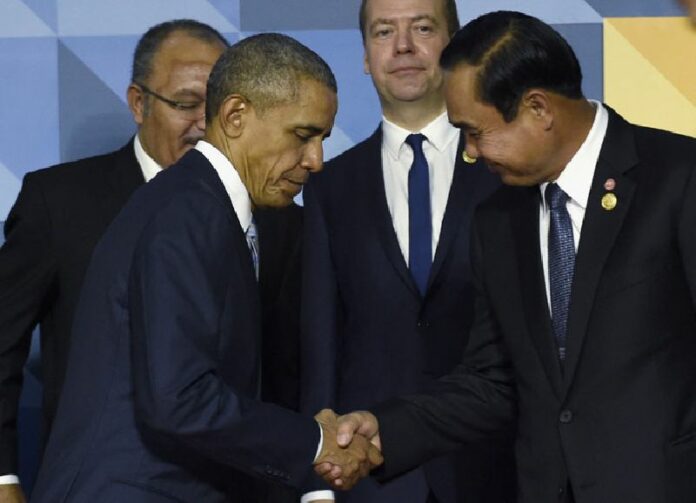
President Barack Obama shakes hands with Prime Minister Prayuth Chan-ocha on Nov. 19, 2015, in Manila, Philippines. When Obama welcomes Southeast Asian leaders for a shirt-sleeves summit in California this week, he’ll have some interesting dining companions. There will be a coup leader with a penchant for song, a sultan with a taste for the high life and a ruthless prime minister with 31 years on the job. Photo: Susan Walsh / Associated Press

MANILA, Philippines — A summit next week between Southeast Asian leaders and President Barack Obama is unlikely to deliver any big economic prizes, but will allow the American side to press the advantages of joining a Pacific trade pact that doesn't include China.

The meetings at Rancho Mirage in California set for Monday and Tuesday will be the first summit of its kind for the 10-member Association of Southeast Asian Nations on U.S. soil. Its special nature is intended to show the Obama administration's commitment to countering growing Chinese influence in a region that is home to 620 million people and a USD$2.6 trillion (92.6 trillion baht) economy.

Southeast Asian nations have benefited from increased trade and investment stemming from their giant neighbor's economic rise but many are wary of China achieving overweening influence. The United States, meanwhile, has an interest in maintaining freedom of navigation in the South China Sea, a crucial global trade route.

The summit is meant to send a signal that the Washington values ASEAN, said U.S. Deputy National Security Advisor Ben Rhodes, using the acronym for the Southeast Asian grouping.

"We are going to be engaged in Southeast Asia, we're going to be engaged in working with the nations of the Asia Pacific to clear rules of the road on the various issues of common interest that we share with them," he said.

The Southeast Asian nations of Brunei, Malaysia, Singapore and Vietnam are already part of the U.S.-led Trans Pacific Partnership trade pact that is awaiting ratification by national parliaments. The agreement eliminates many tariffs and also imposes minimum labor standards on member nations as part of U.S. efforts to set rules for trade and business in the region and beyond.

Indonesia, which is the largest economy in Southeast Asia, along with Thailand and the Philippines are prospective members of the pact, which took several years to negotiate and was a main plank in Obama's drive for a deeper relationship with Asia.

Cambodia, Laos and Myanmar, which are the least developed countries in Southeast Asia, aren't eligible to join because they aren't members of the Asia Pacific Economic Cooperation grouping.

Richard Javad Heydarian, assistant professor of political science at Manila's De La Salle University, said he expects Obama to pitch the benefits of American-led economic initiatives, and particularly for Southeast Asia's economic heavyweights, Indonesia and Thailand, to join the Pacific trade agreement.

He also expects Obama to court Cambodia, Laos and Myanmar as countries that are within the economic orbit of China.

"What the U.S. can do, what Obama can do, is encourage these countries to be less dependent on China so that they have more options when it comes to their foreign policy, when it comes to how they govern themselves," he said.

A new U.S. initiative called ASEAN Connect aims to set up U.S. government regional offices in Jakarta, Bangkok and Singapore to help Southeast Asia on infrastructure projects, and support development by helping poorer countries such as Laos, Myanmar and Cambodia to improve customs services, develop investment regulations and the rule of law.

Philippine Finance Secretary Cesar Purisima said expanded economic ties could "form the building blocks of a potential trade agreement and perhaps prepare the region in joining the TPP."

Alexander Feldman, president and CEO of the Washington-based US-ASEAN Business Council representing American businesses in Southeast Asia, said the addition of Indonesia, Thailand and the Philippines would be a substantial boost to the Trans Pacific Partnership.

But there are challenges to overcome for each country. The Philippines, for example, needs to amend foreign ownership restrictions in its constitution, a highly contentious move in the rambunctious democracy of more than 100 million people.

Feldman, a former Assistant Secretary of State, does not expect a lot of concrete outcomes from the summit. But he said it will set the stage for successful US-ASEAN and East Asia summits in Laos in September, and continued close ties after Obama bows out of office next year.

Story: Teresa Cerojano / Associated Press

Advertisement

Getting in Touch With the Inner Dictator

By Pravit Rojanaphruk
Senior Staff Writer

\


Editor’s note: Instead of filing his regular column, Khun Pravit left the following document in an unmarked manila envelope.


EVALUATION FILE


FILE NO. 220514

Subject: Full-time military dictator since late May 2014. At present, subject has held absolute power without the consent of the people for nearly two years.

Subject Title: The General, Dear Junta Leader, Mr. Prime Minister, The Dictator, Uncle.

Age: 60-something.

Future Occupation: Very uncertain.


SYMPTOMOLOGY

Mood Lability: Subject suffers from severe mood lability (mood swings) characterized by recurring outbursts of anger. The behavior manifests when subject feels unappreciated and resentful toward people who do not appreciate or praise him.

Behavioral Observation: “I am worthless,” subject declared Feb. 3 during his latest fit of mood lability.

At times the subject resorts to shouting in public, using language unfit even for an unelected prime minister, and since usurping power, has developed a compulsive addiction to throwing objects at reporters such as partially eaten fruit. In one of his latest mood swings, the subject expressed self-destructive impulses by angrily pounding his fist onto his own podium – an object he once desired enough to stage a coup d’etat for – until his reading glasses were knocked to the floor.

Insomnia: The subject publicly admitted last week he struggles to sleep.

Behavioral Observation: “These days I can’t sleep. Last night I couldn’t sleep. I kept thinking until 3am. I think a lot, think every day, think about everything. … I didn’t realize there would be so much problems” subject was overheard saying by the Daily News newspaper.

It was unclear whether the subject referred to problems facing Thailand or himself, or whether he can differentiate between the two.

State of Denial: Despite the subject’s welldocumented mood lability, the subject appeared to be in a state of denial about his own condition.

Behavioral Observation: On Feb. 4, a television station broadcast a clip of subject on camera telling others: “You people should not look at me as being moody.”

This was preceded by the subject’s admission on camera that he doesn’t know quite how to behave any longer.

“I don’t know what to do. When I speak at length [on compulsory-broadcast TV monologues every Friday evening] people don’t listen and want to watch soaps. If I speak too briefly, they won’t understand. Should the leader just dance in a stage drama then?” subject commented, nothing he never felt “this tired” when he previously led an army with “200,000 to 300,000 officers” under his command.


DIAGNOSIS

The subject appears to suffer from an overdose of power and overconcentration of responsibility in his hands. It’s unlikely he will delegate these to subordinates, as by nature, a dictator is compelled to dictate.

Subject is driven by a deep need for acceptance and legitimacy. Countless case studies of dictators who came to power by taking it struggle to be loved by those who would have preferred to choose who led them.

Given his own statements, subject exhibits self-awareness of the conditions he suffers from but unequipped for alleviating those conditions. He appears to suffer stress, anxiety, feelings of inadequacy and more. Despite the absolute power he has accrued and uses to suppress others, subject appears unable to suppress his own emotions.


SUGGESTED COURSE OF TREATMENT

Being a military dictator in a despotism-nurturing society, where many dictators have enjoyed healthy and productive reigns, does not come with a capacity for listening. It’s unlikely the subject would take any therapeutic suggestions kindly.

While taking ownership of his personal-cum-national baggage by admitting guilt, expressing remorse and asking for forgiveness would likely see marked improvement in the subject’s own sense of self-worth and desire to be loved, such is not naturally expressed behavior by those who cling to autocratic tendencies.

Any psychiatric course of mood-stabilizing or -elevating drugs may prove ineffective and is contraindicated due to subject’s pre-existing intoxication with own absolute power.

Subject’s absolute power under Article 44 of the military provisional constitution is also useless. Although the subject exhibits a full-blown dictatorial tendency, he has clearly proved over the last year and a half that he is unable to use his absolute power to control his own mood.


CONCLUSIONS

Any public prescription or recommendation must be done at prescriber’s own risk. Such attempts may exacerbate symptoms and provoke further bouts of mood lability.


Pravit Rojanaphruk can be reached at [email protected] and @PravitR.

Follow Khaosod English on Facebook and Twitter for news, politics and more from Thailand. To reach Khaosod English about this article or another matter, please contact us by e-mail at [email protected].


Follow @KhaosodEnglish

\

Advertisement

Military Blocks Satirical Student Float, Re-Arrests 'Ja New'

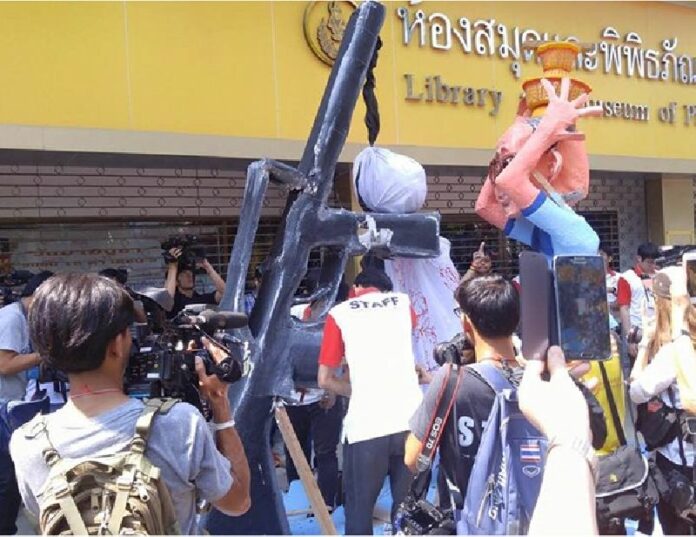
Thammasat university students remove a rifle from a float satirizing the junta-sponsored draft constitution Saturday at Bangkok’s National Stadium. Photo: Matichon

BANGKOK — Satire and at least student activist were removed by force Saturday from an annual student parade known for skewering politics.

Plainclothes military forces ordered students cut something that looked like a gun from a float about the new constitution at the National Stadium in Bangkok, where Thammasat and Chulalongkorn university students gathered for an annual football scrum, and later arrested a well-known activist leader.

After security forces were duped last year  when students disguised their political messages, hundreds of non-uniformed officers gathered to monitor and censor the satirical parade famously used as an outlet for student political expression.

One float featuring the controversial draft constitution, criticism of which has been squelched by the junta, was ordered changed.

“Students are ordered to saw off the gun figure, otherwise the officers won’t let it enter the field,” wrote the independent satirical political group of Thammasat university on Facebook. “They said it’s inappropriate because the gun looks violent.”

It was reported that a banner about politics was also confiscated as it said “NCPO” in reference to the junta’s formal name, the National Council for Peace and Order.

Student activist, Sirawith “Ja New” Seritiwat, a fourth-year political science student at Thammasat University and leader of the New Democracy Movement, was reportedly arrested by undercover officers disguised in Thammasat football jerseys Saturday afternoon after joining the parade.

Sirawith was being held at the Thonburi Railway Police Station. It is believed he was taken under the power of an arrest warrant issued after he tried to lead a group of activists to the scandal-tainted Rajabhakti Park in December.

“There is no reason for me to fear the arrest warrant,” Sirawith said to reporters following his arrest Saturday. “Because for me, the orders of the NCPO are not the law.”

In 2015 students frustrated military minders by disguising political messages under more innocent messages that were ripped off as they entered the playing field. Aghast officers rushed to close the gate but the images ended up widely disseminated in the media.


As much as its pre-game parade, the football game is also famous for students flashing provocative flash cards messages from the stands during the game.

A military officer said Friday the event would be shut down if any conduct or message was deemed to be defamatory, cause social disharmony or damage the nation’s image.

“The committee of the event will inspect the satirical floats and cooperate with officers,” said Maj. Gen. Chalermphol Srisawat on Friday. “If there is a problem, the show will be abruptly ordered to stop.”

Though when the parade entered, an officer disguised in a Chulalongkorn football jersey suddenly interrupted and ripped away a banner carried by students.

Update: Story updated with information about arrest of student activist Sirawith Seritiwat.


Advertisement

Hot News

LATEST NEWS

Bangkok
scattered clouds
30 ° C
32.2 °
30 °
80 %
2kmh
48 %
Fri
31 °
Sat
36 °
Sun
36 °
Mon
36 °
Tue
34 °