28.3 C
Bangkok
Sunday, June 21, 2026
Home Blog Page 2809

300 Rare and Famous Guitars Coming to NYC Auction

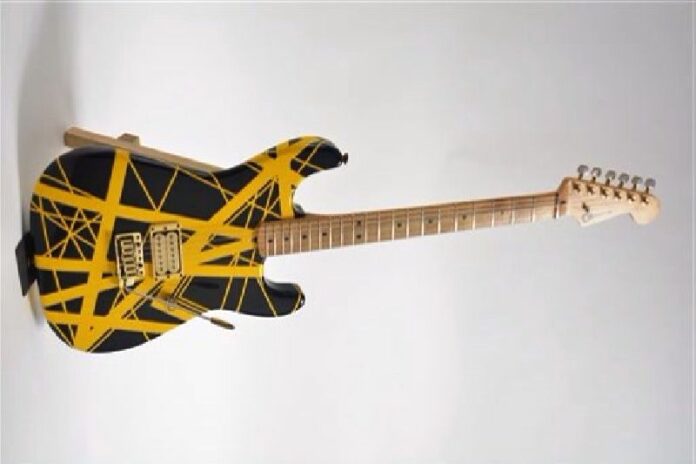
This undated photo provided by Guernsey’s auction house shows a yellow-and-black Charvel guitar, customized for Eddie Van Halen in the 1980s It could bring $60,000 to $80,000 when it goes up for sale on Feb. 27, 2016, in New York. Photo: Guernsey's / AP

NEW YORK — About 300 guitars, including instruments associated with Eric Clapton, Elvis Presley and Eddie Van Halen, are heading to a New York City auction.

Also on tap at Guernsey's sale Feb. 27 are acoustic guitars from the late 1800s and one played by actor Robert Blake in the film "In Cold Blood."

Among the top highlights is a 1952 Gibson Super 400 CES 7-String made for late studio guitarist Tony Mottola that could bring as much as $100,000. Mottola worked with such music greats as Frank Sinatra, Perry Como, Johnny Mathis and Rosemary Clooney.

There are two "In Cold Blood" guitars. One was used by Blake in the role of killer Perry Edward Smith in the 1967 Oscar-wiinning movie based on the blockbuster book by Truman Capote, and the other is the actual guitar owned by Smith. They are being offered as one lot with a pre-sale estimate of $150,000 to $200,000.

A yellow-and-black Charvel guitar, customized for Eddie Van Halen in the 1980s, could bring $60,000 to $80,000. The original bill of sale made out to Van Halen is included.

A 1959 Gibson owned by Franny Beecher, the lead guitarist for the rock and roll band Bill Haley & His Comets, could fetch $20,000 to $25,000. It's one of only 57 made in 1959 in the natural finish.

Also in the auction catalog are four guitars associated with Eric Clapton, two of them signed; several Elvis Presley items, including a signed guitar; and Jimi Hendrix's guitar strap from Woodstock.

The sale also includes vintage guitars and mandolins made by string instrument maker Joseph Bohmann and more than 40 guitars from the late arranger and jazz musician Robert Yelin. About two dozen instruments owned by guitarist and singer-songwriter George Benson also are being offered.

Story: Associated Press


To reach us about this article or another matter, please contact us by e-mail at: [email protected].

Follow Khaosod English on Facebook and Twitter for news, politics and more from Thailand.

Follow @KhaosodEnglish

\

Advertisement

N. Korea Praises Launch, Others See as Covert Missile Test

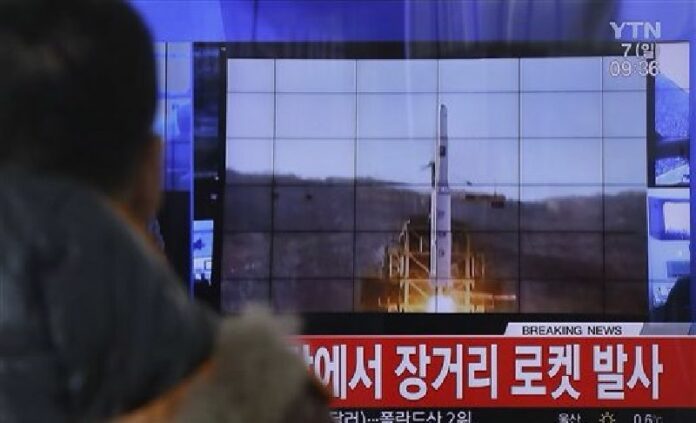
A South Korean man watches a TV news program with file footage about North Korea's rocket launch at Seoul railway station, Sunday, Feb.7. 2016. Photo: Ahn Young-joon / AP

SEOUL — North Korea on Sunday defied international warnings and launched a long-range rocket that the United Nations and others call a cover for a banned test of ballistic missile technology.

The rocket was fired from North Korea's west coast and its path was tracked separately by the United States, Japan and South Korea; no damage from debris was reported. At an emergency national security council meeting in Seoul, the country's president called the firing an "intolerable provocation."

North Korea, which calls its launches part of a peaceful space program, trumpeted the beauty of the launch's "fascinating vapor" as the rocket cut through the clear blue sky and said it had successfully put a new Earth observation satellite, the Kwangmyongsong 4, or Shining Star 4, into orbit less than 10 minutes after liftoff. It vowed more such launches. A U.S. official said it might take days to assess whether the launch was a success.

The firing came about two hours after an eight-day launch window opened Sunday morning. It follows North Korea's widely disputed claim last month to have tested a hydrogen bomb. Washington and its allies will consider it a further provocation and push for more tough sanctions. The United States and Japan quickly requested an emergency meeting of the U.N. Security Council on Sunday morning, saying Pyongyang violated a council ban on ballistic missile launches.

North Korean rocket and nuclear tests are seen as crucial steps toward the North's ultimate goal of a nuclear armed missile that could hit the U.S. mainland. North Korea under leader Kim Jong Un has pledged to bolster its nuclear arsenal unless Washington scraps what Pyongyang calls a hostile policy meant to collapse Kim's government. Diplomats are also pushing to tighten U.N. sanctions because of the North's Jan. 6 nuclear test.

In a statement, North Korea's National Aerospace Development Administration, in typical propaganda-laden language, praised "the fascinating vapor of Juche satellite trailing in the clear and blue sky in spring of February on the threshold of the Day of the Shining Star." Juche is a North Korean philosophy focusing on self-reliance; the Day of the Shining Star refers to the Feb. 16 birthday of former dictator Kim Jong Il. North Korea has previously staged rocket launches to mark important anniversaries.

Defense Ministry spokesman Moon Sang Gyun said a South Korean Aegis-equipped destroyer detected the North Korean launch at 9:31 a.m. The rocket's first stage fell off North Korea's west coast at 9:32 a.m. and the rocket disappeared from South Korean radars at 9:36 a.m. off the southwestern coast. There was no reported damage in South Korea.


International Reaction


The South Korean government couldn't immediately confirm reports by Yonhap news agency and YTN TV that the rocket might have failed.

The U.S. Strategic Command issued a statement saying it detected and tracked a missile launched on a southern trajectory but it did not pose a threat to the United States or its allies.

Japan's NHK broadcaster showed footage of an object visible in the skies from the southern island of Okinawa that was believed to be the rocket. Japanese chief Cabinet spokesman Yoshihide Suga told reporters that no debris fell on Japanese territory.

The global condemnation began almost immediately.

South Korean President Park Geun-hye called the launch an "intolerable provocation." She said the North's efforts to advance its missile capabilities were "all about maintaining the regime" in Pyongyang and criticized the North Korean leadership for ignoring the hardships of ordinary North Koreans.

Japanese Prime Minister Shinzo Abe vowed to "take action to totally protect the safety and well-being of our people." U.S. National Security Adviser Susan Rice called the North's missile and nuclear weapons programs a "serious threats to our interests — including the security of some of our closest allies."

The Foreign Ministry in China, the North's only major ally and protector in the U.N. Security Council, where Beijing wields veto power, expressed "regret that, disregarding the opposition from the international community, the (North) side obstinately insisted in carrying out a launch by using ballistic missile technologies."

Kim Jong Un has overseen two of the North's four nuclear tests and three long-range rocket tests since taking over after the death of his father, dictator Kim Jong Il, in late 2011. The U.N. Security Council prohibits North Korea from nuclear and ballistic missile activity. Experts say that ballistic missiles and rockets in satellite launches share similar bodies, engines and other technology.

"If North Korea has only nuclear weapons, that's not that intimidating. If they have only rockets, that's not that intimidating, either. But if they have both of them, that means they can attack any target on Earth. So it becomes a global issue," said Kwon Sejin, a professor at the Korea Advanced Institute of Science and Technology.

North Korea in 2013 also did a nuclear test and then unnerved the international community by orchestrating an escalating campaign of bombast, including threats to fire nuclear missiles at the U.S. and Seoul.

North Korea has spent decades trying to develop operational nuclear weapons.

North Korea has said that plutonium and highly enriched uranium facilities at its main Nyongbyon nuclear complex are in operation. The North is thought to have a small arsenal of crude atomic bombs and an impressive array of short- and medium-range missiles. But it has yet to demonstrate that it can produce nuclear bombs small enough to place on a missile, or missiles that can reliably deliver its bombs to faraway targets.

After several failures testing a multistage, long-range rocket, it put its first satellite into space with a long-range rocket launched in December 2012.

The North's recent activity comes amid a long-standing diplomatic stalemate. Six-nation negotiations on dismantling North Korea's nuclear program in exchange for aid fell apart in early 2009.

Story: Foster Klug / Associated Press


To reach us about this article or another matter, please contact us by e-mail at: [email protected].

Follow Khaosod English on Facebook and Twitter for news, politics and more from Thailand.

Follow @KhaosodEnglish

\

Advertisement

No Evidence of Sexual Assault of Russian Woman, Pattaya Police Say

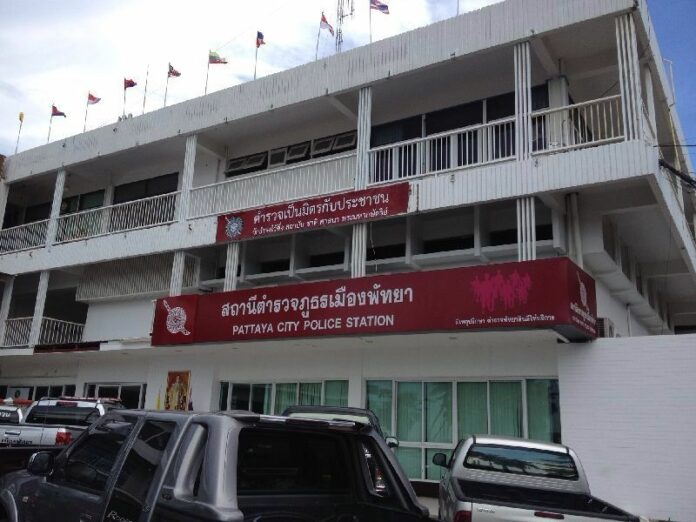
Pattaya City Police Station in an undated file photo.

By Pravit Rojanaphruk
Senior Staff Writer

PATTAYA — Pattaya police said a medical examination found no evidence of rape in the case of a 20-year-old Russian woman who said she had been sexually assaulted by a Thai man.

Pattaya Police commander Col. Sukthat Pumpanmuang said no indication of sexual intercourse was found, and they believe it was more likely she was a victim of attempted sexual assault as they wait for the results of a more thorough examination by mid-February.

“At this moment, there was no trace of rape. We got the suspect,” Sukthat said, adding that the suspect, 30-year-old tattoo artist Wuthipong Phoomkokrat, insisted he got as far as removing his pants before being kicked by the woman. “We believe no actual rape took place, and the woman seems to have understood now that she has not been raped.”

Police Capt. Thitiwatt Boonon, who is in charge of investigating the case, said the woman and the accused will meet Feb. 15 when the results of the full medical examination are expected to be released.

Thitiwatt said Wuthipong will, for now, be charged with indecent assault. As he has a registered residency in Pattaya city, he was allowed to go home and ordered to report to police Feb. 15.

Police said the woman and Wuthipong met through a common friend. The woman, who has been living on-and-off in Pattaya for the past two years, went out to drink and eat with him and returned to his apartment early Wednesday morning. She then told police that she drank some orange juice and fell half asleep. When she woke up her clothing had been partially removed.

Thitiwatt said the Russian woman wants to know if she was drugged, so a blood sample was taken for testing with the results expected within two weeks.

The maximum penalty for indecent assault is five years in jail, although the charge can be settled out of court if both parties reach agreement.

Related stories:

Rape of Russian Woman Reported in Pattaya


Advertisement

Army Denounces Deep South Torture Report as Product of ‘Imagination’

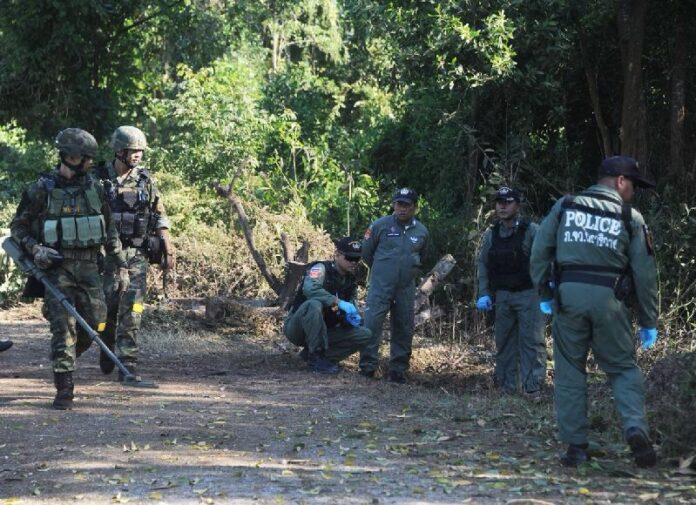
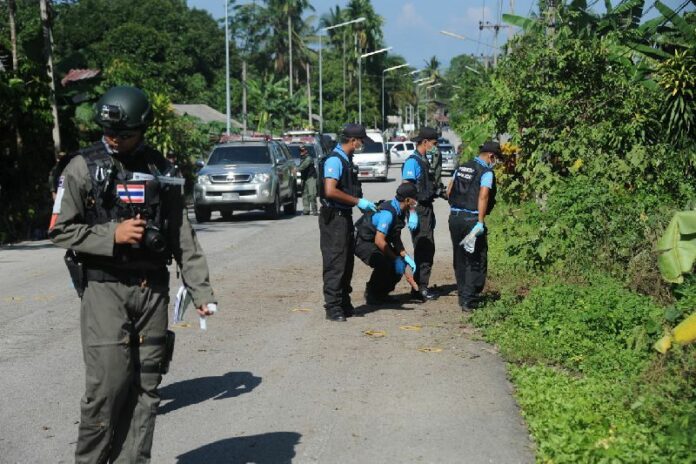
Security forces investigate the site of a bomb attack Jan. 12 in Narathiwat province.

BANGKOK — A spokesman for the national counter-insurgency agency today denounced a report alleging the use of more than a dozen torture techniques to force confessions from insurgent suspects in the Deep South as a work of fiction aimed at destroying the credibility of the army.

The report released Tuesday by the Pattani-based Muslim Attorney Center Foundation alleged that in 2015, the military used a wide range of physical and psychological abuse to secure confessions from suspected separatist insurgents, claims which Col. Pramote Promin, spokesman for the Internal Security Operation Command, or ISOC, discounted as an attempt to discredit Thailand.

The report details the use of techniques including waterboarding, electric shock, detaining suspects in a cold room, forcing water into the mouth, forced removal of all clothes, chemical injections with psychological effects, forced drinking of urine, hooding suspects with plastic bags and forcing suspects to do things that are against their religious beliefs.

\
Cover page of the report by the Muslim Attorney Center Foundation

“There is no crime or evil worse than such an act being conducted by using power under the law,” part of the report stated.

Interrogations running all day and all night were also alleged to also have taken place, according to the foundation. The Muslim Attorney Center Foundation said the allegations were made by 33 complainants who said they occurred in 2015 in the three southernmost provinces of Pattani, Yala and Narathiwat.

“It’s a result of imagination not based on reality,” said Pramote of ISOC’s Region 4 Forward Command, whose agency provides security in those provinces.

He said the army is well aware of human rights and accused the group of attorneys which released the report of wanting to undermine the credibility of the Thai state in the eyes of the world.

“Why don’t you to try to analyse it yourself and ask if that’s possible?” he said. “These people want to discredit the state. We learnt our lessons, and detentions are done transparently.”

According to the report, the most common form of alleged torture is various physical assaults, often with wooden batons. The lawyers said they had received 29 such complaints.“In some cases, family members have also been threatened by convincing them [to have their family member] confess.”

Pramote said the report was a work of the imagination and that the ISOC is looking into it, including consulting with its legal team. He went on to say that he and some locals doubt whose side the group of Muslim lawyers represent and asked why they don’t assist victims of separatist violence.

“Why don’t they help these people? Some locals ask if they’re on the side of the goons,” he said.


Advertisement

Fire Scene Cordoned off for Inspection

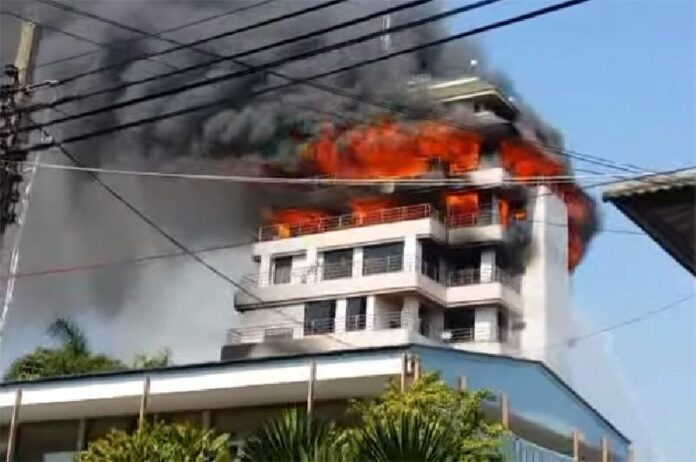
Still image from a video showing the fire Friday afternoon at a building on Soi Narathiwas 18.


By Pravit Rojanaphruk
Senior Staff Writer

BANGKOK — Police have cordoned off the 10-story building which caught fire Friday in Bangkok’s Yannawa district to allow for an inspection by officials. The Department of Public Works and Town and Country Planning will assess whether the building can still be used.

A woman was killed in yesterday’s fire and the building which is on Soi Naradhiwas Rajanagarindra 18 in Sathorn area appears to be structurally damaged. The inspection is expected to take two days and the authority will check whether the building owner made any additions to the structure without seeking a permit.

Angkana Osiri, 65, was killed on a seventh floor balcony in the building yesterday. She appeared to have suffocated and lost consciousness before being engulfed by fire according to witnesses. A number of people jumped down from the flaming building to safety and at least three were injured in the incident but survived.


Related Stories

Rescue Workers Search for Victims Trapped in Fire

Follow Khaosod English on Facebook and Twitter for news, politics and more from Thailand. To reach Khaosod English about this article or another matter, please contact us by e-mail at [email protected].


Follow @KhaosodEnglish

\

Advertisement

The Artistic Side of Thai Political Crisis

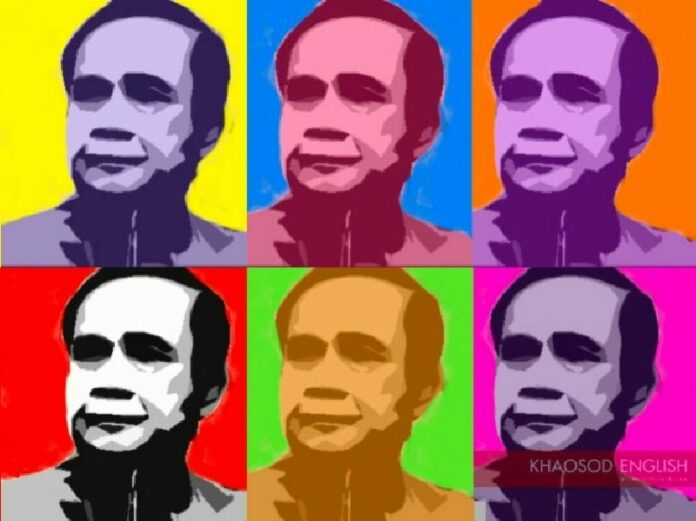
Gen. Prayuth Chan-ocha

By Pravit Rojanaphruk
Senior Staff Writer

\

BANGKOK — One of the most problematic aspects of the decade-long political feud in Thailand is that many people cling to their own perceived political truths with no room for differing views. The result is little dialogue, not to mention sympathy.

These people can best be understood using a few Western artistic schools as a guide. Ten years is a long period of time for any society to be trapped in a pithole of crisis, and the sooner people can recognize our perceptive shortcomings the better.


The Impressionists: These Thais heavily rely on their impression to interpret political situation. If their perception is that junta leader Gen. Prayuth Chan-ocha is a gentlemanly officer who is sacrificing his time to save the kingdom from bloodshed and self destruction, then no mount of stats, facts or repression can sway their established opinion.

\The same goes with Thaksin-Yingluck Shinawatra fans. No amount of abuse of power or corruption allegations or court cases can shake their belief in the siblings as heroes. To these people, if their impression is that the sky is green, then it’s just green. There’s enough information ghettos on cyberspace for these two groups in endlessly dwell in their own world of good versus evil – the only choice to is decide which side is good or evil.


The Expressionists: Too busy to listen to differing views, the Expressionists indulge themselves in spreading their one-sided views on Twitter, Facebook or YouTube to satisfy their artistic, oops, political urges. The military junta may believe in ramming propaganda into our skulls, most recently with one-sided info about its draft charter to be broadcast twice daily Feb. 3-15, but they are not alone. Many netizens are very determined to only say nice things about whoever they’re rooting for. People like exiled former Thammasat University historian Somsak Jeamteerasakul, who is perceived as being pro-Thaksin/Yingluck, have recently been attacked by those genuinely pro-Thaksin/Yingluck for merely some general criticism of the Shinawatras.

To the political expressionists, listening to differing political views is a waste of time and not part of their daily repertoire.


The Realists: The political realists see society as static. They have neither dreams nor aspirations for a better Thailand. Corrupt politicians will always be corrupt, coups will recur every few years and Thais will never be ready for democracy because they’re irresponsible, naive, little-educated and probably corrupt. They are apolitical.

These people can’t seem to grasp that no society is static, that in terms of rights and liberties, Thailand has progressed much since the days of absolute monarchy less than a century ago at least excluding May 2014 through the present.  


The Surrealists: Dictator Prayuth regularly suggests the public should be grateful for having him stage the coup and rule over us (with an iron fist covered with a thin Thai silk glove). This definitely qualifies the junta leader a surrealist. Prayuth and his men can go on talking about how they respect human rights and how selfless they are in working toward achieving 99.9 percent democracy for Thailand while arresting opponents and forbidding political assembly of five or more persons. Listening to Prayuth talk is a surreal experience in itself, bordering on political Dadaism.

While I respect people’s rights to perceive Thailand however they wish, it would be scandalous to tell Van Gogh, Rothko or Dali that there’s only one way to represent and express reality. For now, Thailand seems trapped in Dali’s “The Persistence of Memory,” where time itself seems to have melted and things refuse to move on.


Follow Khaosod English on Facebook and Twitter for news, politics and more from Thailand. To reach Khaosod English about this article or another matter, please contact us by e-mail at [email protected].


Follow @KhaosodEnglish

\

Advertisement

Bhutan's Queen Gives Birth to a Baby Boy

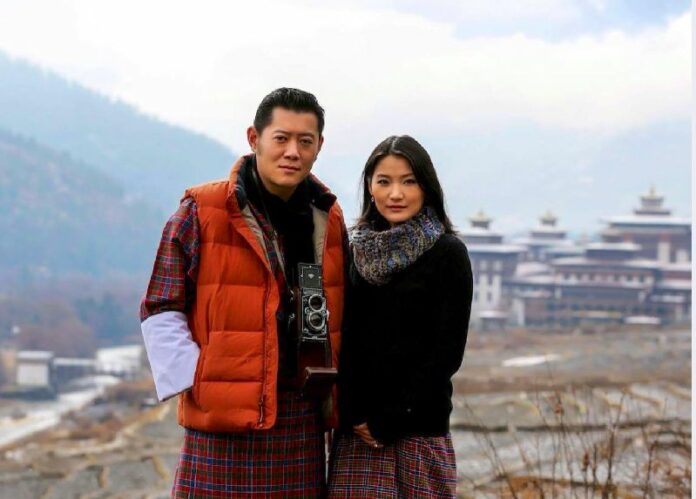
The King and Queen of Bhutan at an unspecified location on Jan. 20, 2016. Photo: Jetsun Pema / Facebook

GAUHATI, India — The tiny Himalayan nation of Bhutan has a new crown prince.

The Royal Media Office in capital Thimphu said Saturday that the baby boy was born on Friday to King Jigme Khesar Namgyal Wangchuck and his wife, Queen Jetsun Pema.

Wangchuck married Jetsun Pema in a Buddhist ceremony in 2011.

The child, the royal couple's first, was delivered by a medical team at the Lingkana Palace in Thimphu.

The media statement says that King Wangchuck was by the side of the queen during the delivery.

Story: Associated Press


To reach us about this article or another matter, please contact us by e-mail at: [email protected].

Follow Khaosod English on Facebook and Twitter for news, politics and more from Thailand.

Follow @KhaosodEnglish

\

Advertisement

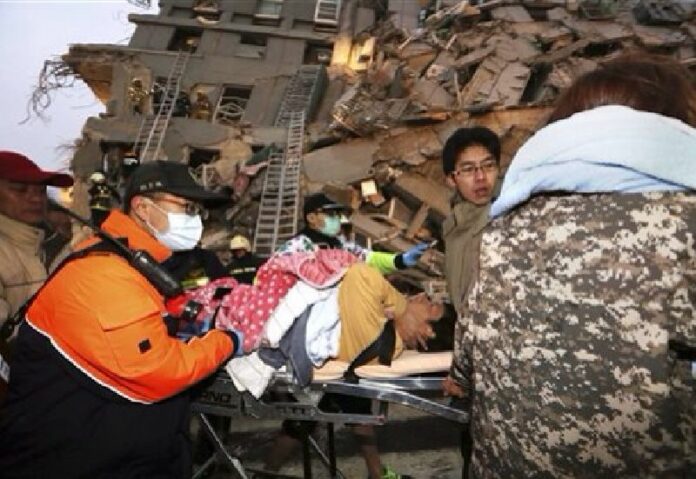
5 Dead, Hundreds Rescued and Injured as Quake Rattles Taiwan

Rescue workers carry a man from the site of a toppled building after an earthquake in Tainan, Taiwan, Saturday Feb. 6, 2016. Photo: Taiwan Out / AP

TAINAN, Taiwan ― A powerful, shallow earthquake struck southern Taiwan before dawn Saturday, collapsing a high-rise residential complex and killing at least five people and injuring hundreds. At least 230 people were pulled out from rubble, as rescuers raced against time to find dozens of others unaccounted for.

More than 1,200 firefighters and soldiers in the worst-hit Tainan city scrambled with ladders, cranes and other equipment to the ruins of a 17-floor residential building that folded like an accordion in a pile of rubble and twisted metal. Local media said the building included a care center for newborns and mothers.

The central disaster response center said five people were killed, including four at the high-rise. One victim was a 10-day-old.

The fifth death was caused by falling objects at a water tower. Another 378 people were injured, the disaster response center said.

The Wei Guan residential tower was home to 256 people living in 96 units. According to the disaster response center, 230 of them were rescued and 26 unaccounted for, although it was unclear how many people were inside the building at the time of the fall.

The news website ET Today reported that a mother and a daughter were among the survivors from the Wei Guan building, and that the girl drank her urine while waiting for rescue, which came sooner than expected.

Dozens more people have been rescued or safely evacuated from a market and a seven-floor building that was badly damaged, the official China Central News Agency reported. A bank building also careened, but no injuries were reported, it said.

Most people were caught asleep when the 6.4-magnitude temblor struck about 4 a.m. local time, Saturday. It was located some 35 kilometers southeast of Yujing, and struck about 10 kilometers underground, according to the U.S. Geological Survey.

As dawn broke, live Taiwanese TV showed survivors being brought gingerly from the high-rise, including an elderly woman in a neck brace and others wrapped in blankets. The trappings of daily life ― a partially crushed air conditioner, pieces of a metal balcony, windows ― lay twisted in rubble.

People with their arms around firefighters were being helped from the building, and cranes were being used to search darkened parts of the structure for survivors. Newscasters said other areas of the city were still being canvassed for possible damage.

Men in camouflage, apparently military personnel, marched into one area of collapse carrying large shovels.

The disaster response center said 1,236 rescuers were deployed, including 840 from the army, along with six helicopters and 23 rescue dogs.

The quake was felt as a lengthy, rolling shake in the capital, Taipei, on the other side of the island. But Taipei was quiet, with no sense of emergency or obvious damage just before dawn.

Residents in mainland China also reported that the tremor was felt there.

Questions were being asked if the construction crew had cut corners when building the Wei Guan residential complex that was finished in 1989. The interior minister, Chen Wei-zen, said an investigation would examine if the developer skirted requirements.

Earthquakes frequently rattle Taiwan, but most are minor and cause little or no damage.

However, a magnitude-7.6 earthquake in central Taiwan in 1999 killed more than 2,300 people.

Facebook has activated its "safety check" feature for Taiwan that allows users to let their friends and loved ones know they're safe.

Facebook chairman and CEO Mark Zuckerberg says in a posting, "My thoughts are with everyone in Taiwan and across our global community affected by this disaster."

The link is available at http://www.facebook.com/safetycheck/taiwanearthquake-feb02-2016

China has offered assistance to Taiwan following a 6.4-magnitude quake that killed at least three people and injured more than 150 in the south of the self-ruled island.

According to China's office handling relations with Taiwan, mainland officials have been in touch with their Taiwanese counterparts since shortly after the quake hit the southern city of Tainan.

China sent a letter offering rescue assistance if needed, and expressed condolences to those who suffered in the quake.

Story: Wally Santana / Associated Press


To reach us about this article or another matter, please contact us by e-mail at: [email protected].

Follow Khaosod English on Facebook and Twitter for news, politics and more from Thailand.

Follow @KhaosodEnglish

\

Advertisement

Police Find Pipe Bomb Rocket in Hat Yai

The site where a roadside bomb injured four security officers and two students May 29, 2015, in Narathiwat province.

HAT YAI — Police in southern Thailand, where Muslim separatists are staging an insurgency, said they found and disarmed a small improvised explosive rocket on Friday similar to ones discovered for the first time last month.

Police Col. Patta Madawa said the device, which looks like a pipe bomb with fins, fell into the living room of a house in Narathiwat province and was defused by demolition experts. Police later found a launching device on a football field at a nearby Muslim school.

Last month, after several similar devices were found by authorities, the separatist Patani United Liberation Organization said it was targeting Thai army bases with rocket attacks, though it is unclear if any launches were carried out.

More than 5,000 people have been killed since an insurgency erupted in 2004 in Thailand's three southernmost provinces, the only ones with Muslim majorities in the Buddhist-dominated country. Last year the level of violence dropped, according to official figures, but peace talks have made little apparent progress.

A police explosives expert who asked not to be identified because he was not authorized to speak to the media said the device found Friday did not appear to have been aimed at a target, and was probably just a test. The rocket, made of 4-inch (10-centimeter) diameter pipe, was similar to a pipe bomb and contained ball bearings to serve as shrapnel. He said it had elements similar to rockets found in Pattani province in January and it was likely they were produced at the same place.

The insurgents are known for drive-by shootings and bombs placed on parked motorcycle and cars. They are not known to have used homemade rockets before, and those discovered in January apparently were not actually fired.

Story: Associated Press

Advertisement

10 Other Surprisingly Absurd Thai Laws

As everyone but Pattaya police scratch their heads over why 32 elderly, Western retirees were taken into custody in a raid on their bridge game, authorities point to a 73-year-old law banning the possession of more than 120 playing cards.

While police are now throwing the book at the seniors, one need only turn its pages to find other peculiar laws that remain in effect to this day: How to properly pilot a chariot, what you should never do in front of the enemy, the importance of rendering aid to postal workers and more.

With a tendency to change governments with an impressive frequency, Thailand has accumulated a body of laws that remain in effect to today. Niwat Kaewluan, head of the Lawyers Council of Thailand, said those laws, no matter how surreal or impractical they may be, remain in effect if Parliament does not formally abolish them.

A number of fine examples remain from the dictatorship era of the 1960s, when the ruling junta – the self-styled “Revolutionary Council” – enacted decree after decree without consultation of anyone.

Here are a few wacky laws to become familiar with because, as Niwat said, ignorance of them is no defense in the courtroom.


1. Roller-Skating or Bowling After Midnight (1972)

\

The 45th Revolutionary Decree issued in January 1972 bans public skating and bowling in any venue, whether commercial or noncommercial, between midnight and midday. The law said the ban was meant “to encourage frugality and health of the people and to prevent ill incidents that can occur" because "criminals exploit opportunities to use these venues to gather and commit crimes."


2. Forming or Joining a Secret Society (1800s)

\
 

The offense dates back to Rama IV, when Chinese triads (secret societies) were formed, sometimes with criminal intent. Triads, known in Thai-Chinese lingo asAng Yi, were also accused of sparking riots and revolts against the authorities in Thailand.

Although long gone in history, Ang Yi  remain alive and well in the law. Section 109 of the Penal Code specifically outlaws Ang Yi and similar organizations. The law defines Ang Yi-like behavior as belonging to a secret society with an intent to break the law.


3. Being a Lazy Cop (1934)

\
Photo: Bobby Shi / Flickr

Laziness, negligence of duty, getting drunk on duty or using foul language are violations under Section 5 of the 1934 Act of Police Disciplines. Signed by Rama VII only two years after the revolution that established a democratic regime in Thailand.


4. Cutting Down a Tree in Military Sensitive Areas in Full View of the Enemy (1935)

\

A 1935 law specifically outlaws unauthorized removal of trees in any place declared a "military sensitive area." You will go to jail for one year for such a treasonous act.

But if the enemy sees you doing it? Cutting down trees while in view of the enemy gets you five years in jail.


5. Don’t Let Go of the Harness (1979)

\

Section 111 of the Land Traffic Act bans riding a chariot without hands firmly gripping the horse’s harness. Driving any animal-teamed carriage without control over the animal is also illegal.

6. Inspecting a Crime Inside a Catholic Church Without Priest Permission (1909)

\

Section 11 of the 1909 Act of Catholic Churches in Siam states that priests have full authority over their respective churches and requires laws enforcement officers to first ask for their permission to investigate any crime reported inside.


7. Wear It and Wear it Correctly (1972)

\

If you are a student and don't wear your uniform according to code, you break not only school regulations but the law. As enshrined in the 132nd Revolutionary Decree, repeated offenses may land students in a state welfare facility, with their parents fined 1,000 baht.

8. Booze Ban, Old School Edition (1972)

\

While booze bans come and booze bans go, the central pillar of such laws – an order it only be sold from 11am to 2pm and 5pm to midnight – was first enacted by the 253rd Revolutionary Decree in 1972.


9. No Caps for Cabbies (2002)

\
Photo: Kevin J. Charles / Flickr
 

According to 2002 order issued by the Royal Thai Police, taxi drivers must only dress in plain shirts, with their shirts always tucked into their pants. They must also wear "ankle-covering shoes" at all times, except when their feet are hurt, and they cannot wear any hat or cap, unless it is military-styled headgear.

10. Refusing to Help a Postman (1934)

\
Responding to frustration over regularly mangled packages, Thailand Post issued this helpful infographic in 2014 on how parcels should be sent inside of larger parcels to decrease the chance of damage.

Kind of like those Good Samaritan laws but with a very specific application. Section 47 of the 1934 Post Act states that if a mail bag falls by accident (whether on land OR sea!) it is the “duty of every capable individual to provide assistance” to the postman and ensure the mail bag goes on its way. Be warned: Refusal to help a mailman in distress will get you a hefty fine of 50 baht.


Teeranai Charuvastra can be reached at[email protected] and @Teeranai_C.


\

Advertisement

Hot News

LATEST NEWS

Bangkok
overcast clouds
28.3 ° C
33.3 °
28.3 °
77 %
3.3kmh
100 %
Sun
32 °
Mon
38 °
Tue
37 °
Wed
37 °
Thu
37 °